Hobbies and Interests on a Resume: What to Include (and What to Skip)
Should you list hobbies on your resume? Learn when to include interests, see examples by industry, and discover how to showcase hobbies that impress recruiters.
This guide shows you how to structure a Data Scientist CV, select ATS keywords, and present measurable impact. You’ll get summary examples, quantified bullet points, skills lists, and sector-specific guidance for 2026 hiring.
Hiring for data roles remains competitive in 2026: many companies consolidate tooling, expect faster model delivery cycles, and screen heavily via ATS using specific keywords (Python, SQL, MLOps, A/B testing). To stand out, your Data Scientist CV must read like evidence: clear scope, data scale, and outcomes tied to business metrics—not a list of libraries.
Recruiters typically spend under 60 seconds on first review, so structure and quantified bullets are decisive. A strong profile also anticipates cross-functional expectations: product, engineering, and risk/compliance.
A good Data Scientist CV must demonstrate:
Use the guide below to craft an ATS-friendly CV that still convinces a technical hiring panel.

Discover our CV templates adapted to all experience levels. Each example is ATS-optimized.

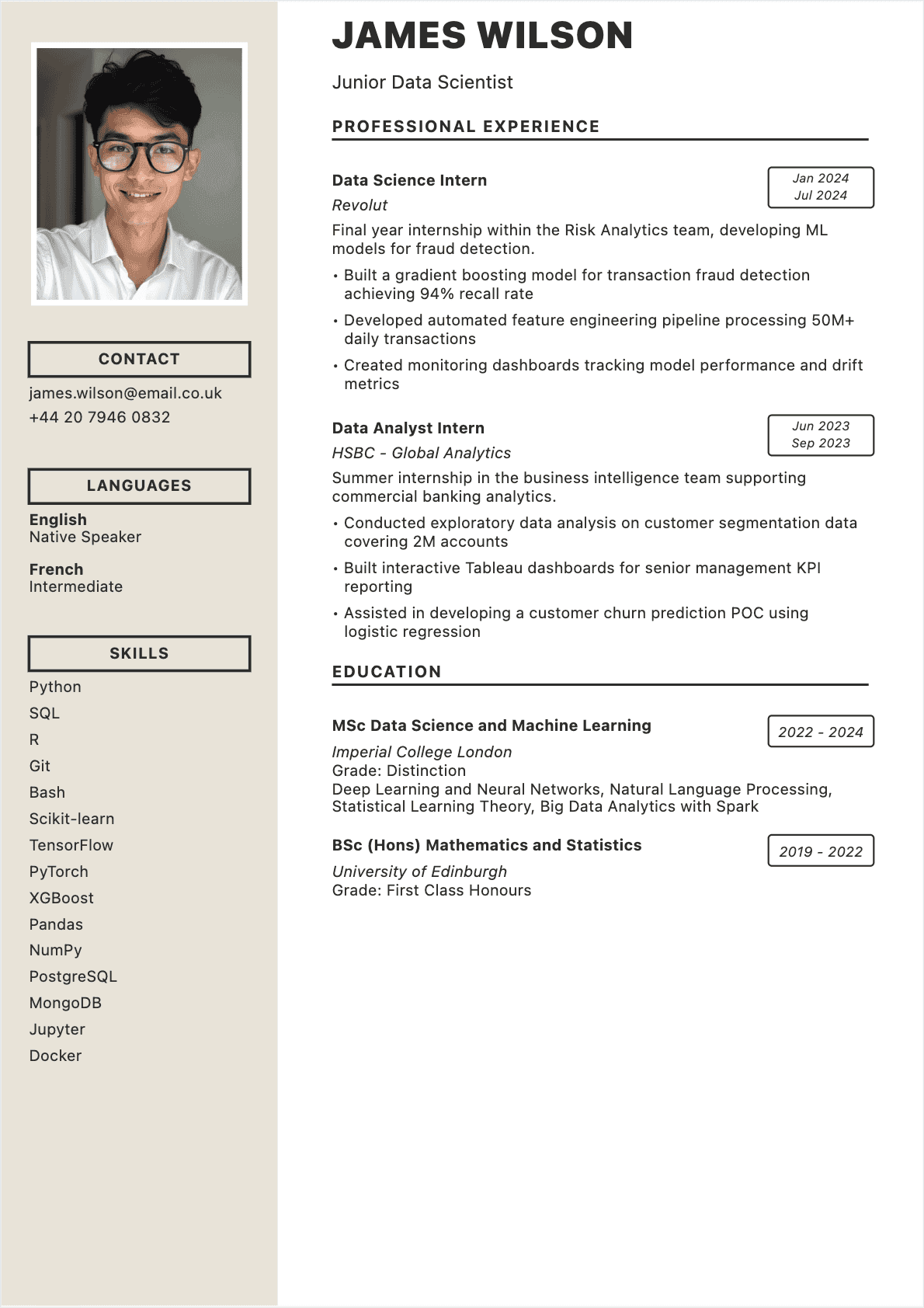
For graduates and junior profiles targeting entry-level roles. Focus on projects, internships, Kaggle-style work, core ML skills, and clear metrics (AUC, latency, cost).
Use this template
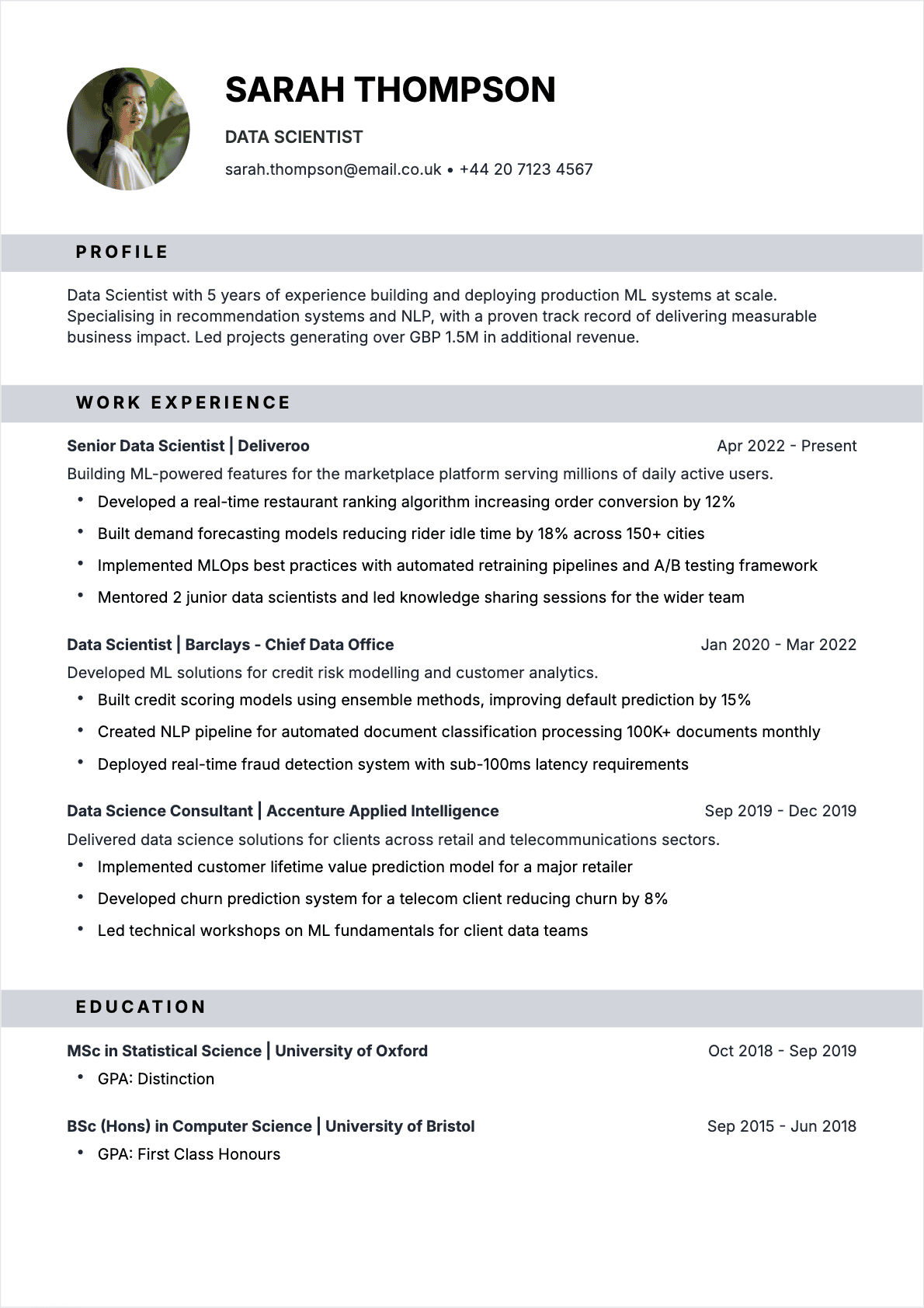
For 3–7 years of experience. Highlight end-to-end ML delivery, stakeholder management, MLOps practices, and business outcomes like churn reduction or revenue uplift.
Use this template
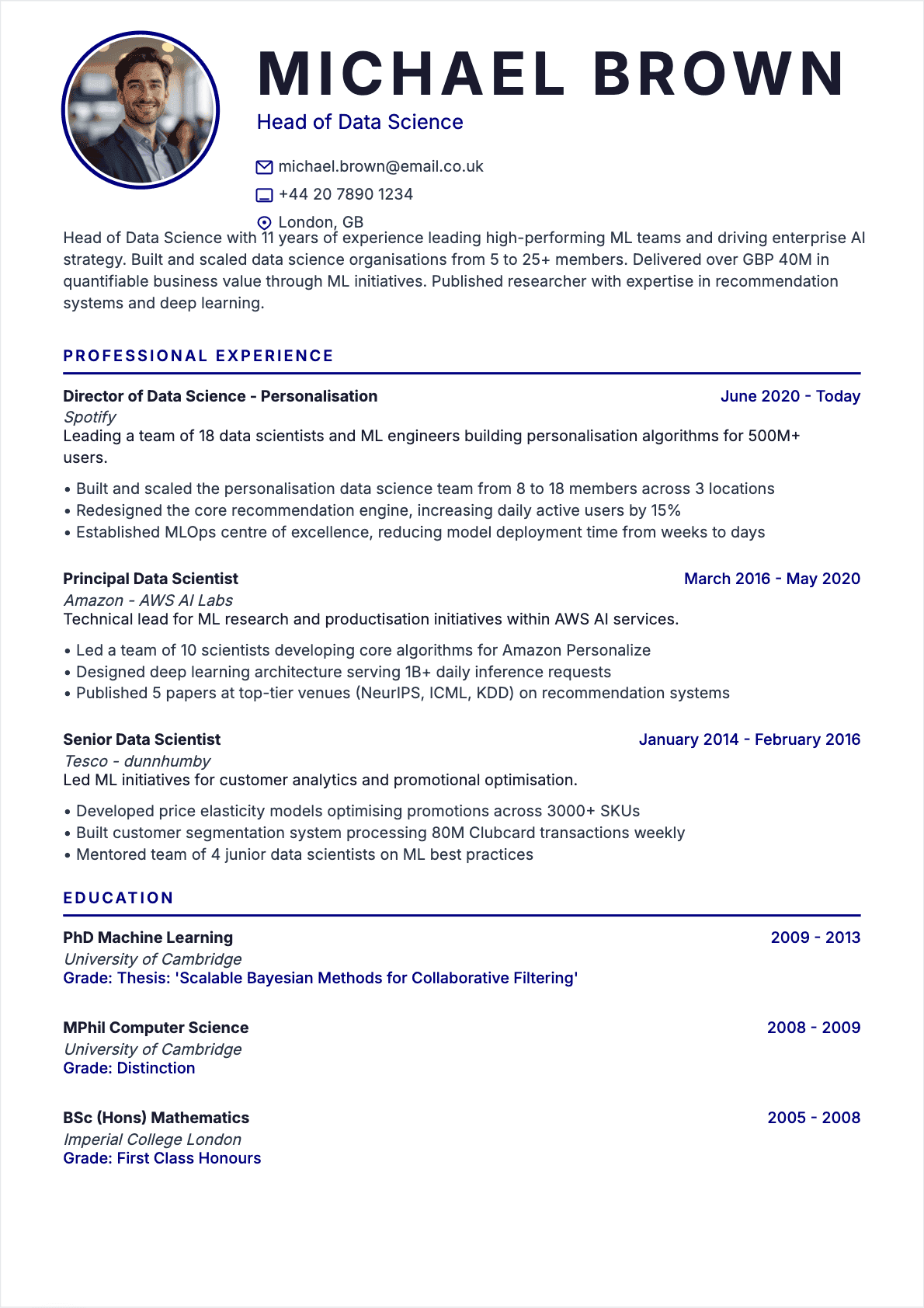
For senior ICs and leads. Emphasize strategy, model governance, mentoring, platform choices, and portfolio impact across teams with scale metrics and reliability targets.
Use this templateCheck each item to ensure your CV is complete and optimized.
The professional summary is the first thing recruiters see. It should summarize your profile in a few impactful lines.
“Data Scientist with 5+ years in e-commerce analytics, delivering churn and pricing models from discovery to production. Improved retention by 3.8% and reduced prediction latency from 900ms to 180ms using Python, SQL, Spark, and MLflow on AWS. Strong A/B testing and stakeholder delivery.”
“Motivated and dynamic data scientist, passionate about AI, available immediately, ready to take on new challenges and work in a fast-paced team.”
The good example is effective because it:
The bad example fails because it:
Here are examples of professional experiences. Note how results are quantified.
Shopify, London
Worked in a 9-person data squad (PM, analyst, 3 data scientists, 3 engineers) supporting checkout and retention. Owned churn prediction, experimentation analytics, and model monitoring; partnered with engineering to ship real-time inference.
Key Achievements
Here are the technical and soft skills most sought after by recruiters.
Technical Skills
Soft Skills
ATS systems filter CVs based on specific keywords. Include these terms to maximize your chances.
ATS Tip
Click on a keyword to copy it. ATS systems filter CVs based on these exact terms.
Data Scientist roles typically favor a strong quantitative background (computer science, statistics, mathematics, engineering) and evidence of applied work. In 2026, hiring teams often accept diverse routes: a Master’s in Data Science, a CS degree with ML projects, or a domain degree (economics, physics) paired with strong coding and experimentation skills.
If you have limited experience, elevate coursework and projects with clear metrics (AUC, MAE, lift, latency) and reproducible links. With several years of experience, prioritize production outcomes and keep education concise unless it’s directly relevant (e.g., thesis on causal inference).
Languages matter because Data Scientist work is collaborative and documentation-heavy: writing experiment plans, explaining trade-offs, and aligning on metrics with non-technical partners. English is often required for international teams, vendor documentation, and conferences; additional languages can help in regional product research or cross-site collaboration.
Present your level consistently (Native/Fluent/Proficient/Intermediate) and add proof when available (e.g., IELTS score) rather than vague labels.
Native
Proficient (C1)
Intermediate (B1)
Certifications are not mandatory for most Data Scientist roles, but they can speed up screening when they match the company stack (cloud, MLOps, data platforms). They are most useful when you lack brand-name experience, are switching industries, or target cloud-heavy environments.
A Data Scientist CV that reads like an inventory (Python, TensorFlow, Spark, AWS) forces the reader to guess your level and contribution. Hiring teams want evidence that your work changed a metric, reduced risk, or improved reliability. Without numbers, even strong projects look academic and are harder to compare across candidates.
The core issue: tools are transferable, but impact proves you can deliver under constraints (data quality, latency, governance, stakeholder alignment).
Always include :
Use this formula: Action + Method/Tool + Scale + Result + Measurement method.
Many CVs mention “deployed models” but provide no detail on how deployment worked, who owned it, or how it was monitored. In 2026, this is a major screening point because companies have seen models fail in production due to drift, data breaks, and unclear ownership.
To avoid : "Deployed ML models to production and improved performance."
Prefer : "Deployed batch scoring pipeline (Airflow + Docker) to AWS; added Great Expectations checks and drift alerts; improved weekly forecast MAPE from 18% to 12% over a 6-month backtest."
This level of detail signals engineering maturity and reduces perceived delivery risk.
“Built a recommendation system” can mean a weekend notebook or a system serving millions of users. Without scale, constraints, and evaluation, recruiters and interviewers assume the smallest interpretation.
To mention :
Practical tip: add one clause per bullet for scale and one for measurement. It increases credibility without making bullets longer than two lines.
Even excellent profiles get filtered out when the CV uses non-standard headings, graphics, or missing keywords. Many ATS tools struggle with text boxes, two-column layouts, and icons. If the role description says “SQL, A/B testing, MLflow, deployment,” your CV must contain those phrases in plain text where ATS can read them.
Checklist :
Lead with a targeted headline : Add one line under your name stating role + domain + stack (e.g., “Data Scientist — pricing & experimentation | Python, SQL, Spark, MLflow”) so recruiters match you in seconds.
Quantify at least two metrics per role : Combine business and technical numbers (uplift + model metric, or savings + latency). Example: “+1.2% conversion” and “p95 latency 180ms” on the same project.
Show your evaluation method : Specify A/B tests, backtest windows, confidence intervals, or offline validation splits. This signals rigor and prevents reviewers from dismissing results as anecdotal.
Name your deployment pattern : Batch scoring, streaming, or real-time API. Add the toolchain (Airflow, Docker, Kubernetes, SageMaker) and one reliability element (SLA, monitoring, drift).
Make SQL visible : Include a dedicated skill line for SQL and at least one bullet describing analytics work with window functions, performance tuning, or data modeling; many roles screen heavily on SQL.
Curate projects like products : For each portfolio link, add a one-sentence problem statement, dataset size, metric (AUC/MAE), and a reproducible README. Remove unfinished notebooks with no results.
Tailor to the sector : Swap 3–5 keywords and 1–2 bullets to match the domain (fraud, demand forecasting, NLP). Keep the core structure identical to stay ATS-friendly.
Find answers to the most frequently asked questions.
For most candidates, one page is ideal up to ~5 years of experience, and two pages is acceptable for senior roles with multiple shipped models. Prioritize quantified impact, production details, and the most relevant projects. Remove older tools, unrelated coursework, and duplicate bullets to keep scan time low.
Common ATS filters include Python, SQL, machine learning, statistics, A/B testing, feature engineering, model deployment, and MLOps. Add stack-specific keywords that match the job posting (e.g., MLflow, Spark, SageMaker, Databricks). Only include keywords you can defend in interviews with examples and metrics.
Yes, if the work is polished and easy to evaluate. Link to 1–2 projects with a clear README, reproducible environment, and a short summary of results (e.g., AUC 0.83, MAPE 12%). Avoid dumping many links. One strong project that mirrors the target role beats five unfinished notebooks.
Use proxy metrics and operational outcomes: reduced manual effort (hours/week), improved forecast accuracy (MAPE), lowered incident rate, reduced latency, or improved decision quality. If revenue impact is confidential, describe directional effects and adoption, e.g., “used by 35 analysts weekly” or “enabled 14 experiments/quarter.”
In most English-speaking markets, a photo is not expected and may be discouraged, especially in the US and many UK processes. Focus instead on a strong headline, a results-based summary, and clean ATS formatting. If a role explicitly requests a photo due to local norms, follow the employer guidance.
Skills should be a short, scannable list of tools and methods you actually used (Python, SQL, Spark, MLflow, A/B testing). Experience should prove those skills with context and numbers: what you built, at what scale, how you measured performance, and what changed for the business or platform.

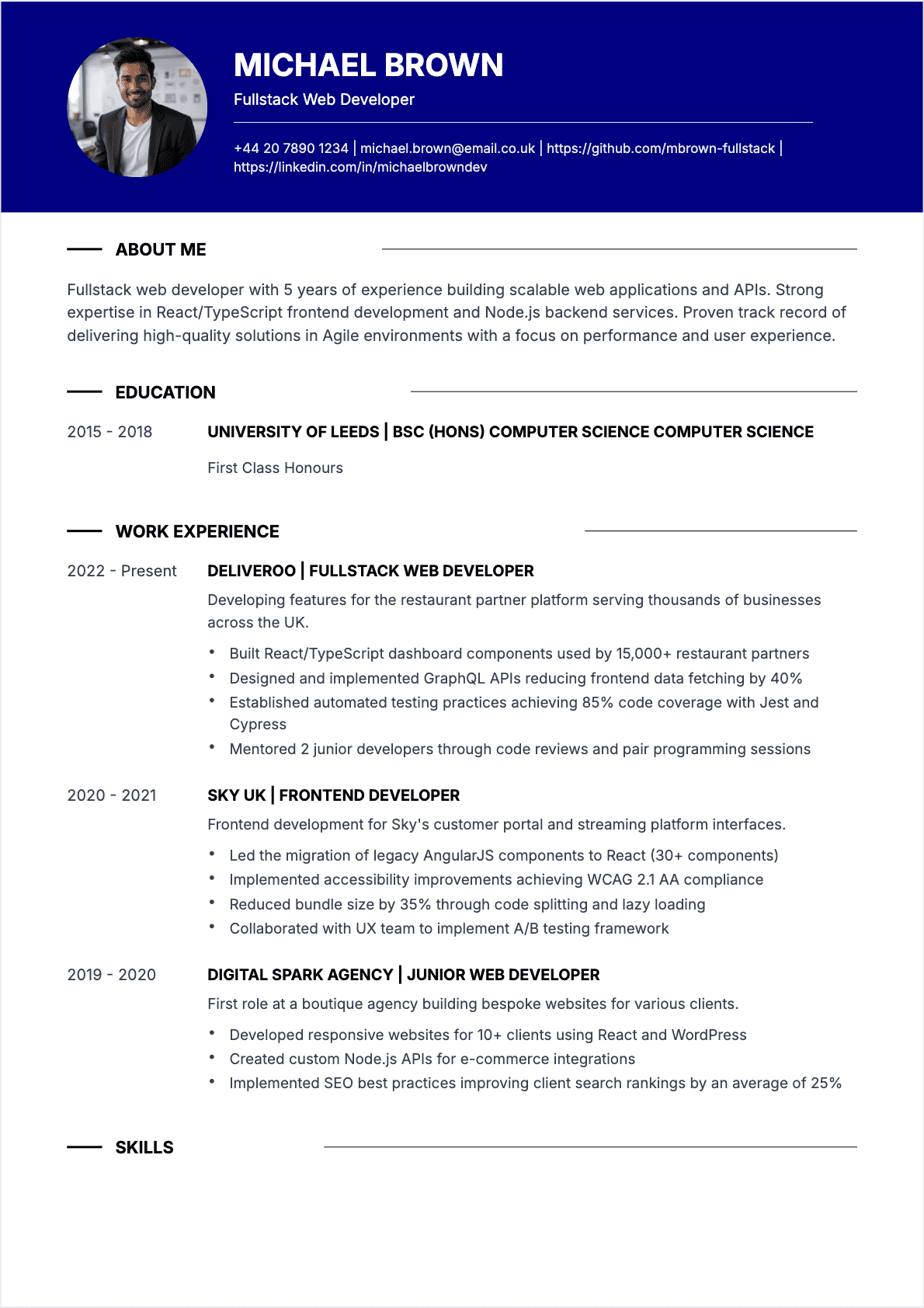
Build a Web Developer CV that passes ATS in 2026: quantified achievements, skills keywords, and templates to win more interviews across roles.
Use this template
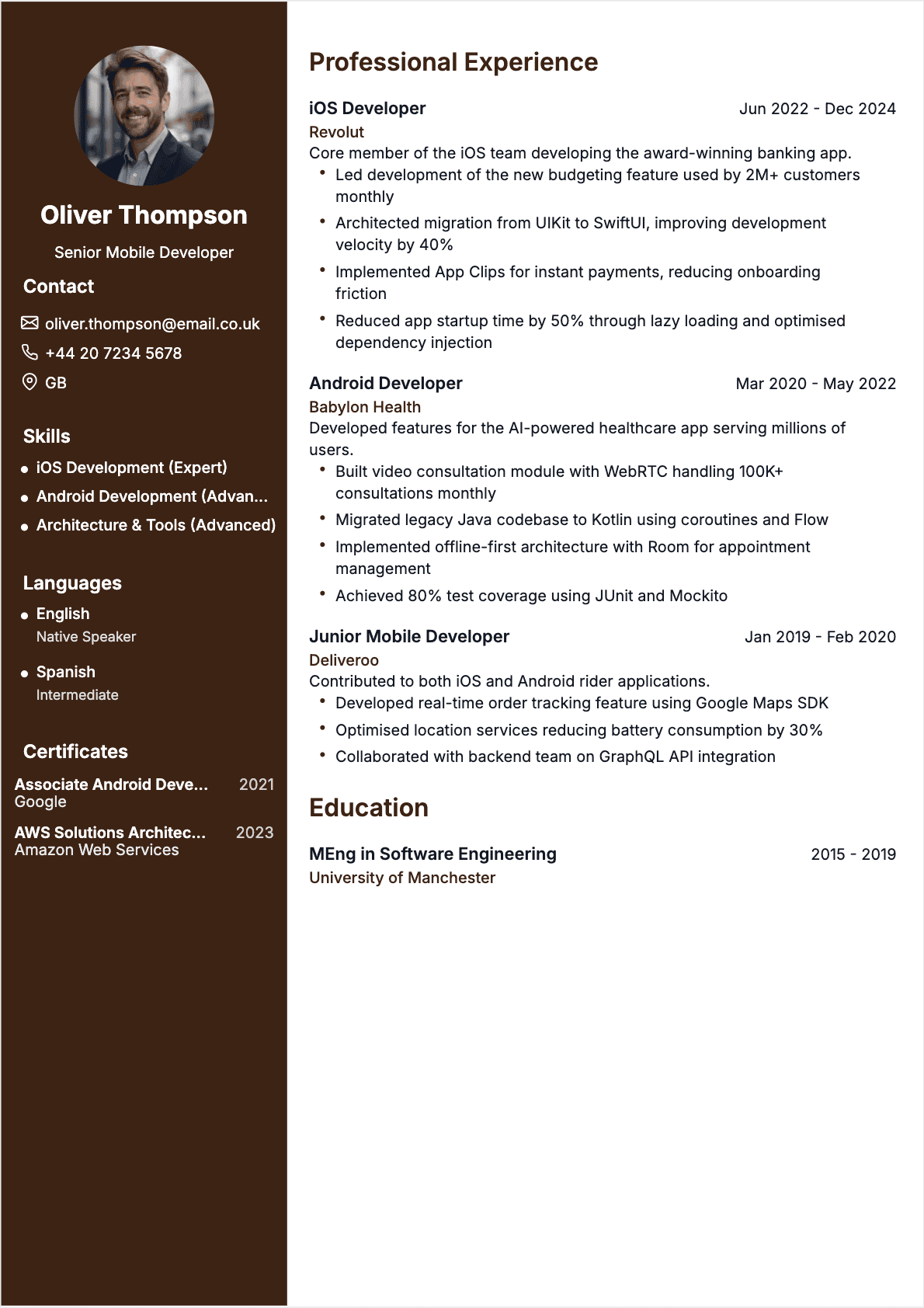
Create a CV Mobile Developer that passes ATS in 2026: skills, keywords, quantified achievements, and templates for Android, iOS, and Flutter roles.
Use this template
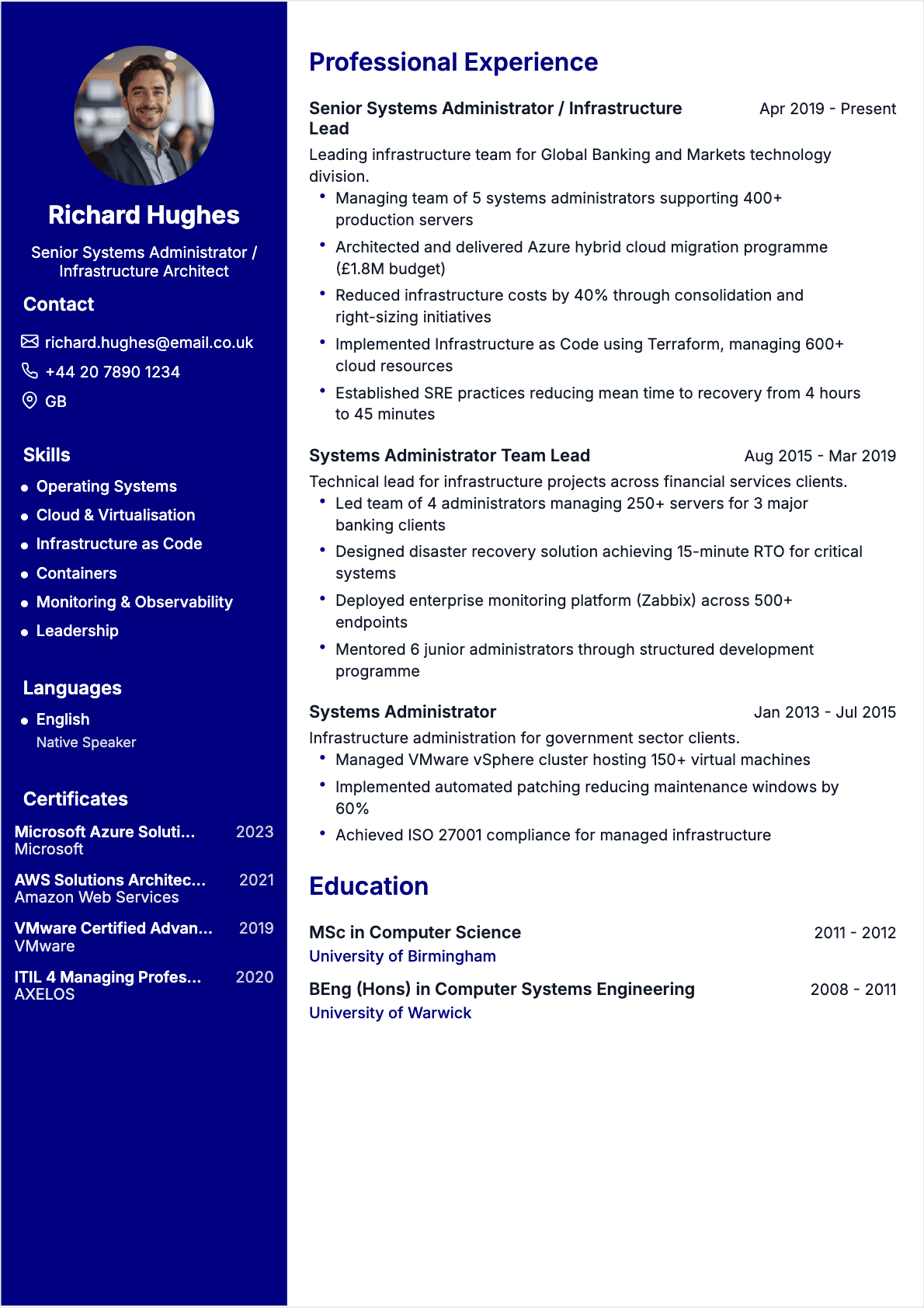
Create a Systems Administrator CV for 2026 with ATS keywords, quantified achievements, and proven sections to showcase uptime, automation, and security impact.
Use this template
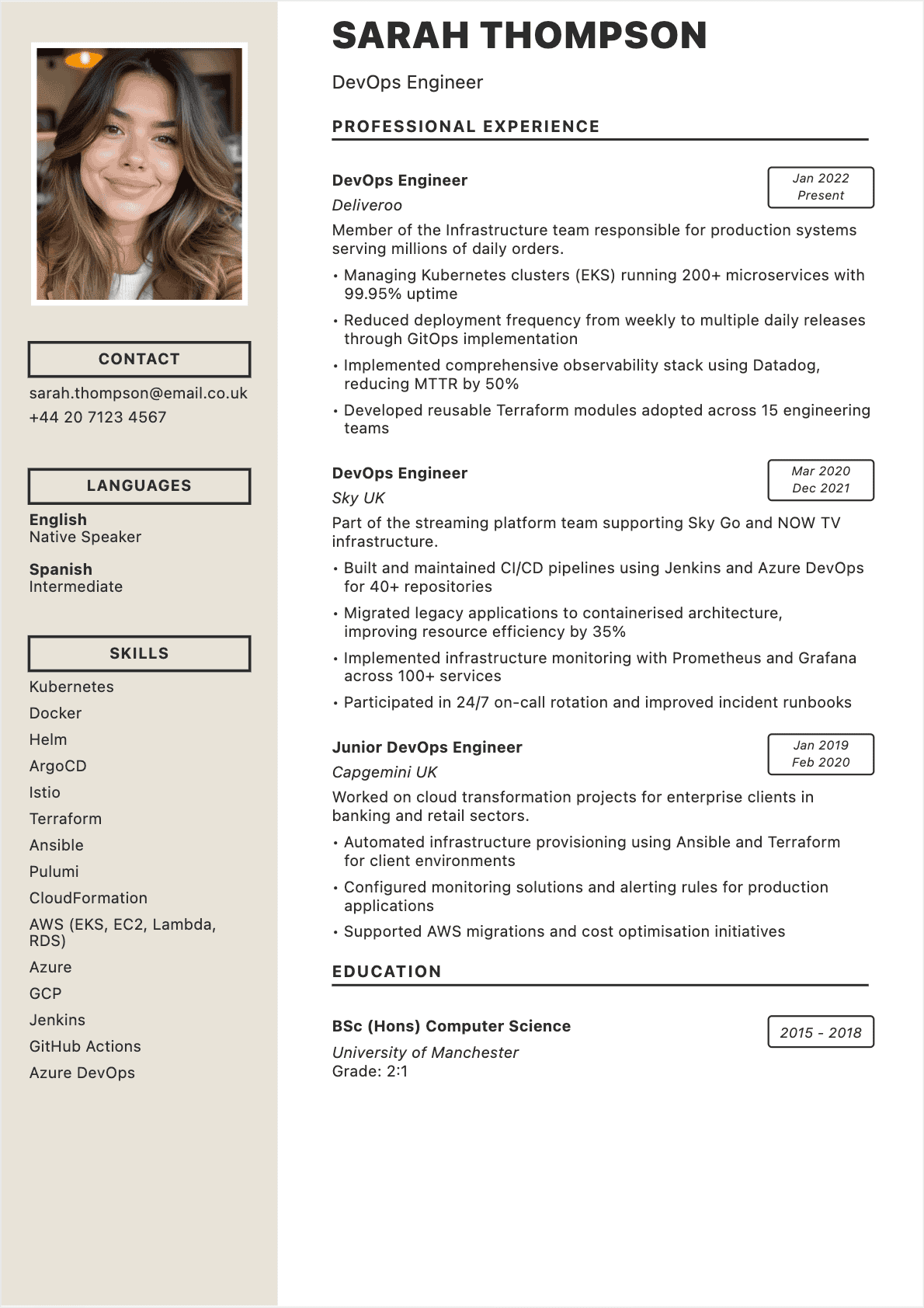
Build a DevOps Engineer CV for 2026 with ATS keywords, quantified achievements, and proven sections to pass screening and win interviews.
Use this template
Should you list hobbies on your resume? Learn when to include interests, see examples by industry, and discover how to showcase hobbies that impress recruiters.

Don't send another resume without this checklist. 15 critical checks used by recruiters to screen candidates, plus the mistakes that get resumes rejected instantly.

Learn how to create a resume that gets interviews. Former Fortune 500 recruiter shares the exact elements that make hiring managers stop and read.
Use the CVtoWork CV builder to generate an ATS-friendly Data Scientist CV in minutes, with pre-written sections, keywords, and quantified bullet prompts tailored to 2026 hiring.
Create my Resume