IT & Tech

CV Web Developer: ATS-ready guide for 2025

Learn how to write a Web Developer CV that recruiters can scan in seconds and ATS can parse correctly. Get keyword lists, quantified bullet examples, and role-specific tailoring tips for 2025 hiring.

13 min de lectureUpdated December 12, 2025

Key Takeaways

In 2025, web development hiring keeps shifting toward measurable product impact and reliable delivery. Companies screen fast: many roles receive 150–300 applications, and recruiters often spend under 30 seconds on a CV before shortlisting. That means your document must read like an evidence-based snapshot of what you shipped, how you shipped it, and what improved because of your work.

A strong CV Web Developer should demonstrate:

  • Modern web fundamentals and a clear stack (front-end, back-end, or full stack)
  • Quantified results (performance, revenue, reliability, delivery speed)
  • Production habits (testing, CI/CD, monitoring, security basics)

Use the guide below to build an ATS-friendly CV that is easy to scan and tailored to the role you want.

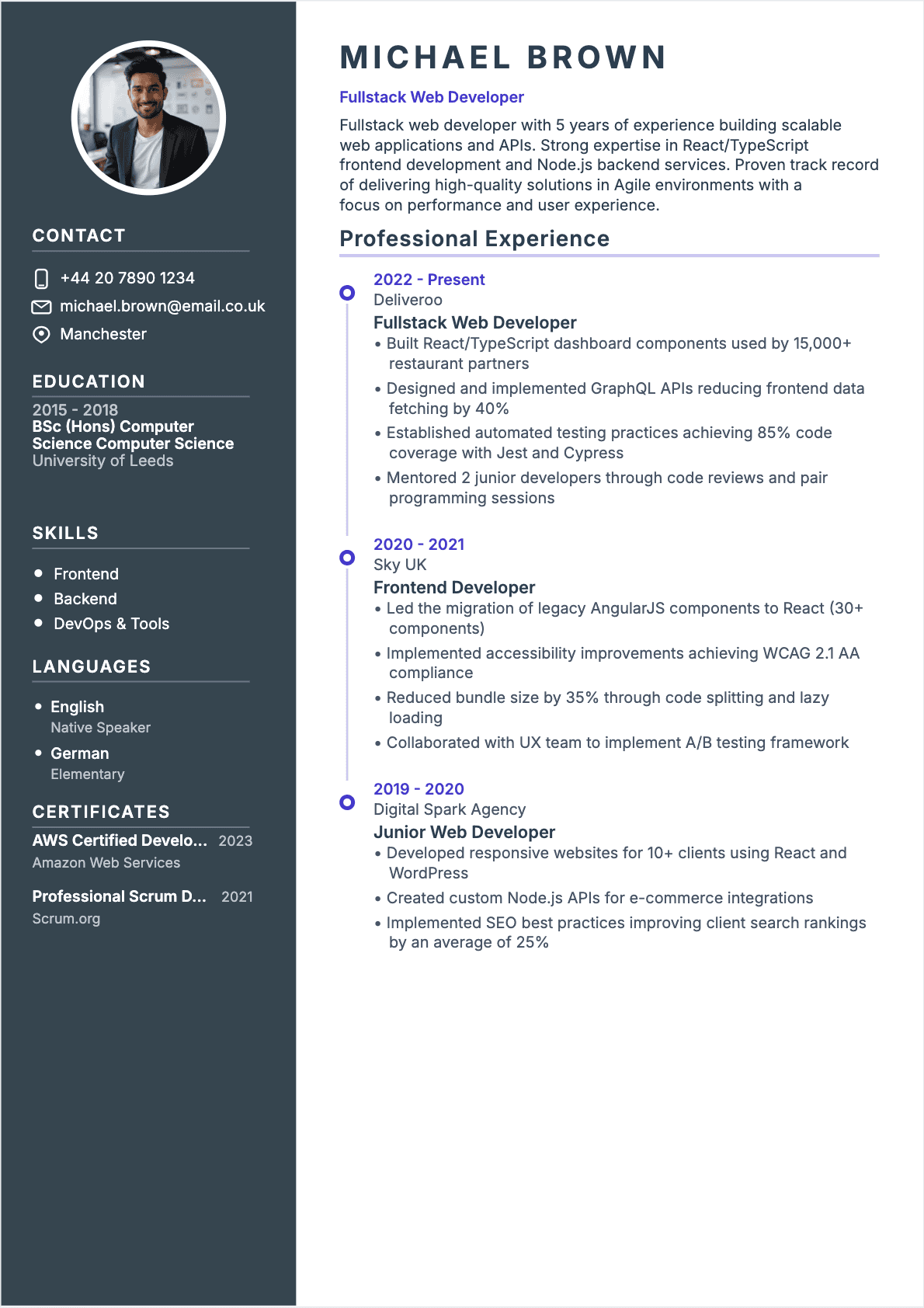
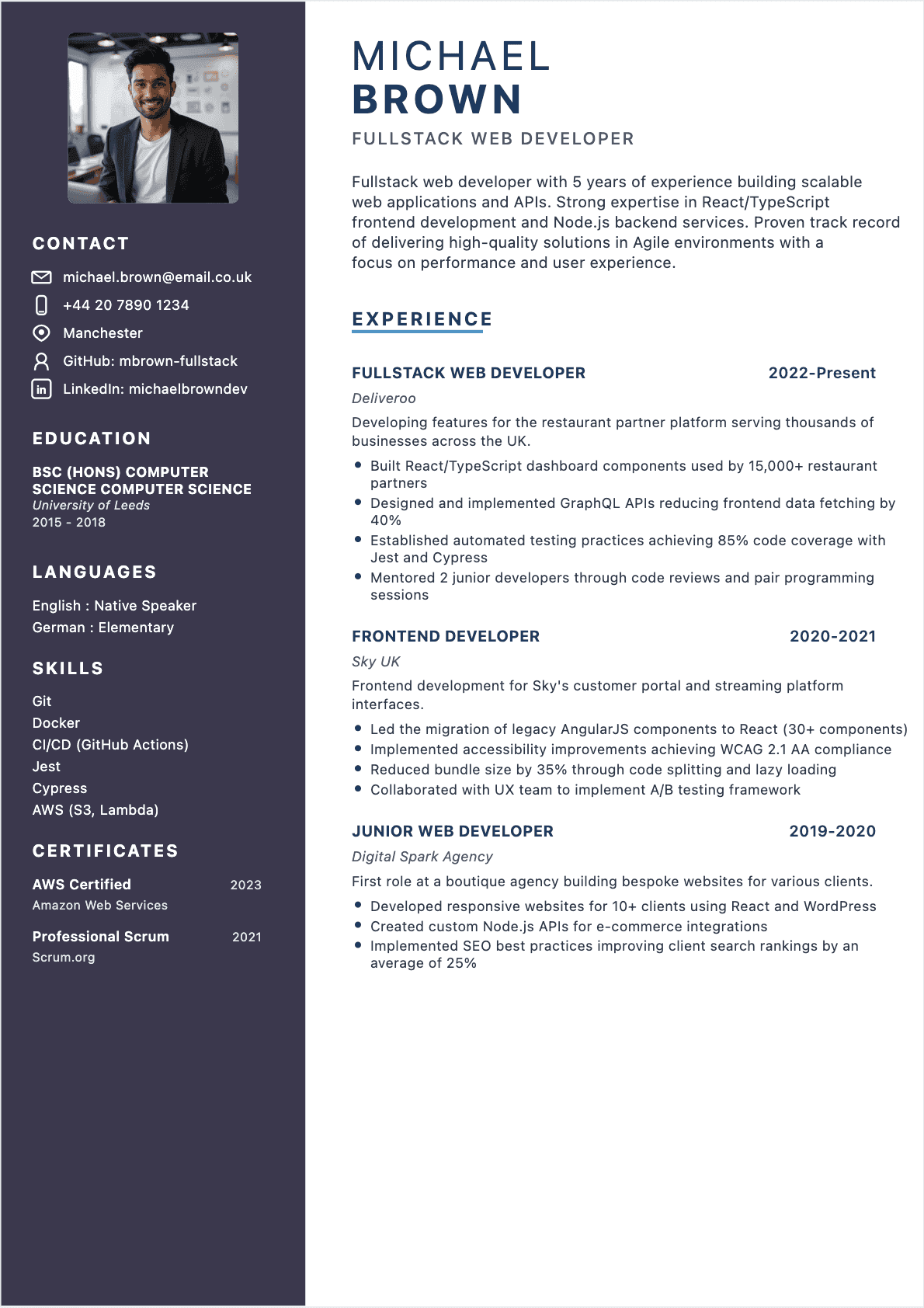
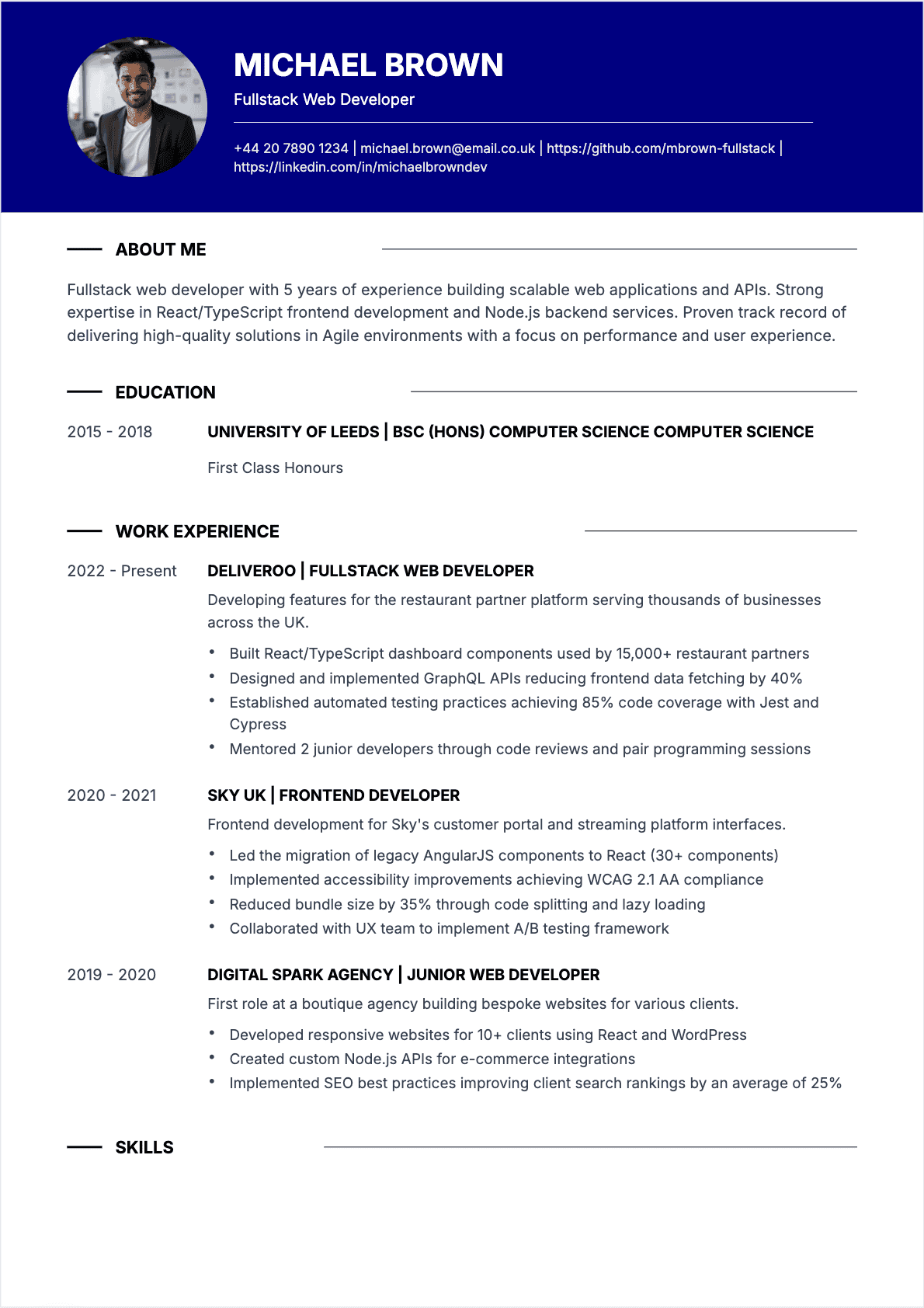
CV Examples - CV Web Developer

Discover our CV templates adapted to all experience levels. Each example is ATS-optimized.

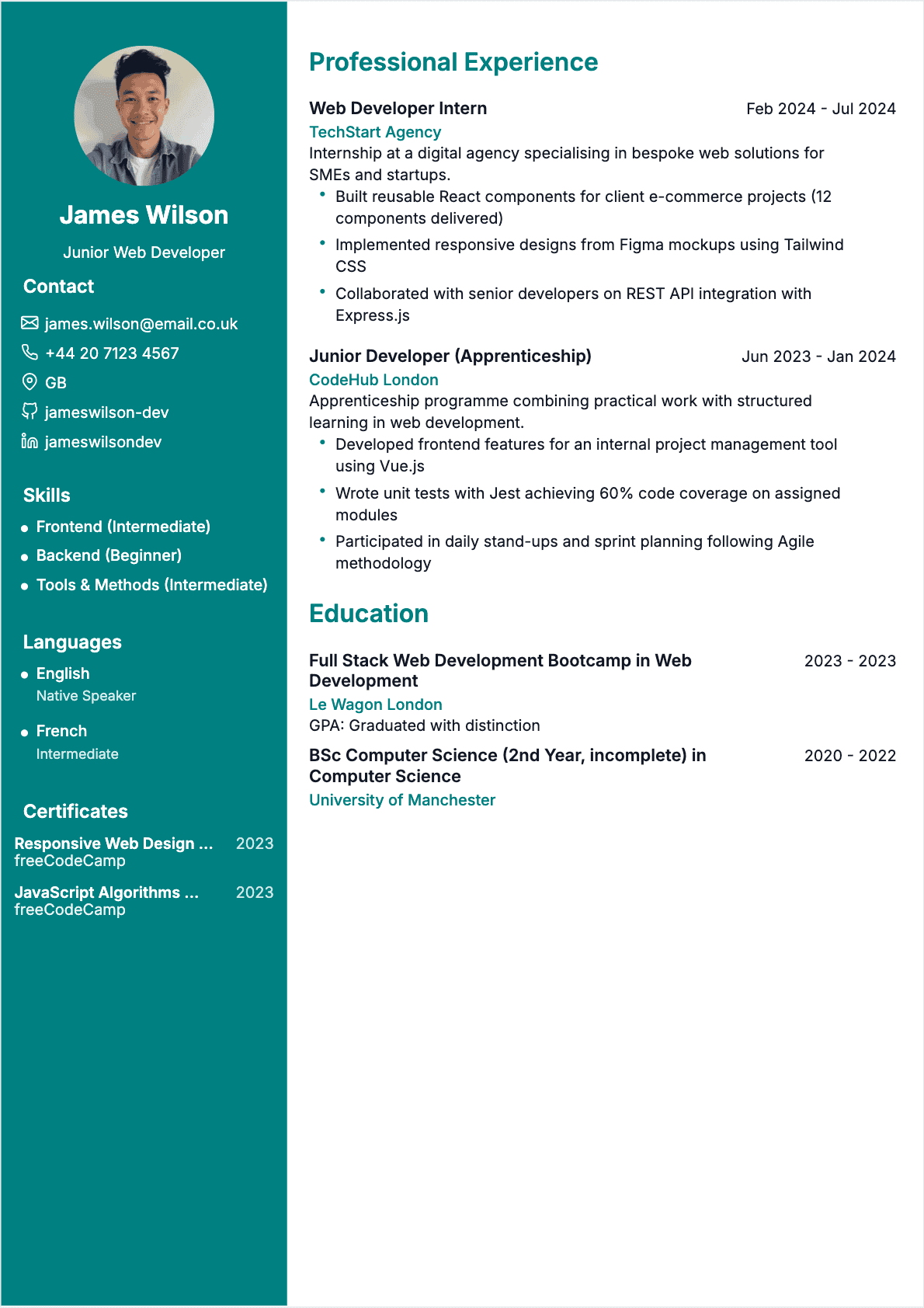
CV Web Developer Beginner

For junior developers and recent graduates: highlight internships, personal projects, GitHub links, core web fundamentals, and measurable outcomes like Lighthouse scores and bug fixes.

Utiliser

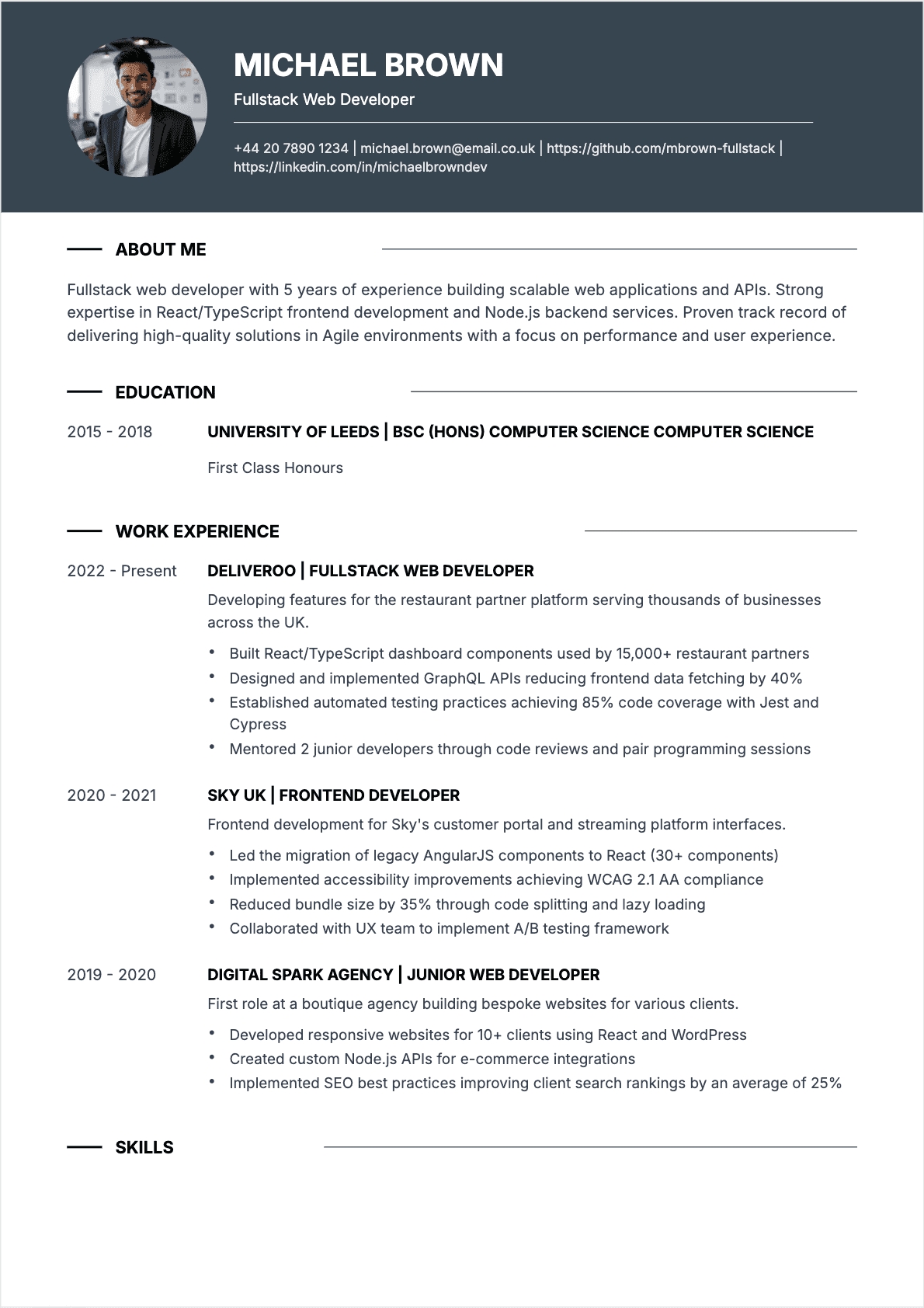
CV Web Developer Intermediate

For 3–7 years of experience: showcase shipped features, system ownership, performance gains, and cross-team collaboration, backed by metrics like conversion uplift, latency reduction, and test coverage.

Utiliser

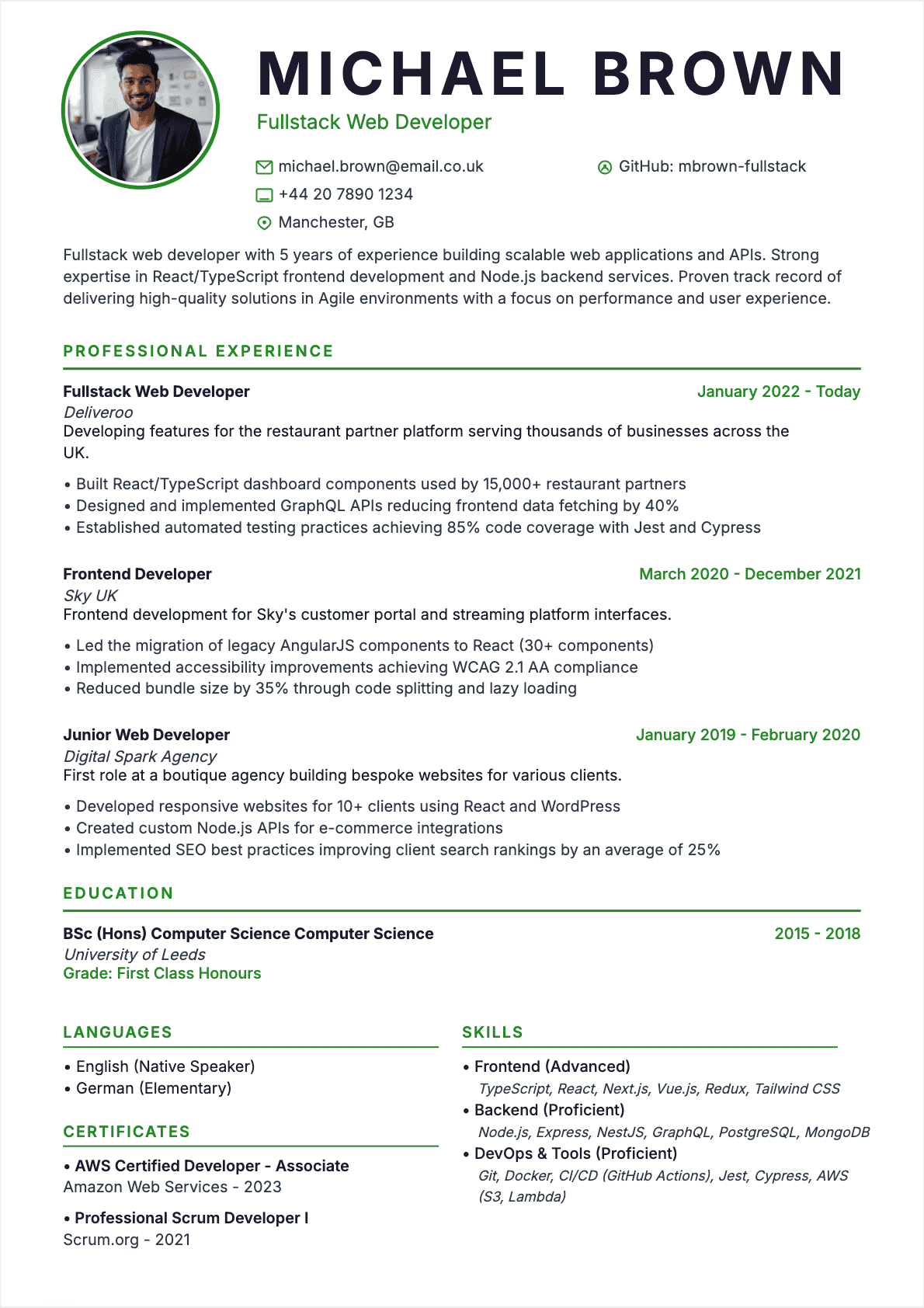
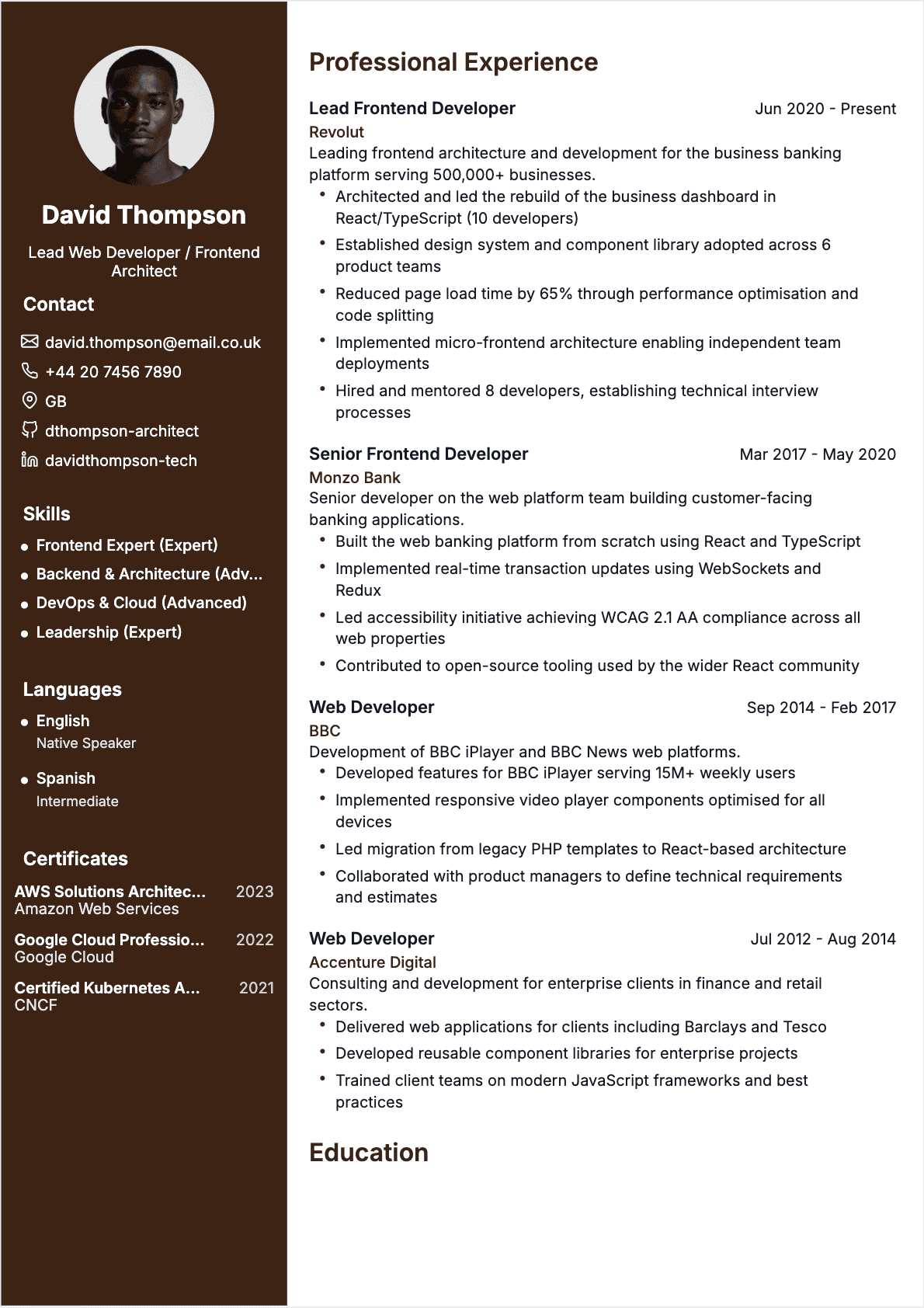
CV Web Developer Senior

For senior profiles with leadership: emphasize architecture decisions, mentoring, platform reliability, delivery cadence, and business impact, supported by numbers across uptime, cost, and team throughput.

Utiliser

Perfect CV Checklist - CV Web Developer

Check each item to ensure your CV is complete and optimized.

Your Progress0%

Professional Summary - CV Web Developer

The professional summary is the first thing recruiters see. It should summarize your profile in a few impactful lines.

Good example

Web Developer with 5+ years in SaaS, shipping React/TypeScript features and Node.js APIs. Improved checkout conversion by 9.4% and cut p95 API latency from 420ms to 210ms. Strong with PostgreSQL, Redis, Docker, AWS (Lambda, ECS), CI/CD, and automated testing (Jest, Playwright).

Bad example

Motivated and dynamic web developer, passionate about coding, available immediately, ready to take on any challenge and work under pressure.

Why is it effective?

The good example works because it:

  • States seniority and context: “5+ years in SaaS” helps recruiters match level and domain fast
  • Names a coherent stack: React/TypeScript + Node.js + AWS signals hands-on production experience
  • Proves impact with numbers: conversion +9.4% and latency -50% show outcomes, not tasks
  • Adds credibility via tooling: CI/CD, Jest, Playwright, Docker indicate an engineer who can ship reliably

The bad example fails because it:

  • Uses vague adjectives instead of evidence and scope
  • Doesn’t mention a stack, products, or types of projects delivered
  • Gives no metrics (performance, revenue, quality, delivery cadence)
  • Sounds identical to many profiles, making it hard to shortlist

Professional experience examples

Here are examples of professional experiences. Note how results are quantified.

Web Developer (Full-Stack)

Shopify, Toronto

Apr 2021 – Oct 2025

Worked in a 9-person product squad (PM, designer, 6 engineers, QA) on checkout and post-purchase experiences. Owned front-end performance initiatives and built Node.js services integrating payments, fraud checks, and analytics.

Key Achievements

Improved Core Web Vitals: LCP from 3.2s to 2.1s and INP from 280ms to 160ms on top templates
Increased checkout completion rate by 9.4% through A/B-tested UX changes and error-recovery flows
Reduced p95 API latency by 50% (420ms to 210ms) via caching, SQL tuning, and payload trimming
Cut production incidents from 12 to 5 per quarter by adding Playwright smoke tests and SLO-based alerting

Key skills for your resume

Here are the technical and soft skills most sought after by recruiters.

Technical skills to list on a Web Developer CV

Technical Skills

  • JavaScript (ES6+) and TypeScript
  • React (hooks, state management) and Next.js
  • Git (GitHub/GitLab) and pull request workflows
  • Docker and container-based development
  • Node.js (Express/NestJS) and API design
  • SQL (PostgreSQL) and query optimization
  • Testing (Jest, React Testing Library, Playwright/Cypress)
  • CI/CD (GitHub Actions, GitLab CI) and monitoring basics

Professional skills recruiters evaluate

Soft Skills

  • Writing clear technical documentation (RFCs, ADRs, runbooks)
  • Estimating work with explicit assumptions and risk notes
  • Communicating trade-offs to product and design stakeholders
  • Debugging under uncertainty and reporting progress objectively
  • Code review discipline (actionable feedback, standards enforcement)
  • Ownership of outcomes (quality, performance, reliability)
  • Prioritization when scope changes mid-sprint
  • Mentoring juniors through pairing and structured feedback

ATS Keywords to Include

ATS systems filter CVs based on specific keywords. Include these terms to maximize your chances.

ATS Tip

Click on a keyword to copy it. ATS systems filter CVs based on these exact terms.

Mots-clés importants

Hiring Sectors

Discover the most promising sectors for your career.

1

SaaS and B2B software

2

E-commerce and retail

3

Fintech and digital banking

4

Media and streaming platforms

5

Healthtech and digital services

6

Agencies and consulting firms

Education & Degrees

Web development roles typically value demonstrable delivery over brand-name degrees, but a solid educational baseline still helps, especially for early-career candidates. Recruiters look for evidence you understand algorithms and data structures, networking basics (HTTP, caching, cookies), databases, and software engineering practices.

Common pathways include a Computer Science degree, a software engineering program, coding bootcamps with strong portfolios, or self-taught routes backed by shipped projects and open-source contributions.

If you have limited formal education, compensate with 2–3 well-documented projects, production-like tooling (tests, CI), and measurable outcomes (performance, users, uptime).

Recommended Degrees

  • Bachelor’s Degree in Computer Science
  • Bachelor’s Degree in Software Engineering
  • Master’s Degree in Computer Science
  • Master’s Degree in Data Science (with web engineering electives)
  • Coding Bootcamp Certificate (Full-Stack Web Development)
  • Associate Degree in Web Development / Information Technology

Languages

Languages matter in web development because teams, documentation, and tooling are often English-first. Even in local markets, product specs, error messages, and cloud provider docs typically use English terminology. Multilingual profiles also help when you collaborate with distributed teams, join on-call rotations across time zones, or work with international clients.

  • Reading RFCs, API docs, and security advisories quickly
  • Participating in cross-border standups and incident calls
  • Writing tickets and documentation that global teams can reuse

Present your level with a clear label (Native/Fluent/Proficient/Intermediate) and, if relevant, add a recognized test score or recent usage context (work language, client-facing meetings).

🇬🇧

English

Native

🇫🇷

French

Fluent

🇪🇸

Spanish

Intermediate

Recommended certifications

Certifications are not mandatory for most Web Developer roles, but they can strengthen your profile when you lack brand-name experience or you’re targeting cloud-heavy stacks. Prioritize certifications that match your job targets (AWS/Azure/GCP) and prove applied skills (testing, security, Scrum). Treat certificates as support; your shipped outcomes and portfolio remain the main differentiator.

AWS Certified Developer – Associate (DVA-C02)
Microsoft Certified: Azure Developer Associate (AZ-204)
Google Cloud Certified: Professional Cloud Developer
Certified Kubernetes Application Developer (CKAD)
Professional Scrum Master I (PSM I)
Meta Front-End Developer Professional Certificate

Mistakes to avoid

Listing responsibilities without measurable impact

Many Web Developer CVs read like job descriptions: “built features”, “fixed bugs”, “worked with a team”. Recruiters can’t infer level, scope, or business value from that. Replace tasks with outcomes tied to product metrics or engineering KPIs (performance, reliability, delivery speed).

Always include :

  • A metric baseline and the improved result (e.g., p95 latency 420ms → 210ms)
  • The method or constraint (A/B test, caching strategy, migration, budget)
  • The context (traffic, users, size of codebase, team size)

Use this formula: Action + Scope + Tooling + Metric + Business impact.

Overstuffing the skills section with buzzwords

A long, unstructured skills list can look like keyword stuffing and doesn’t help the reviewer understand what you can actually deliver. If you mention 30 tools, expect questions on all of them. Curate your skills to match the target role and show proof in Experience or Projects.

To avoid : "Skills: React, Angular, Vue, Svelte, Node, Deno, Rust, Go, Java, Python, Kubernetes, Terraform, AI, Blockchain..."

To prefer : "Front-end: React 18, TypeScript, Next.js, Storybook; Back-end: Node.js, PostgreSQL, Redis; DevOps: Docker, GitHub Actions; Testing: Jest, Playwright."

Your CV should make it easy to map skills to shipped results.

Skipping project links or shipping evidence

For Web Developer hiring, proof beats claims. If you don’t include links (portfolio, GitHub, live demos), the reviewer has no fast way to validate your work. Even for proprietary work, you can share sanitized case studies: screenshots, architecture diagrams, and anonymized metrics.

To mention :

  • GitHub or GitLab profile with 2–3 pinned repos (clean README, screenshots, setup steps)
  • A live project URL (Netlify/Vercel/Render) or a short demo video
  • What you owned end-to-end (design handoff, implementation, tests, deployment)

Ignoring ATS formatting and readability

A visually heavy layout can break parsing: columns, icons, text boxes, and embedded charts often cause ATS to miss skills and dates. Keep your CV scannable: one column, standard headings, consistent date formats, and simple bullet lists. If a human can’t skim it in 20 seconds, it’s too dense.

Checklist :

  • Use standard headings: Summary, Experience, Skills, Education
  • Keep dates consistent (e.g., Apr 2021 – Oct 2025)
  • Export as text-readable PDF; avoid images for core content

Expert tips

  • 1

    Use a metrics bank : Keep a note of baseline and after values (LCP, INP, error rate, conversion, build time). Add at least 2 metrics per role to make impact visible.

  • 2

    Mirror the job description carefully : Reuse the employer’s terms (React, Next.js, REST, GraphQL) where truthful, and place them in Skills plus in at least one Experience bullet.

  • 3

    Show ownership boundaries : Specify what you owned (a service, a page, a component library) and how many stakeholders depended on it (teams, internal users, monthly sessions).

  • 4

    Prove quality and reliability : Mention test coverage targets, incident reduction, monitoring, and rollback plans. Recruiters trust candidates who can ship without breaking production.

  • 5

    Prioritize recent, relevant projects : Two strong projects with clear outcomes beat six unfinished repos. Include a short “Problem → Approach → Result” line and a link.

  • 6

    Describe collaboration concretely : Write how you worked with design/PM (Figma handoff, A/B testing plan, acceptance criteria) and include cycle-time improvements when possible.

  • 7

    Keep the tech stack coherent : Align the stack to the target job. If you’re applying for React roles, put React-first evidence at the top, not a generic full-stack inventory.

Frequently asked questions

Find answers to the most frequently asked questions.

In most English-speaking markets (especially the US), it’s safer to avoid a photo to reduce bias and keep the CV ATS-friendly. In the UK it’s optional, but still uncommon for tech. Use the space for a GitHub link, portfolio, and 2–3 quantified highlights.

Aim for 1 page if you have under ~5 years of experience, and up to 2 pages for senior profiles with multiple roles and notable projects. Keep it scannable: 4–6 bullets per role, and make sure every role contains at least one metric tied to impact.

Create a small public case study: describe the problem, your approach, and the measurable result without naming internal systems. Add screenshots with sensitive data removed, a simplified architecture diagram, and metrics in ranges (e.g., “~200k monthly sessions”, “p95 latency reduced ~40%”).

For front-end, prioritize UI performance (Core Web Vitals), accessibility, design systems, and state management, plus tools like Storybook and Playwright. For back-end, lead with API design, database work, caching, observability, and reliability metrics (error rate, latency, uptime), plus Docker and cloud services.

ATS usually filters by role title and core stack. Make sure your CV includes the exact job title (Web Developer) and the technologies listed in the posting (e.g., React, TypeScript, Node.js, SQL, AWS). Place them in Skills and demonstrate them in Experience bullets to avoid looking like keyword stuffing.

Show scope and decision-making: architecture choices, migration plans, mentoring, incident ownership, and measurable platform improvements. Add evidence like “reduced incidents 12→5 per quarter”, “cut build time 18→9 minutes”, or “led a migration for 6 services with zero downtime” to signal senior impact.

Build your Web Developer CV in minutes

Use our CV builder to create an ATS-friendly Web Developer CV with the right structure, keywords, and quantified bullet points. Customize templates, export a clean PDF, and apply faster.

Create my Resume