CV Mobile Developer: ATS-ready resume guide (2025)
Use this 2025 guide to build a Mobile Developer CV that recruiters can scan in seconds. Get structure, ATS keywords, quantified achievement examples, and role-specific tips for Android, iOS, Flutter, and React Native.
Key Takeaways
Mobile hiring in 2025 remains competitive: companies keep investing in mobile-first acquisition, while expecting higher quality bars (performance, reliability, privacy). Public benchmarks used by many product teams target crash-free sessions above 99.5% and release cycles of 1–2 weeks for customer-facing apps. Recruiters therefore screen CVs fast, looking for proof you can ship, measure, and improve.
A strong Mobile Developer CV must demonstrate:
- End-to-end delivery (design-to-release) with store submissions and measurable outcomes
- Technical depth (architecture, performance, testing, CI/CD) tied to real constraints
- Product thinking (analytics, experimentation, accessibility) that improves user and business metrics
Follow the sections below to craft a CV that is both ATS-friendly and convincing for engineering managers.
CV Examples - CV Mobile Developer
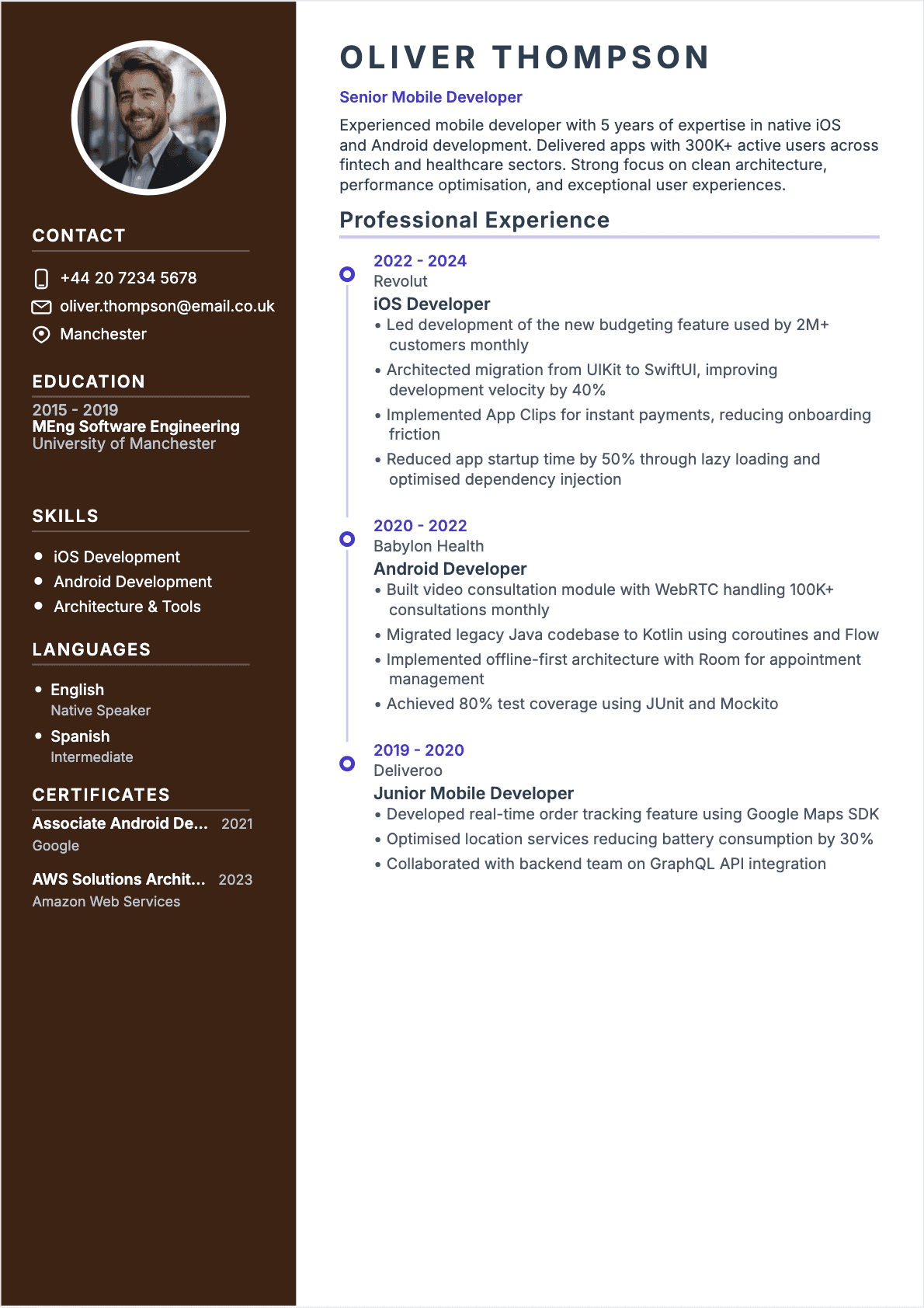
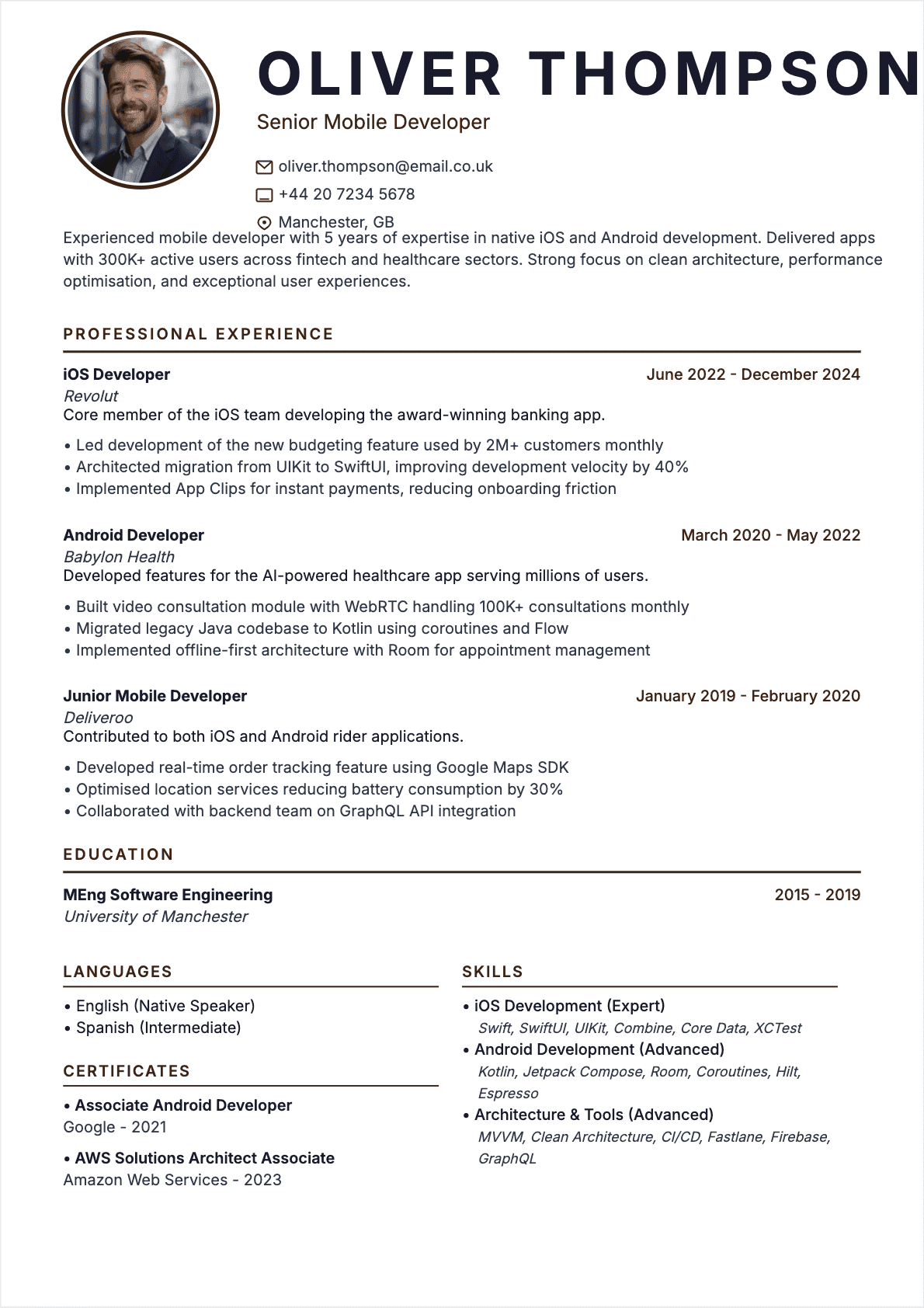
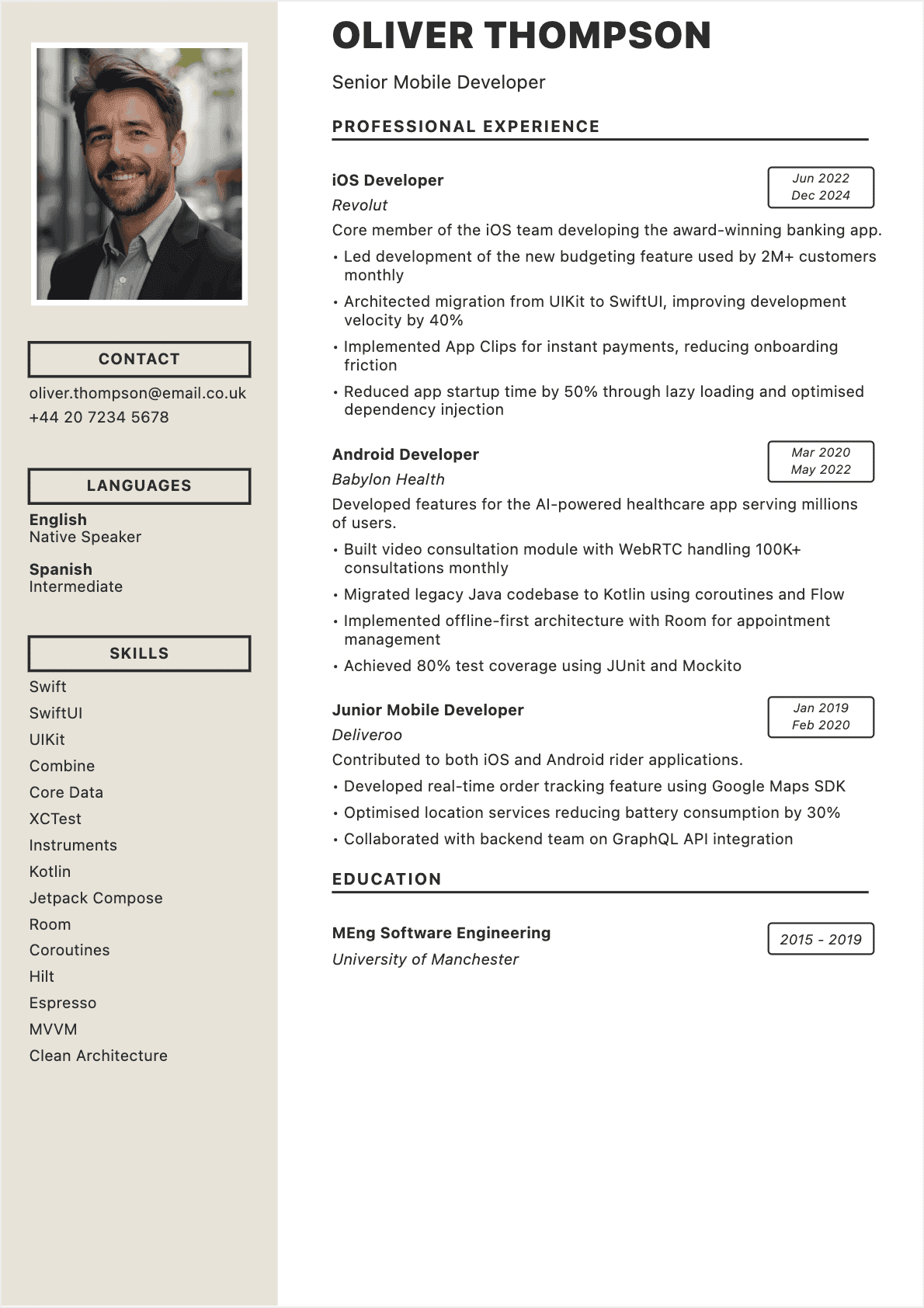
Discover our CV templates adapted to all experience levels. Each example is ATS-optimized.

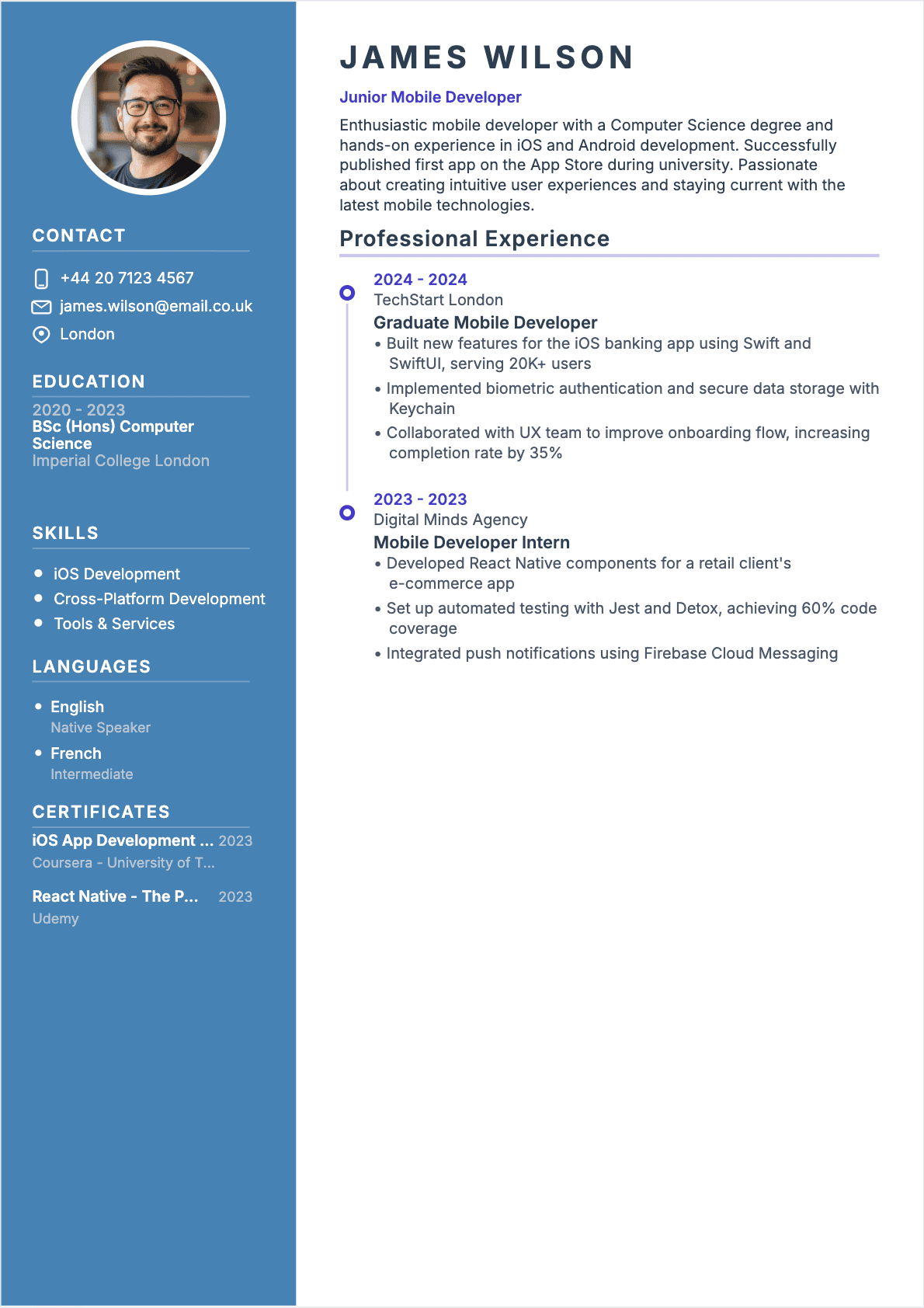
CV Mobile Developer Beginner
Built for interns, juniors, and fresh graduates. Emphasize academic projects, GitHub, core Android/iOS fundamentals, and measurable app outcomes like crash-free sessions and small feature deliveries.
Utiliser
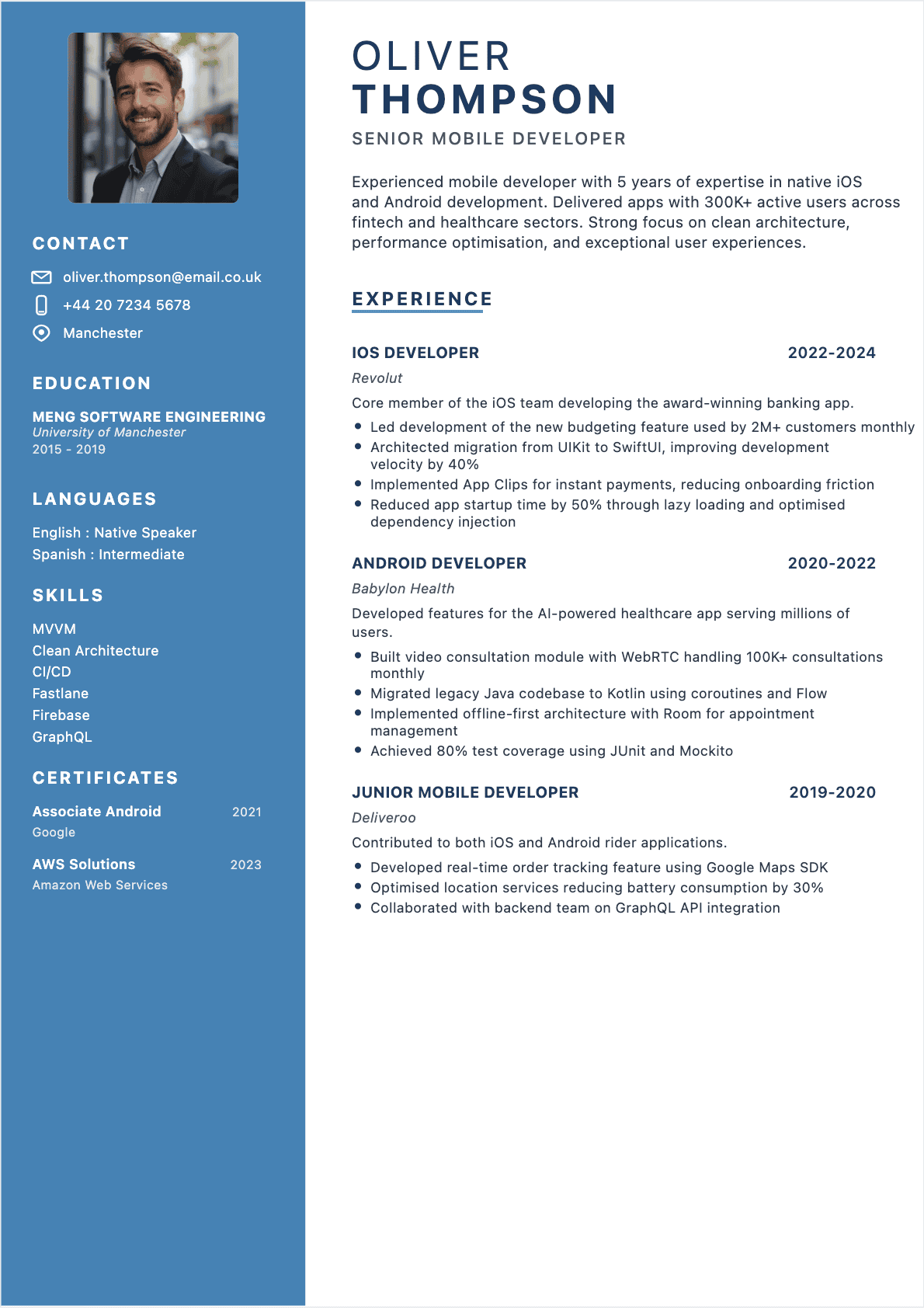
CV Mobile Developer Intermediate
For 3–7 years of experience. Highlight shipped apps, performance improvements, analytics-driven iterations, CI/CD ownership, and collaboration with product, design, and backend teams.
Utiliser
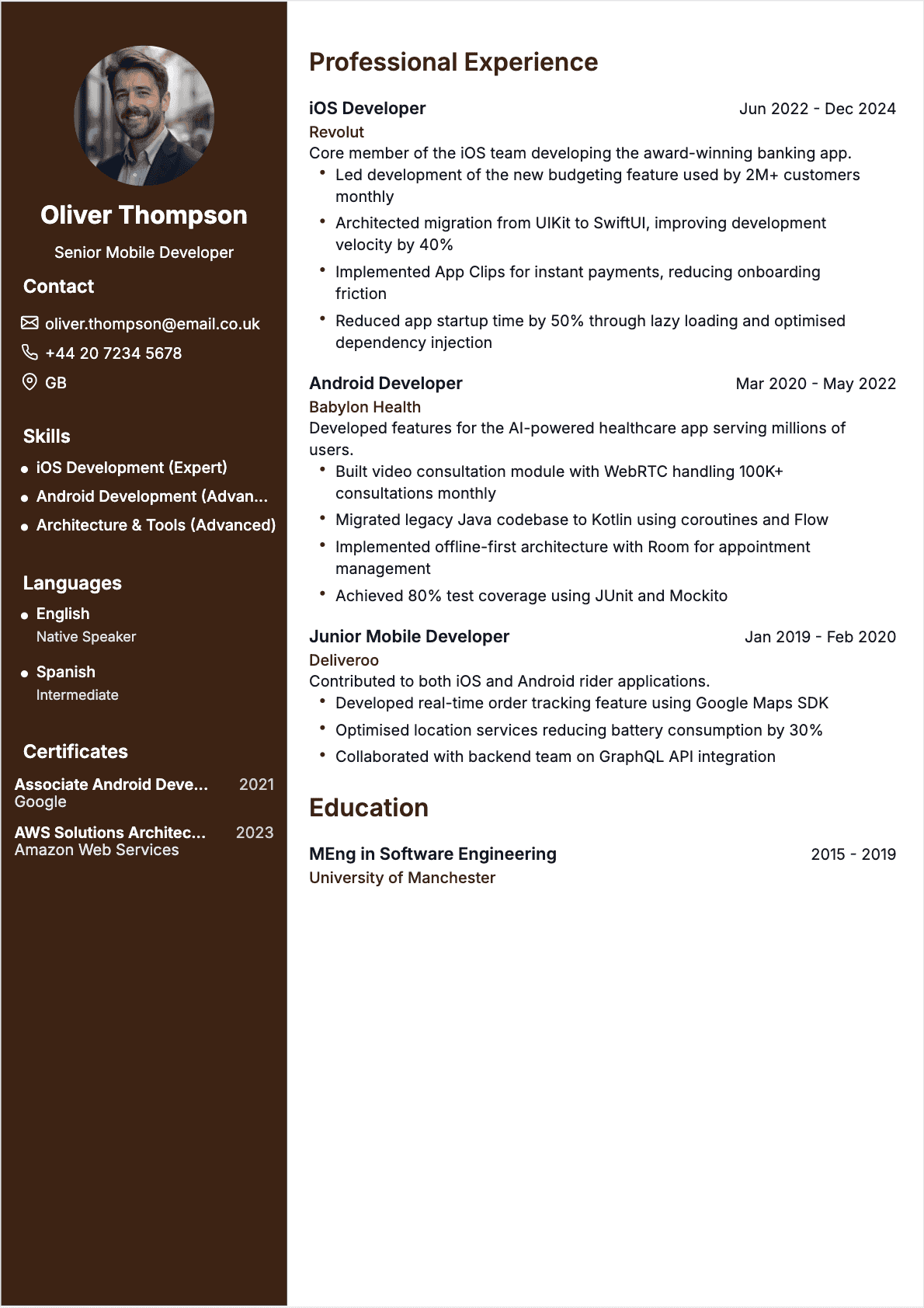
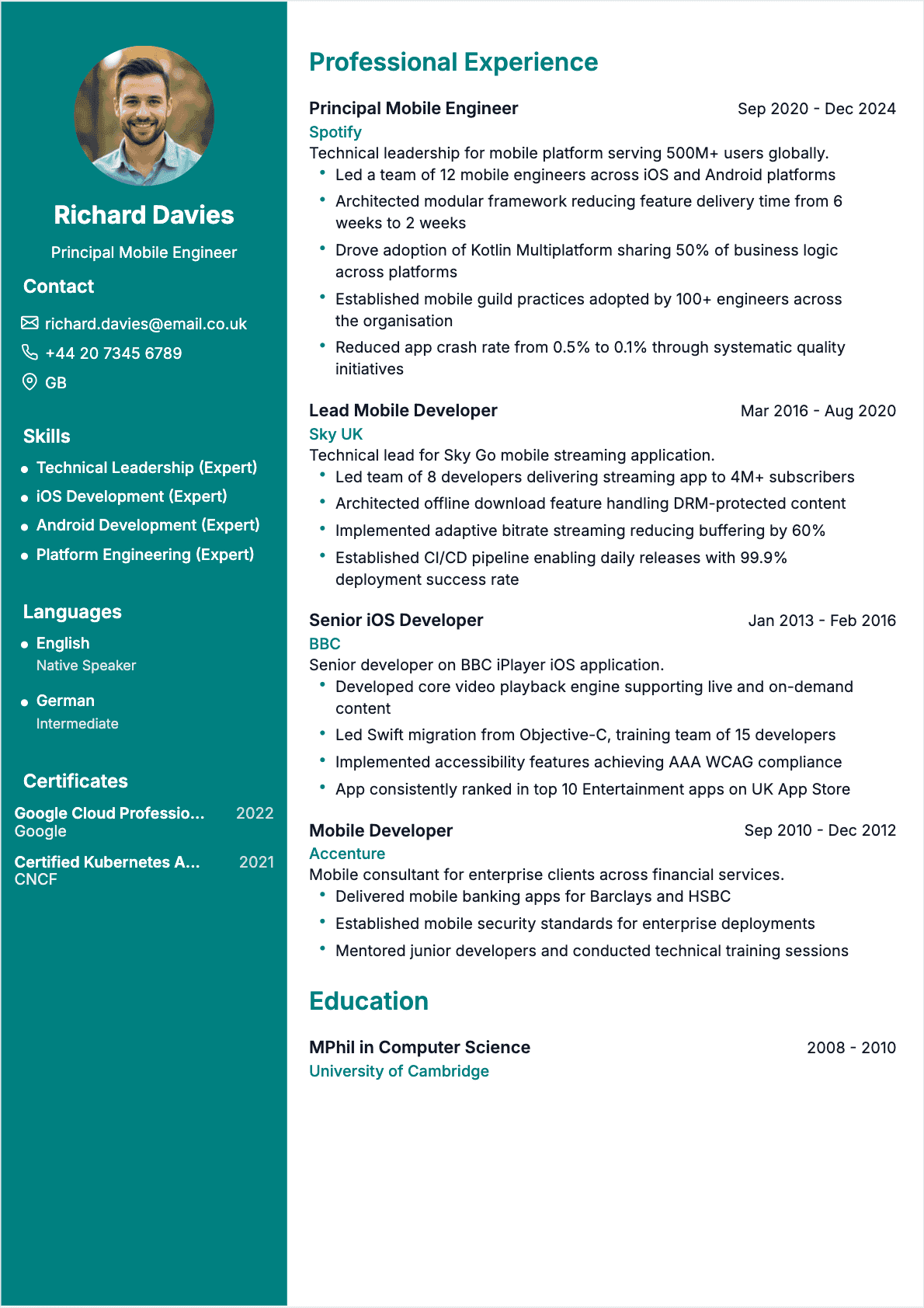
CV Mobile Developer Senior
For senior engineers and tech leads. Showcase architecture decisions, mentoring, cross-team influence, reliability metrics, release management, and business impact across multiple products.
UtiliserPerfect CV Checklist - CV Mobile Developer
Check each item to ensure your CV is complete and optimized.
Professional Summary - CV Mobile Developer
The professional summary is the first thing recruiters see. It should summarize your profile in a few impactful lines.
“Mobile Developer with 5+ years in fintech and e-commerce, shipping Android (Kotlin) and Flutter features to 2.3M users. Reduced crash rate from 1.1% to 0.3% and improved cold start by 28% using profiling, modularization, and CI/CD (Fastlane, GitHub Actions, Firebase).”
“Motivated and dynamic mobile developer, passionate about apps and available immediately. I like challenges, teamwork, and I always give 200% on every project.”
Why is it effective?
Le bon exemple est efficace car il :
- Donne un niveau clair : “5+ years” et des secteurs (“fintech and e-commerce”) pour situer ton expérience
- Ajoute des preuves chiffrées : baisse du crash rate (1.1% à 0.3%) et gain de performance (28%)
- Cite une stack précise : Kotlin, Flutter, Fastlane, GitHub Actions, Firebase (mots-clés ATS + crédibilité)
- Relie technique et impact : qualité et vitesse de lancement mesurables pour un produit à 2.3M d’utilisateurs
Le mauvais exemple échoue car il :
- Utilise des clichés (“motivated”, “dynamic”, “passionate”) sans preuve
- Ne donne aucun contexte (plateforme, domaine, taille d’application)
- N’inclut pas de résultats ni de métriques
- N’aide pas l’ATS ni le recruteur à comprendre ta valeur dès la première lecture
Professional experience examples
Here are examples of professional experiences. Note how results are quantified.
Mobile Developer (Android & Flutter)
Revolut, London
Joined a 9-person mobile squad in a regulated fintech environment. Owned feature delivery from discovery to release, collaborated with backend and risk teams, and maintained reliability targets across Android and Flutter modules for a high-traffic onboarding flow.
Key Achievements
Key skills for your resume
Here are the technical and soft skills most sought after by recruiters.
Technical skills to list on a Mobile Developer CV
Technical Skills
- Android development (Kotlin, Jetpack Compose)
- iOS development (Swift, SwiftUI)
- Cross-platform development (Flutter, Dart)
- React Native (TypeScript) and native modules
- Mobile architecture (MVVM, Clean Architecture, modularization)
- Networking & APIs (REST/GraphQL, OAuth2, offline sync)
- Mobile CI/CD (Fastlane, GitHub Actions, Bitrise)
- Analytics & crash reporting (Firebase Analytics, Crashlytics, Sentry)
Behavioral skills recruiters expect
Soft Skills
- Writing crisp technical RFCs for trade-offs (scope, latency, security)
- Product-focused prioritization with measurable success criteria
- Cross-functional execution with designers and backend engineers
- Debugging discipline under incident pressure (triage, rollback, postmortem)
- Clear code review feedback that improves maintainability
- Ownership of release coordination and stakeholder communication
- Mentoring juniors through pairing and structured learning plans
- Customer empathy translated into accessibility and UX improvements
ATS Keywords to Include
ATS systems filter CVs based on specific keywords. Include these terms to maximize your chances.
ATS Tip
Click on a keyword to copy it. ATS systems filter CVs based on these exact terms.
Mots-clés importants
Hiring Sectors
Discover the most promising sectors for your career.
Fintech & digital banking
E-commerce & retail
SaaS & productivity tools
Mobility, travel & logistics
Healthcare & digital therapeutics
Media, streaming & gaming
Education & Degrees
Mobile Developer roles accept multiple education paths, but recruiters still value a solid base in software engineering: data structures, networking, OS fundamentals, and secure coding. In English-speaking markets, a Bachelor’s degree is common for entry roles, while a Master’s can help for R&D-heavy teams (graphics, ML on-device, performance).
Alternatives also work: coding bootcamps plus a portfolio of shipped apps, open-source contributions, and well-documented projects. If you have 3+ years of experience, practical delivery (store releases, reliability metrics, CI/CD ownership) usually weighs more than the exact degree title.
Recommended Degrees
- Bachelor’s in Computer Science
- Bachelor’s in Software Engineering
- Master’s in Computer Science
- Master’s in Mobile Computing or Human-Computer Interaction
- MBA (for product-focused or leadership tracks in tech)
- PhD in Computer Science (for specialized roles: ML, graphics, systems)
Languages
Languages matter in mobile development because product teams are often distributed and documentation is predominantly in English. You’ll use languages in at least three contexts: collaborating with international stakeholders, writing clear tickets/specs, and handling user-facing localization (screens, store listings, in-app support content).
Show your level with a recognizable label (Native/Fluent/Proficient/Intermediate) and add proof when possible (IELTS/TOEFL scores, bilingual work environment). If you contribute to global releases, mention experience with i18n, pluralization rules, and RTL layouts.
English
Fluent (IELTS Academic 7.5)
French
Proficient
Spanish
Intermediate
Recommended certifications
Certifications are not mandatory for most Mobile Developer roles, but they can help in three cases: junior profiles with limited experience, candidates pivoting from another stack, and roles in cloud-heavy mobile platforms. Prioritize credible vendor certifications and agile credentials that match how teams actually ship.
Mistakes to avoid
Listing responsibilities instead of shipped outcomes
Many mobile CVs read like a job description: “worked on features”, “fixed bugs”, “collaborated with the team”. That does not show your leverage. Mobile teams care about reliability, performance, store ratings, retention, and delivery speed. If you can’t quantify, you look interchangeable, even with solid experience.
Toujours inclure :
- A baseline and a delta (e.g., crash rate 0.9% → 0.4%)
- A scope (app area, module, user base, platform)
- The method/tools (profilers, CI/CD, testing, analytics)
Use this formula: Action + context + metric + tool (e.g., “Reduced cold start by 28% using baseline profiles and startup tracing”).
Overloading the skills section with buzzwords
A long skills list can backfire if it looks like keyword stuffing. Hiring managers spot inflated stacks quickly, especially for mobile where depth matters (state management, threading, memory, build systems). Keep skills aligned to what you used in the last 12–24 months and what the role requires.
À éviter : "Flutter, Swift, Kotlin, React Native, Unity, Rust, Go, ML, Blockchain, AR/VR, DevOps, Kubernetes (expert)"
À privilégier : "Android (Kotlin, Compose), Flutter (Dart), MVVM/Clean Architecture, Fastlane, Firebase, REST/GraphQL, unit/UI tests"
Your goal is credibility: fewer items, each supported by experience bullets and measurable results.
Hiding release and store experience
Some candidates describe development but omit the “last mile”: versioning, code signing, store submissions, phased rollout, monitoring, and hotfix strategy. For mobile products, release ownership is a strong signal because it combines technical rigor, coordination, and risk management.
À mentionner :
- App Store Connect / Google Play Console usage (staged rollouts, TestFlight, internal testing)
- CI/CD pipeline and branching model (Fastlane, GitHub Actions, trunk-based or GitFlow)
- Post-release monitoring (Crashlytics/Sentry, dashboards, alert thresholds)
Ignoring ATS readability and link hygiene
A technically strong profile can be filtered out by ATS if formatting and keywords are inconsistent. Avoid multi-column layouts that break parsing, and don’t hide critical information in images. Also ensure portfolio links are accessible: recruiters will click them.
Checklist :
- Use standard headings (Summary, Experience, Skills, Education) and one-column layout
- Mirror job-title naming (e.g., “iOS Engineer” vs “Apple Developer”) based on the posting
- Include clean links (GitHub, LinkedIn, store pages) and verify they work without login
Expert tips
- 1
Lead with your platform : Put “Android (Kotlin)” or “iOS (Swift)” in the headline and summary. Recruiters search by platform first; make matching instant before they read details.
- 2
Show 2–3 signature metrics : Pick reliability, performance, and product impact (e.g., crash-free 99.7%, cold start -30%, conversion +5%). Repeat them across summary and top experience.
- 3
Make testing visible : Name the types (unit/UI/snapshot) and tools (XCTest, Espresso, Maestro). Add at least one achievement tied to fewer regressions or faster releases.
- 4
Explain architecture with one line : Mention MVVM/Clean Architecture and the why (scalability, testability). Avoid diagrams; keep it readable and tied to a shipped module.
- 5
Prove collaboration : Add one bullet about API contracts, feature flags, or design system adoption. Mobile delivery is cross-functional; show you can work through dependencies.
- 6
Link to real artifacts : Store links, GitHub repos, and a short case study README. One strong repository beats ten abandoned ones; focus on relevance and clarity.
- 7
Optimize for scanning : Use 3–5 bullets per role, each starting with a verb and containing a metric or tool. If a bullet has no proof, rewrite it.
Frequently asked questions
Find answers to the most frequently asked questions.
If you have under ~5 years of experience, aim for one page by prioritizing shipped apps, core stack, and 2–3 quantified achievements per role. For senior profiles, two pages are acceptable when you include architecture ownership, reliability work, mentoring, and multiple products. Keep every line tied to impact or decision-making.
Include LinkedIn, GitHub, and at least one store link (App Store/Google Play) when possible. If the app is private, link a portfolio page with screenshots, metrics you can share, and a short description of your role. Make URLs clickable and readable, and verify they work from an incognito browser.
Use percentage deltas and engineering metrics that are not confidential: crash-free sessions, ANR rate, cold start time, bundle size, CI pipeline time, test coverage, or release frequency. Example: “Reduced build time by 22%” or “Improved crash-free sessions to 99.7%.” Always add context (module, platform, timeframe).
Prioritize platform and language keywords (Android, iOS, Kotlin, Swift), architecture terms (MVVM, Clean Architecture), and delivery tooling (CI/CD, Fastlane, GitHub Actions). Add analytics and reliability tools (Firebase, Crashlytics, Sentry) plus API terms (REST, GraphQL). Match the job posting wording exactly where truthful.
State the framework plus what you shipped: “Flutter (Dart) — migrated 6 screens, shared UI kit, reduced duplicate code by 35%.” Mention state management (Bloc/Provider/Riverpod for Flutter, Redux/Context for RN), native integrations, and performance work. Hiring managers want evidence you can handle platform constraints, not only UI.
In most English-speaking markets (especially the US), avoid adding a photo because it can introduce bias concerns and is not expected. In the UK it is optional, but still uncommon in tech. Focus on content: measurable outcomes, stack depth, and links to shipped work. Let the portfolio do the visual proof instead.
Build your CV Mobile Developer in minutes
Use our CV builder to generate an ATS-friendly Mobile Developer CV with the right structure, keywords, and quantified bullet points—then export to PDF and apply with confidence.
Create my Resume