Web Developer Resume
Example, Template & Expert Tips 2026
Updated on April 18, 2026.
Build a Web Developer CV that passes ATS in 2026: quantified achievements, skills keywords, and templates to win more interviews across roles.
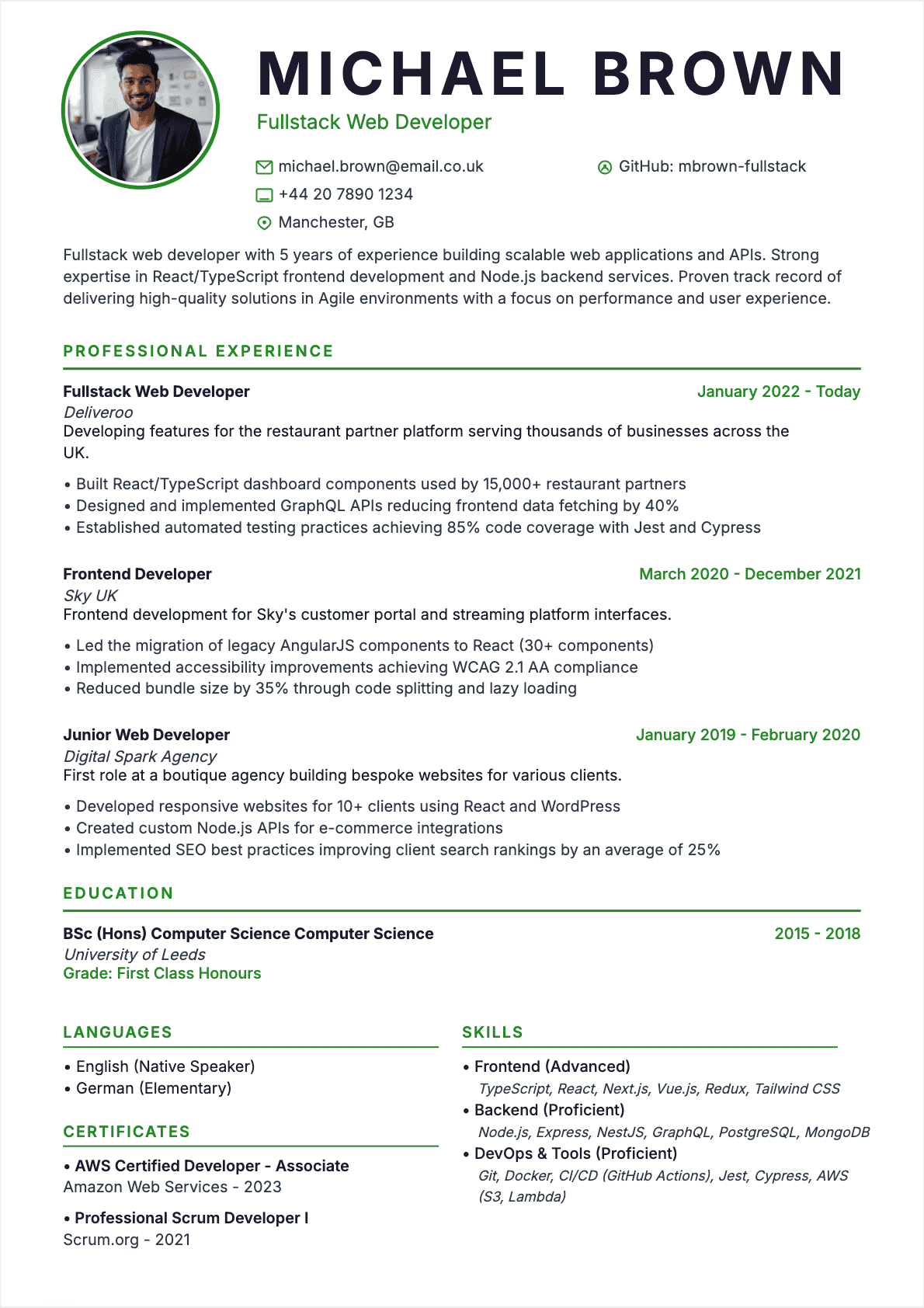
Web Developer Resume Templates
8 Templates available
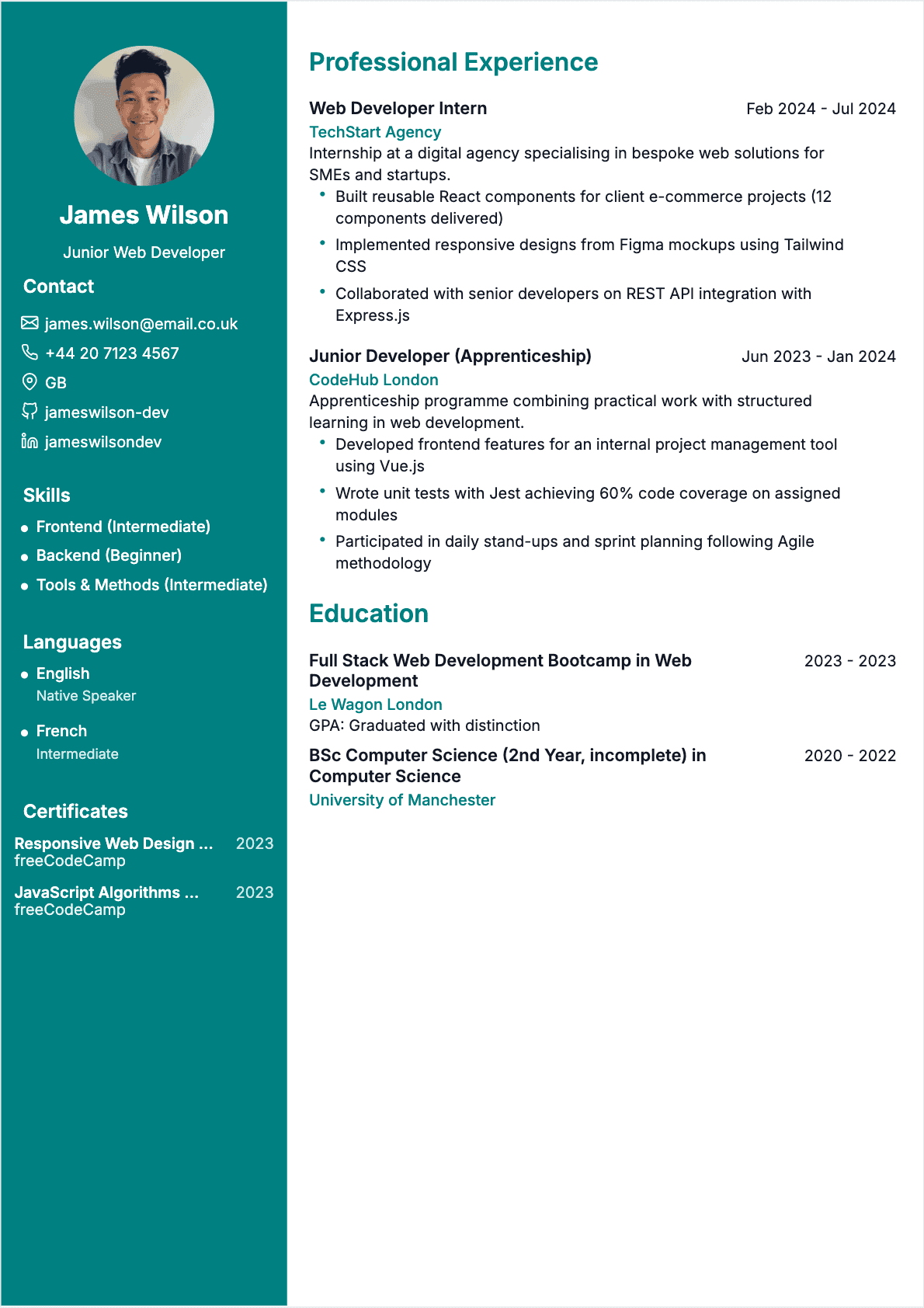
Resume Web Developer Junior
Web Developer resume template for Junior profile
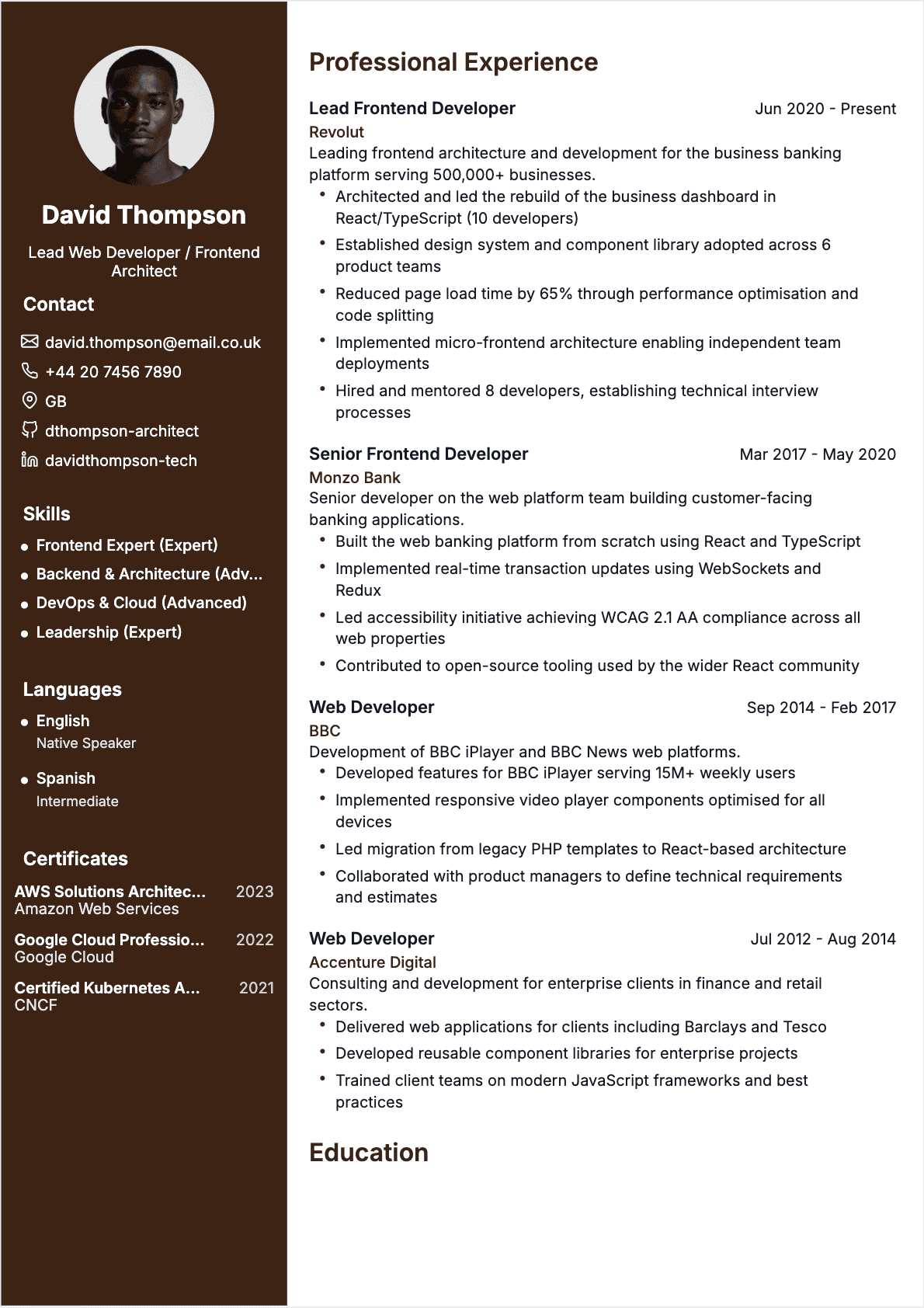
Resume Web Developer Senior
Web Developer resume template for Senior profile
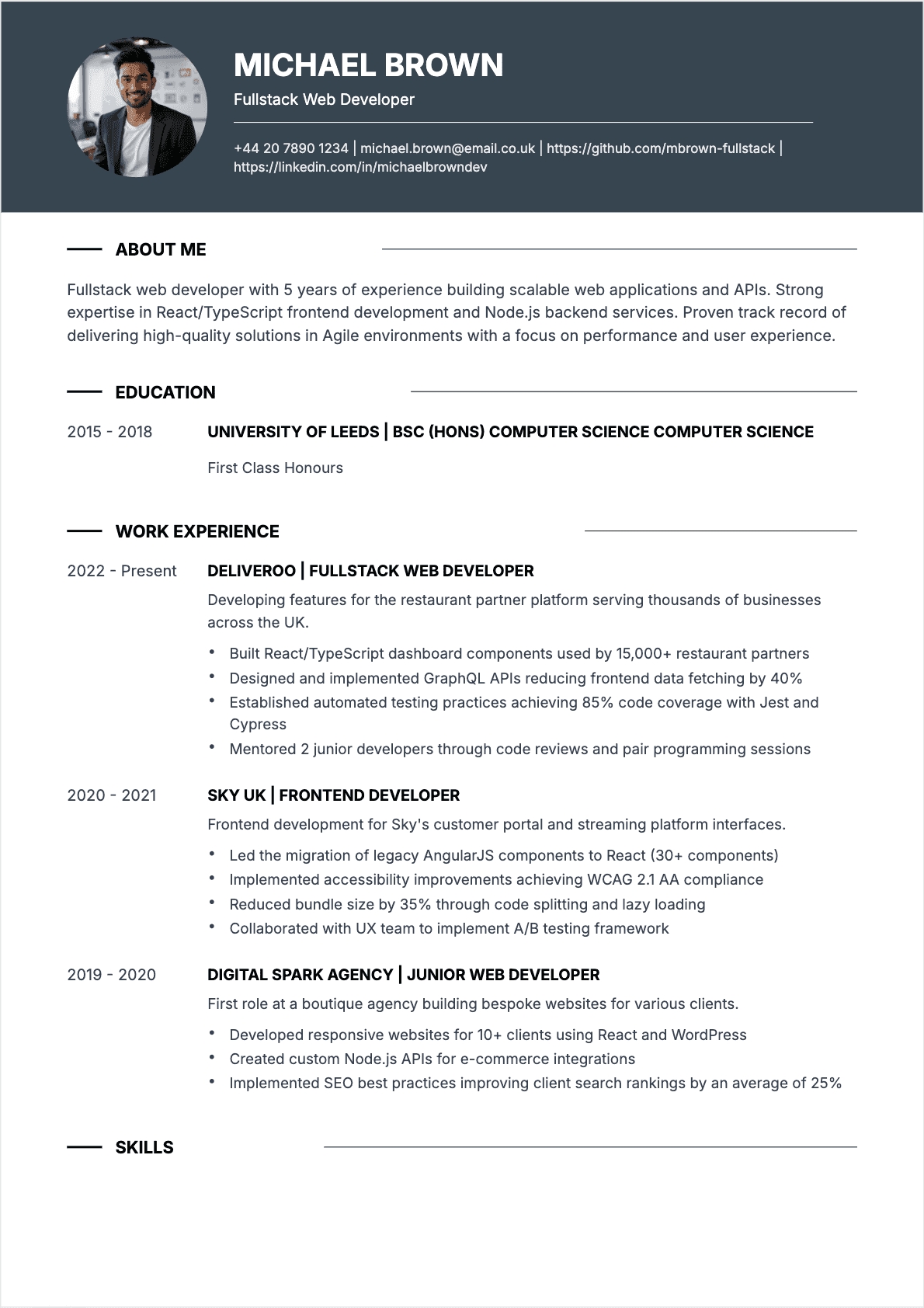
Resume Web Developer Confirmé
Web Developer resume template for Confirmé profile
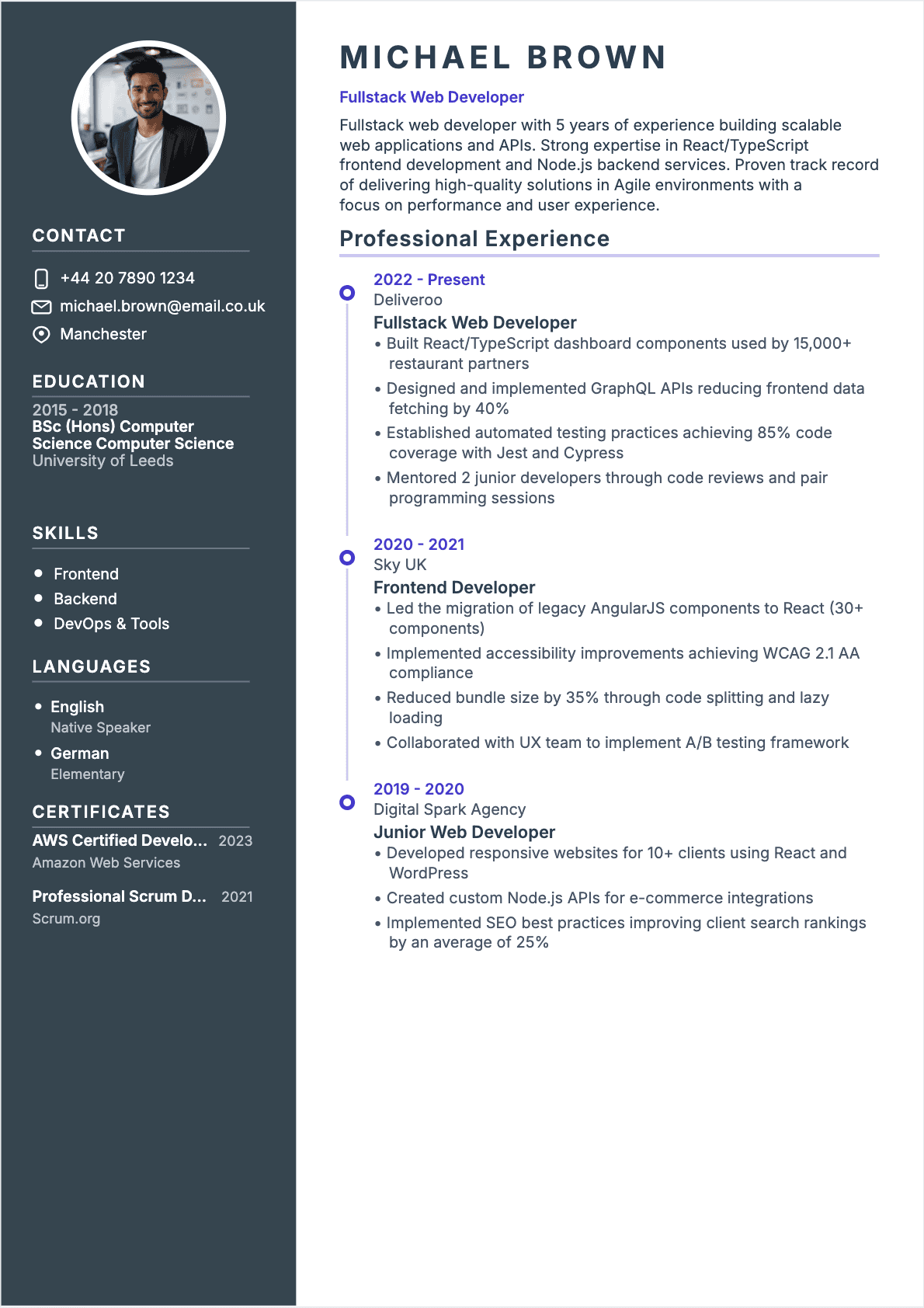
Resume Web Developer Confirmé
Web Developer resume template for Confirmé profile
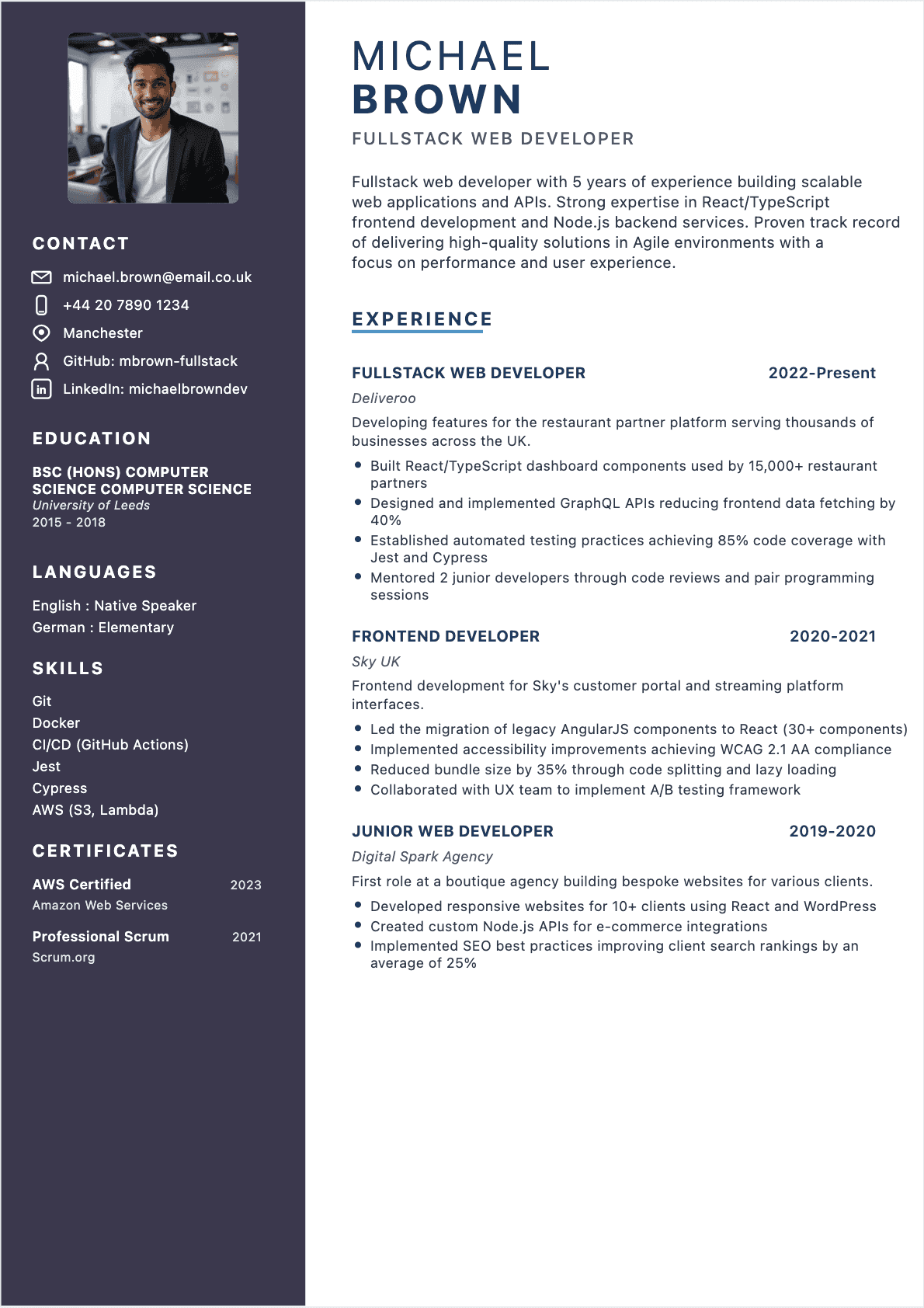
Resume Web Developer Confirmé
Web Developer resume template for Confirmé profile
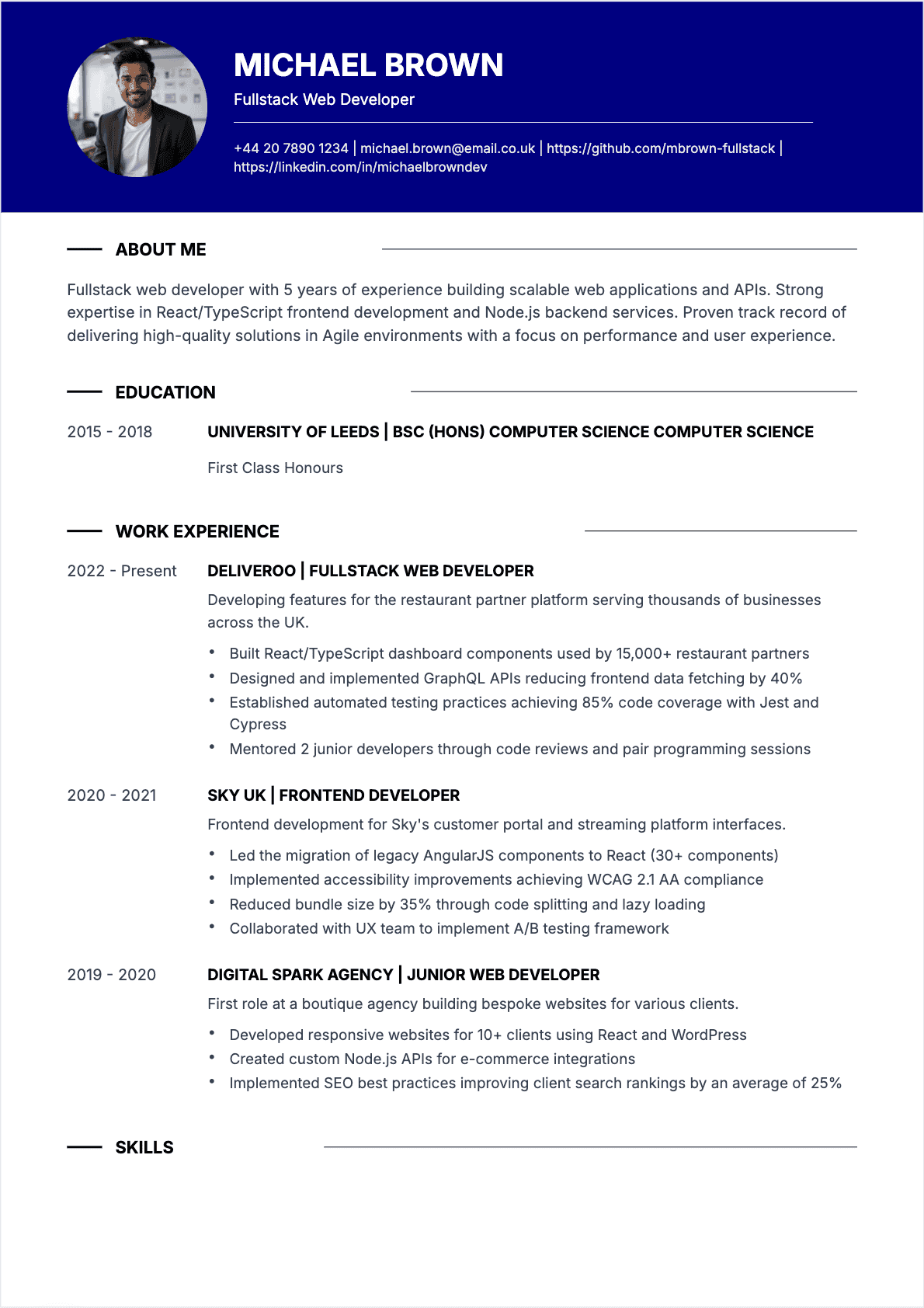
Resume Web Developer Confirmé
PopularWeb Developer resume template for Confirmé profile
Like one of these Web Developer resume templates?
Select it, fill in your details and download your resume as PDF.
Web Developer Resume Examples
Michael Brown
Fullstack Web Developer
michael.brown@email.co.uk
+44 20 7890 1234
Manchester, GB
Fullstack web developer with 5 years of experience building scalable web applications and APIs. Strong expertise in React/TypeScript frontend development and Node.js backend services. Proven track record of delivering high-quality solutions in Agile environments with a focus on performance and user experience.
Work Experience
Fullstack Web Developer
Deliveroo
- ●Built React/TypeScript dashboard components used by 15,000+ restaurant partners
- ●Designed and implemented GraphQL APIs reducing frontend data fetching by 40%
- ●Established automated testing practices achieving 85% code coverage with Jest and Cypress
Frontend Developer
Sky UK
- ●Led the migration of legacy AngularJS components to React (30+ components)
- ●Implemented accessibility improvements achieving WCAG 2.1 AA compliance
- ●Reduced bundle size by 35% through code splitting and lazy loading
Junior Web Developer
Digital Spark Agency
- ●Developed responsive websites for 10+ clients using React and WordPress
- ●Created custom Node.js APIs for e-commerce integrations
- ●Implemented SEO best practices improving client search rankings by an average of 25%
Education
BSc (Hons) Computer Science
University of Leeds
Skills
Languages
English — Native Speaker
German — Elementary
Certifications
AWS Certified Developer - AssociateAmazon Web Services
Professional Scrum Developer IScrum.org
Web Developer role overview
Web developers build and maintain websites and web applications that millions of people use daily. Your work spans from creating responsive landing pages for small businesses to developing complex e-commerce platforms or interactive web applications. You write code in languages like HTML, CSS, JavaScript, and various backend technologies, transforming design mockups and business requirements into functional digital experiences.
The day-to-day reality involves more than just writing code. You spend significant time debugging issues, reviewing pull requests from teammates, attending stand-up meetings, and collaborating with designers and product managers. You'll test your code across different browsers and devices, optimize performance, and ensure your work meets accessibility standards. Problem-solving takes up a substantial portion of your day—figuring out why a feature isn't working as expected or finding the most efficient way to implement a new requirement.
Career progression typically follows a clear path. Junior developers focus on implementing features under supervision, mid-level developers take ownership of entire features or small projects, and senior developers architect solutions, mentor others, and make technical decisions that affect the entire codebase. Many web developers eventually specialize as frontend, backend, or full-stack developers, while others move into technical leadership, product management, or DevOps roles.
Salary ranges vary significantly by experience and location. In the United States, junior web developers earn between $55,000-$75,000 annually, mid-level developers command $75,000-$110,000, and senior developers typically earn $110,000-$160,000 or more in major tech hubs. In the UK, expect £25,000-£35,000 for junior roles, £35,000-£55,000 for mid-level, and £55,000-£85,000+ for senior positions. Remote work has somewhat equalized these ranges, with many companies offering competitive salaries regardless of location.
Typical daily tasks include:
- Writing and reviewing code for new features or bug fixes, typically spending 4-6 hours in your code editor
- Debugging issues reported by QA testers or users, using browser developer tools and logging systems
- Participating in daily stand-ups, sprint planning, and code review sessions with your team
- Collaborating with designers to ensure pixel-perfect implementation of UI designs
- Testing your code across different browsers, devices, and screen sizes to ensure compatibility
- Updating documentation, writing commit messages, and maintaining clear communication about your work progress
Essential skills for a Web Developer resume
Your resume needs to demonstrate both technical proficiency and the collaborative abilities that make you effective in a team environment. Recruiters scan for specific programming languages and frameworks, but they also want evidence that you can communicate technical concepts, work within agile processes, and continuously learn as technologies evolve. The skills you emphasize should match the job description while honestly representing your capabilities.
ATS systems prioritize exact keyword matches, so include the specific technologies mentioned in the job posting. If a role requires "React" and you list "JavaScript frameworks," the ATS might not make the connection. However, don't just list skills—demonstrate them through your work experience bullets by showing what you built and the impact it had.
Core skills recruiters search for:
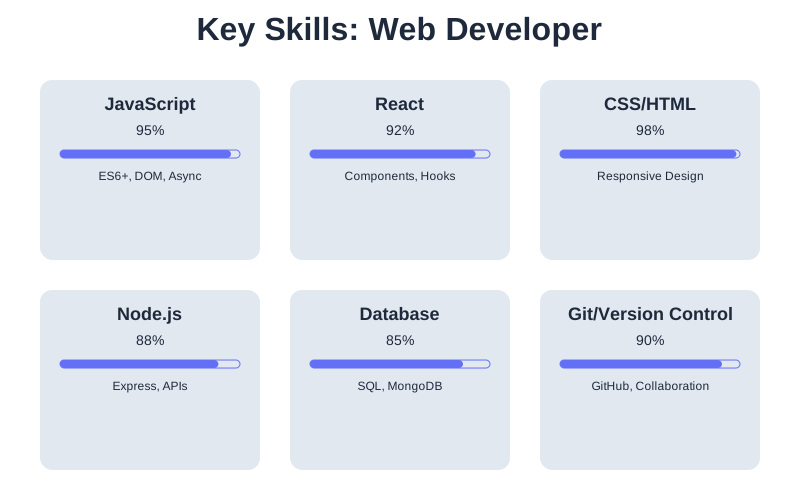
- HTML5/CSS3 - Foundation of all web development; recruiters expect you to write semantic, accessible markup and create responsive layouts without relying entirely on frameworks
- JavaScript (ES6+) - The language of the web; you need modern syntax knowledge including promises, async/await, destructuring, and modules to work with contemporary codebases
- React, Vue, or Angular - At least one major framework is essential; companies invest heavily in specific frameworks and need developers who can contribute immediately
- Git version control - Non-negotiable for team collaboration; you must understand branching, merging, pull requests, and resolving conflicts in real project workflows
- Responsive design - Mobile-first development is standard; you need to build interfaces that work flawlessly on devices from 320px phones to 4K monitors
- RESTful APIs - Most applications consume external data; understanding how to fetch, post, and handle API responses is fundamental to modern web development
- Node.js/Express or similar backend - Even frontend-focused roles often require basic backend knowledge to understand full application architecture and communicate with backend teams
- Testing frameworks (Jest, Cypress) - Quality-focused companies expect test coverage; knowing how to write unit and integration tests demonstrates professional development practices
- Problem-solving ability - Debugging complex issues requires logical thinking; employers want evidence you can break down problems and find solutions independently
- Communication skills - You'll explain technical decisions to non-technical stakeholders; clear documentation and the ability to articulate trade-offs matter as much as coding ability
- Agile/Scrum experience - Most development teams use agile methodologies; familiarity with sprints, user stories, and iterative development shows you understand modern workflows
- Performance optimization - Slow websites lose users and revenue; knowledge of lazy loading, code splitting, and Core Web Vitals demonstrates you care about user experience
How to write a Web Developer resume step by step
1. Start with a targeted professional summary
Write 3-4 lines that immediately tell recruiters your specialization, years of experience, and key technical strengths. Skip generic statements like "passionate developer seeking opportunities." Instead, write something specific: "Full-stack web developer with 4 years building React applications for fintech companies. Specialized in performance optimization and accessibility, reducing load times by 40% across three major product releases."
2. List your technical skills in a scannable format
Create a dedicated skills section near the top with categories like "Languages," "Frameworks," "Tools," and "Practices." Use the exact terminology from the job description. If they want "TypeScript," don't just list "JavaScript." Format it clearly: Languages: JavaScript (ES6+), TypeScript, Python, SQL | Frameworks: React, Next.js, Node.js, Express | Tools: Git, Docker, AWS, Webpack. This helps both ATS and human reviewers quickly verify your qualifications.
3. Quantify your achievements in every work experience bullet
Transform vague descriptions into measurable results. Instead of "Developed responsive websites," write "Built 12 responsive websites for healthcare clients, achieving 95+ Google Lighthouse scores and increasing mobile conversions by 28%." Instead of "Worked on e-commerce platform," write "Implemented shopping cart functionality processing $2.3M in annual transactions with 99.9% uptime." Numbers prove impact and make your contributions concrete.
4. Use the PAR format: Problem-Action-Result
Structure your bullets to show context, what you did, and the outcome. Example: "Identified performance bottleneck causing 8-second page loads (Problem), implemented code splitting and lazy loading with React.lazy() (Action), reducing load time to 2.1 seconds and decreasing bounce rate by 34% (Result)." This storytelling approach helps recruiters understand your thinking process and impact.
5. Include relevant projects with technical details
If you're early in your career or changing specializations, add a projects section. Don't just list "Portfolio website - HTML, CSS, JavaScript." Instead: "Real-time chat application using Socket.io and React - Built WebSocket-based messaging system supporting 50+ concurrent users, implemented JWT authentication, deployed on AWS EC2 with CI/CD pipeline via GitHub Actions." Link to live demos or GitHub repos when possible.
6. Tailor your resume for each application
Read the job description carefully and mirror their language. If they emphasize "accessibility," add bullets about WCAG compliance work you've done. If they want "microservices architecture," highlight relevant backend experience. Don't fabricate skills, but reorder and emphasize the experience that matches their needs. This takes 10-15 minutes per application but dramatically improves your response rate.
7. Keep formatting clean and ATS-friendly
Use standard section headings like "Work Experience," "Education," and "Skills" rather than creative alternatives like "My Journey" or "Tech Arsenal." Avoid tables, text boxes, headers, and footers that confuse ATS parsers. Stick to standard fonts (Arial, Calibri, Georgia) and save as a .docx or PDF. Test your resume by copying and pasting it into a plain text editor—if the formatting breaks completely, ATS systems will struggle too.
Before and after examples:
Weak: Responsible for website maintenance and updates
Strong: Maintained 8 client websites built on WordPress and custom PHP, implementing 45+ feature requests and resolving 200+ support tickets with 24-hour average response time
Weak: Used React to build components
Strong: Developed reusable React component library with 35+ components, reducing development time for new features by 40% and ensuring consistent UI across 6 product teams
Weak: Improved website speed
Strong: Optimized web application performance by implementing code splitting, image compression, and CDN integration, improving Core Web Vitals scores from 45 to 92 and increasing SEO rankings by 15 positions
Common mistakes on Web Developer resumes
Listing every technology you've ever touched
Recruiters see through resume padding. If you completed one tutorial in Angular three years ago, don't list it alongside React where you have two years of professional experience. This dilutes your actual expertise and raises questions about your honesty. Instead, categorize skills by proficiency: "Proficient: React, JavaScript, Node.js" and "Familiar: Vue, Python, Django." Better yet, only list technologies you'd feel comfortable discussing in a technical interview.
Describing responsibilities instead of accomplishments
Your resume shouldn't read like a job description. "Developed web applications using React" tells recruiters nothing about your impact. Did those applications serve 10 users or 10 million? Did you build them alone or as part of a 50-person team? Transform every bullet into an achievement: "Architected and launched customer portal serving 45,000 users, reducing support tickets by 30% by enabling self-service account management." The difference is evidence of impact versus a list of duties.
Using outdated technologies without context
If your most recent role heavily featured jQuery or PHP 5, address it strategically. Don't hide it, but show you're current. Add a "Continuous Learning" section mentioning recent courses in modern frameworks, or include a side project using contemporary tools. Recruiters understand that your job required certain technologies, but they need assurance you can adapt to their stack. A resume showing only legacy tech suggests you haven't kept pace with industry evolution.
Failing to demonstrate problem-solving
Anyone can say they "built features" or "fixed bugs." What makes you valuable is how you approach challenges. Instead of "Fixed cross-browser compatibility issues," write "Diagnosed and resolved IE11 rendering bug affecting 15% of users by refactoring CSS Grid implementation to Flexbox fallback, restoring functionality for 8,000+ monthly visitors." This shows your debugging process, technical decision-making, and awareness of user impact.
Ignoring soft skills and collaboration
Web development is rarely solitary work. Resumes that only showcase technical skills miss half the picture. Include bullets demonstrating teamwork: "Led code review sessions for 5-person frontend team, establishing style guide that reduced PR revision cycles by 50%." Or communication: "Translated complex API documentation into user-friendly developer guides, reducing integration support requests by 40%." These skills often determine who gets hired when technical abilities are comparable.
Generic project descriptions
Saying you "built an e-commerce site" means nothing without specifics. What scale? What challenges? What technologies? Compare: "E-commerce website with shopping cart" versus "Built Shopify-integrated e-commerce platform processing 500+ daily orders, implementing Stripe payment gateway, inventory management system syncing with 3 warehouses, and custom analytics dashboard tracking conversion funnels across 12 product categories." The second version demonstrates scope, technical complexity, and business understanding.
Neglecting mobile and accessibility experience
In 2026, mobile-first development and accessibility aren't optional specializations—they're baseline expectations. If your resume doesn't mention responsive design, mobile optimization, or accessibility standards, recruiters assume you lack this experience. Add specific bullets: "Ensured WCAG 2.1 AA compliance across all components, implementing ARIA labels, keyboard navigation, and screen reader compatibility, increasing accessibility audit score from 68 to 94." This shows you build for all users, not just desktop users with perfect vision.
Web Developer resume trends in 2026
The hiring bar for web developers has risen significantly as AI coding assistants change what's considered baseline productivity. Employers now expect developers to accomplish more in less time, using tools like GitHub Copilot, Cursor, and ChatGPT as force multipliers. Your resume should demonstrate not just coding ability, but efficiency and the judgment to know when AI suggestions are helpful versus when they introduce security vulnerabilities or technical debt. Mention experience with AI-assisted development if you have it, but focus on the quality and impact of what you built, not the tools you used to build it.
TypeScript has moved from "nice to have" to "expected" for most frontend positions. Companies that previously accepted vanilla JavaScript now specifically require TypeScript experience because it catches bugs before production and makes large codebases maintainable. If you've only worked with JavaScript, invest time learning TypeScript and add a project demonstrating it. Similarly, frameworks like Next.js and Remix that handle server-side rendering, routing, and data fetching are becoming standard rather than advanced skills. Your resume should reflect familiarity with these meta-frameworks, not just React alone.
Performance and Core Web Vitals now directly impact hiring decisions because they affect SEO rankings and revenue. Google's algorithm changes have made page speed a competitive advantage, so companies prioritize developers who understand performance optimization. Quantify your performance work: "Reduced Largest Contentful Paint from 4.2s to 1.8s through image optimization and code splitting, improving SEO ranking from page 3 to page 1 for primary keyword." Mention specific metrics like LCP, FID, and CLS if you've worked on them—these acronyms signal you understand modern web performance standards.
Remote work has fundamentally changed what employers value. Your resume should demonstrate asynchronous communication skills, self-direction, and experience with distributed team tools. Bullets like "Collaborated with 8-person team across 5 time zones using GitHub, Slack, and Notion, maintaining 95% sprint completion rate" show you can thrive in remote environments. Companies also care more about documentation quality now—if you've created technical documentation, API guides, or onboarding materials, highlight it. Clear written communication matters more when you can't walk over to someone's desk.
Security awareness has become a core competency rather than a specialized skill. With increasing data breaches and privacy regulations, employers expect all developers to understand basic security principles. Your resume should mention authentication implementation (OAuth, JWT), input validation, XSS prevention, CORS configuration, or GDPR compliance work if applicable. You don't need to be a security expert, but showing awareness of security considerations in your development work distinguishes you from candidates who only think about features.
The rise of full-stack expectations means even frontend-focused roles often require backend knowledge. Employers want developers who can build a feature end-to-end without waiting for backend support. Your resume should demonstrate some backend experience—whether that's Node.js, Python, or working with databases and APIs. If you're purely frontend, consider adding a full-stack project to your portfolio. The most competitive candidates can discuss database schema design, API architecture, and deployment processes, not just component styling.
Green web development and sustainability are emerging considerations, particularly at larger companies with environmental commitments. While still niche, mentioning work that reduced server costs, optimized resource usage, or decreased carbon footprint through efficient code can differentiate you. Example: "Reduced bundle size by 60% through tree-shaking and dynamic imports, decreasing bandwidth usage by 2TB monthly and cutting CDN costs by $1,200/month." This shows technical skill while aligning with corporate sustainability goals that are increasingly influencing hiring priorities.
Further reading:
Frequently asked questions
Find answers to the most frequently asked questions.
In most English-speaking markets (especially the US), it’s safer to avoid a photo to reduce bias and keep the CV ATS-friendly. In the UK it’s optional, but still uncommon for tech. Use the space for a GitHub link, portfolio, and 2–3 quantified highlights.
Aim for 1 page if you have under ~5 years of experience, and up to 2 pages for senior profiles with multiple roles and notable projects. Keep it scannable: 4–6 bullets per role, and make sure every role contains at least one metric tied to impact.
Create a small public case study: describe the problem, your approach, and the measurable result without naming internal systems. Add screenshots with sensitive data removed, a simplified architecture diagram, and metrics in ranges (e.g., “~200k monthly sessions”, “p95 latency reduced ~40%”).
For front-end, prioritize UI performance (Core Web Vitals), accessibility, design systems, and state management, plus tools like Storybook and Playwright. For back-end, lead with API design, database work, caching, observability, and reliability metrics (error rate, latency, uptime), plus Docker and cloud services.
ATS usually filters by role title and core stack. Make sure your CV includes the exact job title (Web Developer) and the technologies listed in the posting (e.g., React, TypeScript, Node.js, SQL, AWS). Place them in Skills and demonstrate them in Experience bullets to avoid looking like keyword stuffing.
Show scope and decision-making: architecture choices, migration plans, mentoring, incident ownership, and measurable platform improvements. Add evidence like “reduced incidents 12→5 per quarter”, “cut build time 18→9 minutes”, or “led a migration for 6 services with zero downtime” to signal senior impact.
Your career deserves a better resume
With CVtoWork, select a template, fill in the fields and download your resume as PDF.
Start creating