Training Coordinator Resume
Example, Template & Expert Tips 2026
Updated on April 18, 2026.
Write a Training Coordinator CV that gets interviews: quantified achievements, ATS keywords, skills, and proven formatting tips for 2026.
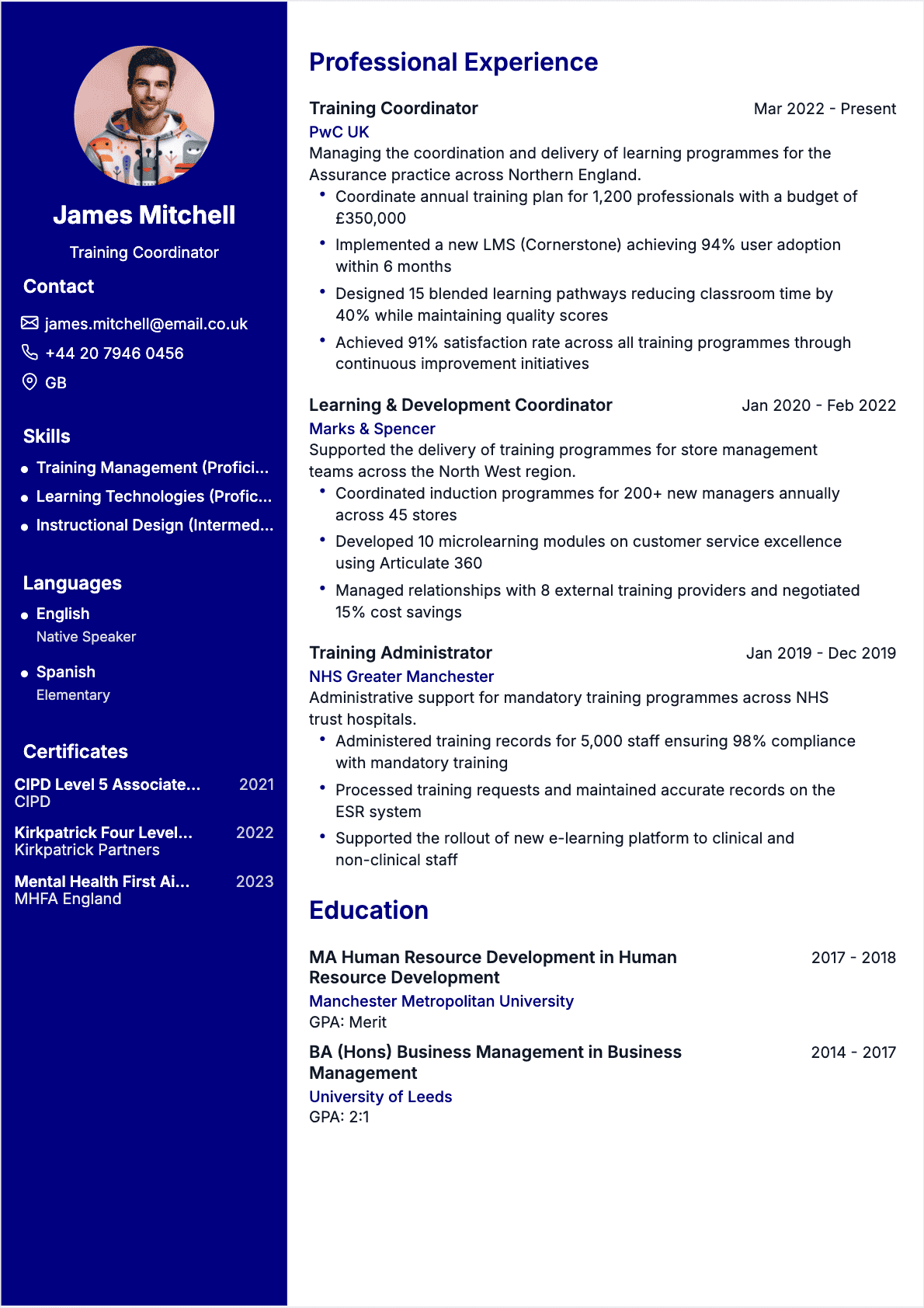
Training Coordinator Resume Templates
8 Templates available
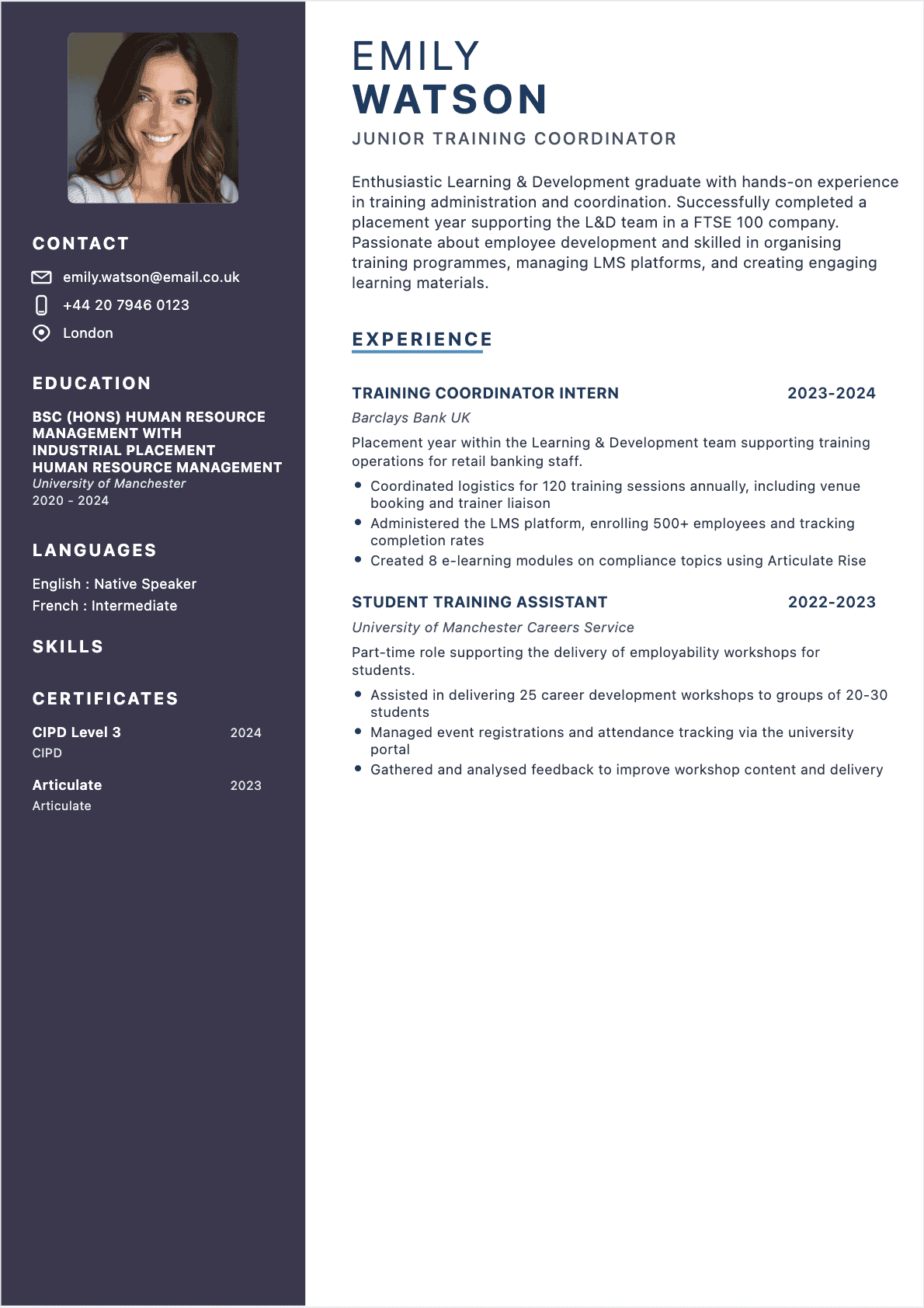
Resume Training Coordinator Junior
Training Coordinator resume template for Junior profile
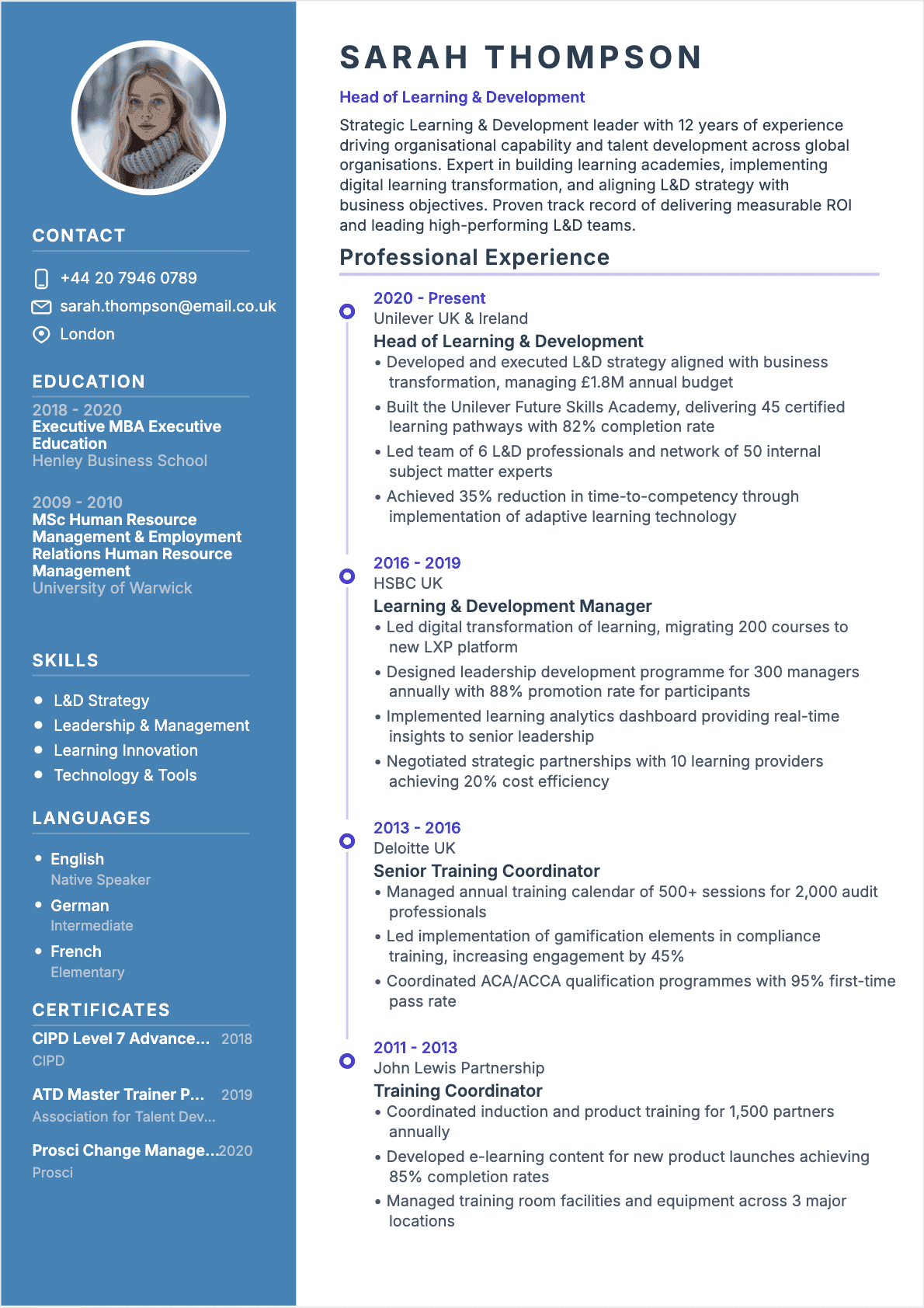
Resume Training Coordinator Senior
PopularTraining Coordinator resume template for Senior profile
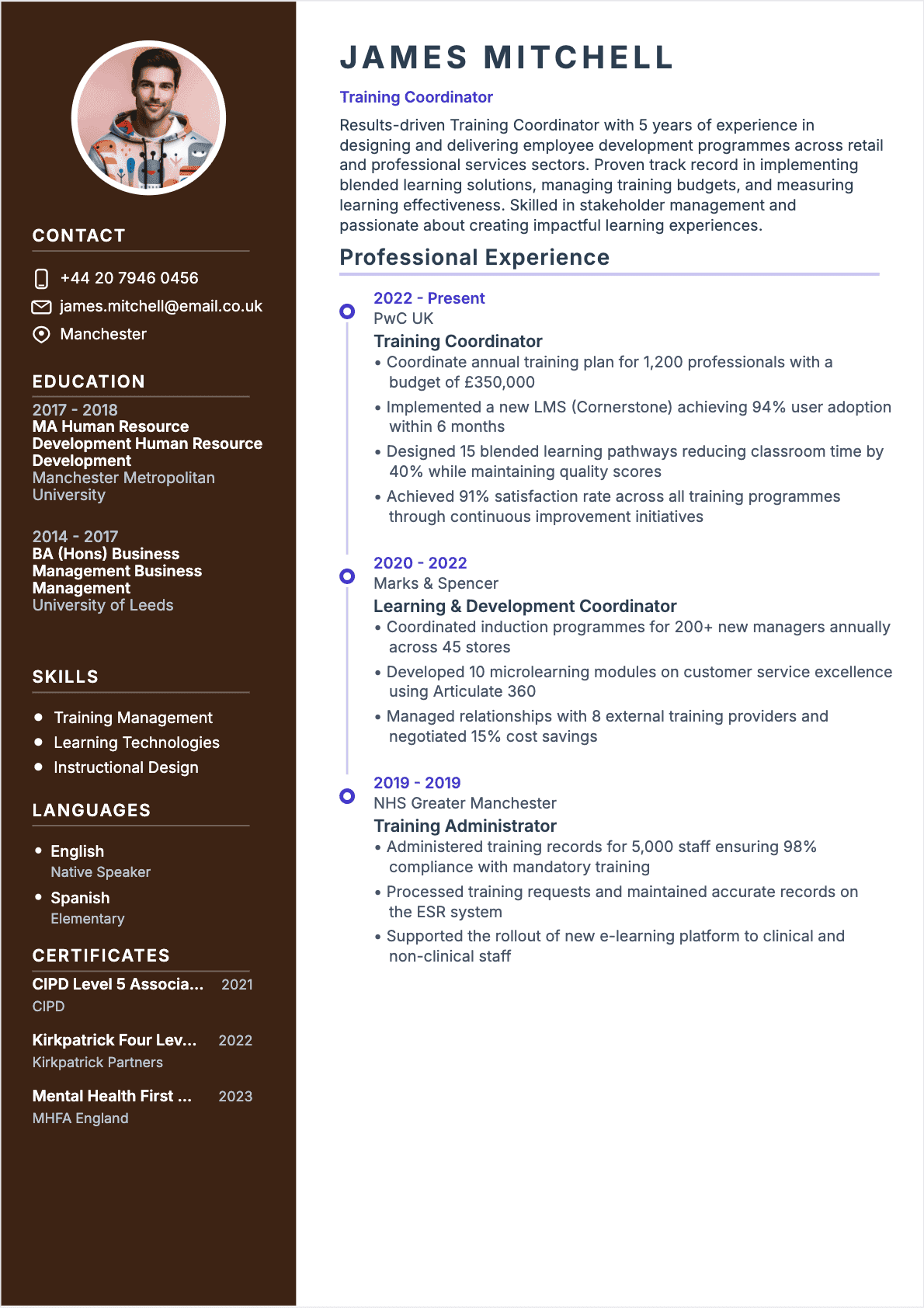
Resume Training Coordinator Confirmé
Training Coordinator resume template for Confirmé profile
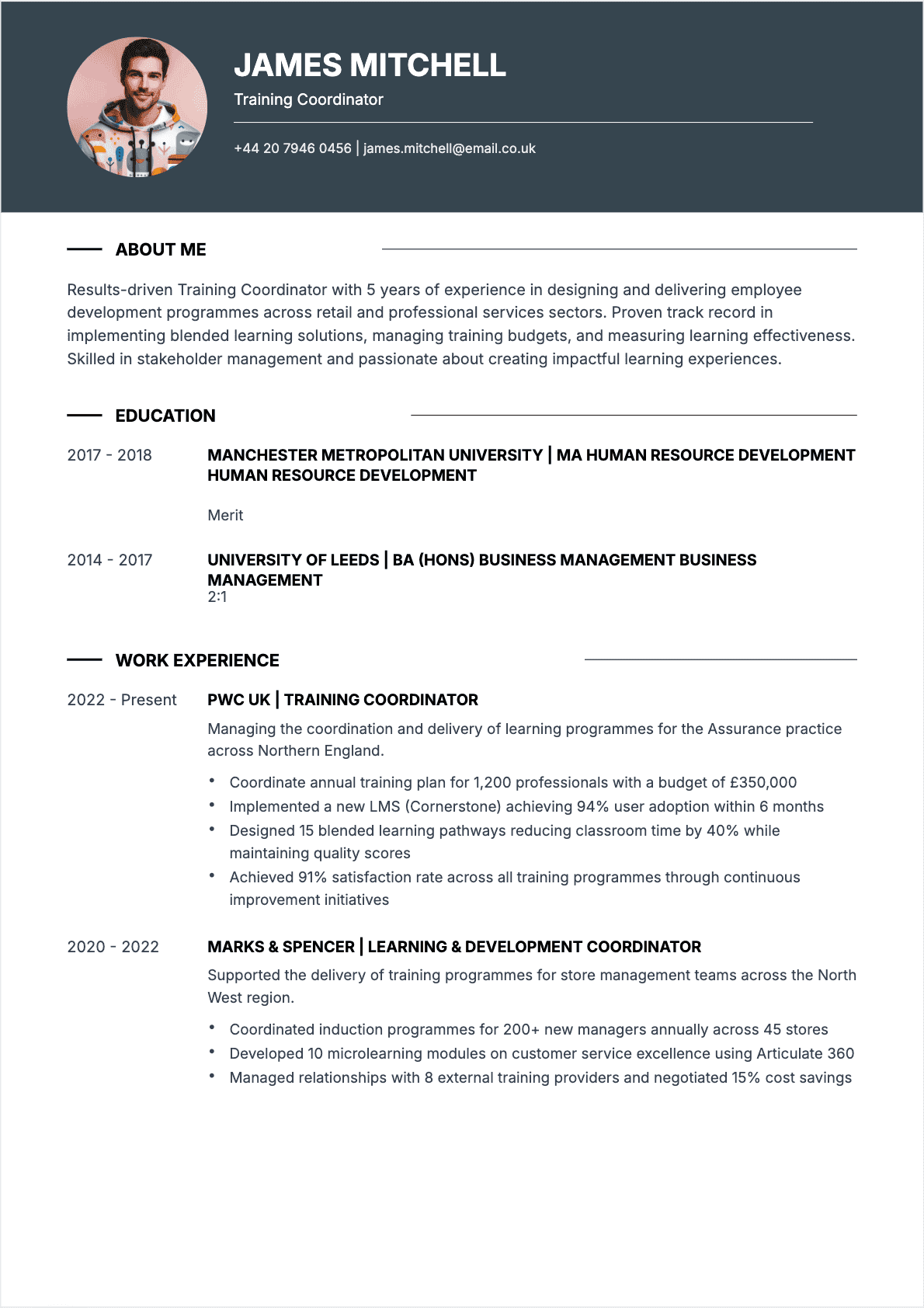
Resume Training Coordinator Confirmé
Training Coordinator resume template for Confirmé profile
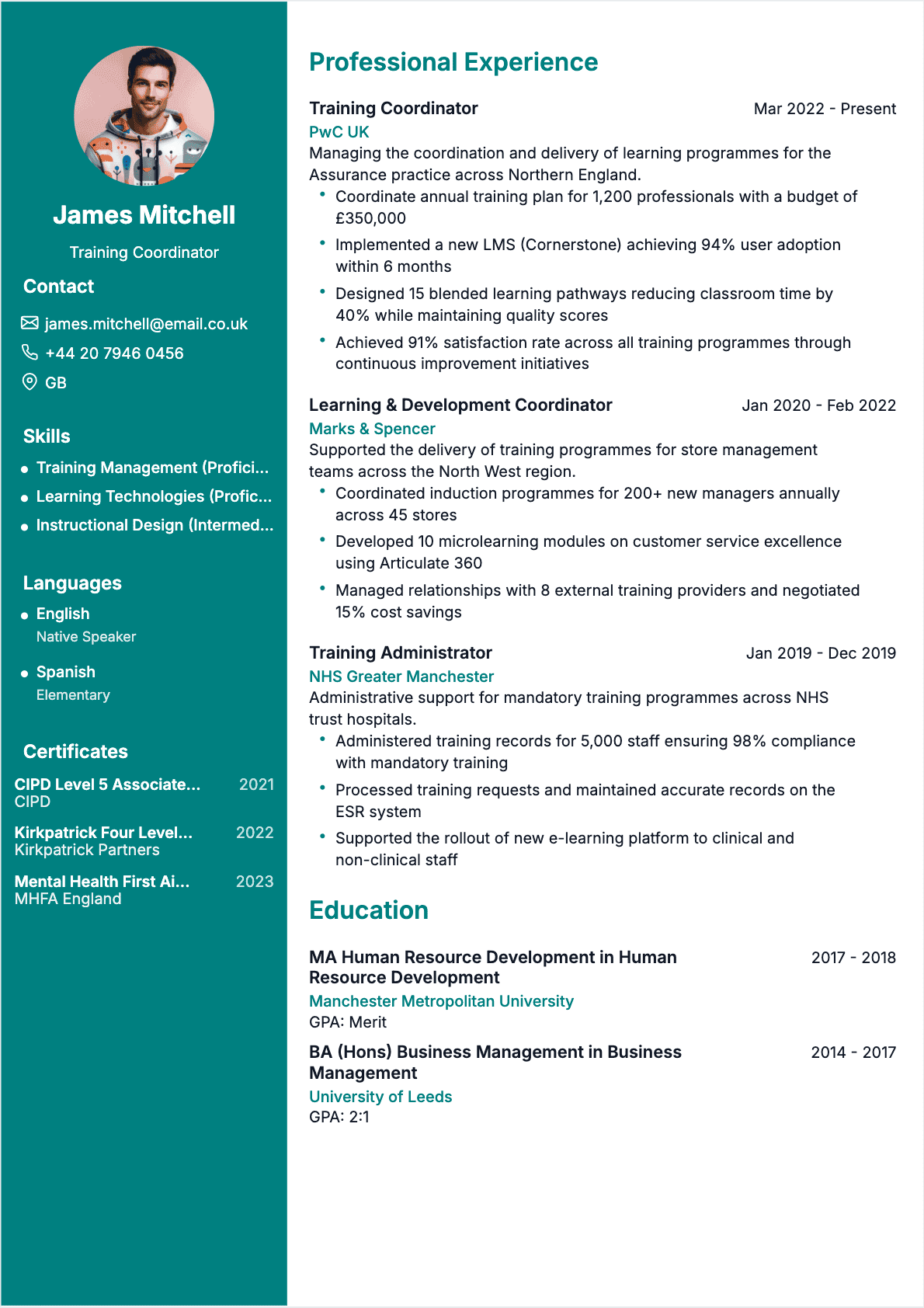
Resume Training Coordinator Confirmé
Training Coordinator resume template for Confirmé profile
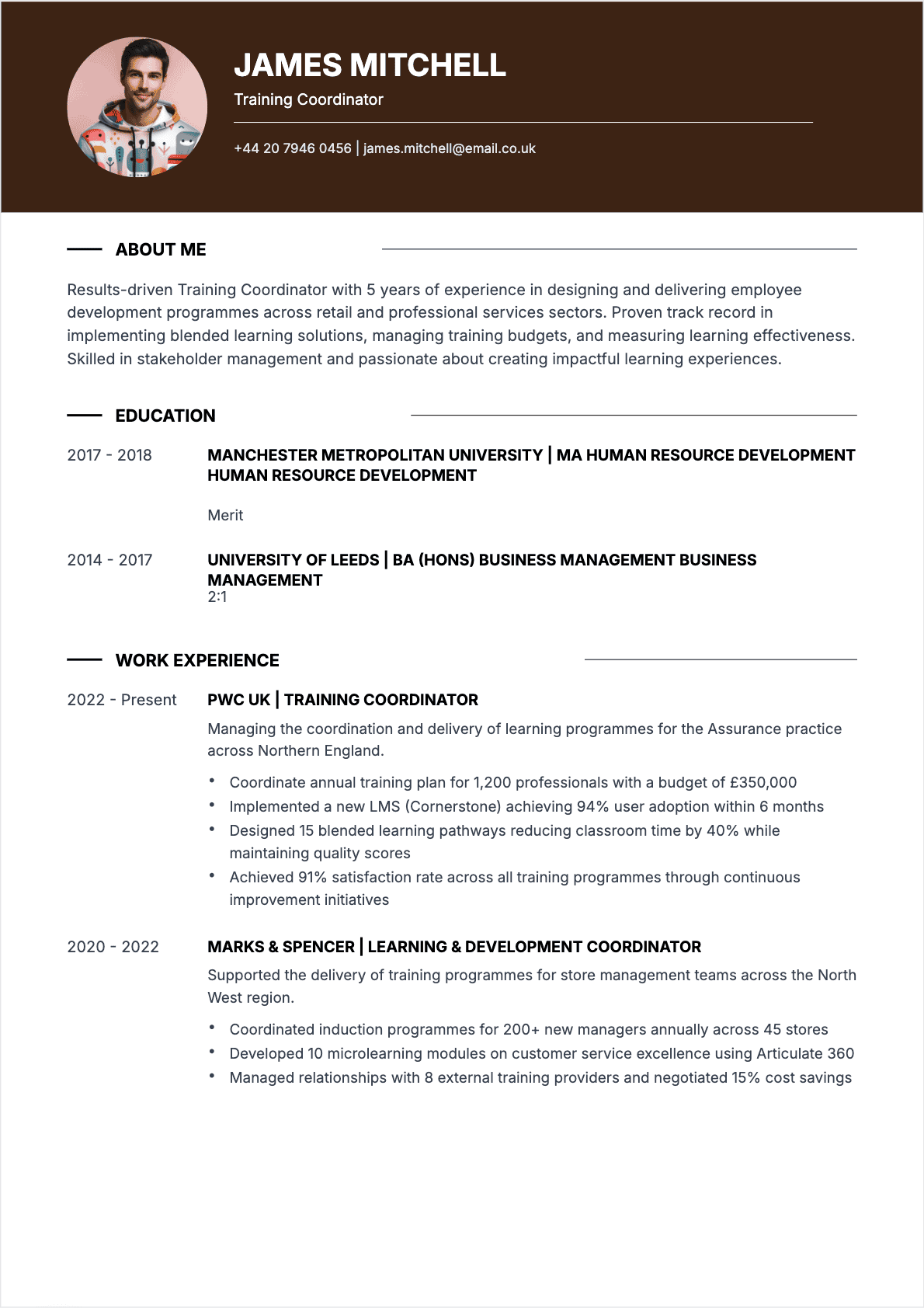
Resume Training Coordinator Confirmé
Training Coordinator resume template for Confirmé profile
Like one of these Training Coordinator resume templates?
Select it, fill in your details and download your resume as PDF.
Training Coordinator Resume Examples
James Mitchell
Training Coordinator
james.mitchell@email.co.uk
+44 20 7946 0456
Manchester, GB
Results-driven Training Coordinator with 5 years of experience in designing and delivering employee development programmes across retail and professional services sectors. Proven track record in implementing blended learning solutions, managing training budgets, and measuring learning effectiveness. Skilled in stakeholder management and passionate about creating impactful learning experiences.
Work Experience
Training Coordinator
PwC UK
- ●Coordinate annual training plan for 1,200 professionals with a budget of £350,000
- ●Implemented a new LMS (Cornerstone) achieving 94% user adoption within 6 months
- ●Designed 15 blended learning pathways reducing classroom time by 40% while maintaining quality scores
Learning & Development Coordinator
Marks & Spencer
- ●Coordinated induction programmes for 200+ new managers annually across 45 stores
- ●Developed 10 microlearning modules on customer service excellence using Articulate 360
- ●Managed relationships with 8 external training providers and negotiated 15% cost savings
Training Administrator
NHS Greater Manchester
- ●Administered training records for 5,000 staff ensuring 98% compliance with mandatory training
- ●Processed training requests and maintained accurate records on the ESR system
- ●Supported the rollout of new e-learning platform to clinical and non-clinical staff
Education
MA Human Resource Development
Manchester Metropolitan University
BA (Hons) Business Management
University of Leeds
Skills
Languages
English — Native Speaker
Spanish — Elementary
Certifications
CIPD Level 5 Associate Diploma in Organisational Learning & DevelopmentCIPD
Kirkpatrick Four Levels Evaluation CertificationKirkpatrick Partners
Mental Health First AiderMHFA England
Training Coordinator role overview
A Training Coordinator serves as the operational backbone of an organization's learning and development function. You'll spend your days scheduling training sessions, coordinating with external vendors and internal subject matter experts, managing learning management systems (LMS), and ensuring that employees have access to the development opportunities they need. This role sits at the intersection of human resources, project management, and logistics, requiring you to juggle multiple training initiatives simultaneously while maintaining meticulous attention to detail.
Your typical workday involves communicating with stakeholders across all organizational levels. You'll field questions from employees about course enrollment, troubleshoot technical issues with e-learning platforms, negotiate contracts with training providers, and track completion rates to ensure compliance requirements are met. You're also responsible for maintaining training records, preparing reports on training metrics for leadership, and often handling the budget for learning and development programs. Many Training Coordinators also support the design and delivery of training materials, though the extent varies by organization size and structure.
Career progression typically follows a clear path. Entry-level Training Coordinators with 0-2 years of experience earn between £22,000-£28,000 annually in the UK. With 3-5 years of experience, mid-level coordinators earn £28,000-£38,000, taking on more strategic responsibilities like vendor management and program evaluation. Senior Training Coordinators with 5+ years earn £38,000-£48,000 and often oversee junior coordinators or specialize in specific training domains. From there, many professionals advance to Training Manager, Learning and Development Manager, or Organizational Development Specialist roles, with salaries ranging from £45,000-£65,000+.
The role offers excellent prospects for those interested in human capital development. You can specialize in areas like technical training, compliance training, leadership development, or instructional design. Some Training Coordinators transition into HR Business Partner roles, while others move into change management or talent management positions. The skills you develop—project management, stakeholder communication, data analysis, and process improvement—are highly transferable across industries.
Typical daily tasks include:
- Scheduling training sessions and coordinating logistics including room bookings, catering, equipment setup, and participant communications
- Managing the learning management system by uploading courses, enrolling participants, troubleshooting access issues, and generating completion reports
- Communicating with training vendors to arrange external courses, negotiate pricing, and ensure quality delivery
- Tracking training budgets and processing invoices for training-related expenses
- Maintaining training records and databases to ensure compliance with regulatory requirements and company policies
- Preparing monthly or quarterly reports on training metrics such as participation rates, completion percentages, and feedback scores for management review
Essential skills for a Training Coordinator resume
Your resume needs to demonstrate both the administrative capabilities and the people skills that make training programs run smoothly. Recruiters scan for specific technical competencies that indicate you can handle the systems and processes involved, while also looking for evidence that you can communicate effectively with diverse audiences and manage competing priorities. The key is showing you understand not just how to coordinate logistics, but why training matters to organizational success.
For ATS optimization, prioritize skills that appear in the job description, particularly LMS platform names (Cornerstone, Workday Learning, SAP SuccessFactors, Moodle), compliance training terminology (GDPR, health and safety, mandatory training), and project management methodologies. Many organizations use ATS filters to identify candidates with specific system experience, so if you've used their exact LMS platform, make sure it appears in your skills section and within your work experience descriptions.
Core skills to feature prominently:
- Learning Management System (LMS) Administration - You need hands-on experience with platforms like Cornerstone, Workday, or Moodle to upload content, manage user accounts, generate reports, and troubleshoot technical issues that learners encounter daily.
- Training Logistics Coordination - This encompasses scheduling, venue management, equipment setup, catering arrangements, and participant communications, demonstrating your ability to orchestrate multiple moving parts without dropping details.
- Vendor Management - You'll negotiate contracts with external training providers, evaluate their quality, manage relationships, and ensure they deliver value for money, which requires both commercial awareness and relationship-building skills.
- Budget Tracking and Financial Administration - Training Coordinators often manage five or six-figure budgets, so you need to track expenditures, process invoices, forecast costs, and identify savings opportunities without compromising quality.
- Data Analysis and Reporting - You'll extract data from multiple systems, create dashboards showing completion rates and evaluation scores, and present insights to leadership in formats they can use for decision-making.
- Compliance Training Management - Understanding regulatory requirements for industries like healthcare, finance, or manufacturing, and ensuring mandatory training is completed and documented properly to avoid organizational risk.
- Stakeholder Communication - You'll communicate with everyone from frontline employees to C-suite executives, adapting your style and messaging to each audience while maintaining professionalism and clarity.
- Microsoft Office Suite (Advanced Excel) - You'll use Excel for budget tracking, data manipulation, and creating reports, Word for training materials and communications, and PowerPoint for presentations to leadership.
- Project Management - Training programs are essentially projects with timelines, resources, stakeholders, and deliverables, so applying project management principles ensures programs launch on time and within scope.
- E-learning Content Coordination - While you may not design courses yourself, you need to understand SCORM packages, video formats, accessibility requirements, and how to coordinate with instructional designers and subject matter experts.
- Calendar and Schedule Management - You'll manage complex training calendars with multiple sessions, instructors, and locations, requiring exceptional organizational skills and attention to conflicting commitments.
- Problem-Solving and Adaptability - When instructors cancel, technology fails, or participants have conflicts, you need to quickly develop alternative solutions that keep training initiatives on track without compromising quality.

How to write a Training Coordinator resume step by step
1. Start with a results-focused professional summary
Write 3-4 lines that immediately communicate your experience level, key strengths, and the value you bring. Include a quantified achievement that demonstrates impact. Instead of 'Experienced Training Coordinator with strong organizational skills,' write 'Training Coordinator with 4+ years managing learning programs for 800+ employees, achieving 96% completion rate for mandatory compliance training and reducing training costs by 18% through strategic vendor consolidation.'
2. Quantify your training program achievements
Recruiters want to see the scope and impact of your work. For every role, include metrics like number of employees served, training sessions coordinated per month, budget managed, completion rates achieved, or cost savings delivered. Transform 'Coordinated training programs' into 'Coordinated 45+ training programs annually serving 600 employees across 8 locations, managing £120,000 training budget and achieving 94% average participant satisfaction score.'
3. Highlight your LMS and technology expertise prominently
Create a dedicated 'Technical Skills' or 'Systems' section near the top of your resume listing specific platforms you've used. Within your experience bullets, describe what you accomplished with these systems. Instead of 'Managed LMS,' write 'Administered Cornerstone OnDemand LMS for 1,200 users, creating 30+ custom reports, reducing course enrollment time by 40% through automated workflows, and maintaining 99.8% system uptime.'
4. Demonstrate your vendor and stakeholder management capabilities
Show that you can build relationships and manage external partners effectively. Rather than 'Worked with training vendors,' write 'Managed relationships with 12 external training providers, negotiating contracts that saved £22,000 annually while improving Net Promoter Scores from 7.2 to 8.6 through rigorous quality evaluations and feedback implementation.'
5. Showcase your compliance and regulatory knowledge
If you've worked in regulated industries, emphasize your understanding of compliance requirements. Change 'Ensured compliance training was completed' to 'Maintained 100% compliance with mandatory health and safety training requirements across 450 employees, implementing automated reminder system that reduced overdue training by 85% and passed three regulatory audits with zero findings.'
6. Include relevant certifications and professional development
List certifications like CIPD qualifications, project management credentials (Prince2, PMP), or training-specific certifications (Certified Professional in Learning and Performance). Also mention relevant courses in instructional design, data analysis, or HR systems that demonstrate your commitment to professional growth.
7. Use action verbs specific to training coordination
Start bullets with verbs that reflect the nature of the work: coordinated, scheduled, administered, facilitated, tracked, analyzed, implemented, negotiated, maintained, streamlined. Avoid overused generic verbs like 'responsible for' or 'helped with' that weaken your impact.
8. Structure your experience to pass ATS screening
Include keywords from the job description naturally throughout your resume. If they mention 'onboarding training,' 'leadership development programs,' or 'virtual training delivery,' use those exact phrases where truthful. Place your most relevant experience and skills in the top half of your resume where both ATS systems and human recruiters focus their attention first.
Before and after examples:
Weak: 'Responsible for organizing training sessions and managing the training calendar.'
Strong: 'Coordinated 35+ training sessions quarterly for 250 employees across technical, compliance, and soft skills programs, maintaining 92% on-time delivery rate and 4.3/5.0 average facilitator rating.'
Weak: 'Used LMS to track employee training completion.'
Strong: 'Administered SAP SuccessFactors LMS for 1,800 users, generating weekly compliance dashboards that enabled managers to improve completion rates from 78% to 94% within six months.'
Weak: 'Helped reduce training costs.'
Strong: 'Reduced annual training expenditure by £35,000 (23%) by consolidating vendors from 8 to 4 providers, renegotiating contracts, and transitioning 40% of classroom training to blended learning formats.'
Common mistakes on Training Coordinator resumes
Listing only administrative tasks without showing business impact
Many Training Coordinators describe their work as purely logistical: 'Scheduled training sessions, booked rooms, sent calendar invites.' While these are part of the role, recruiters want to see how your coordination contributed to organizational goals. Did your efficient scheduling increase training capacity? Did your vendor management reduce costs? Did your follow-up processes improve completion rates? Always connect your activities to outcomes. Show that you understand training as a business function, not just an administrative task.
Failing to quantify the scope of your programs
A resume that says 'Coordinated training programs' tells recruiters almost nothing about your experience level. Were you managing training for 50 people or 5,000? Five sessions per year or fifty? A £10,000 budget or £100,000? Without numbers, recruiters can't assess if your experience matches their needs. Every bullet point should include at least one metric: number of participants, sessions coordinated, budget managed, completion rates, satisfaction scores, or time savings achieved.
Using generic LMS experience instead of naming specific platforms
Writing 'Proficient in learning management systems' is too vague. Organizations invest heavily in specific platforms and want coordinators who can hit the ground running. If you've used Cornerstone, Workday Learning, SAP SuccessFactors, Moodle, TalentLMS, or any other system, name it explicitly. If you've used multiple platforms, even better—it shows adaptability. Describe specific functions you performed: report creation, user administration, course uploading, integration management, or troubleshooting. This specificity helps you pass ATS filters and demonstrates genuine expertise.
Neglecting to mention compliance and regulatory training
Compliance training is a critical responsibility for most Training Coordinators, yet many resumes barely mention it. If you've managed mandatory training for health and safety, data protection (GDPR), anti-harassment, financial regulations, or industry-specific requirements, feature this prominently. Include your track record on compliance rates, audit results, and how you maintained documentation. Recruiters in regulated industries specifically search for this experience, and omitting it can eliminate you from consideration even if you have the experience.
Focusing on training delivery instead of coordination
Some candidates confuse Training Coordinator responsibilities with Trainer or Learning and Development Specialist roles. If you occasionally facilitated sessions, mention it briefly, but don't make it your focus unless the job specifically requires delivery. Coordinators are valued for their organizational skills, system administration, vendor management, and program logistics. Overemphasizing facilitation can make recruiters question whether you understand the coordinator function or if you're actually seeking a trainer position.
Omitting budget and financial management experience
Training budgets are substantial, and organizations need coordinators who can manage them responsibly. If you've tracked expenses, processed invoices, forecasted costs, or identified savings opportunities, include specific numbers. 'Managed training budget' is weak; 'Managed £85,000 annual training budget, tracking expenditures across 15 cost centers, processing 200+ invoices, and delivering year-end savings of £12,000 through strategic vendor negotiations' demonstrates financial acumen that sets you apart.
Writing a generic resume instead of tailoring to the industry
Training coordination in healthcare looks different from training in financial services or manufacturing. Healthcare emphasizes clinical competencies and regulatory compliance; finance focuses on product knowledge and certification tracking; manufacturing prioritizes safety and technical skills. Review the job description carefully and adjust your examples to match the industry context. If you're applying to a healthcare organization, emphasize your experience with clinical training, mandatory certifications, and healthcare-specific LMS features rather than generic examples that could apply anywhere.
Training Coordinator resume trends in 2026
The Training Coordinator role is evolving rapidly as organizations embrace hybrid work models and artificial intelligence tools. Employers increasingly expect coordinators to manage both in-person and virtual training programs seamlessly, which means your resume should demonstrate experience with virtual classroom platforms (Zoom, Microsoft Teams, Webex), webinar coordination, and hybrid event management. If you've coordinated training across multiple time zones, managed virtual breakout sessions, or troubleshot technology issues for remote participants, these experiences are now essential rather than nice-to-have.
AI-powered learning platforms are transforming how training is delivered and tracked. Modern LMS platforms now include AI features for personalized learning paths, automated content recommendations, and predictive analytics about completion risks. Forward-thinking Training Coordinators are learning to work with these tools rather than being replaced by them. Highlight any experience you have with learning analytics, data-driven decision making, or implementing AI-enhanced learning features. Employers want coordinators who can interpret AI-generated insights and use them to improve program effectiveness, not just administrators who process enrollments.
Skills-based hiring is reshaping training priorities across industries. Organizations are moving away from traditional role-based training toward skills-based development aligned with business capabilities. This means Training Coordinators need to understand skills taxonomies, competency frameworks, and how to map training programs to specific skill development. If you've worked with skills assessment tools, created skills matrices, or coordinated training aligned with competency models, emphasize this experience. Recruiters are specifically searching for coordinators who understand the skills agenda and can support skills-based talent strategies.
Microlearning and just-in-time training delivery are becoming standard expectations. The days of coordinating only full-day workshops are fading as organizations recognize that shorter, more frequent learning interventions often deliver better results. Your resume should reflect experience with diverse learning formats: 15-minute modules, mobile learning, video-based training, podcasts, and digital resources. If you've coordinated a shift from traditional classroom training to blended or microlearning approaches, quantify the results: improved completion rates, higher engagement scores, or better knowledge retention.
Diversity, equity, and inclusion (DEI) considerations now influence training coordination. Employers expect coordinators to ensure training programs are accessible to all employees, including those with disabilities, non-native speakers, and workers across different locations and time zones. Experience with accessibility standards (WCAG compliance), closed captioning, translation coordination, or inclusive scheduling practices strengthens your candidacy. If you've implemented changes that improved training accessibility or participation from underrepresented groups, include these achievements with supporting metrics.
The demand for Training Coordinators with data analysis capabilities has surged. Organizations want coordinators who can move beyond basic completion reports to provide insights about training effectiveness, ROI, and business impact. If you've used tools like Power BI, Tableau, or advanced Excel to create dashboards, identify trends, or correlate training data with business outcomes, feature these skills prominently. The ability to tell a story with training data—showing how programs contributed to reduced turnover, improved performance, or faster onboarding—differentiates you from coordinators who only track attendance.
Remote and hybrid work has made training coordination more complex but also more flexible. Many Training Coordinator positions now offer hybrid or fully remote options, particularly in organizations with distributed workforces. Your resume should demonstrate that you can coordinate training effectively without being physically present: managing virtual logistics, building relationships remotely, and using collaboration tools to stay connected with stakeholders. If you've successfully coordinated training programs while working remotely, mention this explicitly, as it addresses a key concern for employers offering flexible work arrangements.
Further reading:
Frequently asked questions
Find answers to the most frequently asked questions.
In English-speaking markets (especially the US), a photo is typically not recommended due to bias and compliance considerations. Focus on clear formatting, keywords, and quantified outcomes. If you apply in regions where photos are common, follow local norms and keep it professional, but never let a photo replace strong metrics.
Aim for 1 page if you have under 5 years of experience and your scope is straightforward. Use 2 pages if you coordinate multi-site programs, manage vendors/budgets, or have 7+ years with measurable results. Prioritize recent, relevant achievements and keep older roles to 2–3 bullets.
The most scanned keywords are LMS administration, training coordination, compliance training, ILT/VILT, training calendar management, reporting, and evaluations. Add the exact LMS name (Cornerstone, Workday Learning, SAP SuccessFactors) plus metrics terms like completion rate, attendance, and audit readiness to match postings.
Operational roles still generate measurable outcomes. Track and report improvements such as fewer no-shows, faster scheduling lead times, higher completion rates, better CSAT, and fewer data errors. You can also quantify volume (sessions, learners, sites) and efficiency (hours saved through templates or automation).
List the LMS, Excel level, collaboration tools, and any survey/reporting stack you used. Typical tools include Cornerstone/Workday Learning/SuccessFactors, Excel (pivot tables), Teams/Zoom, SharePoint, and survey tools like Qualtrics or Microsoft Forms. Only list tools you can use independently.
For L&D roles, emphasize learner experience, evaluations, session design support, and stakeholder partnership with managers. For compliance roles, prioritize audit readiness, due-date tracking, transcript accuracy, and escalation processes. In both cases, quantify outcomes (completion, attendance, cycle time, savings) and name the LMS workflows you owned.
Your career deserves a better resume
With CVtoWork, select a template, fill in the fields and download your resume as PDF.
Start creating