Traffic Manager Resume
Example, Template & Expert Tips 2026
Updated on April 18, 2026.
Build a Traffic Manager CV that passes ATS: strong summary, relevant keywords, and quantified campaign results to win paid media and growth.
Traffic Manager Resume Templates
8 Templates available
Resume Traffic Manager Junior
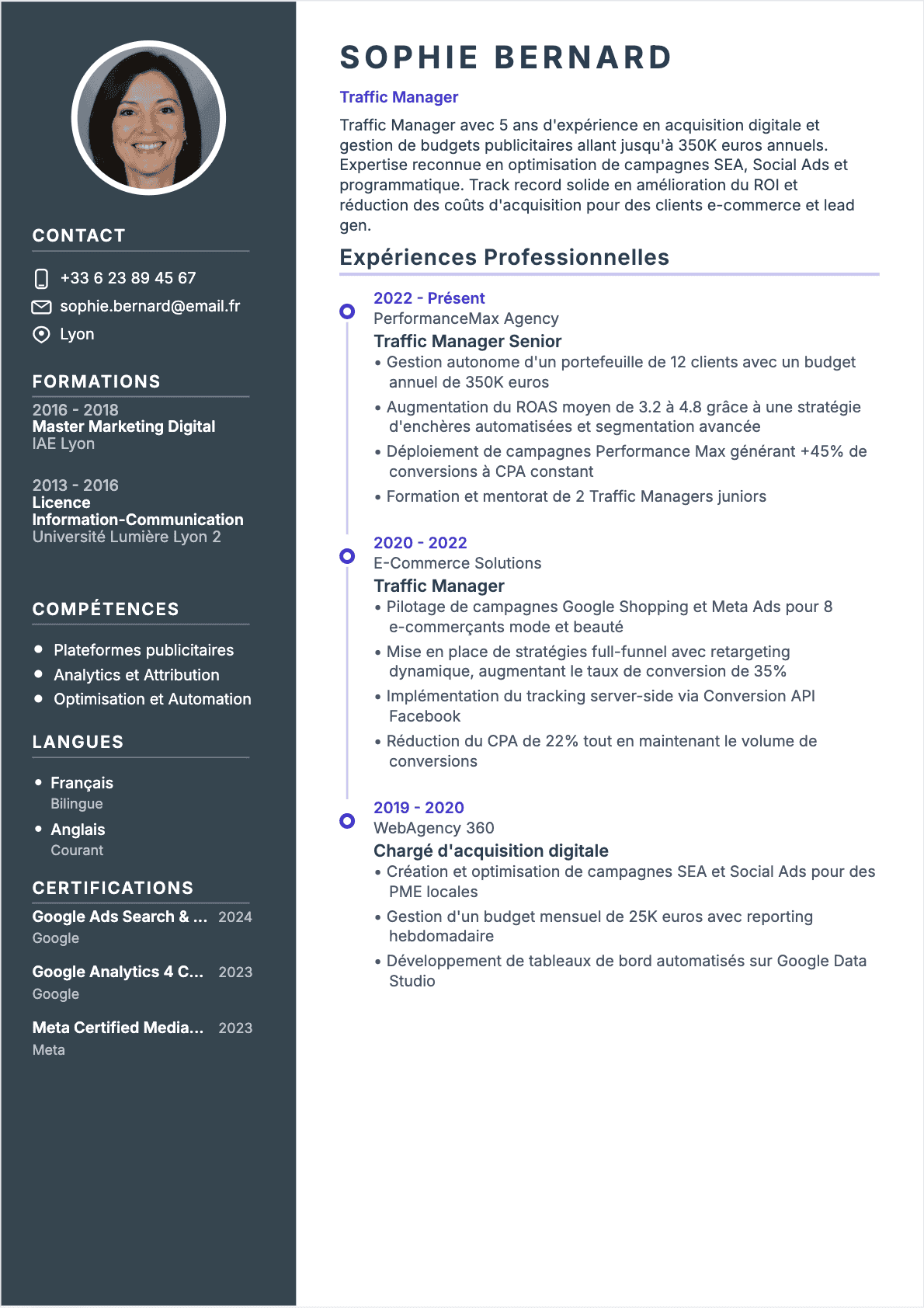
Traffic Manager resume template for Junior profile
Resume Traffic Manager Senior
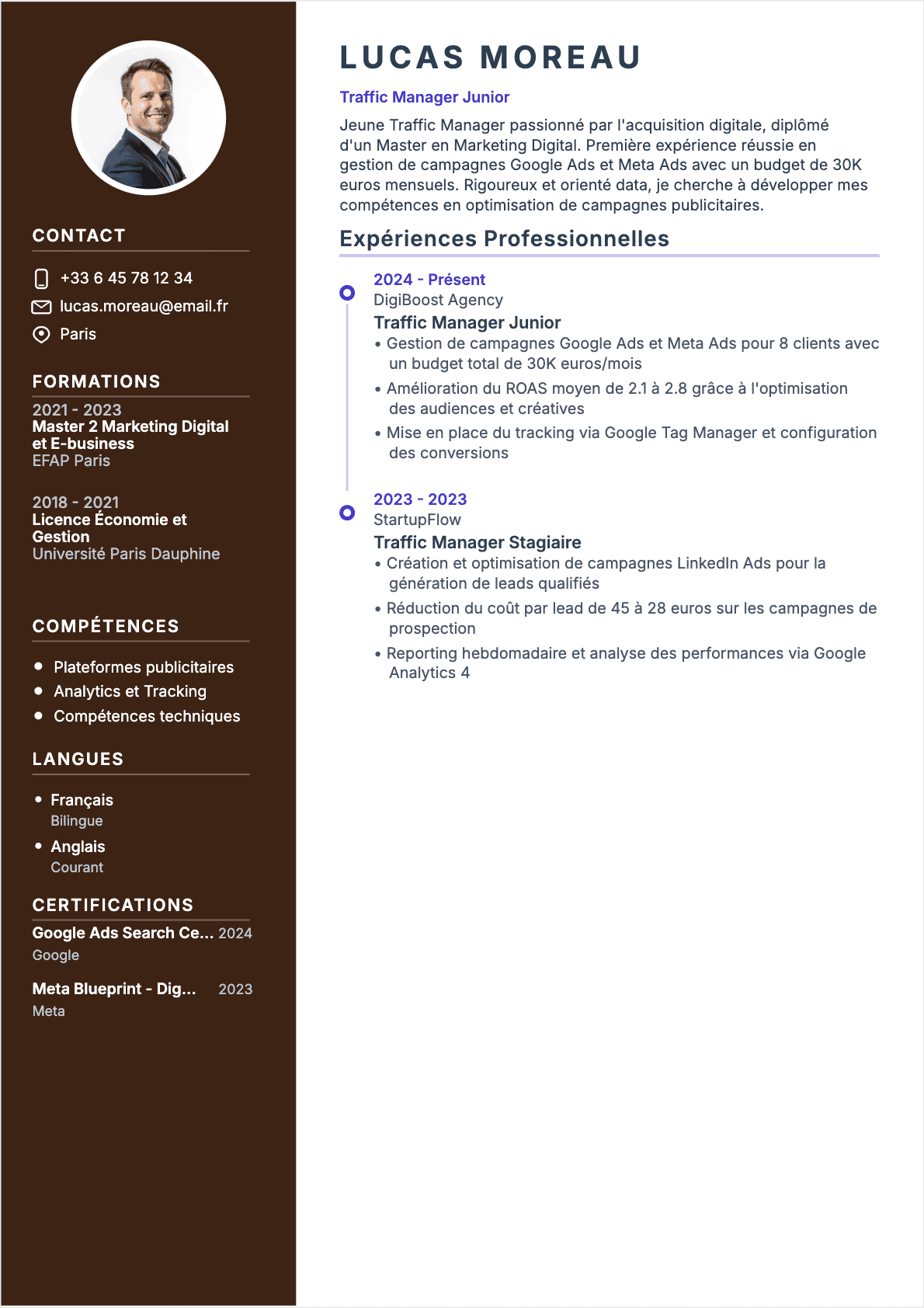
Traffic Manager resume template for Senior profile
Resume Traffic Manager Confirmé
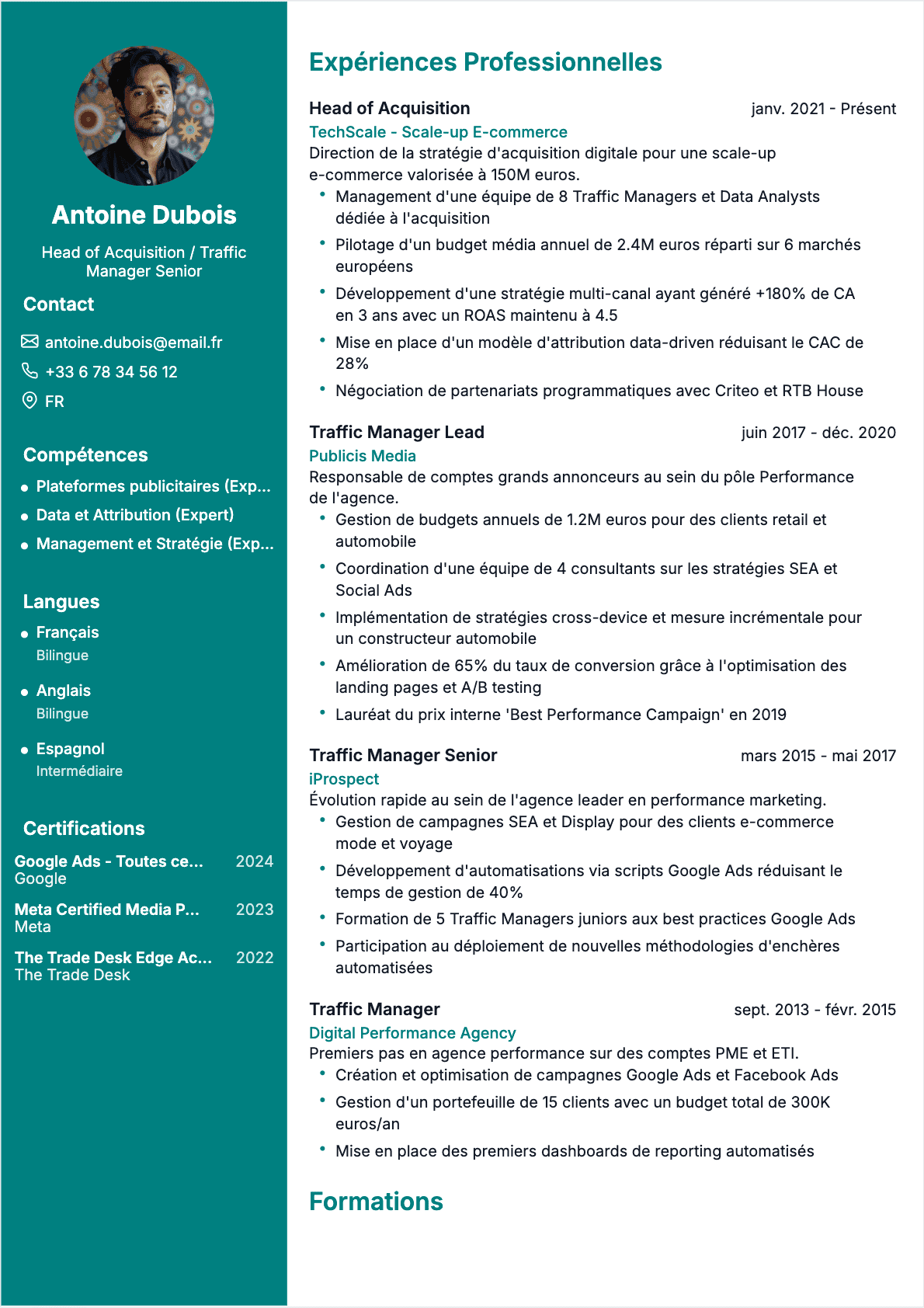
Traffic Manager resume template for Confirmé profile
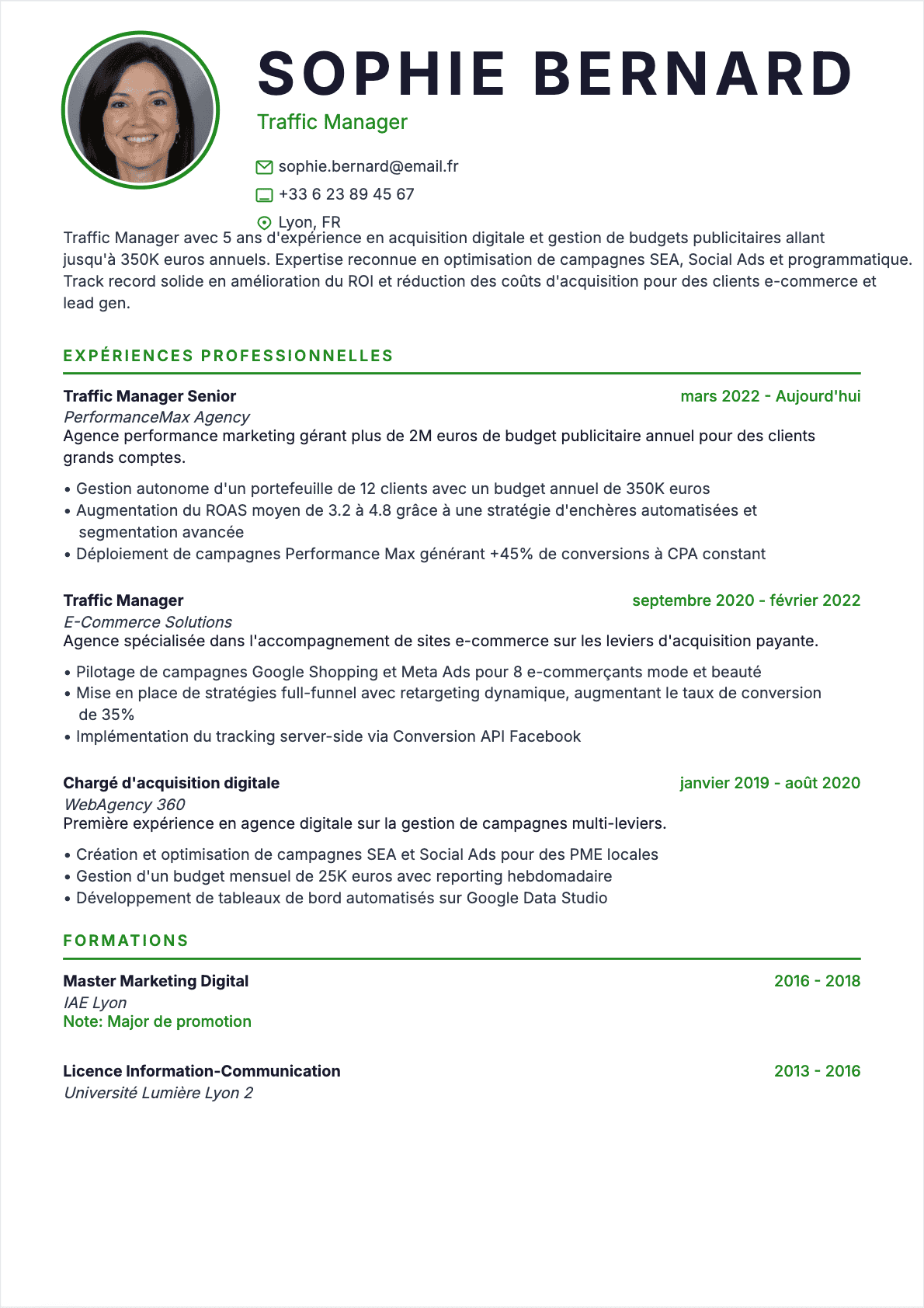
Resume Traffic Manager Confirmé
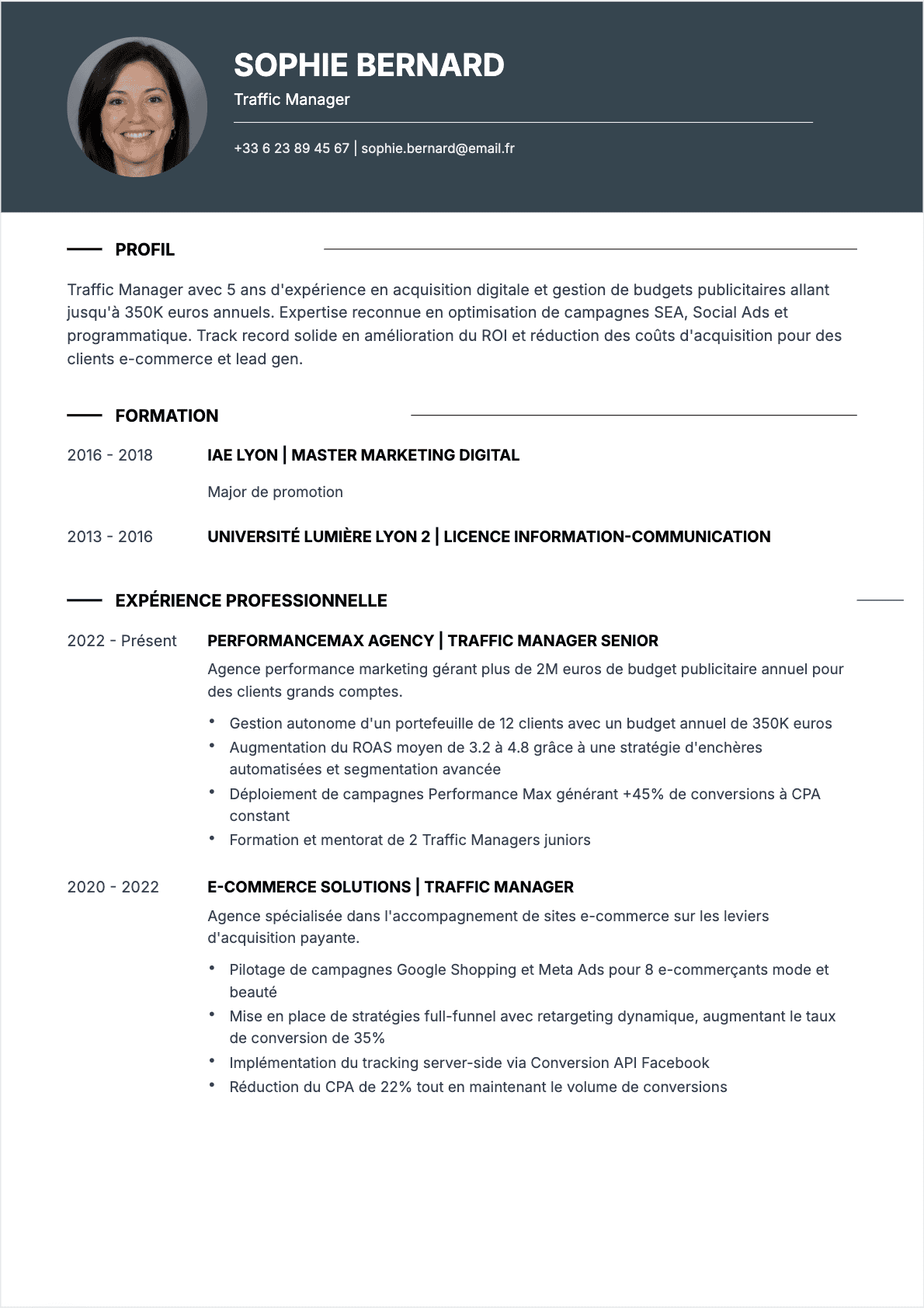
PopularTraffic Manager resume template for Confirmé profile
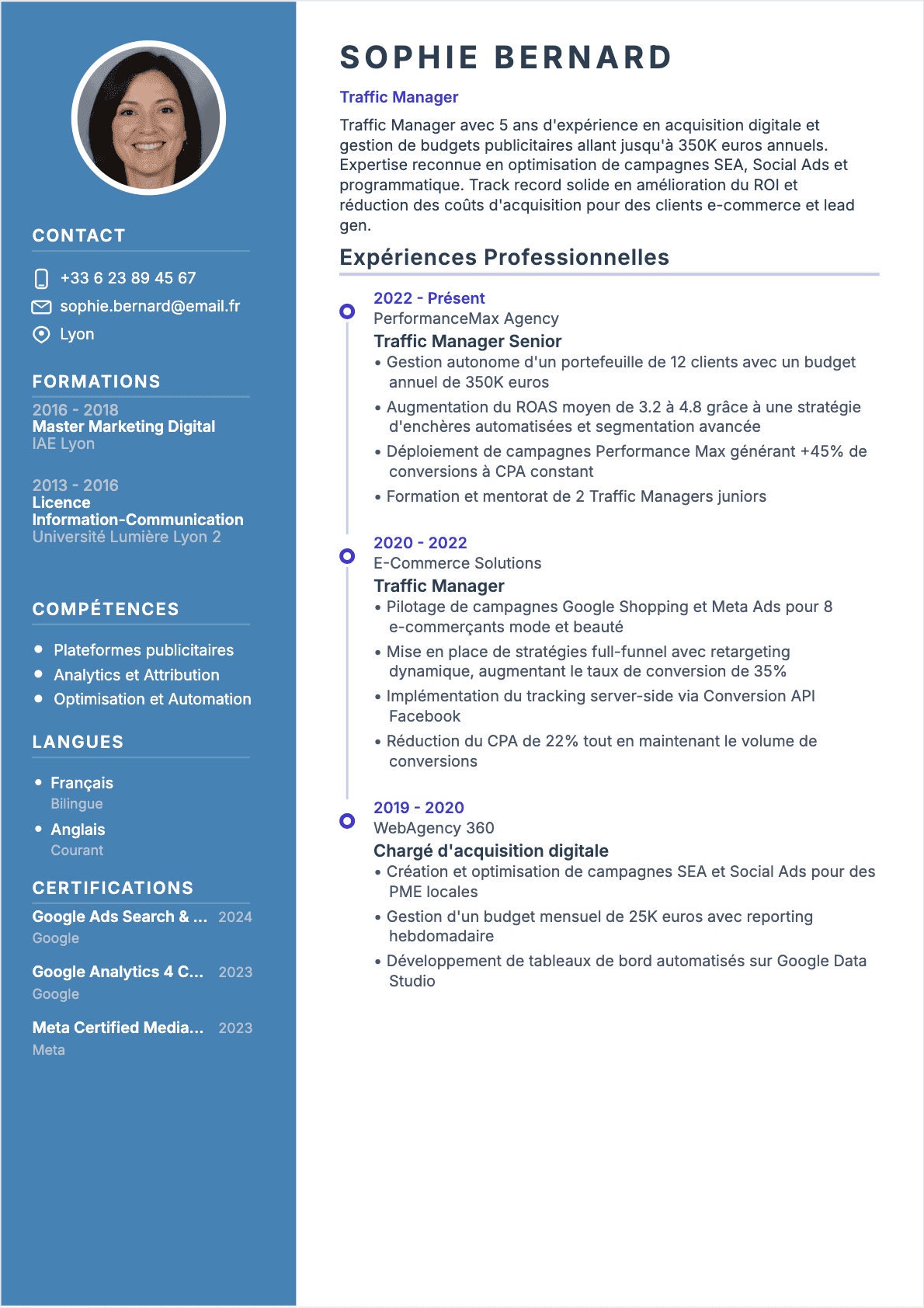
Resume Traffic Manager Confirmé
Traffic Manager resume template for Confirmé profile
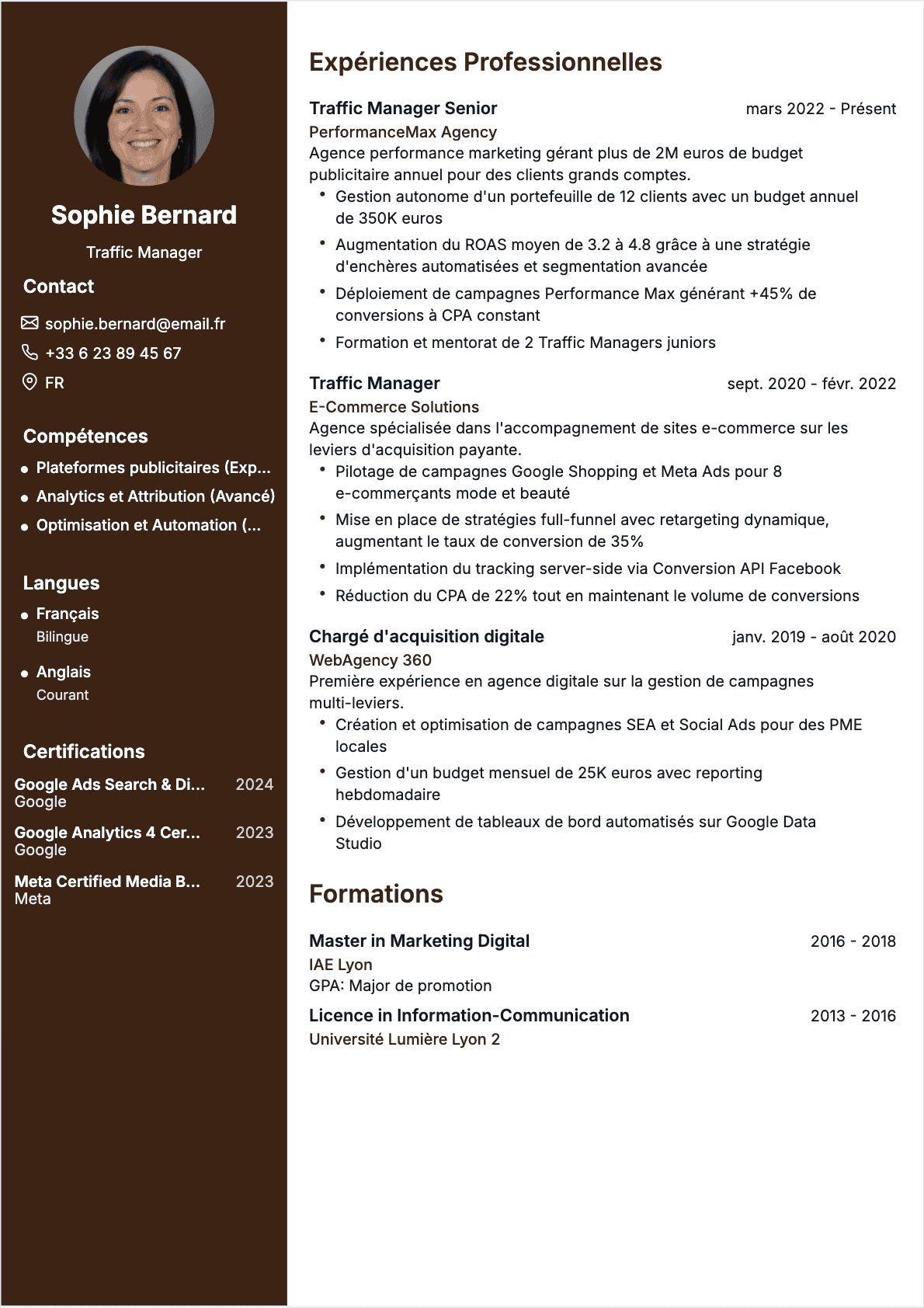
Resume Traffic Manager Confirmé
Traffic Manager resume template for Confirmé profile
Like one of these Traffic Manager resume templates?
Select it, fill in your details and download your resume as PDF.
Traffic Manager Resume Examples
Emma Richardson
Traffic Manager
emma.richardson@email.co.uk
+44 20 8123 4567
Manchester, GB
Results-driven Traffic Manager with 5 years of experience in digital acquisition and performance marketing. Proven track record of managing annual advertising budgets up to GBP 400,000 across Google, Meta, and programmatic channels. Expert in campaign optimisation, attribution modelling, and delivering measurable ROI improvements for e-commerce and lead generation clients.
Work Experience
Senior Traffic Manager
Conversion Labs
- ●Managing a portfolio of 10 e-commerce clients with combined annual spend of GBP 400,000
- ●Increased average ROAS from 3.4 to 5.2 through implementation of automated bidding strategies and audience segmentation
- ●Led migration to GA4 and server-side tracking, improving conversion data accuracy by 25%
Traffic Manager
Digital Spark Agency
- ●Managed Google Ads, Meta Ads, and Microsoft Ads campaigns for 15 clients
- ●Developed full-funnel advertising strategies combining prospecting and remarketing
- ●Reduced average CPA by 35% through landing page optimisation and A/B testing
Paid Media Executive
GrowthPath Marketing
- ●Built and optimised PPC campaigns for B2B and B2C clients
- ●Managed monthly budgets of GBP 20,000 across search and social channels
- ●Created comprehensive monthly performance reports for client presentations
Education
MSc
University of Birmingham
BA (Hons)
University of Nottingham
Skills
Languages
English — Native Speaker
Spanish — Intermediate
Certifications
Google Ads Search & Display CertificationGoogle
Google Analytics 4 CertificationGoogle
Meta Certified Media Buying ProfessionalMeta
Traffic Manager role overview
A Traffic Manager sits at the operational heart of digital advertising and marketing campaigns, coordinating the flow of creative assets, managing campaign timelines, and ensuring that every advertisement reaches the right audience at precisely the right moment. You'll work closely with account managers, creative teams, media buyers, and clients to transform campaign briefs into live, trackable digital experiences across platforms like Google Ads, Meta, programmatic networks, and emerging channels.
Your day revolves around campaign setup, quality assurance, and performance monitoring. You'll configure tracking pixels, implement UTM parameters, troubleshoot delivery issues, and maintain the technical infrastructure that allows marketing teams to measure ROI. This role demands both technical precision and communication skills—you're translating between creative teams who think in brand narratives and data analysts who speak in conversion rates and CPAs.
Career progression typically follows a clear path: Junior Traffic Manager (1-2 years) focusing on campaign execution and basic reporting, Mid-level Traffic Manager (3-5 years) managing larger budgets and mentoring juniors, Senior Traffic Manager (5-8 years) overseeing multiple campaigns and strategic planning, then advancing to Head of Trafficking, Programmatic Director, or Digital Operations Manager roles. Many Traffic Managers transition into media buying, marketing operations, or ad tech product management.
Salary expectations in the UK range from £25,000-£32,000 for junior positions, £35,000-£48,000 for mid-level roles, and £50,000-£70,000 for senior Traffic Managers. In the US, expect $45,000-$55,000 (junior), $60,000-$80,000 (mid-level), and $85,000-$110,000 (senior). Agency roles often pay slightly less than in-house positions but offer broader experience across industries.
Typical daily tasks include:
- Setting up campaigns in ad platforms (Google Ads, Meta Ads Manager, DV360, Trade Desk) with correct targeting parameters, budgets, and creative specifications
- Implementing and testing tracking codes, conversion pixels, and analytics tags to ensure accurate attribution and reporting
- Conducting pre-launch quality assurance checks on landing pages, ad creative, and tracking infrastructure
- Monitoring campaign pacing and delivery, adjusting bids or budgets to meet daily spend targets and performance KPIs
- Coordinating with creative teams to resize assets, update copy, or produce new variations for A/B testing
- Generating performance reports and communicating delivery issues, optimization opportunities, or technical problems to stakeholders
Essential skills for a Traffic Manager resume
Traffic Manager roles demand a specific blend of technical platform expertise and project coordination abilities. Recruiters scan for hands-on experience with ad platforms and trafficking tools, not just familiarity. Your CV needs to demonstrate that you've actually built campaigns, solved technical problems, and delivered measurable results under deadline pressure.
The most critical skills combine platform proficiency with analytical thinking. You need to understand how tracking works at a technical level—not just clicking buttons in an interface, but comprehending how cookies, pixels, and attribution models function. Equally important are organizational skills that prevent costly errors when managing dozens of simultaneous campaigns with different flight dates, budgets, and reporting requirements.
Core skills to highlight on your CV:
- Google Ads campaign management - Recruiters expect expertise in Search, Display, Video, and Shopping campaigns with proof you've managed substantial budgets (specify monthly spend amounts).
- Meta Ads Manager proficiency - Demonstrate knowledge of campaign structure, Advantage+ campaigns, pixel implementation, and Conversions API setup for iOS14+ tracking challenges.
- Programmatic platform experience - Familiarity with DSPs like DV360, Trade Desk, or Amazon DSP shows you can handle complex, data-driven media buying beyond social and search.
- Tag management systems - Google Tag Manager expertise is nearly mandatory; you should explain how you've implemented custom events, triggers, and data layers for accurate tracking.
- Analytics and attribution - Beyond basic Google Analytics, show you understand multi-touch attribution, view-through conversions, and how to diagnose tracking discrepancies between platforms.
- Ad serving platforms - Experience with Campaign Manager 360, Flashtalking, or Sizmek demonstrates enterprise-level campaign management capabilities.
- Excel and data manipulation - Highlight advanced functions (VLOOKUP, pivot tables, macros) used for budget pacing, bulk uploads, or performance analysis across multiple campaigns.
- Project management tools - Mention Asana, Monday.com, or Jira experience to show you can coordinate complex workflows with multiple stakeholders and dependencies.
- HTML/CSS basics - Even minimal coding knowledge helps you troubleshoot landing pages, customize tracking implementations, or communicate effectively with developers.
- Communication and stakeholder management - Emphasize your ability to translate technical issues into business language and manage expectations when campaigns underdeliver.
- Quality assurance methodology - Describe your systematic approach to pre-launch testing, including checklist creation and cross-browser/device verification processes.
- Budget management and pacing - Show you can forecast spend, identify pacing issues early, and make real-time adjustments to hit budget targets without overspending.
For ATS optimization, prioritize platform names (Google Ads, Meta Ads Manager, DV360, Google Analytics 4, Google Tag Manager) and specific technical terms (conversion tracking, UTM parameters, pixel implementation, programmatic advertising, campaign trafficking). These exact phrases appear in most Traffic Manager job descriptions and will boost your CV's ranking in applicant tracking systems.

How to write a Traffic Manager resume step by step
1. Lead with a results-focused professional summary
Your opening 3-4 lines should immediately establish your trafficking expertise and quantified impact. Instead of 'Experienced Traffic Manager with strong digital marketing skills,' write 'Traffic Manager with 4 years managing £2.3M annual ad spend across Google, Meta, and programmatic platforms, reducing campaign setup time by 35% through process automation and maintaining 99.2% tracking accuracy across 200+ monthly campaigns.' Include your years of experience, total budget managed, primary platforms, and one impressive metric.
2. Structure your work experience with campaign-focused bullet points
Each role should include 5-7 bullets that follow this formula: action verb + specific task + platform/tool + quantified result. Instead of 'Managed digital advertising campaigns,' write 'Trafficked 180+ campaigns monthly across Google Ads (Search, Display, YouTube) and Meta platforms, managing £450K monthly spend with 97% on-time launch rate.' Always include numbers: campaign volume, budget size, team size, or performance improvements you drove.
3. Quantify your technical implementations
Traffic Managers live in the details, so your CV should reflect technical precision. Instead of 'Implemented tracking solutions,' write 'Deployed Google Tag Manager tracking infrastructure across 12 client websites, implementing 45+ custom event tags and reducing tracking discrepancies from 18% to 3% through systematic QA protocols.' Specify the tools, scale of implementation, and measurable outcomes.
4. Highlight process improvements and efficiency gains
Recruiters value Traffic Managers who optimize workflows, not just execute tasks. Include bullets like 'Created standardized campaign setup templates in Google Sheets, reducing average trafficking time from 45 to 28 minutes per campaign and eliminating 89% of launch-day errors.' Show how you've made operations smoother, faster, or more accurate through your initiatives.
5. Create a technical skills section with proficiency indicators
List platforms and tools in order of relevance to the job description. Group them logically: 'Ad Platforms: Google Ads (Expert), Meta Ads Manager (Expert), DV360 (Advanced), LinkedIn Campaign Manager (Intermediate) | Analytics: Google Analytics 4 (Advanced), Google Tag Manager (Expert), Looker Studio (Advanced) | Tools: Excel (Advanced - pivot tables, macros), Asana (Intermediate), Salesforce (Basic).' This format passes ATS while giving human reviewers clear proficiency context.
6. Include a certifications section with dates
Traffic Manager roles heavily weight platform certifications. List 'Google Ads Search Certification (2024), Google Analytics 4 Certification (2024), Meta Certified Digital Marketing Associate (2023)' with renewal dates to show current knowledge. If you have 4+ certifications, this deserves its own section rather than burying them in skills.
7. Add a projects or achievements section for standout wins
If you've managed particularly complex campaigns or solved significant technical problems, create a brief 'Key Projects' section: 'Led trafficking for £800K product launch campaign across 8 platforms, coordinating 15 stakeholders and implementing custom attribution model that revealed 32% of conversions were previously untracked, resulting in 24% budget reallocation to higher-performing channels.' This gives you space to tell a complete story that doesn't fit in standard bullet points.
8. Tailor platform mentions to each job description
If a job emphasizes programmatic experience, ensure DV360 or Trade Desk appears in your summary and multiple work bullets. If it's focused on paid social, prioritize Meta and TikTok Ads Manager mentions. Mirror the exact platform names from the job posting—write 'Google Ads' if they say 'Google Ads,' not 'AdWords' or 'Google advertising.' This directly improves ATS matching.
Before/after examples:
Weak: 'Responsible for managing digital advertising campaigns and ensuring they ran properly.'
Strong: 'Trafficked 200+ monthly campaigns across Google Ads, Meta, and LinkedIn, managing £380K monthly spend with 98.5% on-time launch rate and zero billing discrepancies over 18 months.'
Weak: 'Worked with tracking and analytics tools to monitor campaign performance.'
Strong: 'Implemented Google Tag Manager tracking across 8 client domains, configuring 60+ custom events and reducing tracking discrepancies from 15% to 2.8% through systematic pre-launch QA protocols.'
Weak: 'Helped improve campaign processes and efficiency.'
Strong: 'Developed automated budget pacing spreadsheet using Excel macros, reducing daily monitoring time by 3 hours while improving budget delivery accuracy from 87% to 96% across 45 active campaigns.'
Common mistakes on Traffic Manager resumes
Listing platform names without demonstrating actual expertise
Many candidates write 'Proficient in Google Ads, Meta Ads Manager, DV360' without proving they've done more than basic campaign setup. Recruiters immediately spot this vagueness. Instead, specify what you've actually done: 'Built and optimized 300+ Google Ads campaigns across Search, Display, and Performance Max, managing £1.2M annual spend with average ROAS of 4.2:1.' If you've only dabbled in a platform, either omit it or mark it clearly as 'Basic' proficiency rather than claiming expertise you can't demonstrate in an interview.
Focusing on creative or strategy instead of operational execution
Traffic Managers sometimes try to position themselves as strategists or creative contributors, which dilutes their core value proposition. A bullet like 'Developed creative concepts for social media campaigns' doesn't belong on a Traffic Manager CV—that's the creative team's role. Your value is in flawless execution: 'Coordinated creative asset delivery from 6 designers across 40 simultaneous campaigns, implementing version control system that reduced asset revision errors by 73%.' Stay in your lane and emphasize operational excellence.
Omitting the technical details that prove trafficking competence
Generic statements like 'Implemented tracking solutions' tell recruiters nothing about your actual technical ability. They need specifics: Did you implement pixels? Configure GTM containers? Set up server-side tracking? Write 'Deployed Facebook Conversions API via Google Tag Manager server-side container to recover 28% of iOS14+ conversion data previously lost to ATT restrictions, working with development team to configure custom event parameters.' The technical specificity proves you understand how tracking actually works, not just that you clicked 'Install Pixel.'
Using campaign performance metrics you didn't directly influence
Traffic Managers sometimes claim credit for ROAS, conversion rate improvements, or revenue growth that resulted from strategy or creative changes they didn't control. This backfires in interviews when you can't explain how you achieved those results. Instead, focus on metrics you directly impact: campaign setup accuracy, launch timeliness, tracking precision, budget pacing, process efficiency, or error reduction. 'Maintained 99.4% tracking accuracy across 2,400 annual campaigns through systematic QA protocols' is more credible than 'Improved campaign ROAS by 45%' when you only handled trafficking.
Failing to show scale and complexity
A bullet saying 'Managed campaigns in Google Ads' could mean anything from one small account to enterprise-level operations. Always quantify scale: 'Trafficked campaigns across 18 client accounts ranging from £5K to £200K monthly spend, managing 120+ active campaigns simultaneously with zero missed launch deadlines over 14 months.' Recruiters need to understand whether you've handled complexity comparable to their needs.
Neglecting to mention cross-functional coordination
Traffic management is fundamentally a coordination role, but many CVs read like you worked in isolation. Highlight stakeholder management: 'Coordinated campaign launches across account management, creative, analytics, and client teams, managing 8-12 stakeholders per campaign and maintaining 96% on-time delivery rate despite average 72-hour turnaround requirements.' This shows you can handle the communication complexity that makes or breaks Traffic Managers.
Including outdated platforms or certifications
Listing 'Google AdWords Certified (2016)' or experience with defunct platforms like DoubleClick Bid Manager (now DV360) signals you haven't kept current. Either update certifications to current versions or remove dates if they're older than 2-3 years. Similarly, remove platforms that no longer exist or have been rebranded—use current naming conventions (Google Ads, not AdWords; Campaign Manager 360, not DoubleClick Campaign Manager) to show you're actively working in the field.
Traffic Manager resume trends in 2026
The Traffic Manager role is evolving rapidly as automation handles routine campaign setup while human expertise becomes critical for complex technical implementations. Google's AI-powered campaign types (Performance Max, Demand Gen) and Meta's Advantage+ campaigns reduce manual trafficking tasks but increase demand for Traffic Managers who understand how to properly structure accounts, implement advanced tracking, and troubleshoot when automated systems fail. Your CV needs to demonstrate comfort with AI-assisted tools while emphasizing the technical depth and problem-solving abilities that machines can't replicate.
Privacy-centric tracking has become the defining technical challenge of modern trafficking. With third-party cookie deprecation, iOS ATT restrictions, and evolving privacy regulations, employers desperately need Traffic Managers who understand server-side tracking, Conversions API implementations, Google's Enhanced Conversions, and first-party data strategies. CVs that mention 'Implemented server-side GTM container with Facebook Conversions API, recovering 31% of iOS conversion data' or 'Configured Google Enhanced Conversions using hashed customer data, improving conversion tracking accuracy by 22%' immediately stand out. Generic 'pixel implementation' experience no longer suffices—you need to show you've adapted to the privacy-first tracking environment.
Cross-platform attribution and incrementality testing are replacing last-click attribution as the standard for campaign measurement. Traffic Managers who can implement and explain multi-touch attribution models, configure data-driven attribution in Google Analytics 4, or coordinate geo-holdout tests become significantly more valuable. Mention experience with 'Configured GA4 data-driven attribution model and coordinated with analytics team to implement custom conversion paths, revealing 40% of conversions involved 3+ touchpoints' to show sophisticated measurement capabilities beyond basic campaign setup.
Programmatic advertising expertise has shifted from nice-to-have to expected for mid-level and senior positions. As brands move budgets from traditional display to programmatic channels, Traffic Managers need hands-on experience with DSPs (DV360, Trade Desk, Amazon DSP), private marketplace deals, and audience targeting strategies. Even if your primary experience is in paid search and social, adding 'Managed £180K quarterly programmatic budget in DV360, implementing custom audience segments and contextual targeting strategies' demonstrates the platform diversity employers increasingly require.
Remote and hybrid work has fundamentally changed how trafficking teams operate, with most agencies and brands now offering flexible arrangements. However, this flexibility comes with higher expectations for self-direction, documentation, and asynchronous communication. Your CV should subtly address this by emphasizing 'Created comprehensive campaign setup documentation and video tutorials, enabling team of 4 remote Traffic Managers to maintain consistent processes across 12 client accounts' or 'Managed campaign operations across US and UK time zones, implementing Asana workflows that reduced coordination delays by 60%.' These details signal you can thrive in distributed team environments.
Employers increasingly value Traffic Managers who can bridge the gap between marketing operations and marketing technology. Experience with CDPs (Segment, mParticle), marketing automation platforms (HubSpot, Marketo), or data warehousing tools (BigQuery, Snowflake) positions you for higher-level roles. Even basic familiarity—'Collaborated with MarTech team to configure Segment event tracking, ensuring consistent data flow between ad platforms, CRM, and data warehouse'—shows you understand the broader data ecosystem beyond individual ad platforms.
The most forward-thinking Traffic Manager CVs now include AI tool proficiency. Mention experience with 'Used ChatGPT to generate 200+ ad copy variations for A/B testing, reducing copywriting bottlenecks by 70%' or 'Implemented automated budget pacing alerts using Google Sheets Apps Script, reducing daily monitoring time from 90 to 20 minutes.' These examples show you're augmenting your capabilities with AI rather than being threatened by it—exactly the mindset employers want in 2026.
Further reading:
Frequently asked questions
Find answers to the most frequently asked questions.
Use a clean, ATS-friendly layout: one column, clear headings, and consistent dates. Put a quantified summary at the top, then a “Key achievements” section, then experience. Most candidates should keep it to one page (up to two pages if you manage large budgets across multiple regions).
Prioritise KPIs tied to business outcomes: ROAS, CAC/CPA, revenue, and conversion rate. Add supporting metrics like CTR, CPC, CPM, impression share, and retention/LTV indicators when relevant. Always include timeframe and baseline so results are interpretable (e.g., “CAC -18% in 6 months”).
Describe concrete ownership: setting up GA4 events, QA in GTM preview mode, pixel troubleshooting, UTM governance, and aligning conversions with business definitions. Add one measurable impact such as reduced discrepancies, faster reporting cycles, or higher conversion coverage via enhanced conversions. Keep claims scoped to what you actually did.
If you apply in the US, skip the photo. In the UK, it’s typically optional, but many companies still prefer no photo to reduce bias. Use the space for performance signals instead: channels, budgets, and one standout metric. Follow the norm of the country and the employer.
For e-commerce, emphasise ROAS, revenue, Shopping feeds, and conversion rate optimisation. For B2B, focus on lead quality, CPL, MQL-to-SQL rate, pipeline value, and CRM alignment (e.g., Salesforce). Reorder bullets and keywords so the primary KPI and funnel stage in the job ad appear first.
Use ranges and percentages: “six-figure monthly budget” or “€120K–€180K/month,” plus relative impact like “ROAS +29%” or “CAC -18%.” You can also quantify operational outputs: number of campaigns, markets managed, reporting cadence, and data-quality metrics like discrepancy reduction.
Your career deserves a better resume
With CVtoWork, select a template, fill in the fields and download your resume as PDF.
Start creating