Sales Representative Resume
Example, Template & Expert Tips 2026
Updated on April 18, 2026.
Sales representative resume template with technical sales keywords, metrics, and sales strategies. Build an ATS-ready resume that hits sales targets.
Sales Representative Resume Templates
8 Templates available
Resume Sales Representative Junior
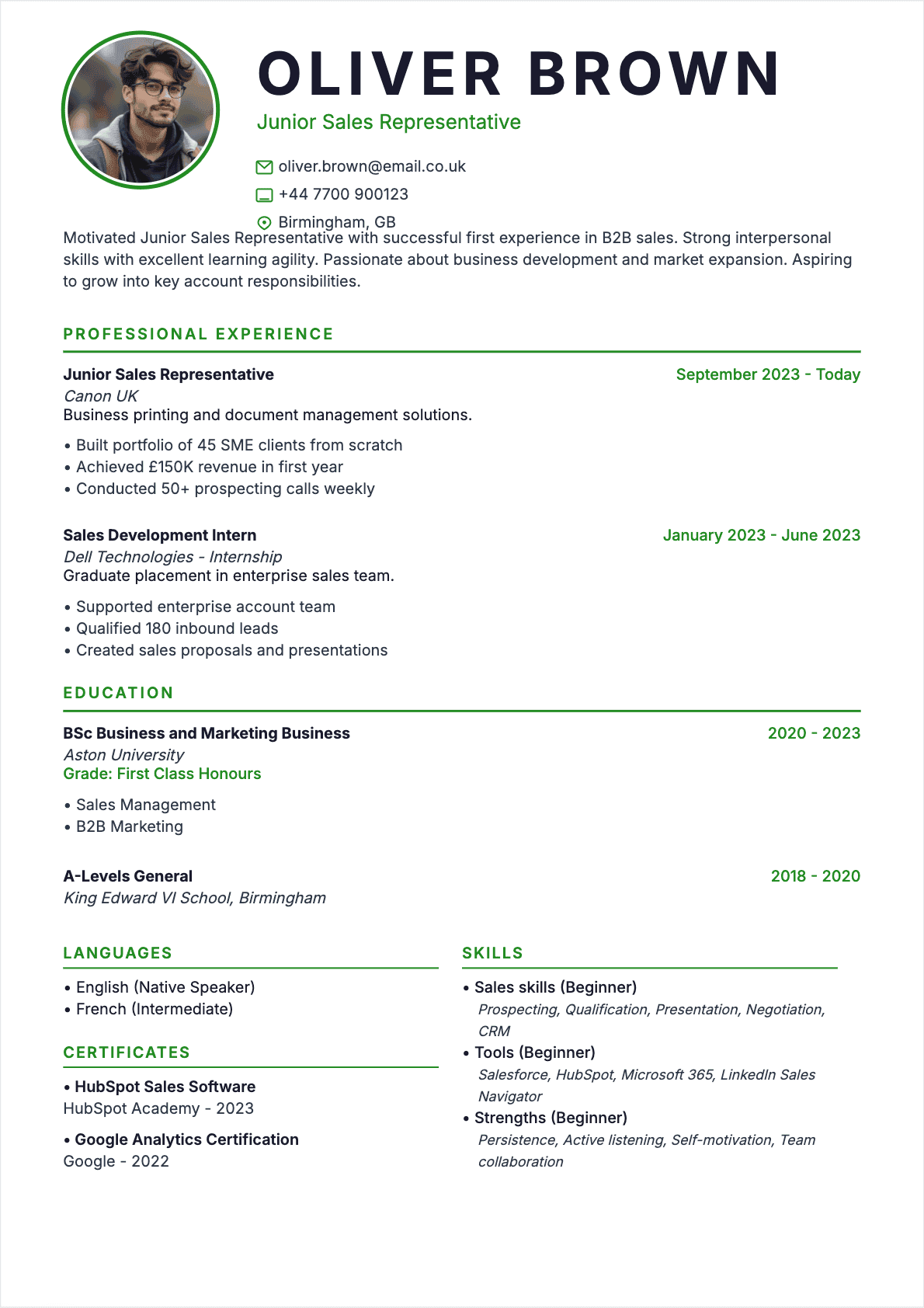
Sales Representative resume template for Junior profile
Resume Sales Representative Senior
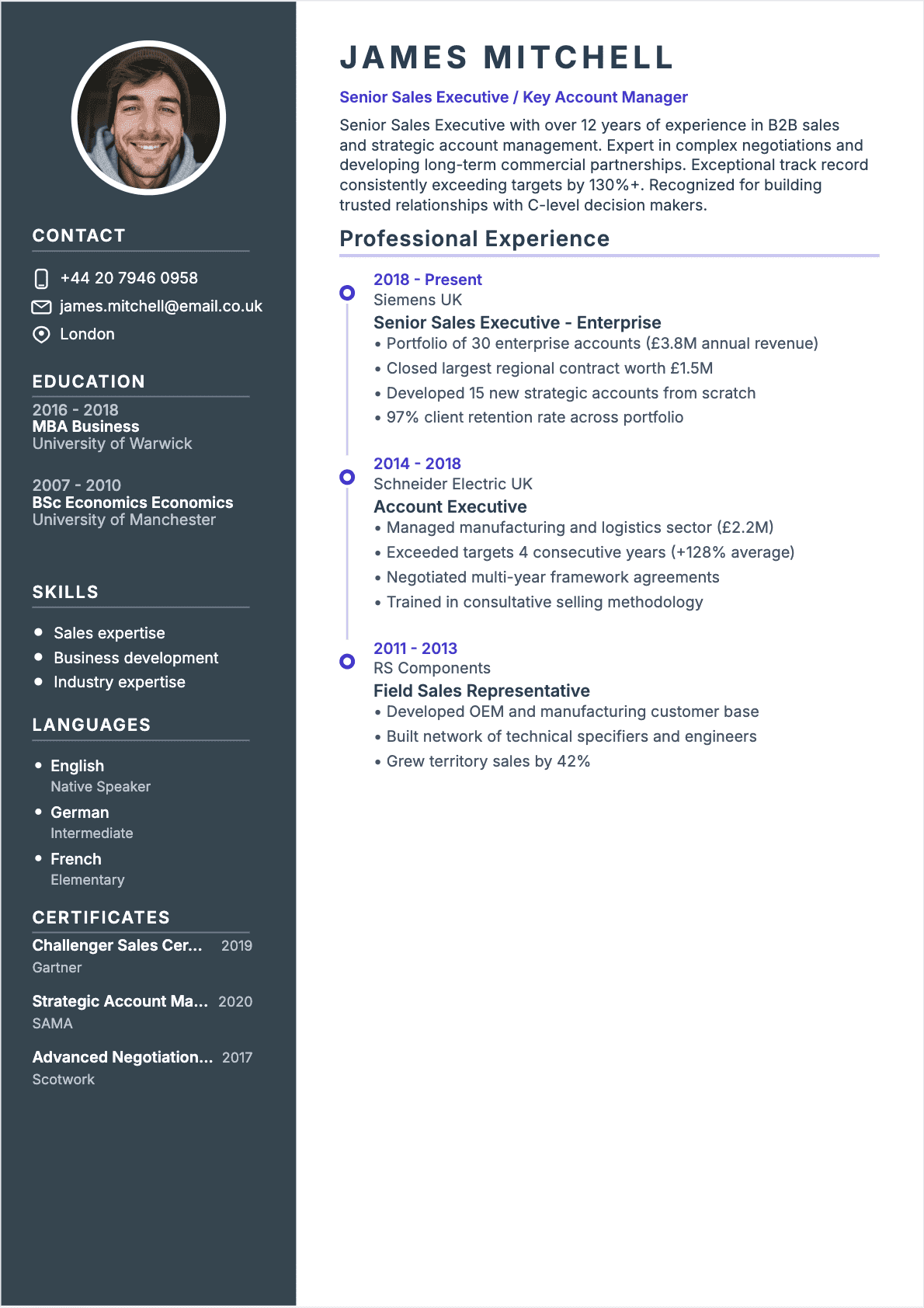
Sales Representative resume template for Senior profile
Resume Sales Representative Confirmé
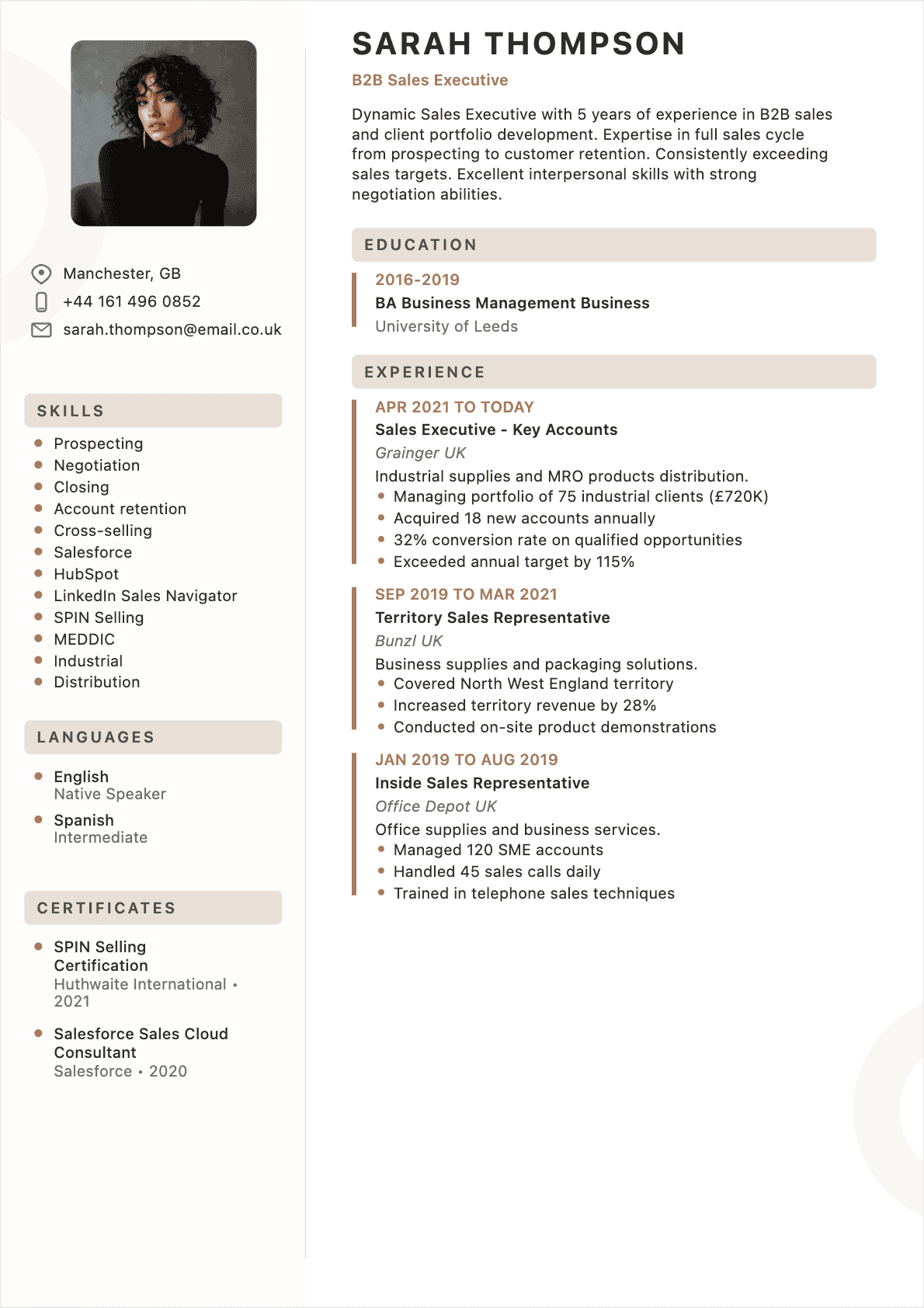
PopularSales Representative resume template for Confirmé profile
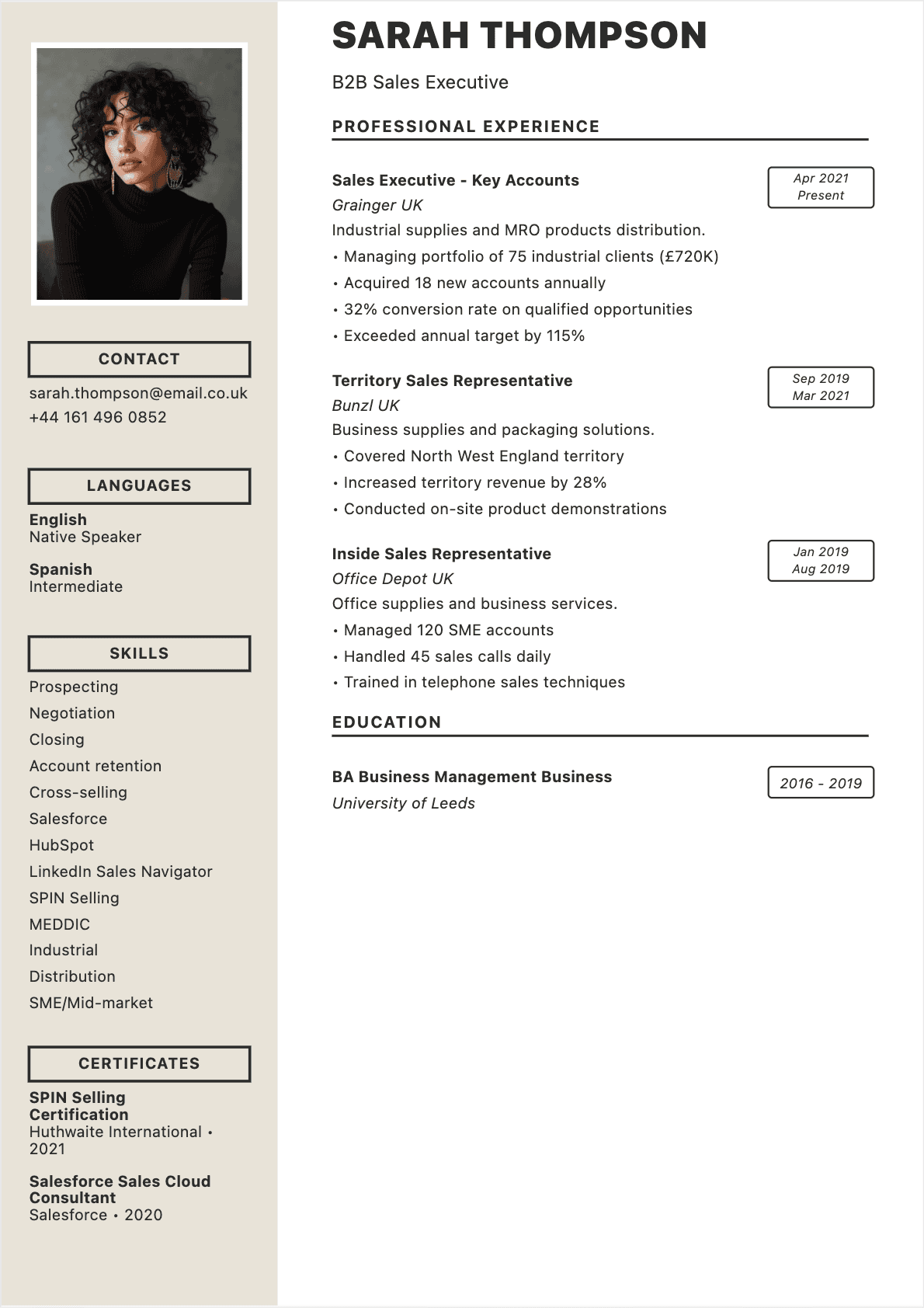
Resume Sales Representative Confirmé
Sales Representative resume template for Confirmé profile
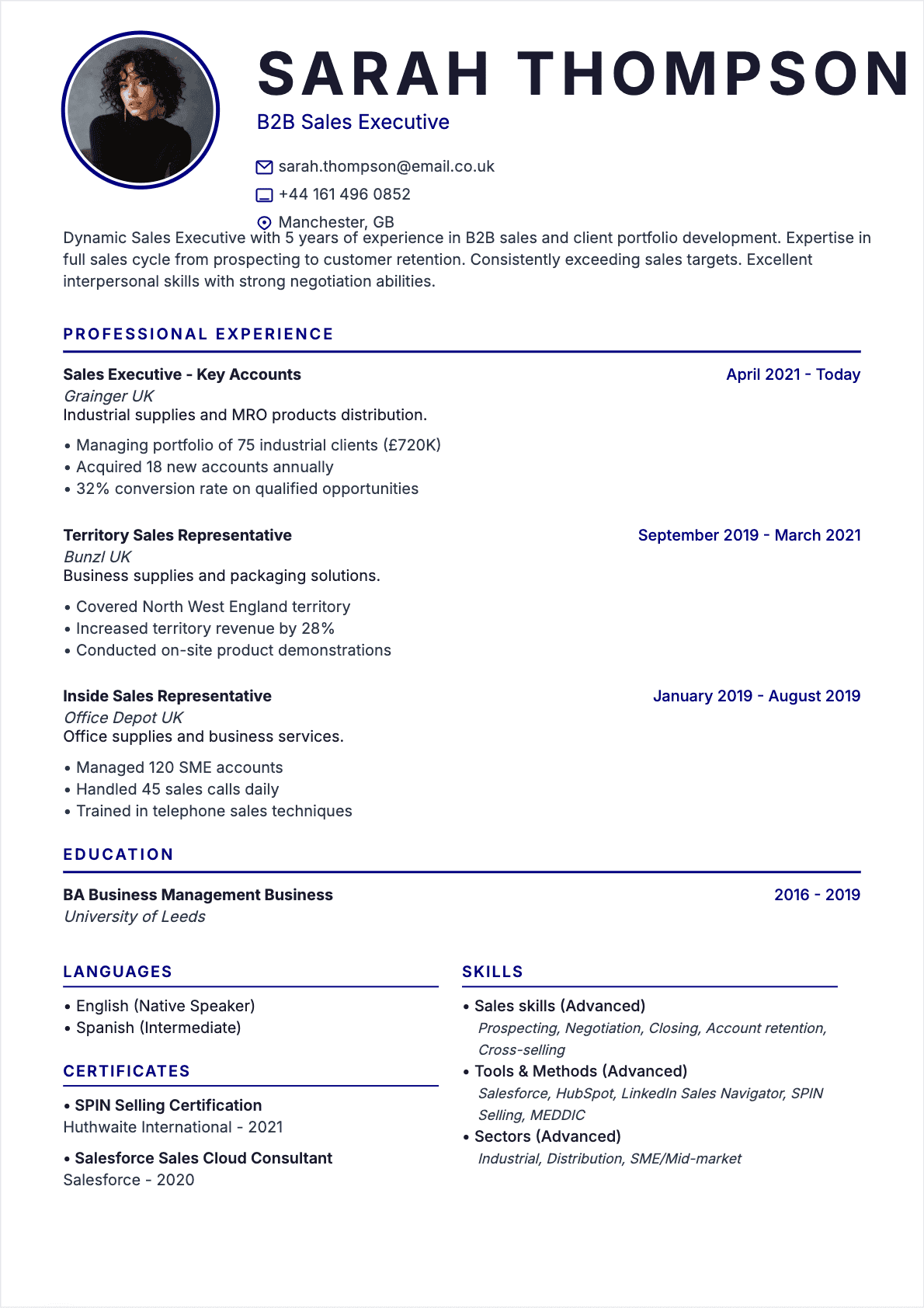
Resume Sales Representative Confirmé
Sales Representative resume template for Confirmé profile
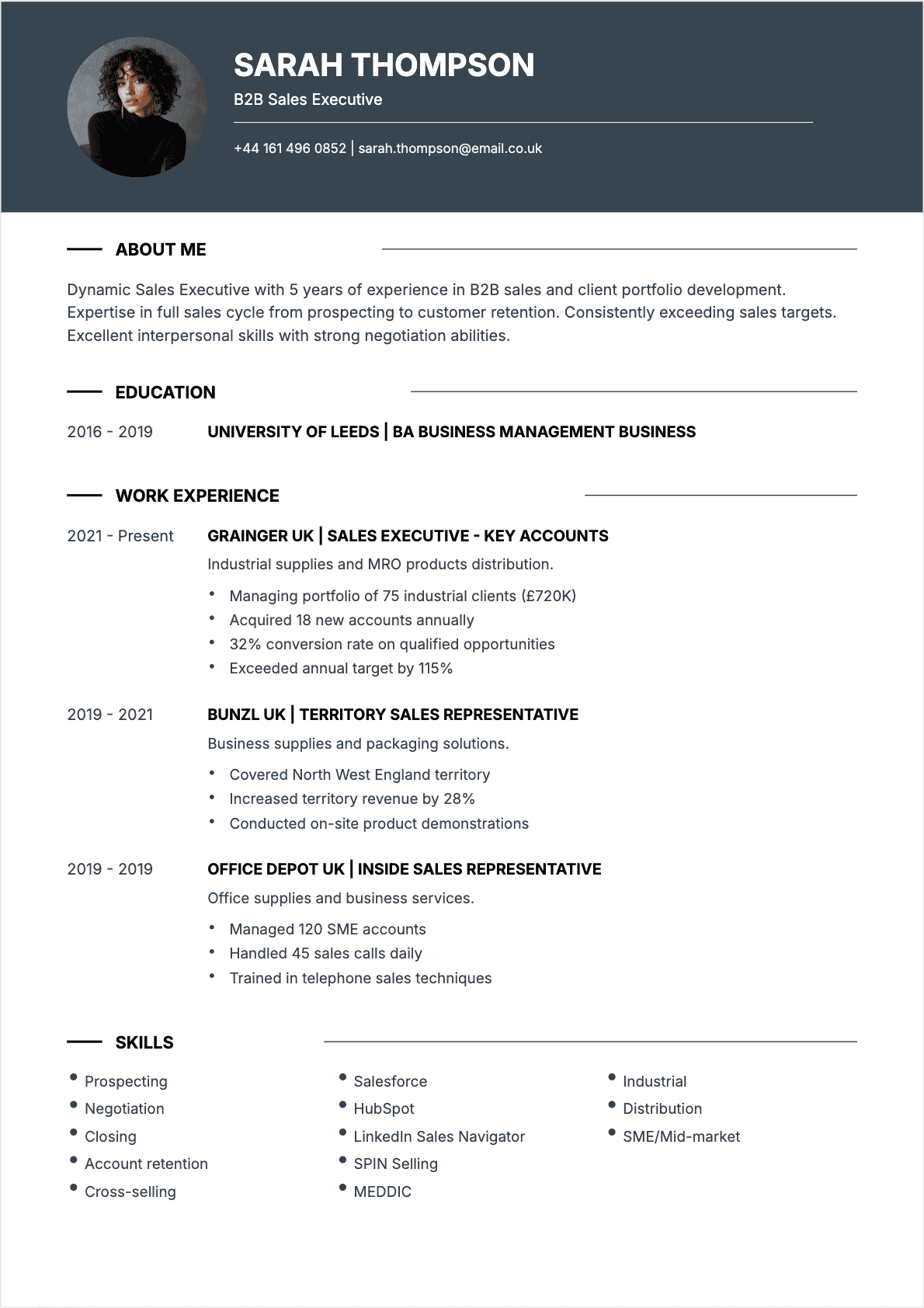
Resume Sales Representative Confirmé
Sales Representative resume template for Confirmé profile
Like one of these Sales Representative resume templates?
Select it, fill in your details and download your resume as PDF.
Sales Representative Resume Examples
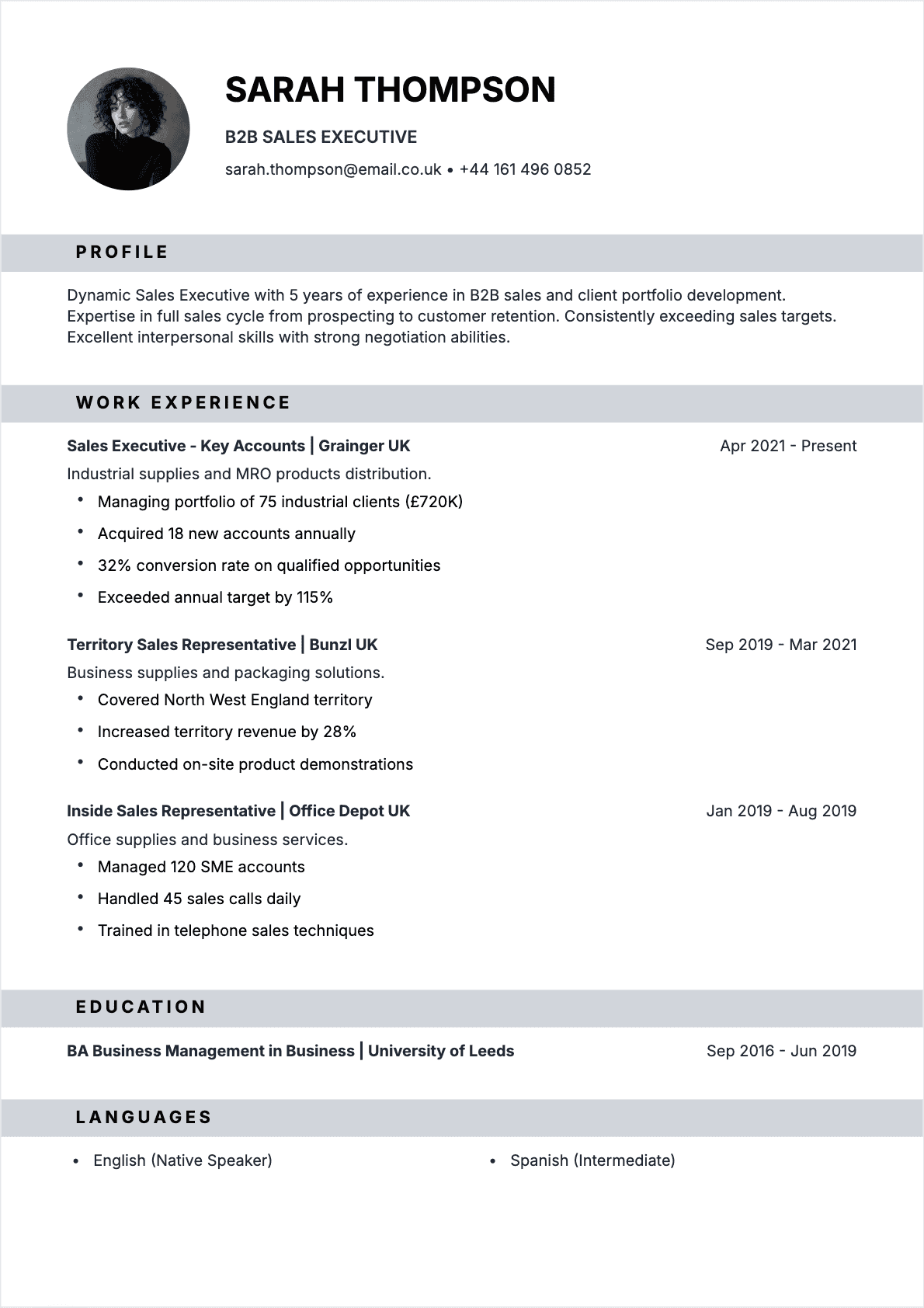
Sarah Thompson
B2B Sales Executive
sarah.thompson@email.co.uk
+44 161 496 0852
Manchester, GB
Dynamic Sales Executive with 5 years of experience in B2B sales and client portfolio development. Expertise in full sales cycle from prospecting to customer retention. Consistently exceeding sales targets. Excellent interpersonal skills with strong negotiation abilities.
Work Experience
Sales Executive - Key Accounts
Grainger UK
- ●Managing portfolio of 75 industrial clients (£720K)
- ●Acquired 18 new accounts annually
- ●32% conversion rate on qualified opportunities
Territory Sales Representative
Bunzl UK
- ●Covered North West England territory
- ●Increased territory revenue by 28%
- ●Conducted on-site product demonstrations
Inside Sales Representative
Office Depot UK
- ●Managed 120 SME accounts
- ●Handled 45 sales calls daily
- ●Trained in telephone sales techniques
Education
BA Business Management
University of Leeds
Skills
Languages
English — Native Speaker
Spanish — Intermediate
Certifications
SPIN Selling CertificationHuthwaite International
Salesforce Sales Cloud ConsultantSalesforce
Sales Representative role overview
Sales representatives are the revenue engine of any organization, responsible for identifying prospects, building relationships, and closing deals that directly impact the bottom line. Your day typically starts with reviewing your pipeline in the CRM, prioritizing follow-ups based on deal stage and potential value, and preparing for scheduled calls or meetings. You'll spend significant time researching prospects, understanding their pain points, and crafting personalized outreach that resonates with their specific business challenges.
The role demands a balance between proactive prospecting and nurturing existing relationships. You'll conduct product demonstrations, negotiate terms, handle objections, and guide prospects through the sales cycle from initial contact to signed contract. Depending on your industry, this might involve field visits to client locations, virtual presentations, or a hybrid approach. You're also responsible for maintaining accurate records in your CRM system, forecasting your monthly and quarterly numbers, and collaborating with marketing teams to refine messaging based on what you're hearing in the field.
Career progression typically follows a clear path: starting as a Sales Development Representative (SDR) or Business Development Representative (BDR) focused on lead generation, advancing to Account Executive handling full-cycle sales, then moving into Senior Account Executive or Territory Manager roles with larger accounts and higher quotas. From there, you can transition into sales management (Sales Manager, Director of Sales) or specialize in enterprise sales, channel partnerships, or sales operations. Some representatives pivot into customer success, product management, or revenue operations roles where their field experience becomes invaluable.
Salary ranges vary significantly based on experience, industry, and company size. Entry-level sales representatives typically earn between $45,000-$65,000 base salary with on-target earnings (OTE) of $60,000-$85,000 when hitting quota. Mid-level representatives with 3-5 years experience command $60,000-$85,000 base with OTE of $90,000-$140,000. Senior representatives and those in technical or enterprise sales can earn $80,000-$120,000 base with total compensation exceeding $200,000 when performance is strong. Commission structures vary widely, with some roles offering 50/50 base-to-commission splits and others weighted more heavily toward salary.
Typical daily tasks include:
- Conducting 40-60 outbound calls or emails to qualified prospects, tracking response rates and adjusting messaging based on what generates engagement
- Leading 3-5 product demonstrations or discovery calls, asking diagnostic questions to uncover needs and position your solution effectively
- Updating CRM records with detailed notes from conversations, next steps, and deal stage changes to maintain pipeline accuracy
- Researching target accounts using LinkedIn Sales Navigator, company websites, and industry news to personalize outreach and identify decision-makers
- Collaborating with sales engineers or solution consultants on technical proposals and responding to RFPs for complex deals
- Attending team meetings to review pipeline health, share competitive intelligence, and participate in role-play sessions for handling objections
Essential skills for a Sales Representative resume
Your resume needs to demonstrate both the technical sales competencies and interpersonal abilities that hiring managers actively screen for. Technical skills prove you can operate effectively in modern sales environments with sophisticated tools and methodologies, while soft skills signal your ability to build trust, handle rejection, and close deals under pressure. Many companies use Applicant Tracking Systems (ATS) that scan for specific keywords, so including the exact terminology used in the job description is critical.
Prioritize CRM proficiency and sales methodology expertise for ATS optimization, as these terms appear in nearly every sales job posting. Include the specific CRM platforms you've used (Salesforce, HubSpot, Microsoft Dynamics) rather than generic phrases like 'CRM experience.' Similarly, name the sales methodologies you've applied—SPIN Selling, Challenger Sale, MEDDIC—rather than just stating you follow a 'consultative approach.' Quantify your proficiency where possible, such as 'Maintained 98% CRM data accuracy across 200+ active opportunities.'
Critical skills to feature on your resume:
- CRM Management (Salesforce, HubSpot, Pipedrive) - Hiring managers need proof you can maintain clean pipeline data, generate accurate forecasts, and use reporting features to identify trends without constant supervision.
- Sales Prospecting & Lead Generation - Your ability to fill your own pipeline through cold calling, social selling, and networking directly correlates to your value, especially in roles without dedicated SDR support.
- Consultative Selling & Needs Analysis - Modern buyers reject pushy tactics; demonstrating you ask diagnostic questions and tailor solutions to specific pain points sets you apart from transactional sellers.
- Contract Negotiation & Deal Structuring - Closing skills matter most when deals reach the finish line; showing you can handle pricing discussions, terms negotiations, and procurement processes proves you won't lose deals at the final stage.
- Sales Presentation & Product Demonstration - Your ability to articulate value propositions clearly and handle technical questions during demos directly impacts conversion rates from opportunity to closed-won.
- Pipeline Management & Forecasting - Sales leaders need representatives who can accurately predict their numbers; this skill shows you understand deal velocity, probability weighting, and commit vs. best-case scenarios.
- Account Planning & Territory Management - Strategic thinking about which accounts to prioritize and how to penetrate white space within existing customers demonstrates you're not just order-taking but actively growing revenue.
- Sales Methodology Application (MEDDIC, SPIN, Challenger) - Naming specific frameworks you've used signals formal training and a structured approach rather than winging it on every call.
- Objection Handling & Competitive Positioning - Every deal faces obstacles; showing you can address concerns about price, timing, or competitors without becoming defensive is essential for maintaining deal momentum.
- Relationship Building & Stakeholder Management - Complex B2B sales involve multiple decision-makers; your ability to map organizations, build champions, and manage consensus proves you can handle enterprise complexity.
- Sales Analytics & Performance Metrics - Data-driven sellers who track their own KPIs (conversion rates, average deal size, sales cycle length) and adjust tactics accordingly consistently outperform those who rely on gut feel.
- Cross-functional Collaboration - Sales doesn't happen in isolation; your ability to work with marketing on campaign feedback, with product on feature requests, and with customer success on smooth handoffs shows organizational maturity.

How to write a Sales Representative resume step by step
1. Lead with a results-focused summary that includes your quota attainment
Your resume summary should immediately communicate your track record of hitting or exceeding targets. Include your years of experience, industries served, and most impressive achievement. Instead of 'Experienced sales professional with strong communication skills,' write 'B2B sales representative with 5 years in SaaS, consistently achieving 115-140% of quota and closing $2.3M in new business annually across 35-state territory.' This approach gives hiring managers the metrics they care about in the first three seconds.
2. Structure your experience section around quantified achievements, not job duties
Each bullet point should follow the formula: action verb + specific task + measurable result. Hiring managers don't need to know you 'conducted sales calls'—that's assumed. They want to see 'Generated 85 qualified opportunities through targeted cold calling campaign, converting 28% to demos and closing 12 deals worth $340K.' Always include numbers: revenue generated, quota percentage, deals closed, pipeline value, conversion rates, or territory growth. If you don't have exact figures, use reasonable estimates based on your typical deal size and volume.
3. Highlight your full sales cycle ownership and deal complexity
Specify whether you handled inbound leads, outbound prospecting, or both. Clarify your average deal size and sales cycle length to give context. For example: 'Managed complete sales cycle for mid-market accounts ($25K-$75K ACV) from initial outreach through contract signature, with average 90-day close timeline involving 3-5 stakeholders.' This tells employers exactly what level of complexity you can handle and whether your experience matches their sales motion.
4. Feature your CRM proficiency and sales tools throughout your experience
Don't relegate tools to a separate skills section—weave them into your achievement bullets. Write 'Built and managed pipeline of 150+ opportunities in Salesforce, maintaining 96% data accuracy and generating weekly forecasts that predicted quarterly results within 5%' rather than just listing 'Salesforce' as a skill. This proves you actually used these tools to drive results, not just clicked around in them during onboarding.
5. Include relevant certifications, training, and awards in a dedicated section
Sales certifications carry weight, especially for competitive roles. List any formal sales training (Sandler, Challenger, SPIN), product certifications relevant to your industry (AWS Certified Cloud Practitioner for tech sales, LEED credentials for commercial real estate), and sales awards (President's Club, Top Performer, Rookie of the Year). Include the year and context: 'President's Club Winner, 2024 - Top 5% of 200+ global sales team, 142% quota attainment.'
6. Tailor your resume for each application using keywords from the job description
ATS systems scan for exact matches to the job posting. If the description mentions 'territory management,' use that exact phrase rather than 'regional account oversight.' If they want 'experience with enterprise accounts,' don't just say 'large clients.' Create a master resume with all your achievements, then customize a version for each application that mirrors their language while remaining truthful. This isn't about lying—it's about emphasizing the aspects of your experience that match their needs.
7. Add a brief education section and keep it proportional to your experience
If you have 5+ years of sales experience, your education section should be minimal—just degree, institution, and graduation year. If you're early career, you can include relevant coursework, sales competitions, or business club leadership. A business degree helps but isn't required for most sales roles; many top performers have diverse educational backgrounds. What matters more is your demonstrated ability to sell.
Before and after examples:
Weak: 'Responsible for managing client relationships and meeting sales targets in assigned territory.'
Strong: 'Grew territory revenue 34% year-over-year ($1.8M to $2.4M) by expanding wallet share within existing accounts and adding 23 new logos through referral program and targeted LinkedIn outreach.'
Weak: 'Worked with team to close deals and provide excellent customer service.'
Strong: 'Collaborated with sales engineers on 15+ technical proof-of-concepts, resulting in 73% win rate for deals over $100K and average 22-day reduction in sales cycle length.'
Weak: 'Used CRM system to track sales activities and generate reports.'
Strong: 'Analyzed HubSpot pipeline data to identify bottlenecks at demo-to-proposal stage, implemented new qualification criteria that improved conversion rate from 18% to 31% over two quarters.'
Common mistakes on Sales Representative resumes
Listing responsibilities instead of achievements
The most frequent error is describing what you were supposed to do rather than what you actually accomplished. Writing 'Managed a portfolio of 50 accounts' tells hiring managers nothing about your performance. Did those accounts grow or shrink under your management? What was the retention rate? Transform this into 'Managed portfolio of 50 mid-market accounts with 94% retention rate, growing average account value 28% through upsells and cross-sells worth $420K annually.' Every bullet point should answer the question: 'So what? What was the impact?'
Failing to provide context for your numbers
Stating '150% of quota' sounds impressive until the hiring manager wonders if your quota was $50K or $5M. Always provide context: '150% of $1.2M annual quota, ranking #3 of 45 representatives nationwide.' Similarly, 'Closed 40 deals' means nothing without average deal size and time frame. Make it '40 deals averaging $35K ACV in FY2024, contributing $1.4M to company revenue.' Context transforms raw numbers into meaningful accomplishments that recruiters can evaluate against their own metrics.
Using vague language instead of sales-specific terminology
Generic phrases like 'excellent communicator' or 'team player' waste valuable resume space and don't pass ATS screening. Sales has its own vocabulary that signals insider knowledge. Replace 'talked to potential customers' with 'conducted discovery calls using SPIN methodology.' Change 'helped close deals' to 'advanced opportunities through qualification, demo, proposal, and negotiation stages.' Use terms like 'pipeline velocity,' 'win rate,' 'average contract value,' and 'sales cycle length' to demonstrate you understand the metrics that matter in sales organizations.
Ignoring the importance of quota attainment percentage
Nothing matters more to a sales hiring manager than whether you hit your number. If you consistently achieved 90%+ of quota, that should be prominent in your summary and throughout your experience section. If you struggled in certain years, focus on other metrics like pipeline generation, meeting activity, or customer retention. But never leave hiring managers guessing about your performance against target. If you exceeded quota, say so explicitly: 'Exceeded annual quota for 4 consecutive years (2021-2024), averaging 127% attainment.'
Overlooking the sales methodology and process details
Employers want to know not just that you hit your numbers, but how you did it. Did you follow a structured sales process? Which methodology? How did you qualify opportunities? What was your approach to prospecting? Include details like 'Applied MEDDIC qualification framework to prioritize opportunities with identified pain, quantified metrics, and executive sponsorship, improving forecast accuracy from 62% to 89%.' This shows you're a strategic seller who can replicate success in their organization, not someone who got lucky with a few deals.
Neglecting to mention industry or product complexity
Selling enterprise software requires different skills than selling office supplies. Your resume should clarify what you sold, to whom, and at what price point. Write 'Sold cloud infrastructure solutions ($50K-$250K ACV) to IT directors and CTOs at mid-market manufacturing companies' rather than just 'B2B sales.' This helps hiring managers assess whether your experience translates to their product, market, and buyer personas. If you've sold technical products, emphasize that—it's a differentiator.
Leaving out collaboration with other teams
Modern sales requires working closely with marketing, customer success, product, and sales engineering. Resumes that only focus on individual achievements miss the opportunity to show organizational awareness. Include bullets like 'Partnered with marketing to refine ICP definition based on closed-won analysis, resulting in 40% improvement in MQL-to-SQL conversion rate' or 'Coordinated with customer success team on strategic account planning, identifying $280K in expansion opportunities across 12 accounts.' This demonstrates you understand that revenue generation is a team sport.
Sales Representative resume trends in 2026
The sales profession is experiencing significant shifts driven by artificial intelligence, changing buyer behaviors, and evolving work arrangements. Companies increasingly seek representatives who can work effectively with AI-powered sales tools while maintaining the human connection that closes complex deals. Your resume needs to reflect both technical adaptability and the consultative skills that automation can't replace. Hiring managers are specifically looking for evidence that you understand how to use AI for efficiency while focusing your time on high-value activities that require emotional intelligence and strategic thinking.
AI-assisted prospecting and outreach tools have become standard in modern sales organizations. Employers expect familiarity with platforms like Gong, Chorus, or Clari for conversation intelligence, and tools like Apollo, ZoomInfo, or Cognism for data enrichment. Your resume should demonstrate you've used these technologies to improve your efficiency or effectiveness: 'Implemented Gong conversation analysis to identify successful talk patterns, reducing average sales cycle by 18 days' or 'Used Apollo.io to build targeted prospect lists, improving connect rate from 12% to 27%.' The key is showing you use AI as a productivity multiplier, not a replacement for relationship-building.
Virtual selling skills have transitioned from pandemic necessity to permanent requirement. Even field sales roles now involve significant remote interaction, and many companies have eliminated geographic territories entirely in favor of vertical or account-based assignments. Your resume should highlight your proficiency with video conferencing platforms, digital presentation tools, and virtual collaboration software. More importantly, demonstrate results achieved in remote environments: 'Closed $1.8M in new business entirely through virtual channels, maintaining 89% quota attainment despite transition from field-based to inside sales model.' Companies want proof you can build trust and close deals without face-to-face meetings.
Revenue intelligence and data analysis capabilities have become differentiators for top performers. Sales leaders increasingly expect representatives to analyze their own metrics, identify improvement opportunities, and adjust tactics based on data rather than intuition. Resumes that showcase analytical thinking stand out: 'Analyzed pipeline data to identify 35% drop-off rate at proposal stage, implemented new ROI calculator tool that improved proposal-to-close conversion from 22% to 38%.' This trend reflects the professionalization of sales—employers want strategic thinkers who can diagnose problems and test solutions, not just activity machines.
Industry specialization and vertical expertise command premium compensation. Generalist sales representatives face increasing competition from specialists who deeply understand specific sectors like healthcare, financial services, manufacturing, or logistics. If you've developed expertise in a particular industry, emphasize it prominently: 'Healthcare IT sales specialist with 6 years selling to hospital systems and physician groups, fluent in HIPAA compliance, EHR integration requirements, and value-based care reimbursement models.' This specialization makes you significantly more valuable to companies selling into those markets.
Product-led growth (PLG) motions are changing how many companies approach sales. Rather than traditional top-down selling, representatives increasingly work with users who've already adopted freemium products, focusing on expansion and conversion to paid tiers. If you've worked in PLG environments, highlight your ability to identify product-qualified leads, conduct expansion conversations, and collaborate with product teams: 'Converted 45 freemium users to enterprise plans averaging $68K ACV by identifying usage patterns indicating team-wide adoption potential.' This experience is highly sought after in the SaaS sector.
Hybrid work arrangements are now standard, with most sales organizations offering flexibility between home and office. Your resume should demonstrate self-management and results regardless of location. However, some employers still prefer representatives willing to travel for key accounts or industry events. Be clear about your preferences and experience: 'Remote-based sales representative covering Western region with quarterly travel for customer QBRs and annual trade show attendance' or 'Hybrid role with 60% field time conducting on-site demos and relationship-building meetings.' Setting accurate expectations prevents mismatches during the interview process.
Further reading:
Frequently asked questions
Find answers to the most frequently asked questions.
Use a single-column resume format with standard headings (Summary, Experience, Skills, Education). Avoid text boxes and icons. Keep dates right-aligned in plain text. Most sales representatives get better ATS matching when the experience section includes CRM tools (Salesforce/HubSpot) plus sales targets and quota metrics.
For junior sales and inside sales, keep it to 1 page. For 5–10 years, 1–2 pages is acceptable if every line supports sales achievements, technical sales scope, or customer relationship management outcomes. A good rule: each role needs 3–5 quantified bullets, not paragraphs.
Start by copying the job description and marking repeated phrases (technical sales, forecasting, sales presentations, CRM, territory). Then customize your resume: reorder skills, mirror the role title, and adjust 2–4 bullets to match the sales process and technical product. Keep numbers constant and only change framing.
In the US, do not include a photo on your resume. In the UK, it’s generally optional, but most ATS-first processes don’t need it. Use the space for revenue, quota, and customer relationships metrics. If you apply internationally, follow local norms and company guidance.
Prioritize technical sales skills that connect product knowledge to outcomes: discovery, qualification, demo delivery, stakeholder mapping, and technical support coordination. Add customer relationship management, forecasting, and data skills. Then include soft skills that show up in results, such as objection handling and structured communication skills.
Choose certifications that map to the role: AA-ISP CISP for inside sales, NASP Certified Sales Professional for selling fundamentals, HubSpot certifications for modern prospecting, and Salesforce certifications for CRM depth. Certifications don’t replace performance, but they can improve ATS matching and credibility in technical sales.
Your career deserves a better resume
With CVtoWork, select a template, fill in the fields and download your resume as PDF.
Start creating