Sales Director Resume
Example, Template & Expert Tips 2026
Updated on April 18, 2026.
Sales directors: write a sales directors resume that proves revenue impact. Get a sales director resumes template, metrics, skills, and resume example.
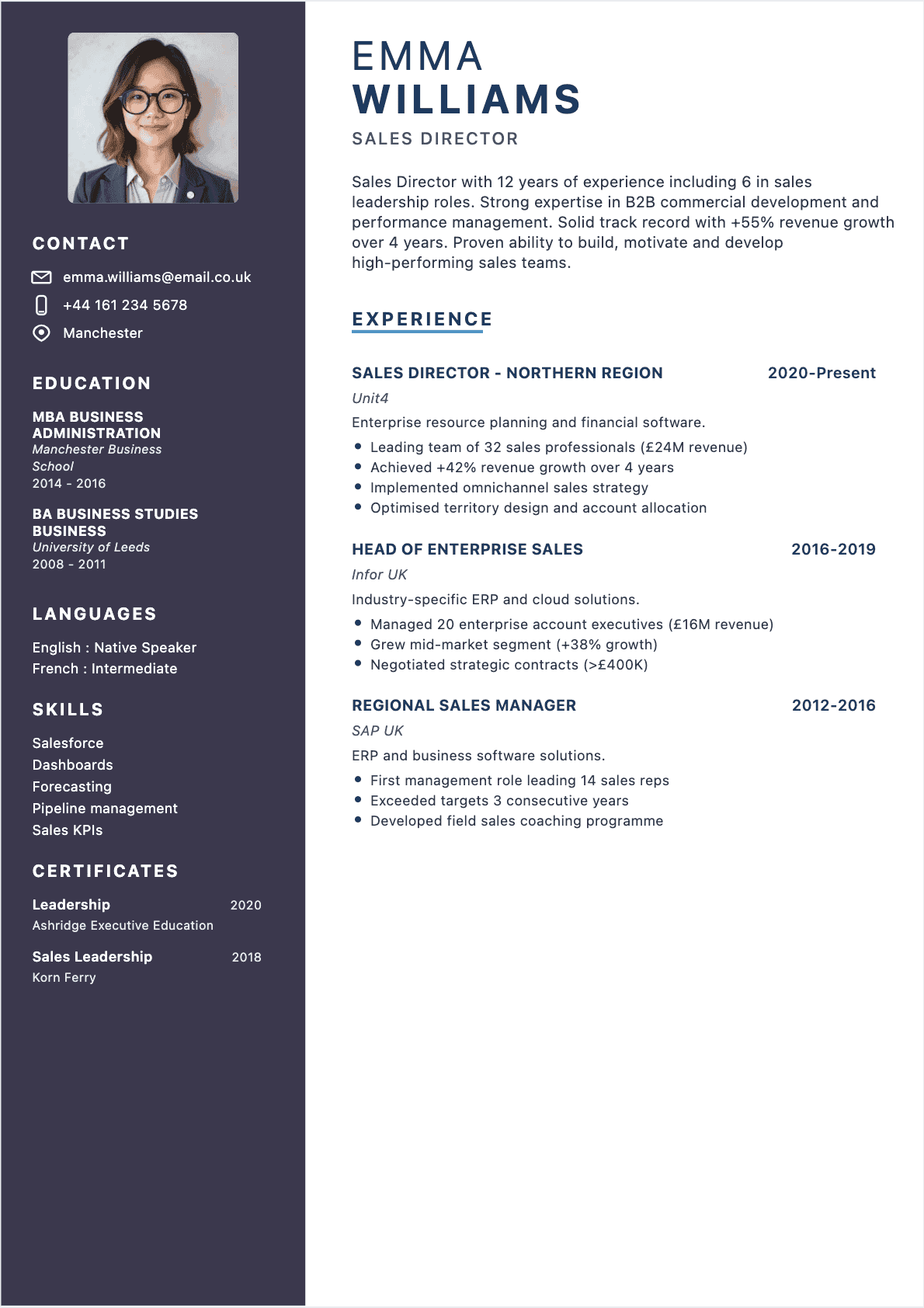
Sales Director Resume Templates
8 Templates available
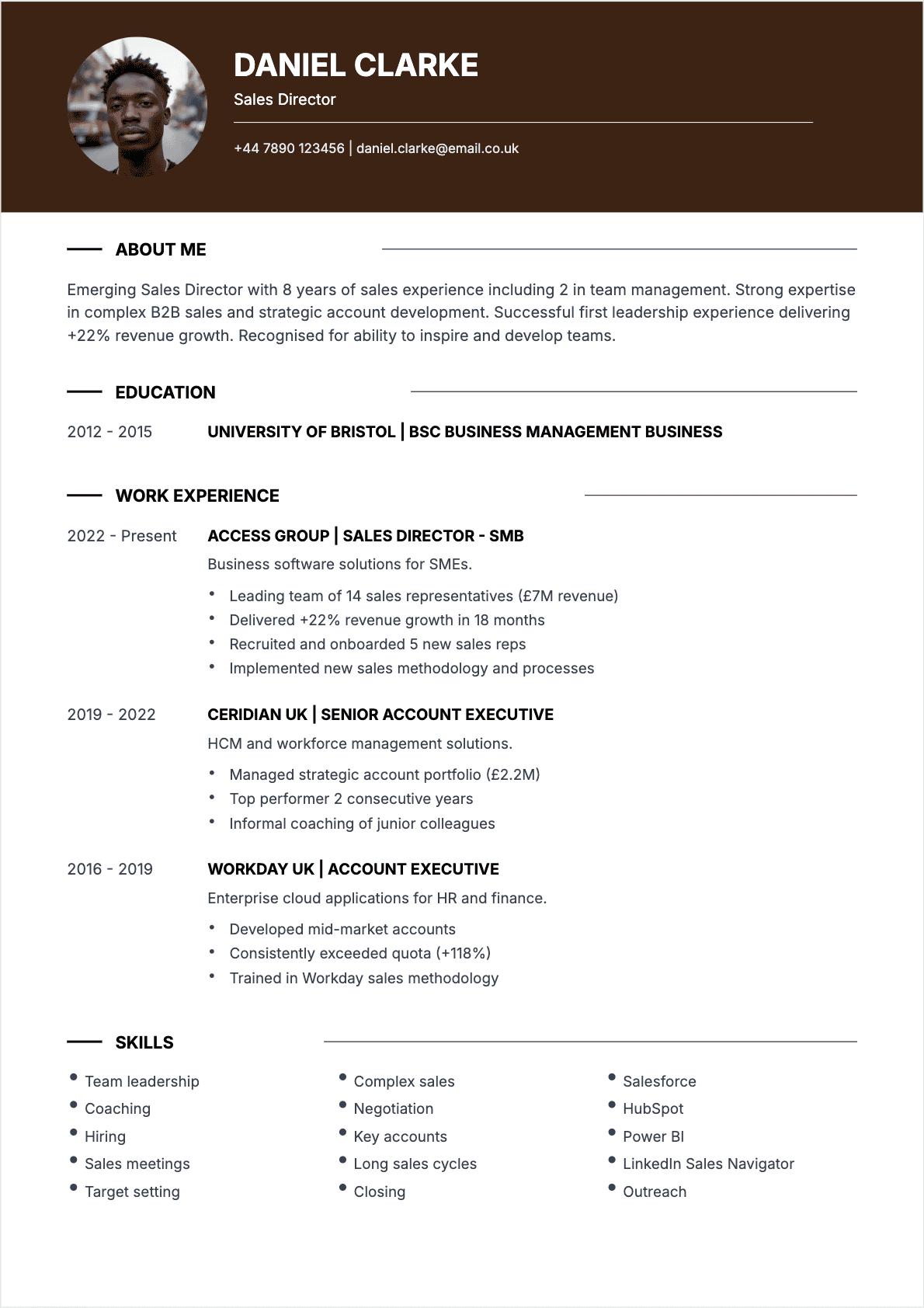
Resume Sales Director Junior
Sales Director resume template for Junior profile
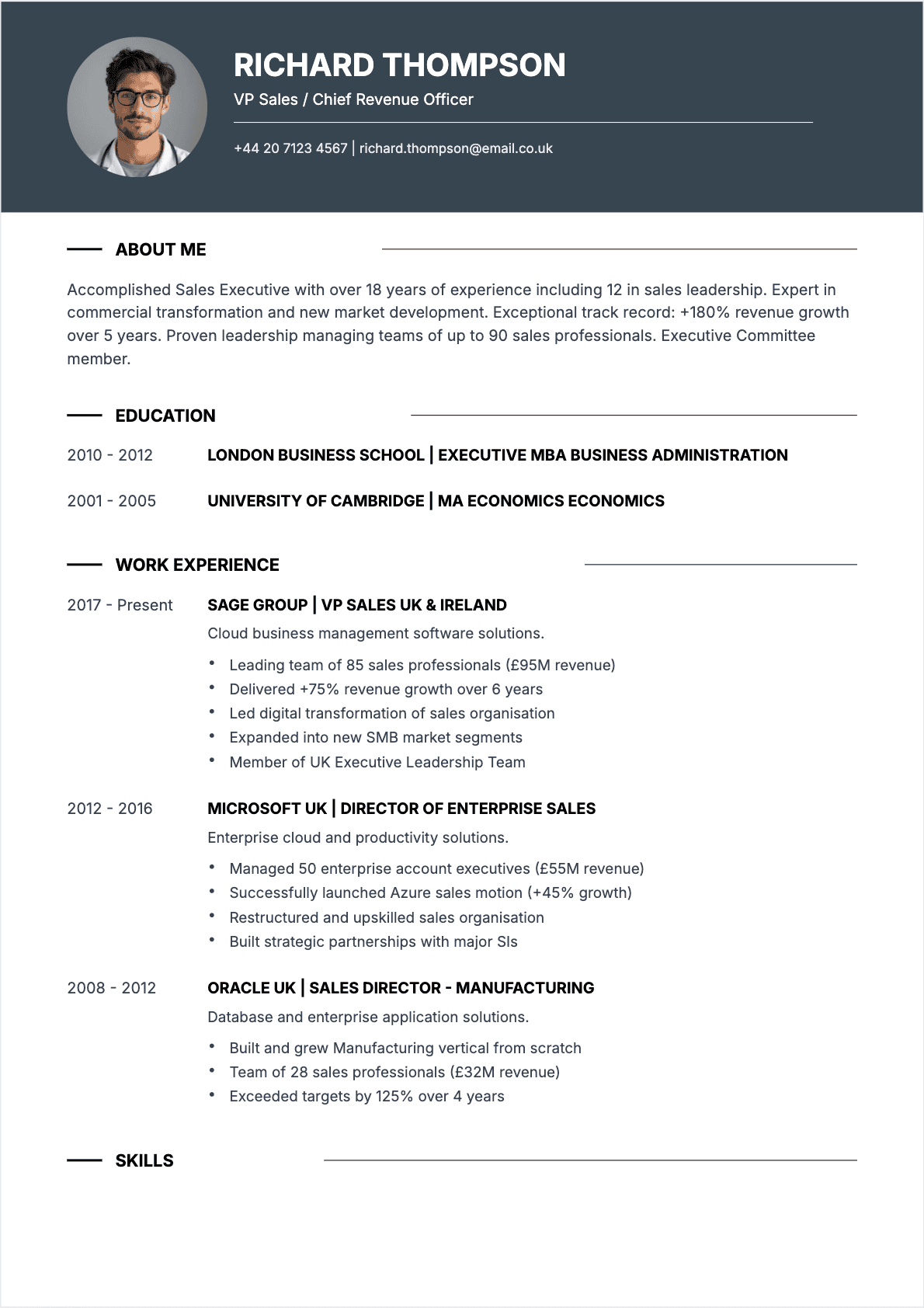
Resume Sales Director Senior
Sales Director resume template for Senior profile
Resume Sales Director Confirmé
Sales Director resume template for Confirmé profile
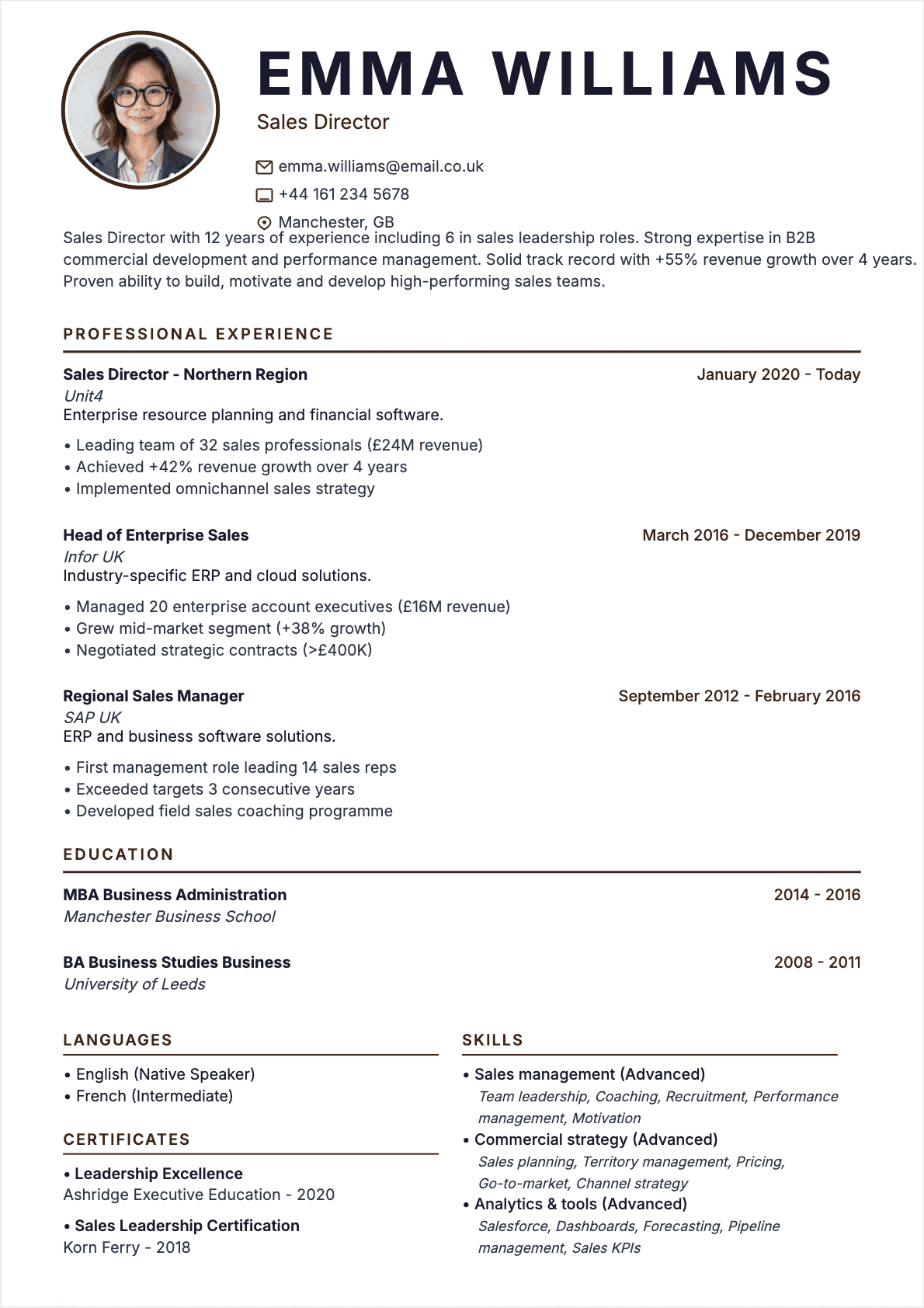
Resume Sales Director Confirmé
Sales Director resume template for Confirmé profile
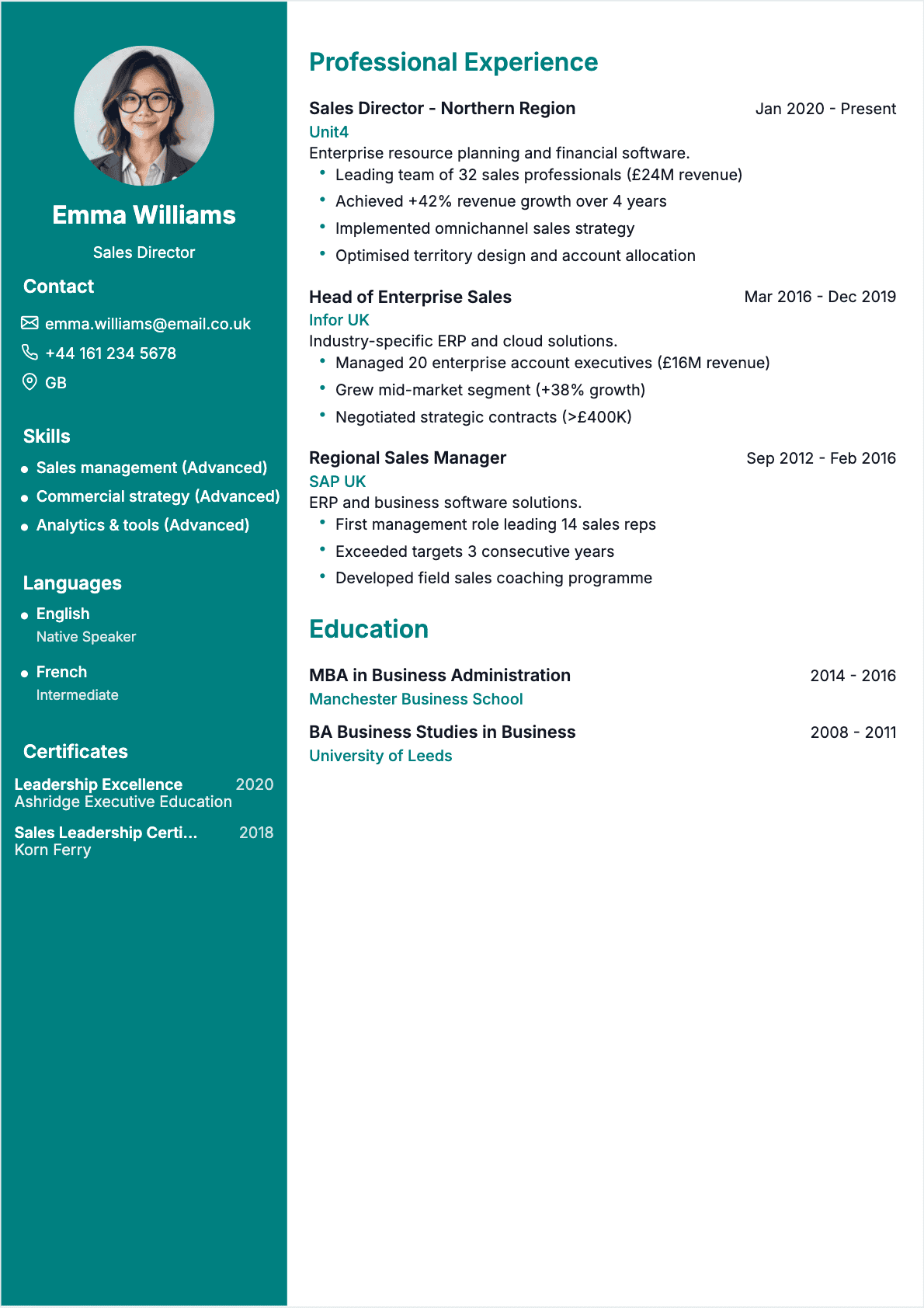
Resume Sales Director Confirmé
Sales Director resume template for Confirmé profile
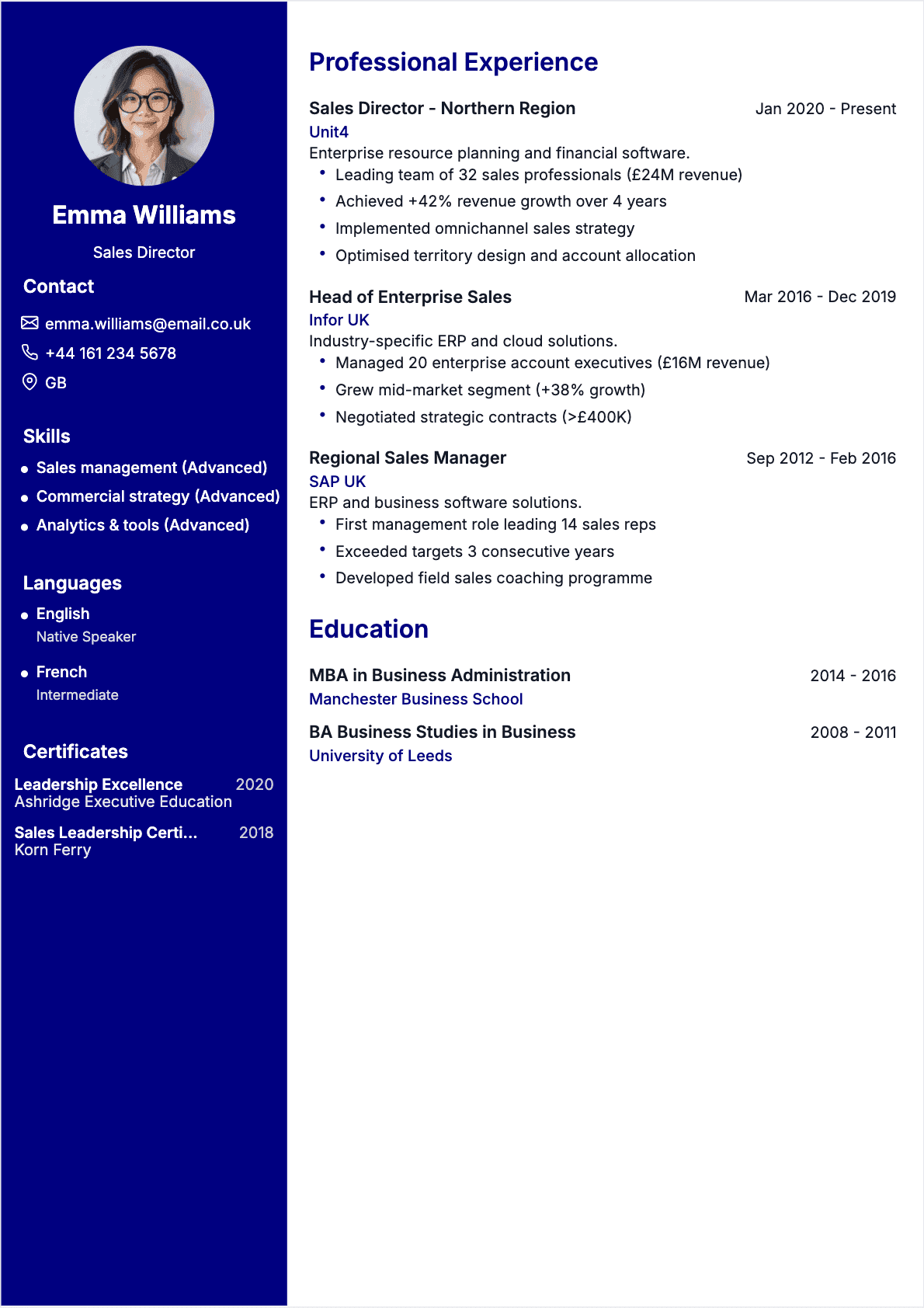
Resume Sales Director Confirmé
PopularSales Director resume template for Confirmé profile
Like one of these Sales Director resume templates?
Select it, fill in your details and download your resume as PDF.
Sales Director Resume Examples
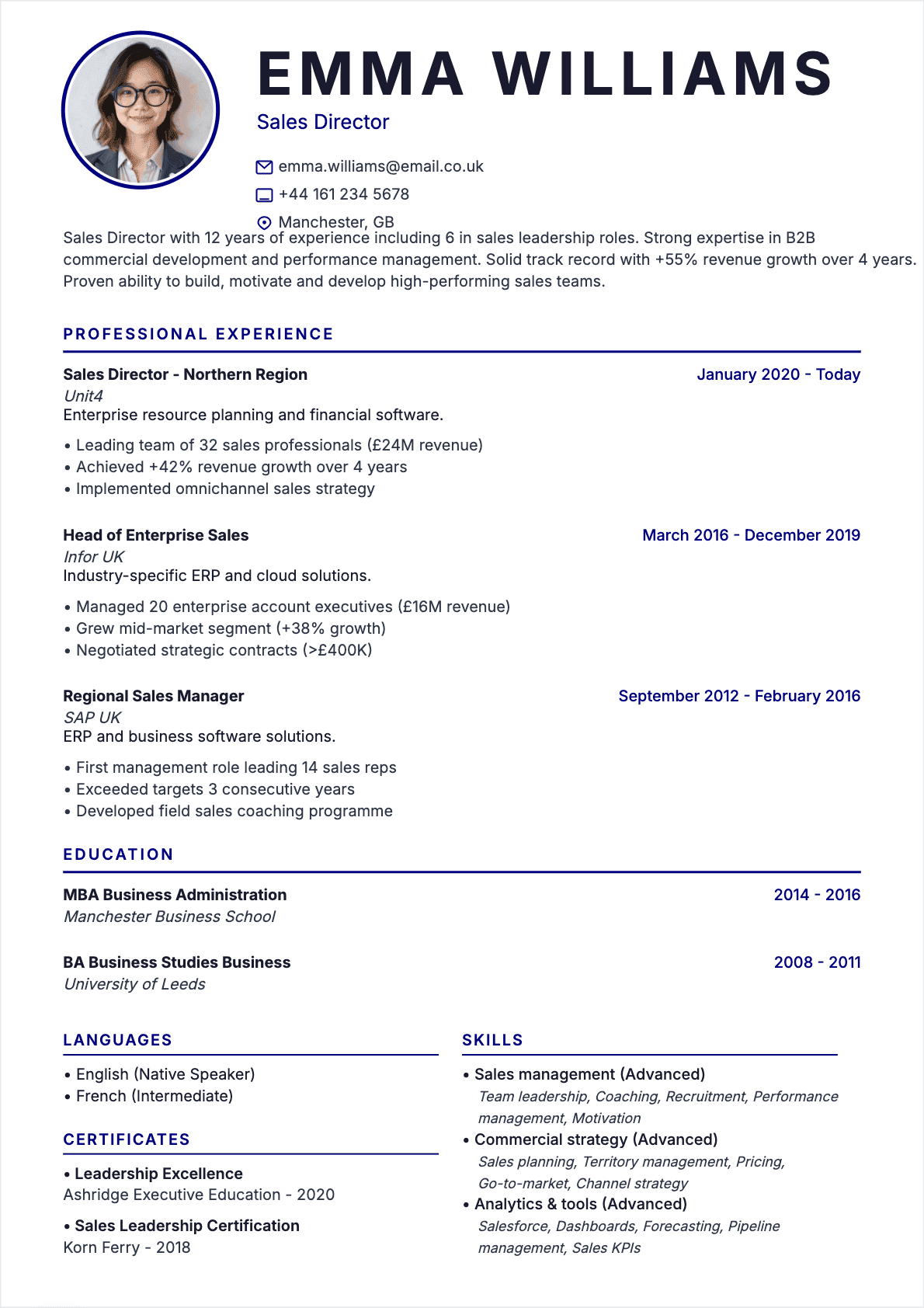
Emma Williams
Sales Director
emma.williams@email.co.uk
+44 161 234 5678
Manchester, GB
Sales Director with 12 years of experience including 6 in sales leadership roles. Strong expertise in B2B commercial development and performance management. Solid track record with +55% revenue growth over 4 years. Proven ability to build, motivate and develop high-performing sales teams.
Work Experience
Sales Director - Northern Region
Unit4
- ●Leading team of 32 sales professionals (£24M revenue)
- ●Achieved +42% revenue growth over 4 years
- ●Implemented omnichannel sales strategy
Head of Enterprise Sales
Infor UK
- ●Managed 20 enterprise account executives (£16M revenue)
- ●Grew mid-market segment (+38% growth)
- ●Negotiated strategic contracts (>£400K)
Regional Sales Manager
SAP UK
- ●First management role leading 14 sales reps
- ●Exceeded targets 3 consecutive years
- ●Developed field sales coaching programme
Education
MBA
Manchester Business School
BA Business Studies
University of Leeds
Skills
Languages
English — Native Speaker
French — Intermediate
Certifications
Leadership ExcellenceAshridge Executive Education
Sales Leadership CertificationKorn Ferry
Sales Director role overview
A Sales Director owns the entire revenue generation strategy for their organization or business unit. You're not just closing deals anymore—you're building the machine that closes deals at scale. Your day starts with pipeline reviews, forecasting sessions, and strategic planning meetings with C-suite executives. You spend significant time coaching your sales managers, analyzing conversion metrics across the funnel, and making decisions about territory allocation, compensation structures, and go-to-market strategies.
The role demands a balance between strategic thinking and tactical execution. You'll design sales processes that your team can replicate, negotiate enterprise-level contracts worth millions, and represent the sales organization in board meetings. You're also the bridge between sales and other departments—working with marketing on lead quality, with product on roadmap priorities, and with finance on revenue forecasting. When a major deal stalls or a key account threatens to churn, you're the one who steps in to salvage the relationship.
Career progression typically follows this path: Sales Representative → Senior Sales Representative → Sales Manager → Regional Sales Manager → Sales Director → VP of Sales → Chief Revenue Officer. Some Sales Directors specialize in specific verticals (SaaS, manufacturing, pharmaceuticals) or sales models (enterprise, mid-market, channel partnerships). The timeline from Sales Manager to Director usually takes 5-8 years, depending on your track record and company growth.
Salary ranges vary significantly by industry, company size, and geography. In the United States, entry-level Sales Directors (managing smaller teams or regions) earn $120,000-$160,000 base plus commission, with total compensation reaching $180,000-$280,000. Mid-level Directors at established companies typically see $150,000-$200,000 base with OTE (on-target earnings) of $280,000-$450,000. Senior Sales Directors at enterprise organizations or high-growth tech companies command $200,000-$300,000 base salaries with total compensation packages exceeding $500,000-$800,000 when equity and accelerators are included.
Typical daily responsibilities include:
- Reviewing pipeline health across all territories and identifying deals at risk or requiring executive involvement
- Conducting one-on-one coaching sessions with sales managers to improve their team leadership and deal strategy
- Analyzing sales metrics (win rates, average deal size, sales cycle length) and adjusting processes accordingly
- Participating in or leading strategic account negotiations, particularly for six- and seven-figure contracts
- Collaborating with marketing and product teams on positioning, pricing, and competitive differentiation
- Presenting revenue forecasts and business updates to executive leadership and board members
Essential skills for a Sales Director resume
Your resume needs to demonstrate both the strategic capabilities that got you into leadership and the technical sales competencies that prove you understand the work your team does. Recruiters scanning Sales Director resumes look for evidence of revenue impact, team development, and cross-functional leadership. The skills you highlight should connect directly to business outcomes—not just activities you performed.
For ATS optimization, prioritize skills that appear in the job description, particularly CRM platforms (Salesforce, HubSpot), sales methodologies (MEDDIC, Challenger, SPIN), and industry-specific terms. However, don't keyword-stuff—each skill you list should have supporting evidence elsewhere in your resume through specific accomplishments or metrics.
Core skills to feature prominently:
- Revenue forecasting and pipeline management - You need to predict quarterly and annual revenue within 5-10% accuracy, which requires deep understanding of deal progression and conversion metrics at each funnel stage.
- Sales team recruitment and development - Building high-performing teams means identifying A-players, creating structured onboarding programs, and implementing coaching frameworks that improve quota attainment across the organization.
- Enterprise sales methodology (MEDDIC, Challenger, Solution Selling) - Demonstrating mastery of a recognized framework shows you bring repeatable processes rather than relying on relationship-based selling that doesn't scale.
- CRM administration and sales analytics (Salesforce, Tableau, Power BI) - You need to extract insights from sales data, build dashboards that drive accountability, and ensure your team maintains data hygiene for accurate reporting.
- Contract negotiation and deal structuring - At the director level, you're handling complex agreements with multiple stakeholders, non-standard terms, and creative pricing models that protect margins while closing business.
- Sales compensation design - Creating comp plans that motivate the right behaviors, align with company goals, and remain financially sustainable requires understanding both psychology and finance.
- Cross-functional leadership - You're constantly aligning sales with marketing (on lead quality and attribution), product (on roadmap priorities), and customer success (on handoffs and expansion opportunities).
- Market segmentation and territory planning - Dividing markets strategically ensures balanced opportunity distribution, prevents account conflicts, and maximizes coverage efficiency across your team.
- Sales enablement and training program development - Creating playbooks, battle cards, and training curricula that reduce ramp time and improve win rates demonstrates your ability to systematize success.
- Budget management and resource allocation - You're accountable for sales operations expenses, technology investments, and headcount decisions that impact profitability and growth trajectory.
- Strategic account planning - Developing multi-year growth strategies for key accounts requires understanding customer business models, identifying expansion opportunities, and orchestrating complex stakeholder relationships.
- Board-level communication and executive presence - Presenting to investors, board members, and C-suite peers requires distilling complex sales dynamics into strategic narratives with clear action plans.

How to write a Sales Director resume step by step
1. Lead with a results-focused summary that quantifies your revenue impact
Your opening summary should immediately establish your track record of hitting revenue targets and building successful teams. Include your years of leadership experience, total revenue managed, and one signature achievement. For example: 'Sales Director with 12 years of B2B SaaS experience leading teams of 25-40 reps across North America. Built and scaled sales organization from $8M to $47M ARR over four years while maintaining 94% quota attainment and reducing customer acquisition cost by 31%.'
2. Structure your experience section around revenue milestones and team performance
Each role should start with context: team size you managed, revenue responsibility, and market focus. Then list 4-6 accomplishments that demonstrate strategic impact. Use the formula: Action + Specific Metric + Business Context. Instead of 'Managed sales team and exceeded targets,' write 'Led 32-person enterprise sales team across 8 territories, achieving 118% of $34M annual quota while improving average deal size from $87K to $143K through strategic account planning and value-based selling methodology.'
3. Highlight team development and organizational building
Recruiters want to see that you can attract, develop, and retain talent. Include metrics about hiring, promotion rates, and team performance improvements. Example: 'Recruited and onboarded 18 sales professionals over 24 months with 94% retention rate; promoted 6 team members to management roles. Reduced average ramp time from 7 months to 4.5 months through structured enablement program and mentorship framework.'
4. Demonstrate cross-functional leadership and strategic initiatives
Show how you've influenced the business beyond your direct sales team. Include examples of process improvements, technology implementations, or strategic partnerships. For instance: 'Partnered with Product and Marketing to launch vertical-specific solution packages, resulting in 40% higher win rates in healthcare and financial services segments. Led Salesforce implementation project that improved forecast accuracy from 68% to 91% and reduced administrative time by 12 hours per rep monthly.'
5. Include specific sales methodology and technology expertise
Name the frameworks and tools you've implemented. Example: 'Implemented MEDDIC qualification framework across organization, increasing pipeline quality and improving win rates from 23% to 34% for qualified opportunities. Deployed Gong.io for conversation intelligence, using insights to refine pitch strategies and objection handling across team.'
6. Quantify the financial impact of your strategic decisions
Connect your initiatives to bottom-line results. Instead of 'Improved sales efficiency,' write 'Redesigned territory alignment and compensation structure, reducing sales cycle from 127 days to 89 days and improving sales productivity by $340K revenue per rep annually.' Show ROI on investments: 'Secured $480K budget for sales enablement technology stack (Outreach, ZoomInfo, Chorus), generating 6.2x ROI through 22% increase in qualified pipeline.'
7. Feature your most impressive accomplishments in a Key Achievements section
After your work experience, add 3-4 standout accomplishments that might get buried in your job descriptions. Format them as: 'Grew Mid-Market segment from $0 to $12M ARR in 18 months by building specialized team, developing segment-specific playbook, and establishing channel partnerships with 14 regional VARs.'
8. Keep education and certifications relevant but concise
List your degree and any sales-specific certifications (Sandler Training, Challenger Certified Coach, Strategic Account Management Association credentials). Unless you're recently graduated, your education section should be 2-3 lines maximum. Prioritize certifications that demonstrate commitment to sales methodology and leadership development.
Common mistakes on Sales Director resumes
Listing activities instead of outcomes
The most frequent mistake is describing what you did rather than what you achieved. Writing 'Managed a team of 20 sales representatives' tells recruiters nothing about your effectiveness. Instead, demonstrate impact: 'Led 20-person team to 127% of annual quota, generating $28M in new business while maintaining 89% employee retention—15 points above industry average.' Every bullet point should answer the question: 'So what? What changed because you did this?'
Failing to provide context for your numbers
Stating 'Increased revenue by 40%' sounds impressive until recruiters wonder: 40% of what baseline? Over what timeframe? In a growing or declining market? Always provide context: 'Grew regional revenue from $14M to $19.6M (40% increase) over two years in a mature market experiencing 3% annual contraction, capturing market share from three major competitors.' Context transforms numbers from abstract percentages into proof of exceptional performance.
Using identical language for different roles
Many Sales Directors copy-paste similar accomplishments across multiple positions, which suggests either lack of growth or lazy resume writing. Your progression should show increasing scope and strategic responsibility. Your most recent role should emphasize organizational design, executive relationships, and company-wide initiatives, while earlier positions can focus more on team building and process implementation. Show evolution: early roles might highlight 'Built sales process for new product line,' while recent roles should feature 'Designed go-to-market strategy across three business units, aligning 65 sales professionals with unified methodology.'
Neglecting to address team performance and development
Some Sales Directors focus exclusively on their personal deal closures or overall team numbers without showing how they developed their people. Recruiters want evidence that you can build sustainable organizations, not just hit numbers through personal heroics. Include metrics like: 'Developed 4 sales managers who were promoted to director roles at other organizations; maintained 91% annual retention rate despite competitive market for sales talent. Implemented quarterly performance calibration process that improved bottom-quartile performer productivity by 47%.'
Omitting the strategic and cross-functional aspects of the role
Resumes that only discuss sales metrics miss half the job. Sales Directors influence pricing strategy, product roadmaps, marketing campaigns, and customer success operations. Show your broader impact: 'Collaborated with Product team to prioritize feature development based on $23M in identified pipeline opportunities, resulting in three new capabilities that increased win rates in enterprise segment by 28%. Partnered with Marketing to redesign lead scoring model, improving MQL-to-SQL conversion by 34% and reducing sales team time spent on unqualified leads by 18 hours weekly.'
Using vague or outdated sales terminology
Phrases like 'consultative selling' or 'relationship building' are too generic for a director-level resume. Be specific about methodologies and frameworks: 'Implemented Command of the Message framework across organization, training 38 sales professionals on value-based differentiation and discovery techniques. Achieved 89% certification rate and 31% improvement in discovery call-to-demo conversion.' Similarly, listing 'CRM experience' is insufficient—specify 'Administered Salesforce Sales Cloud for 50-user organization, customizing opportunity stages, implementing validation rules, and building executive dashboards that reduced forecast preparation time by 6 hours weekly.'
Ignoring the importance of sales efficiency metrics
Revenue growth alone doesn't tell the full story. Top organizations care about how efficiently you generate that revenue. Include metrics like customer acquisition cost, sales cycle length, average deal size, and productivity per rep. Example: 'Reduced customer acquisition cost from $14,200 to $9,800 (31% decrease) while simultaneously improving average contract value from $67K to $94K, resulting in 89% improvement in LTV:CAC ratio and significantly enhanced unit economics.'
Sales Director resume trends in 2026
The Sales Director role is experiencing significant transformation as organizations demand more data-driven decision-making and adapt to AI-enhanced selling processes. Companies now expect directors to demonstrate fluency with revenue intelligence platforms (Gong, Chorus, Clari) and use conversation analytics to coach teams at scale. Your resume should reflect comfort with these technologies—not just listing them as skills, but showing how you've used AI-powered insights to improve win rates, shorten sales cycles, or identify at-risk deals before they slip.
Sales efficiency has become the dominant hiring criterion as economic uncertainty makes growth-at-all-costs strategies less viable. Recruiters scrutinize metrics like revenue per sales rep, customer acquisition cost, and payback periods more carefully than ever. Your resume needs to demonstrate that you can drive growth while maintaining or improving unit economics. Highlight accomplishments like: 'Maintained 34% year-over-year growth while reducing cost of revenue from 41% to 33% through territory optimization, improved lead qualification, and strategic account focus that increased average deal size by 52%.'
Remote and hybrid sales team management has shifted from emergency response to permanent operating model. Organizations want directors who have successfully built culture, maintained performance, and developed talent in distributed environments. Address this directly: 'Led geographically distributed team across 14 states with 87% remote workforce, implementing virtual coaching framework, digital collaboration tools, and quarterly in-person strategy sessions that maintained 92% quota attainment—matching pre-remote performance levels.' Companies are particularly interested in how you've adapted onboarding, training, and performance management for remote contexts.
The integration of sales and customer success functions is accelerating, with many organizations expecting Sales Directors to own the entire customer lifecycle, not just initial acquisition. Forward-thinking resumes demonstrate experience with net revenue retention, expansion revenue, and cross-functional account planning. Show that you think beyond the initial sale: 'Implemented strategic account management program for top 40 customers, coordinating sales, customer success, and product teams to identify expansion opportunities. Grew existing account revenue by 67% year-over-year, with expansion revenue representing 34% of total bookings.'
Specialized industry expertise and vertical focus are increasingly valued over generalist sales leadership. Companies want directors who understand their specific market dynamics, regulatory environment, and buyer personas. If you have deep experience in healthcare, financial services, manufacturing, or other specialized sectors, make this prominent. Your resume should demonstrate domain expertise: 'Built and scaled healthcare vertical sales team from 0 to $18M ARR, developing HIPAA-compliant sales processes, cultivating relationships with 6 GPO partners, and navigating complex procurement cycles involving clinical, IT, and administrative stakeholders.'
Diversity, equity, and inclusion initiatives have become measurable expectations for sales leadership. Organizations want directors who can build diverse teams and create inclusive cultures that improve retention and performance. While you shouldn't fabricate accomplishments, if you've genuinely contributed to DEI efforts, include them: 'Increased team diversity from 23% to 47% underrepresented groups over three years through targeted recruitment partnerships, blind resume screening, and structured interview processes. Implemented inclusive leadership training that correlated with 19% improvement in engagement scores among diverse team members.'
The rise of product-led growth (PLG) models is creating demand for Sales Directors who can build hybrid motions—combining self-service product adoption with high-touch sales for expansion and enterprise accounts. If you've worked in PLG environments, emphasize your ability to identify and convert product-qualified leads, work with usage data to prioritize accounts, and collaborate with product teams on in-app conversion strategies. This skill set is particularly valuable in SaaS and technology companies making the transition from purely sales-led to combined PLG and sales-assisted models.
Further reading:
Frequently asked questions
Find answers to the most frequently asked questions.
Prioritize skills that map to revenue outcomes: sales forecasting, pipeline management, sales process design, and coaching. Add tools (Salesforce, HubSpot, Power BI/Tableau) and show proof, such as 90%+ forecast accuracy, higher win rate, or faster ramp time across a sales team.
Sales directors set sales targets, build territory plans, lead hiring and coaching, run pipeline and forecast cadences, and coordinate with marketing, finance, and sales operations. Strong resumes also show how you drive sales growth through repeatable sales strategies and disciplined execution.
Use a reverse-chronological resume format with clear headings and ATS-friendly structure. Keep it to 1–2 pages, use concise bullets, and lead each role with scope (quota, region, team size). Submit your resume as a PDF after verifying text remains selectable.
Stand out by showing quantifiable sales achievements beyond bookings: win rate, sales cycle, pipeline coverage, forecast accuracy, and rep productivity. Add one flagship achievement per role (e.g., +$18M ARR) and a second that proves operational maturity in the sales process.
Start by copying the job’s top requirements into a checklist: segment (enterprise/mid-market), territory (regional sales or national sales), and tools. Then adjust your resume summary and first 3 bullets per role to mirror those priorities, using matching terms and verified metrics.
If the application allows it, a short sales director cover letter can help when you’re changing industries, relocating, or moving from sales manager to director. Keep it to 200–300 words, reference 2 quantified wins, and connect your sales plan to the company’s market and sales trends.
Your career deserves a better resume
With CVtoWork, select a template, fill in the fields and download your resume as PDF.
Start creating