Recruiter Resume
Example, Template & Expert Tips 2026
Updated on April 19, 2026.
Build a recruiter resume that wins interviews: ATS-friendly format, resume template, quantified achievements, and LinkedIn tips for faster hiring.
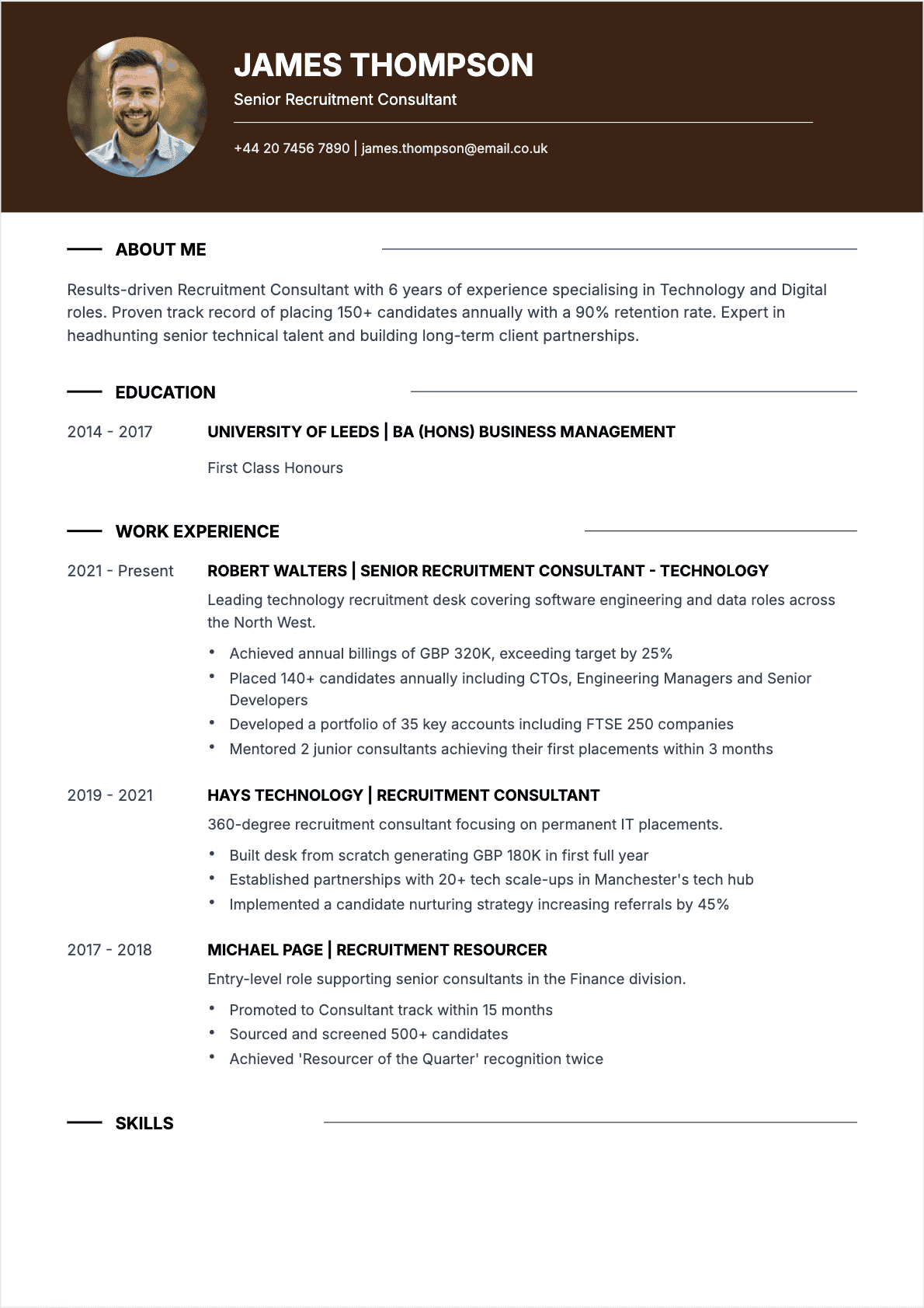
Recruiter Resume Templates
8 Templates available
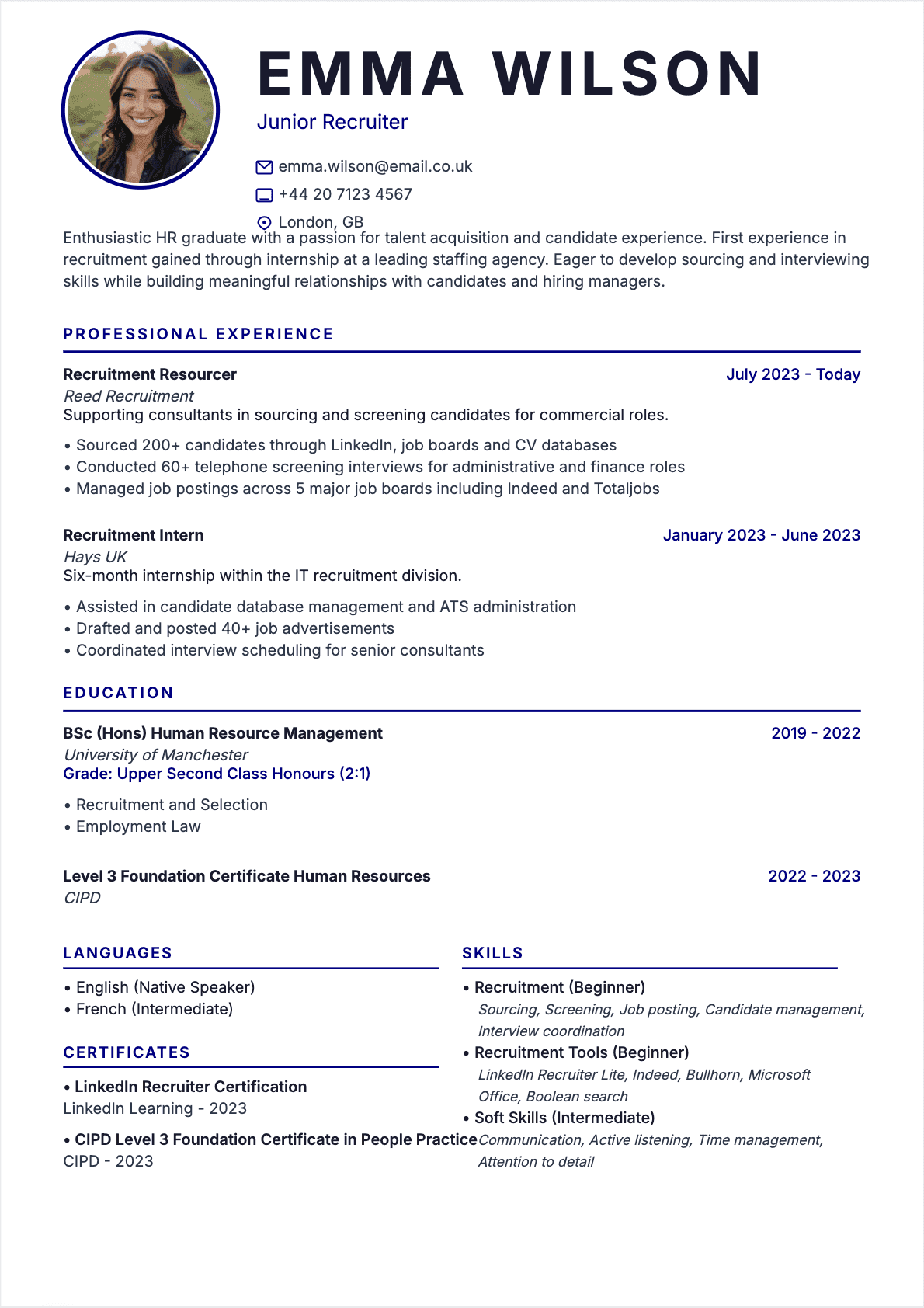
Resume Recruiter Junior
Recruiter resume template for Junior profile
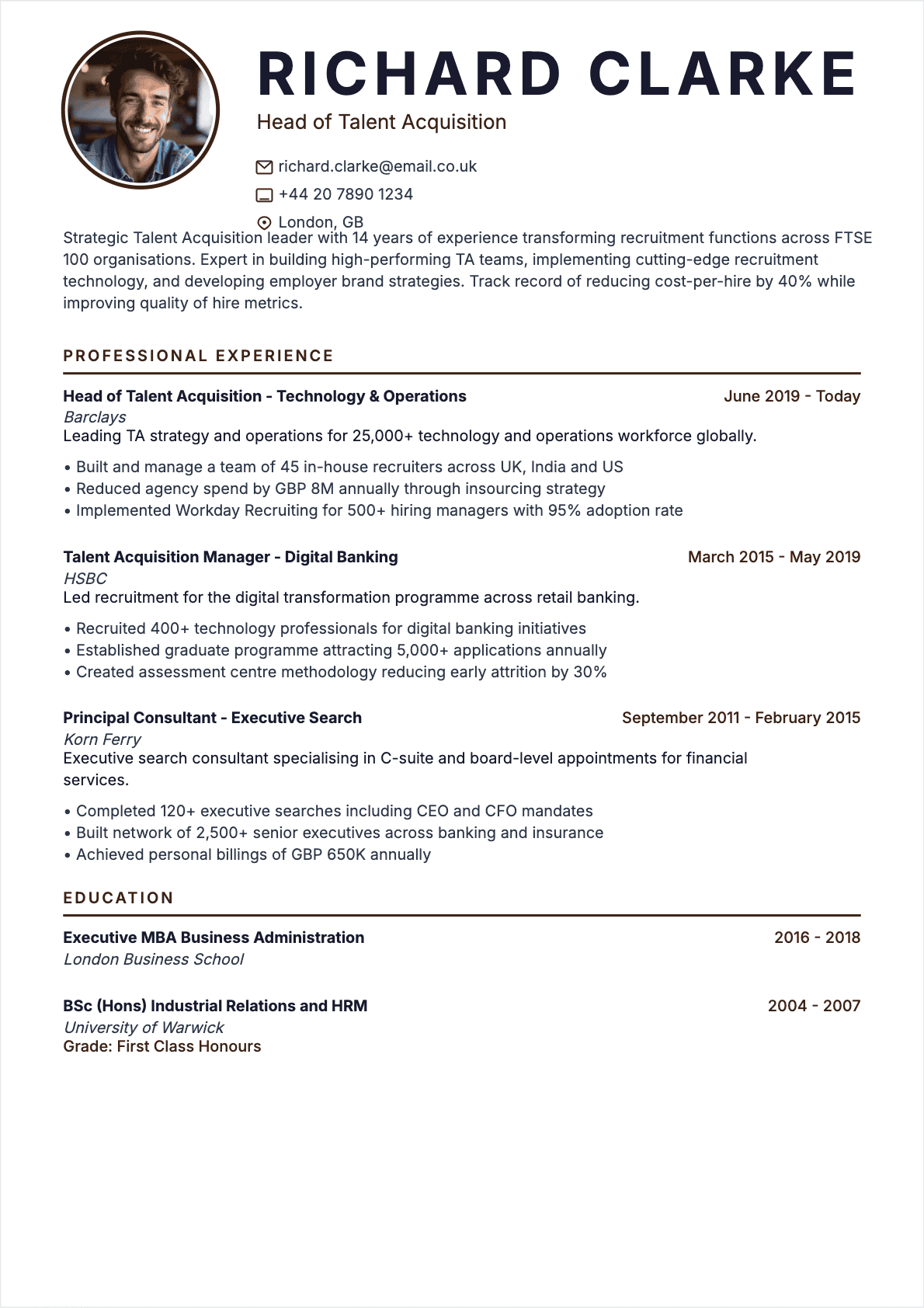
Resume Recruiter Senior
Recruiter resume template for Senior profile
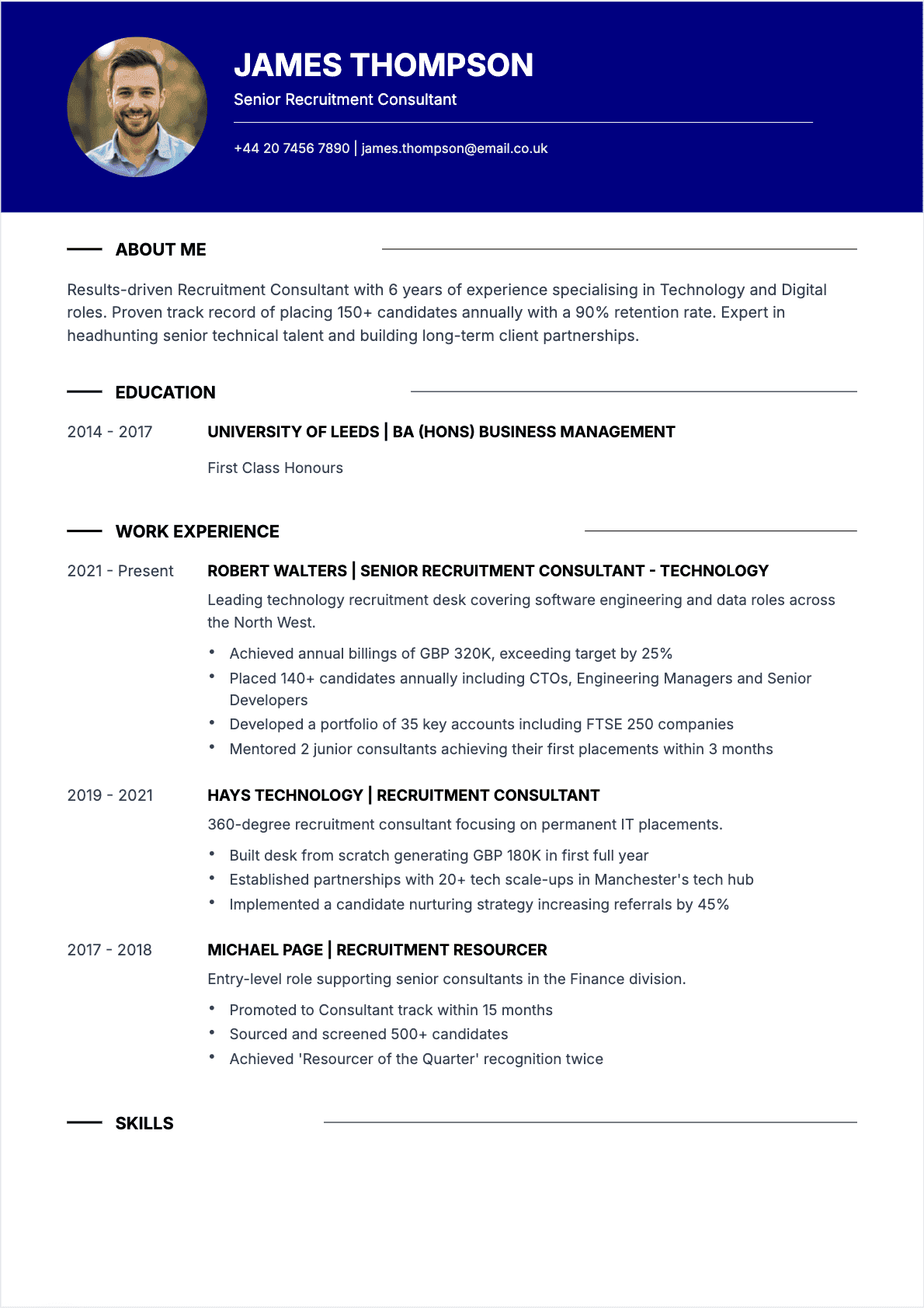
Resume Recruiter Confirmé
Recruiter resume template for Confirmé profile
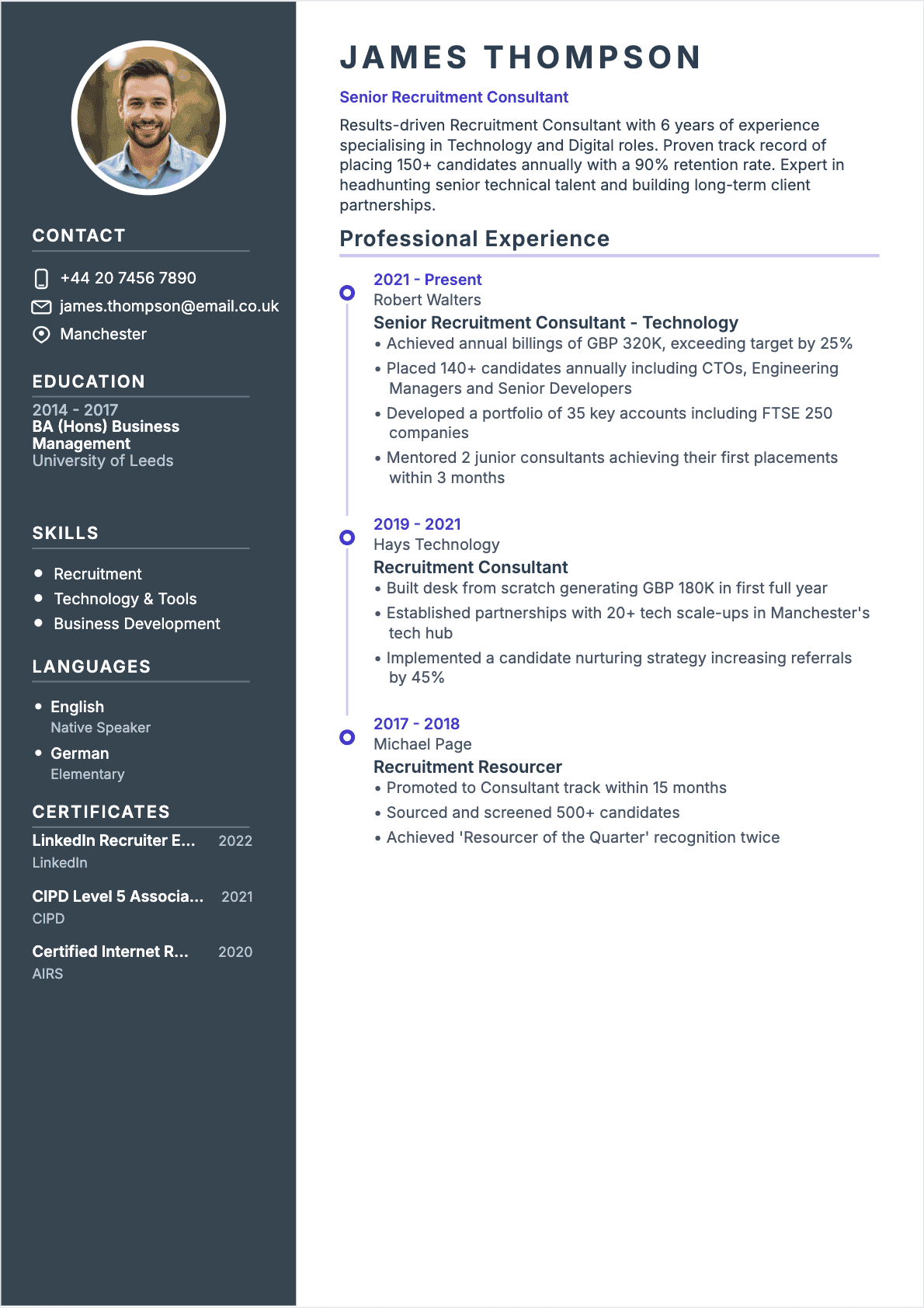
Resume Recruiter Confirmé
Recruiter resume template for Confirmé profile
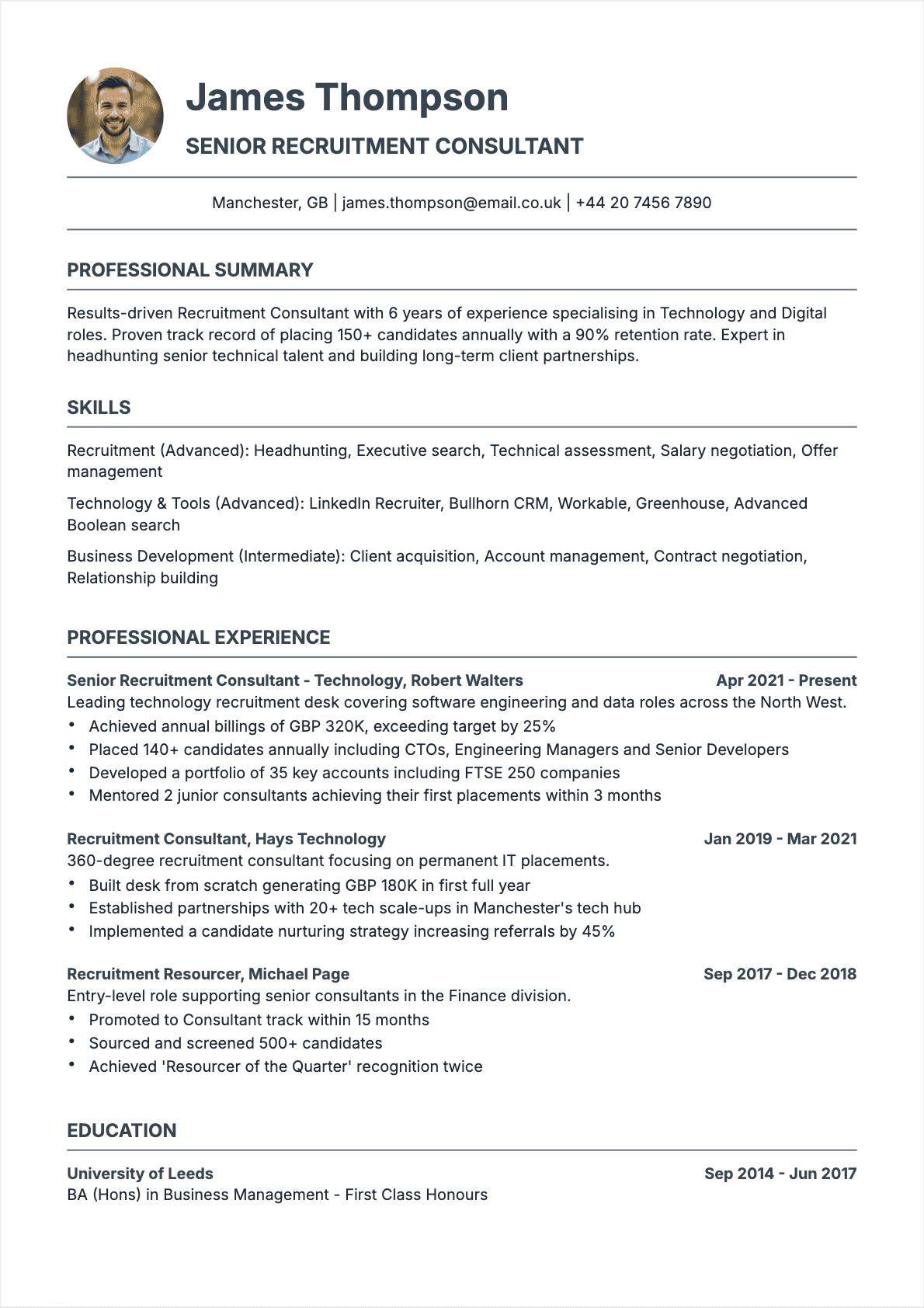
Resume Recruiter Confirmé
Recruiter resume template for Confirmé profile
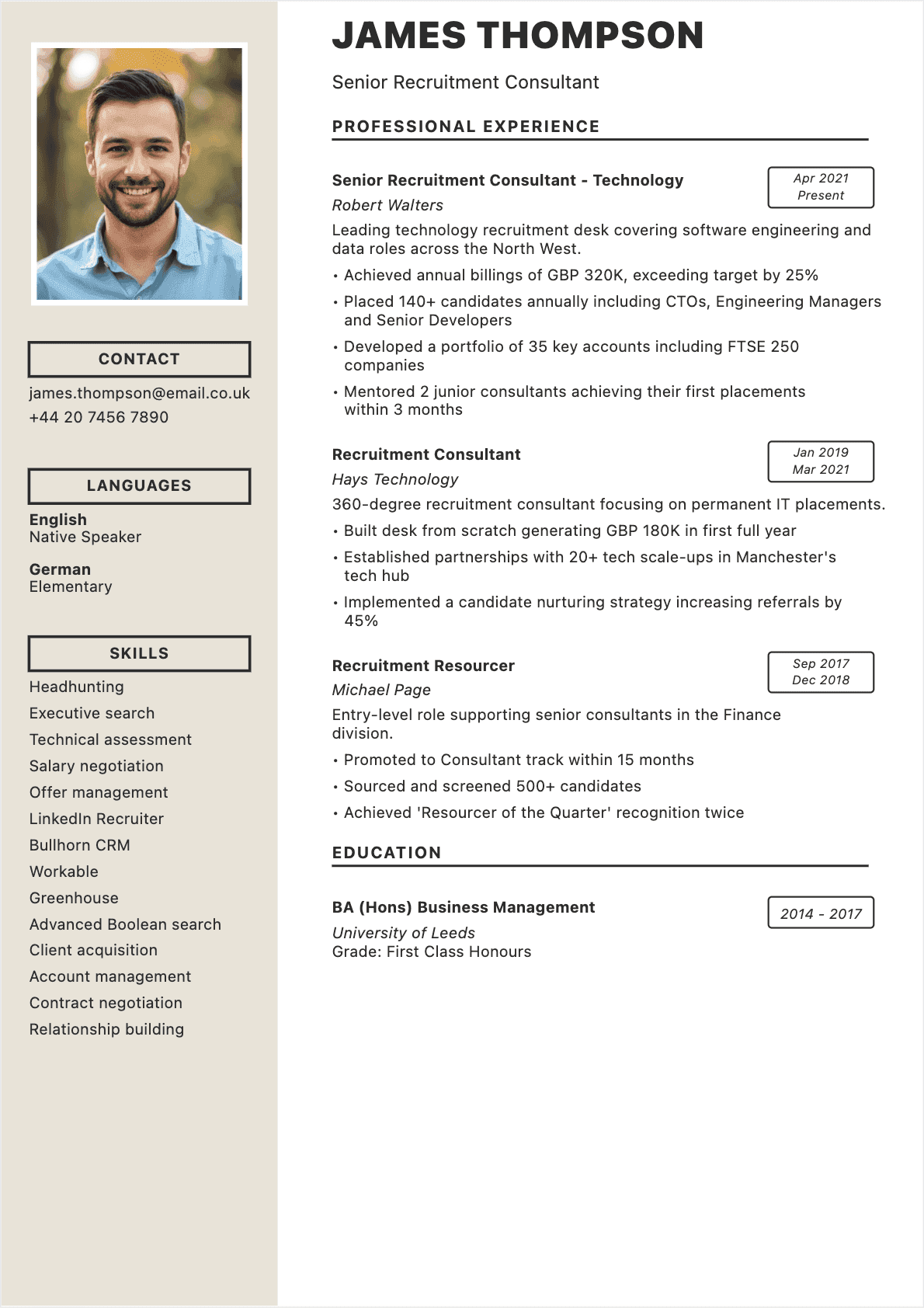
Resume Recruiter Confirmé
Recruiter resume template for Confirmé profile
Like one of these Recruiter resume templates?
Select it, fill in your details and download your resume as PDF.
Recruiter Resume Examples
James Thompson
Senior Recruitment Consultant
james.thompson@email.co.uk
+44 20 7456 7890
Manchester, GB
Results-driven Recruitment Consultant with 6 years of experience specialising in Technology and Digital roles. Proven track record of placing 150+ candidates annually with a 90% retention rate. Expert in headhunting senior technical talent and building long-term client partnerships.
Work Experience
Senior Recruitment Consultant - Technology
Robert Walters
- ●Achieved annual billings of GBP 320K, exceeding target by 25%
- ●Placed 140+ candidates annually including CTOs, Engineering Managers and Senior Developers
- ●Developed a portfolio of 35 key accounts including FTSE 250 companies
Recruitment Consultant
Hays Technology
- ●Built desk from scratch generating GBP 180K in first full year
- ●Established partnerships with 20+ tech scale-ups in Manchester's tech hub
- ●Implemented a candidate nurturing strategy increasing referrals by 45%
Recruitment Resourcer
Michael Page
- ●Promoted to Consultant track within 15 months
- ●Sourced and screened 500+ candidates
- ●Achieved 'Resourcer of the Quarter' recognition twice
Education
BA (Hons)
University of Leeds
Skills
Languages
English — Native Speaker
German — Elementary
Certifications
LinkedIn Recruiter ExpertLinkedIn
CIPD Level 5 Associate Diploma in People ManagementCIPD
Certified Internet Recruiter (CIR)AIRS
Recruiter role overview
Recruiters serve as the bridge between organizations seeking talent and professionals looking for their next opportunity. Your day revolves around sourcing candidates, screening applications, conducting interviews, and managing the entire hiring pipeline from initial contact to offer acceptance. You'll spend significant time on the phone, reviewing resumes, coordinating with hiring managers, and building relationships with both active and passive candidates.
The role demands constant multitasking across multiple open positions simultaneously. You might start your morning reviewing 50+ applications for a software engineer role, then jump into phone screens with three candidates for a marketing position, followed by a strategy meeting with a hiring manager about adjusting job requirements. Afternoons often involve coordinating interview schedules, negotiating offers, and updating your applicant tracking system while keeping all stakeholders informed of progress.
Career progression typically follows a clear path. Entry-level recruiters handle high-volume positions and learn the fundamentals of sourcing and screening. Mid-level recruiters take on more specialized or senior-level searches, often focusing on specific departments or harder-to-fill roles. Senior recruiters and talent acquisition managers oversee recruitment strategies, mentor junior team members, and work directly with executive leadership on workforce planning. Some recruiters transition into HR business partner roles, while others specialize in executive search or start their own recruitment agencies.
Salary expectations vary significantly by experience and location. Entry-level recruiters in the United States typically earn $45,000-$55,000 annually, with the potential for commission or placement bonuses adding another $5,000-$15,000. Mid-level recruiters with 3-5 years of experience command $60,000-$80,000 base salaries, with total compensation reaching $90,000-$110,000 when including performance bonuses. Senior recruiters and talent acquisition managers earn $85,000-$120,000 base, with top performers in competitive markets or specialized industries exceeding $150,000 total compensation.
Typical daily tasks include:
- Sourcing candidates through LinkedIn, job boards, employee referrals, and professional networks to build a pipeline of qualified talent
- Conducting phone screens and initial interviews to assess candidate qualifications, cultural fit, and salary expectations
- Coordinating interview schedules between candidates and multiple hiring team members across different time zones
- Updating applicant tracking systems with candidate notes, status changes, and communication history for compliance and reporting
- Partnering with hiring managers to refine job descriptions, adjust requirements, and develop effective sourcing strategies
- Negotiating offers, managing counteroffers, and guiding candidates through the decision-making process to secure acceptances
Essential skills for a Recruiter resume
Your resume needs to demonstrate both the technical recruiting capabilities and interpersonal skills that make you effective at connecting talent with opportunities. Hiring managers reviewing recruiter resumes look for evidence that you understand the full recruitment lifecycle, can work with applicant tracking systems efficiently, and have a track record of filling positions quickly with quality candidates. The skills you highlight should prove you can handle the volume, complexity, and relationship management that modern recruiting demands.
For ATS optimization, prioritize including the specific applicant tracking system names you've used (Greenhouse, Workday, Lever, iCIMS), sourcing tools (LinkedIn Recruiter, Boolean search), and any recruiting methodologies (full-cycle recruiting, passive candidate sourcing). Many companies filter for these exact terms when screening recruiter applications, so generic phrases like 'recruiting software' won't pass the initial scan.
Core skills to feature on your resume:
- Full-cycle recruiting: Demonstrates you can manage every stage from job requisition approval through offer acceptance, not just one piece of the process.
- Applicant Tracking Systems (ATS): Proficiency with platforms like Greenhouse, Workday, or Lever shows you can manage candidate pipelines efficiently and maintain compliance documentation.
- Boolean search techniques: Advanced search skills prove you can find passive candidates and hidden talent that basic keyword searches miss.
- LinkedIn Recruiter: This premium tool is standard in most recruiting roles, and expertise with its features signals you can source effectively.
- Interview coordination and scheduling: Managing complex calendars across multiple stakeholders while maintaining positive candidate experience requires specific organizational skills.
- Candidate relationship management: Building and maintaining talent pipelines for future opportunities demonstrates strategic thinking beyond immediate openings.
- Hiring metrics and reporting: Understanding time-to-fill, cost-per-hire, source effectiveness, and quality-of-hire shows you think analytically about recruitment performance.
- Salary negotiation: Successfully closing candidates requires understanding market rates, benefits packages, and how to position total compensation competitively.
- Employment law compliance: Knowledge of EEOC guidelines, OFCCP requirements, and fair hiring practices protects organizations from legal risk.
- Stakeholder management: Working effectively with hiring managers, executives, and candidates simultaneously requires diplomacy and clear communication.
- Employer branding: Contributing to how your organization attracts talent through social media, career pages, and candidate communications adds strategic value.
- High-volume recruiting: Experience managing 20+ open requisitions simultaneously or filling hundreds of positions annually demonstrates capacity and efficiency.

How to write a Recruiter resume step by step
1. Lead with recruiting metrics that prove your impact
Recruiters are measured by numbers, so your resume should immediately showcase your performance data. Include your average time-to-fill, number of positions filled annually, retention rates of your hires, and candidate satisfaction scores. Instead of 'Recruited for various positions,' write 'Filled 87 positions across engineering, sales, and operations with an average time-to-fill of 28 days, 15% faster than department average.'
2. Specify the types of roles and volume you've handled
Hiring managers need to know if your experience matches their recruiting needs. Detail whether you've focused on technical roles, executive search, high-volume hourly positions, or specialized functions. For example: 'Managed full-cycle recruitment for 15-20 concurrent software engineering positions ranging from junior developers to principal architects, with requisitions averaging $120K-$180K salary ranges.'
3. Name the tools and systems you've mastered
List specific applicant tracking systems, sourcing tools, and recruiting technologies by name. Write 'Utilized Greenhouse ATS to manage 200+ active candidates monthly, implementing automated workflows that reduced administrative time by 40%' rather than 'Used recruiting software to track candidates.' This specificity helps your resume pass ATS filters and proves immediate readiness.
4. Highlight your sourcing strategies and channels
Demonstrate how you find candidates beyond posting jobs and waiting for applications. Include details like: 'Developed passive candidate pipeline through LinkedIn Recruiter, Boolean search strings, and industry networking events, resulting in 60% of hires coming from proactive sourcing versus job board applications.'
5. Show collaboration with hiring managers and business leaders
Recruiting success depends on partnership with stakeholders. Illustrate this with examples such as: 'Partnered with VP of Sales to restructure account executive job requirements and compensation plan, reducing time-to-fill from 65 days to 34 days and improving offer acceptance rate from 62% to 89%.'
6. Include candidate experience improvements you've implemented
Modern recruiting emphasizes the candidate journey. Showcase initiatives like: 'Redesigned interview process to include structured scorecards and same-day feedback, increasing candidate satisfaction scores from 3.2 to 4.6 out of 5 and reducing candidate drop-off rate by 28%.'
7. Demonstrate industry or specialization expertise
If you've focused on specific sectors or role types, make this clear. For instance: 'Specialized in healthcare recruiting with deep knowledge of nursing credentials, state licensing requirements, and clinical role hierarchies, successfully filling 120+ RN, LPN, and allied health positions annually.'
8. Quantify your contribution to diversity and compliance goals
Organizations prioritize diverse hiring, so include relevant achievements: 'Expanded sourcing channels to include NSBE, Women Who Code, and HBCU partnerships, increasing diverse candidate slate representation from 23% to 47% while maintaining full OFCCP compliance across all requisitions.'
Before and after examples:
Weak: Responsible for recruiting various positions across the company.
Strong: Managed full-cycle recruitment for 45+ annual hires across finance, marketing, and operations functions, achieving 92% hiring manager satisfaction and 18-month retention rate of 87%.
Weak: Used LinkedIn to find candidates and conducted interviews.
Strong: Sourced 200+ qualified candidates monthly through LinkedIn Recruiter and Boolean search techniques, conducting 30-40 phone screens weekly with 35% conversion rate to hiring manager interviews.
Weak: Worked with hiring managers on job requirements.
Strong: Consulted with 12 department heads to refine job descriptions, adjust salary ranges, and identify must-have versus nice-to-have qualifications, reducing average time-to-fill by 22 days.
Common mistakes on Recruiter resumes
Listing responsibilities instead of recruiting outcomes
Many recruiter resumes simply describe what recruiters do rather than what you specifically achieved. Writing 'Managed full recruitment cycle' tells hiring managers nothing about your effectiveness. Instead, they need to see 'Reduced average time-to-fill from 52 days to 31 days while improving quality-of-hire scores by 18% as measured by 90-day manager satisfaction surveys.' Your resume should answer: How many positions did you fill? How quickly? How well did those hires perform?
Failing to specify role types and seniority levels
A recruiter who fills 200 retail positions annually has very different skills than one who fills 15 director-level roles. If your resume just says 'recruited for various positions,' hiring managers can't assess fit. Be explicit: 'Specialized in technical recruiting for software engineers, data scientists, and product managers at mid to senior levels ($100K-$200K salary ranges)' or 'Managed high-volume hourly recruiting for warehouse and customer service roles, filling 300+ positions annually with 45-day retention rate of 82%.'
Omitting the applicant tracking systems you've used
Recruiters should know better than anyone that ATS keywords matter, yet many forget to list the specific systems they've used. Don't write 'proficient in recruiting software.' Name them: Greenhouse, Workday Recruiting, Lever, iCIMS, Taleo, or whatever platforms you've actually used. Companies often filter specifically for candidates experienced with their current ATS because training time matters.
Vague sourcing claims without channel breakdowns
Stating 'sourced candidates from multiple channels' doesn't prove sourcing capability. Hiring managers want to know: 'Generated candidate pipeline with 45% from LinkedIn Recruiter proactive outreach, 25% from employee referrals, 20% from Boolean searches on GitHub and Stack Overflow, and 10% from industry conferences and meetups.' This specificity shows strategic thinking about where different types of candidates are found.
Missing diversity, equity, and inclusion contributions
DEI is a priority for most organizations, and recruiters play a central role in diverse hiring. If you've contributed to these efforts, your resume should reflect it with concrete examples: 'Expanded university recruiting partnerships to include 8 additional HBCUs and Hispanic-serving institutions, increasing diverse early-career candidate applications by 156%.' Omitting this work means missing a key evaluation criterion.
No evidence of stakeholder management skills
Recruiting isn't just about finding candidates—it's about managing hiring managers, executives, and other stakeholders with competing priorities. Your resume should include examples like: 'Managed expectations across 15 hiring managers with varying urgency levels, implementing weekly status reports and monthly recruiting metrics reviews that improved stakeholder satisfaction scores from 72% to 91%.'
Generic bullet points that could apply to any recruiter
Phrases like 'conducted interviews' or 'posted job openings' waste resume space because they're assumed baseline activities. Every bullet point should contain specific numbers, methods, or outcomes: 'Conducted 600+ phone screens annually using structured interview guides and competency-based questions, achieving 40% pass-through rate to hiring manager interviews compared to team average of 28%.' The specificity proves both volume capacity and quality judgment.
Recruiter resume trends in 2026
Artificial intelligence is fundamentally changing what organizations expect from recruiters. Companies now assume you'll use AI-powered sourcing tools, automated candidate screening, and chatbots for initial candidate engagement. Your resume should demonstrate comfort with these technologies rather than resistance to them. Highlight experience with tools like HireVue for video interview analysis, Paradox or Olivia for candidate communication automation, or AI-enhanced ATS features that rank candidates. The recruiters who thrive are those who use AI to handle repetitive tasks while focusing their human judgment on relationship building, cultural assessment, and complex negotiations that technology can't replicate.
Skills-based hiring is replacing degree requirements across industries, which changes how recruiters need to evaluate candidates. Your resume should show you can assess candidates based on demonstrated competencies rather than just credentials. Include examples of how you've implemented skills assessments, work sample tests, or portfolio reviews in your hiring process. Mention if you've worked with platforms like Criteria Corp, TestGorilla, or Codility for skills validation. Organizations want recruiters who can identify talent from nontraditional backgrounds and build diverse pipelines that degree-focused searches would miss.
Data literacy has become non-negotiable for recruiters. Hiring managers expect you to analyze recruiting funnel metrics, identify bottlenecks, and make evidence-based recommendations for process improvements. Your resume should showcase specific analytics work: 'Analyzed 18 months of recruiting data to identify that candidates sourced through employee referrals had 34% higher retention rates, leading to implementation of enhanced referral bonus program that increased referral hires from 18% to 31% of total hires.' Familiarity with recruiting analytics dashboards, SQL for data extraction, or Excel/Google Sheets for analysis strengthens your candidacy.
Remote and hybrid work has expanded talent pools geographically while creating new recruiting challenges. Organizations value recruiters who can source nationally or globally, understand remote work compensation strategies, and assess candidates for distributed team success. Your resume should address this if relevant: 'Expanded recruiting reach from local metro area to nationwide search, building remote candidate pipelines that reduced average salary costs by 15% while maintaining quality-of-hire standards.' Experience with asynchronous video interviews, virtual assessment centers, or remote onboarding processes demonstrates readiness for distributed hiring.
Candidate experience has elevated from nice-to-have to competitive requirement. Top employers track candidate Net Promoter Scores, Glassdoor reviews, and survey feedback throughout the hiring process. Your resume should include candidate experience metrics: 'Redesigned candidate communication cadence to include weekly status updates and personalized rejection feedback, improving candidate experience rating from 3.8 to 4.5 stars and increasing offer acceptance rate by 12%.' Mention any candidate relationship management systems, automated communication workflows, or feedback collection processes you've implemented.
Internal mobility and talent marketplace programs are becoming recruiting priorities as organizations focus on retention and development. Companies want recruiters who can identify internal candidates for open positions and facilitate career growth. If you've worked on internal recruiting, highlight it: 'Launched internal talent marketplace connecting 200+ employees with project opportunities and open positions, resulting in 28% of roles filled internally and reducing external recruiting costs by $340K annually.' This trend means recruiters increasingly need to understand career pathing, skills adjacency, and employee development alongside traditional external recruiting.
Further reading:
Frequently asked questions
Find answers to the most frequently asked questions.
In recruitment, a CV is the candidate’s document summarizing experience, skills, education, and qualifications. Recruiters use it to assess fit against the job requirements, check timelines, and shortlist applicants. In the US, most employers expect a resume; in academia or some countries, CVs are longer and more detailed.
CV stands for “curriculum vitae,” Latin for “course of life.” In many regions it refers to a professional document similar to a resume. The meaning depends on the job market: in the US, a CV is typically used for academic, research, or medical roles, while most other jobs use a resume.
A resume is usually 1–2 pages and tailored to a specific job, focusing on relevant experience and achievements. A CV can be longer and more comprehensive, listing publications, research, and detailed history. For a recruiter job in the US, a concise recruiter resume in an ATS-friendly format is typically the best choice.
Yes. You can hire a resume writer or use a resume builder with a resume template. Choose providers who show recruiter resume example work, explain their process, and ask for the job description up front. Expect to pay roughly $150–$600 depending on seniority, turnaround, and LinkedIn optimization.
Recruiters scan a resume for job titles, recency, scope (req volume), and keywords that match the job description. They also look for measurable results like hires, time-to-fill, and conversion rates. Many teams use an applicant tracking system to parse the resume, so clean format and exact terms matter.
For most job seekers, 1 page works up to about 5–7 years of experience; 2 pages is acceptable for a senior recruiter resume with multiple employers, leadership, or specialized recruiting experience. Prioritize relevance: keep the experience section focused on outcomes and remove older roles that don’t support the specific job.
Your career deserves a better resume
With CVtoWork, select a template, fill in the fields and download your resume as PDF.
Start creating