Product Manager Resume
Example, Template & Expert Tips 2026
Updated on April 18, 2026.
Build a Product Manager CV that passes ATS and wins interviews. Real examples, quantified achievements, skills, keywords, and 2026 formatting tips.
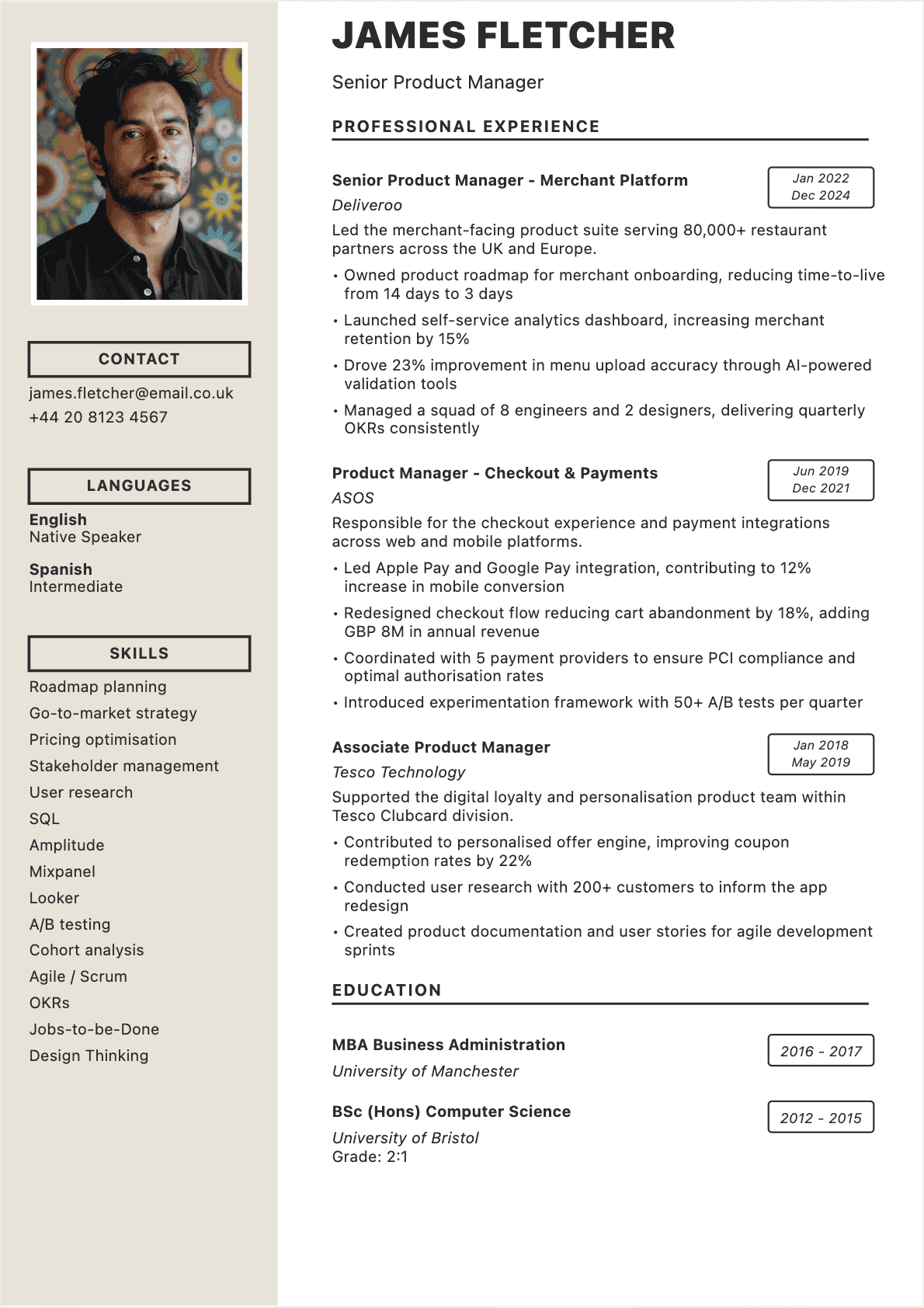
Product Manager Resume Templates
8 Templates available
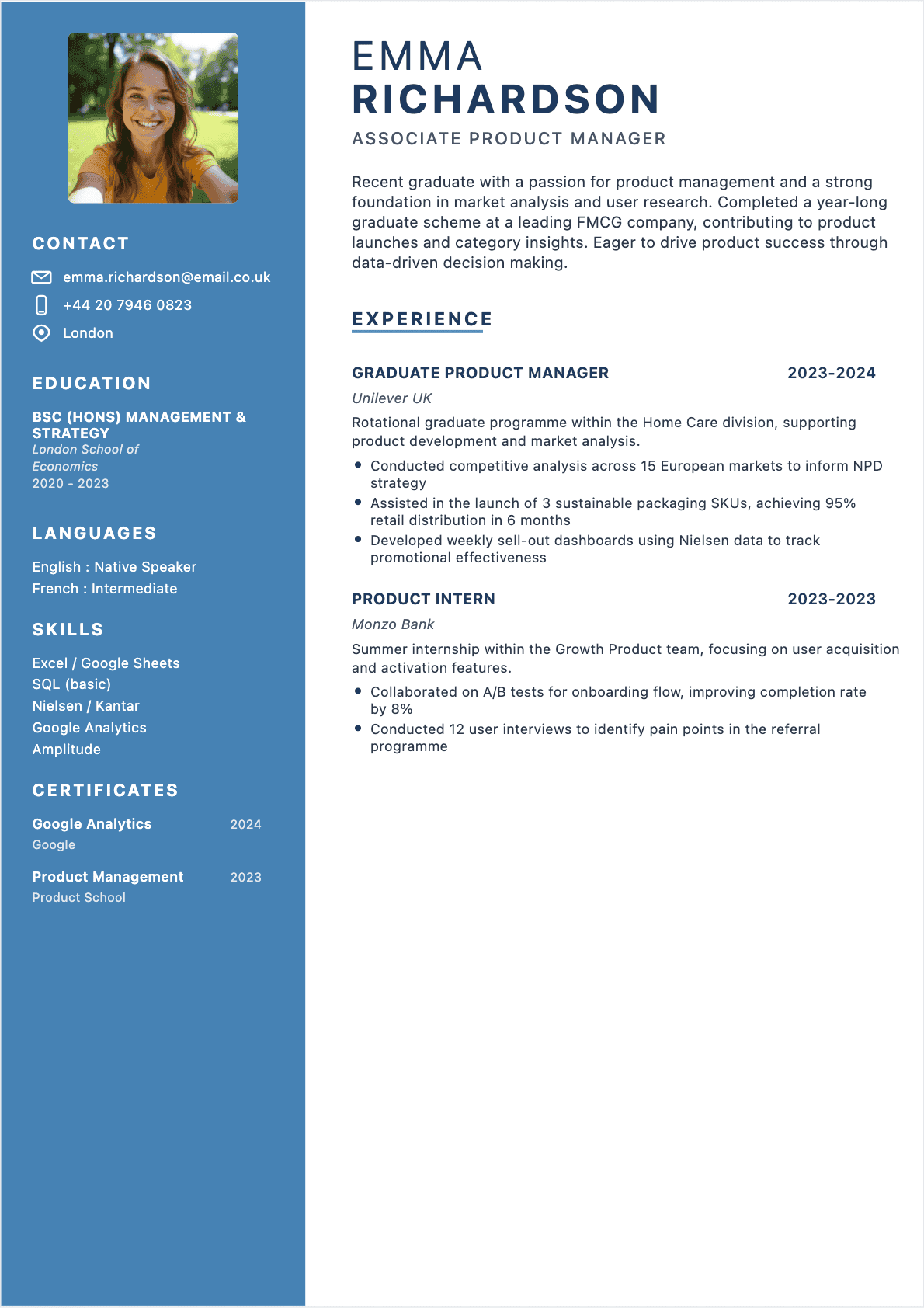
Resume Product Manager Junior
Product Manager resume template for Junior profile
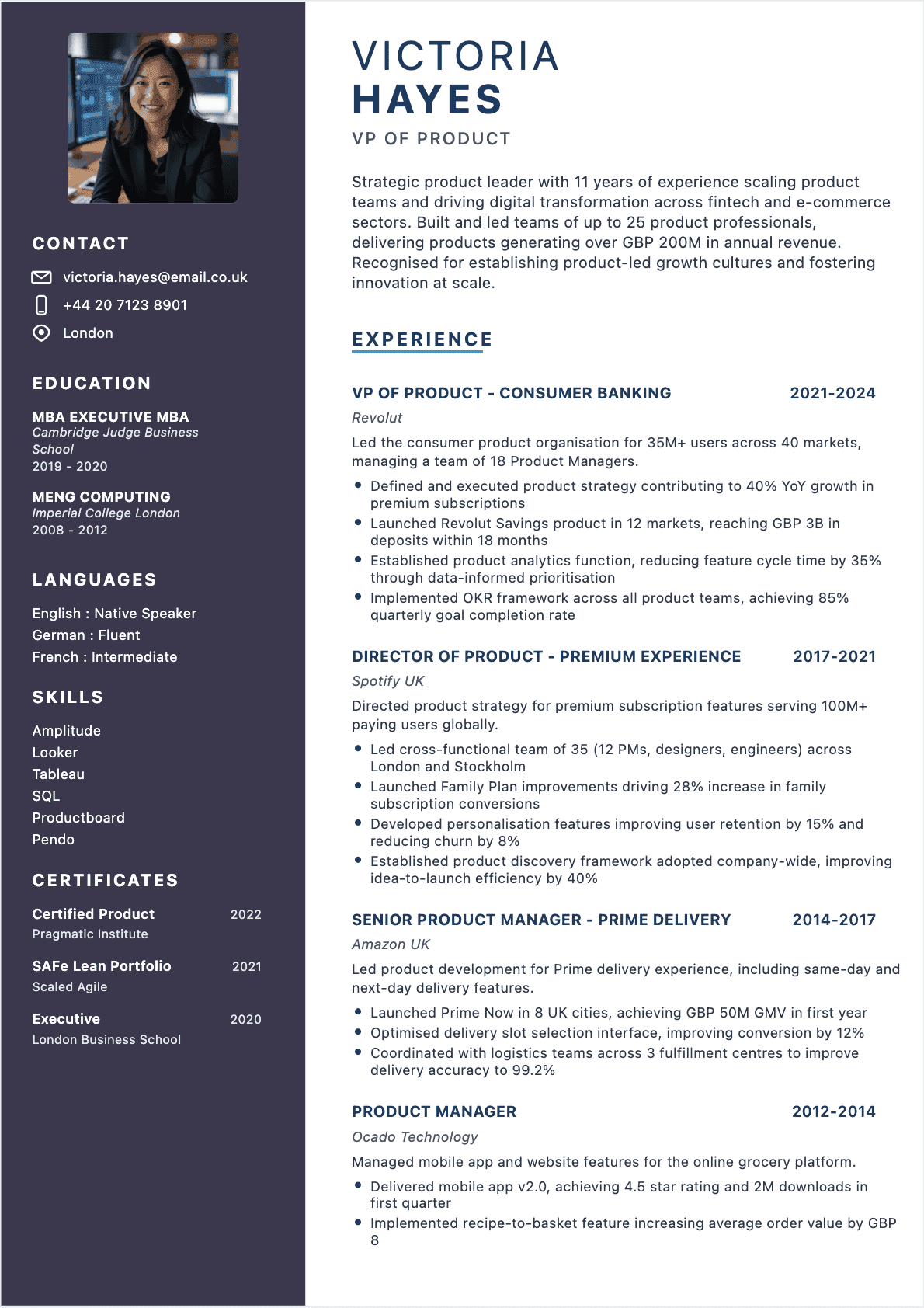
Resume Product Manager Senior
Product Manager resume template for Senior profile
Resume Product Manager Confirmé
Product Manager resume template for Confirmé profile
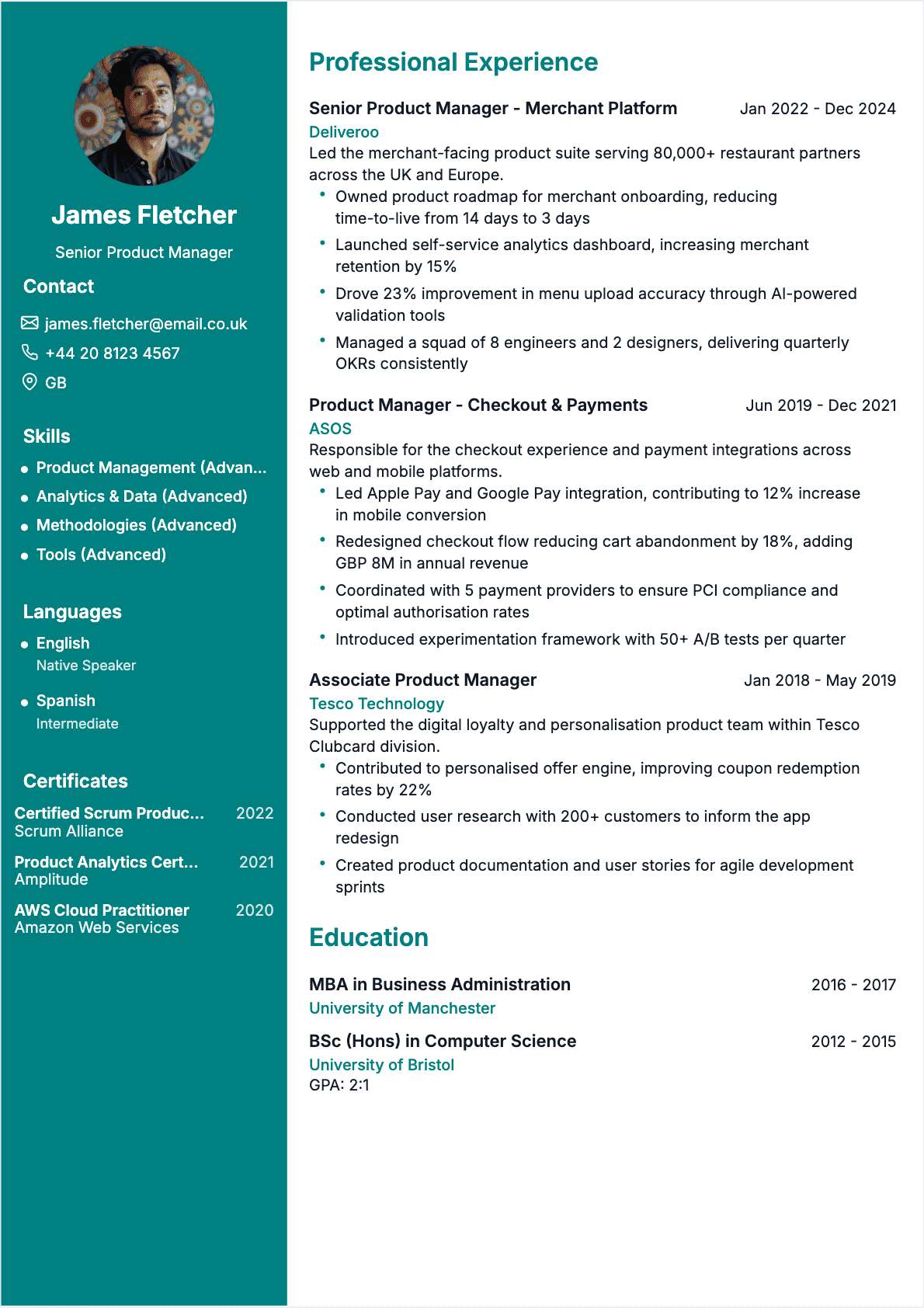
Resume Product Manager Confirmé
Product Manager resume template for Confirmé profile
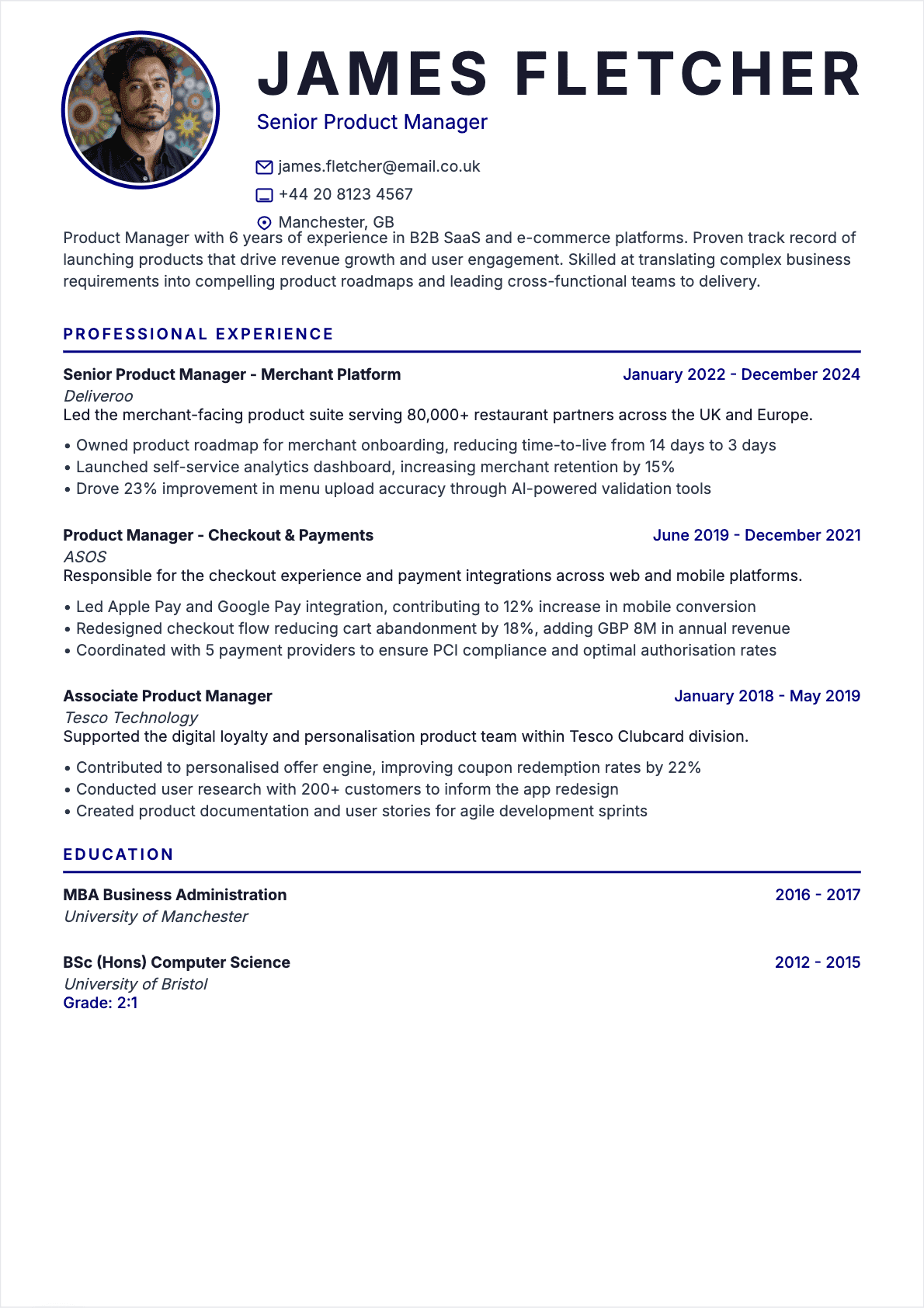
Resume Product Manager Confirmé
Product Manager resume template for Confirmé profile
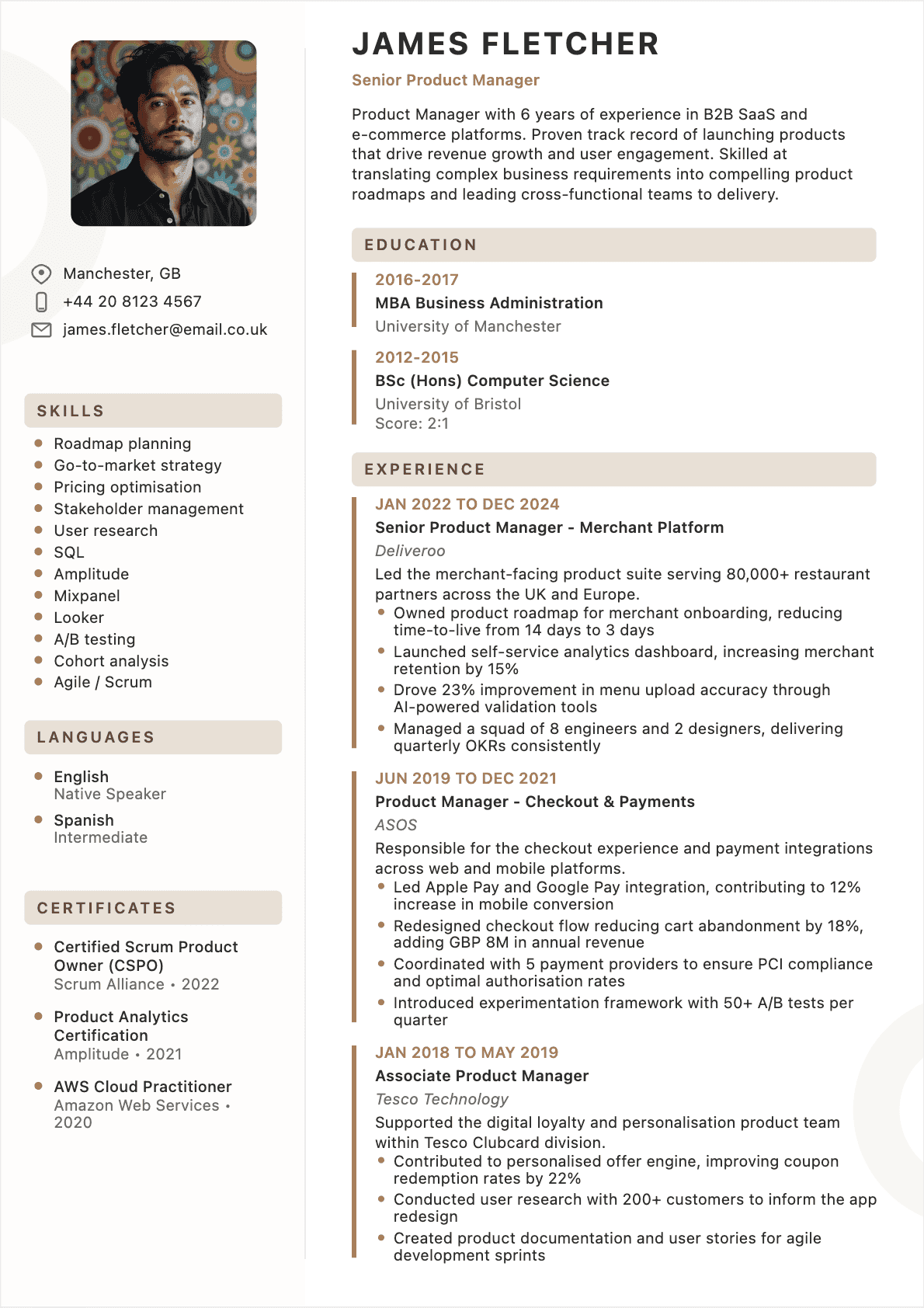
Resume Product Manager Confirmé
PopularProduct Manager resume template for Confirmé profile
Like one of these Product Manager resume templates?
Select it, fill in your details and download your resume as PDF.
Product Manager Resume Examples
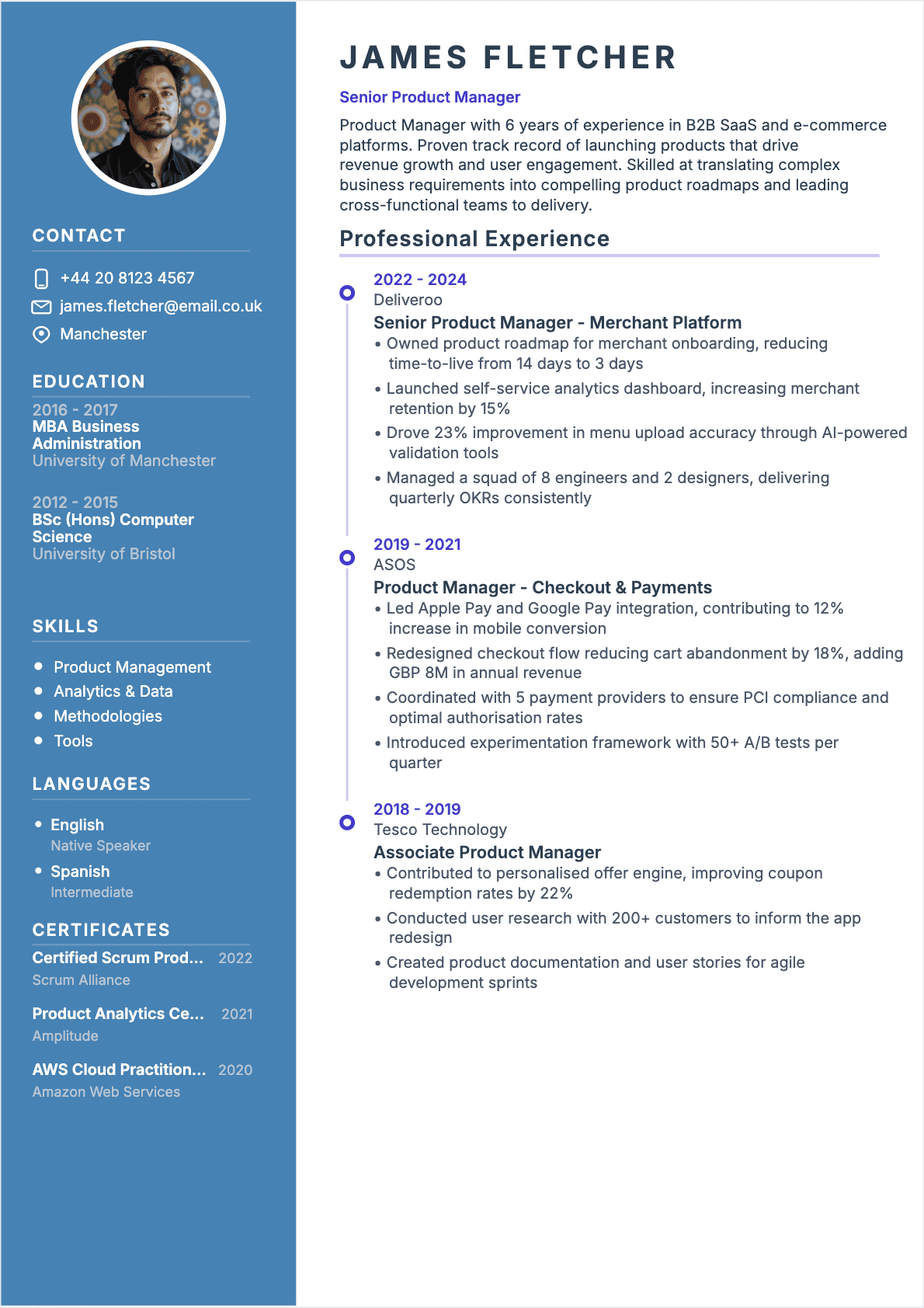
James Fletcher
Senior Product Manager
james.fletcher@email.co.uk
+44 20 8123 4567
Manchester, GB
Product Manager with 6 years of experience in B2B SaaS and e-commerce platforms. Proven track record of launching products that drive revenue growth and user engagement. Skilled at translating complex business requirements into compelling product roadmaps and leading cross-functional teams to delivery.
Work Experience
Senior Product Manager - Merchant Platform
Deliveroo
- ●Owned product roadmap for merchant onboarding, reducing time-to-live from 14 days to 3 days
- ●Launched self-service analytics dashboard, increasing merchant retention by 15%
- ●Drove 23% improvement in menu upload accuracy through AI-powered validation tools
Product Manager - Checkout & Payments
ASOS
- ●Led Apple Pay and Google Pay integration, contributing to 12% increase in mobile conversion
- ●Redesigned checkout flow reducing cart abandonment by 18%, adding GBP 8M in annual revenue
- ●Coordinated with 5 payment providers to ensure PCI compliance and optimal authorisation rates
Associate Product Manager
Tesco Technology
- ●Contributed to personalised offer engine, improving coupon redemption rates by 22%
- ●Conducted user research with 200+ customers to inform the app redesign
- ●Created product documentation and user stories for agile development sprints
Education
MBA
University of Manchester
BSc (Hons)
University of Bristol
Skills
Languages
English — Native Speaker
Spanish — Intermediate
Certifications
Certified Scrum Product Owner (CSPO)Scrum Alliance
Product Analytics CertificationAmplitude
AWS Cloud PractitionerAmazon Web Services
Product Manager role overview
Product Managers sit at the intersection of business, technology, and user experience, making strategic decisions about what gets built and why. You'll spend your days defining product vision, prioritizing features, and coordinating cross-functional teams to deliver solutions that meet both user needs and business objectives. This role requires constant communication with engineers, designers, marketers, and stakeholders while making data-driven decisions about product direction.
The day-to-day work involves analyzing user feedback and metrics, writing detailed product requirements, facilitating sprint planning sessions, and removing blockers that slow down development teams. You'll conduct competitive research, create product roadmaps, and present updates to executives. Much of your time goes into saying 'no' to feature requests that don't align with strategic goals, which requires strong judgment and the ability to defend your decisions with data.
Career progression typically follows this path: Associate Product Manager (0-2 years) earning £35,000-£50,000, Product Manager (2-5 years) at £55,000-£80,000, Senior Product Manager (5-8 years) earning £80,000-£110,000, Lead/Principal Product Manager (8-12 years) at £110,000-£140,000, and Head of Product or VP Product (12+ years) commanding £140,000-£200,000+. Some Product Managers transition into Chief Product Officer roles or pivot to CEO positions, particularly in tech startups.
Typical daily tasks include:
- Reviewing product analytics dashboards to identify usage patterns, drop-off points, and opportunities for improvement
- Writing user stories and acceptance criteria that clearly communicate requirements to engineering teams
- Conducting user interviews or analyzing customer support tickets to understand pain points and validate assumptions
- Facilitating standup meetings, sprint planning sessions, and retrospectives with development teams
- Updating the product roadmap based on changing priorities, new data, or strategic shifts
- Presenting product performance metrics and upcoming initiatives to leadership and stakeholders
Essential skills for a Product Manager resume
Product Manager resumes need to demonstrate both strategic thinking and hands-on execution capabilities. Recruiters scan for evidence that you can translate business goals into technical requirements while keeping teams aligned and productive. The skills you highlight should prove you can make difficult prioritization decisions, communicate effectively across departments, and drive measurable business outcomes.
ATS systems typically scan for specific tools and methodologies, so include exact names of frameworks you've used (Agile, Scrum, OKRs) and software platforms (Jira, Productboard, Amplitude). However, context matters more than keywords alone—show how you applied these skills to achieve results. For technical Product Manager roles, include API knowledge, SQL proficiency, or familiarity with development processes. For consumer product roles, emphasize user research methods and A/B testing experience.
Core skills to include:
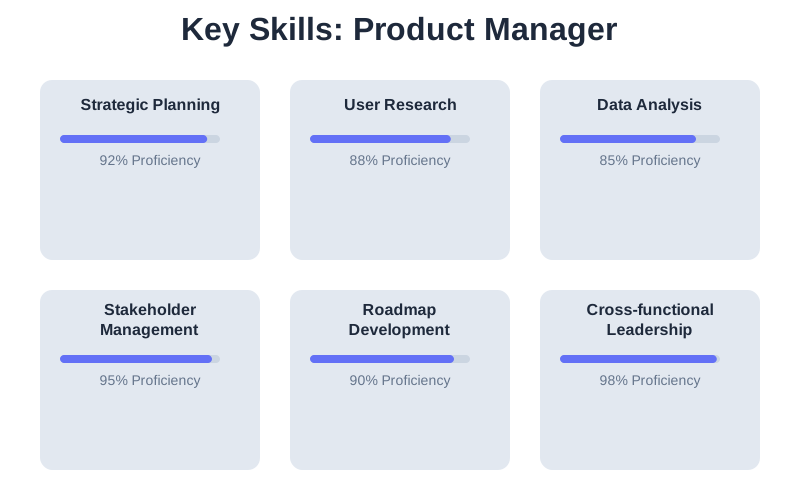
- Product roadmap development – Demonstrates your ability to set strategic direction and sequence initiatives based on business value and technical dependencies
- User research and customer discovery – Shows you make decisions based on real user needs rather than assumptions or internal opinions
- Data analysis and SQL – Proves you can extract insights from databases independently without waiting for analyst support
- A/B testing and experimentation – Indicates you validate hypotheses before full rollouts and make evidence-based decisions
- Agile/Scrum methodologies – Essential for working effectively with engineering teams and managing iterative development cycles
- Wireframing and prototyping tools (Figma, Sketch, Miro) – Shows you can communicate design ideas visually and collaborate with designers
- Technical documentation – Critical for writing clear PRDs, API specifications, and requirements that engineers can implement
- Stakeholder management – Demonstrates your ability to align diverse groups, manage expectations, and secure buy-in for decisions
- Go-to-market strategy – Proves you think beyond building features to launching and promoting products successfully
- Analytics platforms (Google Analytics, Mixpanel, Amplitude) – Shows you monitor product health and user behavior systematically
- Prioritization frameworks (RICE, MoSCoW, Kano) – Indicates you use structured approaches to make difficult trade-off decisions
- API and technical architecture understanding – Particularly important for B2B or platform products where technical constraints shape possibilities
How to write a Product Manager resume step by step
1. Start with a results-focused summary that quantifies your product impact
Your opening summary should immediately communicate the scale and outcomes of products you've managed. Include specific metrics like user growth, revenue generated, or efficiency gains. Instead of 'Experienced Product Manager with strong leadership skills,' write 'Product Manager who grew SaaS platform from 12K to 180K users in 18 months while reducing churn by 34% through data-driven feature prioritization.'
2. Structure each role with context before listing achievements
Begin each position with a brief sentence explaining the product, your scope, and team size. This context helps recruiters understand the complexity of your work. For example: 'Led product strategy for B2B analytics platform serving 400+ enterprise clients, managing roadmap for team of 8 engineers and 2 designers.' Then follow with bullet points detailing specific achievements.
3. Write achievement bullets using the Challenge-Action-Result formula
Each bullet should tell a mini-story: what problem existed, what you did, and what measurable outcome resulted. Bad example: 'Improved user onboarding process.' Good example: 'Redesigned 7-step onboarding flow based on user testing with 45 customers, reducing time-to-first-value from 12 days to 3 days and increasing activation rate from 23% to 61%.' Notice the specific numbers and clear cause-effect relationship.
4. Emphasize cross-functional leadership and influence without authority
Product Managers rarely have direct reports but must drive results through influence. Highlight how you aligned teams and stakeholders. Instead of 'Worked with engineering team,' write 'Facilitated weekly prioritization sessions with engineering, design, and marketing teams, establishing shared OKRs that reduced feature delivery time by 40% while maintaining 98% on-time release rate.'
5. Include both strategic initiatives and tactical execution
Balance big-picture strategy with hands-on work. Show you can set vision and execute details. Example: 'Defined 3-year product vision and quarterly roadmap for mobile app, then wrote 200+ user stories with acceptance criteria, conducted 30+ user interviews, and analyzed SQL queries across 2M user sessions to validate feature priorities.'
6. Demonstrate data literacy with specific analytical work
Product Managers must prove they make decisions based on data, not opinions. Instead of 'Used analytics to improve product,' write 'Built cohort analysis in SQL examining 6-month retention patterns across 15 user segments, identifying that users who completed tutorial had 5x higher retention, leading to mandatory onboarding redesign that improved 90-day retention from 34% to 52%.'
7. Show business impact, not just feature launches
Recruiters want to see how your product work affected company metrics. Bad: 'Launched payment feature.' Good: 'Shipped integrated payment system supporting 6 currencies and 12 payment methods, processing £4.2M in first quarter and reducing transaction abandonment from 28% to 11%, directly contributing to 23% revenue increase.'
8. Tailor technical depth to the role requirements
For technical Product Manager positions, include API work, integration projects, and technical architecture decisions. For consumer product roles, emphasize user research, design collaboration, and growth experiments. Review the job description and mirror the technical depth they're seeking—don't oversell technical skills for a consumer-focused role or undersell them for a platform position.
Common mistakes on Product Manager resumes
Listing features shipped without explaining why they mattered or what they achieved. Many Product Manager resumes read like release notes: 'Launched search functionality,' 'Built notification system,' 'Added export feature.' These statements prove you shipped things but not that you made good decisions about what to build. Recruiters want to see: 'Prioritized search functionality over 14 other requested features based on analysis showing 67% of support tickets involved users unable to find content, resulting in 45% reduction in support volume and 4.2-point NPS increase.' Always connect features to business outcomes or user problems solved.
Claiming ownership of team results without clarifying your specific contribution. Writing 'My team increased revenue by £2M' raises questions about what you personally did versus what engineers, designers, or marketers accomplished. Better approach: 'Defined pricing strategy and feature packaging for enterprise tier based on analysis of 200+ sales calls, working with engineering to build usage-based billing system that generated £2M in new revenue within 6 months.' This shows your strategic decision-making while acknowledging the team execution.
Using vague product management jargon without concrete examples. Phrases like 'drove product vision,' 'aligned stakeholders,' or 'prioritized roadmap' appear on every Product Manager resume and mean nothing without specifics. What vision did you drive, and how did it change the product direction? Which stakeholders had conflicting priorities, and how did you resolve them? Replace generic statements with specific situations: 'Resolved conflict between sales team requesting enterprise features and engineering team focused on technical debt by creating shared scoring framework that evaluated requests on revenue potential, implementation cost, and strategic alignment—resulting in consensus roadmap approved by both teams.'
Failing to demonstrate user-centricity and research rigor. Product Managers who make decisions based on gut feeling rather than user insight are a major red flag. Avoid statements like 'Identified user needs' without explaining your research methodology. Instead: 'Conducted 40 user interviews and analyzed behavioral data from 50K sessions to identify that 73% of users abandoned checkout due to unclear shipping costs, leading to redesign that increased conversion by 28%.' Show your research process and how insights translated to decisions.
Omitting failure, pivots, or learning experiences. The best Product Managers kill bad ideas quickly and learn from experiments that don't work. A resume showing only successes suggests either dishonesty or inability to take risks. Include examples like: 'Hypothesized that gamification would increase engagement, ran 6-week A/B test with 10K users, found no significant impact on retention, and reallocated engineering resources to notification improvements that did increase engagement by 31%.' This demonstrates scientific thinking and intellectual honesty.
Neglecting to show technical collaboration depth. Many resumes say 'worked with engineering teams' but don't prove you can have meaningful technical conversations. Include specifics: 'Collaborated with engineering to evaluate PostgreSQL vs. MongoDB for new feature, weighing query performance requirements against development timeline, ultimately choosing PostgreSQL which supported 2000 concurrent users with sub-100ms response times.' This shows you participate in technical decisions rather than just making feature requests.
Presenting yourself as order-taker rather than strategic decision-maker. Phrases like 'gathered requirements from stakeholders' or 'implemented requested features' suggest you execute others' ideas rather than driving product strategy. Product Managers must show they push back on bad ideas and champion better solutions. Instead of 'Built features requested by sales team,' write 'Evaluated 23 feature requests from sales, conducted win/loss analysis on 50 deals, determined that integration capabilities drove 80% of enterprise wins, and prioritized API development over 18 other requests—resulting in 12 new enterprise deals worth £1.8M in following quarter.'
Product Manager resume trends in 2026
AI-assisted product development has fundamentally changed what companies expect from Product Managers in 2026. You're now expected to understand how to integrate AI features thoughtfully, evaluate AI/ML model performance, and make decisions about when automation adds value versus when human judgment remains essential. Resumes should demonstrate experience with AI tools for user research (analyzing thousands of customer conversations), prototyping (using AI to generate design variations), or analytics (predictive models for churn or conversion). Companies specifically look for Product Managers who've shipped AI features responsibly—showing you considered bias, explainability, and failure modes rather than just adding 'AI-powered' to existing features.
The rise of product-led growth has shifted emphasis from traditional roadmap management to growth experimentation and activation optimization. Employers want Product Managers who think like growth hackers, running continuous experiments on onboarding, activation, and retention. Your resume should highlight experience with experimentation platforms, statistical significance testing, and conversion funnel optimization. Instead of just listing features shipped, show your experimentation velocity: 'Ran 47 A/B tests across signup and onboarding flows in 6 months, achieving 12 significant wins that cumulatively improved trial-to-paid conversion from 8.2% to 14.7%.'
Technical Product Managers with API and platform experience command premium salaries as companies build more interconnected products. The ability to define API specifications, understand webhook architectures, and make build-versus-buy decisions for integrations has become highly valued. If you've worked on developer-facing products, platform features, or integration projects, emphasize this prominently. Companies building B2B SaaS products particularly seek Product Managers who can think in systems and understand how their product fits into customers' broader technology ecosystems.
Remote and distributed team management is now table stakes rather than a special skill. However, what matters in 2026 is demonstrating asynchronous decision-making and documentation practices. Companies want Product Managers who can keep distributed teams aligned without constant meetings. Highlight experience with tools like Notion, Confluence, or Productboard for maintaining single sources of truth, and show how you made decisions transparent: 'Established async decision-making framework using recorded Loom videos and structured RFC documents, reducing synchronous meeting time by 60% while maintaining 95% on-time delivery rate across team spanning 7 time zones.'
Sustainability and ethical product development have moved from nice-to-have to expected considerations. Companies face increasing scrutiny about data privacy, algorithmic bias, accessibility, and environmental impact of digital products. If you've worked on privacy-first features, conducted accessibility audits, or made ethical trade-offs in product decisions, include these examples. This is particularly important for consumer-facing products and companies in regulated industries: 'Led GDPR compliance initiative affecting 2M EU users, redesigning data collection practices and consent flows while maintaining 89% opt-in rate—significantly above industry average of 43%.'
The Product Manager role is splitting into specialized tracks, and your resume should signal which path you're pursuing. Growth Product Managers focus on acquisition, activation, and monetization metrics. Platform Product Managers build developer tools and APIs. AI Product Managers ship machine learning features. Technical Product Managers work closely with engineering on complex backend systems. Consumer Product Managers obsess over user experience and design. Your resume should clearly position you within one of these specializations rather than trying to appear generalist—companies increasingly hire for specific product management expertise rather than general product skills.
Further reading:
Frequently asked questions
Find answers to the most frequently asked questions.
For most Product Managers, one page is ideal up to ~7 years of experience; two pages can work for senior roles with multiple products and leadership scope. Prioritize measurable outcomes, remove outdated tools, and keep each role to 4–6 high-impact bullets tied to key metrics.
Use metrics that match the role: activation rate, conversion rate, retention (D7/D30), churn, ARR/MRR impact, NPS/CSAT, time-to-value, experiment win rate, and cost-to-serve. Always include baseline and delta (e.g., 9.1% to 11.3%) plus timeframe.
SQL is not mandatory for every PM role, but it is a strong differentiator for growth, data-heavy, and B2B SaaS teams. If you can query funnels or cohorts independently, list SQL and specify what you used it for (retention cohorts, segmentation, experiment readouts).
In the US, avoid a photo due to anti-bias hiring practices. In the UK, it is optional but still uncommon in tech. If you apply globally, default to no photo and focus on clarity, keywords, and quantified impact to keep the document ATS-friendly and location-neutral.
Anchor your summary in domain, scope, and outcomes. Include years of experience, product type (B2B SaaS, consumer, platform), your strongest skills (discovery, experimentation, roadmap), and 1–2 quantified wins. Add the tools you actually use (Jira, Figma, Amplitude, GA4, SQL).
Reframe your past work as product outcomes: problems identified, users served, trade-offs made, and measurable improvements delivered. Add product artifacts (PRDs, user research, experiments), side projects, or internal initiatives. A recognized certification (CSPO/PSPO) can help, but impact examples matter more.
Your career deserves a better resume
With CVtoWork, select a template, fill in the fields and download your resume as PDF.
Start creating