Physiotherapist Resume
Example, Template & Expert Tips 2026
Updated on April 18, 2026.
Physical therapist resume guide: structure, metrics, and template to showcase your results, clinical skills, and a strong cover letter.
Physiotherapist Resume Templates
8 Templates available
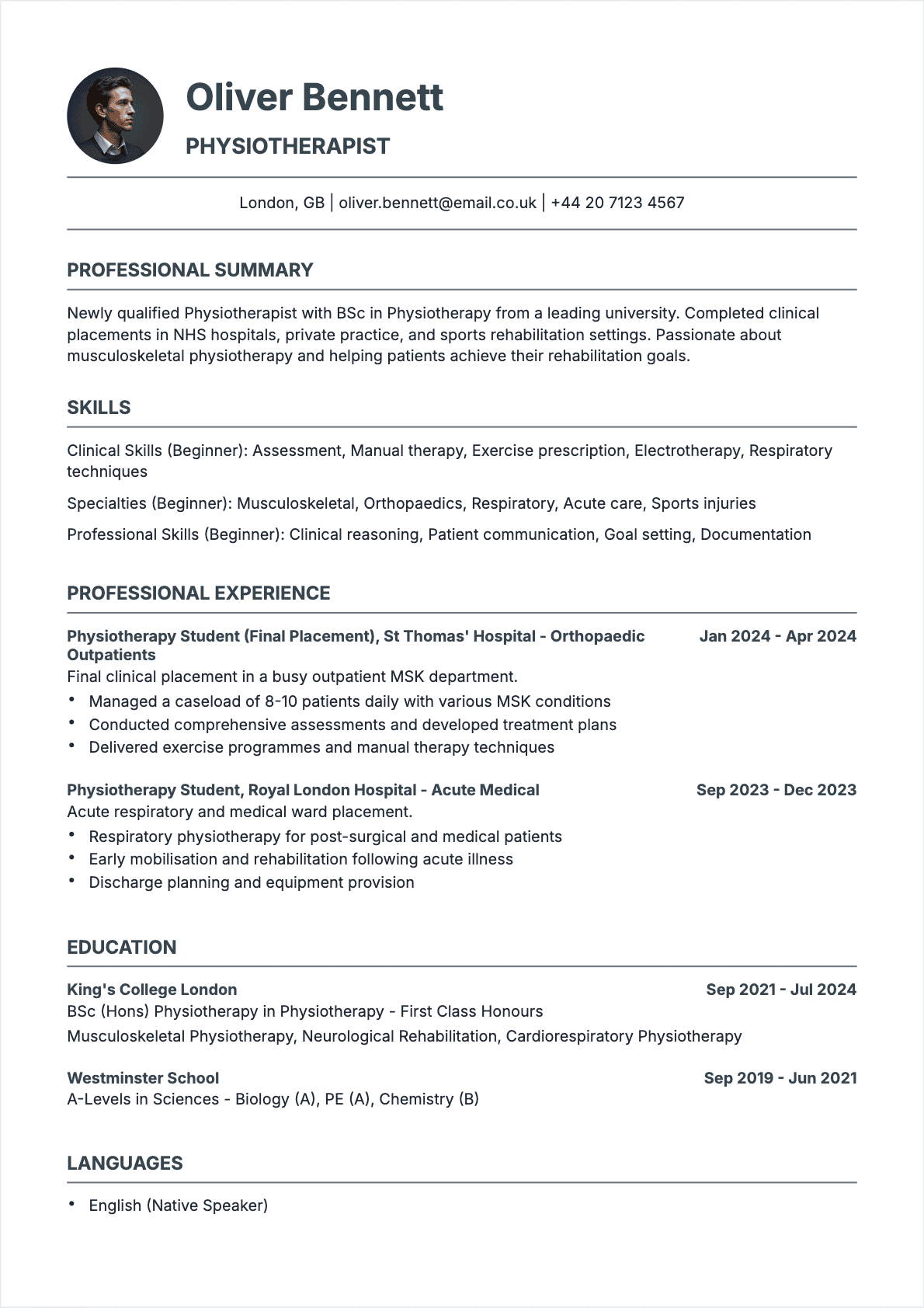
Resume Physiotherapist Junior
Physiotherapist resume template for Junior profile
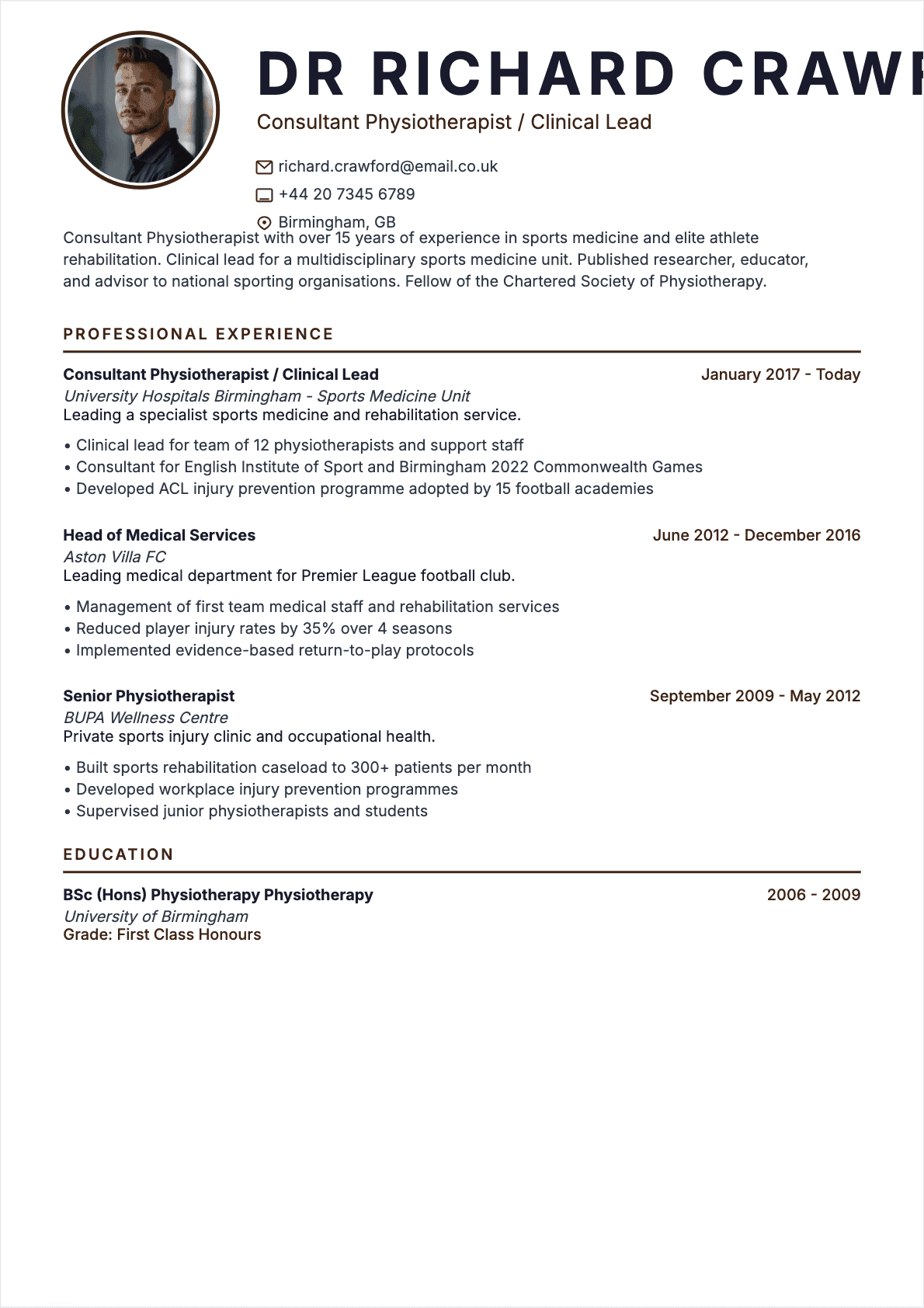
Resume Physiotherapist Senior
PopularPhysiotherapist resume template for Senior profile
Resume Physiotherapist Confirmé
Physiotherapist resume template for Confirmé profile
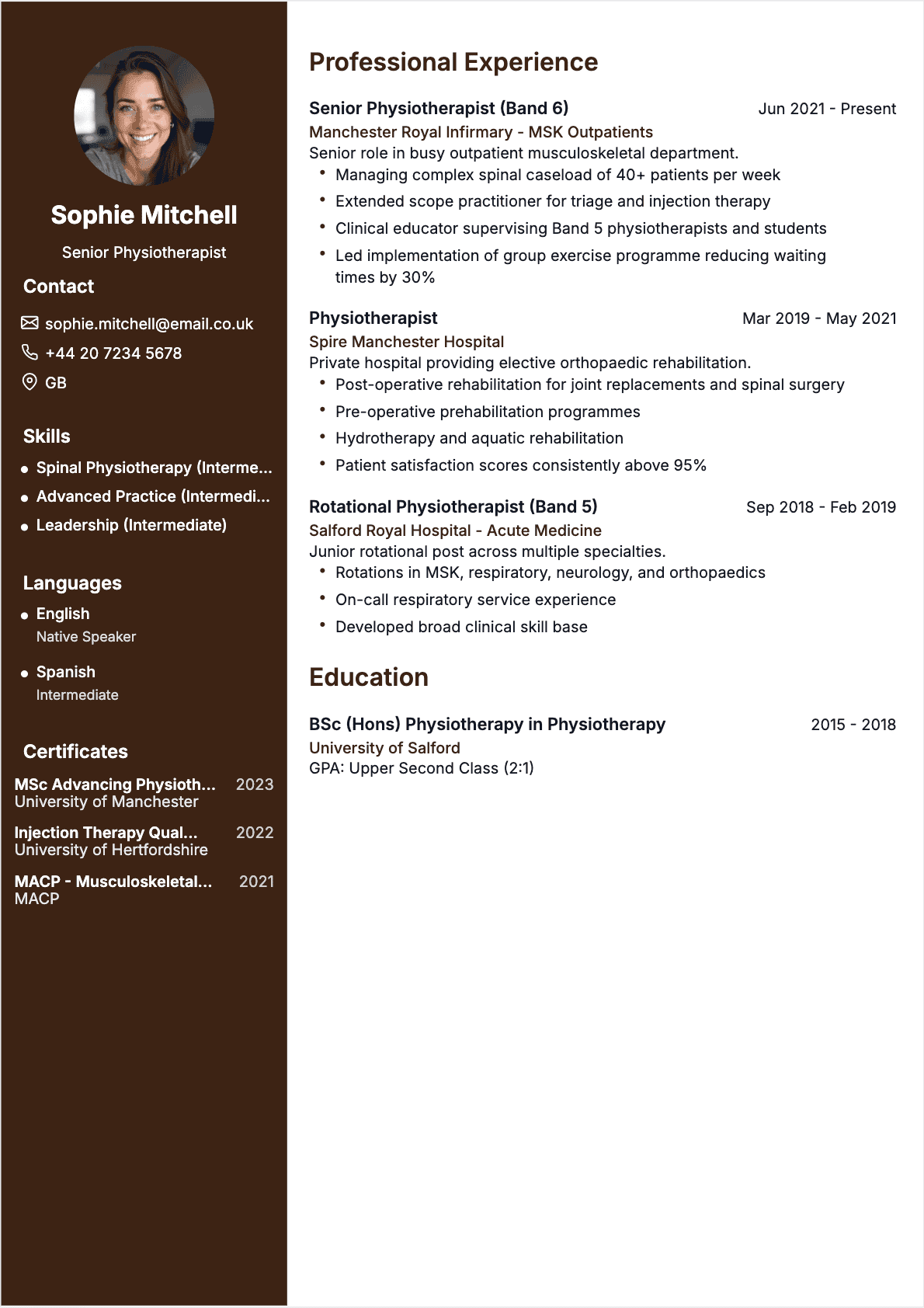
Resume Physiotherapist Confirmé
Physiotherapist resume template for Confirmé profile
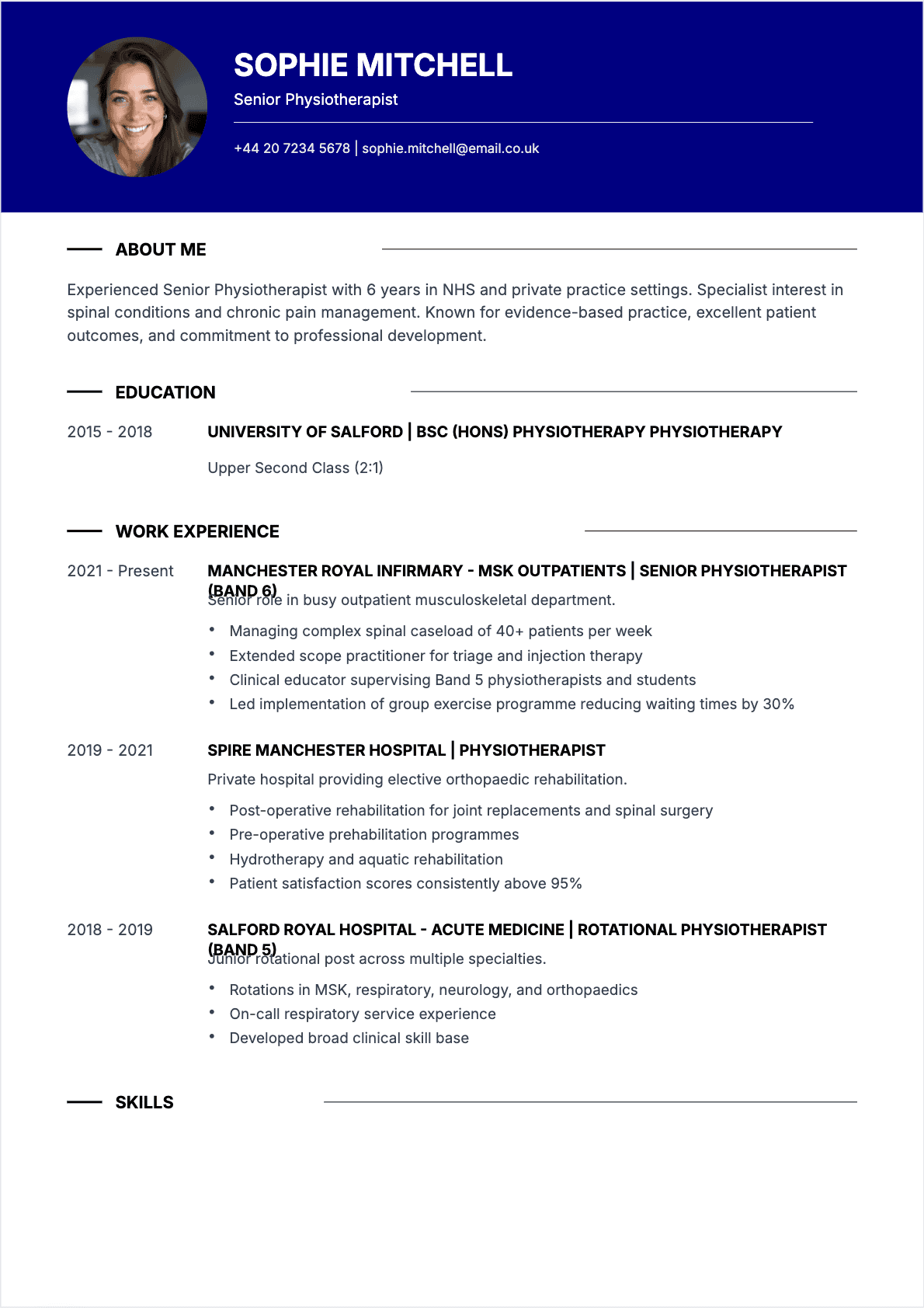
Resume Physiotherapist Confirmé
Physiotherapist resume template for Confirmé profile
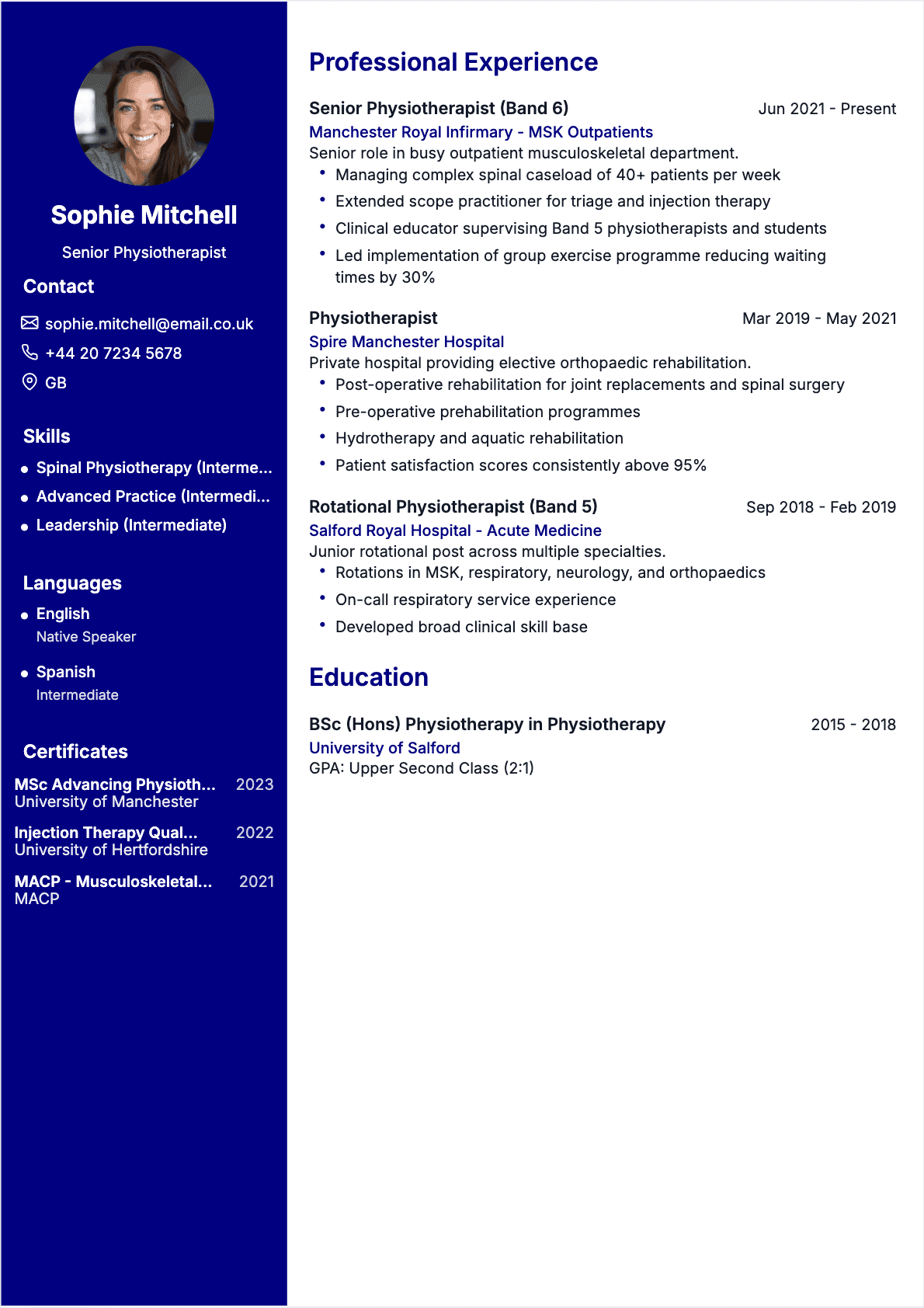
Resume Physiotherapist Confirmé
Physiotherapist resume template for Confirmé profile
Like one of these Physiotherapist resume templates?
Select it, fill in your details and download your resume as PDF.
Physiotherapist Resume Examples
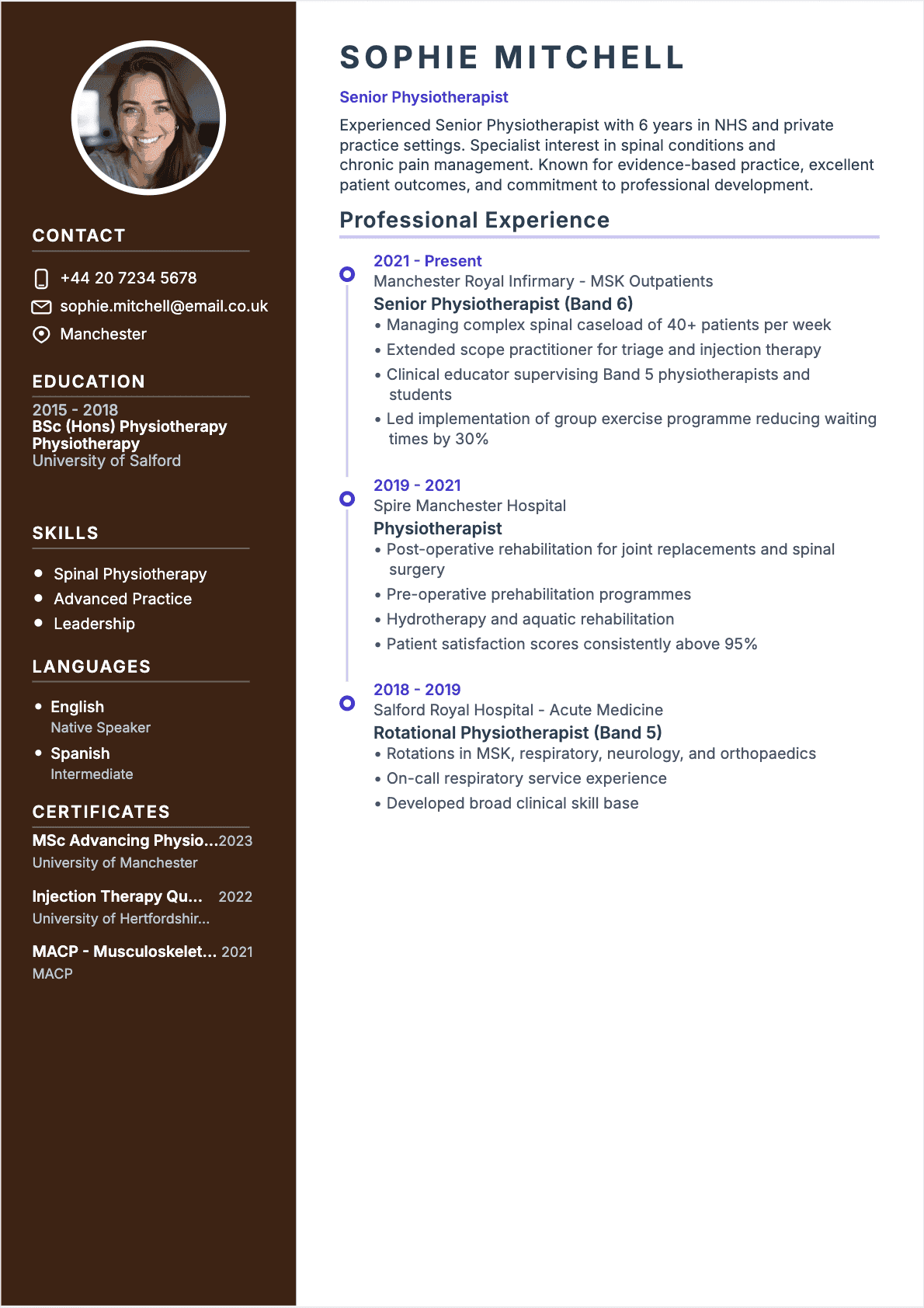
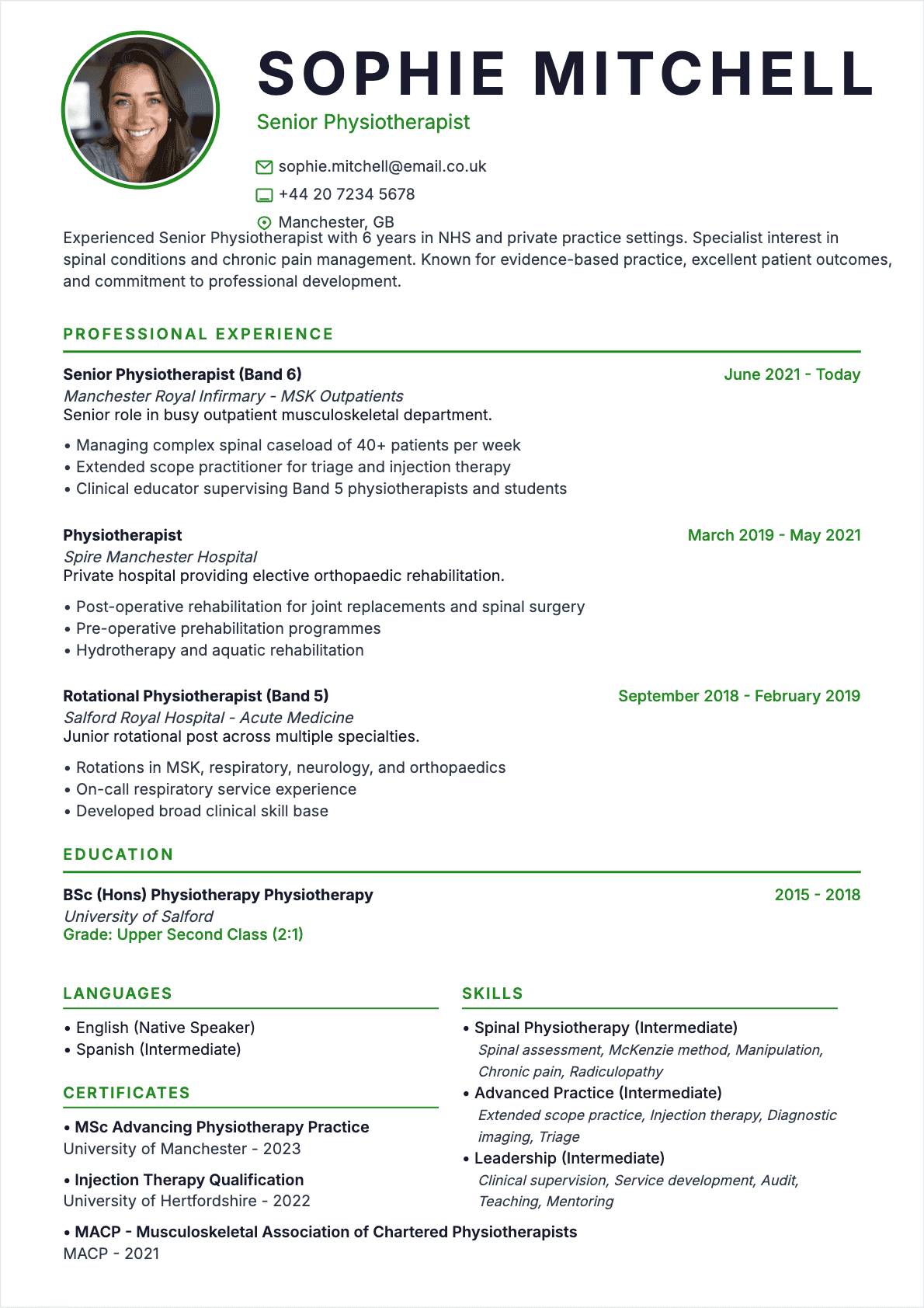
Sophie Mitchell
Senior Physiotherapist
sophie.mitchell@email.co.uk
+44 20 7234 5678
Manchester, GB
Experienced Senior Physiotherapist with 6 years in NHS and private practice settings. Specialist interest in spinal conditions and chronic pain management. Known for evidence-based practice, excellent patient outcomes, and commitment to professional development.
Work Experience
Senior Physiotherapist (Band 6)
Manchester Royal Infirmary - MSK Outpatients
- ●Managing complex spinal caseload of 40+ patients per week
- ●Extended scope practitioner for triage and injection therapy
- ●Clinical educator supervising Band 5 physiotherapists and students
Physiotherapist
Spire Manchester Hospital
- ●Post-operative rehabilitation for joint replacements and spinal surgery
- ●Pre-operative prehabilitation programmes
- ●Hydrotherapy and aquatic rehabilitation
Rotational Physiotherapist (Band 5)
Salford Royal Hospital - Acute Medicine
- ●Rotations in MSK, respiratory, neurology, and orthopaedics
- ●On-call respiratory service experience
- ●Developed broad clinical skill base
Education
BSc (Hons) Physiotherapy
University of Salford
Skills
Languages
English — Native Speaker
Spanish — Intermediate
Certifications
MSc Advancing Physiotherapy PracticeUniversity of Manchester
Injection Therapy QualificationUniversity of Hertfordshire
MACP - Musculoskeletal Association of Chartered PhysiotherapistsMACP
Physiotherapist role overview
As a physiotherapist, you assess, diagnose, and treat patients with physical problems resulting from illness, injury, disability, or aging. Your day begins by reviewing patient files and treatment plans, then conducting one-on-one sessions where you guide patients through exercises, apply manual therapy techniques, and use specialized equipment to improve mobility and reduce pain. You work with diverse populations—from athletes recovering from sports injuries to elderly patients regaining independence after strokes.
The role demands constant adaptation. One hour you might be helping a post-operative knee replacement patient learn to walk again, the next you're treating a construction worker with chronic back pain, followed by a session with a child with cerebral palsy. You document every session meticulously, adjust treatment plans based on progress, and communicate regularly with doctors, occupational therapists, and other healthcare professionals to coordinate comprehensive care.
Career progression typically follows a clear path. Entry-level physiotherapists work under supervision for 1-2 years, earning £25,000-£32,000 annually in the UK (or $60,000-$70,000 in the US). Mid-level practitioners with 3-7 years experience earn £33,000-£45,000 (or $70,000-$90,000), often specializing in areas like sports medicine, pediatrics, or neurology. Senior physiotherapists and clinical specialists command £46,000-£65,000+ (or $90,000-$120,000+), taking on leadership roles, supervising junior staff, or running private practices.
Typical daily tasks include:
- Conducting initial assessments using physical examinations, patient history, and diagnostic test results to create individualized treatment plans
- Performing hands-on treatments including joint mobilization, soft tissue massage, and manipulation techniques to restore function
- Teaching patients therapeutic exercises and proper body mechanics to prevent re-injury and promote long-term wellness
- Operating specialized equipment such as ultrasound machines, electrical stimulation devices, and hydrotherapy pools
- Writing detailed progress notes, updating treatment plans, and communicating with referring physicians about patient outcomes
- Educating patients and families about home exercise programs, pain management strategies, and realistic recovery timelines
Essential skills for a Physiotherapist resume
Your resume must demonstrate both clinical competence and interpersonal abilities. Hiring managers scan for specific technical skills that prove you can handle the physical demands of treatment while also looking for evidence that you can build rapport with patients and work effectively within multidisciplinary teams. The balance between hard and soft skills matters—a physiotherapist who excels at manual therapy but struggles to explain exercises clearly won't succeed.
For ATS optimization, include exact skill names as they appear in job descriptions. Systems scan for terms like 'manual therapy,' 'electrotherapy,' and 'neurological rehabilitation' rather than vague phrases like 'patient care.' Place your most relevant skills in a dedicated skills section and weave them naturally into your work experience bullet points to pass both automated screening and human review.
Core skills to highlight:
- Manual therapy techniques - Demonstrates your ability to perform hands-on treatments like joint mobilization, soft tissue release, and spinal manipulation that form the foundation of physiotherapy practice
- Movement assessment and biomechanics analysis - Shows you can identify dysfunction patterns, postural issues, and gait abnormalities to create targeted treatment plans
- Therapeutic exercise prescription - Proves you design progressive rehabilitation programs tailored to individual patient needs, goals, and physical limitations
- Electrotherapy and modality application - Indicates proficiency with ultrasound, TENS, electrical stimulation, and other equipment used to manage pain and promote healing
- Neurological rehabilitation - Particularly valuable for hospital positions, showing experience treating stroke, spinal cord injury, and traumatic brain injury patients
- Sports injury management - Critical for clinic and sports medicine roles, demonstrating knowledge of athletic injuries, return-to-play protocols, and performance optimization
- Musculoskeletal assessment - Essential for orthopedic settings, proving you can evaluate joint range of motion, muscle strength, and functional limitations
- Patient education and communication - Highlights your ability to explain complex medical concepts in accessible language and motivate patients through difficult recovery processes
- Clinical documentation and EMR systems - Shows familiarity with electronic medical records, insurance requirements, and maintaining legally compliant treatment notes
- Interdisciplinary collaboration - Demonstrates experience working with physicians, occupational therapists, nurses, and other healthcare professionals for coordinated care
- Pain management strategies - Indicates knowledge of both pharmacological and non-pharmacological approaches to acute and chronic pain
- Regulatory compliance and safety protocols - Proves understanding of infection control, patient privacy laws, and professional practice standards

How to write a Physiotherapist resume step by step
1. Start with a focused professional summary
Write 3-4 lines that immediately establish your specialization, years of experience, and key achievement. Instead of 'Dedicated physiotherapist with excellent patient care skills,' write 'Musculoskeletal physiotherapist with 5 years experience treating 800+ patients in orthopedic clinic settings. Reduced average recovery time by 18% through evidence-based manual therapy protocols and personalized exercise programs.' Include your registration number and any board certifications here.
2. Quantify your patient outcomes and caseload
Hiring managers want proof you deliver results. Transform generic statements into measurable achievements. Change 'Provided treatment to patients with various conditions' to 'Treated caseload of 35-40 patients weekly across neurological, orthopedic, and geriatric populations, achieving 92% patient satisfaction scores and 85% successful discharge rate.' Use metrics like patient volume, satisfaction scores, functional improvement percentages, and readmission rates.
3. Detail your clinical specializations and techniques
Don't assume readers know what you do. Specify treatment approaches and populations served. Instead of 'Performed manual therapy,' write 'Applied Maitland joint mobilization, myofascial release, and dry needling techniques to treat chronic pain conditions, reducing medication dependence in 67% of long-term pain patients.' List specific methodologies like McKenzie Method, Mulligan Concept, or PNF to show advanced training.
4. Highlight your education with relevant clinical rotations
List your degree, institution, and graduation year, but also include notable clinical placements. 'Bachelor of Science in Physiotherapy, University of Manchester, 2019 - Clinical rotations: 12-week neurology placement at Salford Royal Hospital, 8-week sports medicine rotation with Manchester City FC academy.' This shows practical experience beyond classroom learning.
5. Showcase continuing education and specialized certifications
Physiotherapy evolves rapidly, so demonstrate commitment to professional development. Create a separate section for certifications like 'Certified Orthopedic Manual Therapist (COMT), 2023,' 'Dry Needling Certification, 2022,' or 'Vestibular Rehabilitation Competency, 2021.' Include relevant workshops like 'Advanced Shoulder Rehabilitation Course' or 'Concussion Management Symposium' with dates.
6. Describe equipment and technology proficiency
Modern practices use sophisticated tools. Mention specific systems: 'Proficient in EPIC and Clinicient EMR systems for documentation and billing. Experienced with AlterG anti-gravity treadmill, Biodex isokinetic dynamometer, and Game Ready compression therapy systems.' This proves you can start contributing immediately without extensive training.
7. Include professional memberships and volunteer work
Membership in organizations like the Chartered Society of Physiotherapy (CSP) or American Physical Therapy Association (APTA) shows professional engagement. Add relevant volunteer work: 'Volunteer physiotherapist, London Marathon medical tent, 2022-2024' or 'Pro bono clinic for uninsured patients, 4 hours monthly.' This demonstrates commitment beyond paid employment.
8. Tailor your experience to the job type
Hospital roles emphasize acute care and interdisciplinary collaboration, while private clinics value patient retention and business development. For hospital positions, write 'Collaborated with 12-member stroke rehabilitation team to develop discharge plans, reducing average length of stay by 2.3 days.' For clinics, try 'Built patient base from 0 to 120 active clients within 18 months through community outreach and physician relationship building, generating £85,000 annual revenue.'
Common mistakes on Physiotherapist resumes
Listing duties instead of patient outcomes
The most frequent error is describing what you were supposed to do rather than what you achieved. Writing 'Responsible for treating patients with back pain' tells employers nothing about your effectiveness. Instead, demonstrate impact: 'Treated 180+ patients with chronic low back pain using McKenzie Method protocols, with 78% reporting significant pain reduction (VAS score decrease of 4+ points) within 6 weeks.' Outcomes matter more than responsibilities in healthcare.
Omitting registration and license details
Failing to prominently display your professional registration number, license state, and status is a critical oversight. Some candidates bury this information or assume it's obvious. Place it directly under your name: 'HCPC Registered Physiotherapist (PH12345) - Full UK Practice Rights' or 'Licensed Physical Therapist, California (PT23456), expires 2026.' Hiring managers need to verify credentials immediately, and missing information raises red flags about your eligibility to practice.
Using vague treatment descriptions
Generic phrases like 'provided physiotherapy services' or 'helped patients recover' reveal nothing about your clinical approach. Physiotherapy encompasses dozens of specialized techniques, and employers want to know exactly what you do. Compare 'Treated sports injuries' with 'Assessed and treated acute ACL tears, rotator cuff tendinopathy, and ankle sprains using progressive loading protocols, functional movement screening, and sport-specific rehabilitation exercises, achieving 95% successful return-to-sport rate.' Specificity demonstrates expertise.
Neglecting to mention patient populations
A physiotherapist who primarily treats elderly stroke patients has vastly different experience from one who works with pediatric cerebral palsy cases or elite athletes. Don't write 'Worked with diverse patient population'—specify: 'Specialized in geriatric rehabilitation for patients aged 65-95 recovering from hip fractures, joint replacements, and falls, with focus on balance training and fall prevention strategies.' This helps employers assess your fit for their specific patient demographic.
Failing to address productivity and efficiency metrics
Healthcare organizations increasingly focus on productivity standards and reimbursement rates. Resumes that ignore business aspects of physiotherapy miss opportunities to show value. Instead of just clinical skills, include: 'Maintained 85% productivity rate while treating 8-10 patients daily, consistently meeting documentation deadlines and achieving 98% clean claim rate for insurance reimbursement.' This proves you understand the business side of healthcare.
Overlooking interdisciplinary collaboration examples
Physiotherapists rarely work in isolation, yet many resumes fail to mention teamwork. Employers want evidence you can communicate effectively with physicians, nurses, occupational therapists, and speech therapists. Add specifics: 'Participated in weekly interdisciplinary rounds with orthopedic surgeons, case managers, and nursing staff to coordinate post-operative care for 25-bed joint replacement unit, reducing discharge delays by 30%.' This shows you're a team player in complex healthcare environments.
Including outdated or irrelevant techniques
Listing treatments that have fallen out of favor or lack evidence basis can hurt your candidacy. Overemphasizing passive modalities like hot packs and ultrasound without mentioning active rehabilitation and exercise prescription suggests outdated practice patterns. Modern physiotherapy emphasizes patient-centered, active approaches. Ensure your resume reflects current evidence-based practice standards and contemporary treatment philosophies rather than techniques from your student days a decade ago.
Physiotherapist resume trends in 2026
The physiotherapy profession is experiencing significant shifts driven by technology integration and changing healthcare delivery models. Telehealth physiotherapy, which exploded during the pandemic, has become a permanent fixture. Employers now expect candidates to demonstrate competence in virtual assessments, remote exercise prescription, and digital patient monitoring. Resumes should highlight experience with platforms like Physitrack, PT Anywhere, or custom telehealth systems, along with patient outcomes achieved through remote care. If you've successfully treated patients virtually, quantify it: 'Conducted 200+ telehealth sessions for post-operative patients, achieving equivalent functional outcomes to in-person care with 40% higher appointment adherence rates.'
Artificial intelligence and wearable technology are transforming how physiotherapists track progress and personalize treatment. Smart sensors, motion capture systems, and AI-powered movement analysis tools are becoming standard in progressive clinics. Employers value candidates who understand how to interpret data from devices like IMU sensors, pressure mapping systems, or smartphone-based gait analysis apps. Mention any experience with technology-enhanced assessment: 'Utilized 3D motion capture analysis to identify biomechanical deficits in runners, creating data-driven return-to-running protocols that reduced re-injury rates by 35%.' Familiarity with AI-assisted clinical decision support tools also strengthens your candidacy.
Specialization continues to intensify across the profession. General practitioners face increasing competition, while specialists in areas like pelvic health, vestibular rehabilitation, oncology rehabilitation, and persistent pain management are in high demand. Your resume should clearly establish your niche expertise rather than presenting yourself as a generalist. Employers prefer candidates who can immediately serve specific patient populations without extensive training. If you're early in your career without a clear specialty, emphasize your willingness to pursue advanced certification in high-demand areas.
Value-based care models are reshaping how physiotherapy services are reimbursed and evaluated. Healthcare systems increasingly tie payment to patient outcomes rather than visit volume, making outcome measurement skills essential. Resumes should demonstrate familiarity with standardized outcome measures like the Lower Extremity Functional Scale (LEFS), Patient-Specific Functional Scale (PSFS), or OPTIMAL outcome tracking systems. Show you understand the business implications: 'Implemented systematic outcome tracking using validated measures, documenting functional improvements that supported value-based contract negotiations worth £120,000 annually.'
Remote and hybrid work arrangements are expanding beyond telehealth to include administrative flexibility. Some physiotherapists now split time between clinic-based patient care and remote work for documentation, treatment planning, and patient education content creation. Progressive employers offer flexible scheduling that allows practitioners to manage caseloads across multiple locations or balance clinical work with consulting, education, or research activities. If you're seeking flexibility, highlight skills that support hybrid models: 'Developed library of 50+ patient education videos and exercise tutorials, reducing in-person instruction time by 25% while improving home program compliance.'
Mental health integration has become a core competency rather than a peripheral concern. Chronic pain management, post-surgical recovery, and long-term rehabilitation all involve psychological factors that physiotherapists must address. Employers increasingly value candidates with training in pain neuroscience education, cognitive-behavioral approaches, or trauma-informed care. Mention relevant training: 'Completed Pain Neuroscience Education certification, integrating biopsychosocial approaches that improved outcomes for chronic pain patients with previous treatment failures.' Understanding the intersection of physical and mental health distinguishes modern practitioners from those using purely biomechanical models.
Further reading:
Frequently asked questions
Find answers to the most frequently asked questions.
A CV is a detailed academic-style document listing education, research, publications, and teaching. In many U.S. clinical jobs, employers ask for a resume instead: a 1–2 page summary focused on patient care results, physical therapy skills, and work history. If the posting says “CV,” check whether it’s a hospital, university, or research role.
Start with licensure, NPI, and contact details, then add education (DPT), clinical rotations, and measurable outcomes from internships or jobs. Use an ATS-safe template and include keywords from the job description (setting, populations, EMR). Add 3–5 quantified bullets per role to prove treatment planning impact and documentation quality.
In physical education, “CV” usually still means curriculum vitae, but the content emphasizes teaching credentials, coaching, curriculum design, and student outcomes rather than clinical patient outcomes. For a physical therapist role, use a resume focused on evaluation, therapeutic exercise, manual therapy, and healthcare documentation—different audiences and different performance metrics.
A cardiovascular physical therapist supports patients with cardiac and pulmonary conditions, often in acute care, inpatient rehab, or outpatient cardiac rehab. They focus on exercise tolerance, vitals monitoring, safety, education, and graded activity. On a resume, highlight telemetry awareness, functional capacity gains, discharge planning, and collaboration with physicians and nurses.
If the application allows it, a cover letter is a practical advantage—especially for competitive hospital roles or specialty clinics. Keep it short (200–300 words) and add 2–3 proof points: a patient outcomes metric, a productivity or compliance metric, and a setting match. Avoid repeating your resume; explain fit and priorities.
Entry-level and recent graduate candidates should aim for one page, prioritizing clinical rotations, key skills, and 6–10 high-quality bullets total. Experienced physical therapists can use two pages if they add measurable outcomes, leadership, and specialty training. Remove older, irrelevant roles and keep every line tied to the target setting.
Your career deserves a better resume
With CVtoWork, select a template, fill in the fields and download your resume as PDF.
Start creating