Payroll Manager Resume
Example, Template & Expert Tips 2026
Updated on April 18, 2026.
Build a resume for payroll specialists with a payroll specialist resume example, quantified wins, ATS keywords, and a practical template.
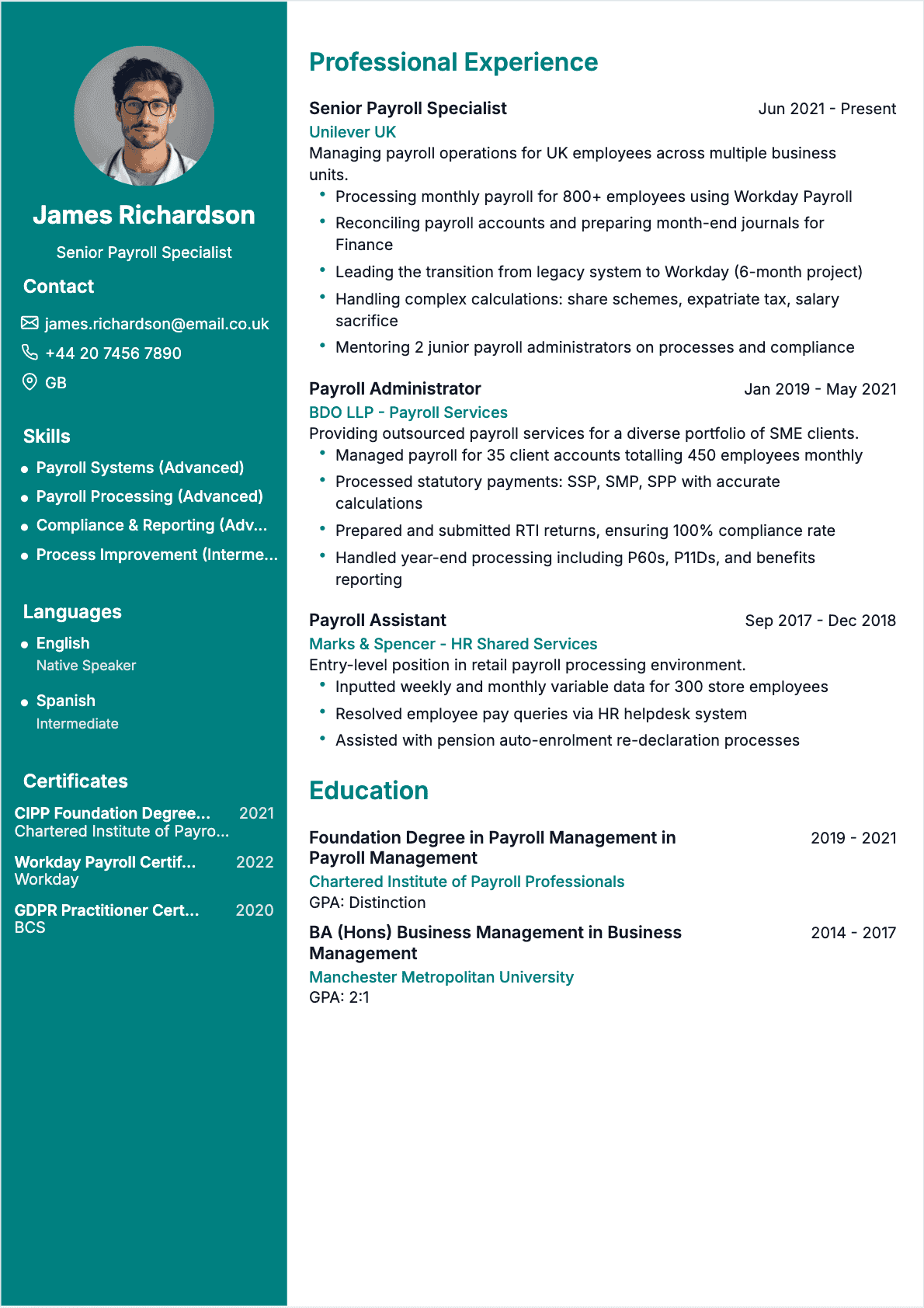
Payroll Manager Resume Templates
8 Templates available
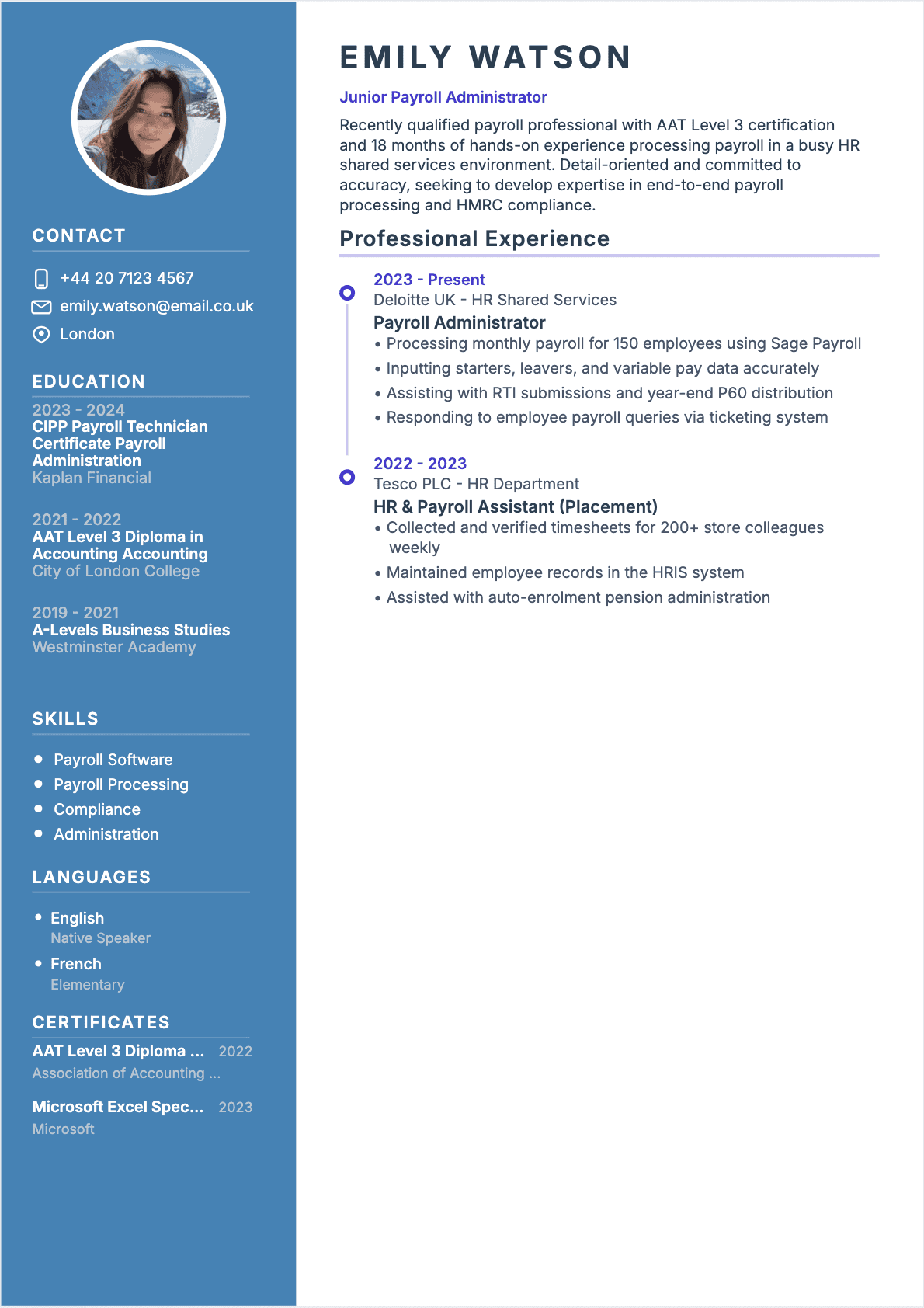
Resume Payroll Manager Junior
Payroll Manager resume template for Junior profile
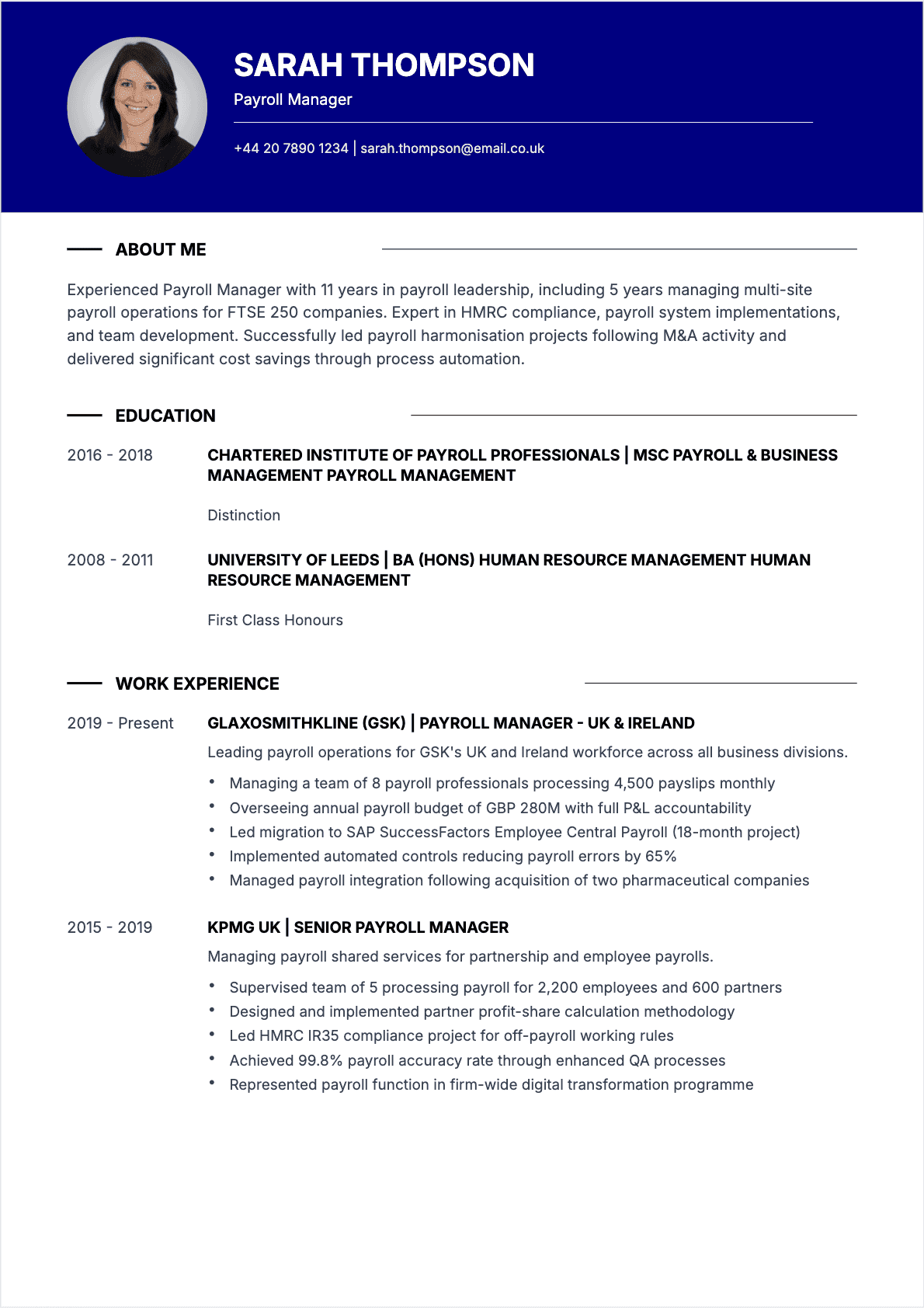
Resume Payroll Manager Senior
Payroll Manager resume template for Senior profile
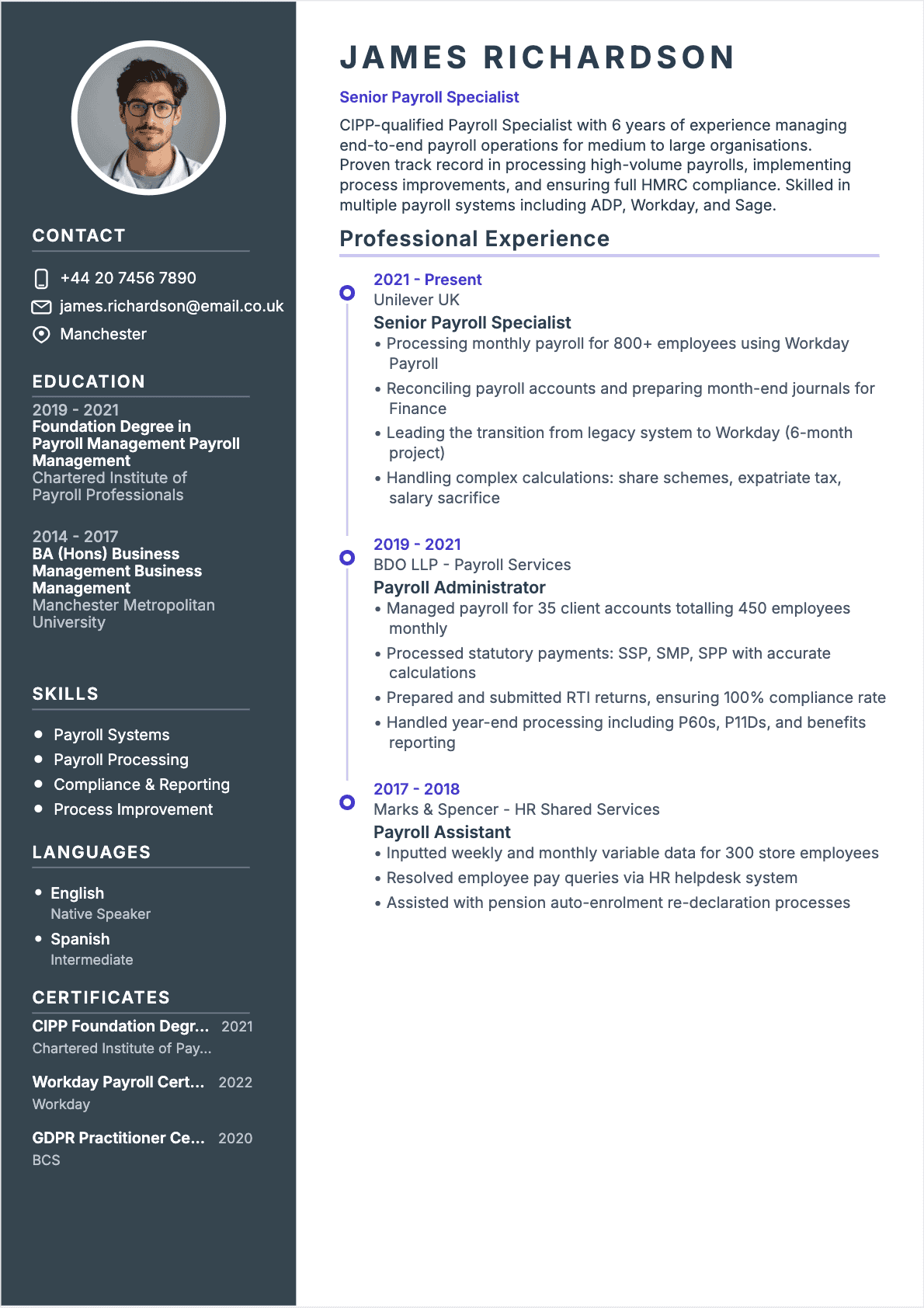
Resume Payroll Manager Confirmé
Payroll Manager resume template for Confirmé profile
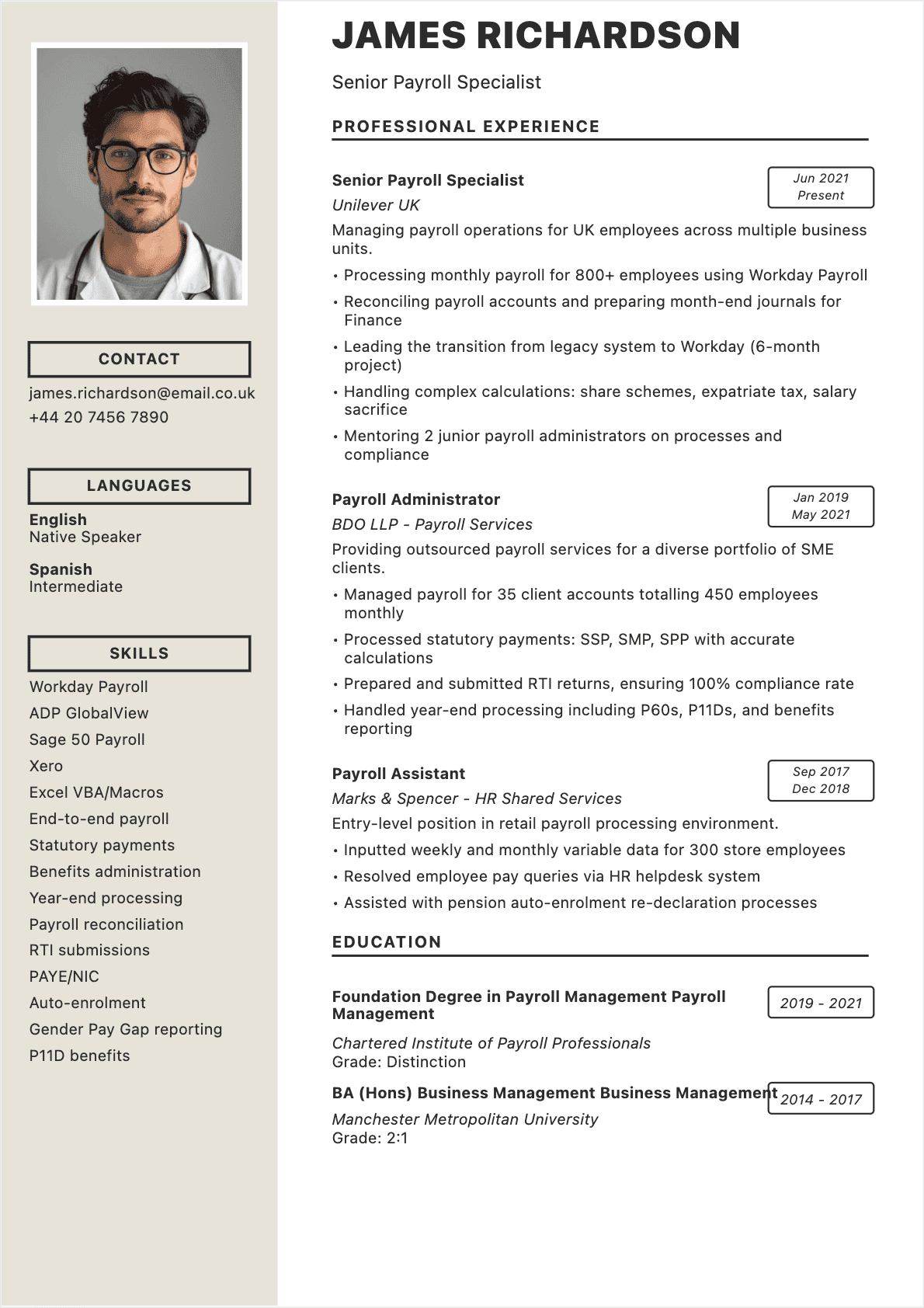
Resume Payroll Manager Confirmé
Payroll Manager resume template for Confirmé profile
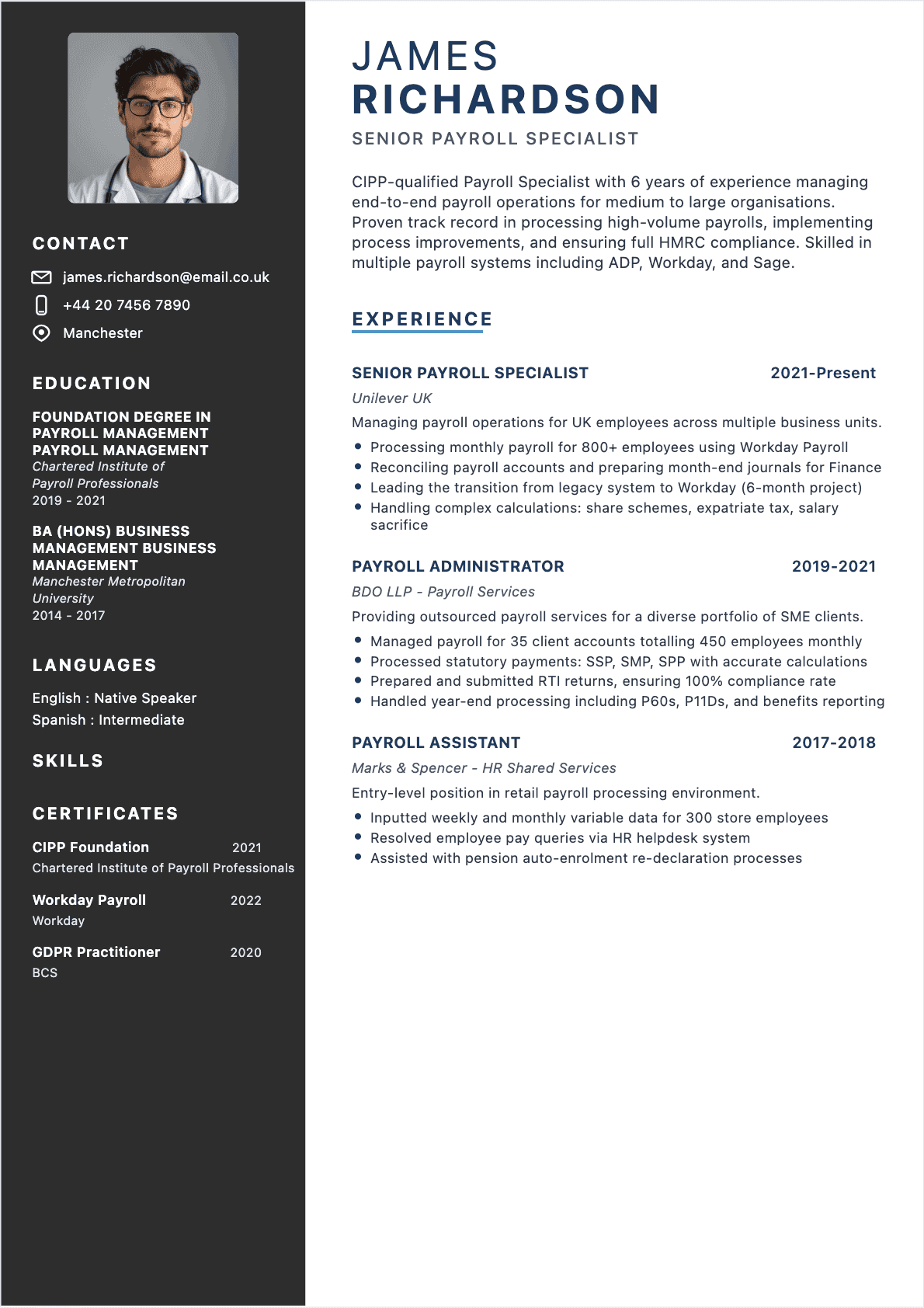
Resume Payroll Manager Confirmé
Payroll Manager resume template for Confirmé profile
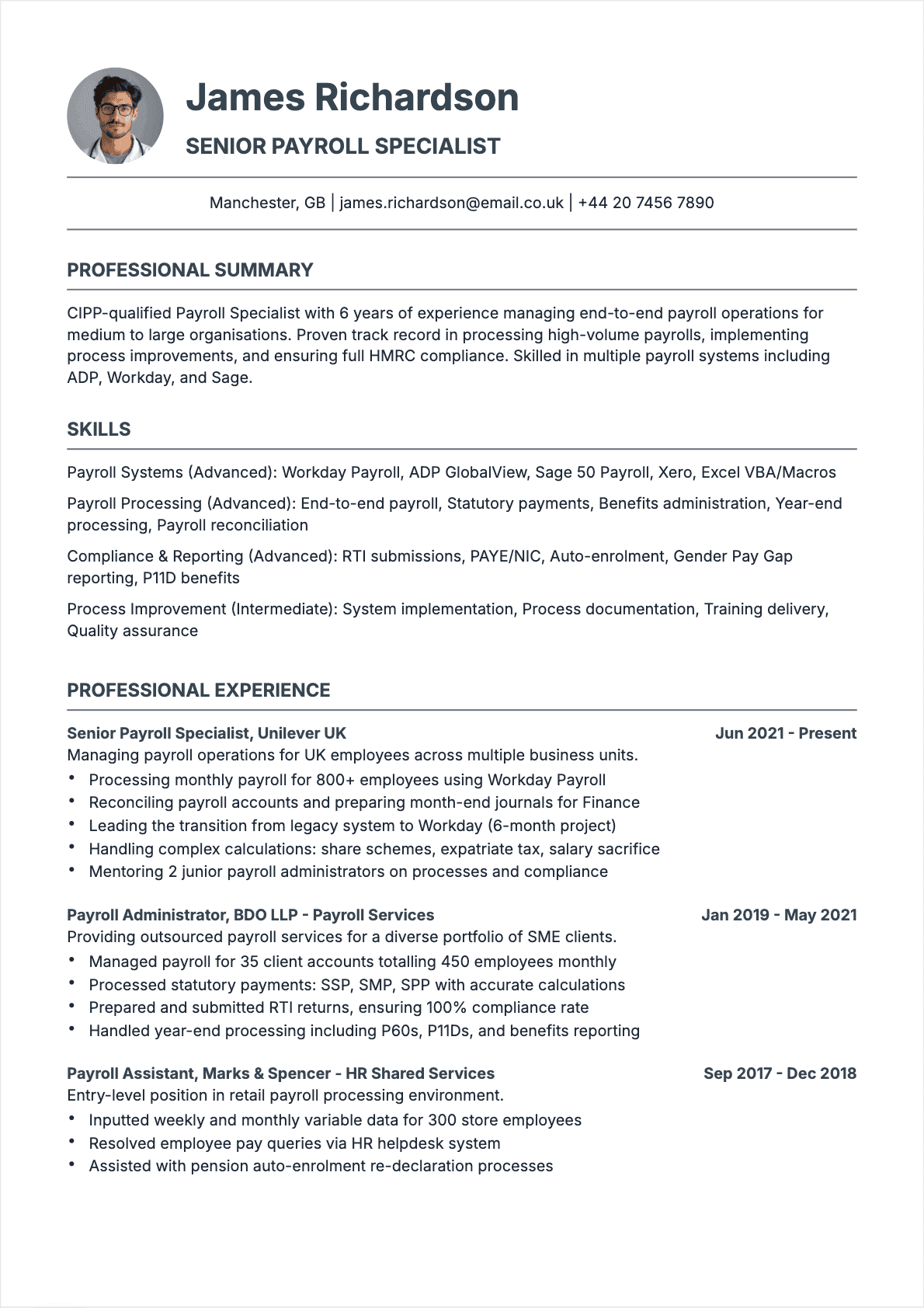
Resume Payroll Manager Confirmé
Payroll Manager resume template for Confirmé profile
Like one of these Payroll Manager resume templates?
Select it, fill in your details and download your resume as PDF.
Payroll Manager Resume Examples
James Richardson
Senior Payroll Specialist
james.richardson@email.co.uk
+44 20 7456 7890
Manchester, GB
CIPP-qualified Payroll Specialist with 6 years of experience managing end-to-end payroll operations for medium to large organisations. Proven track record in processing high-volume payrolls, implementing process improvements, and ensuring full HMRC compliance. Skilled in multiple payroll systems including ADP, Workday, and Sage.
Work Experience
Senior Payroll Specialist
Unilever UK
- ●Processing monthly payroll for 800+ employees using Workday Payroll
- ●Reconciling payroll accounts and preparing month-end journals for Finance
- ●Leading the transition from legacy system to Workday (6-month project)
Payroll Administrator
BDO LLP - Payroll Services
- ●Managed payroll for 35 client accounts totalling 450 employees monthly
- ●Processed statutory payments: SSP, SMP, SPP with accurate calculations
- ●Prepared and submitted RTI returns, ensuring 100% compliance rate
Payroll Assistant
Marks & Spencer - HR Shared Services
- ●Inputted weekly and monthly variable data for 300 store employees
- ●Resolved employee pay queries via HR helpdesk system
- ●Assisted with pension auto-enrolment re-declaration processes
Education
Foundation Degree in Payroll Management
Chartered Institute of Payroll Professionals
BA (Hons) Business Management
Manchester Metropolitan University
Skills
Languages
English — Native Speaker
Spanish — Intermediate
Certifications
CIPP Foundation Degree in Payroll ManagementChartered Institute of Payroll Professionals
Workday Payroll Certified ProfessionalWorkday
GDPR Practitioner CertificateBCS
Payroll Manager role overview
A Payroll Manager oversees the entire payroll function for an organization, ensuring employees receive accurate compensation on time while maintaining compliance with tax regulations and employment laws. You'll manage payroll processing cycles, supervise payroll staff, and serve as the primary point of contact between finance, HR, and external agencies like tax authorities and pension administrators. This role requires meticulous attention to detail combined with strategic thinking about payroll systems and process improvements.
Your day-to-day work involves reviewing and approving payroll runs, resolving complex pay discrepancies, and ensuring all statutory deductions are calculated correctly. You'll coordinate with HR on new hires, terminations, and salary changes, while also managing relationships with benefits providers and payroll software vendors. During peak periods like year-end or after organizational restructures, you'll work extended hours to ensure accurate W-2 preparation or handle mass employee data updates.
Career progression typically starts with payroll clerk or coordinator roles, advancing to payroll specialist, then senior payroll specialist before reaching manager level. From Payroll Manager, you can move into Director of Payroll, Compensation and Benefits Manager, or HRIS Director positions. Some professionals transition into broader finance roles like Financial Controller or move into consulting to advise multiple organizations on payroll strategy.
Salary ranges vary significantly by experience and company size. Entry-level payroll coordinators earn between $42,000-$52,000 annually, while mid-level Payroll Managers with 5-8 years of experience typically earn $68,000-$88,000. Senior Payroll Managers or Directors at large corporations can command $95,000-$135,000, with additional bonuses and benefits packages. Geographic location plays a major role, with coastal metropolitan areas offering 20-30% higher compensation than smaller markets.
Typical daily tasks for a Payroll Manager include:
- Reviewing and approving bi-weekly or monthly payroll runs for accuracy before processing
- Investigating and resolving employee pay inquiries and discrepancies within 24-48 hours
- Auditing time and attendance records to ensure proper overtime and leave calculations
- Coordinating with HR on salary adjustments, promotions, bonuses, and commission structures
- Preparing and filing quarterly tax reports and ensuring compliance with federal and state regulations
- Managing payroll system updates and testing new features or integrations with accounting software
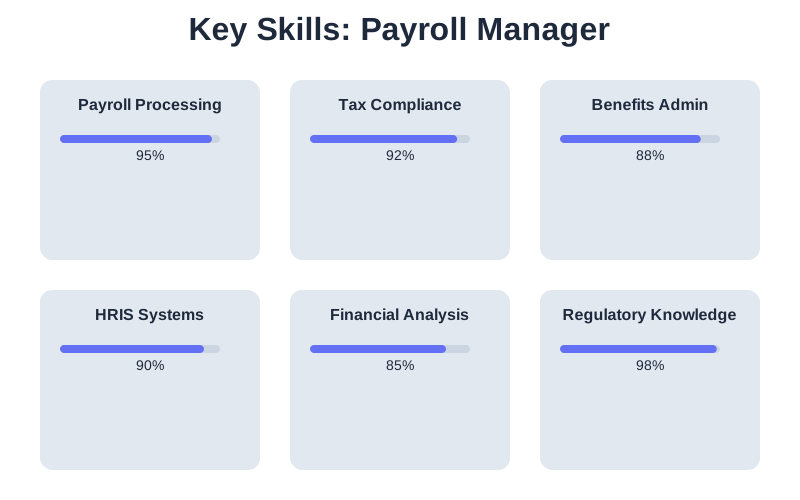
Essential skills for a Payroll Manager resume
Your resume needs to demonstrate both technical payroll expertise and the management capabilities to lead a payroll function. Recruiters scan for specific software proficiencies and regulatory knowledge that prove you can handle complex multi-state or multi-entity payroll operations. The skills you highlight should directly address the compliance risks and operational challenges that keep hiring managers awake at night.
Hard skills matter most for passing Applicant Tracking Systems, which search for exact matches to payroll platforms, tax knowledge, and certification acronyms. However, soft skills like problem-solving and communication differentiate you from other technically qualified candidates, especially since you'll need to explain complex pay issues to employees and present compliance strategies to executives.
Critical skills to feature prominently:
- ADP Workforce Now or similar HRIS platforms - Most organizations use enterprise payroll systems, and experience with their specific platform eliminates training time and reduces implementation risk.
- Multi-state tax compliance knowledge - Understanding nexus rules, state-specific wage laws, and local tax jurisdictions prevents costly penalties and audit findings that can reach six figures.
- FLSA and wage-hour law expertise - Misclassifying employees or miscalculating overtime creates legal liability, so demonstrating you understand exempt vs. non-exempt rules is essential.
- Year-end reporting (W-2, 1099, ACA) - These high-stakes annual processes have strict deadlines and accuracy requirements, making proven experience highly valuable to employers.
- Payroll accounting and general ledger reconciliation - You need to ensure payroll expenses tie to financial statements, requiring solid understanding of debits, credits, and accrual accounting.
- Advanced Excel skills (pivot tables, VLOOKUP, macros) - Payroll involves massive data manipulation, and Excel proficiency enables you to audit files, create reports, and identify discrepancies efficiently.
- Certified Payroll Professional (CPP) credential - This American Payroll Association certification signals commitment to the profession and validates your technical knowledge across all payroll domains.
- Benefits administration and garnishment processing - You'll manage deductions for health insurance, 401(k) contributions, child support orders, and tax levies, each with specific legal requirements.
- Process improvement and documentation - Employers want managers who can streamline workflows, reduce manual tasks, and create clear procedures that survive staff turnover.
- Team leadership and training - You'll supervise payroll clerks and specialists, requiring the ability to delegate tasks, develop staff skills, and maintain quality standards.
- Audit preparation and response - When external auditors or government agencies request documentation, you need to retrieve records quickly and explain your processes clearly.
- Confidentiality and ethical judgment - Handling sensitive salary data and personal information requires discretion and the ability to maintain trust across the organization.
For ATS optimization, include the exact names of payroll systems mentioned in the job description (ADP, Paychex, Workday, UltiPro, Ceridian Dayforce) and spell out acronyms on first use before using the abbreviation throughout your resume.
How to write a Payroll Manager resume step by step
1. Lead with a results-focused summary that quantifies your payroll scope
Your opening summary should immediately establish the scale of payroll operations you've managed. Include the number of employees processed, payroll frequency, number of states or entities, and any major system implementations or compliance achievements. Instead of 'Experienced Payroll Manager with strong attention to detail,' write 'Payroll Manager with 8 years managing bi-weekly processing for 1,200+ employees across 15 states, reducing payroll errors by 47% through automated validation controls.'
2. Structure your experience with clear metrics for each position
For each role, start with a brief overview sentence describing your scope of responsibility, then use 4-6 bullet points highlighting specific achievements. Focus on accuracy improvements, time savings, cost reductions, audit results, and system implementations. Quantify everything: number of employees, payroll budget amounts, error rates, processing time reductions, and compliance records.
3. Transform generic duties into achievement statements
Avoid listing basic responsibilities that every Payroll Manager handles. Instead of 'Processed payroll for company employees,' write 'Executed semi-monthly payroll for 850 employees totaling $3.2M in gross wages, maintaining 99.7% accuracy rate and zero late payments over 24 consecutive pay periods.' Instead of 'Managed payroll team,' write 'Supervised team of 4 payroll specialists, implementing peer review process that reduced post-payroll corrections by 62% within six months.'
4. Highlight compliance achievements and audit results
Employers worry constantly about payroll compliance risks, so emphasize your clean track record. Include statements like 'Maintained 100% compliance across 12 state jurisdictions during 3-year tenure with zero penalties or late filing fees' or 'Successfully managed DOL audit with no findings, providing complete documentation for 500+ employee records within 48-hour deadline.' Mention any voluntary audits you've conducted or compliance improvements you've implemented.
5. Showcase system implementations and technical projects
Major payroll system changes represent significant value to employers. Detail any HRIS implementations, system upgrades, or integration projects you've led. Write 'Led 8-month implementation of ADP Workforce Now, migrating 15 years of historical data for 600 employees, configuring 23 custom earning codes and 47 deduction types, completing transition with zero payroll disruption' rather than simply stating 'Implemented new payroll system.'
6. Include relevant certifications and continuing education prominently
Place your CPP or FPC (Fundamental Payroll Certification) directly after your name in the header or create a dedicated certifications section near the top. List relevant continuing education like 'Annual APA Payroll Congress attendee (2021-2025)' or 'Completed 40-hour Multi-State Payroll Tax course.' These credentials often serve as ATS keywords and demonstrate your commitment to staying current.
7. Add a technical skills section with specific software versions
Create a dedicated skills section listing payroll platforms, HRIS systems, and tools you've used. Be specific: 'ADP Workforce Now (5 years), ADP Enterprise HR (3 years)' or 'Workday Payroll modules: Core Payroll, Tax, Year-End, Time Tracking.' Include accounting software (QuickBooks, SAP, Oracle), advanced Excel capabilities, and any programming or database skills that enable custom reporting.
8. Tailor your resume for each application using their terminology
Read the job description carefully and mirror their language. If they mention 'garnishment administration,' use that exact phrase rather than 'wage attachment processing.' If they specify 'union payroll,' add that term even if you'd normally say 'collective bargaining agreement payroll.' This matching increases your ATS score and shows you understand their specific environment.
Before and after examples:
Weak: 'Responsible for processing payroll and handling employee questions about their paychecks.'
Strong: 'Processed bi-weekly payroll for 450 employees across 8 states totaling $18M annually, resolving 95% of employee inquiries within same business day through detailed pay statement analysis.'
Weak: 'Worked on improving payroll accuracy and reducing errors.'
Strong: 'Reduced payroll errors from 3.2% to 0.4% by implementing three-tier review process and automated validation rules, eliminating $127K in annual off-cycle check costs.'
Common mistakes on Payroll Manager resumes
Listing software without demonstrating depth of expertise
Simply stating 'Proficient in ADP' tells recruiters nothing about your actual capabilities. They need to know which ADP products you've used (Workforce Now, Enterprise, Run), which modules you've configured (tax, benefits, time and attendance), and what complex scenarios you've handled. Write 'Administered ADP Workforce Now for 3 years, configuring custom earnings codes for commission structures, managing quarterly tax filings across 22 states, and building 15+ custom reports for finance reconciliation.' This specificity proves genuine expertise rather than surface-level familiarity.
Failing to address multi-state or multi-entity complexity
If you've only processed payroll in a single state, don't try to hide it, but do emphasize other complexities you've managed like multiple pay frequencies, union contracts, or commission structures. If you have multi-state experience, make it prominent since this dramatically increases your value. Many candidates undersell this expertise by writing 'processed payroll for multiple locations' when they should specify 'managed payroll tax compliance across 18 states including reciprocal agreements, state-specific wage garnishments, and varying overtime thresholds.'
Omitting year-end and regulatory reporting accomplishments
Year-end processing represents your highest-stakes work, yet many resumes barely mention it. Recruiters specifically look for W-2 experience, ACA reporting (1095-C forms), and quarterly tax reconciliation. Include statements like 'Prepared and distributed 1,200 W-2 forms with 99.9% accuracy, correcting only 2 forms post-distribution' or 'Managed ACA reporting for 800+ employees, tracking variable hours and determining full-time status for 145 employees monthly.' These specific accomplishments address major employer concerns.
Using vague language about team size and scope
Writing 'managed payroll team' or 'oversaw payroll operations' forces recruiters to guess at your actual responsibility level. Always specify: number of direct reports, number of employees in payroll, total payroll dollars processed, number of pay cycles per year, and organizational structure. There's a massive difference between managing 2 payroll clerks processing 200 employees monthly and supervising 6 specialists handling 5,000 employees across multiple entities with weekly, bi-weekly, and semi-monthly cycles.
Neglecting to mention compliance training and policy development
Payroll Managers don't just process payroll—you're responsible for training HR and management on wage-hour compliance, developing policies for expense reimbursement and timekeeping, and educating employees about pay practices. Resumes that focus solely on processing miss this strategic dimension. Include accomplishments like 'Developed and delivered quarterly compliance training for 35 managers on FLSA classification, reducing misclassification risk and overtime violations' or 'Created 12-page payroll policy manual covering timekeeping, PTO accrual, and expense reimbursement procedures.'
Ignoring cost savings and efficiency improvements
Finance and HR leaders care deeply about payroll costs beyond wages—processing fees, overnight check charges, manual intervention time, and error correction expenses. Quantify your efficiency improvements: 'Reduced off-cycle check processing by 73% through manager training on deadline adherence, saving $8,400 annually in rush processing fees' or 'Eliminated paper check distribution for 420 employees by implementing direct deposit enrollment campaign, reducing check stock and printing costs by $3,200 annually.'
Presenting outdated or irrelevant early career details
If you have 10+ years of payroll experience, your resume shouldn't dedicate equal space to your first payroll clerk position from 2012. Consolidate early roles into brief entries or remove positions older than 15 years entirely unless they provide unique qualifications. Your most recent 2-3 positions should occupy 70% of your experience section, with detailed accomplishments that reflect current technology and regulations. Recruiters care most about what you've done recently and whether those skills transfer to their environment.
Payroll Manager resume trends in 2026
The payroll profession is experiencing significant transformation as artificial intelligence handles routine calculations and data entry, shifting the Payroll Manager role toward strategic oversight, exception management, and compliance advisory. Employers increasingly seek candidates who can implement and optimize automated systems rather than manually process transactions. Your resume should emphasize your experience with modern cloud-based platforms, API integrations, and data analytics rather than focusing primarily on transaction processing skills.
Automation and AI integration capabilities
Payroll platforms now offer AI-powered features for error detection, predictive analytics for labor cost forecasting, and chatbots for employee inquiries. Employers want Payroll Managers who can configure these tools, interpret their outputs, and handle the complex exceptions that automation can't resolve. Highlight experience with automated validation rules, exception reporting, and any machine learning tools you've used. Mention specific automation projects like 'Implemented automated time and attendance integration that eliminated 15 hours of weekly manual data entry and reduced timecard errors by 81%.'
Multi-country payroll experience gains premium value
As companies expand globally and hire remote workers internationally, multi-country payroll expertise commands significant salary premiums. If you've managed payroll across different countries, even through aggregator services like Papaya Global or Remote.com, emphasize this experience prominently. Include specifics about currency conversions, statutory requirements in different jurisdictions, and coordination with international tax advisors. Even domestic candidates should mention any experience with expatriate payroll, foreign tax equalization, or international assignment compensation.
Data privacy and cybersecurity knowledge
With increasing regulatory focus on personal data protection (GDPR, CCPA, and similar state laws), employers need Payroll Managers who understand data privacy principles. Your resume should address how you've secured payroll data, managed access controls, responded to employee data requests, and ensured vendor compliance with security standards. Mention any training you've completed on data privacy, security certifications, or specific security measures you've implemented like multi-factor authentication or encrypted file transfers.
Advanced analytics and reporting skills
Finance leaders expect payroll data to inform strategic decisions about workforce costs, turnover patterns, and compensation trends. Employers seek Payroll Managers who can build dashboards, analyze labor cost variances, and present insights to executive teams. Highlight experience creating custom reports, using business intelligence tools (Tableau, Power BI), or building financial models. Include accomplishments like 'Developed executive dashboard tracking labor cost trends across 12 departments, identifying $340K in overtime concentration that led to strategic hiring decisions.'
Remote and hybrid workforce management
The shift to remote work creates complex payroll challenges around multi-state tax withholding, establishing nexus in new jurisdictions, and tracking where employees actually perform work. Employers specifically seek candidates who've managed these complications. Address this directly: 'Managed payroll tax compliance for 200+ remote employees across 35 states, implementing monthly location tracking process and registering company in 8 new state tax jurisdictions based on employee work locations.' Understanding convenience rules, reciprocal agreements, and temporary work location exceptions has become essential knowledge.
Emphasis on employee experience and self-service
Modern payroll functions focus heavily on employee satisfaction with pay processes, self-service access to pay information, and clear communication about compensation. Resumes should highlight your role in improving employee experience: 'Implemented employee self-service portal reducing pay inquiry volume by 68% and improving employee satisfaction scores from 3.2 to 4.6 out of 5.' Mention any employee communication campaigns, FAQ development, or training programs you've created to help employees understand their pay statements and benefits deductions.
Top employers in 2026 prioritize candidates who combine deep compliance knowledge with change management skills, technical platform expertise with strategic thinking, and operational excellence with strong communication abilities. They're moving away from pure transaction processors toward strategic advisors who can guide the organization through regulatory changes, system transformations, and workforce evolution.
Further reading:
Frequently asked questions
Find answers to the most frequently asked questions.
Start with scope: headcount, pay frequency, and jurisdictions. Then add a resume summary with one quantified improvement (accuracy, timeliness, reduction in payroll errors). In experience, show end-to-end payroll steps, reconciliations, and compliance touchpoints. Name the payroll system (ADP, Workday, UKG) and tie each tool to outcomes.
Prioritize payroll processing, reconciliations, payroll tax basics, garnishments, time and attendance workflows, and audit documentation. Add payroll software proficiency (ADP Workforce Now, Workday Payroll, UKG Pro) plus Excel skills used for variance checks. Keep soft skills specific: confidentiality, deadline discipline, and structured issue resolution.
Use a reverse-chronological resume format in most cases: it makes your recent payroll cycles, systems, and compliance exposure easy to verify. Keep one page if you have under 7 years of experience; two pages is acceptable for senior payroll specialist profiles with implementations, audits, or multi-state complexity.
Extract the posting’s keywords: payroll system, pay frequency, states, benefits deductions, and reporting needs. Then swap in 2–3 bullets that match those exact requirements, using the same phrasing where accurate. Keep metrics consistent with your scope, and ensure your resume templates don’t hide key terms in graphics.
Not always, but certified payroll credentials strongly help when roles include payroll tax, audit support, or complex deductions. FPC is a strong early-career signal; CPP is a credible standard for experienced payroll specialists. If you’re not certified yet, list it as “In progress” with an expected exam date.
Use related experience: timekeeping, HR coordination, accounting support, data entry with controls, or customer service handling sensitive records. Add a skills section focused on Excel and process discipline, and include coursework or projects (mock payroll reconciliations). If possible, pursue FPC to show commitment and baseline payroll knowledge.
Your career deserves a better resume
With CVtoWork, select a template, fill in the fields and download your resume as PDF.
Start creating