Mobile Developer Resume
Example, Template & Expert Tips 2026
Updated on April 18, 2026.
Create a CV Mobile Developer that passes ATS in 2026: skills, keywords, quantified achievements, and templates for Android, iOS, and Flutter roles.
Mobile Developer Resume Templates
8 Templates available
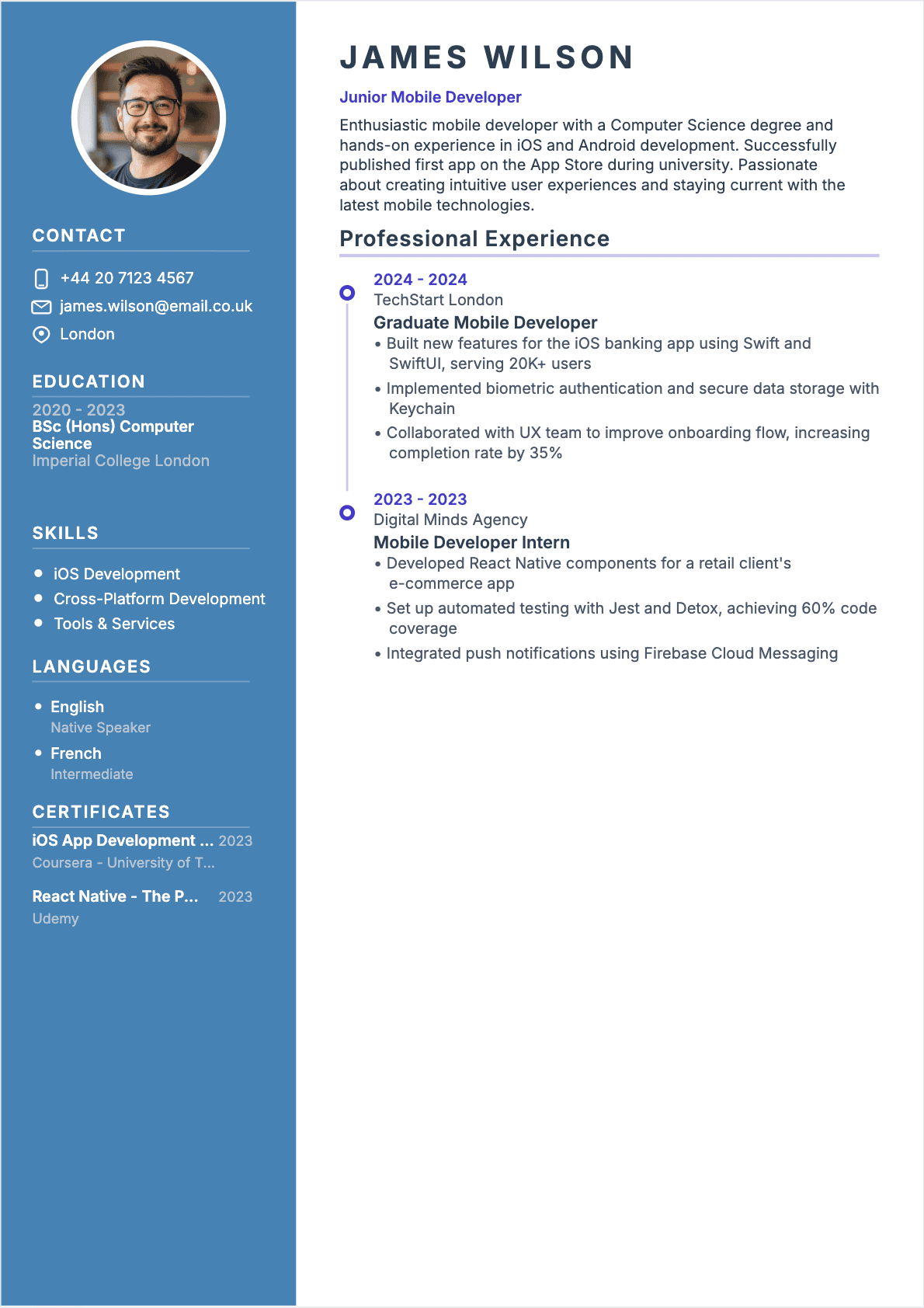
Resume Mobile Developer Junior
Mobile Developer resume template for Junior profile
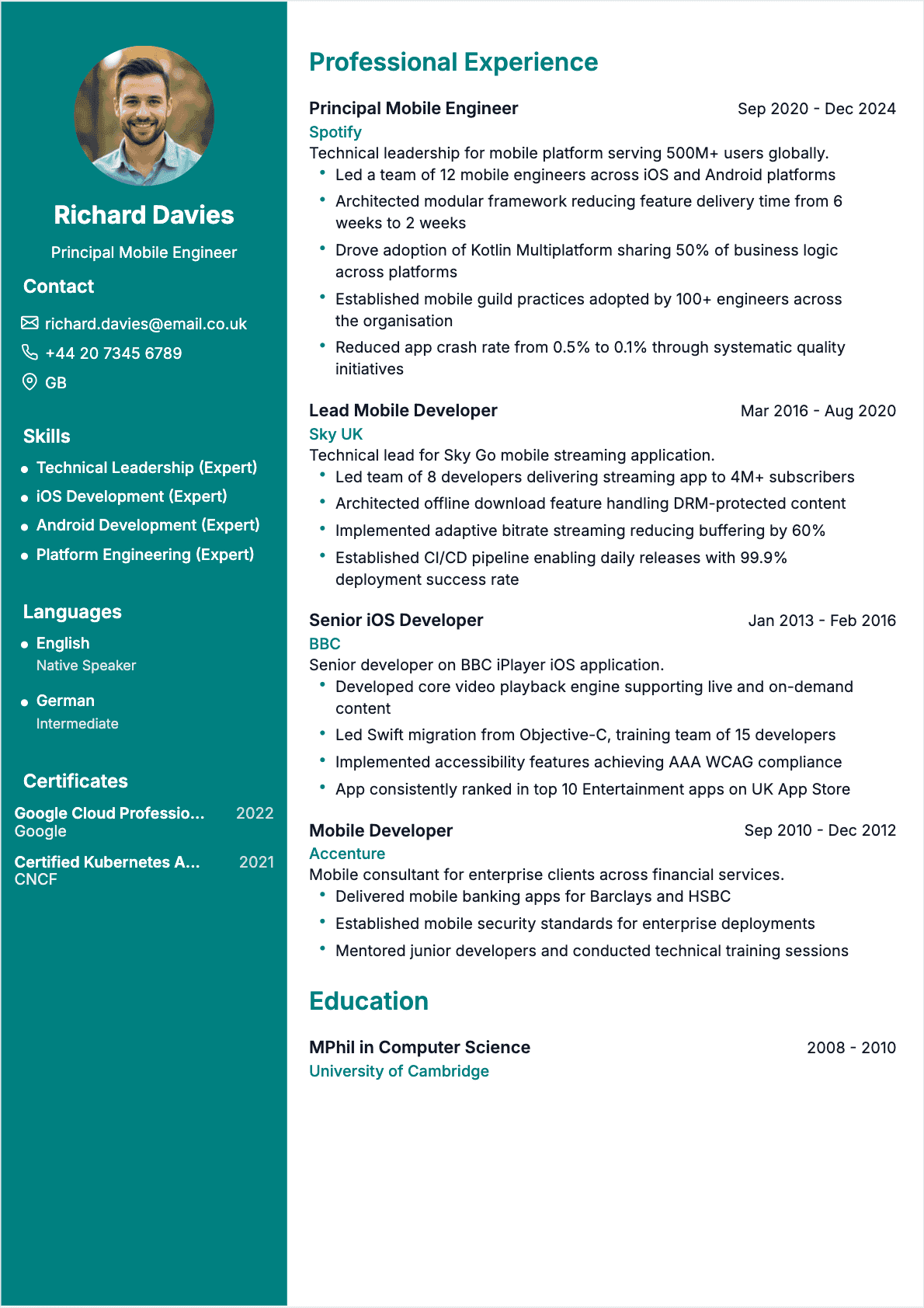
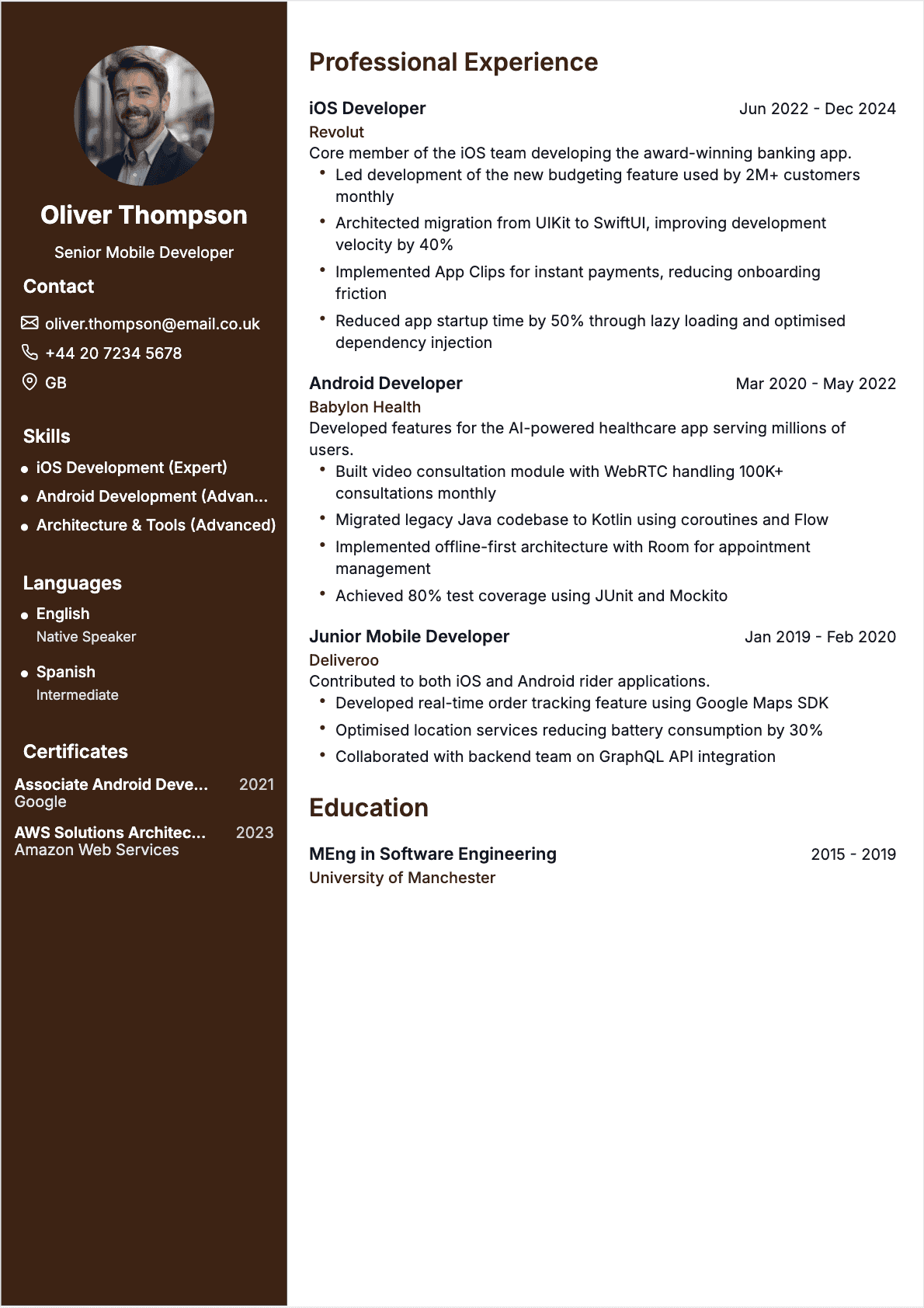
Resume Mobile Developer Senior
Mobile Developer resume template for Senior profile
Resume Mobile Developer Confirmé
Mobile Developer resume template for Confirmé profile
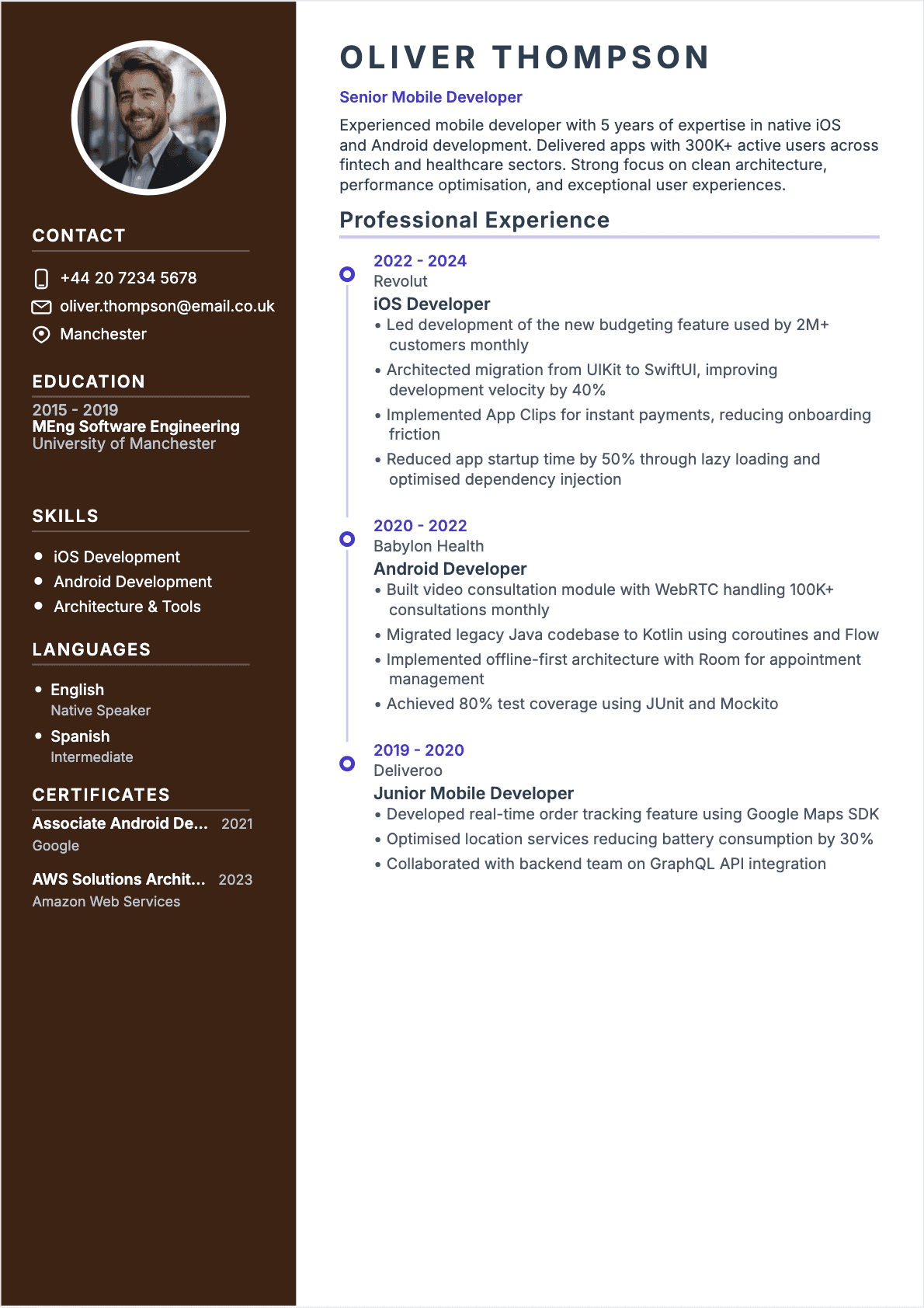
Resume Mobile Developer Confirmé
Mobile Developer resume template for Confirmé profile
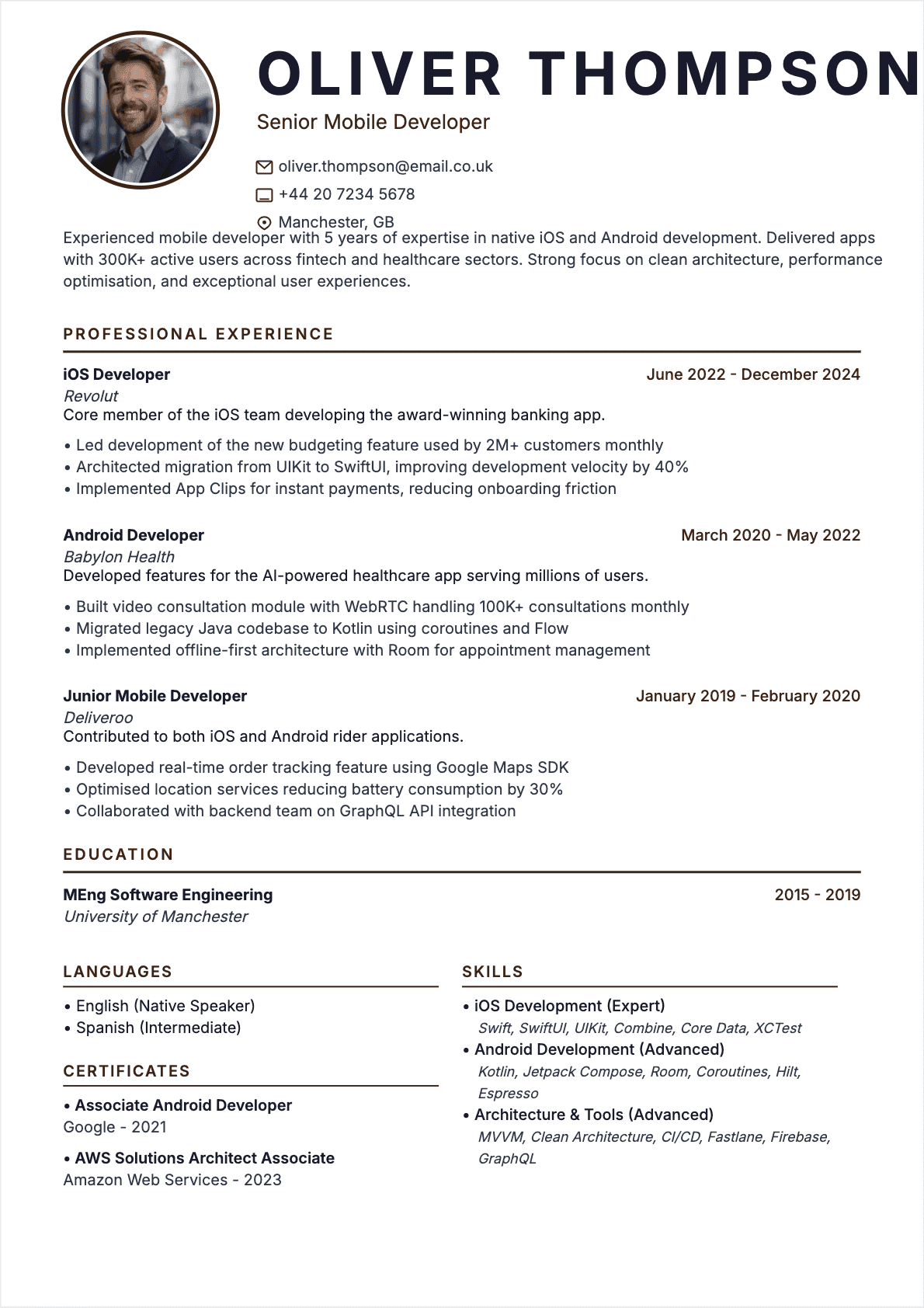
Resume Mobile Developer Confirmé
Mobile Developer resume template for Confirmé profile
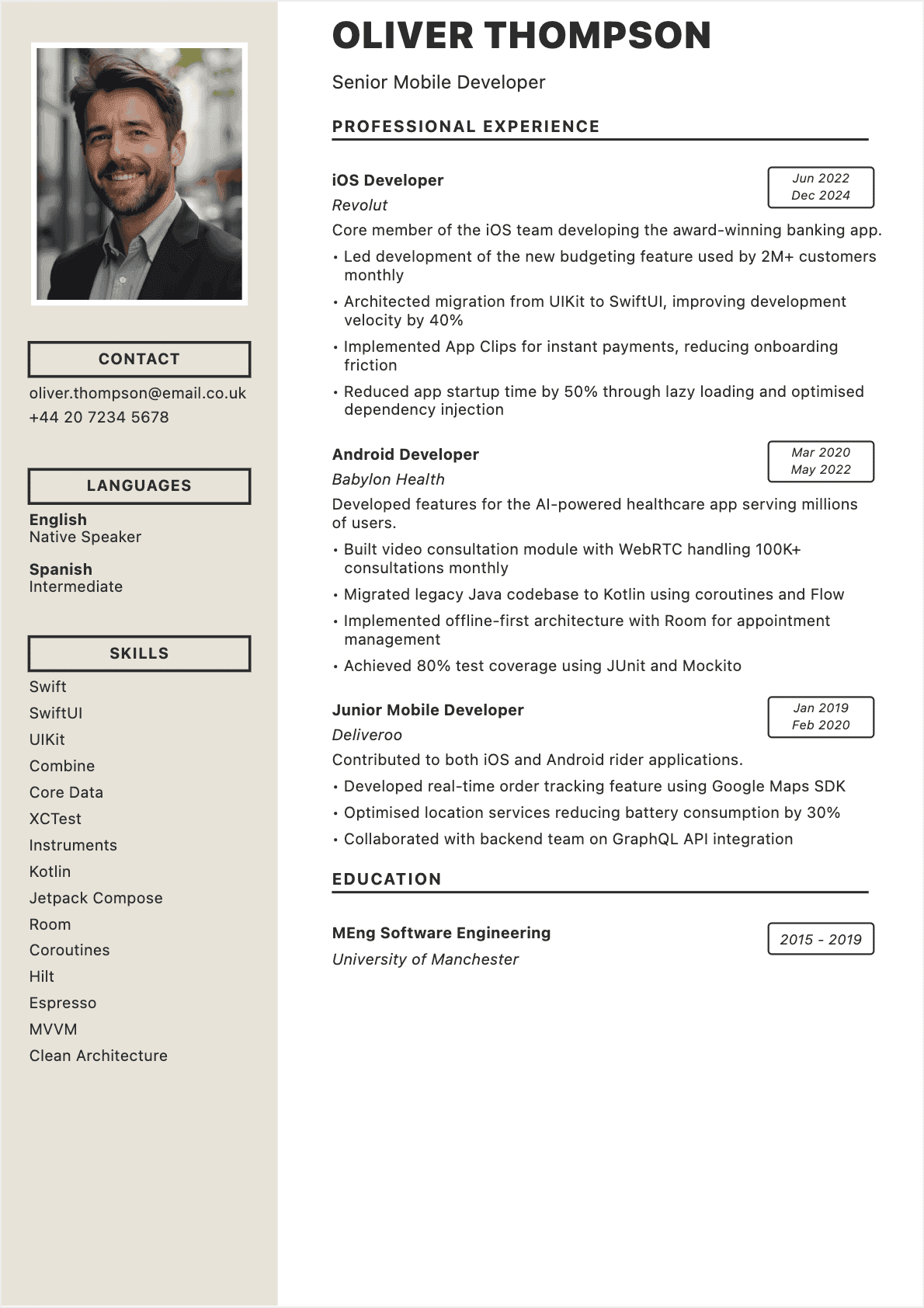
Resume Mobile Developer Confirmé
Mobile Developer resume template for Confirmé profile
Like one of these Mobile Developer resume templates?
Select it, fill in your details and download your resume as PDF.
Mobile Developer Resume Examples
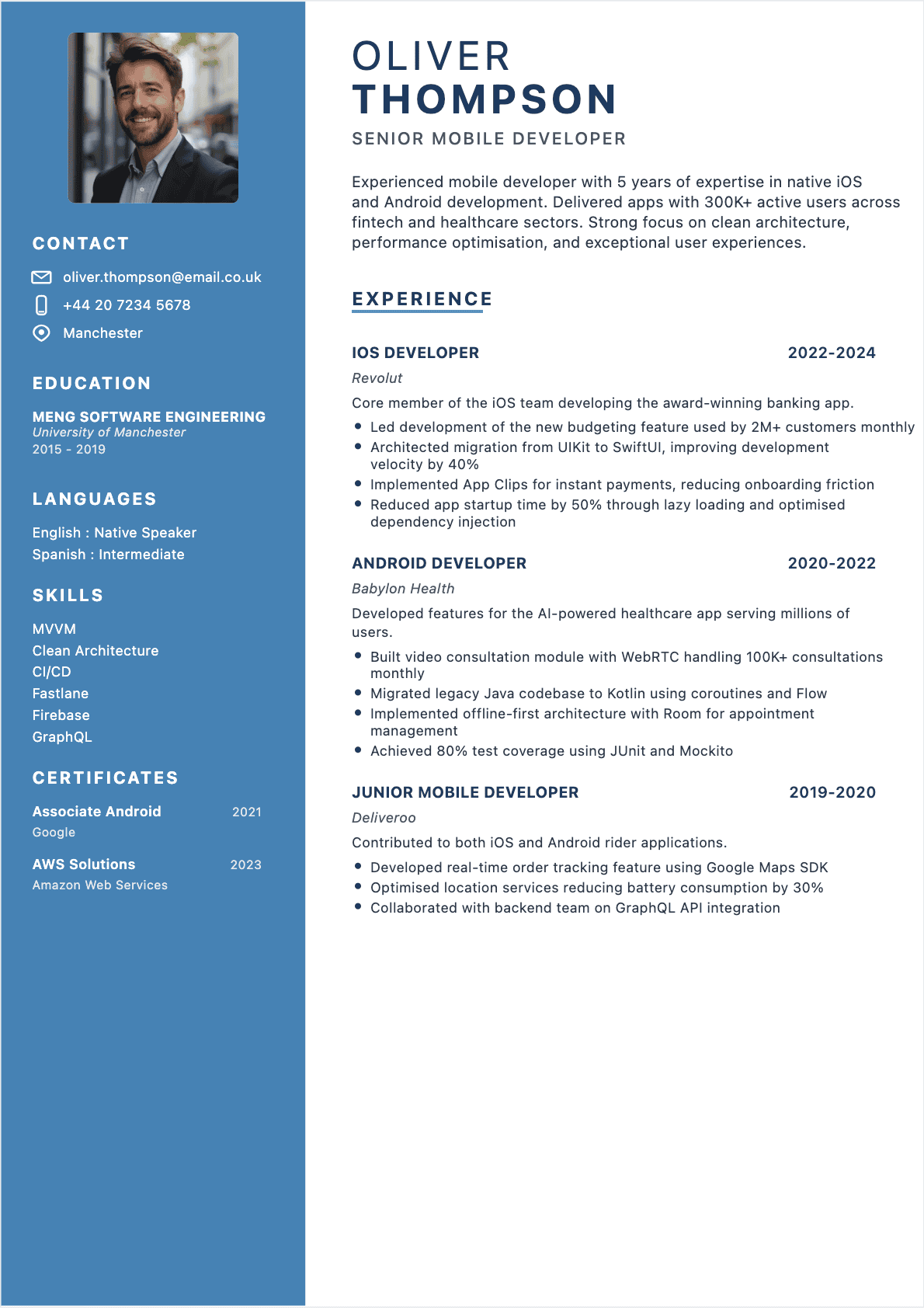
Oliver Thompson
Senior Mobile Developer
oliver.thompson@email.co.uk
+44 20 7234 5678
Manchester, GB
Experienced mobile developer with 5 years of expertise in native iOS and Android development. Delivered apps with 300K+ active users across fintech and healthcare sectors. Strong focus on clean architecture, performance optimisation, and exceptional user experiences.
Work Experience
iOS Developer
Revolut
- ●Led development of the new budgeting feature used by 2M+ customers monthly
- ●Architected migration from UIKit to SwiftUI, improving development velocity by 40%
- ●Implemented App Clips for instant payments, reducing onboarding friction
Android Developer
Babylon Health
- ●Built video consultation module with WebRTC handling 100K+ consultations monthly
- ●Migrated legacy Java codebase to Kotlin using coroutines and Flow
- ●Implemented offline-first architecture with Room for appointment management
Junior Mobile Developer
Deliveroo
- ●Developed real-time order tracking feature using Google Maps SDK
- ●Optimised location services reducing battery consumption by 30%
- ●Collaborated with backend team on GraphQL API integration
Education
MEng
University of Manchester
Skills
Languages
English — Native Speaker
Spanish — Intermediate
Certifications
Associate Android DeveloperGoogle
AWS Solutions Architect AssociateAmazon Web Services
Mobile Developer role overview
Mobile Developers build, test, and maintain applications for smartphones and tablets across iOS, Android, and cross-platform frameworks. Your day starts with stand-ups where you discuss progress on features, blockers, and sprint goals. You spend most of your time writing code, reviewing pull requests from teammates, debugging issues reported by QA or users, and collaborating with designers to implement UI/UX specifications. The work alternates between building new features, refactoring legacy code, optimizing performance, and fixing bugs that surface in production.
The role demands constant learning since mobile platforms update annually with new APIs, design guidelines, and deprecations. You work closely with backend developers to integrate REST or GraphQL APIs, with product managers to clarify requirements, and with QA engineers to ensure test coverage. Depending on your company size, you might also handle app store submissions, monitor crash analytics through Firebase or Sentry, and participate in architecture decisions about state management, navigation patterns, or modularization strategies.
Career progression typically moves from Junior Mobile Developer (0-2 years) to Mid-level (2-5 years) where you own features end-to-end, then Senior (5-8 years) where you architect solutions and mentor juniors. Beyond that, you can become a Lead Mobile Developer managing a small team, a Mobile Architect defining technical strategy, or transition into Engineering Management. Some developers specialize deeply in iOS or Android, while others become cross-platform experts in React Native or Flutter.
Salary ranges vary significantly by location and company size. In the United States, Junior Mobile Developers earn $70,000-$95,000, Mid-level developers make $95,000-$135,000, and Senior developers command $135,000-$180,000+. Tech hubs like San Francisco or New York add 20-30% premiums. In the UK, expect £35,000-£50,000 for junior roles, £50,000-£75,000 mid-level, and £75,000-£110,000+ senior positions. European markets like Germany or Netherlands offer €45,000-€60,000 junior, €60,000-€85,000 mid-level, and €85,000-€120,000 senior ranges.
Typical daily tasks include:
- Writing and reviewing code in Swift, Kotlin, Dart, or JavaScript/TypeScript for mobile applications
- Implementing new features based on product specifications and design mockups from Figma or Sketch
- Debugging crashes and performance issues using Xcode Instruments, Android Profiler, or third-party monitoring tools
- Collaborating with backend teams to integrate APIs and handle data synchronization or offline functionality
- Participating in sprint planning, daily stand-ups, and retrospectives as part of Agile development cycles
- Testing applications on multiple devices and OS versions to ensure compatibility and consistent user experience
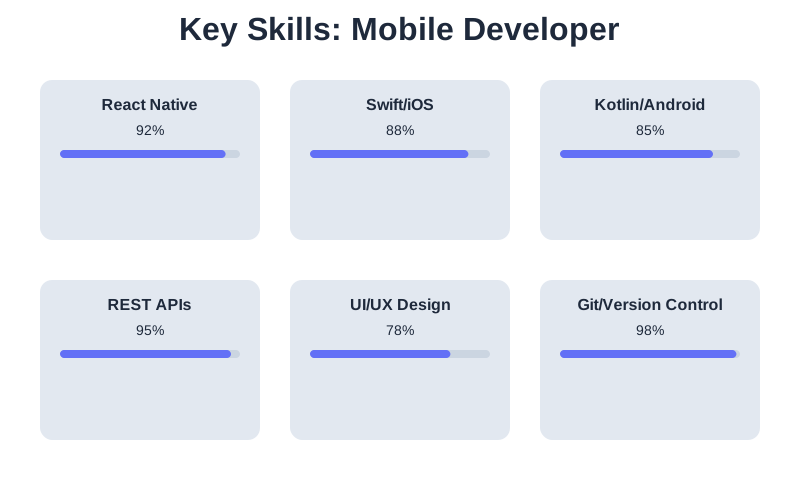
Essential skills for a Mobile Developer resume
Your resume needs to demonstrate both platform-specific expertise and broader software engineering fundamentals. ATS systems scan for specific programming languages, frameworks, and tools, so including exact terminology matters more than generic descriptions. Recruiters spend 15-20 seconds on initial screening, looking for proof you can build production apps, not just tutorial projects.
Technical skills form the foundation, but soft skills determine whether you'll thrive in collaborative environments. Mobile development requires constant communication with designers about implementation feasibility, with product managers about scope, and with QA about reproducible bugs. The ability to write clear documentation, explain technical decisions, and give constructive code review feedback separates good developers from great ones.
Core technical and soft skills to highlight:
- Native iOS Development (Swift/SwiftUI) - Required for iOS-focused roles; demonstrates understanding of Apple's ecosystem, UIKit/SwiftUI patterns, and App Store guidelines that govern feature implementation and approval processes.
- Native Android Development (Kotlin/Java) - Essential for Android positions; shows proficiency with Jetpack Compose or XML layouts, Material Design principles, and Google Play Store requirements for publishing and updates.
- Cross-Platform Frameworks (Flutter/React Native) - Increasingly demanded for startups and companies maintaining both platforms with smaller teams; proves you can share code between iOS and Android while handling platform-specific customizations.
- RESTful API Integration & GraphQL - Critical since mobile apps rarely work standalone; demonstrates ability to consume backend services, handle authentication tokens, manage network errors, and implement offline-first architectures.
- Version Control (Git/GitHub/GitLab) - Non-negotiable for any development role; shows you can collaborate through branches, resolve merge conflicts, write meaningful commit messages, and participate in pull request workflows.
- State Management (Redux/Provider/Bloc) - Separates junior from mid-level developers; proves understanding of how to manage complex application state, prevent bugs from inconsistent data, and structure code for maintainability.
- Unit & UI Testing (XCTest/JUnit/Jest) - Increasingly required as companies prioritize code quality; demonstrates commitment to writing testable code and catching regressions before they reach production users.
- CI/CD Pipelines (Fastlane/GitHub Actions/Bitrise) - Shows you understand modern deployment workflows beyond manual builds; proves ability to automate testing, building, and releasing apps to beta testers or production.
- Problem-Solving & Debugging - Mobile development involves platform-specific quirks, memory constraints, and device fragmentation; ability to systematically isolate issues and find solutions matters more than memorizing syntax.
- Communication & Collaboration - You'll explain technical constraints to non-technical stakeholders, document architecture decisions, and help teammates through code reviews; clear communication prevents misaligned expectations and wasted sprints.
- Attention to UI/UX Details - Mobile users expect polished experiences; noticing animation timing, touch target sizes, loading states, and edge cases shows you care about craft beyond just functional code.
- Adaptability to Platform Changes - iOS and Android release major updates annually that deprecate APIs and introduce new patterns; willingness to learn and migrate codebases demonstrates long-term value to employers.
For ATS optimization, prioritize exact matches to job descriptions. If a posting mentions 'Kotlin' five times, ensure your resume includes it in skills, experience bullets, and project descriptions. Include version numbers for frameworks (Flutter 3.x, React Native 0.72) and specific libraries (Retrofit, Alamofire, Room) that appear in requirements. Generic terms like 'mobile development' score lower than 'iOS development with Swift and SwiftUI' or 'Android development using Kotlin and Jetpack Compose'.
How to write a Mobile Developer resume step by step
1. Start with a targeted professional summary
Write 3-4 lines that immediately communicate your platform expertise, years of experience, and biggest achievement. Avoid generic statements about being 'passionate' or 'detail-oriented.' Instead, specify technologies and quantifiable impact. Example: 'iOS Developer with 4 years building consumer apps in Swift and SwiftUI. Reduced app crash rate from 2.1% to 0.3% through systematic refactoring and improved error handling. Shipped 12 App Store releases serving 500K+ active users across fintech and e-commerce domains.'
2. List technical skills in a scannable format
Create a dedicated skills section with categories: Languages (Swift, Kotlin, Dart, TypeScript), Frameworks (SwiftUI, Jetpack Compose, Flutter, React Native), Tools (Xcode, Android Studio, Git, Firebase), and Testing (XCTest, Espresso, Jest). ATS systems parse this section first, so exact spelling matters—write 'SwiftUI' not 'Swift UI', 'Jetpack Compose' not 'Compose'. Include proficiency levels only if explicitly requested; otherwise, presence in this section implies working knowledge.
3. Structure experience bullets with action-result-metric format
Each bullet should start with what you did, explain the context or challenge, and end with measurable impact. Bad example: 'Developed features for mobile app.' Good example: 'Built real-time chat feature using WebSocket connections and local SQLite caching, enabling offline message queuing that reduced failed sends by 67% and improved user retention by 12%.' Quantify everything possible: users affected, performance improvements, crash reductions, time saved, revenue impacted.
4. Showcase projects with technical depth
For each role, highlight 2-3 significant projects beyond routine feature work. Describe the technical challenge, your architectural decisions, and outcomes. Example: 'Led migration from UIKit to SwiftUI across 40+ screens, implementing MVVM architecture with Combine for reactive data flow. Reduced view controller code by 35% and cut UI-related bugs by 28% in subsequent releases.' This demonstrates initiative, technical judgment, and ability to drive improvements beyond assigned tickets.
5. Include relevant education and certifications
List your degree (Computer Science, Software Engineering, or related field) with graduation year. Add relevant certifications like Google Associate Android Developer, iOS App Development with Swift (Apple), or platform-specific courses from Udacity or Coursera. If you're self-taught, emphasize portfolio projects and open-source contributions instead. Bootcamp graduates should list the program name, duration, and technologies covered, especially if from recognized programs like App Academy or Flatiron School.
6. Add a portfolio or GitHub link
Mobile development is visual and hands-on, so recruiters want to see your work. Include a link to your GitHub profile with pinned repositories showing clean code, proper README files, and commit history. If you have published apps, link to App Store or Google Play listings. For proprietary work, create side projects demonstrating similar technical skills—a weather app showing API integration, a to-do app demonstrating state management, or a UI clone proving design implementation abilities.
7. Optimize for ATS without keyword stuffing
Read the job description and identify repeated technical terms, then naturally incorporate them into your experience bullets. If the role emphasizes 'Kotlin' and 'MVVM architecture,' ensure both appear in context: 'Refactored Android app to MVVM architecture using Kotlin coroutines and LiveData, improving code testability and reducing fragment complexity.' Avoid listing every technology you've touched; focus on what's relevant to the target role. Use standard section headers (Experience, Education, Skills) since ATS systems expect conventional formatting.
Before/after examples:
Before: 'Responsible for mobile app development and maintenance. Fixed bugs and added new features. Worked with team members on various projects.'
After: 'Developed and maintained iOS banking app serving 200K users, implementing biometric authentication with Face ID/Touch ID that increased login success rate from 78% to 94%. Collaborated with 3 backend engineers to integrate 12 RESTful endpoints, reducing average API response rendering time from 1.2s to 340ms through pagination and caching strategies.'
Before: 'Built mobile applications using Flutter. Improved app performance.'
After: 'Architected Flutter e-commerce app with BLoC pattern for state management, supporting 50K daily active users across iOS and Android. Optimized image loading and list rendering, reducing initial load time by 58% (from 4.1s to 1.7s) and decreasing memory usage by 42%, resulting in 23% fewer crashes on mid-range devices.'
Common mistakes on Mobile Developer resumes
Listing technologies without demonstrating application
Many resumes include long lists of languages and frameworks without showing how you actually used them. Writing 'Skills: Swift, Kotlin, Flutter, React Native, Java, Objective-C' suggests surface-level familiarity rather than expertise. Recruiters for mobile roles want proof you've shipped production code. Instead, weave technologies into experience bullets: 'Migrated legacy Objective-C codebase to Swift 5, refactoring 15K lines across 60 classes while maintaining backward compatibility.' This proves hands-on experience, not just tutorial completion.
Ignoring platform-specific conventions and terminology
Generic descriptions like 'created user interfaces' miss opportunities to demonstrate platform knowledge. iOS developers should reference UIKit, SwiftUI, Auto Layout, Human Interface Guidelines, and App Store Connect. Android developers need to mention Jetpack libraries, Material Design, Gradle, and Google Play Console. Cross-platform developers should explain how they handled platform-specific code in Flutter or React Native. Using correct terminology signals you understand the ecosystem beyond just writing code.
Focusing on responsibilities instead of achievements
Weak resumes read like job descriptions: 'Participated in daily stand-ups, wrote code according to specifications, submitted pull requests for review.' These describe what any developer does, not what makes you valuable. Strong resumes quantify impact: 'Reduced Android app size by 34% (from 47MB to 31MB) through ProGuard optimization and asset compression, increasing install conversion rate by 18% in markets with limited bandwidth.' Recruiters hire based on proven results, not task completion.
Omitting metrics about app scale and performance
Mobile development impact relates directly to user numbers, performance benchmarks, and quality metrics. Saying you 'built a social media app' means nothing without context. Compare: 'Developed iOS social networking app handling 2M daily active users, implementing infinite scroll with prefetching that maintained 60fps scrolling performance and reduced memory footprint by 40% to prevent crashes on iPhone 8 and older devices.' Numbers prove you've worked at scale and understand performance constraints.
Including outdated technologies or irrelevant experience
Still listing Objective-C as a primary skill in 2026 signals you haven't kept current, unless you're specifically maintaining legacy codebases. Similarly, spending resume space on unrelated roles (retail, food service) when you have 3+ years of mobile development dilutes your expertise. If you're transitioning from another field, keep prior experience to one line and emphasize mobile projects, bootcamp work, or open-source contributions. Recruiters want to see your trajectory toward mobile specialization, not your complete work history.
Neglecting to mention app store presence or user feedback
If you've published apps to the App Store or Google Play, include download numbers, ratings, and user reviews. 'Published 3 iOS apps with combined 50K downloads and 4.6-star average rating' demonstrates you understand the full release cycle, not just coding. Mention if you handled app store optimization, responded to user reviews, or managed beta testing through TestFlight or Firebase App Distribution. This shows ownership beyond writing code.
Using vague descriptions for technical architecture
Statements like 'implemented best practices' or 'used modern architecture patterns' mean nothing specific. Mobile recruiters want to know if you understand MVVM, MVP, VIPER, Clean Architecture, or MVI. Be explicit: 'Architected Android app using Clean Architecture with three layers (presentation, domain, data), implementing dependency injection via Hilt and repository pattern for data access, resulting in 85% unit test coverage and modular codebase that reduced feature development time by 30%.' Specificity proves expertise.
Mobile Developer resume trends in 2026
The mobile development hiring market in 2026 prioritizes developers who can work across platforms efficiently. Companies increasingly prefer hiring one Flutter or React Native developer over separate iOS and Android specialists, especially startups and mid-size companies with limited budgets. However, large tech companies and enterprises still value native expertise for performance-critical apps. Your resume should clarify your specialization—if you're a native iOS expert, emphasize Swift and SwiftUI depth; if you're cross-platform, highlight how you've managed platform-specific code and maintained native performance.
AI-assisted development tools have changed expectations around productivity. GitHub Copilot, ChatGPT, and platform-specific AI tools now help generate boilerplate code, write tests, and debug issues faster. Recruiters assume you're using these tools, so resumes should emphasize higher-level skills: architectural decisions, performance optimization, complex state management, and cross-functional collaboration. Mention how you've used AI tools to accelerate development—'Utilized AI-assisted coding to reduce boilerplate by 40%, focusing engineering time on complex business logic and UX refinement'—but focus on outcomes, not the tools themselves.
Declarative UI frameworks have become standard. SwiftUI for iOS and Jetpack Compose for Android are now expected skills for developers with less than 5 years of experience. If you're still primarily using UIKit or XML layouts, your resume should explain why (maintaining legacy apps) and demonstrate you're learning modern approaches. Include side projects or recent training in SwiftUI or Compose to show you're current. For cross-platform developers, Flutter's popularity continues growing, while React Native remains strong but faces competition.
Security and privacy expertise now differentiate candidates. With GDPR, CCPA, and platform-specific privacy requirements (App Tracking Transparency on iOS, permission models on Android), companies need developers who understand compliance from the start. Highlight experience with: secure data storage using Keychain or EncryptedSharedPreferences, implementing certificate pinning, handling biometric authentication, managing user consent flows, or passing security audits. Example: 'Implemented end-to-end encryption for messaging feature using CryptoKit, ensuring HIPAA compliance for healthcare app serving 80K patients.'
Top employers in 2026 look for evidence of full-cycle ownership. They want developers who can take a feature from product spec through design collaboration, implementation, testing, release, and monitoring. Your resume should show you've handled app store submissions, integrated analytics to measure feature adoption, monitored crash reports through Firebase Crashlytics or Sentry, and iterated based on user feedback. Companies value developers who think beyond code to business impact and user experience.
Remote and hybrid work have permanently changed mobile development hiring. Geographic restrictions have loosened, meaning you're competing with developers globally, but you also have access to opportunities worldwide. Emphasize asynchronous communication skills, experience with distributed teams, and self-direction. Mention tools you've used for remote collaboration: Figma for design handoff, Notion or Confluence for documentation, Slack for communication, and Loom for explaining technical concepts. Companies hiring remotely prioritize developers who can work independently and communicate proactively.
Emerging skills gaining traction include: Kotlin Multiplatform Mobile (KMM) for sharing business logic between iOS and Android while keeping native UIs; SwiftUI animations and complex layouts as design expectations increase; GraphQL and real-time subscriptions for data-heavy apps; and accessibility implementation beyond basic compliance. If you have experience with any of these, feature them prominently. Also mention exposure to emerging technologies like AR (ARKit/ARCore), machine learning integration (Core ML/ML Kit), or wearable development (watchOS/Wear OS) if relevant to target roles.
Further reading:
Frequently asked questions
Find answers to the most frequently asked questions.
If you have under ~5 years of experience, aim for one page by prioritizing shipped apps, core stack, and 2–3 quantified achievements per role. For senior profiles, two pages are acceptable when you include architecture ownership, reliability work, mentoring, and multiple products. Keep every line tied to impact or decision-making.
Include LinkedIn, GitHub, and at least one store link (App Store/Google Play) when possible. If the app is private, link a portfolio page with screenshots, metrics you can share, and a short description of your role. Make URLs clickable and readable, and verify they work from an incognito browser.
Use percentage deltas and engineering metrics that are not confidential: crash-free sessions, ANR rate, cold start time, bundle size, CI pipeline time, test coverage, or release frequency. Example: “Reduced build time by 22%” or “Improved crash-free sessions to 99.7%.” Always add context (module, platform, timeframe).
Prioritize platform and language keywords (Android, iOS, Kotlin, Swift), architecture terms (MVVM, Clean Architecture), and delivery tooling (CI/CD, Fastlane, GitHub Actions). Add analytics and reliability tools (Firebase, Crashlytics, Sentry) plus API terms (REST, GraphQL). Match the job posting wording exactly where truthful.
State the framework plus what you shipped: “Flutter (Dart) — migrated 6 screens, shared UI kit, reduced duplicate code by 35%.” Mention state management (Bloc/Provider/Riverpod for Flutter, Redux/Context for RN), native integrations, and performance work. Hiring managers want evidence you can handle platform constraints, not only UI.
In most English-speaking markets (especially the US), avoid adding a photo because it can introduce bias concerns and is not expected. In the UK it is optional, but still uncommon in tech. Focus on content: measurable outcomes, stack depth, and links to shipped work. Let the portfolio do the visual proof instead.
Your career deserves a better resume
With CVtoWork, select a template, fill in the fields and download your resume as PDF.
Start creating