Marketing Manager Resume
Example, Template & Expert Tips 2026
Updated on April 18, 2026.
Marketing Manager CV 2026 guide with ATS keywords, quantified bullet examples, and layout tips to prove ROI, CAC impact, and pipeline contribution.
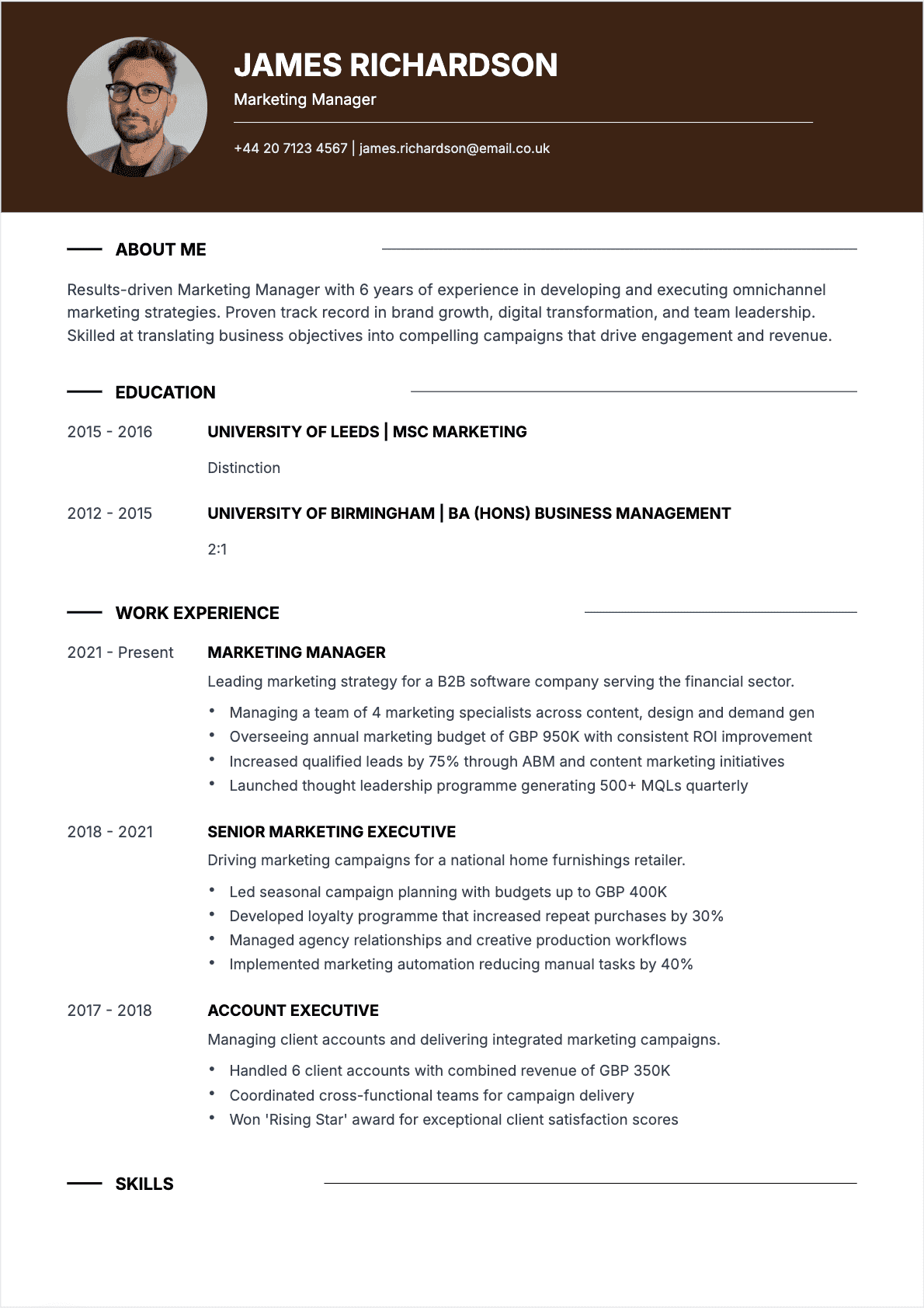
Marketing Manager Resume Templates
8 Templates available
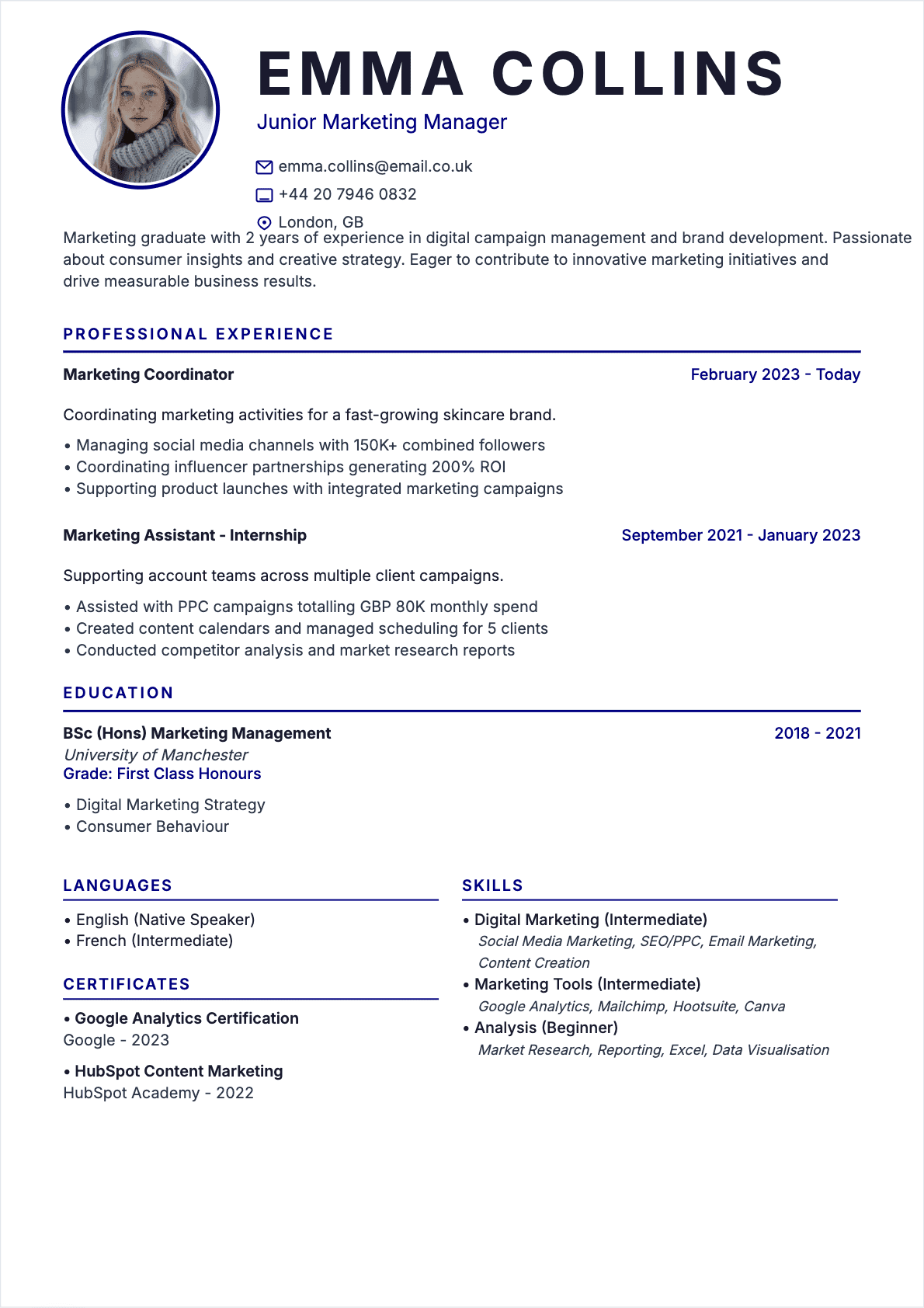
Resume Marketing Manager Junior
Marketing Manager resume template for Junior profile
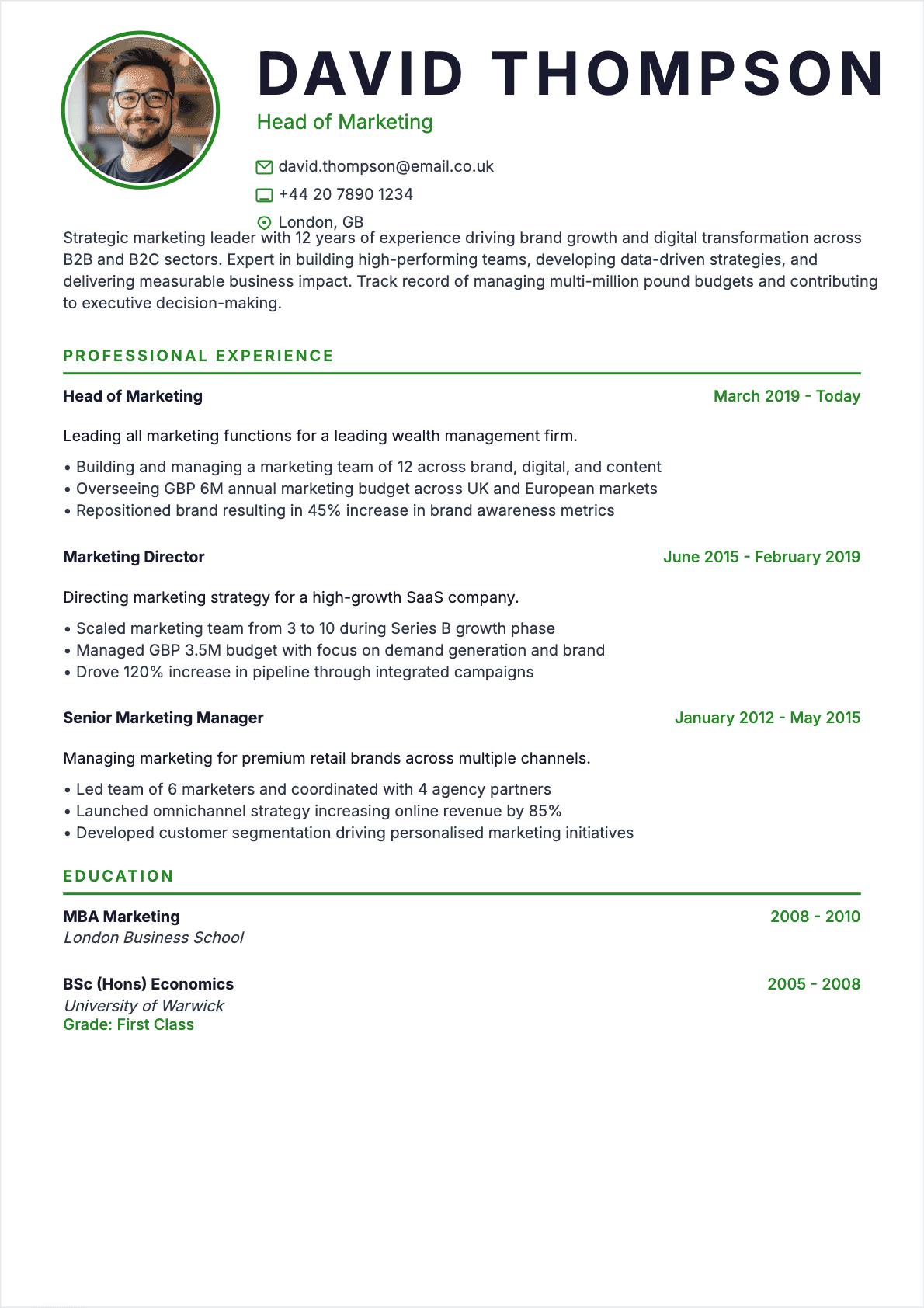
Resume Marketing Manager Senior
Marketing Manager resume template for Senior profile
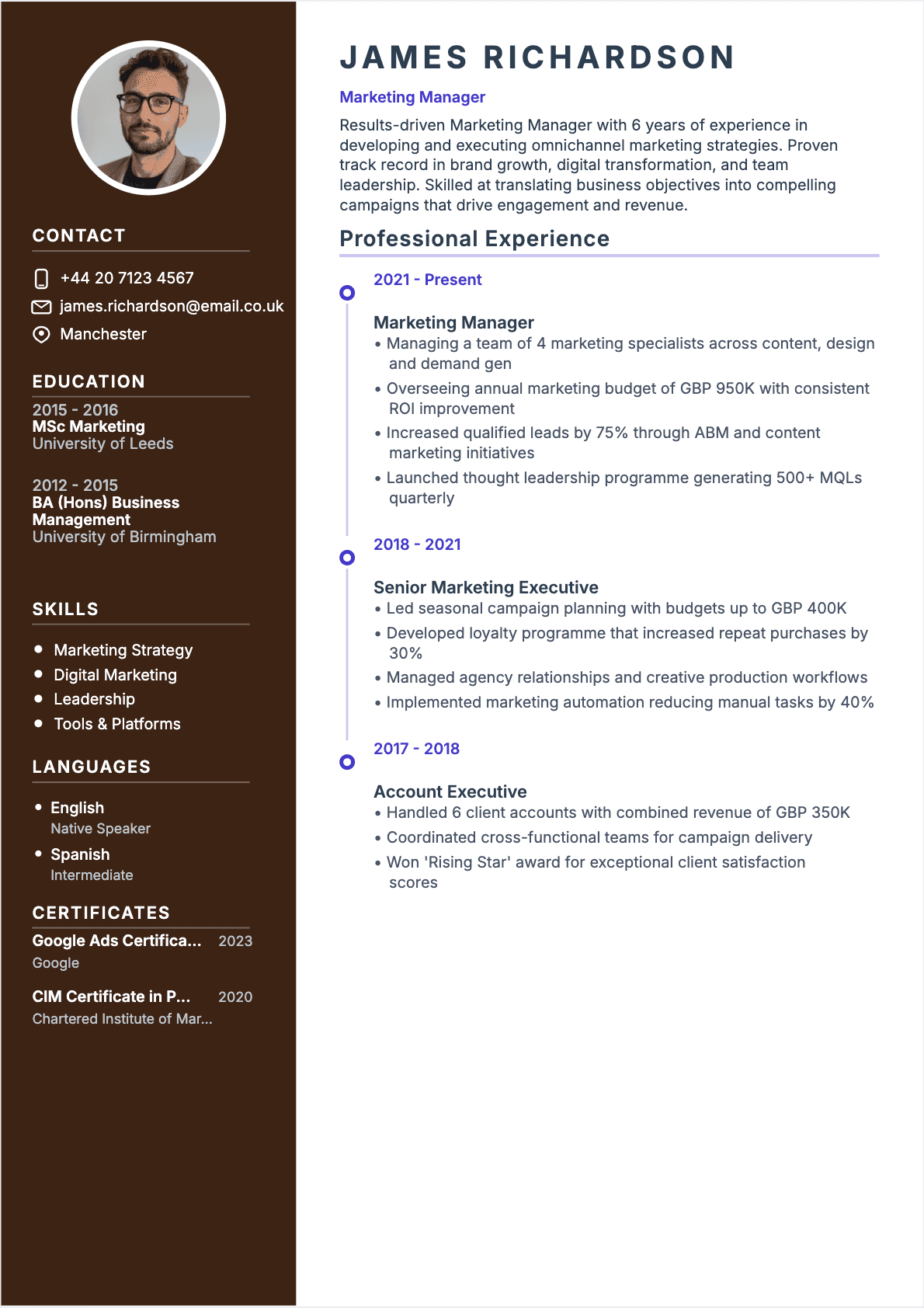
Resume Marketing Manager Confirmé
Marketing Manager resume template for Confirmé profile
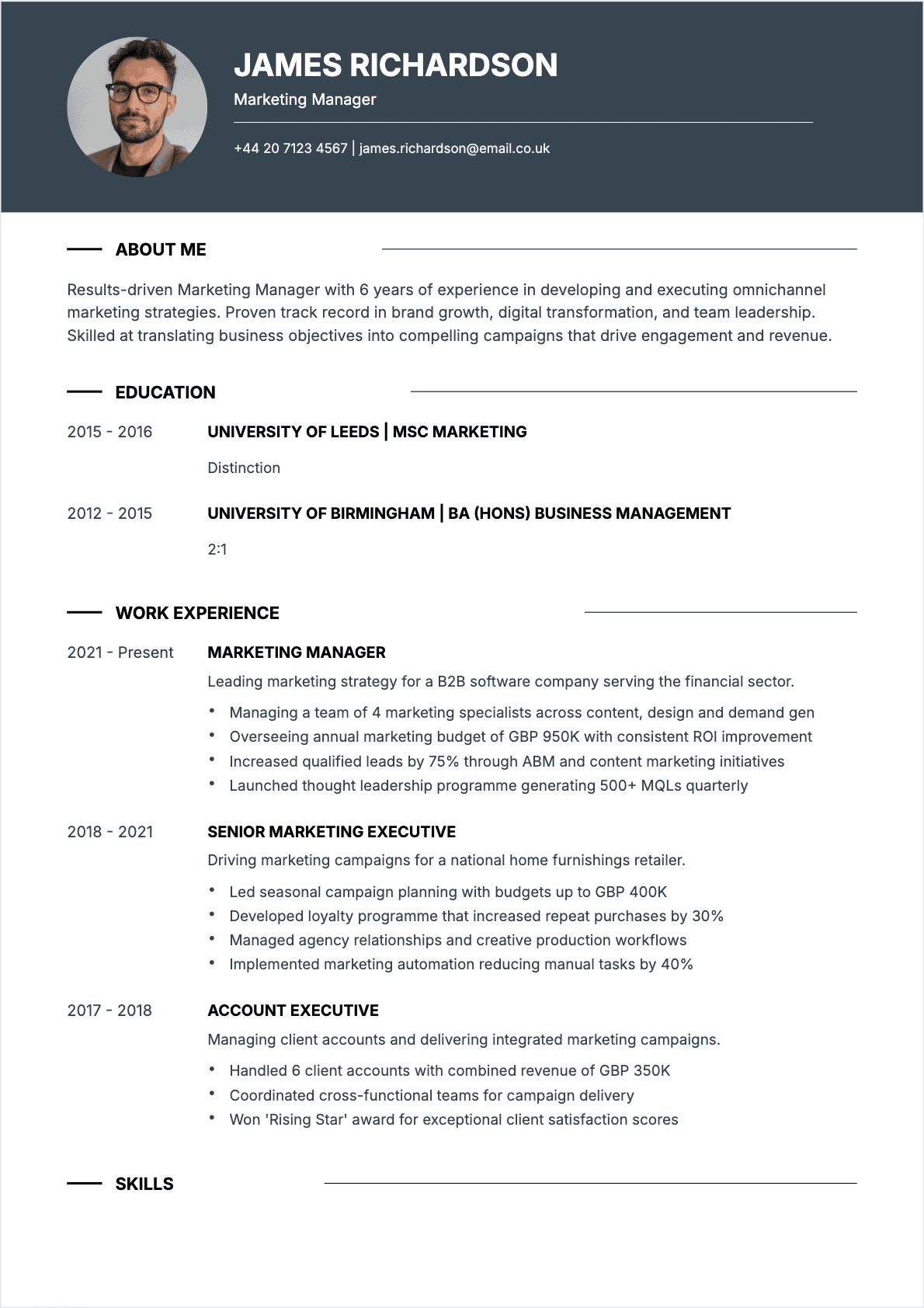
Resume Marketing Manager Confirmé
Marketing Manager resume template for Confirmé profile
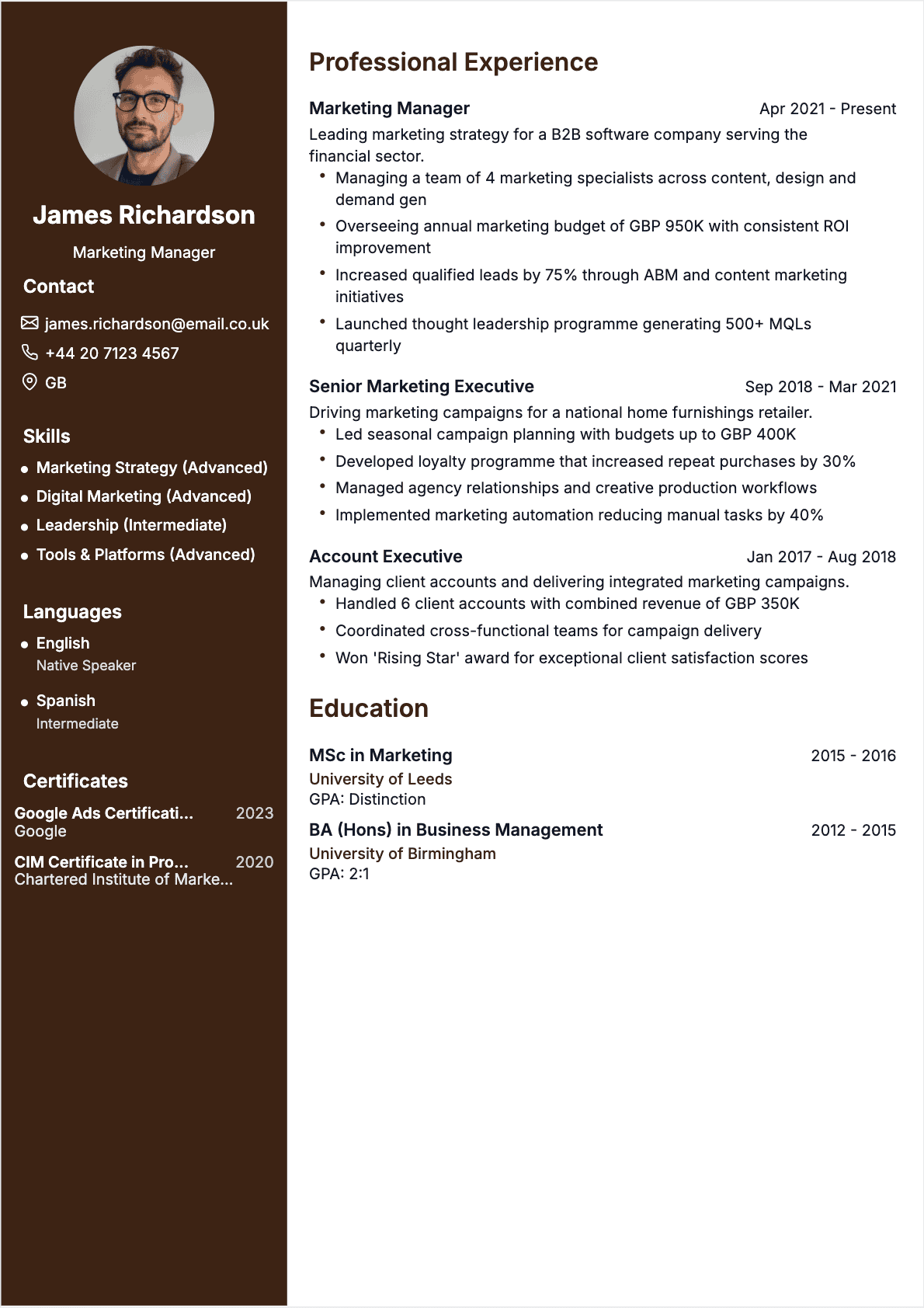
Resume Marketing Manager Confirmé
Marketing Manager resume template for Confirmé profile
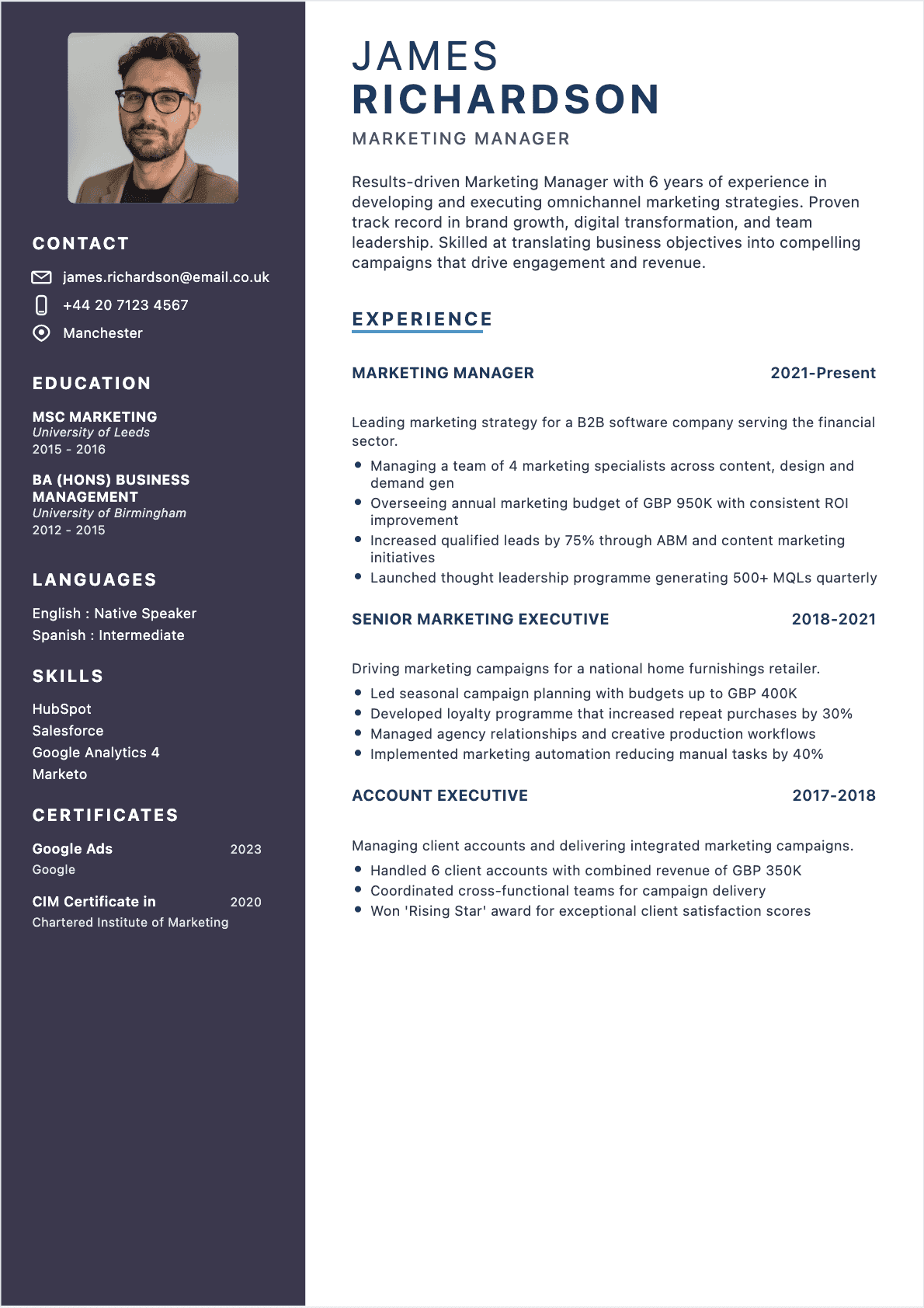
Resume Marketing Manager Confirmé
Marketing Manager resume template for Confirmé profile
Like one of these Marketing Manager resume templates?
Select it, fill in your details and download your resume as PDF.
Marketing Manager Resume Examples
James Richardson
Marketing Manager
james.richardson@email.co.uk
+44 20 7123 4567
Manchester, GB
Results-driven Marketing Manager with 6 years of experience in developing and executing omnichannel marketing strategies. Proven track record in brand growth, digital transformation, and team leadership. Skilled at translating business objectives into compelling campaigns that drive engagement and revenue.
Work Experience
Marketing Manager
- ●Managing a team of 4 marketing specialists across content, design and demand gen
- ●Overseeing annual marketing budget of GBP 950K with consistent ROI improvement
- ●Increased qualified leads by 75% through ABM and content marketing initiatives
Senior Marketing Executive
- ●Led seasonal campaign planning with budgets up to GBP 400K
- ●Developed loyalty programme that increased repeat purchases by 30%
- ●Managed agency relationships and creative production workflows
Account Executive
- ●Handled 6 client accounts with combined revenue of GBP 350K
- ●Coordinated cross-functional teams for campaign delivery
- ●Won 'Rising Star' award for exceptional client satisfaction scores
Education
MSc
University of Leeds
BA (Hons)
University of Birmingham
Skills
Languages
English — Native Speaker
Spanish — Intermediate
Certifications
Google Ads CertificationGoogle
CIM Certificate in Professional MarketingChartered Institute of Marketing
Marketing Manager role overview
A Marketing Manager orchestrates the strategy, execution, and measurement of campaigns that drive customer acquisition, retention, and revenue growth. You'll spend your days balancing strategic planning with hands-on execution—reviewing campaign performance dashboards in the morning, briefing creative teams before lunch, and presenting ROI analyses to leadership in the afternoon. This role sits at the intersection of data analysis, creative direction, and cross-functional collaboration, requiring you to translate business objectives into measurable marketing initiatives.
Your responsibilities extend beyond campaign management to include budget allocation, team leadership, and vendor relationships. You'll own the marketing calendar, coordinate product launches, manage agencies or freelancers, and ensure brand consistency across channels. Depending on company size, you might oversee a team of 2-8 specialists or work as a solo marketing leader wearing multiple hats. The role demands both big-picture thinking and attention to granular metrics like cost per acquisition, conversion rates, and customer lifetime value.
Career progression typically follows this path: Marketing Coordinator → Marketing Specialist → Senior Marketing Specialist → Marketing Manager → Senior Marketing Manager → Director of Marketing → VP of Marketing or CMO. Some Marketing Managers transition laterally into Product Marketing, Growth Marketing, or Brand Management roles. The timeline from Marketing Manager to Director level usually spans 3-5 years with demonstrated revenue impact and team leadership experience.
Salary ranges vary by experience and company size. In the United States, Marketing Managers earn between $65,000-$85,000 at entry level (0-2 years in the manager role), $85,000-$115,000 at mid-level (3-5 years), and $115,000-$160,000+ at senior level (6+ years). Total compensation often includes performance bonuses of 10-20% and equity in startups or tech companies.
Typical daily tasks include:
- Analyzing campaign performance metrics across paid, owned, and earned channels to identify optimization opportunities
- Conducting team standups to review project status, remove blockers, and reallocate resources based on priorities
- Collaborating with Sales to align on lead quality, pipeline contribution, and messaging for target accounts
- Reviewing creative assets, landing pages, and email copy to ensure brand consistency and conversion optimization
- Managing marketing budget allocation across channels and adjusting spend based on CAC and ROAS data
- Reporting on marketing-attributed revenue, MQLs, SQLs, and other KPIs to executive stakeholders
Essential skills for a Marketing Manager resume
Marketing Manager resumes must demonstrate both strategic thinking and technical execution capabilities. Recruiters scan for specific platform proficiencies and measurable outcomes rather than vague statements about 'marketing expertise.' The skills you highlight should directly connect to revenue impact, efficiency gains, or audience growth—these are the metrics hiring managers care about when evaluating candidates.
ATS systems prioritize hard skills and specific tool names, so include exact platform versions and certifications where applicable. However, soft skills like stakeholder management and analytical thinking differentiate strong candidates once you reach the interview stage. Balance technical proficiencies with evidence of leadership and strategic decision-making throughout your resume.
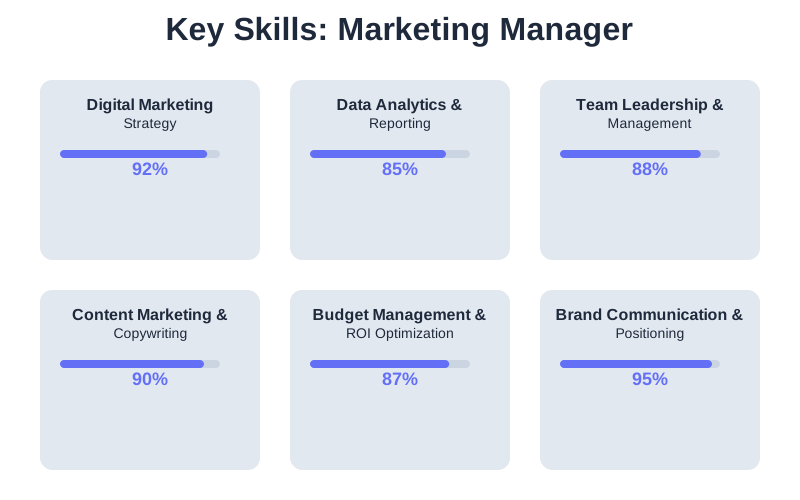
Core skills to feature prominently:
- Marketing automation platforms (HubSpot, Marketo, Pardot) – These tools manage lead nurturing workflows and attribution tracking, essential for demonstrating how you've improved conversion rates and shortened sales cycles.
- Google Analytics 4 and data visualization (Tableau, Looker) – Ability to extract actionable insights from campaign data and present findings to non-technical stakeholders proves your analytical rigor.
- Paid advertising management (Google Ads, Meta Ads Manager, LinkedIn Campaign Manager) – Direct experience optimizing ad spend and reducing CAC shows you can manage substantial budgets efficiently.
- CRM proficiency (Salesforce, HubSpot CRM) – Understanding the full customer journey from MQL to closed-won demonstrates alignment with sales objectives and pipeline contribution.
- Content management systems (WordPress, Contentful, Webflow) – Technical ability to publish and optimize content without developer dependency increases your operational efficiency.
- SEO and SEM strategy – Organic and paid search expertise directly impacts customer acquisition costs and proves you can drive sustainable traffic growth.
- Email marketing and segmentation – Sophisticated email strategies with A/B testing and personalization show your ability to maximize owned channel performance.
- Project management tools (Asana, Monday.com, Jira) – Experience coordinating cross-functional initiatives demonstrates organizational skills critical for managing multiple campaigns simultaneously.
- Budget management and financial modeling – Ability to forecast marketing spend, calculate ROI, and reallocate resources based on performance separates strategic managers from tactical executors.
- Stakeholder communication and executive reporting – Translating marketing metrics into business impact for C-suite audiences shows strategic maturity and leadership readiness.
- Team leadership and vendor management – Experience building processes, mentoring junior marketers, and managing agency relationships indicates readiness for senior-level responsibilities.
- A/B testing and conversion rate optimization – Systematic experimentation approach with documented lift percentages proves your commitment to data-driven decision-making.
How to write a Marketing Manager resume step by step
1. Lead with a results-focused summary that quantifies your marketing impact
Your resume summary should immediately communicate your revenue contribution and specialization. Skip generic introductions and open with your most impressive metric. Instead of 'Experienced Marketing Manager with strong leadership skills,' write 'Marketing Manager who reduced CAC by 34% while scaling monthly lead volume from 450 to 1,200 MQLs across B2B SaaS campaigns.' Include your years of experience, primary channels, and one standout achievement that demonstrates business impact.
2. Structure your experience section with company context and scope
Before listing achievements, provide a one-line company description and your scope of responsibility. Write 'Series B fintech startup, $12M ARR' or 'Enterprise healthcare software provider, 200+ employees' so recruiters understand your operating environment. Follow with your team size, budget, and channels managed: 'Led 4-person marketing team with $850K annual budget across paid social, content, and events.' This context makes your achievements more meaningful and helps recruiters assess role fit.
3. Write achievement bullets using the Challenge-Action-Result formula with specific metrics
Each bullet should tell a mini-story with quantified outcomes. Instead of 'Managed email marketing campaigns,' write 'Rebuilt email nurture sequences with behavioral triggers and dynamic content, increasing email-attributed pipeline from $2.1M to $4.7M quarterly (124% growth) while improving open rates from 18% to 31%.' Include percentage changes, dollar amounts, time periods, and comparative benchmarks. Aim for 4-6 bullets per role, prioritizing achievements from the last 5 years.
4. Incorporate ATS keywords naturally within achievement context
Identify 15-20 keywords from the job description—typically specific platforms, methodologies, and metrics. Weave these into your bullets organically rather than listing them separately. Transform 'Responsible for demand generation' into 'Executed multi-channel demand generation strategy using Marketo automation, reducing cost per MQL from $145 to $89 while maintaining 28% MQL-to-SQL conversion rate.' This approach satisfies ATS algorithms while remaining readable for human reviewers.
5. Create a dedicated 'Key Achievements' or 'Impact Highlights' section for standout wins
Pull your top 3-4 accomplishments into a prominent section near the top of your resume. Format these as brief, metric-heavy statements: 'Launched product rebrand that increased brand awareness by 43% and generated 2,300+ inbound leads in first quarter' or 'Negotiated and managed $1.2M partnership with industry publication, delivering 18:1 ROAS.' This section ensures busy recruiters see your biggest wins even if they skim your detailed experience.
6. Tailor your skills section to match job requirements and seniority level
Organize skills into categories: 'Marketing Platforms,' 'Analytics & Data,' 'Channel Expertise,' and 'Leadership & Strategy.' List specific tools rather than categories—write 'Google Ads, Meta Business Suite, LinkedIn Campaign Manager' instead of 'social media advertising.' For senior roles, emphasize strategic skills like 'Budget Planning & Forecasting' and 'Cross-Functional Team Leadership.' For individual contributor roles, highlight execution skills like 'Landing Page Optimization' and 'Marketing Automation Workflows.'
7. Include relevant certifications and demonstrate continuous learning
Marketing evolves rapidly, so current certifications signal you're staying updated. List credentials like 'Google Analytics Individual Qualification (GAIQ),' 'HubSpot Marketing Software Certification,' or 'Meta Blueprint Certification' with completion dates. If you've completed recent courses in emerging areas like AI-assisted content creation or privacy-compliant tracking, include these to show adaptability. Place certifications in a dedicated section or integrate them into your skills area.
8. Optimize formatting for both ATS parsing and human readability
Use standard section headings like 'Professional Experience,' 'Education,' and 'Skills' that ATS systems recognize. Avoid tables, text boxes, headers, and footers that confuse parsing algorithms. Choose a clean, single-column layout with consistent formatting—use the same date format throughout, align text uniformly, and maintain consistent spacing. Save your resume as both .docx and PDF formats, submitting the version requested in the job posting. Keep total length to 2 pages maximum, using every line to demonstrate measurable impact rather than padding with duties.
Common mistakes on Marketing Manager resumes
Listing responsibilities instead of outcomes
The most frequent mistake is describing what you were supposed to do rather than what you actually achieved. Writing 'Managed social media accounts' or 'Oversaw content marketing strategy' tells recruiters nothing about your effectiveness. These are job descriptions, not accomplishments. Instead, show the business impact: 'Grew LinkedIn following from 3,400 to 18,700 while increasing engagement rate by 156%, generating 340 qualified leads through organic social content.' Recruiters assume you performed basic duties—they're hiring you based on the results you delivered.
Vague metrics that lack context or comparison
Stating 'Increased website traffic' or 'Improved conversion rates' without specific numbers makes your achievements meaningless. Even when candidates include numbers, they often omit critical context. 'Generated 5,000 leads' sounds impressive until you learn the previous manager generated 12,000. Always provide before/after comparisons, percentage changes, or time periods: 'Increased organic traffic from 12,000 to 34,000 monthly sessions (183% growth) over 14 months through SEO optimization and content expansion.' Include baseline metrics, timeframes, and the scale of change.
Failing to connect marketing activities to revenue
Many Marketing Manager resumes focus exclusively on vanity metrics—impressions, clicks, followers—without tying these to business outcomes. Executives care about pipeline contribution, customer acquisition costs, and revenue attribution. Transform 'Executed email campaigns with 25% open rate' into 'Designed email nurture program that contributed $3.2M in pipeline and influenced 34% of closed-won deals, with average open rate of 25% (8 points above industry benchmark).' Always trace your work to its impact on revenue, sales efficiency, or customer retention.
Outdated or irrelevant platform experience
Featuring obsolete tools or platforms signals you haven't kept pace with industry evolution. Highlighting expertise in Google Universal Analytics when GA4 is standard, or emphasizing Facebook Ads Power Editor instead of Meta Business Suite, suggests your skills are stale. Similarly, listing every tool you've ever touched dilutes your expertise. Focus on platforms currently used by your target employers and relevant to the seniority level. A Marketing Manager resume should emphasize strategic platforms like marketing automation and analytics tools rather than basic execution tools like Canva or Mailchimp.
Generic skills without proof points
Simply listing 'Leadership,' 'Strategic Planning,' or 'Data-Driven Decision Making' in a skills section means nothing without evidence. These claims are universal and unverifiable. Instead, demonstrate these qualities through your achievements: 'Built and mentored 5-person content team, reducing freelancer costs by $78K annually while increasing content output by 40%' proves leadership better than the word itself. If you must include a skills section, pair each skill with a proficiency level or certification, and ensure your experience bullets provide concrete examples of each skill in action.
Ignoring industry-specific terminology and metrics
Marketing varies dramatically across B2B, B2C, e-commerce, and SaaS contexts. Using the wrong terminology signals misalignment. B2B resumes should emphasize MQLs, SQLs, pipeline contribution, and account-based marketing, while e-commerce resumes should focus on ROAS, cart abandonment rates, and customer lifetime value. Research the specific metrics and language your target industry uses. A B2B SaaS company won't care about your Instagram influencer campaigns, just as a DTC brand won't prioritize your trade show experience.
Poor formatting that buries key information
Marketing Managers should demonstrate visual hierarchy and information design skills through their resume layout. Dense paragraphs, inconsistent formatting, and buried metrics make recruiters work too hard to find your value. Use bold text to highlight key metrics within bullets, maintain consistent date and location formatting, and create clear visual separation between roles. Your resume's design is itself a work sample—if you can't present your own achievements clearly and compellingly, recruiters will question your ability to create effective marketing materials.
Marketing Manager resume trends in 2026
The Marketing Manager role has shifted dramatically toward technical proficiency and data literacy. Companies now expect managers to independently build reports, configure marketing automation workflows, and interpret attribution models without relying on analysts or IT support. Resumes that showcase hands-on experience with SQL queries, API integrations, or custom dashboard creation in Looker or Tableau stand out. This technical depth matters more than ever as marketing teams become leaner and organizations expect managers to do more with smaller budgets and headcounts.
AI-assisted marketing has moved from experimental to essential, fundamentally changing what employers value. Hiring managers actively seek candidates who've used AI tools to scale content production, personalize campaigns, or optimize ad creative. Your resume should demonstrate practical AI application—'Used ChatGPT and Jasper to increase content output from 8 to 24 articles monthly while maintaining quality standards and SEO performance' or 'Implemented AI-powered email subject line testing, improving open rates by 19% across 200+ campaigns.' Generic mentions of 'AI familiarity' don't differentiate you; specific use cases and measured outcomes do.
Privacy-compliant marketing has become a core competency as third-party cookie deprecation and privacy regulations reshape digital advertising. Employers prioritize candidates who've successfully adapted to iOS 14.5+ attribution challenges, implemented server-side tracking, or built first-party data strategies. Highlight experience with consent management platforms, first-party data activation, or privacy-compliant attribution modeling. Phrases like 'Rebuilt attribution model using first-party data and Google Analytics 4, recovering 78% of previously lost conversion visibility post-iOS 14.5' demonstrate you've solved real problems created by privacy changes.
Cross-functional collaboration skills have intensified in importance as marketing increasingly influences product development, customer success, and revenue operations. Companies want Marketing Managers who can partner effectively with Product teams on go-to-market strategy, align with Sales on account-based marketing, and work with Customer Success on expansion campaigns. Your resume should include achievements that span departments: 'Partnered with Product and Sales to launch new enterprise tier, creating positioning, sales enablement, and demand generation strategy that acquired 23 enterprise customers worth $4.1M ARR in first year.'
Remote and hybrid work arrangements have created new expectations around asynchronous communication and distributed team management. Marketing Managers must now demonstrate ability to coordinate campaigns across time zones, manage remote agencies or contractors, and maintain team productivity without in-person oversight. If you've successfully managed remote teams or coordinated global campaigns, emphasize these experiences. Include specifics like 'Managed distributed team of 6 across 4 time zones, implementing asynchronous planning processes that reduced meeting time by 40% while improving campaign launch velocity.'
Specialized channel expertise increasingly trumps generalist experience, particularly in competitive hiring markets. While well-rounded knowledge remains valuable, companies often prefer deep expertise in their primary growth channel—whether that's paid search, content marketing, or account-based marketing. If you're applying to PLG (product-led growth) companies, emphasize in-product marketing and user onboarding optimization. For enterprise B2B roles, highlight field marketing, executive engagement, and long sales cycle nurturing. Tailor your resume to emphasize the 2-3 channels most critical to each specific employer rather than presenting equal weight across all channels.
Sustainability and purpose-driven marketing have emerged as differentiators, particularly for consumer brands and B2B companies targeting millennial and Gen Z decision-makers. If you've developed campaigns around corporate social responsibility, sustainability initiatives, or brand purpose, feature these prominently. Quantify impact when possible: 'Led sustainability messaging pivot that increased brand favorability by 28% among target demographic while maintaining customer acquisition efficiency.' This trend matters most in industries like consumer goods, fashion, and technology where brand values influence purchase decisions.
Further reading:
Frequently asked questions
Find answers to the most frequently asked questions.
Aim for 1 page if you have under 5 years of experience, and up to 2 pages if you manage budgets, multi-channel programs, or teams. Prioritize quantified achievements over task lists. Recruiters typically scan for tools, scope (budget/market), and 2–3 standout metrics in the first 30 seconds.
In English-speaking markets, a photo is usually not expected and can even be discouraged in the US due to hiring bias concerns. Use the space for a strong summary and key metrics instead. If you apply in regions where photos are common, follow local norms and keep it professional.
Use metrics that match the business model and role: pipeline or revenue influenced (B2B), ROAS and CAC (paid growth), conversion rate and activation (product-led), retention and expansion revenue (lifecycle). Add scale indicators like budget, traffic, or database size so results can be evaluated properly.
Mirror the job description with 8–12 precise keywords (e.g., demand generation, GA4, marketing automation) across Summary, Skills, and Experience. Then anchor each keyword to evidence: a tool you used, a workflow you built, or a result you achieved. Avoid long tool lists that you cannot defend in an interview.
Use proxy metrics with a clear link to outcomes: MQL-to-SQL conversion, qualified meeting volume, demo-to-trial rate, activation, retention, or contribution to pipeline stages. State what you influenced and how it was measured (CRM reports, attribution model, cohort tracking). Clarity beats over-claiming.
They help most when they validate operational skills (GA4, Google Ads, HubSpot/Marketo, Salesforce Marketing Cloud). Certifications won’t replace results, but they reduce perceived ramp-up time—especially if you’re switching industries or stepping up from specialist to manager. List the credential name and year if recent.
Your career deserves a better resume
With CVtoWork, select a template, fill in the fields and download your resume as PDF.
Start creating