IT Project Manager Resume
Example, Template & Expert Tips 2026
Updated on April 18, 2026.
Write an IT Project Manager CV that passes ATS and wins interviews: Agile delivery metrics, tool keywords, achievement bullets, and 2026-ready templates.
IT Project Manager Resume Templates
8 Templates available
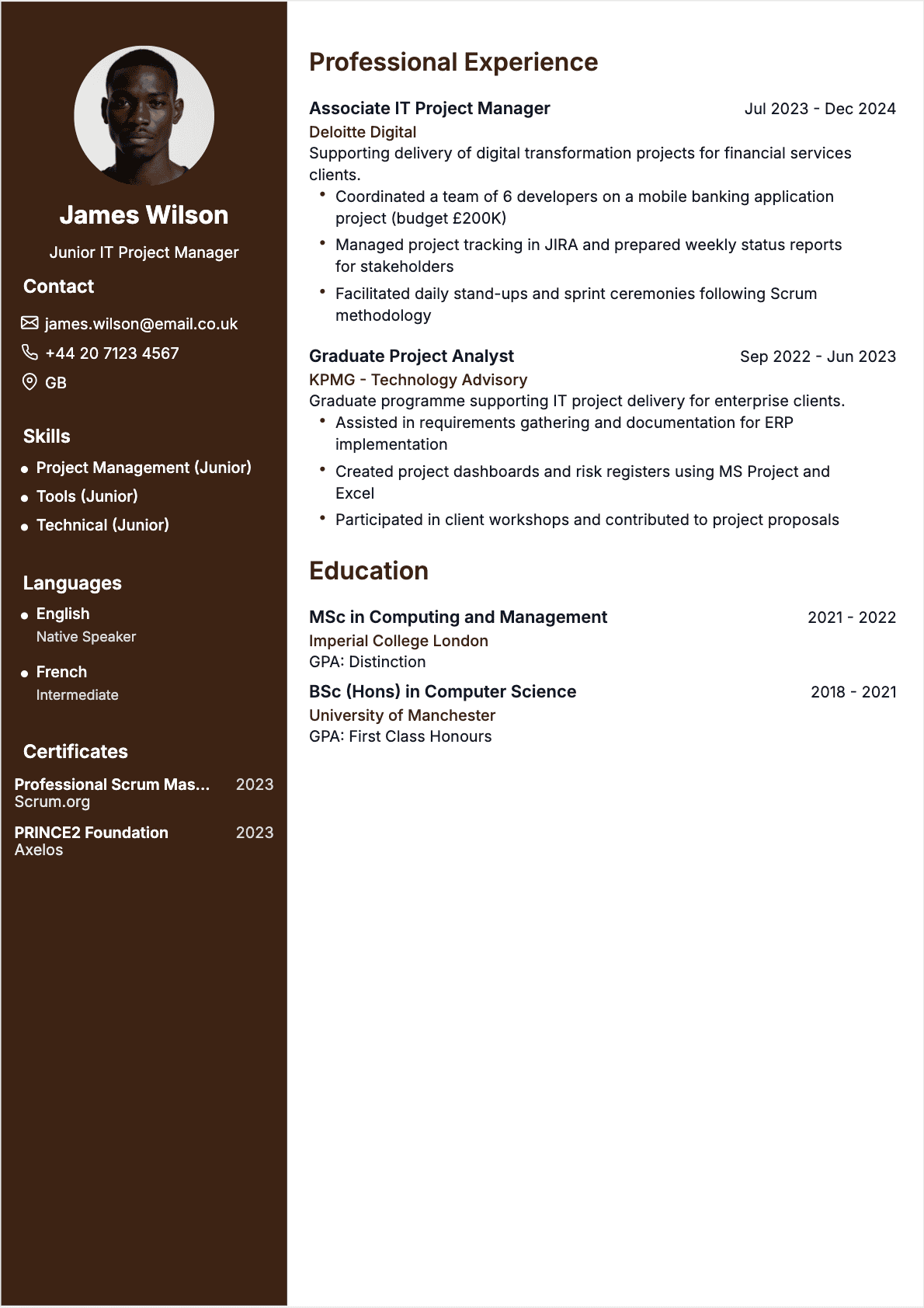
Resume IT Project Manager Junior
PopularIT Project Manager resume template for Junior profile
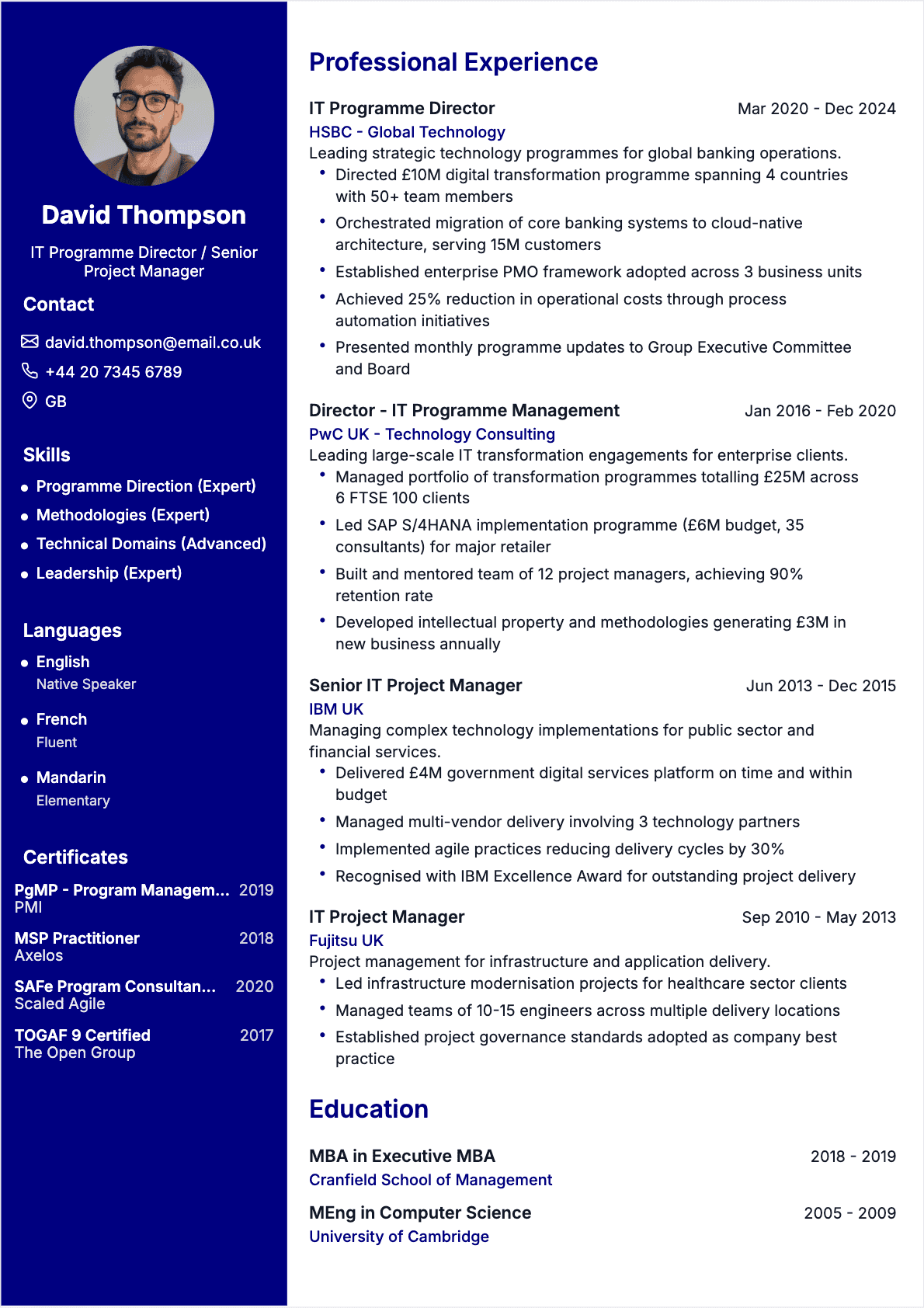
Resume IT Project Manager Senior
IT Project Manager resume template for Senior profile
Resume IT Project Manager Confirmé
IT Project Manager resume template for Confirmé profile
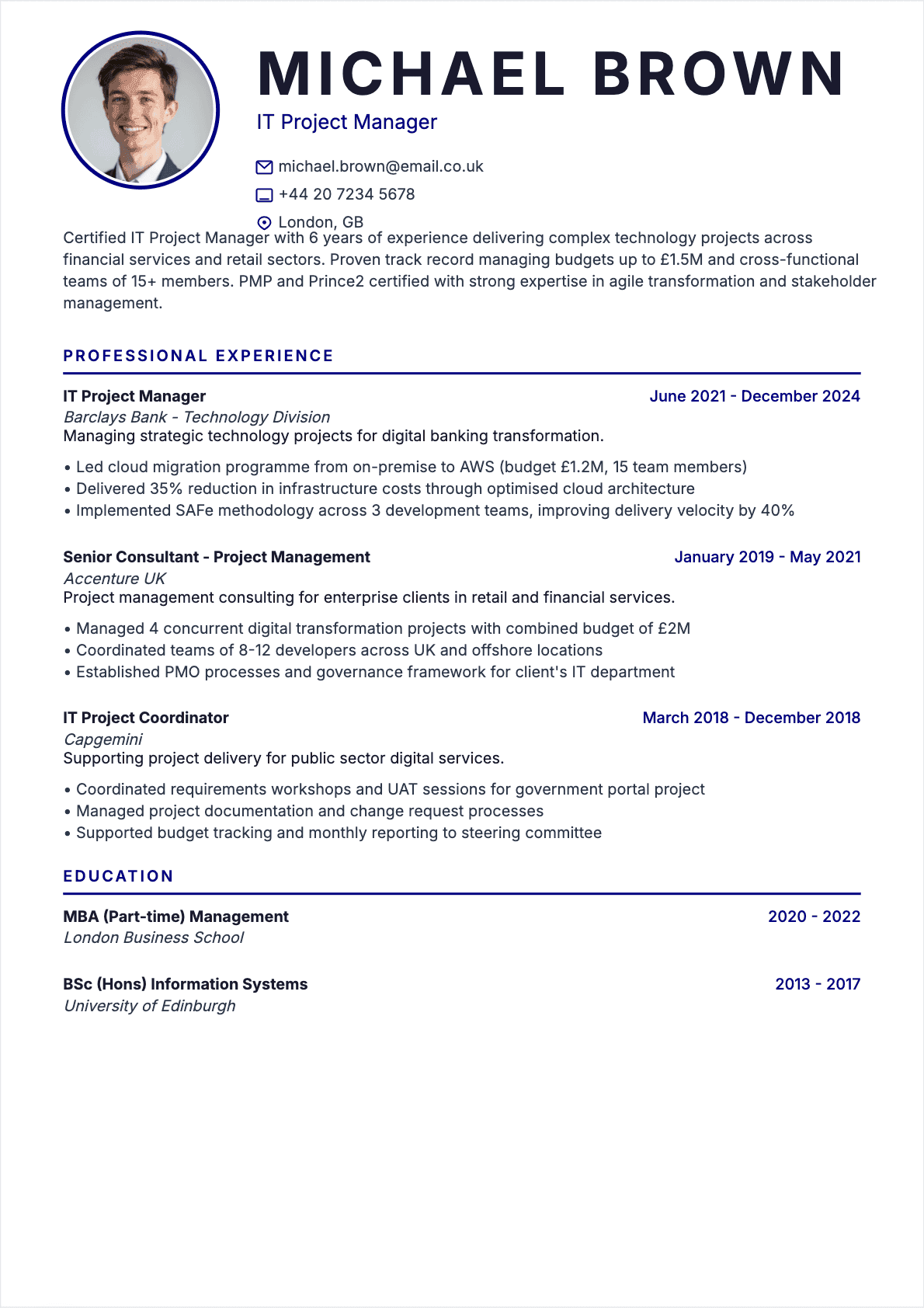
Resume IT Project Manager Confirmé
IT Project Manager resume template for Confirmé profile
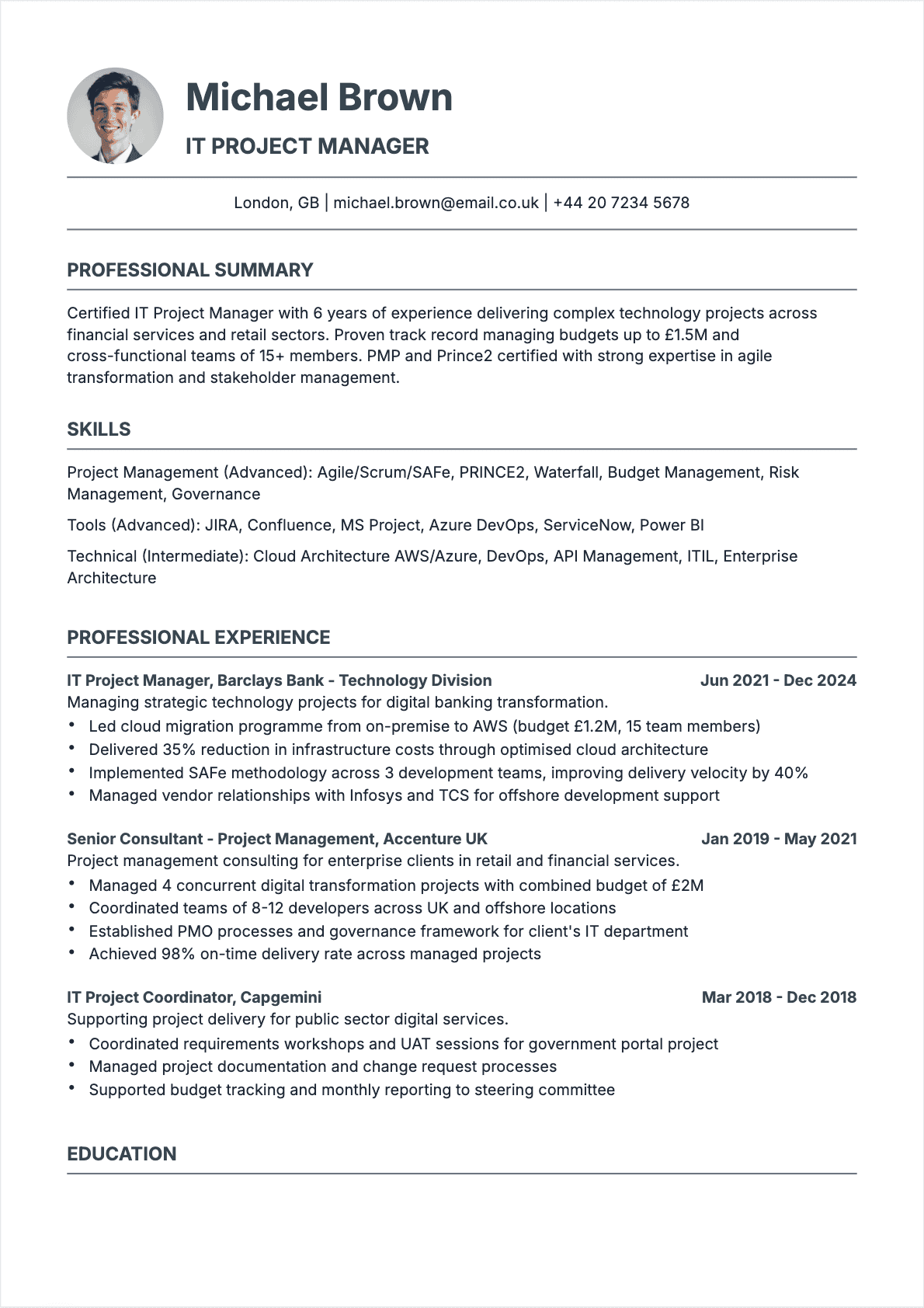
Resume IT Project Manager Confirmé
IT Project Manager resume template for Confirmé profile
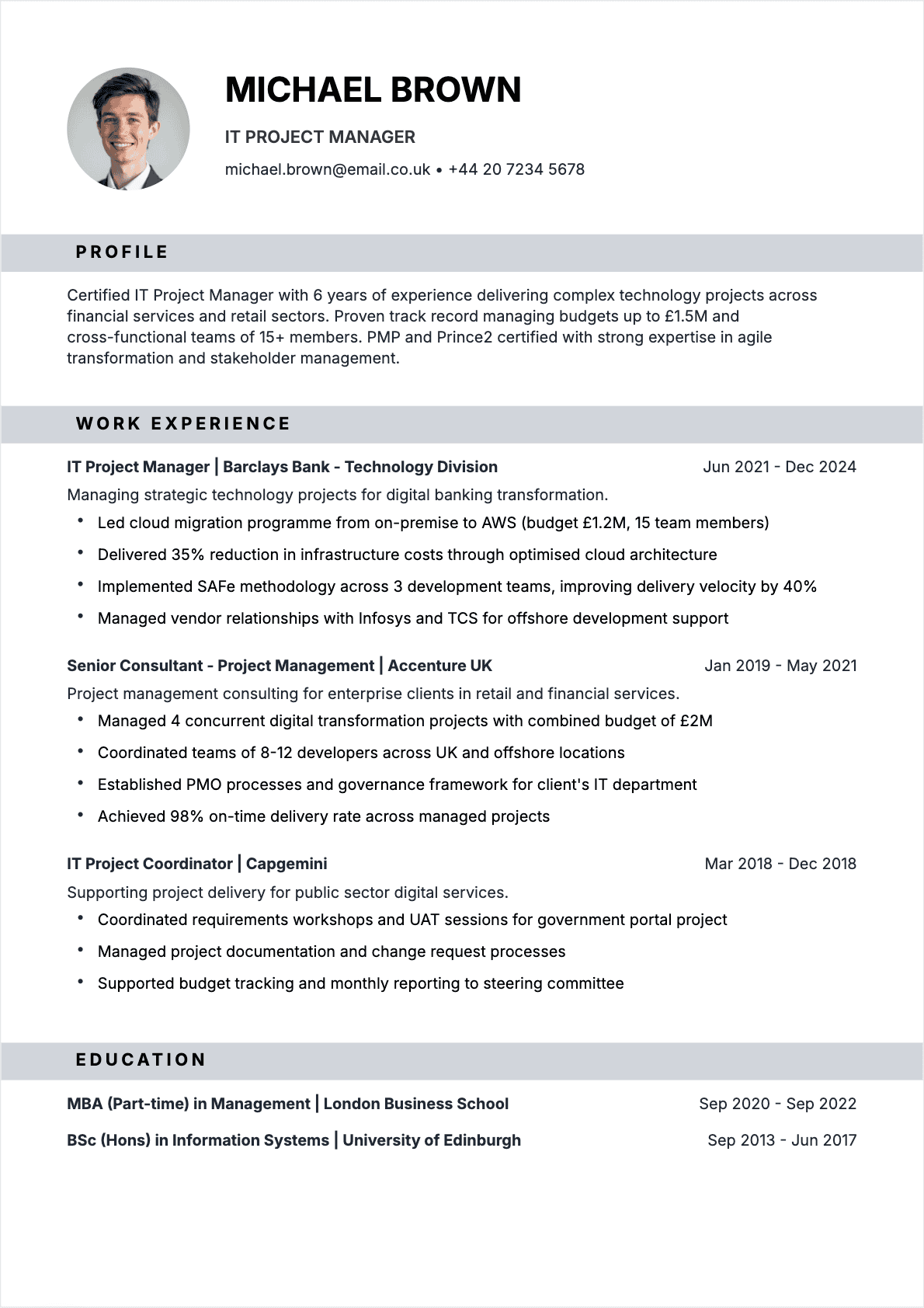
Resume IT Project Manager Confirmé
IT Project Manager resume template for Confirmé profile
Like one of these IT Project Manager resume templates?
Select it, fill in your details and download your resume as PDF.
IT Project Manager Resume Examples
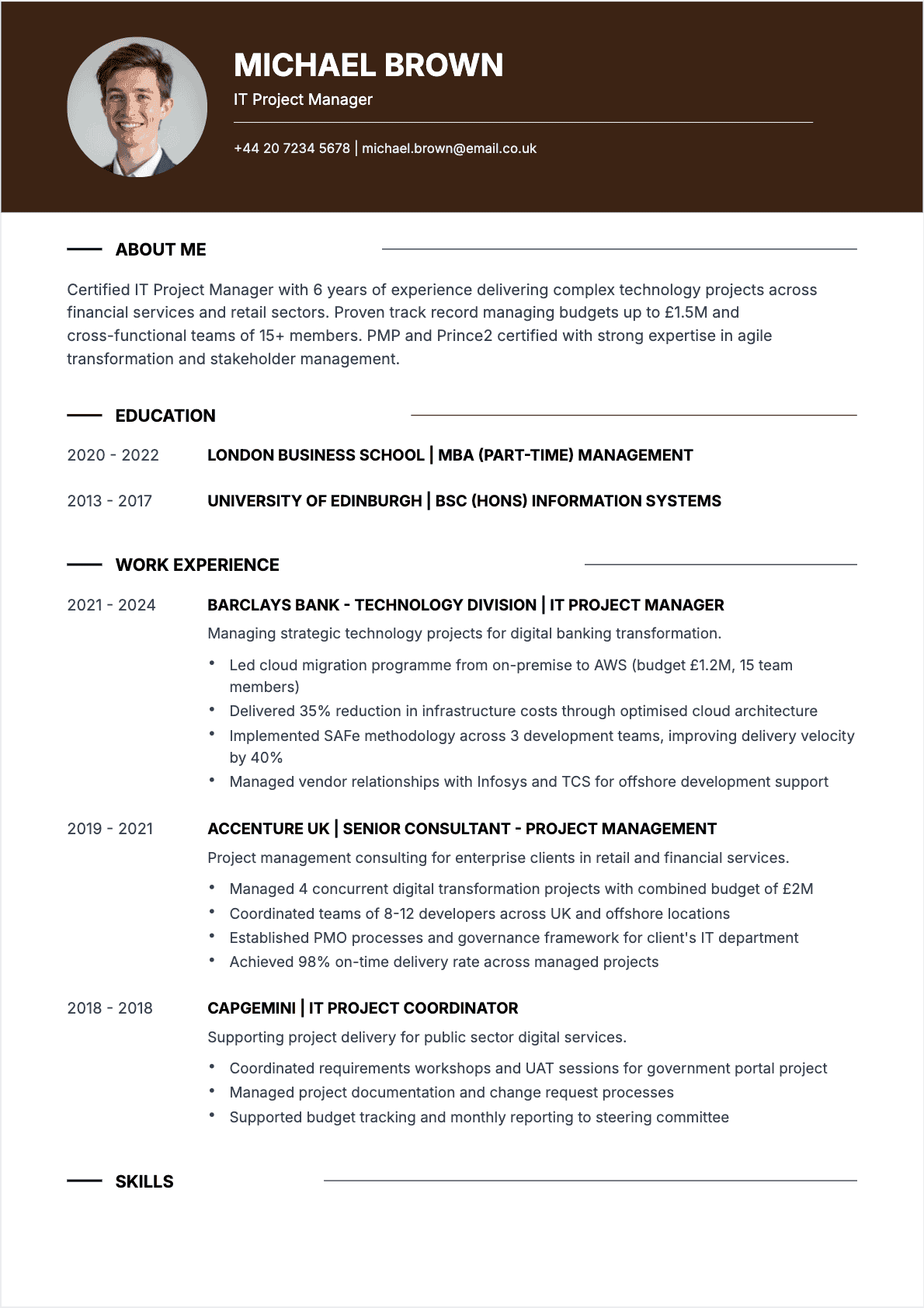
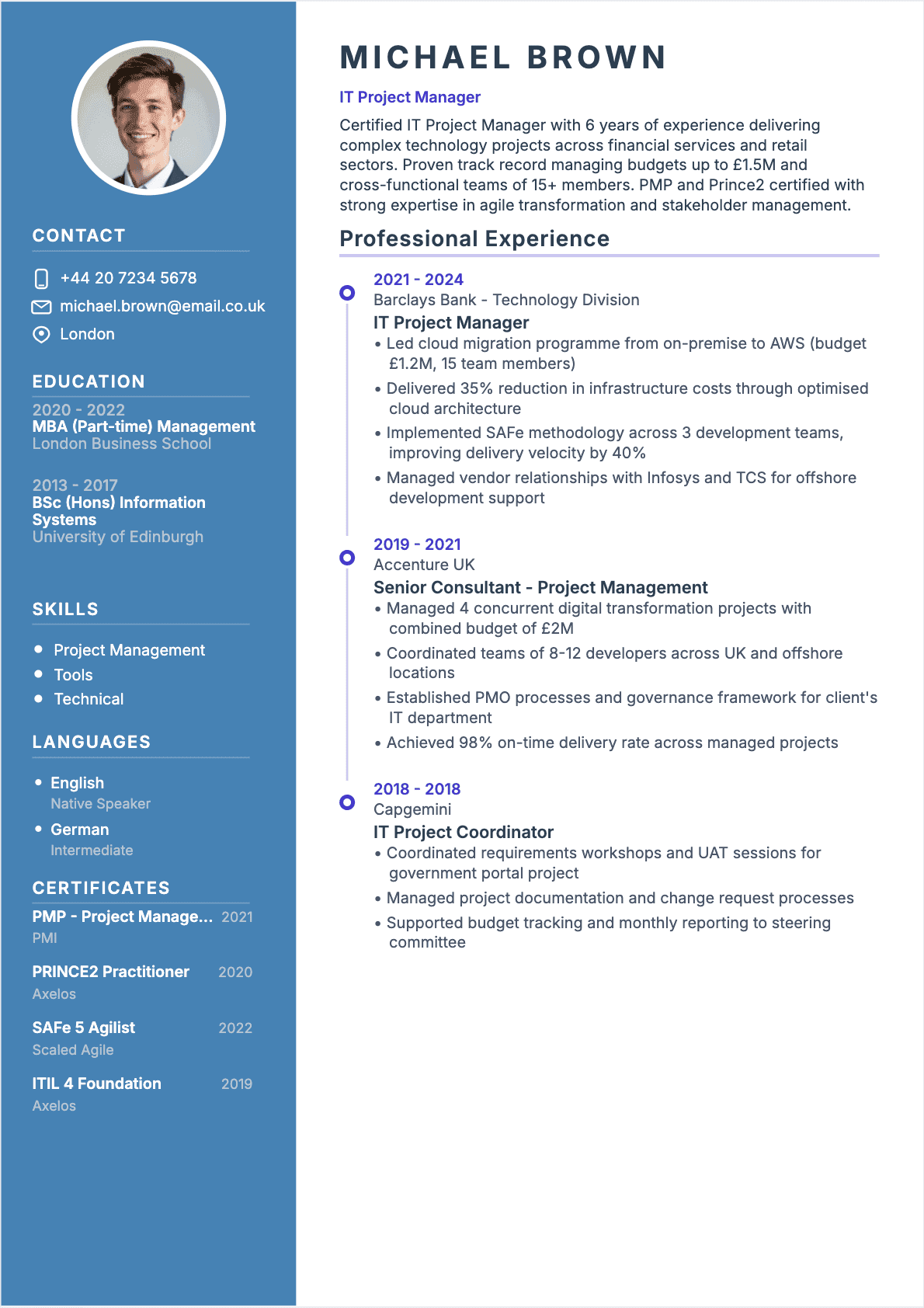
Michael Brown
IT Project Manager
michael.brown@email.co.uk
+44 20 7234 5678
London, GB
Certified IT Project Manager with 6 years of experience delivering complex technology projects across financial services and retail sectors. Proven track record managing budgets up to £1.5M and cross-functional teams of 15+ members. PMP and Prince2 certified with strong expertise in agile transformation and stakeholder management.
Work Experience
IT Project Manager
Barclays Bank - Technology Division
- ●Led cloud migration programme from on-premise to AWS (budget £1.2M, 15 team members)
- ●Delivered 35% reduction in infrastructure costs through optimised cloud architecture
- ●Implemented SAFe methodology across 3 development teams, improving delivery velocity by 40%
Senior Consultant - Project Management
Accenture UK
- ●Managed 4 concurrent digital transformation projects with combined budget of £2M
- ●Coordinated teams of 8-12 developers across UK and offshore locations
- ●Established PMO processes and governance framework for client's IT department
IT Project Coordinator
Capgemini
- ●Coordinated requirements workshops and UAT sessions for government portal project
- ●Managed project documentation and change request processes
- ●Supported budget tracking and monthly reporting to steering committee
Education
MBA (Part-time)
London Business School
BSc (Hons)
University of Edinburgh
Skills
Languages
English — Native Speaker
German — Intermediate
Certifications
PMP - Project Management ProfessionalPMI
PRINCE2 PractitionerAxelos
SAFe 5 AgilistScaled Agile
ITIL 4 FoundationAxelos
IT Project Manager role overview
IT Project Managers orchestrate technology initiatives from conception through delivery, acting as the bridge between technical teams, business stakeholders, and executive leadership. You'll spend your days coordinating software development cycles, managing budgets that typically range from £100K to £5M+, and ensuring projects align with strategic business objectives. Unlike traditional project managers, you need fluency in both technical architecture and business outcomes—understanding API integrations as well as ROI calculations.
The role demands constant context-switching between sprint planning sessions, stakeholder presentations, risk mitigation meetings, and vendor negotiations. You'll work with cross-functional teams including developers, QA engineers, business analysts, and UX designers, often managing 3-5 concurrent projects at various stages. Most IT Project Managers report to a Programme Manager, PMO Director, or CTO, with accountability for on-time delivery, scope management, and resource allocation across technical workstreams.
Career progression typically follows this trajectory: Junior IT Project Manager (1-3 years, £35K-£50K) handling smaller projects with guidance, Mid-level IT Project Manager (3-7 years, £50K-£75K) managing complex initiatives independently, Senior IT Project Manager (7-12 years, £75K-£95K) overseeing multiple high-stakes projects, and Programme Manager or PMO Director (12+ years, £95K-£130K+) directing entire portfolios. Some professionals pivot into Product Management, Agile Coaching, or IT Consultancy roles.
The compensation reflects both technical complexity and business impact. Entry-level positions in regional UK markets start around £35K-£40K, while London-based roles command £45K-£55K. Mid-career professionals with certifications (PMP, PRINCE2, Agile) and proven delivery records earn £60K-£80K, with senior positions in financial services or technology sectors reaching £90K-£110K plus bonuses tied to project success metrics.
Typical daily tasks for an IT Project Manager:
- Facilitate daily stand-ups and sprint ceremonies with development teams, removing blockers and adjusting priorities based on business needs
- Review project dashboards in Jira, Azure DevOps, or Monday.com to track velocity, burndown rates, and resource utilization against planned timelines
- Conduct stakeholder meetings to communicate progress, manage scope change requests, and align technical deliverables with business expectations
- Update project documentation including risk registers, RAID logs, budget forecasts, and status reports for PMO governance reviews
- Coordinate with infrastructure, security, and operations teams to plan deployment windows, UAT phases, and production release schedules
- Negotiate with vendors and third-party providers on licensing agreements, SLA commitments, and integration timelines for external dependencies
Essential skills for an IT Project Manager resume
Your CV must demonstrate both project management methodology expertise and technical literacy. Recruiters scan for specific frameworks (Agile, Scrum, Kanban, PRINCE2) alongside technical competencies that prove you can speak the language of development teams. The most effective IT Project Manager resumes balance hard certifications with quantified delivery achievements—showing you've actually shipped products, not just attended meetings.
ATS systems prioritize exact keyword matches for methodologies, tools, and certifications. Include the full names and acronyms ("Project Management Professional (PMP)") and mention specific software platforms you've used. Technical skills should appear in both your skills section and woven into achievement bullets with metrics. Soft skills matter enormously in this role since you're constantly mediating between technical and non-technical stakeholders, but they need concrete evidence rather than empty claims.
Critical skills to feature on your IT Project Manager CV:
- Agile/Scrum methodology – Most IT projects now follow iterative frameworks; recruiters expect hands-on experience facilitating sprints, managing backlogs, and coaching teams on Agile principles rather than theoretical knowledge.
- Jira and Confluence proficiency – These Atlassian tools dominate IT project tracking; demonstrate you can configure workflows, generate burndown reports, and maintain documentation that development teams actually use.
- Stakeholder management – You'll translate technical constraints into business language and vice versa; show you've managed C-suite expectations while keeping development teams focused on realistic deliverables.
- Budget and resource planning – IT projects involve software licenses, cloud infrastructure costs, and contractor rates; prove you've forecasted expenses, tracked actuals, and delivered within financial constraints.
- Risk and issue management – Technology projects face technical debt, integration challenges, and dependency delays; demonstrate proactive risk identification and mitigation strategies that prevented project derailment.
- SDLC knowledge – Understanding software development lifecycles (waterfall, Agile, DevOps) lets you plan realistic timelines; show you grasp development, testing, deployment, and maintenance phases.
- Azure DevOps or GitHub project management – Modern development teams use integrated platforms; familiarity with CI/CD pipelines, repository management, and automated testing workflows sets you apart.
- Change management – IT implementations disrupt existing workflows; prove you've managed organizational change, user training, and adoption strategies that ensured successful go-lives.
- Vendor and contract negotiation – Most projects involve third-party integrations or outsourced development; show you've evaluated proposals, negotiated terms, and managed external relationships.
- Technical documentation – You'll create architecture diagrams, API specifications, and deployment runbooks; demonstrate ability to produce clear technical documentation for diverse audiences.
- Microsoft Project or Smartsheet – Traditional planning tools still matter for Gantt charts and resource leveling; proficiency signals you can work in both Agile and waterfall environments.
- Problem-solving under pressure – Production incidents, missed deadlines, and scope creep are inevitable; provide examples of how you've made tough decisions with incomplete information and competing priorities.

How to write an IT Project Manager resume step by step
1. Lead with a results-focused professional summary
Your opening 3-4 lines should immediately communicate your project delivery track record, methodology expertise, and technical domain. Skip generic statements about being "detail-oriented" or "passionate." Instead, open with your years of experience, project types you've delivered, and one standout achievement. Example: "IT Project Manager with 6 years delivering SaaS implementations and cloud migrations across financial services. Led 12 Agile projects averaging £800K budgets with 94% on-time delivery rate. Certified Scrum Master with expertise in Azure DevOps and stakeholder management for technical transformations."
2. Structure your experience with the STAR+metrics formula
Each role should contain 4-6 bullet points following this pattern: Situation (project context), Task (your responsibility), Action (specific methodology or approach), Result (quantified outcome). Poor example: "Managed software development projects." Strong example: "Directed £1.2M CRM implementation for 450-user organization, coordinating 8-person development team through 6-month Agile delivery that reduced customer onboarding time by 40% and achieved 98% user adoption within 3 months post-launch." Notice the specific numbers, tools implied (CRM), methodology (Agile), team size, timeline, and business impact.
3. Emphasize Agile delivery metrics that matter
Recruiters want proof you've actually managed iterative delivery, not just attended Scrum training. Include sprint velocity improvements, backlog refinement outcomes, and release frequency. Example: "Increased team velocity from 32 to 51 story points per sprint over 4 quarters through backlog optimization and technical debt reduction, enabling bi-weekly releases versus previous monthly cadence." These metrics demonstrate operational excellence and continuous improvement mindset.
4. Showcase technical tool proficiency in context
Don't just list "Jira, Confluence, Azure DevOps" in a skills section. Demonstrate how you used these tools to drive outcomes. Instead of: "Used Jira for project tracking," write: "Configured Jira workflows for 3 concurrent development teams, implementing automated status updates and custom dashboards that reduced status meeting time by 60% while improving stakeholder visibility." This proves hands-on expertise rather than superficial familiarity.
5. Quantify everything—budgets, timelines, team sizes, business impact
IT Project Manager CVs live or die by numbers. Every bullet should contain at least two quantifiable elements. Before: "Successfully delivered cloud migration project." After: "Orchestrated £2.4M AWS cloud migration across 47 applications and 12TB data, coordinating 15-person cross-functional team through 9-month phased delivery that reduced infrastructure costs by £180K annually and improved system uptime from 97.2% to 99.7%." The specificity builds credibility and helps ATS systems match your experience to job requirements.
6. Highlight certifications and methodology training prominently
Place certifications immediately after your name or in a dedicated section near the top. IT Project Manager roles often have hard certification requirements (PMP, PRINCE2 Practitioner, Certified Scrum Master, SAFe Agilist). Include certification numbers and expiry dates for active credentials. If you're pursuing a certification, note "PMP certification in progress (exam scheduled March 2026)" to show commitment to professional development.
7. Tailor your technical vocabulary to each job posting
ATS systems scan for exact keyword matches. If the job description mentions "PRINCE2," "risk registers," and "Microsoft Project," ensure these exact phrases appear in your CV where truthful. Create a master CV with all your skills and experiences, then customize each application to mirror the language in the job posting. This isn't dishonesty—it's strategic positioning of your genuine experience using the terminology that specific employer values.
8. Include a technical competencies section with categorization
Create a scannable skills section organized by category: Project Management Methodologies (Agile, Scrum, Kanban, PRINCE2, Waterfall), Project Management Tools (Jira, Azure DevOps, Monday.com, MS Project), Technical Knowledge (SDLC, CI/CD, Cloud platforms, API integration), and Certifications. This structure helps both ATS parsing and human reviewers quickly assess your technical breadth. Place this section prominently—either directly after your summary or in a sidebar for visual CVs.
Common mistakes on IT Project Manager resumes
Listing responsibilities instead of achievements
The most frequent error is describing what IT Project Managers generally do rather than what you specifically accomplished. Writing "Responsible for managing software development projects" tells recruiters nothing distinctive. Every IT Project Manager manages projects—that's the job title. Instead, focus on outcomes: "Delivered 8 software releases across 18 months with zero production rollbacks, implementing automated testing protocols that reduced post-deployment defects by 73%." The difference is evidence of competence versus a job description.
Vague or missing metrics
Claiming you "improved project delivery" without quantification raises red flags. Recruiters in this field expect specific numbers: budget sizes, team compositions, timeline achievements, and business impact. Bad example: "Led successful ERP implementation." Good example: "Directed £3.2M SAP ERP implementation for manufacturing division with 280 users, completing 14-month project 3 weeks ahead of schedule and £120K under budget while achieving 92% user satisfaction in post-launch survey." If you genuinely can't remember exact figures, use ranges or approximations ("approximately £500K" or "15-20 team members").
Ignoring Agile terminology when claiming Agile experience
Many CVs claim "Agile project management experience" but use waterfall language throughout. If you've worked in Agile environments, your bullets should reference sprints (not phases), backlogs (not requirements documents), retrospectives (not post-mortems), and velocity (not progress tracking). This vocabulary signals genuine Agile fluency versus someone who attended a two-day training. Similarly, don't claim Scrum Master certification if your experience bullets describe traditional command-and-control project management—the contradiction is obvious to experienced recruiters.
Technical skills listed without evidence
A skills section claiming proficiency in "Jira, Azure DevOps, Confluence, Smartsheet, MS Project" means nothing if your experience bullets never mention using these tools. Recruiters assume you've copy-pasted a generic skills list. Instead, weave tool usage into your achievements: "Migrated project tracking from spreadsheets to Jira, creating custom workflows and automation rules that reduced manual status updates by 12 hours weekly across 4 development teams." This proves hands-on expertise rather than aspirational knowledge.
Focusing on project activities instead of business outcomes
IT Project Managers sometimes get caught describing project mechanics ("Conducted daily stand-ups, maintained RAID logs, updated Gantt charts") without connecting these activities to business value. Recruiters care about what the project achieved for the organization, not just that you followed process. Transform "Managed project communications and stakeholder updates" into "Established weekly executive steering committee reporting that secured additional £200K funding for critical infrastructure upgrades, preventing projected 6-week delivery delay." The second version shows strategic impact.
Outdated certifications or methodology references
Highlighting "Microsoft Project 2010 expert" or "Waterfall methodology specialist" without acknowledging modern Agile practices signals you haven't kept pace with industry evolution. Even if you've worked primarily in waterfall environments, demonstrate awareness of contemporary approaches: "Managed hybrid delivery model combining PRINCE2 governance framework with Agile development sprints for regulatory compliance project, satisfying audit requirements while maintaining 2-week release cadence." This shows adaptability rather than obsolescence.
Neglecting to address remote/distributed team experience
Post-2020, IT Project Managers must demonstrate capability managing distributed teams. If your CV only references co-located teams, you appear out of touch with current work realities. Include specifics: "Coordinated globally distributed team across UK, India, and US time zones using asynchronous communication protocols and Confluence documentation standards, maintaining sprint velocity within 8% of previous co-located team performance." This addresses an unspoken concern many recruiters have about remote project management effectiveness.
IT Project Manager resume trends in 2026
The IT Project Manager role is experiencing significant transformation as organizations shift from project-based delivery to product-centric operating models. Many companies now prefer "Product Delivery Managers" or "Technical Programme Managers" who combine traditional project management with product ownership responsibilities. Your CV should demonstrate adaptability to this evolution—showing you understand not just delivering to specification, but iterating based on user feedback and business metrics. Highlight any experience where you've maintained ongoing relationships with delivered products rather than simply handing off to operations teams.
AI and automation tools are reshaping project management workflows, and recruiters expect you to be comfortable with these technologies. Platforms like Monday.com now offer AI-powered workload balancing, predictive timeline adjustments, and automated risk flagging. Your CV should reference experience with intelligent project management tools, even if that means noting "Currently implementing AI-assisted resource planning in Azure DevOps" or "Piloting Jira's predictive analytics for sprint planning." Employers want IT Project Managers who embrace automation rather than fear it will replace them—the role is shifting toward strategic decision-making while routine tracking becomes automated.
Cloud-native project delivery has become the default expectation. Recruiters specifically look for experience managing projects involving AWS, Azure, or Google Cloud infrastructure, containerization (Docker, Kubernetes), and microservices architectures. Even if you're not a cloud engineer, demonstrating familiarity with cloud deployment models, serverless computing, and infrastructure-as-code concepts signals you can effectively manage modern technical teams. Include any experience coordinating cloud migrations, managing cloud infrastructure costs, or working with DevOps practices that blur traditional development and operations boundaries.
The certification landscape is evolving beyond traditional PMP credentials. While Project Management Professional certification remains valuable, employers increasingly prioritize Agile-specific certifications (Certified Scrum Master, SAFe Agilist, Professional Scrum Product Owner) and platform-specific credentials (Atlassian Certified Jira Administrator, Microsoft Certified: Azure Fundamentals). Your CV should reflect this shift—if you hold only PMP certification, consider adding "Pursuing Certified Scrum Master certification" or highlighting Agile training courses. The combination of traditional project management rigor and modern Agile fluency is particularly attractive to employers managing hybrid delivery models.
Remote and hybrid work has fundamentally changed stakeholder management expectations. Recruiters now specifically evaluate your capability to maintain project momentum with distributed teams, asynchronous communication, and reduced face-to-face interaction. Your CV should explicitly address this: "Managed fully remote development team across 4 time zones, implementing asynchronous decision-making protocols and Miro-based virtual workshops that maintained stakeholder engagement equivalent to previous co-located projects." Don't assume recruiters will infer this capability—make it explicit, as many organizations have struggled with remote project delivery and actively seek proven expertise.
Cybersecurity and compliance integration has become a core IT Project Manager responsibility rather than a specialist concern. Projects now routinely involve GDPR considerations, SOC 2 compliance, penetration testing, and security-by-design principles. Your CV should demonstrate awareness of security requirements in project planning, even if you're not a security specialist. Include examples like "Integrated security review gates into sprint cycles, coordinating with InfoSec team to address 47 vulnerabilities before production deployment, achieving security audit approval on first review." This shows you understand modern risk management extends beyond schedule and budget.
Data-driven decision making has become non-negotiable. Employers expect IT Project Managers to use analytics dashboards, velocity trends, and predictive modeling rather than gut instinct. Your CV should reference specific metrics you've tracked and acted upon: "Analyzed sprint velocity patterns across 8 quarters, identifying 23% productivity decline during months with excessive meeting load, then implemented focus time policies that restored velocity to target levels within 2 sprints." This demonstrates analytical thinking and continuous improvement mindset that separates strategic project managers from administrative coordinators.
Further reading:
Frequently asked questions
Find answers to the most frequently asked questions.
Aim for 1 page if you have under 5 years of experience, and 2 pages for senior profiles or complex programs. Prioritize quantified achievements, project scope, and ATS keywords. Remove older roles that add no evidence of delivery impact, or compress them into 2–3 lines without losing dates and titles.
For most English-language markets, especially the US, do not include a photo due to bias concerns. In the UK it’s optional but rarely helpful. Use the space for a strong summary, certifications, or key metrics (budget, team size, on-time delivery) that improve screening outcomes.
Hiring managers typically value schedule predictability (on-time milestones, schedule variance), financial control (budget variance, cost avoidance), and operational outcomes (incident reduction, uptime, change success rate). Add adoption measures too: active users, training completion, or ticket volume reduction after go-live. Keep metrics tied to your actions.
Reference concrete Agile artifacts and results: sprint cadence, estimation method, backlog tooling, and measurable improvements (lead time, release frequency, defect escape rate). Clarify your role versus Scrum Master responsibilities. Mention how you handled dependencies and governance gates (security reviews, CAB) in hybrid delivery environments.
PMP and PRINCE2 Practitioner are widely recognized for project governance and are frequently searched by recruiters. Pair one of those with an Agile credential such as PSM I or CSM if you deliver in Scrum. ITIL 4 Foundation helps when projects touch service operations, change control, and incident/problem management.
Use standard headings (Summary, Experience, Skills, Education, Certifications), a single-column layout, and simple bullet points. Place key tools and methods in a dedicated Skills section (Jira, Confluence, Azure DevOps, MS Project, RAID). Mirror job-posting terms truthfully and avoid tables or icons that break parsing.
Your career deserves a better resume
With CVtoWork, select a template, fill in the fields and download your resume as PDF.
Start creating