HR Specialist Resume
Example, Template & Expert Tips 2026
Updated on April 18, 2026.
Write a CV HR Specialist that passes ATS and wins interviews. Get 2026 structure, keywords, metrics, and ready-to-use examples for HR roles.
HR Specialist Resume Templates
8 Templates available
Resume HR Specialist Junior
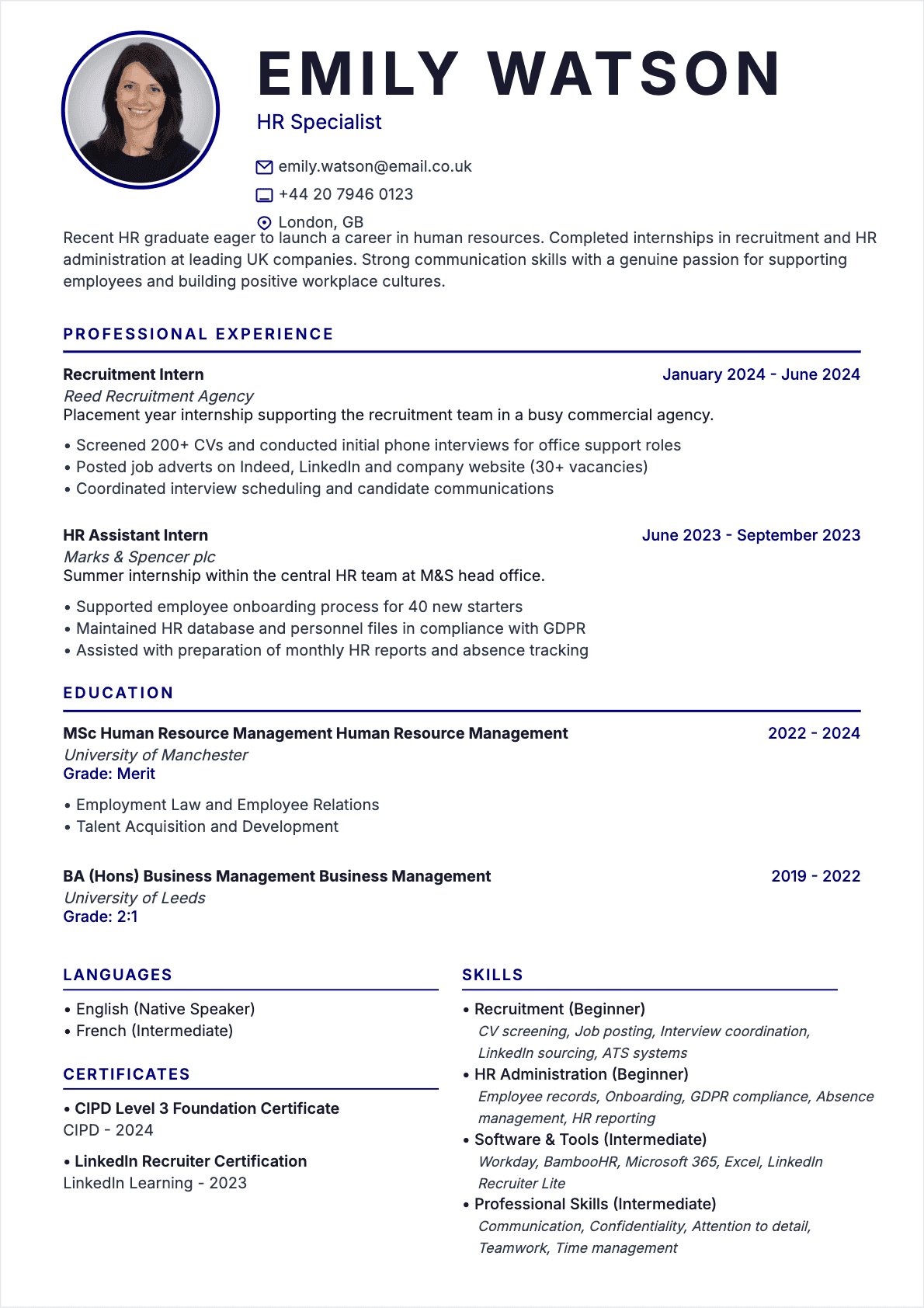
HR Specialist resume template for Junior profile
Resume HR Specialist Senior
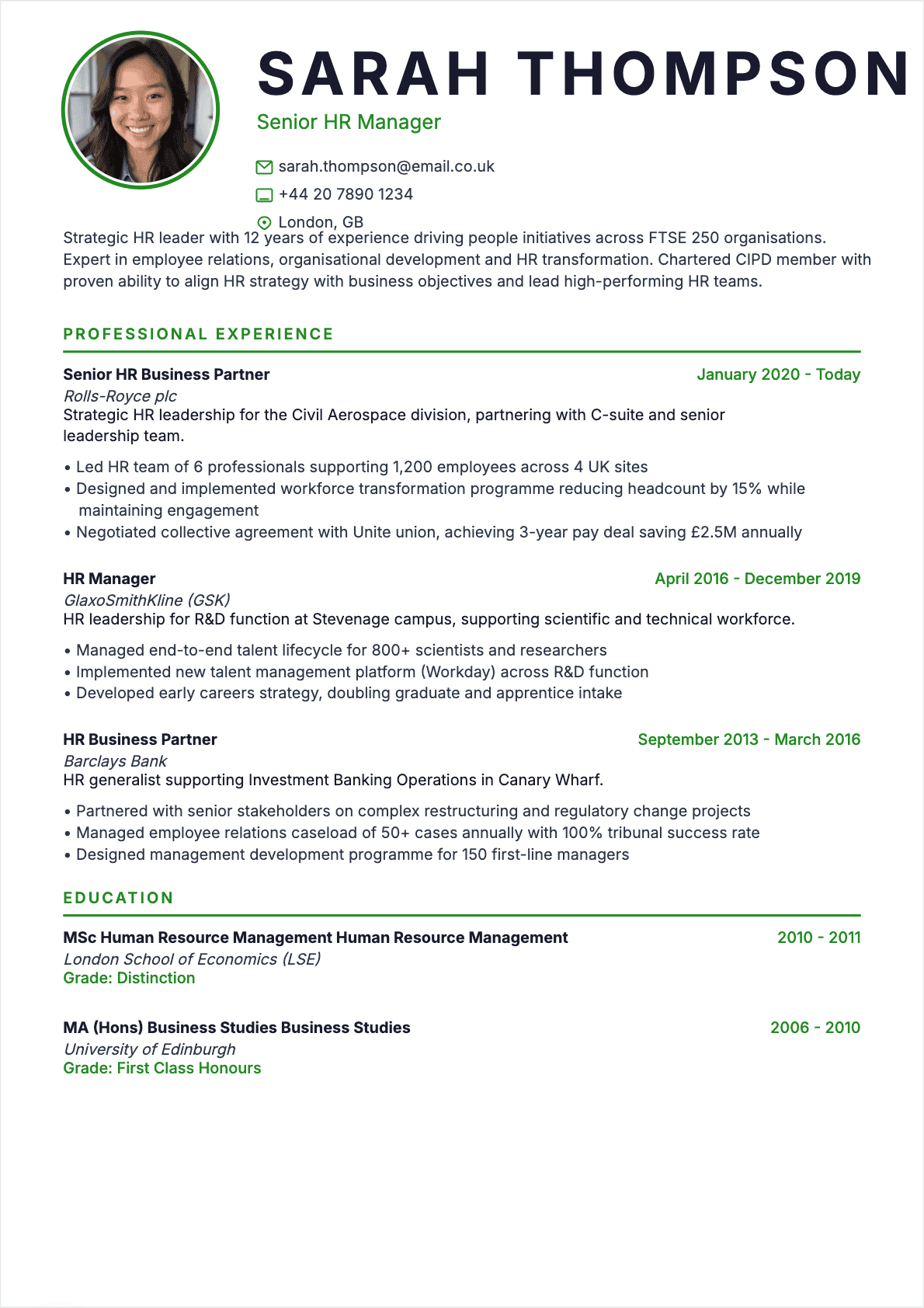
HR Specialist resume template for Senior profile
Resume HR Specialist Confirmé
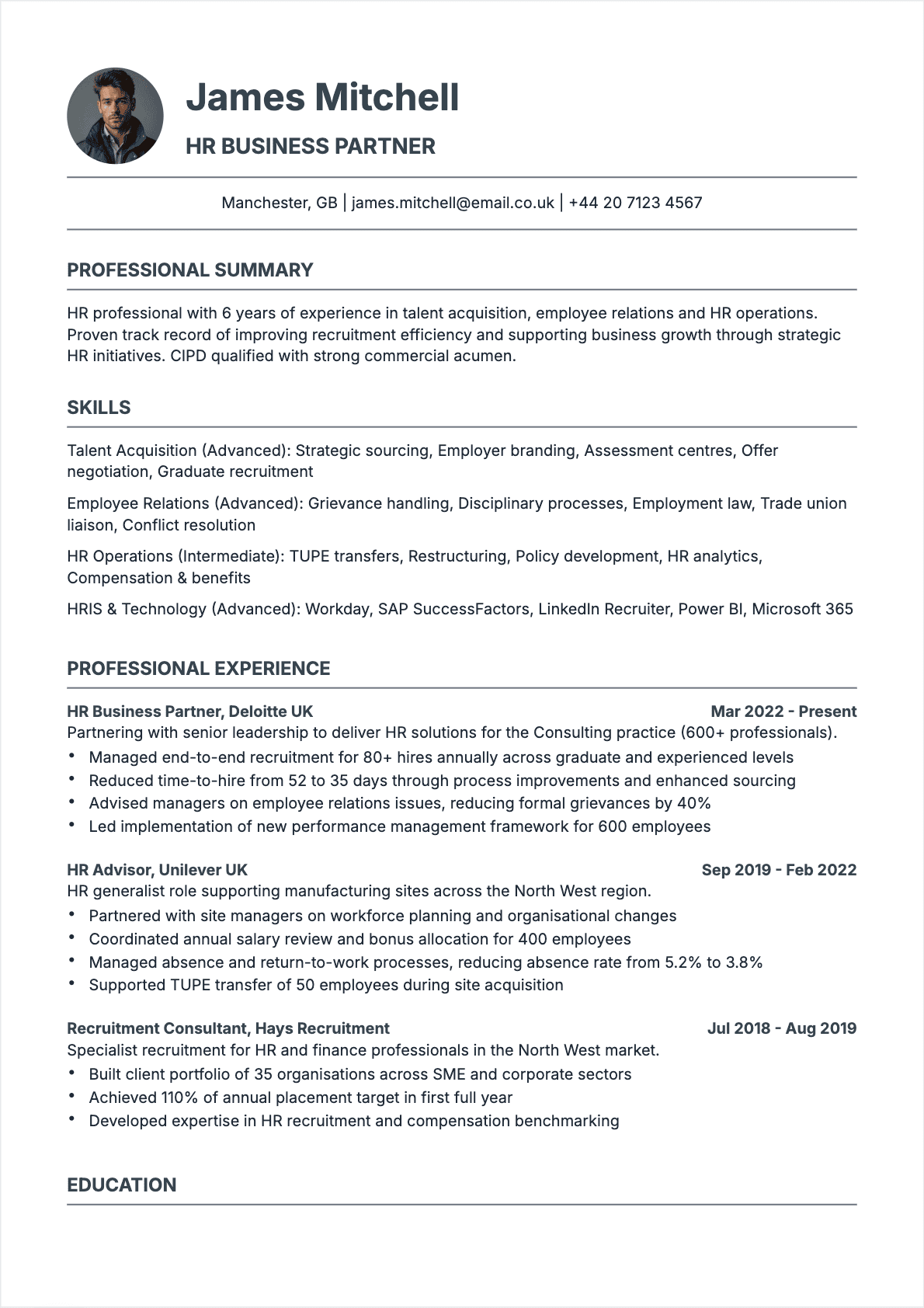
HR Specialist resume template for Confirmé profile
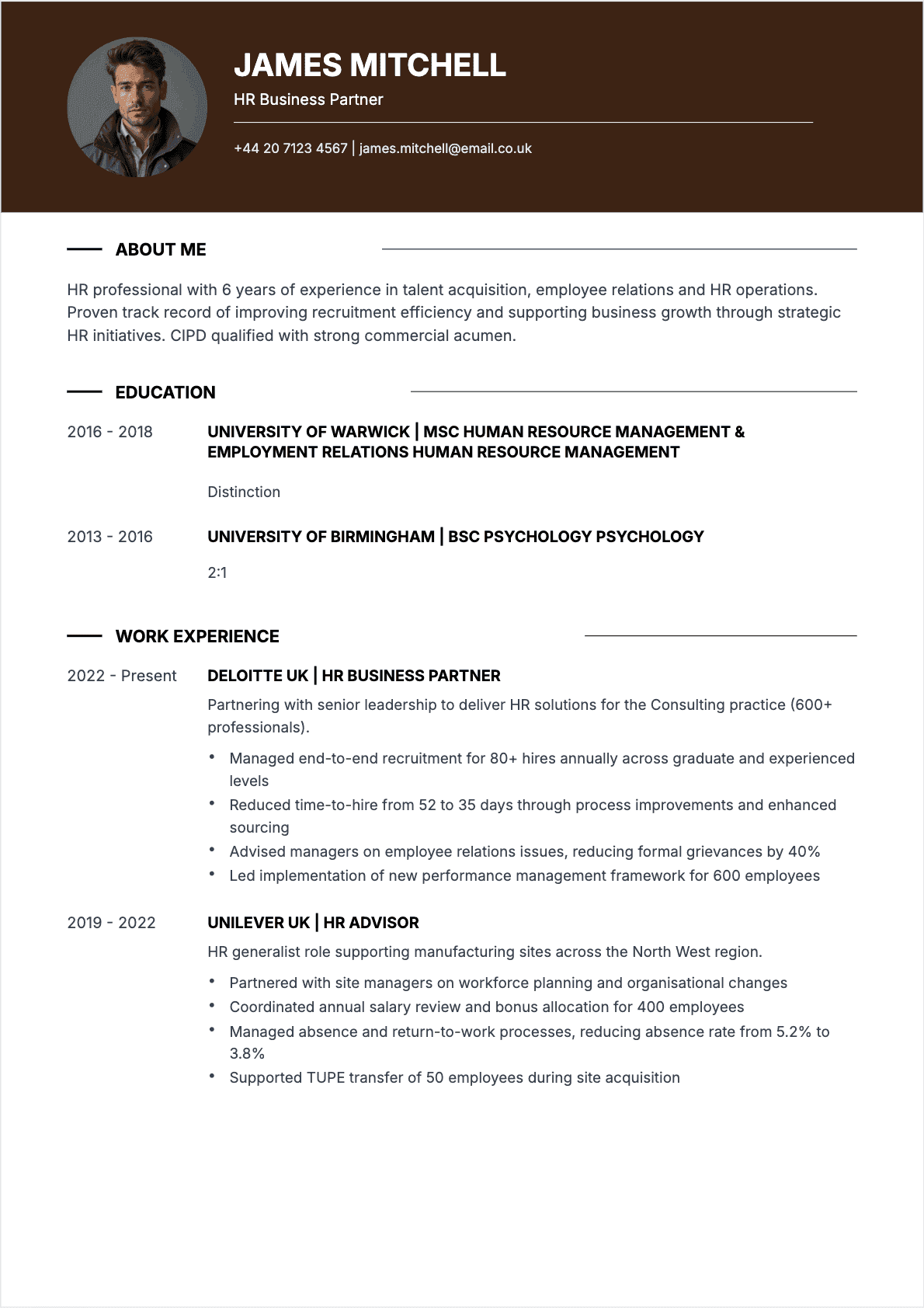
Resume HR Specialist Confirmé
HR Specialist resume template for Confirmé profile
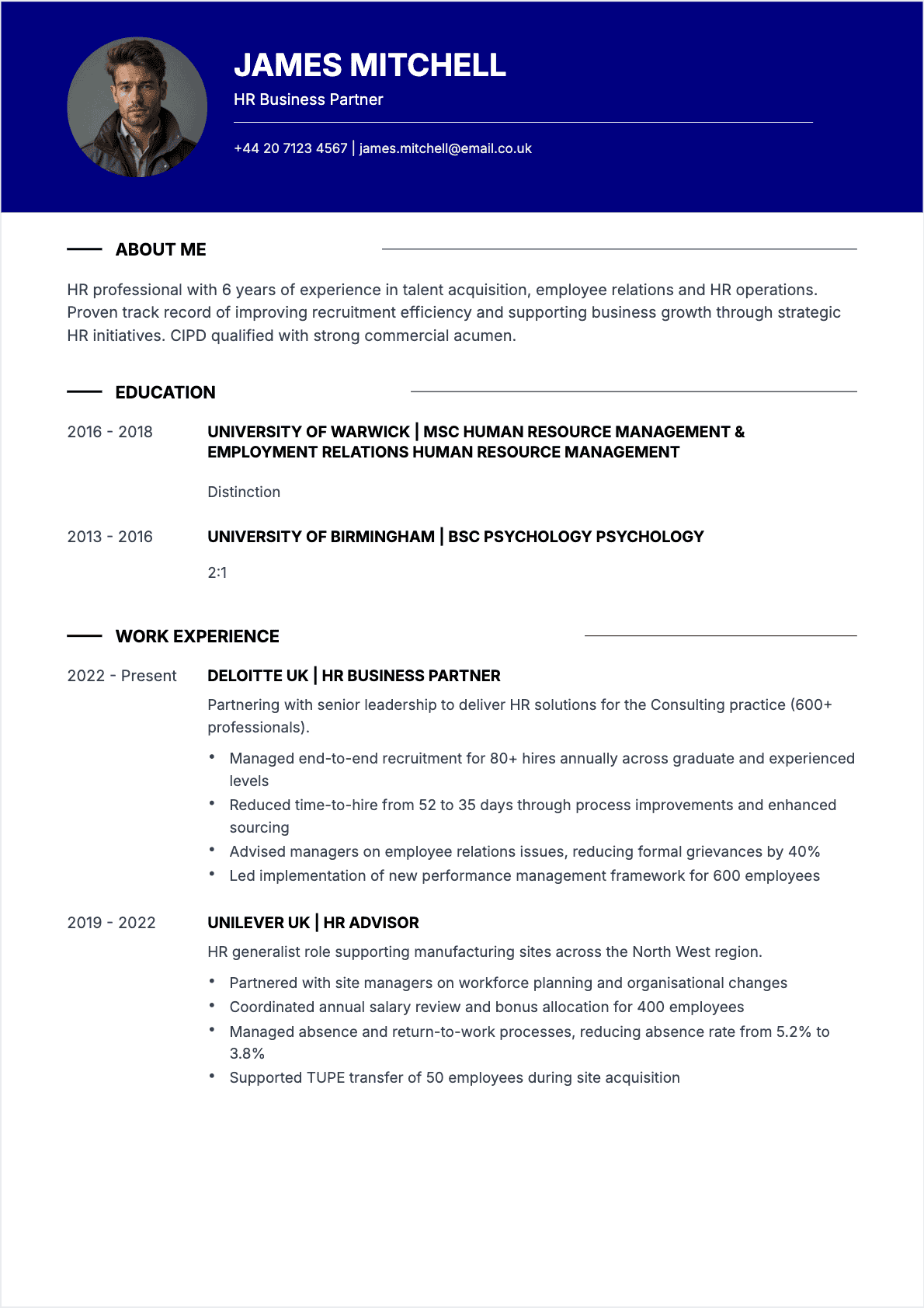
Resume HR Specialist Confirmé
PopularHR Specialist resume template for Confirmé profile
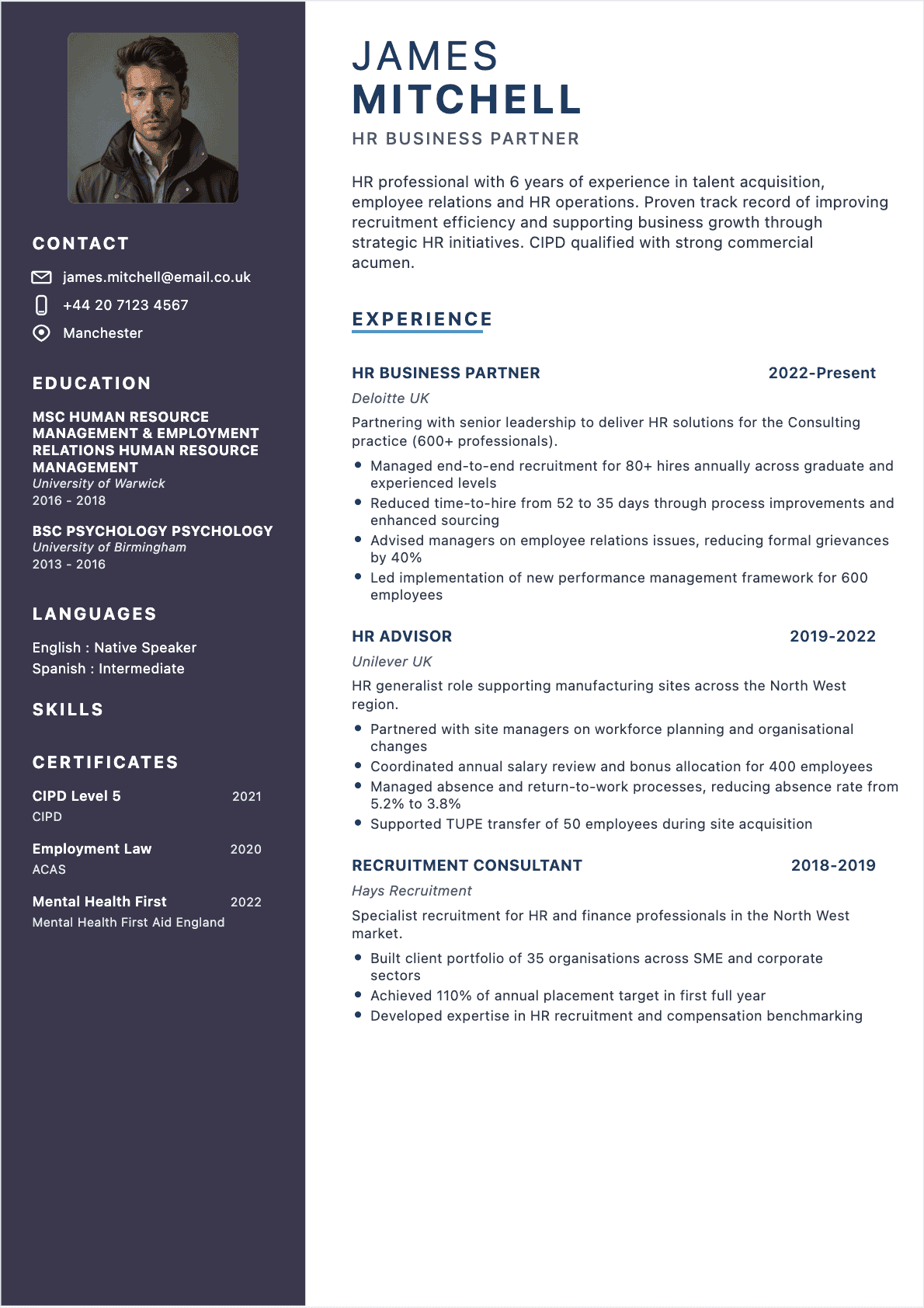
Resume HR Specialist Confirmé
HR Specialist resume template for Confirmé profile
Like one of these HR Specialist resume templates?
Select it, fill in your details and download your resume as PDF.
HR Specialist Resume Examples
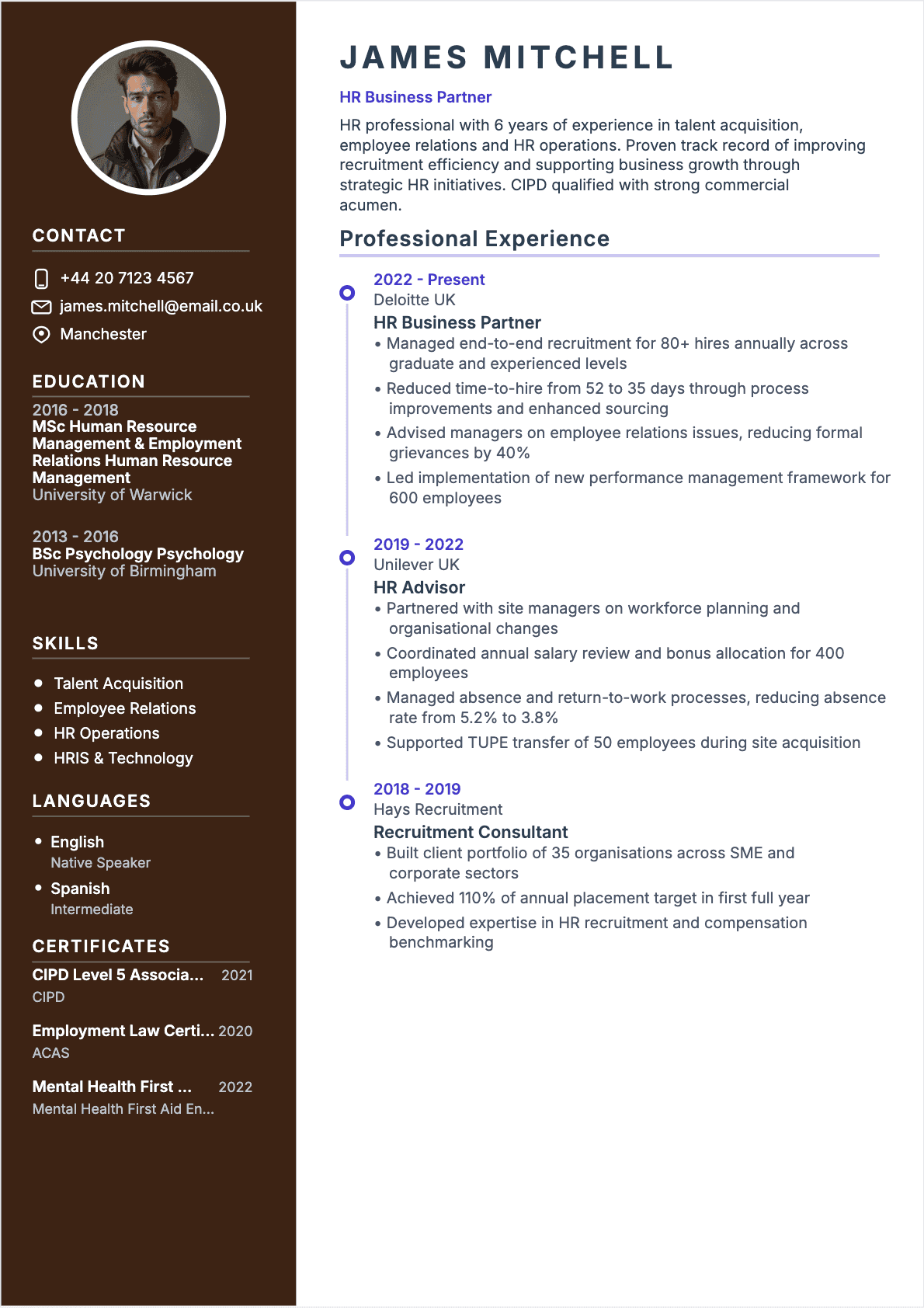
James Mitchell
HR Business Partner
james.mitchell@email.co.uk
+44 20 7123 4567
Manchester, GB
HR professional with 6 years of experience in talent acquisition, employee relations and HR operations. Proven track record of improving recruitment efficiency and supporting business growth through strategic HR initiatives. CIPD qualified with strong commercial acumen.
Work Experience
HR Business Partner
Deloitte UK
- ●Managed end-to-end recruitment for 80+ hires annually across graduate and experienced levels
- ●Reduced time-to-hire from 52 to 35 days through process improvements and enhanced sourcing
- ●Advised managers on employee relations issues, reducing formal grievances by 40%
HR Advisor
Unilever UK
- ●Partnered with site managers on workforce planning and organisational changes
- ●Coordinated annual salary review and bonus allocation for 400 employees
- ●Managed absence and return-to-work processes, reducing absence rate from 5.2% to 3.8%
Recruitment Consultant
Hays Recruitment
- ●Built client portfolio of 35 organisations across SME and corporate sectors
- ●Achieved 110% of annual placement target in first full year
- ●Developed expertise in HR recruitment and compensation benchmarking
Education
MSc Human Resource Management & Employment Relations
University of Warwick
BSc Psychology
University of Birmingham
Skills
Languages
English — Native Speaker
Spanish — Intermediate
Certifications
CIPD Level 5 Associate DiplomaCIPD
Employment Law CertificateACAS
Mental Health First AiderMental Health First Aid England
HR Specialist role overview
HR Specialists serve as the operational backbone of human resources departments, handling the day-to-day administration of employee lifecycle processes from recruitment through offboarding. Unlike generalist HR roles that touch everything lightly, HR Specialists typically develop deep expertise in specific areas such as benefits administration, compensation analysis, employee relations, or talent acquisition. You'll spend your days managing HRIS systems, ensuring compliance with employment law, processing employee requests, and serving as a trusted resource for both managers and staff navigating workplace policies.
The role requires balancing administrative precision with interpersonal sensitivity. One moment you're auditing payroll data to catch discrepancies before they affect employee paychecks, the next you're coaching a manager through a difficult performance conversation. You'll maintain employee records with meticulous attention to detail while also interpreting how policy changes affect real people. Most HR Specialists report to an HR Manager or HR Business Partner and collaborate closely with payroll, legal, and department heads across the organization.
Career progression typically follows one of two paths: the specialist track or the generalist track. Specialists often deepen their expertise in areas like compensation and benefits, becoming Compensation Analysts or Benefits Managers, or move into talent acquisition as Recruitment Managers. The generalist path leads toward HR Manager, HR Business Partner, and eventually Director of HR roles. Many professionals switch between these tracks mid-career as they discover whether they prefer deep functional expertise or broad strategic influence.
Salary ranges vary significantly by experience and location. In the United States, entry-level HR Specialists earn between $45,000-$55,000 annually, while mid-level professionals with 3-5 years of experience typically make $58,000-$72,000. Senior HR Specialists with 6+ years and specialized expertise command $75,000-$95,000, with total compensation reaching $110,000+ in high-cost markets like San Francisco or New York when including bonuses and equity.
Typical daily tasks include:
- Processing employee status changes including promotions, transfers, and terminations in HRIS systems
- Responding to employee inquiries about benefits, policies, time-off requests, and workplace concerns
- Conducting new hire orientations and ensuring completion of onboarding documentation
- Auditing HR data for accuracy and compliance with federal, state, and local employment regulations
- Coordinating recruitment activities such as posting jobs, screening resumes, and scheduling interviews
- Preparing reports on headcount, turnover, time-to-fill, and other workforce metrics for leadership review
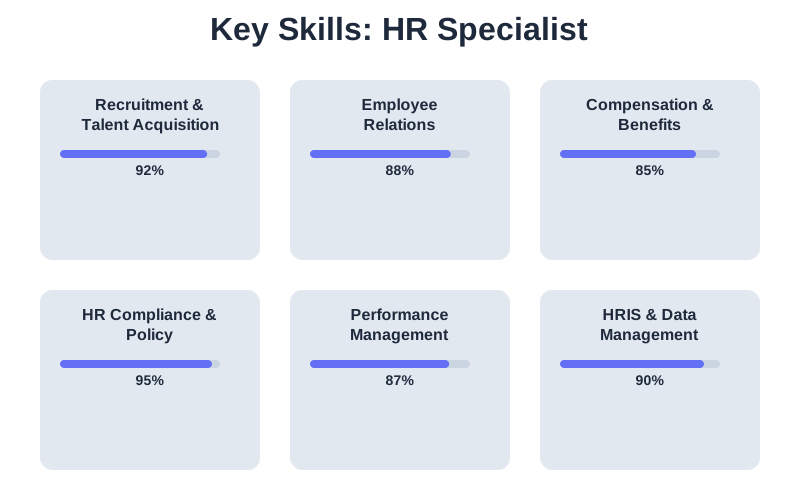
Essential skills for an HR Specialist resume
HR Specialist resumes must demonstrate both technical proficiency with HR systems and the interpersonal skills that make you effective when handling sensitive employee matters. Applicant Tracking Systems scan for specific technical competencies, so including the exact names of HRIS platforms you've used and certifications you hold significantly increases your chances of passing initial screening. However, recruiters also look for evidence that you can handle confidential information appropriately, communicate policy clearly to diverse audiences, and maintain composure during workplace conflicts.
The skills that matter most fall into three categories: system proficiency, regulatory knowledge, and people skills. System proficiency proves you can hit the ground running without extensive training on tools the company already uses. Regulatory knowledge demonstrates you won't create compliance risks that lead to lawsuits or fines. People skills show you can be trusted with the human side of HR, not just the paperwork. When optimizing for ATS, prioritize including the specific HRIS platforms mentioned in the job description, relevant certifications like PHR or SHRM-CP, and compliance areas like FMLA or FLSA that appear in the posting.
Critical skills to highlight:
- HRIS administration (Workday, ADP, BambooHR, UltiPro) - Recruiters need proof you can manage their specific systems without a learning curve that slows down operations
- Employment law compliance (FMLA, ADA, FLSA, EEO) - Mistakes in these areas cost companies hundreds of thousands in settlements, so demonstrated knowledge is non-negotiable
- Benefits administration - You'll field constant questions about health insurance, 401(k) matching, and PTO policies, requiring both technical knowledge and communication skills
- Recruitment coordination - Most HR Specialists support hiring processes, so experience with applicant tracking systems and interview scheduling is expected
- Data analysis and reporting - HR increasingly relies on metrics to justify decisions, making Excel proficiency and the ability to present data clearly essential
- Employee relations - Handling workplace conflicts, grievances, and sensitive conversations requires discretion and emotional intelligence
- Onboarding program management - First impressions matter, and you'll own the process that shapes new employees' initial experience
- Payroll coordination - While payroll specialists handle processing, HR Specialists verify data accuracy and resolve discrepancies affecting employee pay
- Policy interpretation and communication - You translate complex HR policies into plain language that employees and managers can actually understand and apply
- Document management and recordkeeping - Maintaining organized, audit-ready files protects the company legally and ensures smooth operations
- Change management support - When companies restructure or update policies, you help employees understand and adapt to changes
- Confidentiality and discretion - You'll access sensitive information about salaries, performance issues, and personal circumstances that must never be disclosed inappropriately
How to write an HR Specialist resume step by step
1. Start with a targeted summary that names your HR specialty
Generic HR summaries get ignored. Instead, specify whether you focus on benefits, recruitment, employee relations, or compliance. Include your years of experience, the size of employee populations you've supported, and one measurable achievement. For example: 'HR Specialist with 4 years supporting 600+ employees across manufacturing and corporate environments. Reduced benefits enrollment errors by 34% through process redesign and employee education initiatives.'
2. Quantify your impact on every bullet point possible
HR work generates measurable results even when it feels administrative. Track metrics like time-to-fill for open positions, employee satisfaction scores, onboarding completion rates, compliance audit findings, or cost savings from benefits negotiations. Instead of 'Managed employee onboarding process,' write 'Redesigned onboarding process for 85 annual new hires, increasing 90-day retention from 78% to 91% and reducing paperwork completion time by 40%.' Numbers prove you deliver results, not just complete tasks.
3. List HRIS and software systems prominently in a dedicated skills section
ATS algorithms specifically scan for technology keywords. Create a 'Technical Skills' or 'HR Systems' section listing every platform you've used: Workday, SAP SuccessFactors, ADP Workforce Now, Paycom, BambooHR, Greenhouse, Lever, or whatever applies to your experience. Don't just list them—include your proficiency level and what you did with each system. For instance: 'Workday (Advanced): Managed full employee lifecycle from hire to termination, generated custom reports, configured workflows for approval processes.'
4. Demonstrate compliance knowledge with specific regulations
Mention employment laws by name and describe how you ensured compliance. Rather than 'Ensured HR compliance,' write 'Administered FMLA leave for 40+ employees annually, maintaining 100% compliance during DOL audit and reducing processing time from 5 days to 48 hours through standardized documentation.' This shows you understand the regulations and can implement them effectively, not just that you've heard of them.
5. Show progression and increasing responsibility
Even if your job titles didn't change, your responsibilities likely expanded. Structure your experience to show growth: early roles might focus on administrative tasks, while recent positions should highlight project leadership, process improvements, or mentoring junior staff. If you started handling more complex employee relations cases, managing larger recruitment projects, or taking ownership of specific HR programs, make that progression visible.
6. Include relevant certifications and continuing education
HR certifications significantly boost your resume's ATS score and credibility. List PHR, SHRM-CP, or specialized certifications in compensation, benefits, or talent acquisition prominently. If you're pursuing certification, include it as 'PHR (in progress, exam scheduled May 2026).' Also mention relevant continuing education like employment law updates, HR technology training, or diversity and inclusion workshops that show you stay current.
7. Address gaps or career changes directly
If you transitioned into HR from another field, frame your previous experience as an asset. Former teachers bring training skills, retail managers understand customer service that translates to employee relations, and accountants offer analytical abilities valuable for compensation work. Include a brief statement connecting your background to HR: 'Transitioned from operations management to HR, applying process improvement expertise to reduce onboarding time by 30%.'
8. Tailor your resume for each application
Read the job description carefully and mirror its language. If the posting emphasizes 'talent acquisition,' use that phrase instead of 'recruitment.' If it mentions specific challenges like 'high-volume hiring' or 'multi-state compliance,' address those exact issues in your bullets. This isn't dishonest—it's translating your genuine experience into the terms that specific employer uses and that their ATS is programmed to find.
Before/after examples:
Weak: 'Responsible for benefits administration and answering employee questions'
Strong: 'Administered health, dental, and 401(k) benefits for 450 employees across 3 states, resolving 200+ inquiries monthly with 95% first-contact resolution rate'
Weak: 'Helped with recruiting and interviewed candidates'
Strong: 'Coordinated recruitment for 35 positions annually, screening 800+ applications and reducing average time-to-fill from 52 to 38 days through improved candidate pipeline management'
Weak: 'Maintained employee files and HR records'
Strong: 'Digitized 1,200+ employee records during HRIS migration to Workday, establishing document retention protocols that ensured 100% compliance during subsequent audit'
Common mistakes on HR Specialist resumes
Listing responsibilities instead of accomplishments
The biggest mistake HR Specialists make is describing their job duties rather than their impact. Recruiters already know HR Specialists process paperwork and answer questions—they want to know how well you did it. Saying 'Processed employee status changes' tells them nothing. Saying 'Processed 300+ employee status changes annually with 99.7% accuracy rate, implementing quality control checklist that reduced errors by 60%' proves you excel at the work. Every bullet point should answer 'so what?' If you can't explain why your contribution mattered, rewrite it.
Using vague language about 'employee relations'
Many HR Specialists write 'Handled employee relations issues' without specifying what that means. Did you mediate conflicts between coworkers? Investigate harassment complaints? Coach managers through performance improvement plans? Each requires different skills and carries different weight with recruiters. Be specific: 'Conducted 15 workplace investigations annually regarding policy violations and employee grievances, maintaining detailed documentation and recommending corrective actions that reduced repeat incidents by 40%.' This shows exactly what you can handle.
Omitting the size and scope of your employee population
Supporting 50 employees at a startup differs dramatically from supporting 5,000 at a multinational corporation. Always include context about the population you served: number of employees, number of locations, industries, union vs. non-union environments, or organizational complexity. 'Managed benefits administration' means little, but 'Managed benefits administration for 800 employees across 12 retail locations in 4 states, coordinating with 3 insurance carriers and maintaining compliance with varying state regulations' demonstrates significant capability.
Failing to mention specific HR technologies
Writing 'Proficient in HRIS systems' without naming them is a critical ATS mistake. Companies search for candidates experienced with their specific platforms because training on new systems is expensive and time-consuming. If you've used Workday, SAP, ADP, Paycom, BambooHR, or any other system, name it explicitly. Also specify what you did with it—running reports, configuring workflows, managing integrations, or training users. Generic technology claims suggest you lack real depth.
Neglecting to demonstrate compliance knowledge
HR Specialists who don't explicitly mention employment law compliance raise red flags. Even if compliance feels like background knowledge, recruiters need to see you understand FMLA, ADA, FLSA, EEO, COBRA, and other regulations relevant to their industry and locations. Include specific examples: 'Ensured ADA compliance by coordinating 25+ reasonable accommodation requests annually, partnering with managers and legal counsel to implement solutions that met employee needs while maintaining operational requirements.'
Including outdated or irrelevant HR practices
Mentioning that you maintained paper personnel files or used outdated systems signals you haven't kept pace with the field. Focus on current practices: cloud-based HRIS, data analytics, employee self-service portals, and digital onboarding. If your current employer uses older methods, describe how you improved processes or advocated for modernization. Similarly, avoid dated terminology like 'personnel' instead of 'employees' or 'manpower planning' instead of 'workforce planning.'
Writing a one-size-fits-all resume
HR Specialist roles vary enormously by industry, company size, and focus area. A resume emphasizing manufacturing safety compliance won't resonate with a tech startup seeking someone to build recruitment pipelines. Tailor your resume to match each opportunity: highlight relevant industry experience, emphasize the HR functions that role prioritizes, and use the specific terminology from the job description. A generic resume suggests you're mass-applying without genuine interest or relevant qualifications.
HR Specialist resume trends in 2026
The HR Specialist role is evolving rapidly as artificial intelligence automates routine administrative tasks while simultaneously creating demand for specialists who can manage AI tools and interpret the data they generate. Companies increasingly expect HR Specialists to move beyond transaction processing toward strategic support—analyzing workforce trends, identifying retention risks, and recommending data-driven solutions. Your resume should demonstrate comfort with HR analytics platforms, experience extracting insights from HRIS data, and examples of how you've used metrics to improve processes or inform decisions.
Skills in AI-powered HR tools are becoming table stakes rather than nice-to-haves. Platforms like HireVue for video interview analysis, Eightfold.ai for talent matching, Workday's machine learning features for predictive analytics, and chatbots handling tier-one employee inquiries are now standard at mid-size and larger companies. Highlight any experience implementing, managing, or optimizing these tools. If you haven't used AI-specific platforms yet, emphasize your general technical aptitude, willingness to learn new systems quickly, and any experience training employees on technology adoption.
Employee experience has emerged as a critical focus area, with HR Specialists expected to think like customer service professionals. Companies want specialists who design onboarding journeys that feel personalized, create self-service resources that actually answer questions, and proactively identify friction points in HR processes. Demonstrate this mindset by describing how you've improved employee satisfaction scores, reduced time employees spend on HR tasks, or redesigned processes based on employee feedback. Quantify improvements in engagement survey results, onboarding satisfaction ratings, or reduced inquiry volume after you improved documentation.
Compliance has grown more complex with remote work spanning multiple jurisdictions. HR Specialists who understand multi-state employment law, remote work policies, and international contractor regulations are highly valued. If you've managed compliance across different locations, supported distributed teams, or helped your company adapt policies for remote work, feature this prominently. Mention specific challenges you've addressed: varying state leave laws, remote work equipment policies, time tracking across time zones, or tax implications of employees relocating.
The shift toward skills-based hiring is changing how HR Specialists support recruitment. Instead of focusing solely on credentials and years of experience, companies want help identifying candidates with specific competencies and potential for growth. If you've worked with competency frameworks, skills assessments, or alternative credential evaluation, highlight this experience. Describe how you've helped hiring managers define role requirements in terms of skills rather than traditional qualifications, or how you've sourced candidates from non-traditional backgrounds.
Mental health and wellbeing support has become a core HR function rather than a peripheral benefit. HR Specialists increasingly coordinate employee assistance programs, mental health resources, wellness initiatives, and accommodations for employees managing mental health conditions. If you've administered EAP programs, tracked utilization and outcomes, trained managers on mental health awareness, or developed resources supporting employee wellbeing, include specific examples and metrics showing impact on absenteeism, retention, or employee feedback.
Remote and hybrid work considerations now appear in virtually every HR Specialist job description. Companies need specialists who can onboard employees they'll never meet in person, maintain culture across distributed teams, ensure equitable treatment of remote and in-office workers, and manage technology enabling virtual collaboration. Demonstrate your capability by describing remote onboarding programs you've run, virtual employee engagement initiatives you've coordinated, or policies you've helped develop ensuring fairness across work arrangements. Include metrics like remote employee retention rates, virtual onboarding completion rates, or satisfaction scores from distributed teams.
Further reading:
Frequently asked questions
Find answers to the most frequently asked questions.
For most HR Specialist profiles, aim for 1 page under 7 years of experience and 2 pages if you have complex scope (multi-country, HRIS projects, ER exposure). Prioritize measurable bullets, core HR domains, and HRIS tools. Remove older roles that do not add HR operations or compliance value.
Use role-relevant terms that appear in postings: HR operations, HRIS, Workday, SAP SuccessFactors, onboarding, employee relations, payroll administration, benefits administration, HR compliance, and HR analytics. Place keywords naturally in Skills and Experience bullets, and make sure dates and job titles are in a standard format.
Avoid names and sensitive details. Use anonymized, measurable framing: number of cases supported per year, categories (attendance, grievance, conduct), your role (triage, documentation, manager guidance), and outcomes (time to close, documentation completeness). Mention escalation and policy adherence to show risk control.
If you are applying in the US, generally do not include a photo. In the UK it is optional; in many international contexts it varies. When in doubt, prioritize a clean ATS-friendly layout. If a photo is included, keep it professional and ensure it does not push key content onto an extra page.
Use volume and turnaround metrics even for internships: number of interviews scheduled per week, onboarding files processed, HR tickets logged, or employee queries resolved. Add quality metrics like document accuracy, checklist completion rate, or processing time. Tie your work to tools used (Excel, HRIS, ATS).
A reverse-chronological format is usually best because it makes dates, titles, and progression easy to verify and ATS-friendly. Use a short skills section to highlight HRIS and HR domains, but keep proof in your Experience bullets. A fully skills-based CV can raise questions about timeline gaps.
Your career deserves a better resume
With CVtoWork, select a template, fill in the fields and download your resume as PDF.
Start creating