HR Manager Resume
Example, Template & Expert Tips 2026
Updated on April 18, 2026.
Use this HR manager resume template to showcase human resource management wins, HRIS tools, and metrics. Includes manager resume examples and ATS.
HR Manager Resume Templates
8 Templates available
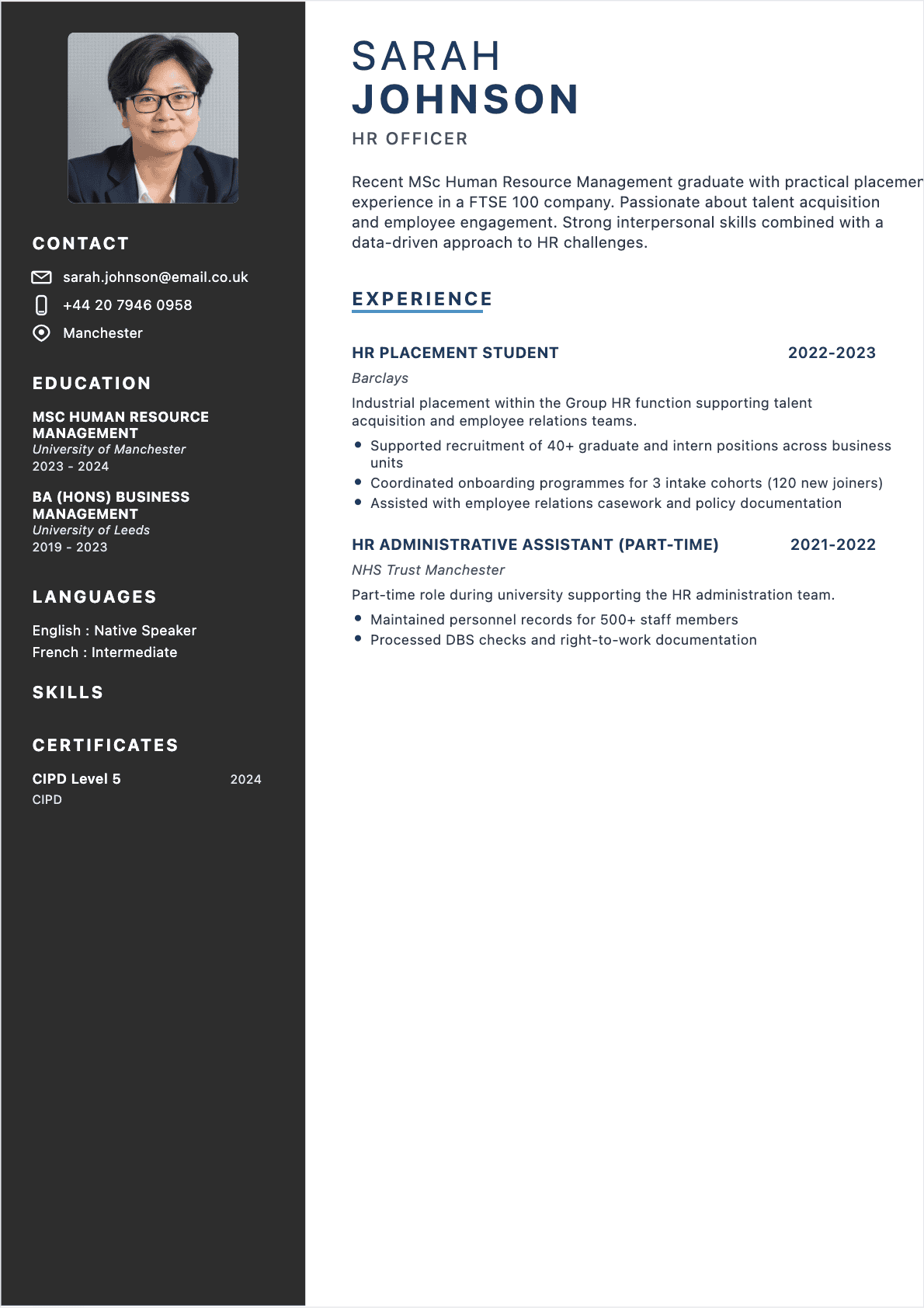
Resume HR Manager Junior
HR Manager resume template for Junior profile
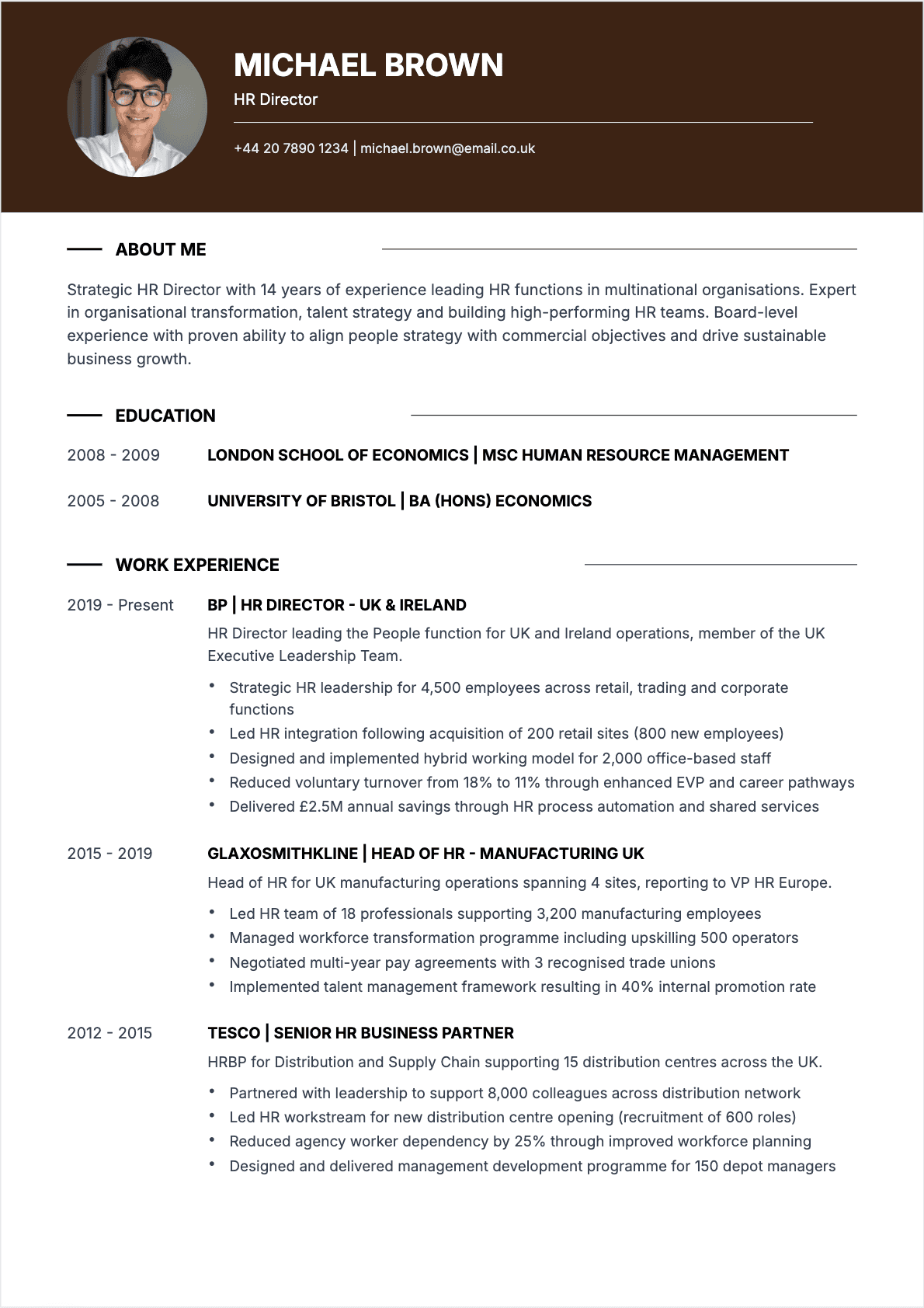
Resume HR Manager Senior
HR Manager resume template for Senior profile
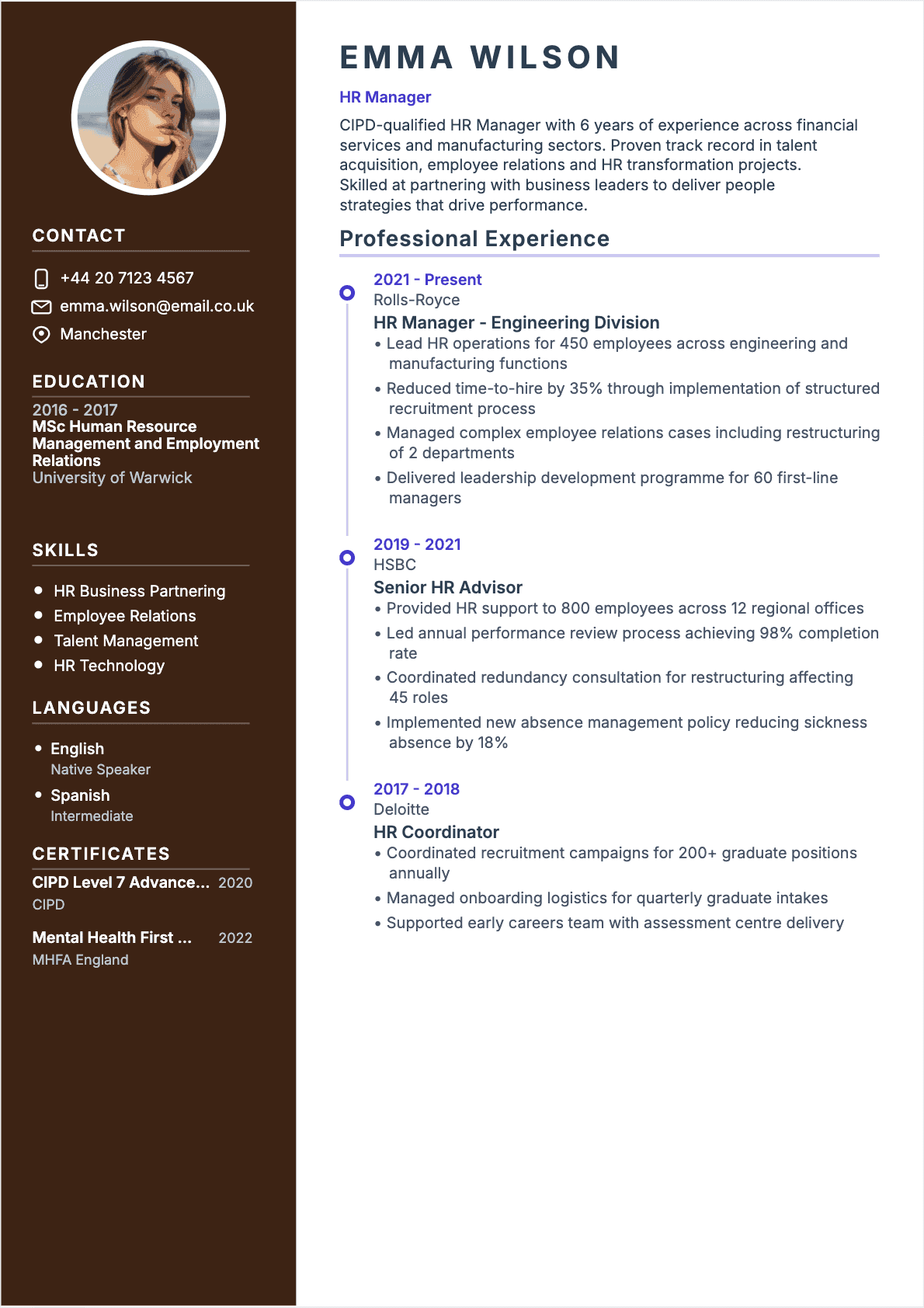
Resume HR Manager Confirmé
HR Manager resume template for Confirmé profile
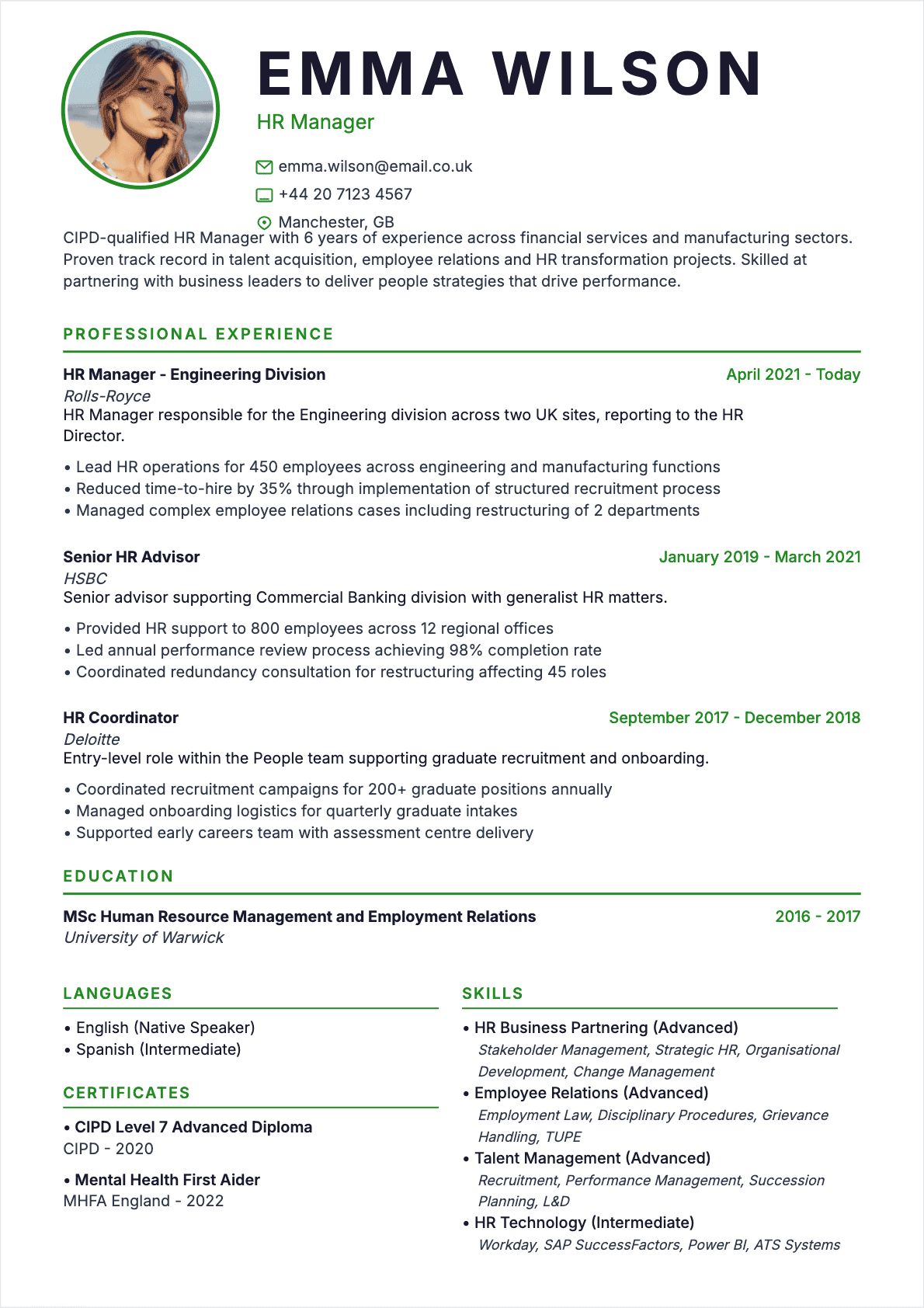
Resume HR Manager Confirmé
HR Manager resume template for Confirmé profile
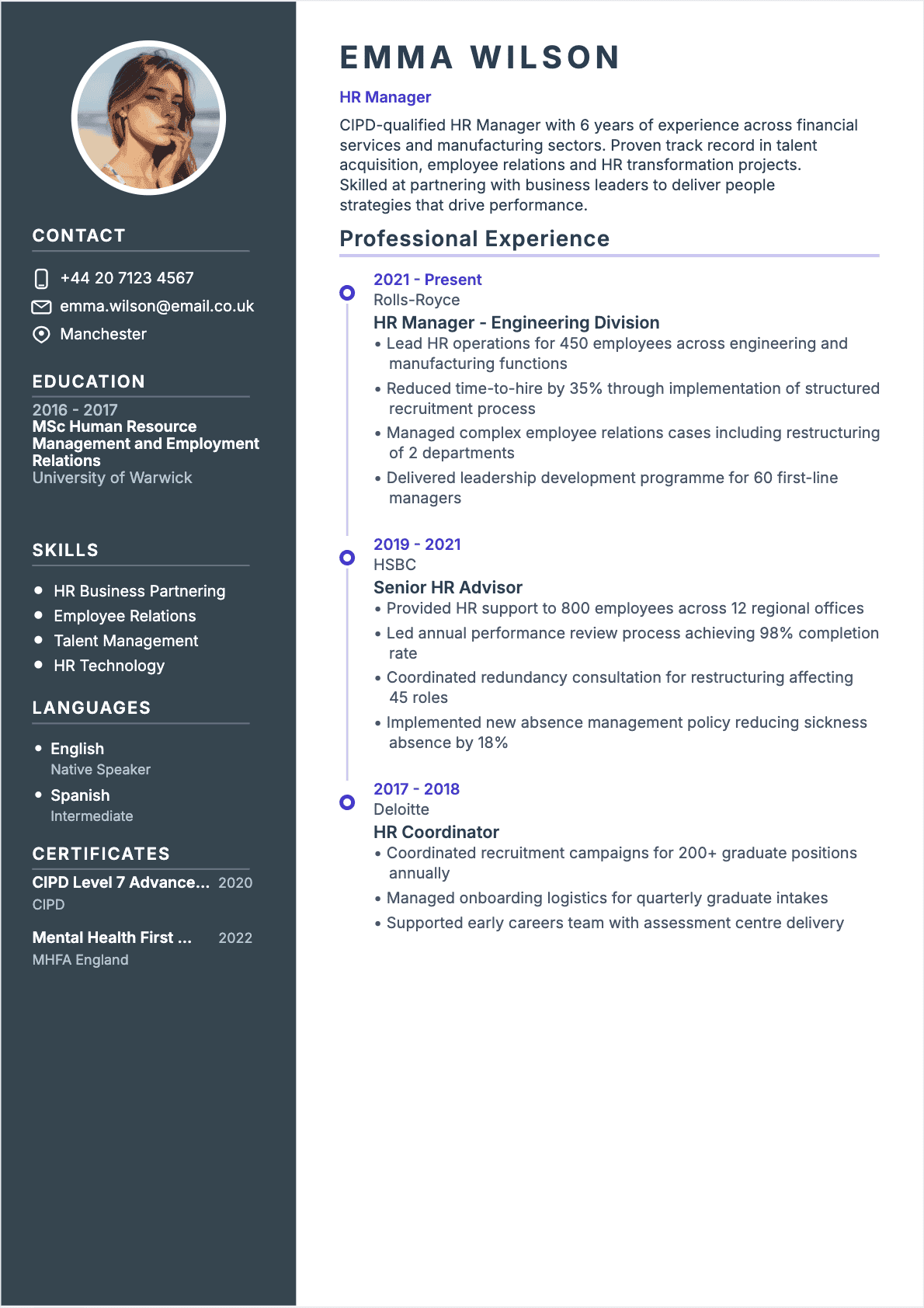
Resume HR Manager Confirmé
HR Manager resume template for Confirmé profile
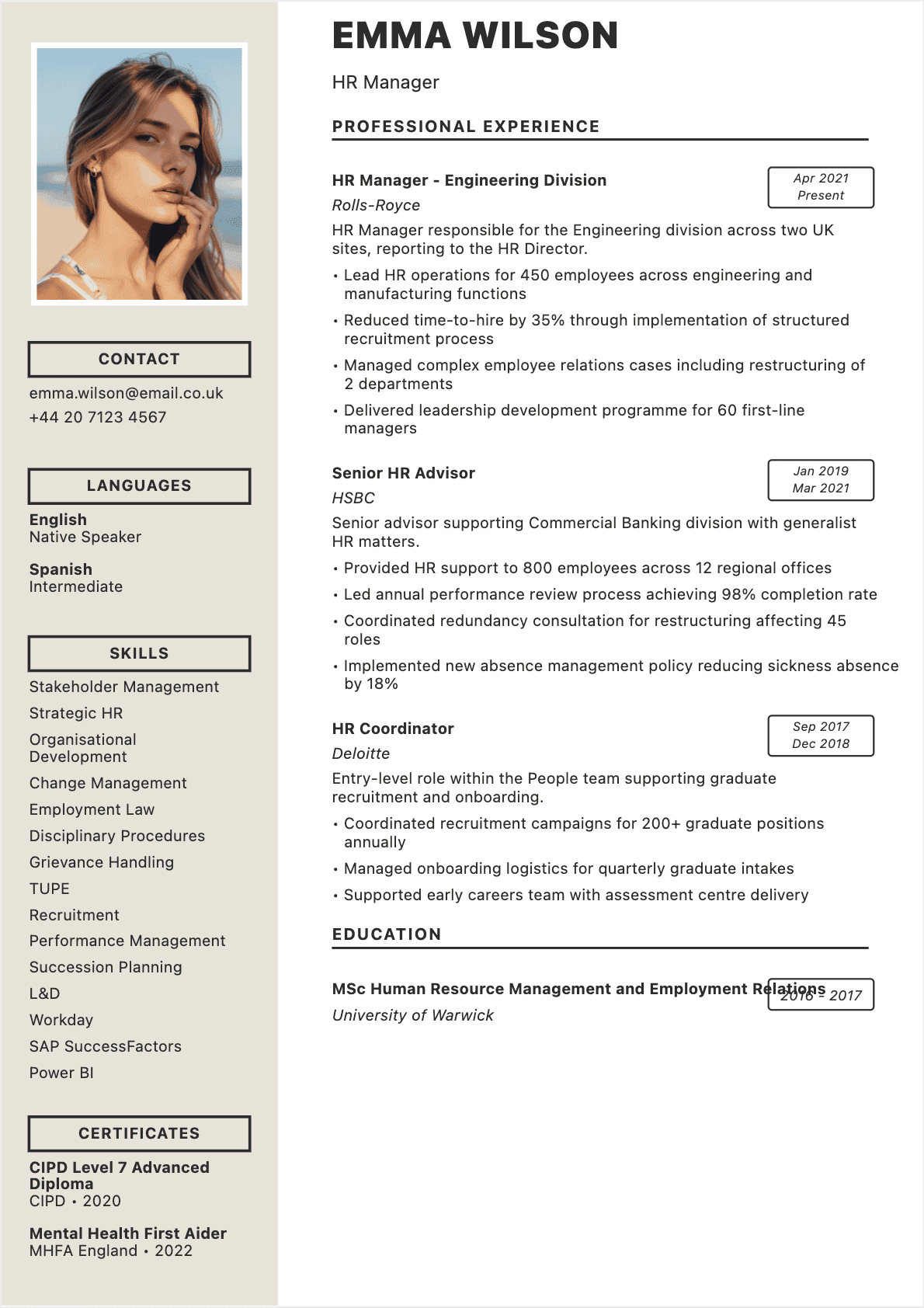
Resume HR Manager Confirmé
HR Manager resume template for Confirmé profile
Like one of these HR Manager resume templates?
Select it, fill in your details and download your resume as PDF.
HR Manager Resume Examples
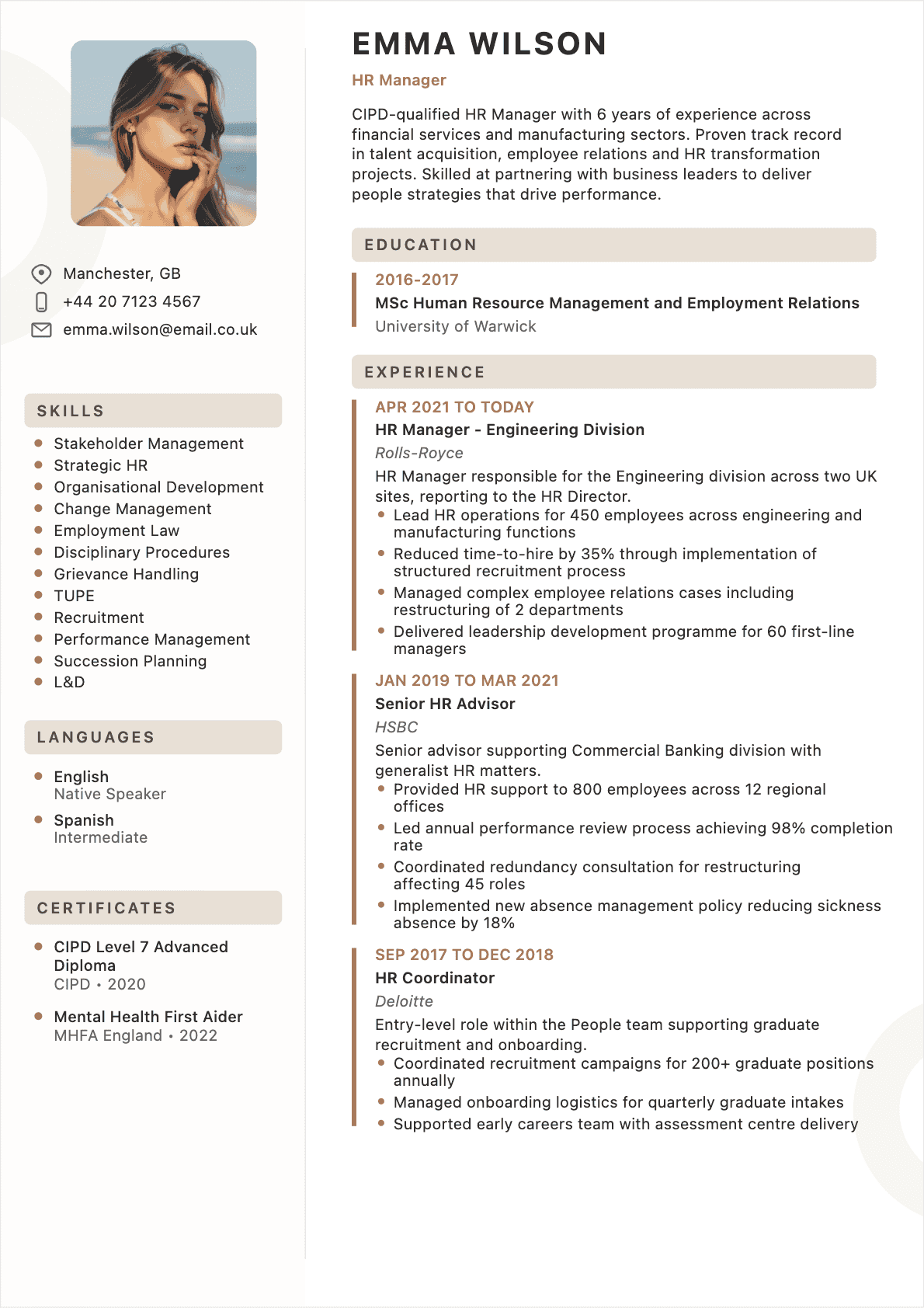
Emma Wilson
HR Manager
emma.wilson@email.co.uk
+44 20 7123 4567
Manchester, GB
CIPD-qualified HR Manager with 6 years of experience across financial services and manufacturing sectors. Proven track record in talent acquisition, employee relations and HR transformation projects. Skilled at partnering with business leaders to deliver people strategies that drive performance.
Work Experience
HR Manager - Engineering Division
Rolls-Royce
- ●Lead HR operations for 450 employees across engineering and manufacturing functions
- ●Reduced time-to-hire by 35% through implementation of structured recruitment process
- ●Managed complex employee relations cases including restructuring of 2 departments
Senior HR Advisor
HSBC
- ●Provided HR support to 800 employees across 12 regional offices
- ●Led annual performance review process achieving 98% completion rate
- ●Coordinated redundancy consultation for restructuring affecting 45 roles
HR Coordinator
Deloitte
- ●Coordinated recruitment campaigns for 200+ graduate positions annually
- ●Managed onboarding logistics for quarterly graduate intakes
- ●Supported early careers team with assessment centre delivery
Education
MSc
University of Warwick
Skills
Languages
English — Native Speaker
Spanish — Intermediate
Certifications
CIPD Level 7 Advanced DiplomaCIPD
Mental Health First AiderMHFA England
HR Manager role overview
An HR Manager oversees the human resources function within an organization, balancing strategic workforce planning with day-to-day people operations. You'll serve as the bridge between leadership and employees, designing policies that support business objectives while maintaining a positive workplace culture. This role requires you to manage everything from recruitment pipelines and performance management systems to employee relations issues and compliance audits.
The position demands both strategic thinking and hands-on execution. You'll spend mornings reviewing workforce analytics and meeting with department heads about headcount planning, then shift to coaching managers through difficult conversations or investigating workplace concerns. You're responsible for ensuring the organization attracts, develops, and retains talent while staying compliant with employment laws and regulations. Most HR Managers oversee a team of HR coordinators, recruiters, or specialists, delegating tactical work while maintaining oversight of critical decisions.
Career progression typically starts with HR Coordinator or HR Generalist roles (1-3 years), advancing to HR Business Partner or Senior HR Generalist (3-5 years), then HR Manager (5-8 years). From there, you can move into Director of HR, VP of People Operations, or Chief Human Resources Officer positions. Some HR Managers specialize in areas like talent acquisition, compensation and benefits, or organizational development, becoming subject matter experts in their chosen domain.
Salary ranges vary by company size and industry. Entry-level HR Managers with 3-5 years of experience typically earn $65,000-$80,000 annually. Mid-level HR Managers with 5-8 years earn $80,000-$105,000, while senior HR Managers with 8+ years and larger team oversight command $105,000-$140,000. Those in tech hubs or Fortune 500 companies often see 15-25% premiums above these ranges.
Typical daily tasks include:
- Reviewing and approving job requisitions, compensation proposals, and promotion recommendations
- Meeting with managers to address performance issues, team dynamics, or organizational changes
- Analyzing turnover data, engagement survey results, and other HR metrics to identify trends
- Updating policies and procedures to reflect changing employment laws or business needs
- Conducting or overseeing investigations into employee complaints or workplace concerns
- Collaborating with leadership on workforce planning, restructuring, or expansion initiatives
Essential skills for an HR Manager resume
Your resume needs to demonstrate both technical HR expertise and the interpersonal capabilities that make you effective in this people-focused role. Recruiters scan for specific HRIS platforms, knowledge of employment law, and quantifiable achievements in talent management. They also look for evidence that you can handle sensitive situations with discretion while influencing stakeholders across the organization.
Hard skills prove you can execute HR functions efficiently and compliantly. Soft skills show you can build trust, mediate conflicts, and drive cultural initiatives that stick. The combination determines whether you're seen as an administrative coordinator or a strategic partner to the business. When optimizing for ATS, prioritize technical skills like HRIS platforms, specific employment laws, and HR certifications, as these are commonly used as knockout criteria in applicant tracking systems.
Critical skills to highlight:
- Workday, SAP SuccessFactors, or BambooHR proficiency - Organizations want HR Managers who can extract workforce analytics and streamline processes through their existing technology stack
- Employment law knowledge (FMLA, ADA, Title VII, FLSA) - You must ensure company practices comply with federal and state regulations to minimize legal risk
- Full-cycle recruitment management - Demonstrates your ability to build talent pipelines, reduce time-to-fill, and improve quality of hire metrics
- Performance management system design - Shows you can create frameworks that drive accountability and development rather than just annual checkbox exercises
- Employee relations and conflict resolution - Proves you can investigate complaints, mediate disputes, and resolve issues before they escalate to legal claims
- Compensation analysis and salary benchmarking - Indicates you understand market rates and can make data-driven recommendations on pay structures
- Change management implementation - Reveals your ability to guide organizations through restructures, mergers, or cultural transformations with minimal disruption
- HR metrics and data analysis - Shows you make decisions based on turnover rates, cost-per-hire, engagement scores, and other quantifiable indicators
- Learning management systems (LMS) - Demonstrates experience building training programs that address skill gaps and support career development
- SHRM-CP or PHR certification - Validates your professional knowledge and commitment to HR best practices
- Stakeholder influence and business acumen - Proves you can translate HR initiatives into business outcomes that resonate with executives
- Policy development and documentation - Shows you can create clear, legally sound handbooks and procedures that employees actually understand

How to write an HR Manager resume step by step
1. Start with a results-focused summary that positions you as a strategic partner
Skip generic statements about being a 'dedicated HR professional.' Instead, open with your years of experience, the size of organizations you've supported, and 1-2 major accomplishments. For example: 'HR Manager with 7 years leading people operations for 300-500 employee organizations. Reduced turnover by 28% through targeted retention programs and redesigned performance management system adopted across 4 business units.'
2. Quantify your achievements with specific HR metrics
Every bullet point should include numbers that demonstrate impact. Instead of 'Improved recruitment process,' write 'Reduced average time-to-fill from 52 to 34 days while improving new hire quality scores by 23% through structured interview training and revised job descriptions.' Track metrics like turnover reduction percentages, cost savings from benefits renegotiation, training completion rates, or employee engagement score improvements.
3. Highlight HRIS and HR technology prominently
List specific platforms you've used in both your skills section and within job descriptions. Write 'Administered Workday HRIS for 450 employees, configuring workflows for PTO requests, performance reviews, and compensation changes that reduced HR ticket volume by 31%' rather than simply listing 'Workday' as a skill. This proves hands-on expertise and helps with ATS keyword matching.
4. Demonstrate strategic contributions beyond administrative tasks
Show how your HR initiatives supported business goals. Instead of 'Managed employee relations issues,' write 'Resolved 45+ employee relations cases annually while partnering with legal counsel to reduce EEOC complaints by 60% through proactive manager training and policy clarification.' Connect your work to retention, productivity, compliance risk reduction, or cost savings.
5. Include relevant certifications and continuing education
Place SHRM-CP, PHR, or SPHR certifications prominently near the top of your resume. If you've completed specialized training in areas like compensation analysis, HR analytics, or employment law updates, include these as well. For example: 'SHRM-CP certified (2022) | Completed Cornell University Certificate in Compensation Management (2024).'
6. Tailor your experience to the job description's priorities
If the posting emphasizes talent acquisition, lead with recruitment achievements. If it focuses on employee relations, prioritize those accomplishments. Reorder your bullet points so the most relevant experiences appear first under each role. Mirror the language in the job posting—if they say 'talent management,' use that phrase instead of 'people development.'
7. Show progression and increasing responsibility
Structure your work history to demonstrate growth. For earlier roles, you might write 'HR Generalist supporting 120 employees across 2 locations,' then for your current role, 'HR Manager overseeing team of 3 HR specialists supporting 400 employees across 5 locations.' This trajectory shows you've earned greater scope and leadership responsibility.
Before/after examples:
Weak: 'Responsible for recruitment and onboarding of new employees'
Strong: 'Hired 67 employees across 8 departments in 2024, reducing time-to-fill by 19 days through Indeed and LinkedIn Recruiter sourcing strategies and structured interview scorecards'
Weak: 'Handled employee relations issues and complaints'
Strong: 'Investigated and resolved 38 employee relations cases including harassment claims, policy violations, and interpersonal conflicts, maintaining 100% documentation compliance and zero legal escalations'
Weak: 'Managed benefits programs for the company'
Strong: 'Renegotiated health insurance contracts with 3 carriers, reducing company costs by $127K annually while maintaining employee contribution levels and adding mental health benefits'
Common mistakes on HR Manager resumes
Listing responsibilities instead of accomplishments
Many HR Manager resumes read like job descriptions: 'Responsible for recruitment, onboarding, benefits administration, and employee relations.' This tells recruiters nothing about your effectiveness. They assume you performed these functions—what they want to know is how well you did them. Did you reduce turnover? Improve hiring quality? Cut benefits costs? Every bullet should answer 'so what?' with a measurable outcome.
Failing to demonstrate strategic thinking
Entry-level HR roles focus on transactional tasks, but HR Managers must show they think strategically. If your resume only mentions processing paperwork, scheduling interviews, and updating handbooks, you'll appear too junior. Include examples of workforce planning, organizational design, culture initiatives, or policy changes that supported business objectives. Show you understand how HR drives company performance, not just maintains compliance.
Being vague about company size and scope
Writing 'Managed HR for the organization' could mean 20 employees or 2,000. Recruiters need context to evaluate your experience level. Always specify: 'Led HR operations for 350-employee manufacturing company across 3 facilities' or 'Supported 180-person tech startup through hypergrowth phase (80 to 180 employees in 18 months).' This helps them assess whether your background matches their organizational complexity.
Ignoring ATS optimization for HR-specific keywords
HR Manager postings often require specific HRIS platforms, certifications, or legal knowledge. If the job description mentions 'ADP Workforce Now' three times and you've used it extensively but only wrote 'HRIS experience,' the ATS may not match you. Mirror the exact terminology: list 'ADP Workforce Now,' 'FMLA administration,' 'SHRM-CP,' and other specific terms exactly as they appear in the posting. Generic phrases like 'HR software' or 'compliance knowledge' don't trigger keyword matches.
Neglecting to show employee relations expertise
Many HR Manager candidates underplay their experience handling sensitive situations. Recruiters specifically look for evidence you can manage investigations, difficult terminations, workplace conflicts, and legal compliance. If you write 'Handled various employee issues,' it sounds like you avoided the hard stuff. Instead: 'Conducted 12 workplace investigations involving harassment, discrimination, and policy violations, partnering with employment counsel to ensure compliant documentation and appropriate corrective action.'
Using outdated HR terminology
Phrases like 'personnel management,' 'human capital,' or 'manpower planning' date your resume. Current terminology includes 'talent management,' 'people operations,' 'employee experience,' and 'workforce analytics.' Similarly, if your most recent HRIS experience is with systems like PeopleSoft or Oracle HRMS without mentioning modern cloud platforms, you may appear behind the curve. Show you've kept pace with evolving HR technology and practices.
Omitting compliance and risk management achievements
HR Managers protect organizations from legal exposure, but many resumes don't emphasize this value. Highlight audit results, policy updates that closed compliance gaps, training programs that reduced liability, or investigations that prevented lawsuits. For example: 'Led company through DOL audit with zero findings by implementing I-9 verification process and conducting manager training on FLSA exemption classifications.' This demonstrates you understand the risk mitigation aspect of the role.
HR Manager resume trends in 2026
The HR Manager role continues shifting from administrative oversight to data-driven decision-making. Organizations now expect HR leaders to present workforce analytics with the same rigor as finance presents budget reports. Your resume should demonstrate proficiency with HR analytics tools, experience building dashboards in platforms like Tableau or Power BI, and examples of using data to solve business problems. Showing you've analyzed attrition patterns, predicted hiring needs based on growth projections, or identified skill gaps through competency assessments positions you as a modern HR professional.
AI tools are transforming talent acquisition and employee management, and employers want HR Managers who can implement and optimize these technologies rather than fear them. Highlight experience with AI-powered applicant tracking systems, chatbots for employee questions, or automated onboarding workflows. For example: 'Implemented HireVue video interviewing platform with AI-assisted candidate evaluation, reducing first-round interview time by 40% while maintaining hiring quality.' Demonstrating comfort with HR technology adoption shows you can help organizations scale efficiently.
Skills-based hiring and internal mobility have become priorities as companies struggle with talent shortages. Employers value HR Managers who've built skills taxonomies, created internal talent marketplaces, or redesigned job descriptions to focus on capabilities rather than credentials. Your resume should include examples like: 'Launched internal mobility program that filled 34% of open positions with existing employees, reducing external recruiting costs by $180K and improving retention of high performers by 19%.' This shows you understand modern talent strategies beyond traditional recruiting.
Employee experience and retention have overtaken recruitment as top priorities for many organizations. The cost of replacing employees—especially in tight labor markets—makes retention initiatives incredibly valuable. Highlight stay interviews you've conducted, retention programs you've designed, or culture initiatives that improved engagement scores. Quantify results: 'Reduced voluntary turnover from 23% to 14% through manager training program, flexible work policy expansion, and quarterly pulse surveys with action planning.' These metrics prove you can keep talent, not just find it.
Remote and hybrid work policies require sophisticated approaches to performance management, culture building, and compliance across jurisdictions. HR Managers who've successfully managed distributed workforces have a competitive advantage. Include examples like: 'Developed hybrid work policy for 280-employee organization, creating equitable guidelines for remote/in-office splits, updating performance metrics for outcome-based evaluation, and ensuring compliance with multi-state employment regulations.' This demonstrates you can handle the complexities of modern work arrangements.
Mental health support and wellbeing programs have moved from nice-to-have perks to essential benefits. Employers want HR Managers who've implemented Employee Assistance Programs, mental health days, or wellbeing initiatives with measurable impact. Your resume might include: 'Expanded EAP services and launched mental health awareness campaign, increasing utilization from 4% to 17% of employees and correlating with 12% reduction in short-term disability claims.' This shows you understand holistic employee support.
Diversity, equity, and inclusion work has become more sophisticated, moving beyond compliance to systemic change. Rather than generic statements about 'supporting DEI initiatives,' show specific programs you've built: 'Redesigned interview process to reduce bias through structured questions and diverse panel composition, resulting in 40% increase in underrepresented candidates advancing to final rounds and 28% improvement in diverse hiring outcomes.' Concrete DEI metrics demonstrate genuine impact rather than performative efforts.
Further reading:
Frequently asked questions
Find answers to the most frequently asked questions.
Start with a resume summary that states your years of HR experience, the workforce scope (headcount/sites), and 2 measurable outcomes (turnover, time-to-hire, audit closure). Then structure experience around achievements, naming HRIS/ATS tools and HR functions (recruitment, onboarding, employee relations, compliance). Match keywords from the job description.
Prioritize skills tied to the hr manager role: employee relations, investigations, performance management, compensation cycles, HR analytics, and HRIS/ATS administration. Certifications that add credibility include SHRM-CP/SHRM-SCP, PHR/SPHR (HRCI), CIPD Level 5 (UK/EU), and Prosci Change Management. List year and status (active/in progress).
Create a keyword map from the posting (e.g., HR compliance, onboarding, HR operations, workforce planning, Workday). Then tailor your resume by rewriting your summary, reordering bullets, and adding 2–3 mirrored phrases in context. Keep the same truth, but align emphasis: metrics and systems for analytics-heavy roles, investigations and policies for ER-heavy roles.
A chronological resume format works best for most HR managers because it shows progression (HR coordinator → HR generalist → HR manager). Use a clean layout with standard headings and consistent dates. For career changers into human resource roles, a hybrid format can help, but still include an ‘Experience’ section with HR-adjacent achievements and numbers.
Most HR manager resumes perform best at 1–2 pages. Use 1 page up to ~7 years of experience if you can keep strong metrics; use 2 pages for senior hr manager scope, multi-site or global HR, and major strategic HR initiatives. Cut older roles to 2–3 bullets and prioritize recent, relevant HR outcomes.
Often yes, especially when the role emphasizes culture, employee relations, or change management. Use the cover letter to connect your resume metrics to their business problem (turnover, hiring volume, compliance risk). Keep it to 200–300 words, reference the HRIS stack, and cite one project with a measured result.
Your career deserves a better resume
With CVtoWork, select a template, fill in the fields and download your resume as PDF.
Start creating