HR Director Resume
Example, Template & Expert Tips 2026
Updated on April 18, 2026.
Build an HR Director resume showcasing leadership, strategy, and measurable outcomes. Template, resume example, ATS keywords, and tips.
HR Director Resume Templates
8 Templates available
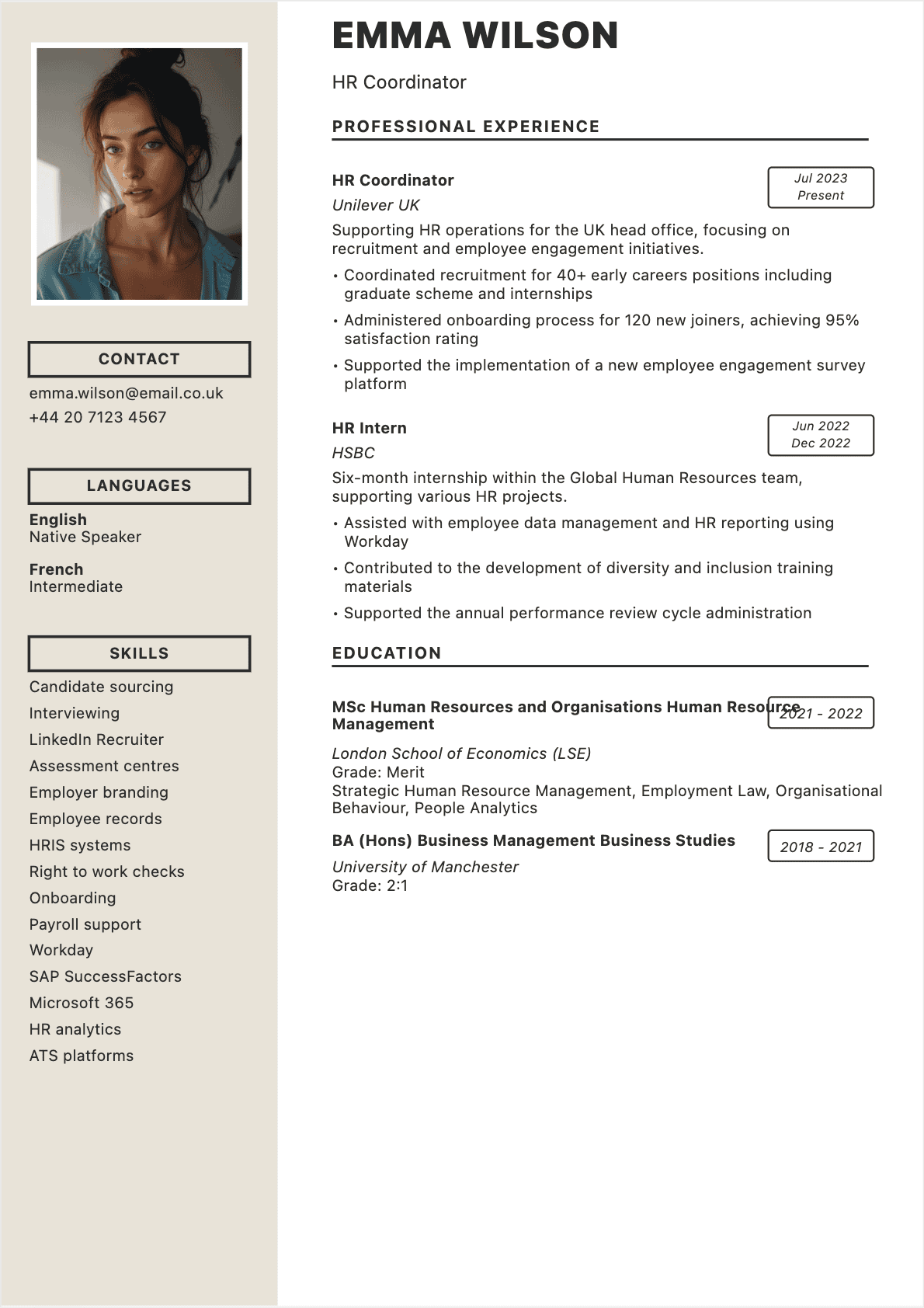
Resume HR Director Junior
HR Director resume template for Junior profile
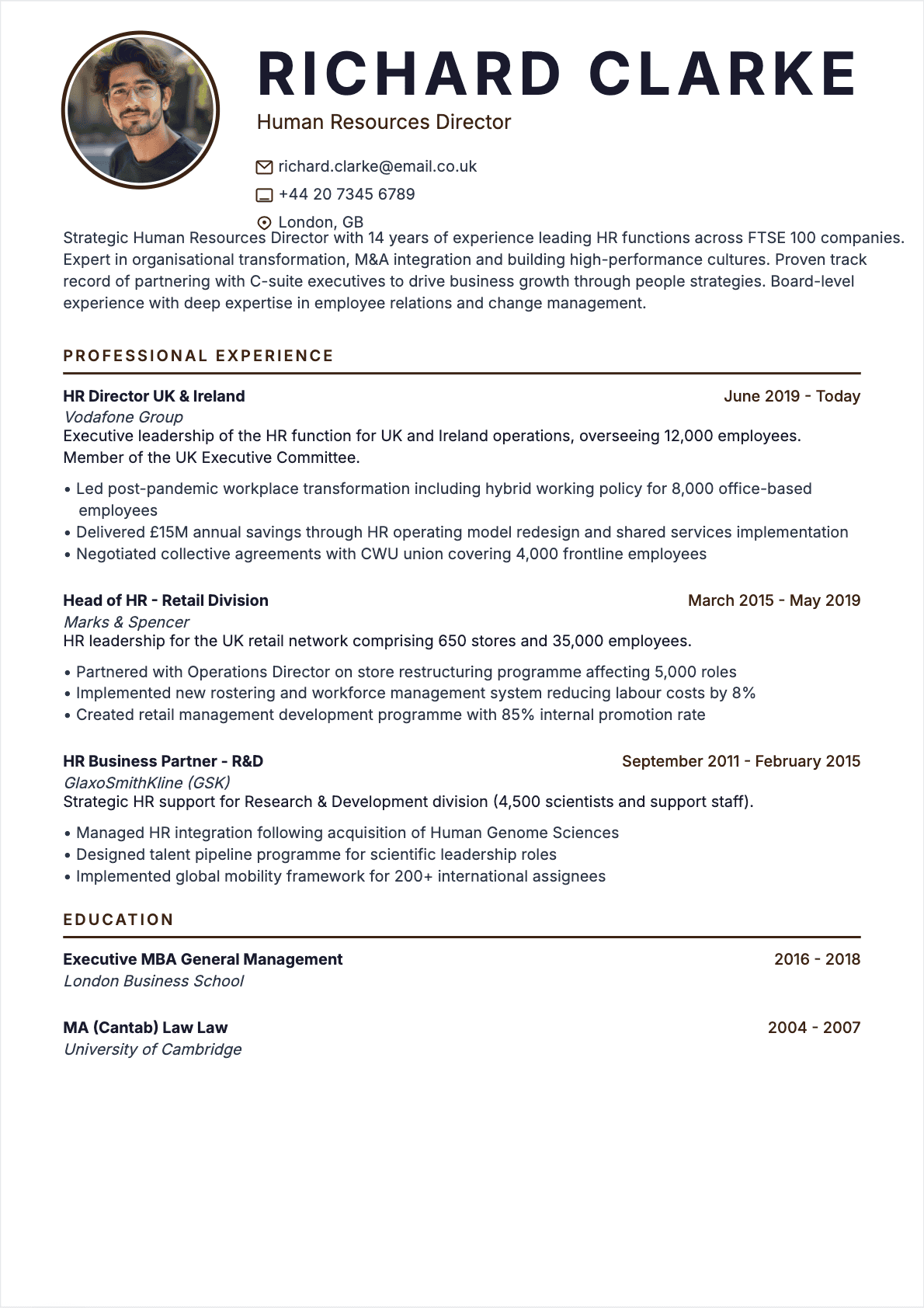
Resume HR Director Senior
HR Director resume template for Senior profile
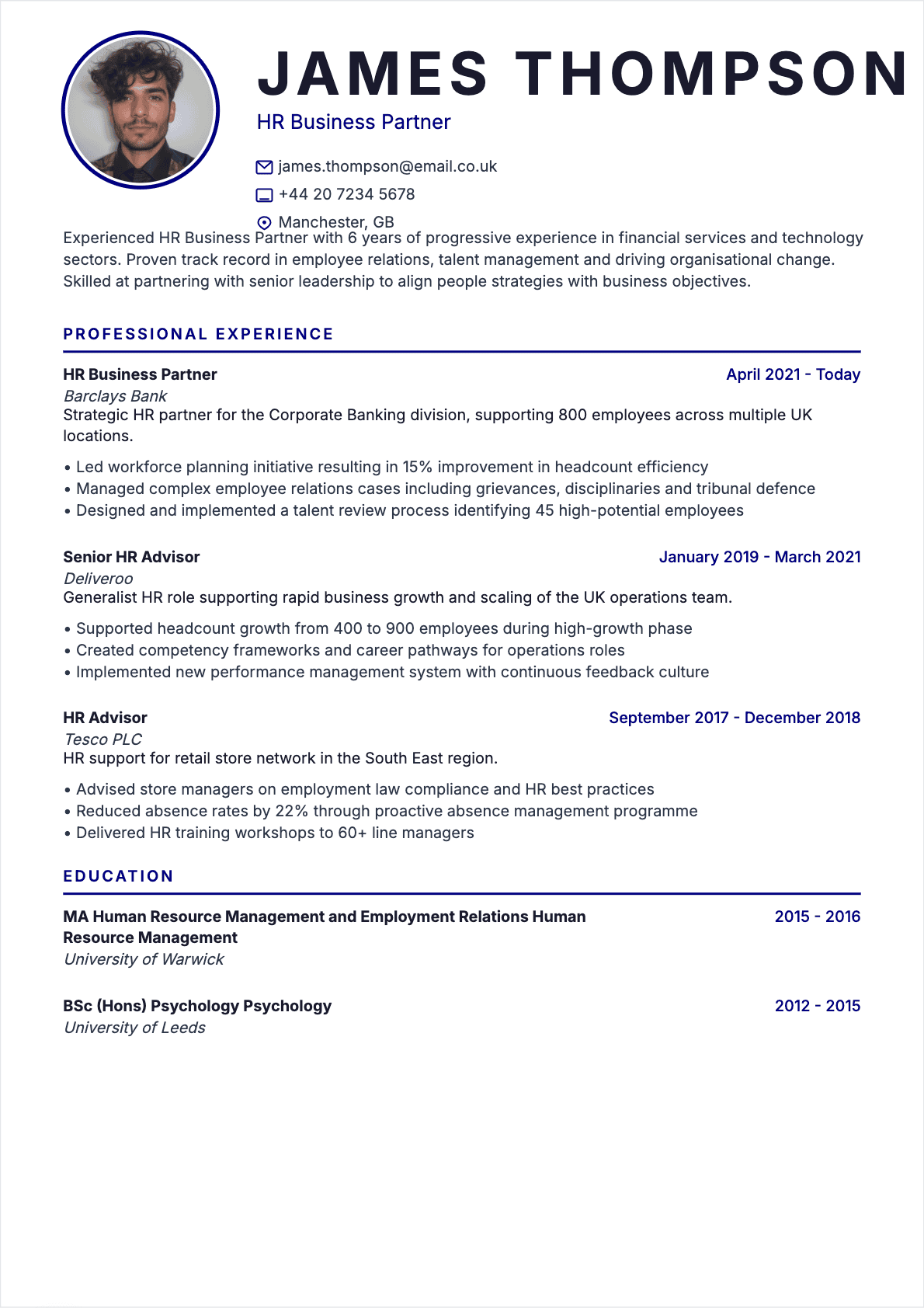
Resume HR Director Confirmé
HR Director resume template for Confirmé profile
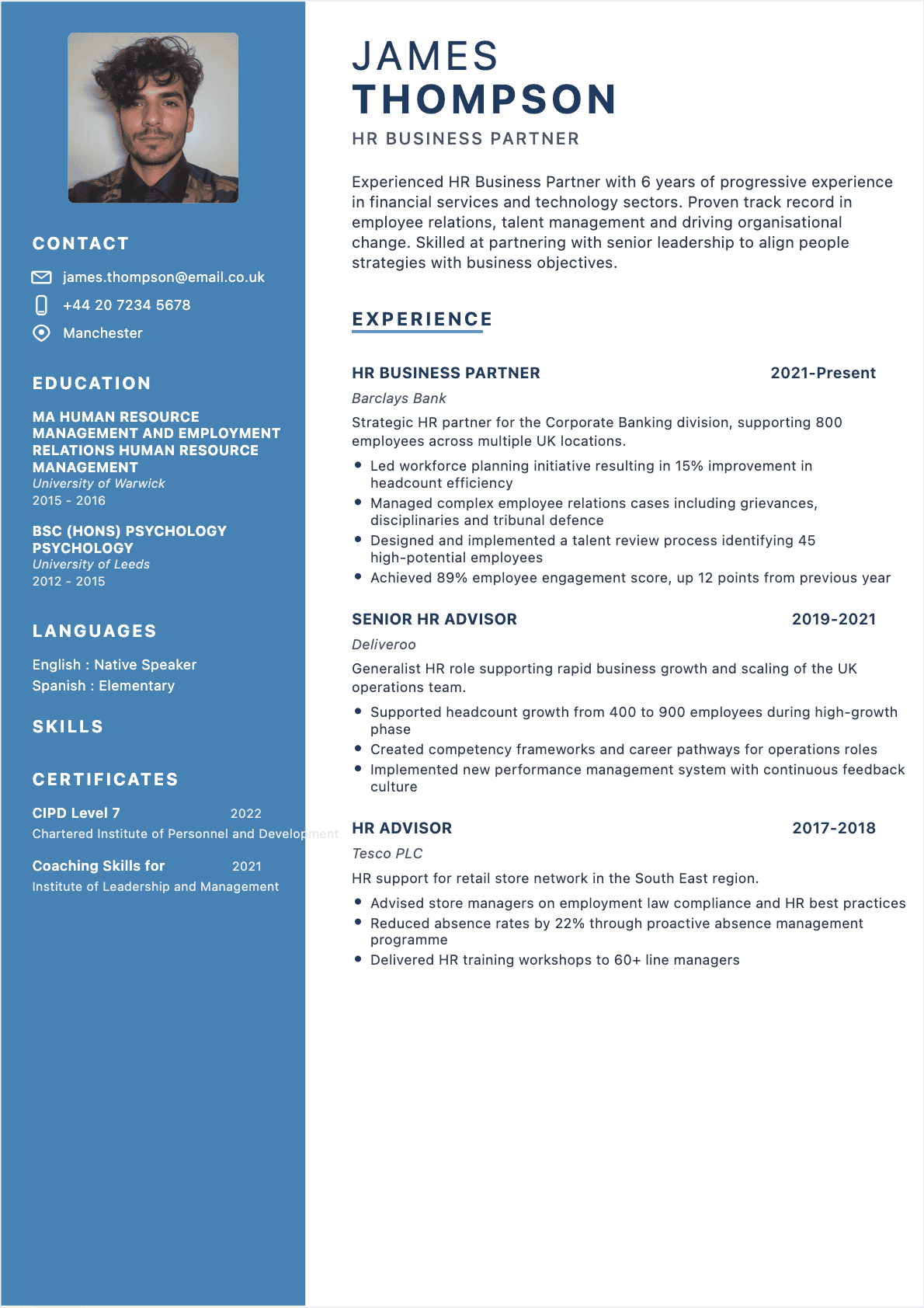
Resume HR Director Confirmé
HR Director resume template for Confirmé profile
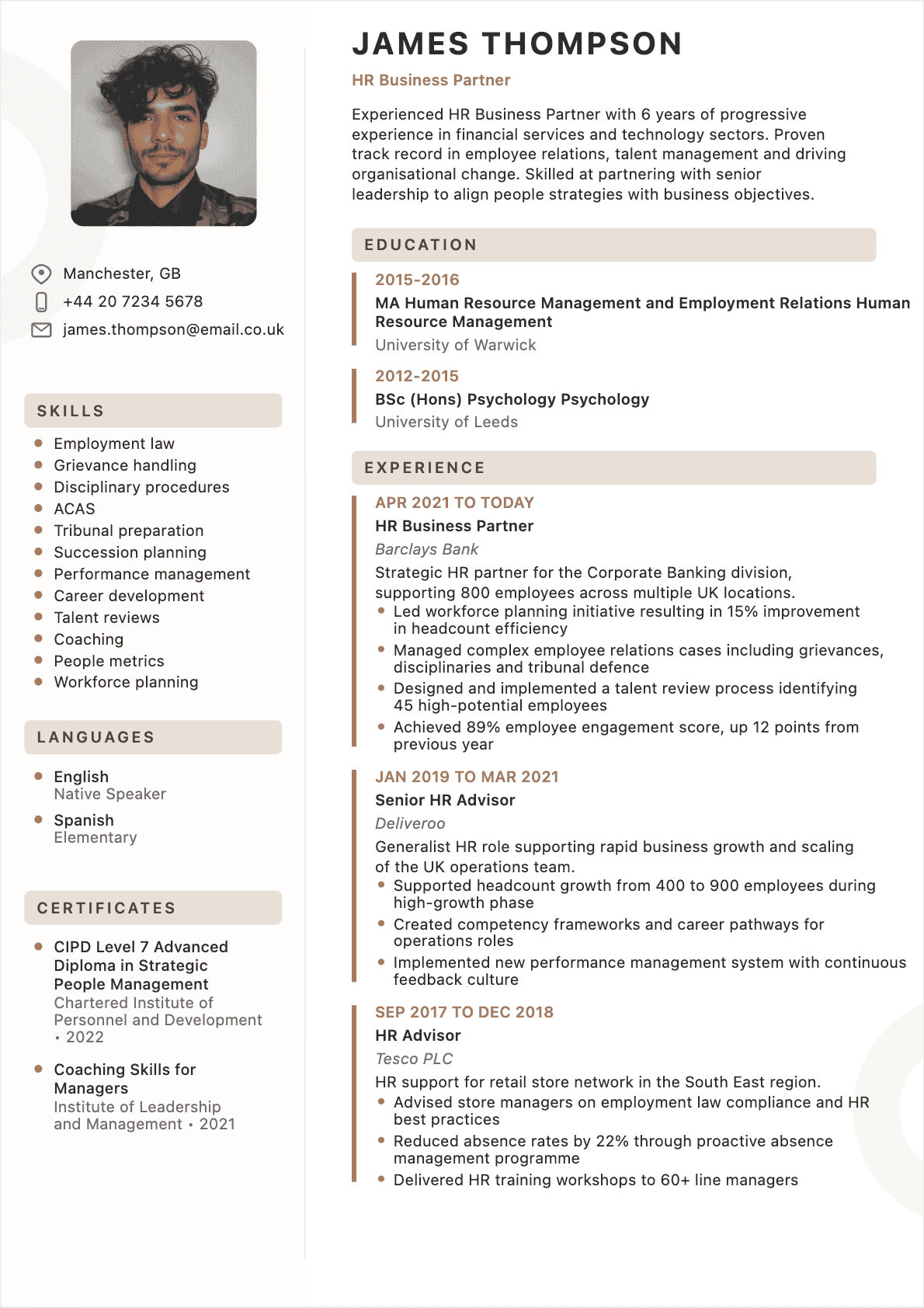
Resume HR Director Confirmé
HR Director resume template for Confirmé profile
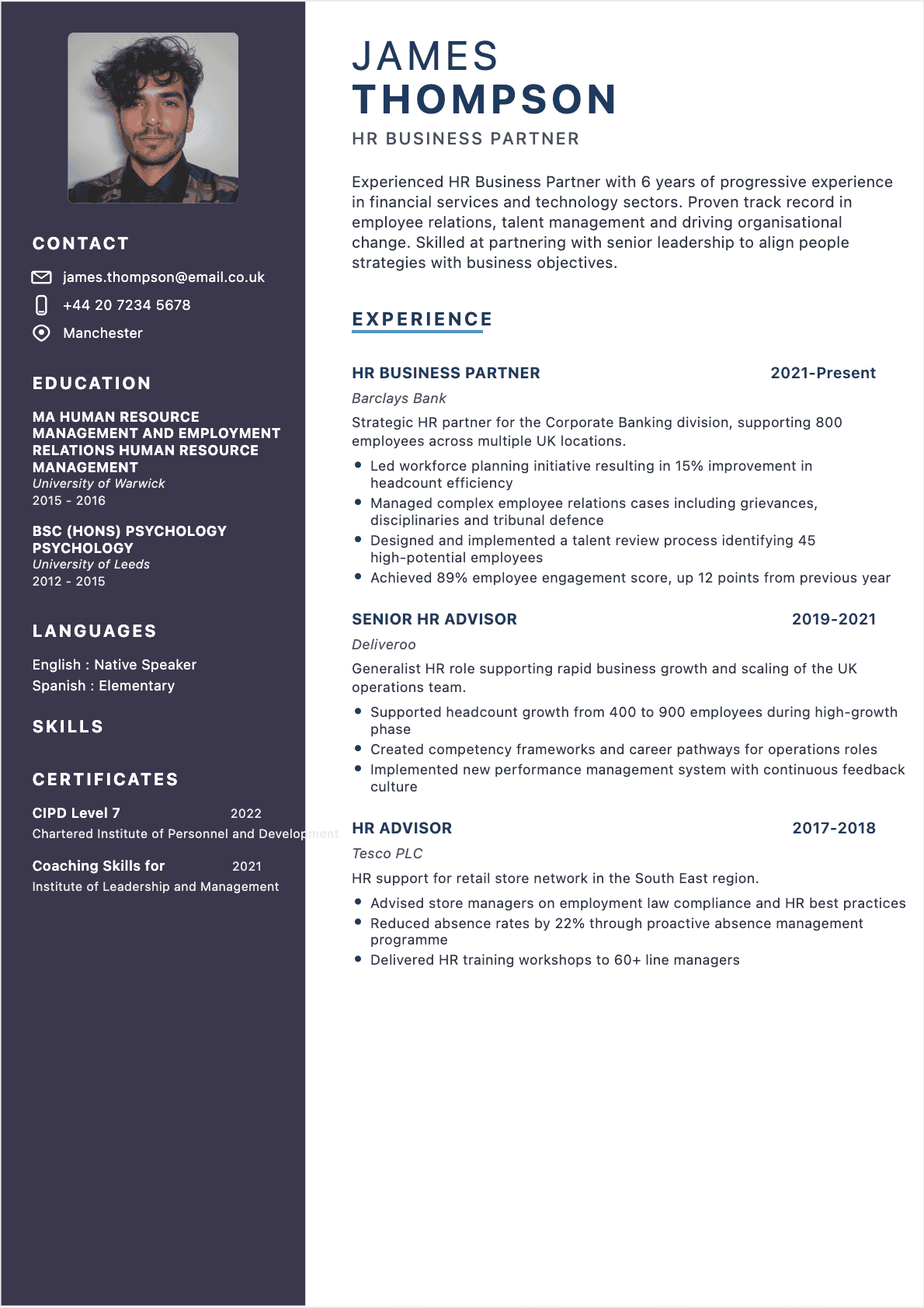
Resume HR Director Confirmé
HR Director resume template for Confirmé profile
Like one of these HR Director resume templates?
Select it, fill in your details and download your resume as PDF.
HR Director Resume Examples
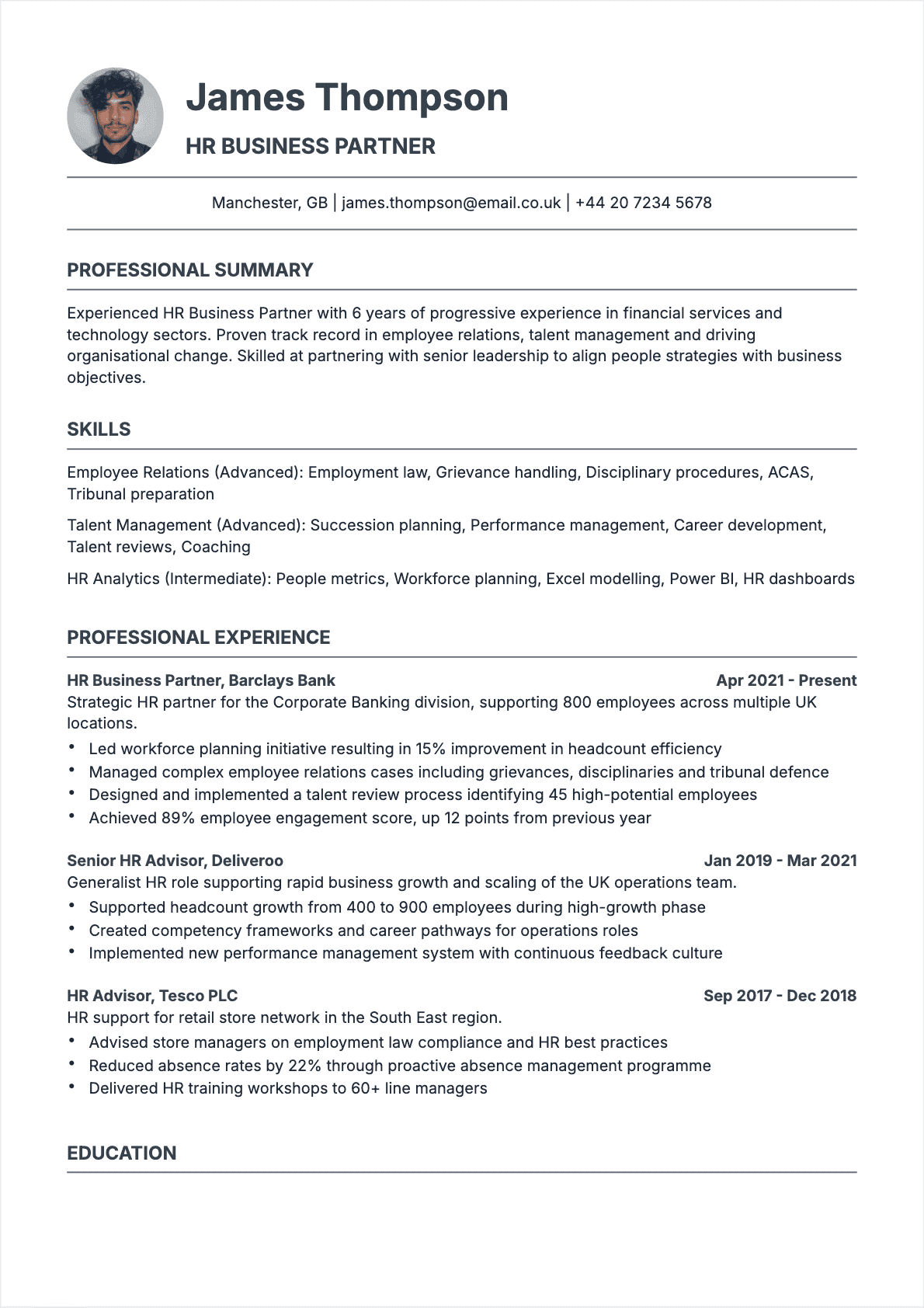
James Thompson
HR Business Partner
james.thompson@email.co.uk
+44 20 7234 5678
Manchester, GB
Experienced HR Business Partner with 6 years of progressive experience in financial services and technology sectors. Proven track record in employee relations, talent management and driving organisational change. Skilled at partnering with senior leadership to align people strategies with business objectives.
Work Experience
HR Business Partner
Barclays Bank
- ●Led workforce planning initiative resulting in 15% improvement in headcount efficiency
- ●Managed complex employee relations cases including grievances, disciplinaries and tribunal defence
- ●Designed and implemented a talent review process identifying 45 high-potential employees
Senior HR Advisor
Deliveroo
- ●Supported headcount growth from 400 to 900 employees during high-growth phase
- ●Created competency frameworks and career pathways for operations roles
- ●Implemented new performance management system with continuous feedback culture
HR Advisor
Tesco PLC
- ●Advised store managers on employment law compliance and HR best practices
- ●Reduced absence rates by 22% through proactive absence management programme
- ●Delivered HR training workshops to 60+ line managers
Education
MA Human Resource Management and Employment Relations
University of Warwick
BSc (Hons) Psychology
University of Leeds
Skills
Languages
English — Native Speaker
Spanish — Elementary
Certifications
CIPD Level 7 Advanced Diploma in Strategic People ManagementChartered Institute of Personnel and Development
Coaching Skills for ManagersInstitute of Leadership and Management
HR Director role overview
An HR Director operates at the intersection of people strategy and business objectives, translating organizational goals into workforce initiatives that drive performance. You'll spend your days balancing strategic planning with operational oversight—designing talent acquisition frameworks in the morning, resolving complex employee relations issues after lunch, and presenting workforce analytics to the C-suite before day's end. This role demands both big-picture thinking and attention to granular details, from shaping company culture to ensuring compliance with employment legislation across multiple jurisdictions.
Your responsibilities extend beyond traditional HR functions into business partnership territory. You'll collaborate with department heads to forecast hiring needs, build succession plans for critical roles, and design compensation structures that attract top talent while respecting budget constraints. Expect to lead a team of HR professionals—typically 3-15 people depending on company size—while maintaining direct involvement in high-stakes situations like executive recruitment, organizational restructuring, or sensitive investigations. The role requires constant adaptation as you respond to shifting business priorities, regulatory changes, and evolving employee expectations.
Career progression typically follows several paths. Many HR Directors advance to Chief Human Resources Officer (CHRO) or Chief People Officer roles in larger organizations, overseeing global HR operations with teams of 50+ professionals. Others transition into general management positions, using their people expertise to lead business units or operations. Some specialize further, becoming experts in areas like organizational development, executive compensation, or HR technology implementation. The lateral move into HR consulting or founding HR advisory firms also appeals to experienced directors seeking portfolio careers.
Salary ranges vary significantly by organization size and sector. In the United States, HR Directors typically earn between $110,000-$160,000 at smaller companies (under 500 employees), $140,000-$200,000 at mid-sized organizations, and $180,000-$280,000+ at large corporations or competitive tech companies. Total compensation often includes performance bonuses (10-25% of base salary), equity in private companies or stock options in public firms, and comprehensive benefits packages. Geographic location matters considerably—directors in major metropolitan areas like New York, San Francisco, or Boston command 20-35% premiums over similar roles in secondary markets.
Typical daily responsibilities include:
- Reviewing workforce metrics and dashboards to identify trends in turnover, time-to-hire, employee engagement, and productivity indicators
- Meeting with department leaders to discuss talent needs, performance concerns, organizational changes, and team development strategies
- Overseeing recruitment for senior positions, including reviewing candidate pipelines, conducting final interviews, and negotiating offer packages
- Addressing escalated employee relations matters such as harassment complaints, performance improvement plans, or termination decisions requiring director-level judgment
- Developing or refining HR policies, programs, and initiatives aligned with business strategy—from remote work guidelines to leadership development programs
- Representing HR in executive meetings, presenting on workforce planning, budget proposals, compensation reviews, or organizational effectiveness initiatives
Essential skills for an HR Director resume
Your resume must demonstrate both strategic HR expertise and operational competence. Recruiters scan for evidence that you can design people strategies while managing day-to-day HR functions effectively. The skills you highlight should reflect your ability to influence business decisions, not just support them. Technical proficiency matters, but your capacity to translate HR initiatives into business outcomes matters more. ATS systems typically prioritize skills mentioned in job descriptions, so mirror the language employers use while ensuring accuracy about your actual capabilities.
Hard skills prove your ability to execute HR functions at scale. Employers expect mastery of HRIS platforms because these systems form the backbone of modern HR operations—you'll use them daily for everything from generating turnover reports to managing open enrollment. Compensation design expertise signals you can create pay structures that balance internal equity with market competitiveness, a constant challenge as companies compete for talent. Employment law knowledge protects organizations from costly litigation and ensures compliant practices across hiring, termination, leave management, and workplace accommodations. Talent acquisition strategy demonstrates you can build recruitment processes that consistently deliver quality hires within budget and timeline constraints.
Soft skills differentiate good HR Directors from exceptional ones. Executive presence allows you to hold your own in C-suite discussions, presenting workforce data with the same authority finance leaders bring to budget conversations. Change management expertise proves you can guide organizations through restructuring, mergers, or cultural transformations without losing key talent or productivity. Conflict resolution skills show you can address sensitive situations—from executive disputes to team dysfunction—with diplomacy and decisiveness. Business acumen indicates you understand how HR decisions impact revenue, profitability, and competitive positioning, not just employee satisfaction scores.
Critical skills to feature prominently:
- Strategic workforce planning – Demonstrates ability to forecast talent needs 12-36 months ahead and build acquisition/development pipelines that prevent capability gaps
- HRIS systems (Workday, SAP SuccessFactors, Oracle HCM) – Shows technical competency managing platforms that house employee data, automate workflows, and generate analytics
- Employment law and compliance – Proves knowledge of FLSA, FMLA, ADA, Title VII, and state-specific regulations that govern employment relationships and minimize legal exposure
- Compensation and benefits design – Signals expertise creating salary structures, incentive programs, and benefits packages that attract talent while controlling costs
- Talent acquisition and recruitment strategy – Indicates capability building sourcing channels, employer branding, candidate experience, and hiring manager partnerships
- Employee relations and conflict resolution – Reflects skill managing investigations, mediating disputes, and resolving sensitive situations that could escalate to legal action
- Organizational development and change management – Shows experience designing interventions that improve effectiveness during growth, restructuring, or cultural transformation
- Performance management system design – Demonstrates ability creating frameworks that drive accountability, development, and alignment between individual and organizational goals
- HR analytics and metrics – Proves competency using data to measure program effectiveness, identify trends, and make evidence-based recommendations to leadership
- Leadership development and succession planning – Signals focus on building internal talent pipelines and preparing high-potential employees for expanded responsibilities
- Executive coaching and stakeholder management – Indicates skill advising senior leaders on people decisions and building trusted advisor relationships across the organization
- Diversity, equity, and inclusion program implementation – Reflects commitment and capability moving beyond statements to measurable initiatives that improve representation and belonging
For ATS optimization, prioritize skills that appear in the job description verbatim. If the posting mentions 'talent management,' use that exact phrase rather than 'people development.' Include both acronyms and full names for certifications (SHRM-SCP and Senior Certified Professional) and systems (ATS and Applicant Tracking System) to capture different search variations.

How to write an HR Director resume step by step
1. Lead with a results-focused summary that positions you as a business partner
Your opening statement should immediately establish your strategic value, not just list HR functions you've performed. Quantify your scope of responsibility—number of employees supported, size of HR team managed, budget overseen—and highlight 1-2 signature achievements that demonstrate business impact. Instead of 'Experienced HR Director with expertise in talent management and employee relations,' write 'HR Director who reduced regrettable turnover by 34% while scaling workforce from 280 to 450 employees during three-year hypergrowth phase, leading team of 8 HR professionals supporting operations across 12 states.'
2. Structure your experience section around business outcomes, not HR activities
Each position should tell a story of problems solved and value created. Start with context (company size, industry, your scope), then organize bullets around themes like talent acquisition, retention, organizational effectiveness, or cost management. Recruiters want to see how your HR initiatives contributed to revenue growth, operational efficiency, or competitive advantage. Frame accomplishments using the formula: action + context + measurable result. Instead of 'Managed recruitment process,' write 'Redesigned technical recruitment process, implementing structured interviews and skills assessments that reduced time-to-hire from 67 to 42 days while improving 90-day retention from 81% to 94%.'
3. Quantify everything possible with specific metrics and timeframes
Numbers transform vague claims into credible evidence. Include percentages (turnover reduction, engagement score improvements), dollar amounts (budget managed, cost savings achieved), timeframes (project completion speed), and scale indicators (employees supported, positions filled, policies implemented). Compare before-and-after states to show your impact. Instead of 'Improved employee engagement,' write 'Increased employee engagement scores from 68% to 82% over 18 months through quarterly pulse surveys, manager training program, and revamped recognition system, contributing to 23% reduction in voluntary turnover.'
4. Highlight change management and transformation initiatives
HR Directors often lead organizations through significant transitions. Dedicate bullets to restructuring projects, system implementations, culture change efforts, or scaling initiatives that demonstrate your ability to manage complexity. Specify the scope of change, stakeholders involved, obstacles overcome, and ultimate outcomes. Instead of 'Led HRIS implementation,' write 'Directed 14-month transition from legacy systems to Workday HCM, managing $890K budget, coordinating 6 vendor partners, training 45 managers, and achieving 99.2% data accuracy at go-live with zero payroll disruptions.'
5. Showcase your leadership and team development capabilities
As a director-level candidate, your ability to build and lead teams matters as much as your individual contributions. Include bullets about team growth, talent development, succession planning, and how you've elevated HR's strategic role. Instead of 'Managed HR team,' write 'Built HR function from 2 generalists to specialized 7-person team (talent acquisition, compensation, employee relations, HRIS), developing internal talent to fill 4 promotions and establishing HR business partner model that increased leadership satisfaction with HR support from 6.2 to 8.7/10.'
6. Feature relevant certifications, education, and professional development
List credentials that validate your expertise: SHRM-SCP, SPHR, or specialized certifications in compensation (CCP), benefits (CEBS), or talent development (CPTD). Include relevant continuing education like executive HR programs from Cornell, Michigan, or similar institutions. If you've completed training in emerging areas like people analytics, HR technology, or organizational psychology, mention these to show you're staying current. Place education after experience unless you have an MBA or relevant master's degree from a prestigious institution, which can appear prominently.
7. Tailor your resume for each application using keywords from the job description
ATS systems scan for specific terms that match job requirements. Read postings carefully and incorporate their exact language where truthful. If they mention 'succession planning,' use that phrase rather than 'leadership pipeline development.' If they emphasize 'M&A integration,' ensure that term appears if you have relevant experience. Create a master resume with all accomplishments, then customize each application by emphasizing the 8-10 most relevant experiences and skills for that specific role.
Before/after examples:
Weak: 'Responsible for recruitment and hiring across all departments'
Strong: 'Filled 127 positions across engineering, sales, and operations during 18-month expansion, reducing average time-to-hire from 56 to 38 days while maintaining 92% hiring manager satisfaction and 89% one-year retention rate'
Weak: 'Handled employee relations issues and complaints'
Strong: 'Resolved 43 formal employee relations cases including harassment allegations, performance disputes, and accommodation requests, conducting thorough investigations that resulted in zero EEOC charges and 100% case closure within 30-day target'
Weak: 'Developed compensation strategy for the organization'
Strong: 'Redesigned compensation structure using market data from 3 industry surveys, creating 12 job levels with defined salary ranges that reduced compression issues by 67%, improved internal equity, and positioned company at 60th percentile for target roles while staying within 3% of budget'
Common mistakes on HR Director resumes
Listing HR activities instead of business outcomes
The most frequent error is describing what you did rather than what changed because of your work. Recruiters assume you 'conducted performance reviews' and 'managed benefits administration'—these are table stakes. They want evidence you moved organizational metrics. Writing 'Oversaw talent acquisition function' tells them nothing about your effectiveness. Instead, show results: 'Reduced cost-per-hire by $2,400 while decreasing time-to-fill for critical roles by 31%, enabling business to meet aggressive expansion timeline without sacrificing quality.' Every bullet should answer the implicit question: 'So what? Why did this matter to the business?'
Using outdated HR terminology that signals you're behind current practices
Language like 'personnel management,' 'manpower planning,' or 'training and development' dates your experience and suggests you haven't evolved with the profession. Modern HR Directors discuss 'talent strategy,' 'workforce analytics,' 'employee experience design,' and 'organizational effectiveness.' Similarly, emphasizing administrative tasks like 'maintained employee files' or 'processed FMLA paperwork' positions you as an operational manager rather than a strategic leader. These functions should be handled by your team while you focus on higher-level initiatives. If you're still doing primarily administrative work, you're not operating at director level.
Failing to demonstrate strategic business partnership
Many resumes show HR Directors operating in a silo, implementing HR programs without connecting them to business strategy. Recruiters want evidence you understand the business model, participate in strategic planning, and align people initiatives with organizational goals. Don't just say 'Developed leadership training program.' Explain the business context: 'Designed 9-month leadership development program in response to 40% projected growth, preparing 15 high-potential managers for expanded roles and enabling company to fill 11 of 13 new leadership positions internally, saving estimated $385K in external recruitment costs.' Show you're at the table when business decisions are made.
Omitting metrics that prove your effectiveness
A resume without numbers is a resume without credibility at the director level. If you can't quantify your impact, recruiters question whether you achieved any. Every HR initiative generates measurable data—turnover rates, engagement scores, time-to-hire, cost-per-hire, training completion rates, internal promotion percentages, diversity metrics, or employee satisfaction indices. Even if you lack perfect data, provide reasonable estimates: 'approximately 250 employees,' 'roughly $1.2M budget,' 'estimated 20% improvement.' Numbers transform abstract claims into concrete evidence. Compare your metrics to industry benchmarks when possible to provide context for your achievements.
Including irrelevant early-career details that dilute your director-level brand
Your resume should emphasize the last 10-15 years when you operated at increasingly senior levels. Detailed descriptions of your HR Coordinator or HR Generalist roles from 20 years ago consume valuable space and position you as less senior than you are. Consolidate early career into a brief 'Early Career' section: 'HR Generalist and Coordinator roles at ABC Company and XYZ Corporation (2003-2009): Progressive responsibilities in recruitment, employee relations, and HRIS administration.' This acknowledges your foundation without dwelling on junior-level work. Your resume real estate should be proportional to role seniority and recency.
Writing generic bullets that could apply to any HR Director
Statements like 'Developed HR policies and procedures' or 'Partnered with leadership on strategic initiatives' are so vague they're meaningless. What specific policies? Which leaders? What initiatives? What resulted? Generic language suggests you're padding your resume with responsibilities you didn't actually fulfill or can't remember clearly. Specificity builds credibility. Instead of 'Improved employee retention,' write 'Reduced turnover in sales organization from 34% to 19% through targeted interventions including revised compensation plan, enhanced onboarding program, and quarterly career development conversations, retaining 8 top performers who had been flight risks.' Details prove authenticity.
Neglecting to address industry-specific HR challenges
HR practices vary significantly across industries. Healthcare HR Directors manage complex credentialing and regulatory compliance. Manufacturing HR Directors focus on safety, union relations, and shift workforce management. Technology HR Directors emphasize equity compensation and technical talent scarcity. Your resume should reflect deep understanding of your industry's unique people challenges. If you're applying across industries, research the target sector's primary HR concerns and emphasize transferable experiences. A retail HR Director moving to tech should highlight experience scaling teams quickly, managing rapid growth, and competing for talent in tight markets—challenges both industries share.
HR Director resume trends in 2026
The HR Director role is experiencing significant transformation as organizations reassess what they need from people leadership. Companies increasingly expect HR Directors to function as business strategists who happen to specialize in people, rather than HR specialists who occasionally contribute to strategy. This shift appears in job descriptions emphasizing P&L understanding, commercial acumen, and experience driving revenue-impacting initiatives. Top candidates now demonstrate fluency in business metrics beyond traditional HR measures—they discuss customer acquisition costs, gross margins, and operational efficiency with the same confidence they bring to turnover analysis. Your resume should reflect this evolution by positioning HR outcomes within broader business context.
People analytics capabilities have moved from 'nice to have' to essential. Organizations expect HR Directors to base decisions on data, not intuition. This means proficiency with analytics tools (Tableau, Power BI, or specialized HR analytics platforms), understanding of statistical concepts, and ability to translate data into actionable insights. Employers want evidence you've used predictive analytics to forecast turnover risk, identify flight-risk employees, or determine which factors most influence performance. Your resume should include specific examples: 'Built predictive turnover model analyzing 23 variables across 400+ employees, achieving 78% accuracy in identifying at-risk talent 90 days before resignation, enabling proactive retention interventions that saved estimated $890K in replacement costs.' Generic claims about being 'data-driven' no longer suffice.
Artificial intelligence is reshaping HR operations faster than most other business functions. HR Directors now evaluate and implement AI-powered tools for resume screening, candidate matching, employee sentiment analysis, and personalized learning recommendations. The most competitive candidates demonstrate experience with these technologies—not just awareness of their existence. Your resume should address how you've integrated AI tools while maintaining the human judgment essential to people decisions. Mention specific platforms (HireVue, Eightfold, Gloat, Workday Skills Cloud) and quantify their impact. Also address the flip side: how you're preparing your organization for AI's impact on jobs, helping employees develop AI-adjacent skills, and managing workforce transitions as automation changes role requirements.
Skills-based talent strategies are replacing traditional job-based approaches. Progressive organizations are moving away from rigid job descriptions toward dynamic talent marketplaces where employees are matched to projects based on capabilities. HR Directors who understand skills taxonomies, can implement skills-based hiring, and create internal mobility platforms are highly sought after. This trend connects to the growing emphasis on internal talent development—companies want to build rather than buy talent when possible. Your resume should highlight experience with skills assessment tools, internal mobility programs, career pathing frameworks, and initiatives that increased internal promotion rates or reduced external hiring needs.
Remote and hybrid work models have permanently changed HR Director responsibilities. You're now expected to design policies that maintain culture and productivity across distributed teams, ensure equity between remote and on-site employees, and address complex questions about compensation geography, performance evaluation in hybrid settings, and technology infrastructure for distributed work. Top employers look for evidence you've successfully managed these challenges. Include accomplishments like 'Designed hybrid work policy for 380-person organization, establishing 3-2 schedule with core collaboration days, implementing collaboration tools, and creating metrics to monitor productivity and engagement, resulting in 91% employee approval rating and 15% reduction in real estate costs.' Companies that struggled with remote work transitions want HR Directors who've figured this out.
Diversity, equity, and inclusion work has matured beyond statements and training into measurable systems change. Employers expect HR Directors to show concrete progress on representation, pay equity, and inclusive practices—not just good intentions. Your resume needs specific metrics: percentage increases in underrepresented groups at various levels, pay gap reductions, retention rate improvements for diverse employees, or supplier diversity spending increases. Also demonstrate sophisticated understanding of DEI challenges: 'Conducted comprehensive pay equity analysis across 450 employees, identifying and correcting $127K in unexplained compensation gaps, then implemented ongoing monitoring process and manager training that maintained equity as organization grew 35%.' Vague claims about 'promoting diversity' raise red flags about performative rather than substantive work.
The war for talent has elevated employer branding to a core HR Director responsibility. Companies recognize that their reputation as an employer directly impacts their ability to attract talent, especially in competitive markets. HR Directors now own employer brand strategy, working closely with marketing on careers site content, social media presence, employee advocacy programs, and candidate experience design. Your resume should include employer brand initiatives and their results: 'Redesigned employer brand and candidate experience, creating authentic employee stories, streamlining application process from 45 to 12 minutes, and implementing text-based communication, resulting in 67% increase in application completion rate and improvement in Glassdoor rating from 3.2 to 4.1 stars.'
Further reading:
Frequently asked questions
Find answers to the most frequently asked questions.
Start with a scope-first summary (headcount, sites, team size), then show measurable outcomes in retention, hiring speed, engagement, and compliance. Use an ATS-friendly single-column layout with standard headings. Include tools like HRIS/HRMS and an applicant tracking system, and tailor keywords to the job description without stuffing.
Prioritize workforce planning, employee relations, compensation and benefits governance, talent acquisition operating models, HR analytics, and regulatory compliance. Add leadership skills that show influence with executives and line managers. Back each skill with proof, such as attrition reduction, improved offer acceptance, or faster case resolution times.
Strong options include SHRM-SCP and SPHR for broad senior HR credibility, plus a specialization aligned to the role (e.g., WorldatWork CCP for compensation or Prosci for change management). Certifications are a bonus when they connect to outcomes you delivered, such as a compensation redesign or a large-scale HR transformation.
Name the platforms (e.g., Workday, SAP SuccessFactors, Greenhouse) and describe what you improved: workflow redesign, reporting automation, data quality, or governance. Add at least one metric, such as reducing time-to-fill by 20% or improving HR data completeness from 85% to 97% after standardizing processes.
Most HR Director resumes land best at 2 pages, especially for 10+ years of experience, because you need room for leadership scope, outcomes, and systems. Keep older roles brief and prioritize the last 5–8 years. If you can’t justify a line with impact or scope, remove it.
It’s recommended for director role applications because it lets you connect your HR strategy to the company’s workforce priorities and risks. Keep it to 250–350 words: why this employer, which two initiatives you’d run in the first 90 days, and a short proof point (e.g., attrition or hiring improvements).
Your career deserves a better resume
With CVtoWork, select a template, fill in the fields and download your resume as PDF.
Start creating