Healthcare Assistant Resume
Example, Template & Expert Tips 2026
Updated on April 18, 2026.
Nursing assistants resume guide: proven resume template, key skills, and nursing assistant resume examples to quantify patient care impact and pass ATS.
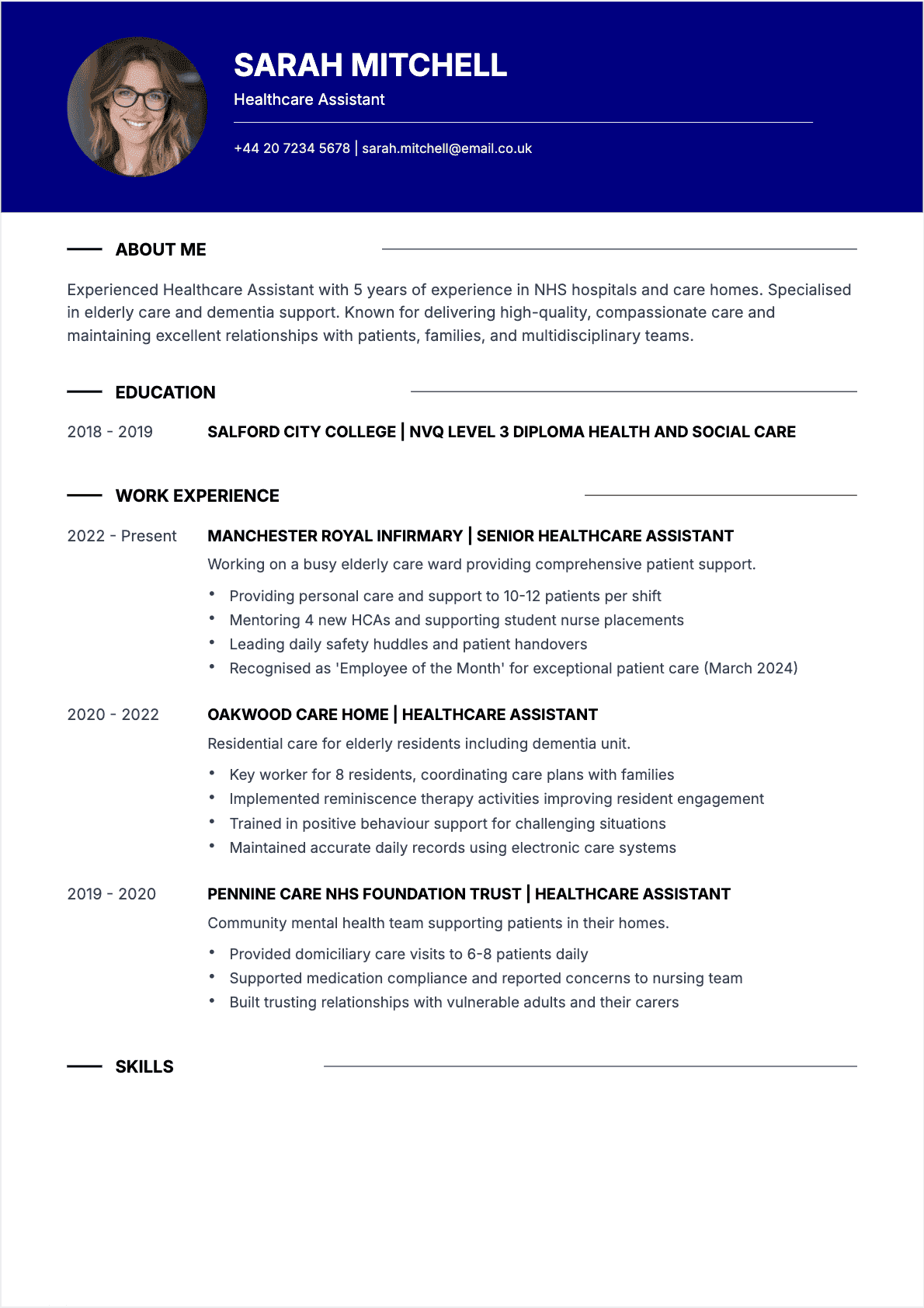
Healthcare Assistant Resume Templates
8 Templates available
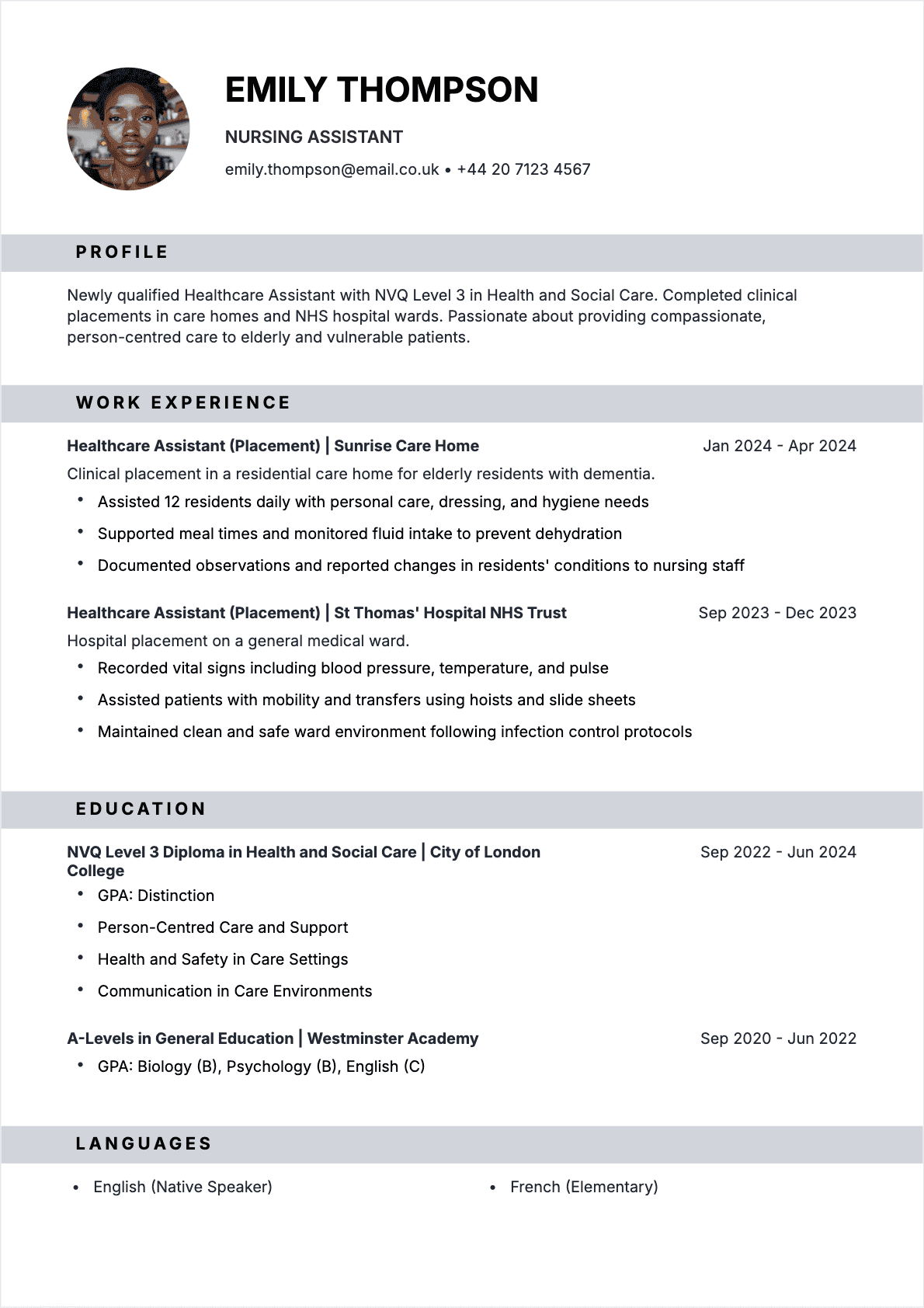
Resume Healthcare Assistant Junior
Healthcare Assistant resume template for Junior profile
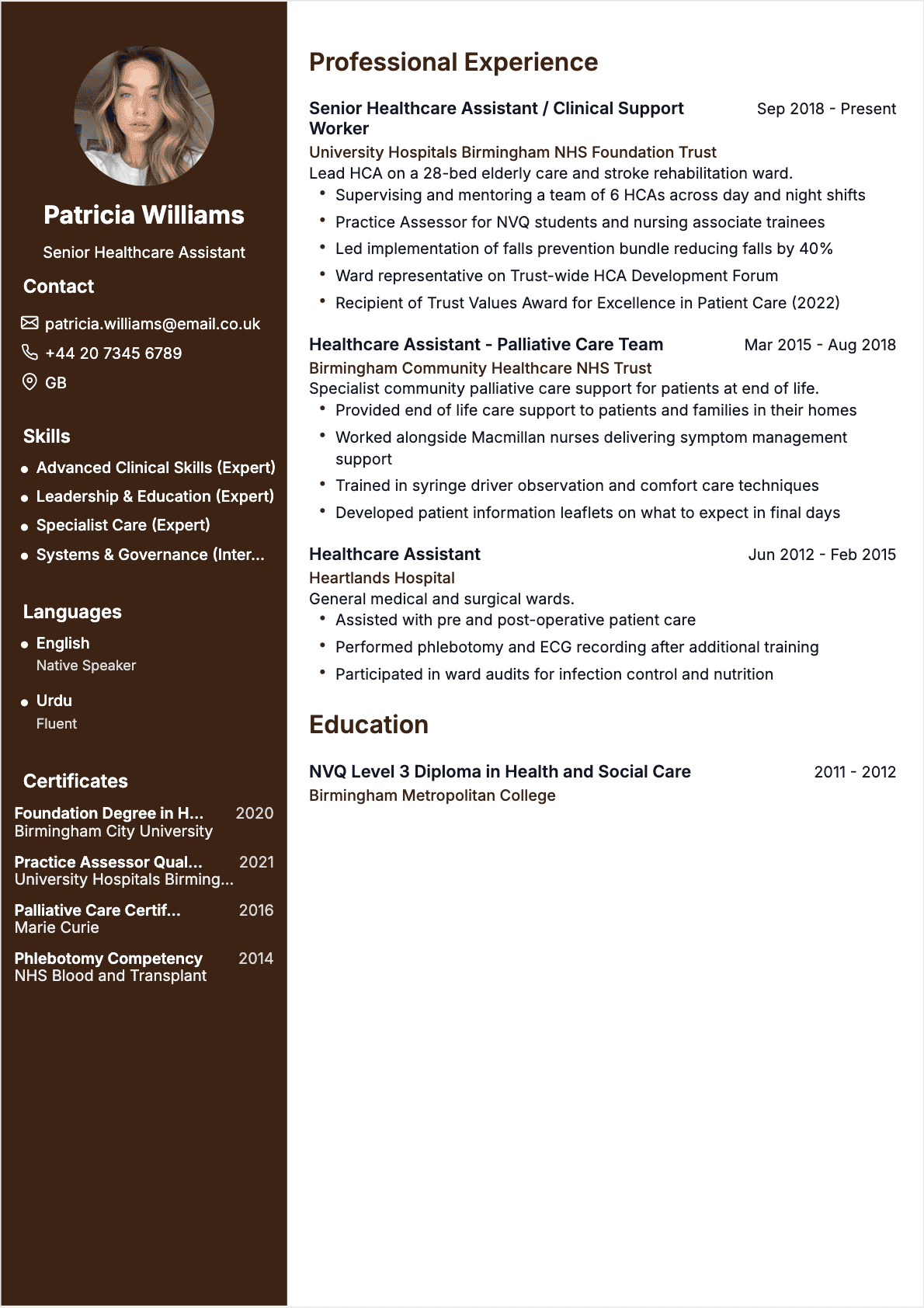
Resume Healthcare Assistant Senior
Healthcare Assistant resume template for Senior profile
Resume Healthcare Assistant Confirmé
Healthcare Assistant resume template for Confirmé profile
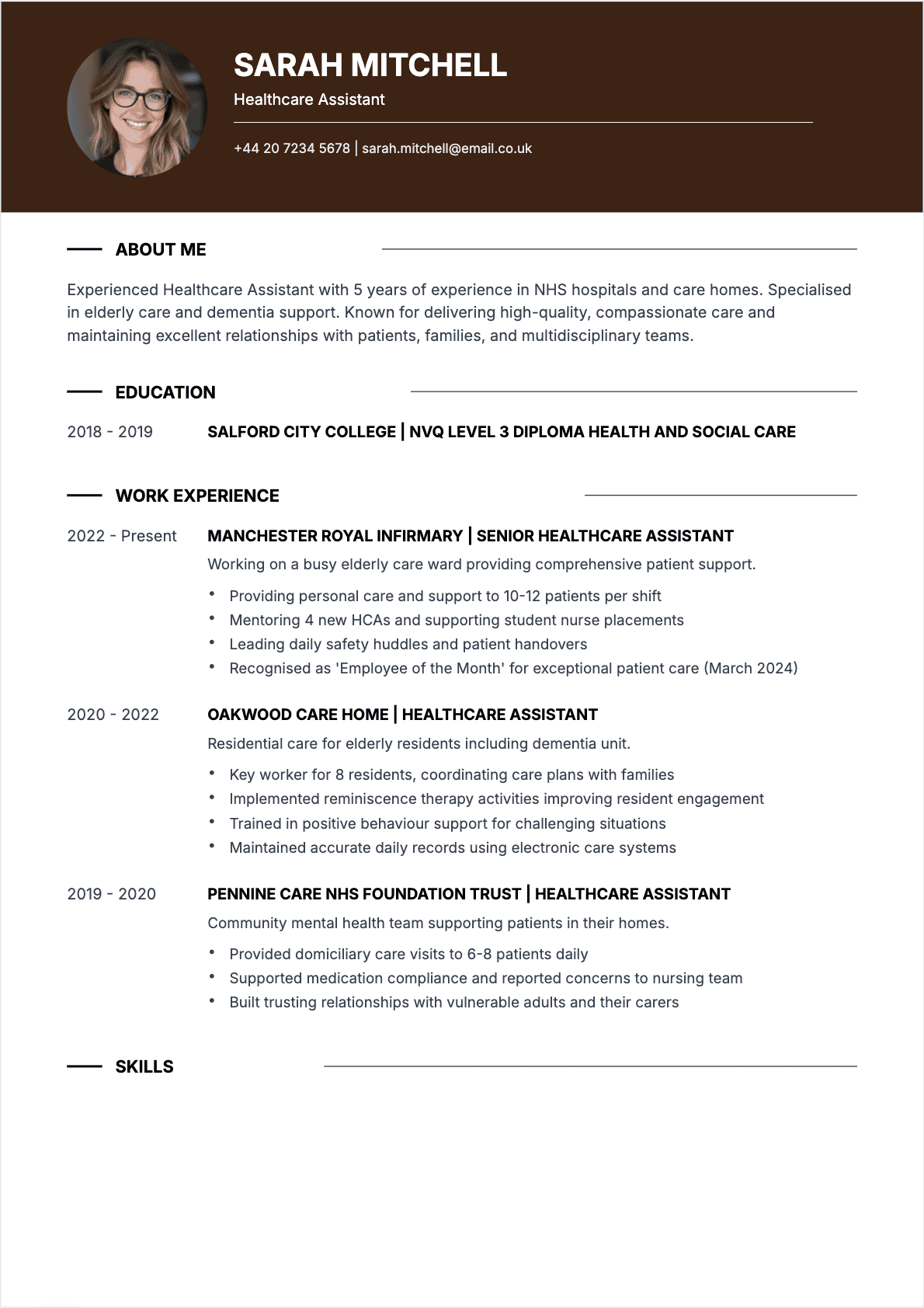
Resume Healthcare Assistant Confirmé
Healthcare Assistant resume template for Confirmé profile
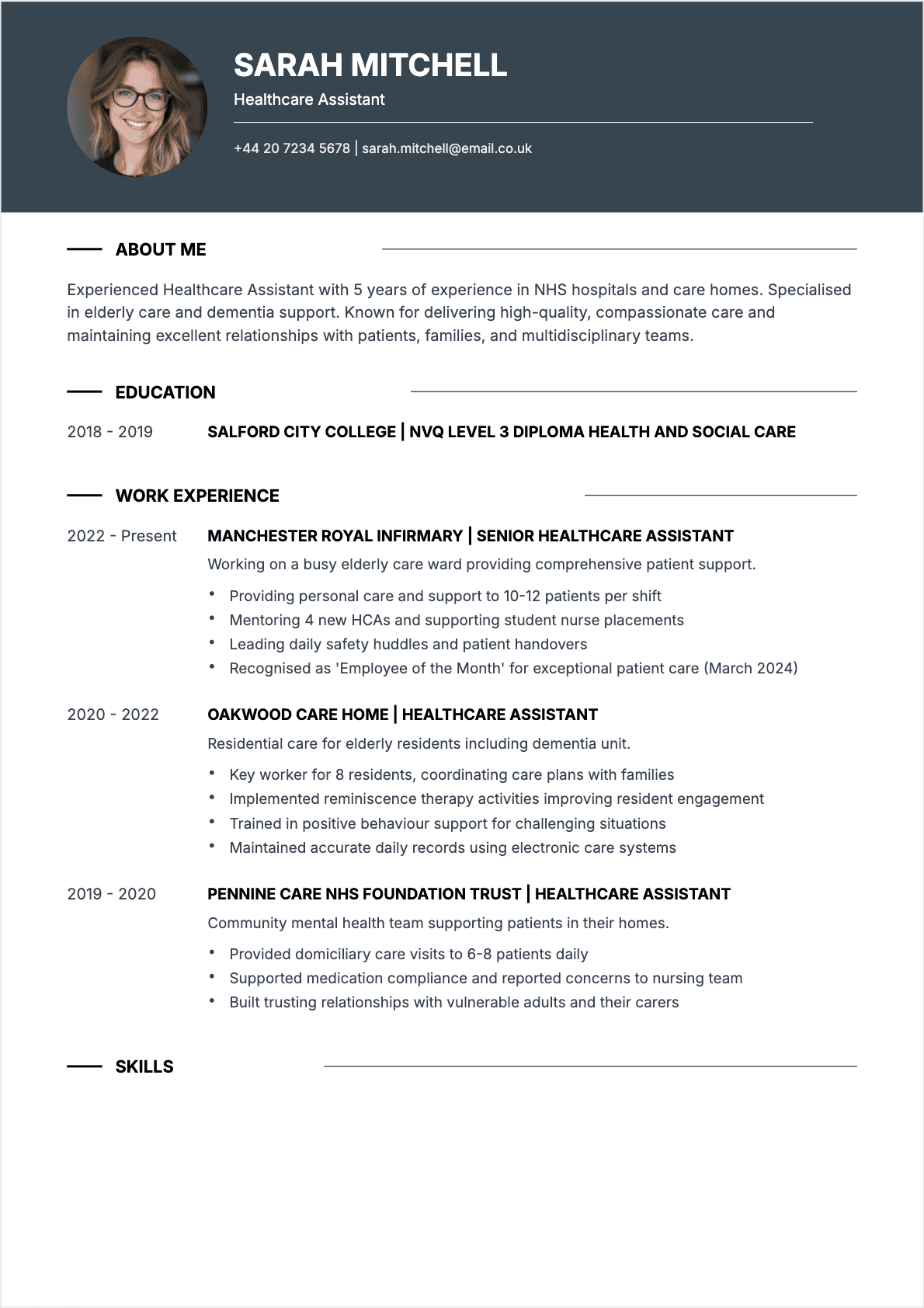
Resume Healthcare Assistant Confirmé
PopularHealthcare Assistant resume template for Confirmé profile
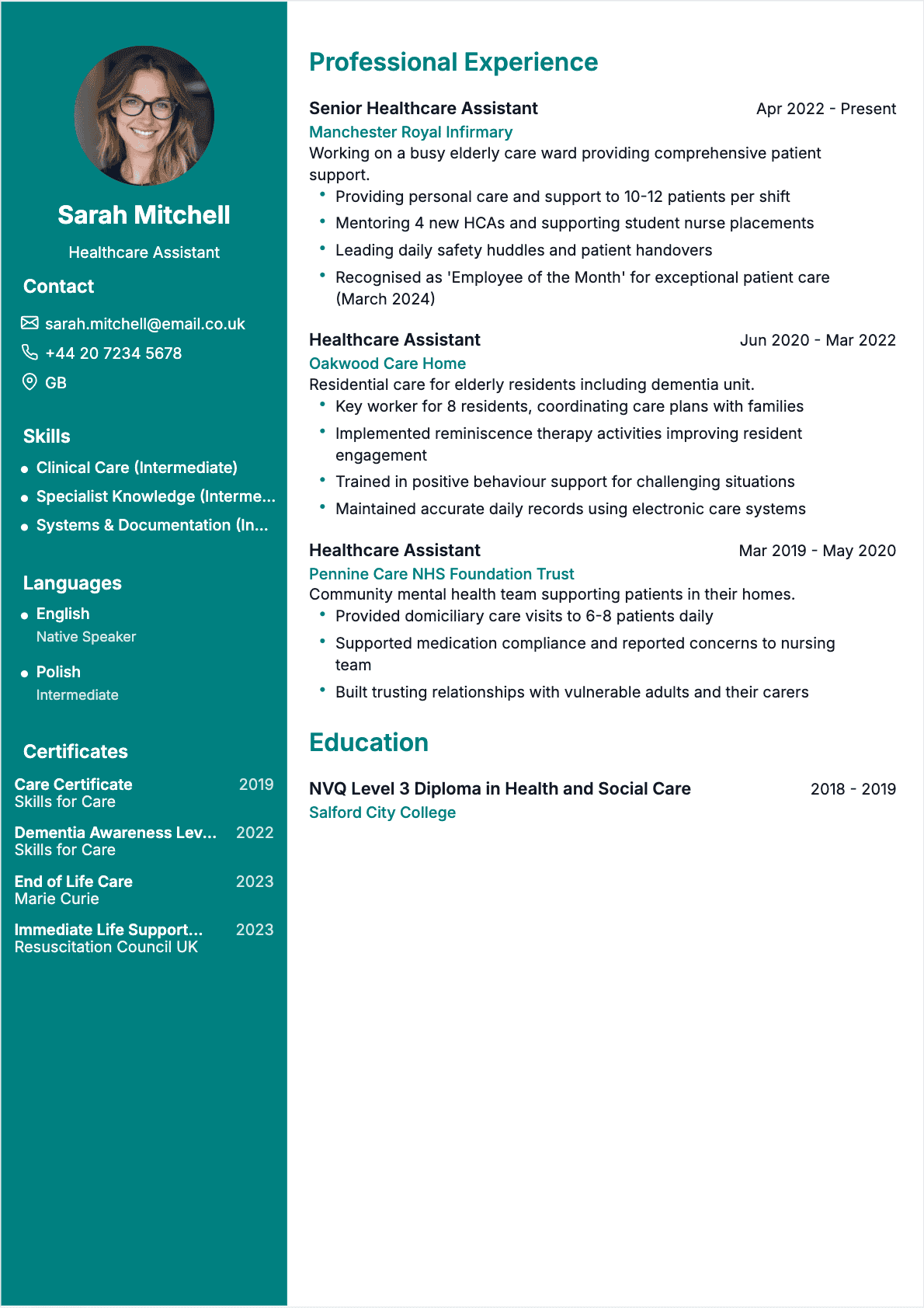
Resume Healthcare Assistant Confirmé
Healthcare Assistant resume template for Confirmé profile
Like one of these Healthcare Assistant resume templates?
Select it, fill in your details and download your resume as PDF.
Healthcare Assistant Resume Examples
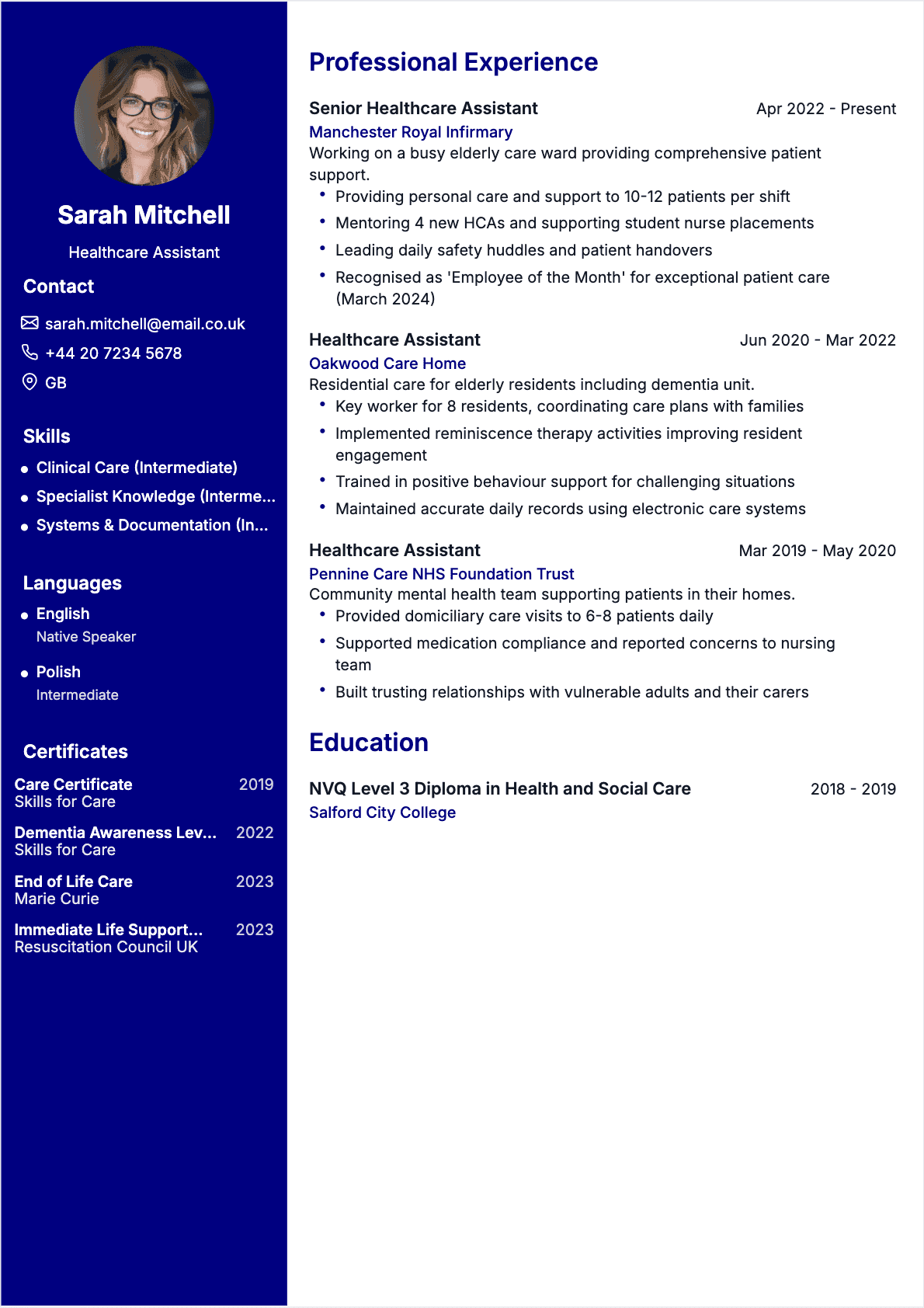
Sarah Mitchell
Healthcare Assistant
sarah.mitchell@email.co.uk
+44 20 7234 5678
Manchester, GB
Experienced Healthcare Assistant with 5 years of experience in NHS hospitals and care homes. Specialised in elderly care and dementia support. Known for delivering high-quality, compassionate care and maintaining excellent relationships with patients, families, and multidisciplinary teams.
Work Experience
Senior Healthcare Assistant
Manchester Royal Infirmary
- ●Providing personal care and support to 10-12 patients per shift
- ●Mentoring 4 new HCAs and supporting student nurse placements
- ●Leading daily safety huddles and patient handovers
Healthcare Assistant
Oakwood Care Home
- ●Key worker for 8 residents, coordinating care plans with families
- ●Implemented reminiscence therapy activities improving resident engagement
- ●Trained in positive behaviour support for challenging situations
Healthcare Assistant
Pennine Care NHS Foundation Trust
- ●Provided domiciliary care visits to 6-8 patients daily
- ●Supported medication compliance and reported concerns to nursing team
- ●Built trusting relationships with vulnerable adults and their carers
Education
NVQ Level 3 Diploma
Salford City College
Skills
Languages
English — Native Speaker
Polish — Intermediate
Certifications
Care CertificateSkills for Care
Dementia Awareness Level 3Skills for Care
End of Life CareMarie Curie
Immediate Life Support (ILS)Resuscitation Council UK
Healthcare Assistant role overview
Healthcare Assistants form the backbone of patient care in hospitals, nursing homes, GP surgeries, and community health settings. You'll spend your day providing hands-on support to patients who need help with daily activities, monitoring vital signs, and acting as a vital communication link between patients and nursing staff. The role demands physical stamina, emotional resilience, and genuine compassion as you work directly with people during vulnerable moments in their lives.
Your responsibilities extend far beyond basic care tasks. You'll be documenting patient observations, recognizing changes in condition that need escalation, maintaining infection control standards, and often providing emotional support to worried families. In many settings, you'll work as part of a multidisciplinary team that includes registered nurses, doctors, physiotherapists, and occupational therapists, contributing your observations to care planning decisions.
Career progression typically follows a clear path. Entry-level Healthcare Assistants can advance to Senior Healthcare Assistant roles within 2-3 years, taking on mentoring responsibilities and specialized care duties. From there, many pursue nursing qualifications through apprenticeship routes or university programs, while others specialize in areas like theatre support, phlebotomy, or care coordination. Some experienced assistants move into healthcare administration, training roles, or community care management.
Salary expectations vary by experience and setting. Entry-level Healthcare Assistants in the UK typically earn £20,000-£22,000 annually, while those with 2-5 years experience can expect £23,000-£26,000. Senior Healthcare Assistants with specialized skills often earn £27,000-£32,000, with additional shift allowances for nights, weekends, and bank holidays potentially adding 20-30% to base salary. NHS Band 2 positions start around £20,270, progressing to Band 3 at £22,816-£24,336.
Typical daily tasks include:
- Assisting patients with personal hygiene, dressing, toileting, and mobility while maintaining dignity and privacy
- Recording vital signs including temperature, blood pressure, pulse rate, and oxygen saturation levels
- Supporting mealtimes by helping patients eat and drink, monitoring dietary intake, and reporting concerns
- Changing bed linens, maintaining clean patient environments, and following strict infection prevention protocols
- Responding to call bells promptly, repositioning patients to prevent pressure sores, and ensuring comfort
- Documenting care activities accurately in patient records and reporting any changes in condition to qualified nurses
Essential skills for a Healthcare Assistant resume
The skills you highlight on your resume need to demonstrate both your clinical competence and your ability to provide compassionate, person-centered care. Recruiters scan for specific technical abilities that show you can perform essential care tasks safely, but they're equally interested in interpersonal skills that indicate you'll thrive in emotionally demanding situations and work effectively within a team.
For ATS optimization, prioritize exact terminology from the job description, particularly clinical skills like 'vital signs monitoring,' 'manual handling,' 'infection control,' and any specialized care areas mentioned. Many healthcare employers use applicant tracking systems that filter for mandatory qualifications like Care Certificate completion and specific care experience, so these should appear prominently in your skills section.
Core skills to include:
- Vital signs monitoring - Essential for detecting early warning signs of deterioration and providing accurate data for clinical decision-making by registered nurses and doctors
- Manual handling and mobility assistance - Demonstrates you can safely move and reposition patients using proper techniques, reducing injury risk for both patients and yourself
- Infection prevention and control - Shows understanding of hand hygiene, PPE use, and isolation procedures that prevent healthcare-associated infections
- Personal care delivery - Indicates competence in assisting with washing, dressing, toileting, and continence care while preserving patient dignity
- Patient observation and reporting - Critical for identifying changes in condition, pain levels, or behavioral concerns that need escalation to qualified staff
- Electronic patient record systems - Familiarity with systems like SystmOne, EMIS, or hospital-specific platforms shows you can document care accurately and efficiently
- Dementia care techniques - Specialized knowledge of validation therapy, distraction methods, and person-centered approaches for confused or agitated patients
- Phlebotomy - Blood collection skills significantly increase your value, especially in GP surgeries, outpatient clinics, and diagnostic units
- Catheter care and stoma management - Specialized clinical skills that qualify you for higher-band positions and more complex patient assignments
- Communication with vulnerable individuals - Ability to adapt your approach for patients with hearing loss, cognitive impairment, or language barriers
- Teamwork in clinical settings - Shows you can collaborate with nurses, therapists, and support staff during busy shifts and emergency situations
- Emotional resilience - Indicates you can maintain professional composure when dealing with distressed patients, difficult family dynamics, or end-of-life care

How to write a Healthcare Assistant resume step by step
1. Start with a targeted professional summary
Write 3-4 sentences that immediately establish your care experience level, clinical competencies, and care philosophy. Instead of 'Dedicated Healthcare Assistant seeking new opportunities,' write 'Compassionate Healthcare Assistant with 4 years experience in acute elderly care, skilled in dementia support and vital signs monitoring across 28-bed medical ward. Care Certificate qualified with additional training in catheter care and end-of-life support.'
2. Quantify your patient care impact
Healthcare recruiters want evidence of your workload capacity and care quality. Transform vague statements into measurable achievements. Replace 'Provided personal care to patients' with 'Delivered personal care to 8-12 patients per shift across mixed dependency levels, maintaining 100% compliance with dignity and privacy standards during CQC inspection.' Include patient numbers, ward sizes, dependency ratios, and any quality metrics.
3. Highlight clinical skills with context
Don't just list skills—show where and how you've applied them. Instead of 'Experienced in vital signs monitoring,' write 'Recorded vital signs for 40+ patients daily using early warning score systems, escalating 15+ deteriorating patients to nursing staff during 2024, contributing to rapid response interventions.' This demonstrates both technical ability and clinical judgment.
4. Structure your experience with PAR statements
Use the Problem-Action-Result format for bullet points. Example: 'Recognized increasing confusion and reduced mobility in post-operative patient (Problem), immediately reported observations to registered nurse and assisted with urgent medical review (Action), contributing to early diagnosis of urinary tract infection and preventing potential falls (Result).' This shows clinical reasoning, not just task completion.
5. Include your Care Certificate and mandatory training
Create a dedicated 'Qualifications & Training' section listing your Care Certificate, any NVQ/QCF qualifications, and mandatory training with completion dates. Specify modules like 'Safeguarding Adults Level 2 (renewed March 2024)' and 'Basic Life Support (current)' since these are non-negotiable requirements that ATS systems specifically scan for.
6. Demonstrate specialized experience
If you've worked in specific settings or with particular patient groups, make this explicit. Replace 'Worked in various healthcare settings' with 'Gained cross-setting experience including 2 years in learning disability residential care, 18 months in acute stroke rehabilitation, and 6 months in community palliative care, developing adaptable care approaches for diverse patient needs.'
7. Show progression and additional responsibilities
Highlight how you've grown beyond basic care duties. Include examples like 'Selected as mentor for 6 new Healthcare Assistants during 2023-2024, providing shadowing support and competency assessments' or 'Appointed link worker for infection control, delivering monthly team briefings and conducting hand hygiene audits.' This positions you for senior roles.
8. Address employment gaps honestly
If you have gaps, briefly explain them positively. 'Career break for family care responsibilities, during which I maintained clinical knowledge through online NHS training modules and volunteered with Age UK befriending service' shows commitment to the care sector even during time away.
Before and after examples:
Weak: 'Helped patients with daily activities and kept records'
Strong: 'Assisted 10-14 elderly patients daily with personal hygiene, dressing, and mobility, documenting care interventions in electronic records and contributing observations to daily nursing handovers'
Weak: 'Worked as part of a team in a busy hospital'
Strong: 'Collaborated with multidisciplinary team across 32-bed respiratory ward, supporting registered nurses during medication rounds, responding to average 45 call bells per shift, and maintaining patient safety during short-staffed periods'
Common mistakes on Healthcare Assistant resumes
Listing tasks without showing care quality or patient outcomes
Many Healthcare Assistant resumes simply list duties: 'Assisted with personal care, took observations, answered call bells.' This tells recruiters nothing about your competence level or the impact of your care. Employers want evidence that you provide safe, dignified, effective care. Instead, write 'Maintained patient safety and dignity while providing personal care to patients with varying dependency levels, receiving zero dignity-related concerns during 18-month period and positive feedback in 12 patient satisfaction surveys.'
Failing to specify clinical settings and patient populations
Writing 'Worked in healthcare for 5 years' leaves recruiters guessing about your actual experience. A Healthcare Assistant who's worked in learning disability services has very different skills from one in acute surgical wards. Be explicit: 'Provided care in 24-bed acute medical ward specializing in elderly patients with complex comorbidities including diabetes, COPD, and dementia' or 'Supported adults with profound learning disabilities and challenging behaviors in residential setting.' This helps employers assess your fit for their specific environment.
Omitting mandatory training dates and renewal status
Healthcare employers need to know your training is current. Writing 'Completed safeguarding training' without dates raises questions. Recruiters may assume your certifications have lapsed, particularly for time-sensitive requirements like Basic Life Support, which requires annual renewal. Always include: 'Basic Life Support (renewed January 2025),' 'Moving and Handling (completed November 2024),' 'Safeguarding Adults Level 2 (current).' This prevents your application being filtered out for non-compliance.
Using medical jargon incorrectly or inconsistently
Some candidates overuse abbreviations or clinical terms incorrectly, which immediately signals inexperience to healthcare recruiters. Don't write 'Performed obs on pts and reported to RN' when you mean 'Recorded patient vital signs including BP, pulse, temperature, and SpO2, reporting findings to registered nurses.' Use professional terminology correctly, but don't sacrifice clarity. If you mention specific procedures like 'catheter care,' briefly indicate what this involved: 'provided catheter care including monitoring output, maintaining hygiene, and identifying signs of infection.'
Neglecting to mention Care Certificate or equivalent qualifications
The Care Certificate became the minimum standard for healthcare support workers in 2015, yet some resumes bury this qualification or omit it entirely. Since many employers filter applications based on this mandatory requirement, it should appear prominently in both your summary and qualifications section. If you completed your training before 2015, mention equivalent qualifications: 'NVQ Level 2 in Health and Social Care (pre-dates Care Certificate introduction)' or 'Completed induction training aligned with Care Certificate standards.'
Writing generic care statements that could apply to any support role
Phrases like 'Provided excellent customer service' or 'Helped people with their needs' sound more like retail than healthcare. Healthcare recruiters want clinical specificity. Replace 'Supported clients with daily living' with 'Assisted patients with personal hygiene using appropriate infection control measures, supported safe eating and drinking for dysphagia patients following SALT guidelines, and facilitated mobility using walking aids and transfer equipment.' This demonstrates genuine healthcare knowledge.
Ignoring shift patterns and work environment demands
Healthcare operates 24/7, and employers need staff willing to work unsociable hours. If you have experience with night shifts, weekends, or on-call work, mention it: 'Worked rotating shift pattern including nights, weekends, and bank holidays across 12-hour shifts in fast-paced acute environment.' If you're only available for specific hours, address this in your cover letter rather than leaving employers to discover scheduling conflicts later. Flexibility is highly valued, so if you can offer it, make it clear.
Healthcare Assistant resume trends in 2026
The healthcare sector faces unprecedented staffing pressures, creating significant opportunities for Healthcare Assistants while also raising expectations for skills and qualifications. NHS England reported over 40,000 nursing and support staff vacancies in 2024, pushing employers to offer enhanced training packages, career development pathways, and improved pay to attract and retain Healthcare Assistants. Your resume should position you as someone ready to grow with the organization, not just fill an immediate gap.
Digital health literacy has become essential rather than optional. Healthcare Assistants now regularly use electronic patient record systems, digital vital signs monitors that automatically upload data, medication management apps, and video consultation platforms for remote patient monitoring. Employers increasingly expect familiarity with technology, so highlight any experience with clinical software systems, even basic competence with tablets or smartphones used for care documentation. Mentioning specific systems like SystmOne, EMIS Web, or hospital-specific platforms gives you an immediate advantage.
Specialized care skills command premium salaries and better career prospects. The aging population has created surging demand for Healthcare Assistants with dementia care expertise, end-of-life care experience, and mental health support skills. Additional clinical competencies like phlebotomy, ECG recording, or catheter care can increase your earning potential by £2,000-£4,000 annually and open doors to Band 3 positions. If you've completed any specialist training modules beyond the Care Certificate, feature these prominently—employers are actively recruiting for these capabilities.
The apprenticeship route into nursing has transformed career pathways for Healthcare Assistants. Nursing degree apprenticeships allow you to train as a registered nurse while working and earning, with employers covering tuition fees. Many NHS trusts and private healthcare providers now actively encourage Healthcare Assistants to pursue this route, offering guaranteed positions upon qualification. If you're interested in nursing progression, mention this in your professional summary: 'Seeking Healthcare Assistant position with nursing apprenticeship opportunities to develop clinical skills while working toward RN qualification.' This signals ambition and long-term commitment.
Infection prevention and control expertise gained new prominence post-pandemic and remains a top priority. Healthcare Assistants who can demonstrate thorough understanding of PPE protocols, isolation procedures, and outbreak management are particularly valued. If you worked through COVID-19, quantify your experience: 'Maintained infection control standards during COVID-19 pandemic, including proper donning and doffing of PPE, supporting isolation protocols for 20+ positive patients, and achieving zero cross-contamination incidents during 18-month period.' This experience translates directly to managing other infectious diseases.
Remote and hybrid work is emerging in unexpected areas of healthcare support. While hands-on patient care requires physical presence, some Healthcare Assistants now work in telephone triage support, remote patient monitoring for chronic conditions, or virtual ward coordination. These roles typically require 2-3 years of clinical experience plus strong communication skills. If you're interested in these emerging opportunities, emphasize your patient communication abilities and any experience with telephone support or health coaching.
Values-based recruitment has replaced purely competency-focused hiring in many healthcare organizations. Employers increasingly assess whether candidates align with organizational values like compassion, respect, and person-centered care during interviews. Your resume should provide evidence of these values in action: 'Recognized by patient feedback as 'always taking time to listen' and 'making me feel like a person, not just a patient'' or 'Volunteered to support activities coordinator in organizing weekly social events, improving patient wellbeing scores by 23% over 6-month period.' These examples demonstrate care quality beyond clinical tasks.
Further reading:
Frequently asked questions
Find answers to the most frequently asked questions.
Often optional, but useful when you’re changing settings (e.g., home care to hospital) or have employment gaps. Keep it to 150–250 words, reference the job description, and add 2 quantified examples (patients/shift, documentation accuracy, safety outcomes). If the posting requests it, submit one.
Copy the posting into a notes doc, highlight repeated terms (unit type, EHR, ADLs, dementia care, transfers), and reflect those exact phrases where truthful. Then reorder bullets so the most relevant responsibilities and achievements appear first. This helps both ATS scoring and human scanning.
Lead with education and clinical experience: CNA program, clinical hours, skills check-offs, and supervised rotations. Add healthcare-adjacent roles (caregiver, dietary aide) with numbers (clients/week, tasks/shift). Use a short resume objective, and include certifications (CNA, BLS) at the top.
In the US, a resume is the standard and is usually 1 page; a CV is longer and more common in academia. If an employer asks for a nursing assistant cv, you can still use a one-page resume format, but add optional sections like training hours, volunteer work, and extra courses if relevant.
Most nursing assistant resumes should be 1 page for 0–7 years. If you have 8–10+ years, multiple facilities, and specialized units (rehab, memory care), 2 pages can be acceptable—only if every bullet is relevant, quantified, and tailored to the posting.
Start with your Certified Nursing Assistant credential (state registry). Add BLS (AHA) if you have it, plus facility-relevant training like dementia care (NCCAP CDP), HIPAA, and OSHA Bloodborne Pathogens. List the issuing organization and expiration dates to reduce compliance questions.
Your career deserves a better resume
With CVtoWork, select a template, fill in the fields and download your resume as PDF.
Start creating