DevOps Engineer Resume
Example, Template & Expert Tips 2026
Updated on April 18, 2026.
Build a DevOps Engineer CV for 2026 with ATS keywords, quantified achievements, and proven sections to pass screening and win interviews.
DevOps Engineer Resume Templates
8 Templates available
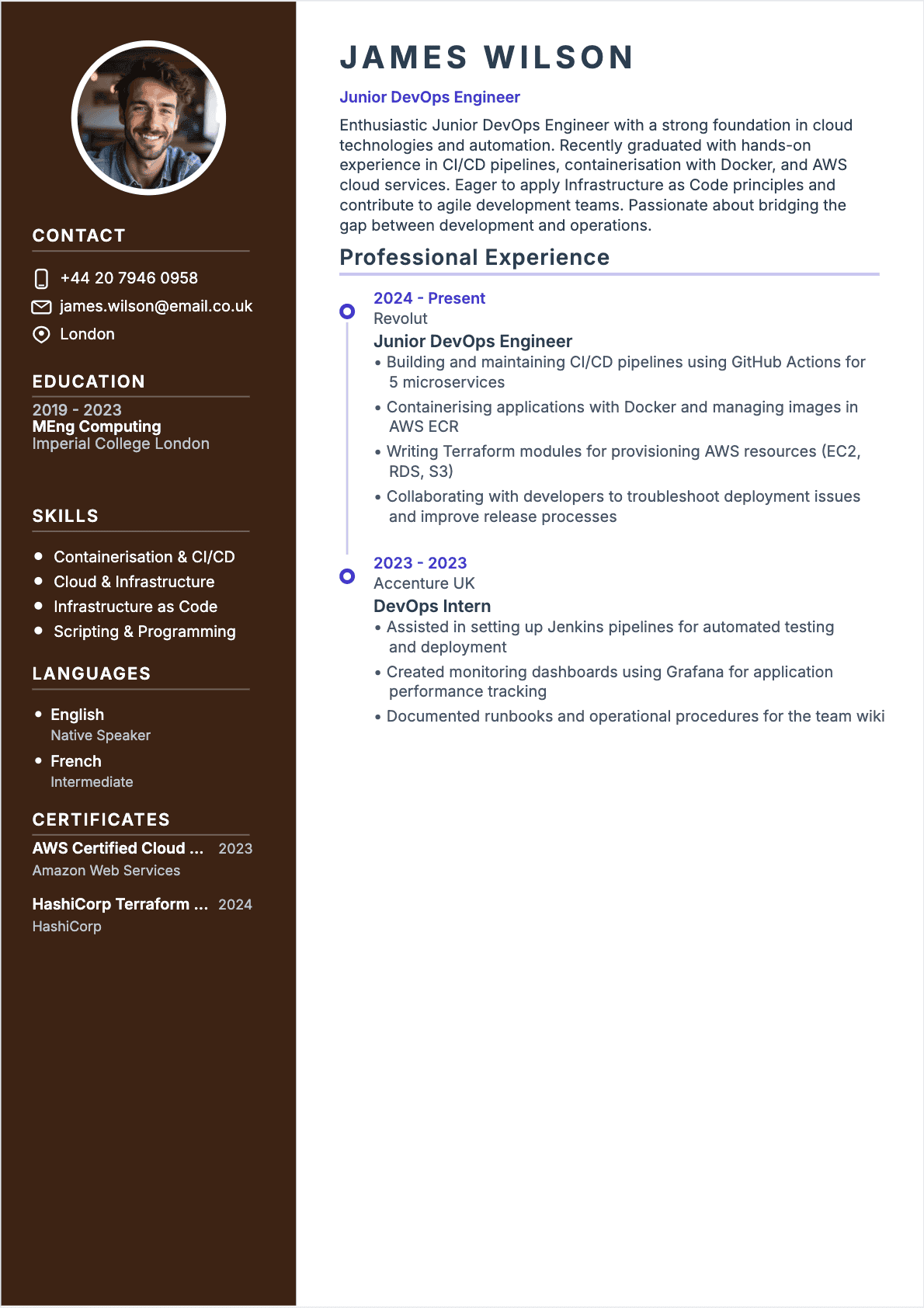
Resume DevOps Engineer Junior
DevOps Engineer resume template for Junior profile
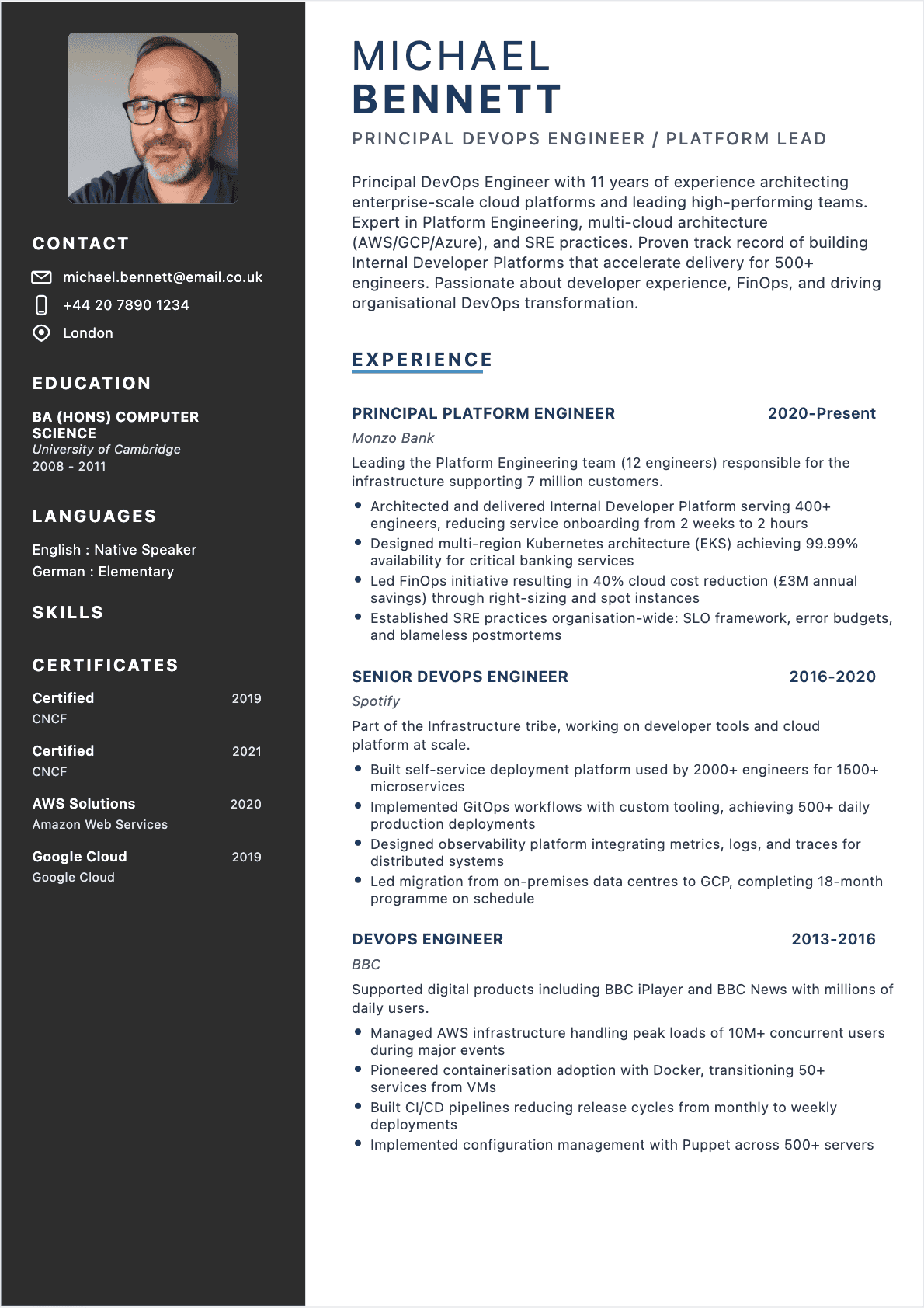
Resume DevOps Engineer Senior
DevOps Engineer resume template for Senior profile
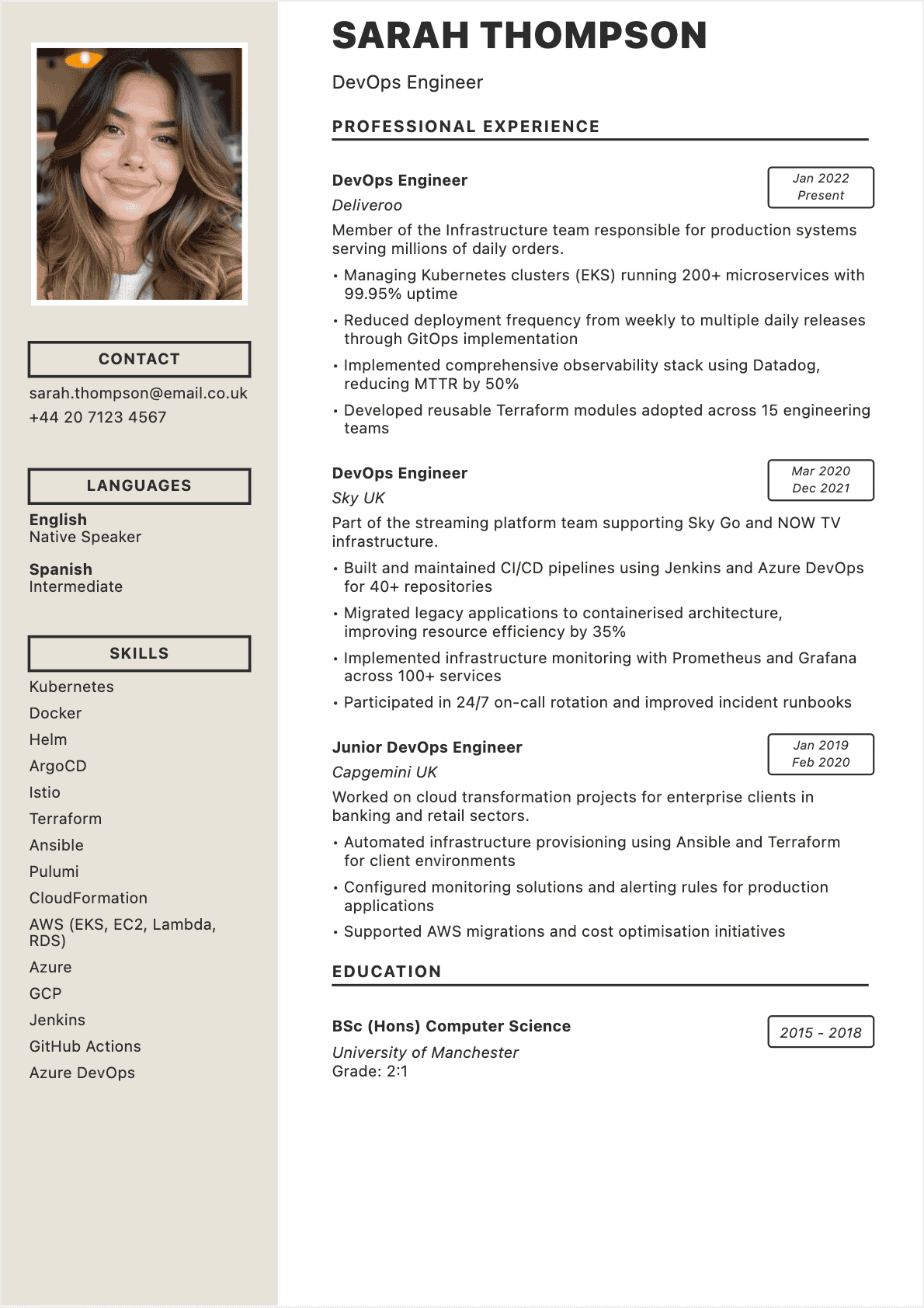
Resume DevOps Engineer Confirmé
DevOps Engineer resume template for Confirmé profile
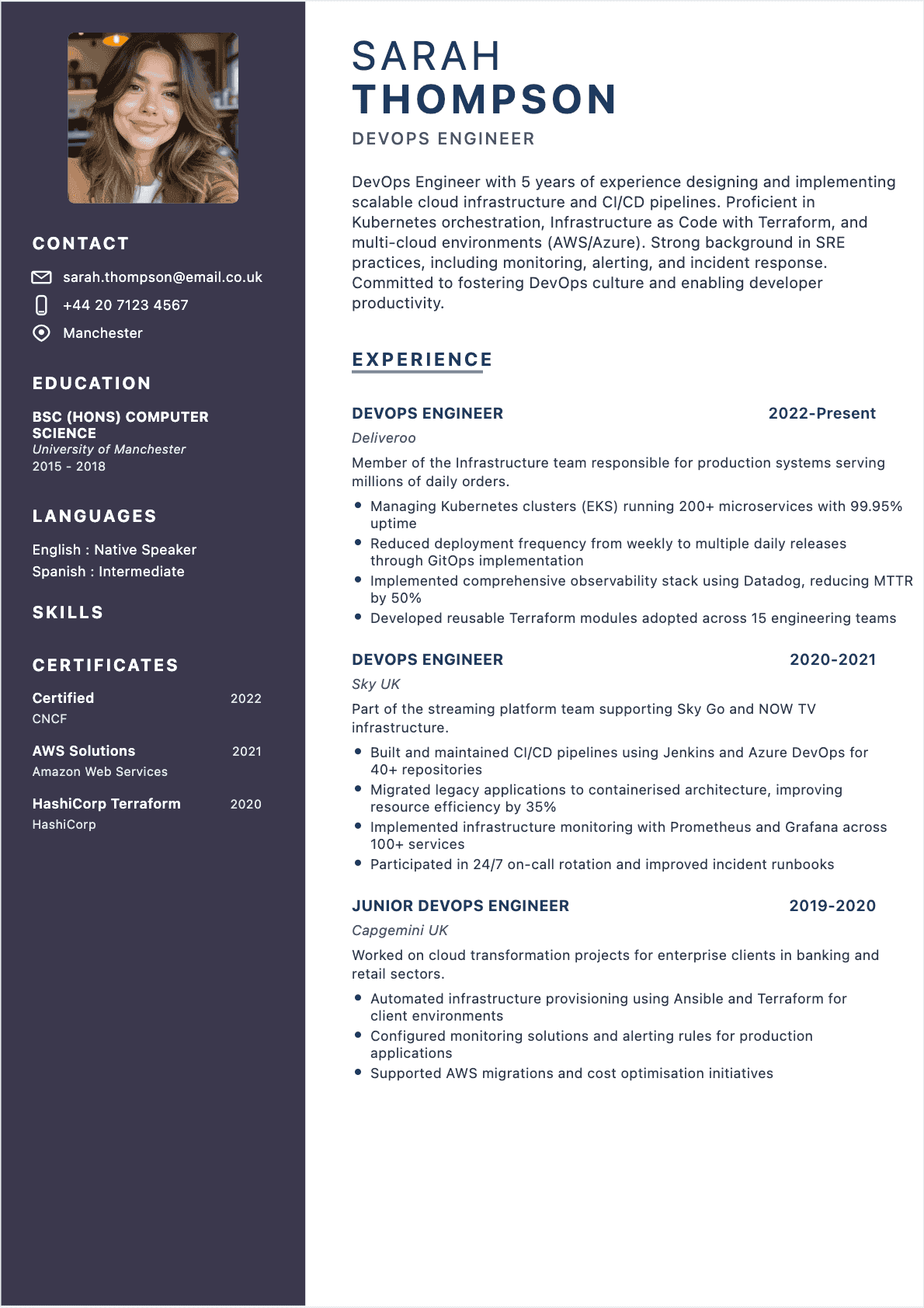
Resume DevOps Engineer Confirmé
DevOps Engineer resume template for Confirmé profile
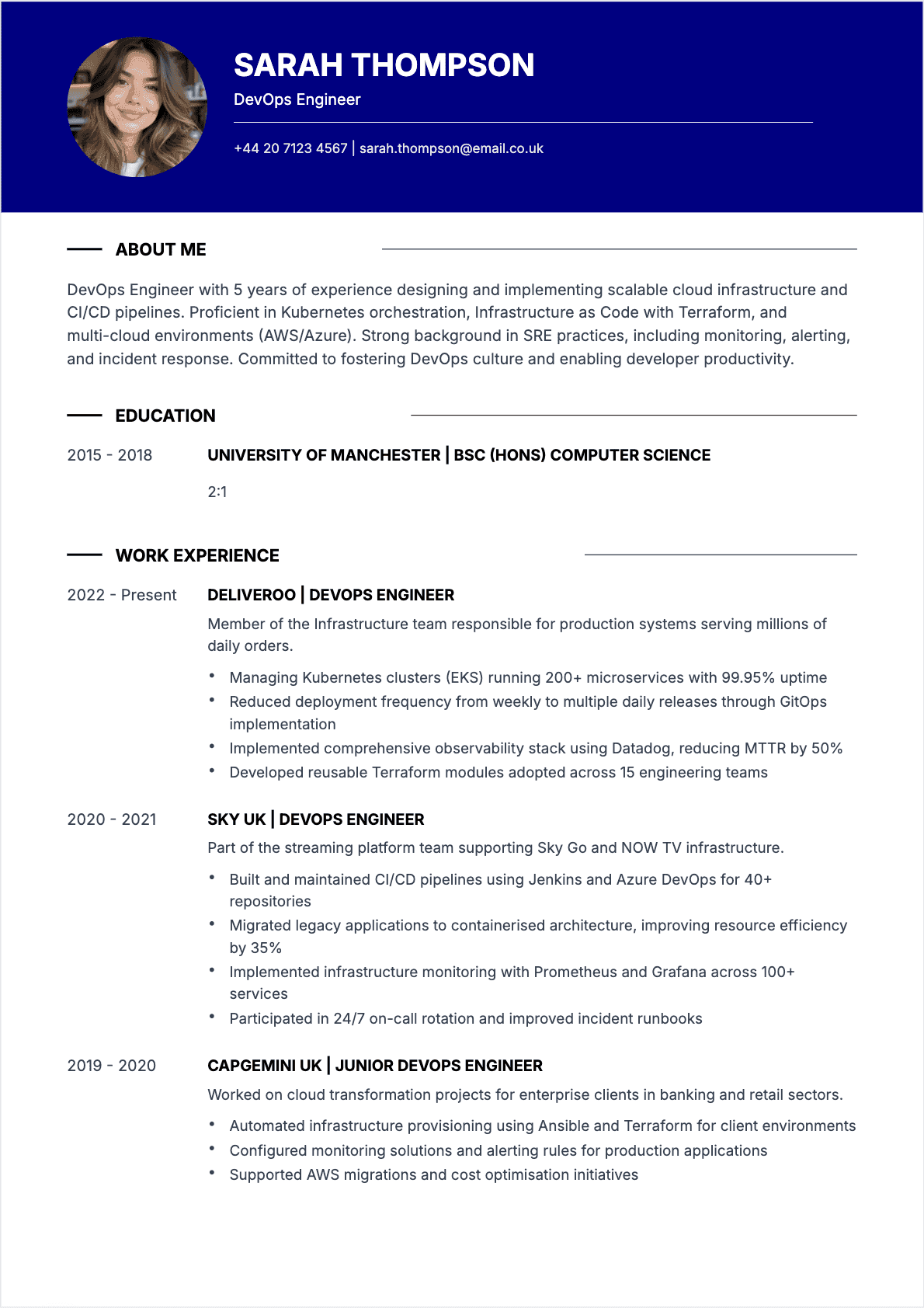
Resume DevOps Engineer Confirmé
DevOps Engineer resume template for Confirmé profile
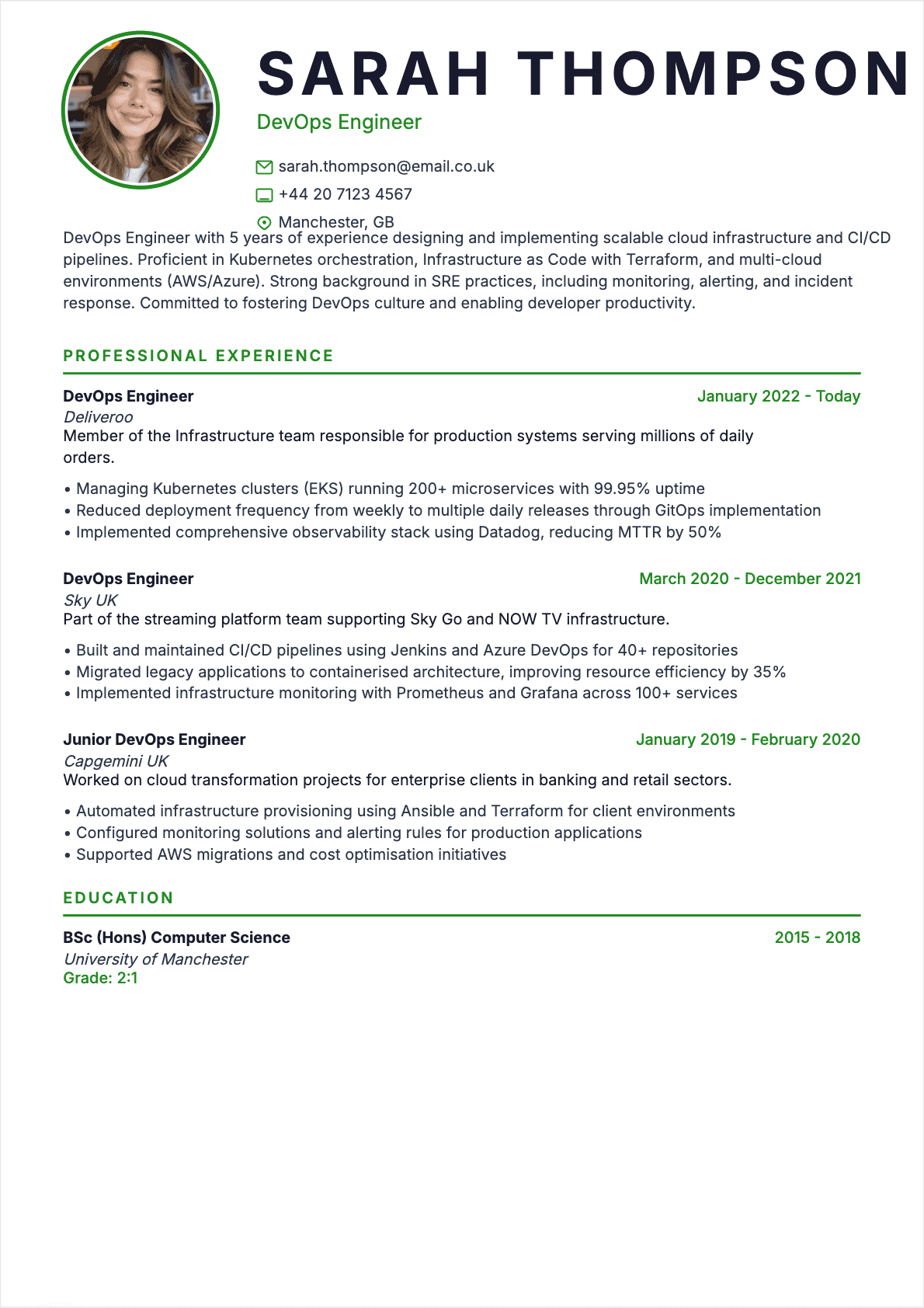
Resume DevOps Engineer Confirmé
DevOps Engineer resume template for Confirmé profile
Like one of these DevOps Engineer resume templates?
Select it, fill in your details and download your resume as PDF.
DevOps Engineer Resume Examples
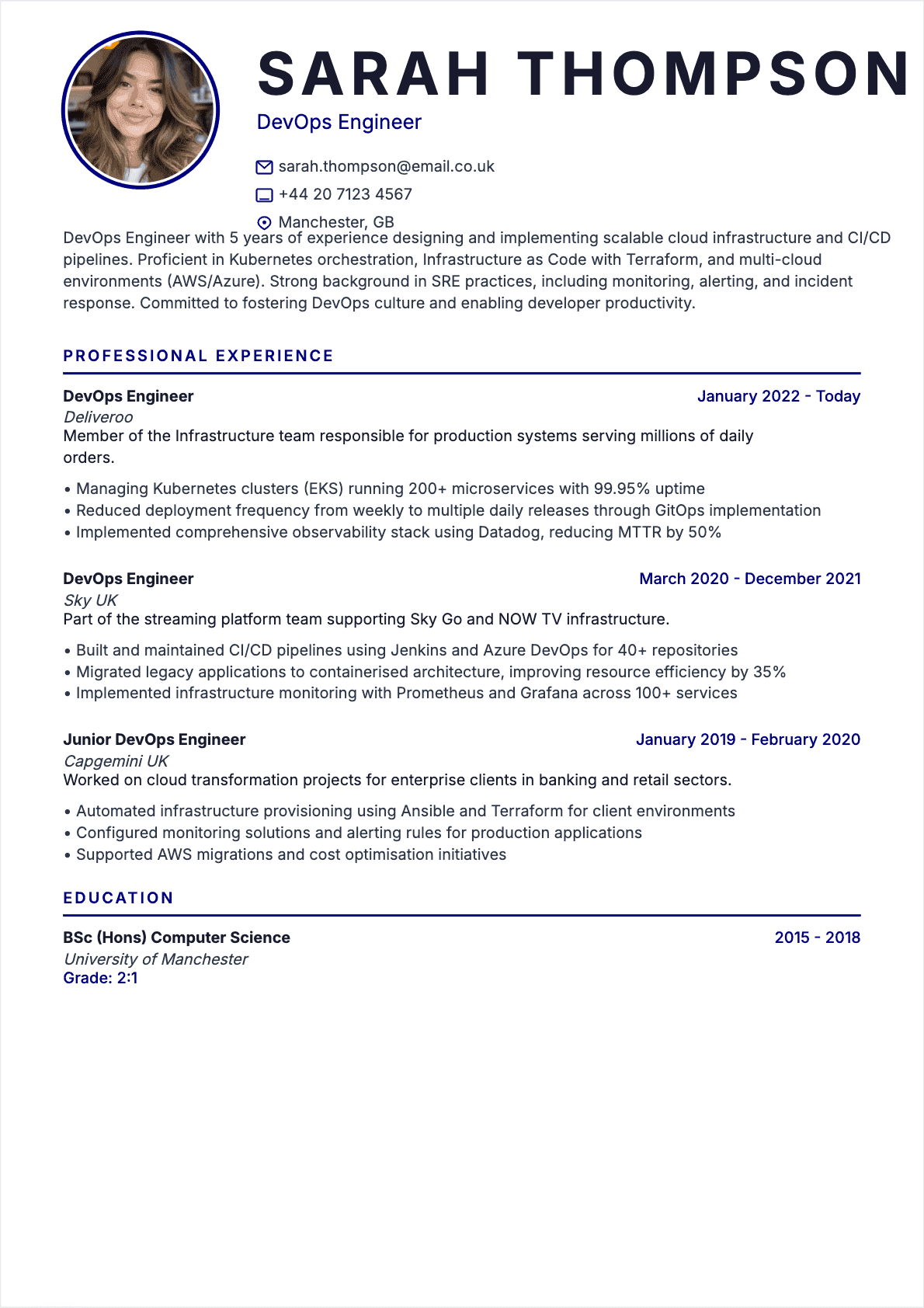
Sarah Thompson
DevOps Engineer
sarah.thompson@email.co.uk
+44 20 7123 4567
Manchester, GB
DevOps Engineer with 5 years of experience designing and implementing scalable cloud infrastructure and CI/CD pipelines. Proficient in Kubernetes orchestration, Infrastructure as Code with Terraform, and multi-cloud environments (AWS/Azure). Strong background in SRE practices, including monitoring, alerting, and incident response. Committed to fostering DevOps culture and enabling developer productivity.
Work Experience
DevOps Engineer
Deliveroo
- ●Managing Kubernetes clusters (EKS) running 200+ microservices with 99.95% uptime
- ●Reduced deployment frequency from weekly to multiple daily releases through GitOps implementation
- ●Implemented comprehensive observability stack using Datadog, reducing MTTR by 50%
DevOps Engineer
Sky UK
- ●Built and maintained CI/CD pipelines using Jenkins and Azure DevOps for 40+ repositories
- ●Migrated legacy applications to containerised architecture, improving resource efficiency by 35%
- ●Implemented infrastructure monitoring with Prometheus and Grafana across 100+ services
Junior DevOps Engineer
Capgemini UK
- ●Automated infrastructure provisioning using Ansible and Terraform for client environments
- ●Configured monitoring solutions and alerting rules for production applications
- ●Supported AWS migrations and cost optimisation initiatives
Education
BSc (Hons)
University of Manchester
Skills
Languages
English — Native Speaker
Spanish — Intermediate
Certifications
Certified Kubernetes Administrator (CKA)CNCF
AWS Solutions Architect AssociateAmazon Web Services
HashiCorp Terraform AssociateHashiCorp
DevOps Engineer role overview
A DevOps Engineer bridges the gap between software development and IT operations, creating automated systems that allow organizations to deploy code faster, more reliably, and with fewer manual interventions. You'll spend your days building CI/CD pipelines, managing cloud infrastructure, monitoring system performance, and collaborating with development teams to ensure their applications run smoothly in production environments. This role requires both deep technical knowledge and strong communication skills, as you'll constantly translate between developer needs and operational constraints.
The daily work involves writing infrastructure-as-code, troubleshooting deployment failures, optimizing cloud costs, and responding to production incidents. You'll work with containerization technologies like Docker and Kubernetes, configure monitoring and alerting systems, and implement security best practices across the entire software delivery lifecycle. Many DevOps Engineers also participate in on-call rotations, where you're responsible for maintaining system uptime and responding to critical issues outside regular business hours.
Career progression typically starts with a Junior DevOps Engineer or Site Reliability Engineer position, where you'll focus on maintaining existing infrastructure and learning automation tools. Mid-level engineers design and implement new infrastructure solutions, mentor junior team members, and take ownership of specific systems or services. Senior DevOps Engineers and Principal Engineers architect entire platform strategies, make technology decisions that affect the whole organization, and often move into leadership roles like DevOps Team Lead, Platform Engineering Manager, or Chief Technology Officer.
Salary ranges vary significantly by experience and location. In the United States, Junior DevOps Engineers typically earn $75,000-$95,000 annually, mid-level engineers command $100,000-$140,000, and senior engineers with 7+ years of experience earn $145,000-$200,000 or more. In the UK, expect £45,000-£60,000 for junior roles, £65,000-£90,000 for mid-level positions, and £95,000-£140,000 for senior engineers. Major tech hubs like San Francisco, London, and Amsterdam typically offer 20-30% higher compensation than these averages.
Typical daily tasks for a DevOps Engineer:
- Review and merge infrastructure code changes, ensuring they follow security and reliability standards before deployment
- Monitor system metrics and logs to identify performance bottlenecks, cost optimization opportunities, or potential failures
- Automate repetitive operational tasks by writing scripts in Python, Bash, or Go that reduce manual work for the team
- Collaborate with developers to troubleshoot deployment issues, optimize application performance, or design scalable architectures
- Maintain and upgrade CI/CD pipelines to incorporate new testing frameworks, security scanning tools, or deployment strategies
- Participate in incident response, investigating root causes of outages and implementing preventive measures to avoid recurrence
Essential skills for a DevOps Engineer resume
Your resume needs to demonstrate both breadth and depth in technical skills while showing you understand how these tools serve business objectives. Recruiters scan for specific technologies their teams already use, but they also value engineers who can learn new tools quickly and choose the right technology for each problem. The skills you emphasize should match the job description closely, as most companies use Applicant Tracking Systems that filter candidates based on keyword matches before any human reviews your application.
Technical skills matter most for passing initial screening, but soft skills determine whether you'll succeed in the role. DevOps requires constant collaboration with developers, product managers, and other stakeholders who may not understand infrastructure complexities. Your ability to explain technical concepts clearly, manage competing priorities, and stay calm during production incidents often matters more than knowing every cloud service by heart.
Core skills to include on your DevOps Engineer resume:
- Cloud platforms (AWS, Azure, or GCP): Most organizations run on cloud infrastructure, and you need hands-on experience provisioning resources, managing costs, and understanding service limitations specific to at least one major provider.
- Container orchestration (Kubernetes, Docker Swarm): Containers have become the standard deployment method, and Kubernetes expertise is now expected for most mid-level and senior positions across the industry.
- Infrastructure-as-Code (Terraform, CloudFormation, Pulumi): Writing infrastructure as code ensures consistency, enables version control, and allows teams to replicate environments reliably, making this skill essential for modern DevOps work.
- CI/CD tools (Jenkins, GitLab CI, GitHub Actions, CircleCI): You'll spend significant time building and maintaining deployment pipelines, so demonstrating experience with popular CI/CD platforms is critical for passing ATS screening.
- Scripting languages (Python, Bash, Go): Automation requires writing custom scripts for tasks that existing tools can't handle, and Python has become the de facto standard for DevOps automation work.
- Configuration management (Ansible, Chef, Puppet): While containers have reduced the need for these tools, many organizations still manage virtual machines and bare-metal servers that require configuration automation.
- Monitoring and observability (Prometheus, Grafana, Datadog, New Relic): You can't improve what you don't measure, and modern DevOps requires deep understanding of metrics, logs, and distributed tracing to maintain reliable systems.
- Version control (Git, GitHub, GitLab): Every aspect of DevOps work involves version control, from infrastructure code to pipeline configurations, making Git proficiency absolutely fundamental.
- Linux system administration: Most production systems run on Linux, so you need comfort with command-line operations, system troubleshooting, networking concepts, and security hardening practices.
- Security practices (SAST, DAST, secrets management, compliance): DevSecOps has become standard practice, and you're expected to integrate security scanning, manage credentials properly, and understand compliance requirements like SOC 2 or GDPR.
- Problem-solving under pressure: Production incidents require quick thinking, systematic troubleshooting, and the ability to coordinate multiple teams while keeping stakeholders informed about progress and impact.
- Communication and documentation: You'll need to explain complex technical decisions to non-technical stakeholders, write clear runbooks for on-call engineers, and document architecture decisions that affect multiple teams.
For ATS optimization, prioritize skills mentioned in the job description and use exact terminology from the posting. If they write 'AWS', don't substitute 'Amazon Web Services'. Include both acronyms and full names where space allows, such as 'CI/CD (Continuous Integration/Continuous Deployment)' to catch different keyword variations.

How to write a DevOps Engineer resume step by step
1. Start with a targeted professional summary that highlights your infrastructure impact
Write 3-4 sentences that immediately show your specialization and quantified achievements. Focus on business outcomes like deployment frequency improvements, cost reductions, or uptime increases rather than listing technologies. For example: 'DevOps Engineer with 5 years of experience building cloud infrastructure that reduced deployment time from 4 hours to 12 minutes while cutting AWS costs by 34%. Specialized in Kubernetes orchestration, Terraform automation, and implementing observability solutions for microservices architectures serving 2M+ daily users.'
2. Quantify every achievement with metrics that matter to businesses
DevOps work generates measurable results, so include specific numbers for deployment frequency, system uptime, cost savings, performance improvements, and team productivity gains. Instead of 'Implemented CI/CD pipeline', write 'Built GitLab CI/CD pipeline that increased deployment frequency from weekly to 40+ times per day while reducing failed deployments by 67%'. Instead of 'Managed Kubernetes clusters', write 'Managed 12 production Kubernetes clusters across 3 AWS regions supporting 200+ microservices with 99.97% uptime SLA'.
3. Structure your experience section with technology-first bullet points
Start each bullet point with the technology or tool you used, followed by the action and result. This format helps ATS systems identify your skills while showing recruiters exactly what you can do. Format: '[Technology] + [Action] + [Measurable Result]'. Example: 'Terraform: Automated infrastructure provisioning across 50+ AWS accounts, reducing environment setup time from 3 days to 45 minutes and eliminating configuration drift issues.' This structure works better than traditional action-verb-first bullets for technical roles.
4. Create a dedicated Technical Skills section organized by category
Group your skills into clear categories like Cloud Platforms, Container Technologies, CI/CD Tools, Monitoring & Logging, Scripting Languages, and Infrastructure-as-Code. List your proficiency level (Expert, Advanced, Intermediate) only if you have genuinely different skill levels, otherwise recruiters assume you're proficient in everything listed. Place this section near the top of your resume, as recruiters often scan for technical skills before reading your experience in detail.
5. Include relevant certifications with expiration dates
DevOps certifications like AWS Certified DevOps Engineer, Certified Kubernetes Administrator (CKA), or HashiCorp Certified Terraform Associate demonstrate commitment to professional development and validate your skills. List the full certification name, issuing organization, and date earned. If a certification expires, include the expiration date to show it's current. Many companies filter candidates based on specific certifications, especially for government or enterprise contracts that require them.
6. Highlight cross-functional collaboration and incident response experience
DevOps success depends on working effectively with development teams, product managers, and security teams. Include bullets that show collaboration: 'Partnered with 8 development teams to migrate 45 applications from monolithic architecture to containerized microservices, reducing average deployment time by 78%'. Also mention on-call experience and incident response: 'Participated in 24/7 on-call rotation, achieving 15-minute mean time to response and resolving 94% of incidents within SLA targets'.
7. Add a Projects or Key Initiatives section for significant migrations or implementations
Major infrastructure projects deserve their own section, especially cloud migrations, Kubernetes implementations, or platform builds that took months. Format each project with: Project Name, Duration, Technologies Used, and 2-3 bullet points describing scope and impact. Example: 'AWS Cloud Migration (8 months) - Led migration of 120 applications from on-premises data center to AWS, resulting in $400K annual infrastructure cost savings and 99.95% uptime improvement. Technologies: AWS, Terraform, Docker, Jenkins.'
8. Tailor your resume for each application by mirroring job description language
Copy the exact terminology from the job posting. If they say 'GitLab CI/CD', don't write 'GitLab pipelines'. If they emphasize 'cost optimization', include specific examples of how you reduced cloud spending. Rearrange your bullet points to prioritize experience that matches their requirements. This takes 10-15 minutes per application but dramatically increases your ATS match score and shows recruiters you've read their posting carefully.
Before/After Examples:
Before: 'Responsible for managing cloud infrastructure and ensuring system reliability'
After: 'Managed AWS infrastructure across 8 production accounts supporting 500K daily active users, maintaining 99.96% uptime while reducing monthly costs from $85K to $62K through reserved instance optimization and auto-scaling policies'
Before: 'Worked with Docker and Kubernetes to deploy applications'
After: 'Kubernetes: Designed and deployed production-grade EKS clusters with automated scaling, monitoring, and disaster recovery, supporting 150+ microservices with zero-downtime deployments and 40% faster rollback capabilities'
Before: 'Improved deployment processes for the development team'
After: 'Built comprehensive CI/CD pipeline using GitHub Actions and ArgoCD that reduced deployment time from 2 hours to 8 minutes, enabled 25+ daily deployments, and decreased rollback incidents by 83% through automated testing gates'
Common mistakes on DevOps Engineer resumes
Listing every technology you've touched without demonstrating depth
Many candidates create a 'technology soup' that lists 40+ tools without showing real expertise in any of them. Recruiters know that touching a tool once in a tutorial doesn't make you proficient. Instead of listing 'AWS, Azure, GCP, Kubernetes, Docker, Jenkins, GitLab, CircleCI, Terraform, Pulumi, CloudFormation, Ansible, Chef, Puppet...', focus on 8-12 technologies where you have substantial production experience and can discuss architectural decisions, trade-offs, and troubleshooting in interviews. Bad: 'Skills: AWS, Azure, GCP, Kubernetes, Docker, Terraform, Ansible, Python, Go, Ruby, Jenkins, GitLab, Prometheus, Grafana, ELK Stack, Datadog, New Relic'. Good: 'Cloud Infrastructure: AWS (5 years production experience with ECS, EKS, Lambda, RDS, S3, CloudFront) | Container Orchestration: Kubernetes (CKA certified, managing 200+ production workloads) | Infrastructure-as-Code: Terraform (built modules used across 12 teams)'.
Focusing on tasks instead of outcomes and business impact
DevOps work exists to solve business problems, not just to implement cool technology. Recruiters want to see how your work affected deployment speed, system reliability, cost efficiency, or developer productivity. Avoid bullets that just describe what you did without explaining why it mattered. Bad: 'Set up monitoring dashboards in Grafana' or 'Wrote Terraform modules for infrastructure'. Good: 'Implemented Grafana dashboards with custom alerts that reduced mean time to detection from 45 minutes to 3 minutes, preventing $200K in potential revenue loss during peak traffic periods' or 'Created reusable Terraform modules adopted by 8 teams, reducing infrastructure provisioning time by 73% and ensuring consistent security configurations across all environments'.
Ignoring security and compliance responsibilities
Modern DevOps Engineers are expected to integrate security throughout the delivery pipeline, but many resumes completely omit security work. This signals to employers that you might create fast but insecure systems. Include specific examples of security implementations, vulnerability management, secrets handling, and compliance work. Bad: Resume contains no mention of security practices. Good: 'Implemented automated security scanning with Snyk and Trivy in CI/CD pipelines, identifying and remediating 200+ vulnerabilities before production deployment' or 'Designed secrets management strategy using HashiCorp Vault, eliminating hardcoded credentials from 85 repositories and achieving SOC 2 compliance requirements'.
Using vague language instead of specific metrics
Words like 'improved', 'optimized', 'enhanced' mean nothing without numbers. DevOps work generates concrete metrics, so use them. Bad: 'Improved deployment process' or 'Optimized cloud costs' or 'Enhanced system performance'. Good: 'Reduced average deployment time from 90 minutes to 12 minutes by implementing blue-green deployment strategy with automated rollback' or 'Cut monthly AWS spending by $28K (31%) through rightsizing EC2 instances, implementing auto-scaling policies, and purchasing reserved instances for predictable workloads' or 'Decreased API response time from 850ms to 180ms by implementing Redis caching layer and optimizing database queries'.
Omitting collaboration and communication experiences
Many DevOps resumes read like they were written by someone who works alone in a basement, but the role requires constant interaction with developers, product teams, and business stakeholders. Show that you can work cross-functionally and explain technical concepts to non-technical audiences. Bad: Resume only contains technical implementation details with no mention of teamwork. Good: 'Collaborated with 6 development teams to establish deployment standards and runbook documentation, reducing mean time to recovery by 54%' or 'Led weekly infrastructure office hours to help developers troubleshoot deployment issues, reducing support tickets by 40% and improving developer satisfaction scores from 6.2 to 8.7'.
Neglecting to mention on-call experience and incident management
Production support and incident response are core DevOps responsibilities, but many candidates leave this off their resumes entirely. Employers need to know you can handle the pressure of production incidents and participate in on-call rotations. Include your incident response experience, on-call participation, and how you improved system reliability. Bad: No mention of production support or incident management. Good: 'Participated in 24/7 on-call rotation (1 week per month), maintaining 12-minute average response time and resolving 89% of incidents within 1 hour' or 'Led post-incident reviews for 15 major outages, implementing preventive measures that reduced similar incidents by 72% over 6 months'.
Writing a generic resume instead of tailoring for each application
DevOps roles vary dramatically between companies. A startup might need someone who can build everything from scratch, while an enterprise wants someone to optimize existing systems. A fintech company prioritizes security and compliance, while a media company focuses on handling traffic spikes. Your resume should reflect the specific priorities of each employer. Bad: Sending identical resume to every company. Good: For a startup emphasizing their AWS migration, you prioritize your cloud migration experience and cost optimization work. For an enterprise seeking Kubernetes expertise, you lead with your container orchestration achievements and multi-cluster management experience.
DevOps Engineer resume trends in 2026
Platform engineering has emerged as a distinct specialization within DevOps, with many organizations creating dedicated platform teams that build internal developer platforms. Your resume should reflect whether you're building platforms for other engineers to use or implementing DevOps practices within product teams. Companies increasingly seek engineers who can create self-service infrastructure capabilities that let developers deploy and manage their own applications without constant DevOps intervention. Highlight experience building internal tools, developer portals, or platform abstractions that improved developer productivity.
FinOps and cloud cost optimization have become critical skills as organizations realize their cloud bills are spiraling out of control. In 2026, nearly every DevOps job description mentions cost management, and companies specifically seek engineers who can reduce spending without sacrificing performance or reliability. Your resume should include specific dollar amounts you've saved through rightsizing, reserved instances, spot instances, auto-scaling policies, or identifying unused resources. Certifications like FinOps Certified Practitioner are gaining traction and worth mentioning if you have them.
AI and machine learning operations (MLOps) are creating new opportunities for DevOps Engineers who understand the unique infrastructure requirements of ML workloads. Training models requires GPU management, experiment tracking, model versioning, and serving infrastructure that differs significantly from traditional application deployment. If you've worked with tools like Kubeflow, MLflow, SageMaker, or built infrastructure for data science teams, emphasize this experience as it's highly sought after and commands premium salaries. Companies building AI products need DevOps engineers who understand these specialized requirements.
Security automation and DevSecOps practices are now table stakes rather than nice-to-have additions. Every DevOps Engineer is expected to integrate security scanning, vulnerability management, and compliance checks into CI/CD pipelines. Your resume should demonstrate familiarity with SAST (Static Application Security Testing), DAST (Dynamic Application Security Testing), SCA (Software Composition Analysis), and container scanning tools. Mention specific security improvements like 'Reduced critical vulnerabilities in production by 91% through automated security scanning with Snyk and Trivy integrated into GitHub Actions pipelines'.
GitOps and declarative infrastructure management have become the preferred approach for managing Kubernetes and cloud infrastructure. Tools like ArgoCD, Flux, and Crossplane are appearing in more job descriptions, replacing older push-based deployment models. If you've implemented GitOps workflows where infrastructure changes happen through Git commits and pull requests, highlight this experience. Employers value the audit trail, rollback capabilities, and consistency that GitOps provides.
Remote and hybrid work has permanently changed DevOps hiring, with many positions now offering full remote options or requiring only occasional office presence. This geographic flexibility means you're competing with candidates from anywhere, but it also opens opportunities at companies you couldn't have joined before. Your resume should demonstrate you can work effectively in distributed teams through clear documentation, asynchronous communication, and self-directed problem-solving. Mention experience with remote collaboration tools and distributed team coordination if you have it.
Observability has evolved beyond basic monitoring, with companies seeking engineers who understand distributed tracing, structured logging, and metrics correlation across complex microservices architectures. Experience with OpenTelemetry, which is becoming the standard for observability instrumentation, is increasingly valuable. Your resume should show you don't just collect metrics but use observability data to improve system reliability, debug complex issues, and inform architectural decisions. Include examples like 'Implemented distributed tracing with OpenTelemetry across 80 microservices, reducing average debugging time from 4 hours to 35 minutes'.
Further reading:
Frequently asked questions
Find answers to the most frequently asked questions.
Aim for 1 page if you have under ~5 years of experience, and 2 pages if you lead platform initiatives or multiple migrations. Prioritize quantified outcomes (MTTR, deployment success rate, cost) over tool lists. A concise CV is easier to scan and usually performs better in ATS and recruiter reviews.
Use keywords that match the role: CI/CD, Kubernetes, Docker, Terraform, Infrastructure as Code, AWS/Azure/GCP, GitOps, SRE, Linux, Prometheus, incident management, and secrets management. Place them naturally in Experience bullets with outcomes, not only in a Skills list, to increase ATS relevance and credibility.
For US-focused applications, skip the photo. For UK and many international contexts it’s optional, but not required for technical roles. When in doubt, prioritize clean formatting, clear section headings, and links to GitHub/LinkedIn. Hiring decisions should rely on impact and skills evidence, not appearance.
Use ranges and relative metrics: “reduced MTTR by 60%,” “cut build time from 22 to 11 minutes,” “improved availability from 99.5% to 99.9%,” or “saved ~€20–30k/month.” Avoid naming internal systems or sensitive architecture. You can also describe scale (services, clusters) without exposing customer data.
Choose one end-to-end project that demonstrates the workflow: a small app containerized with Docker, deployed to Kubernetes, provisioned via Terraform, and shipped through a CI/CD pipeline. Add observability (Prometheus/Grafana) and basic security (image scanning, secrets). Quantify results like build time reduction or deployment automation steps removed.
State rotation frequency and scope: “1 week every 6 weeks for a 24/7 platform,” then add outcomes: alerts reduced, faster detection, or MTTR improvements. Mention practices like postmortems, runbooks, and escalation policies. Keep it factual and measurable; on-call is a strong signal of production readiness and ownership.
Your career deserves a better resume
With CVtoWork, select a template, fill in the fields and download your resume as PDF.
Start creating