Data Scientist Resume
Example, Template & Expert Tips 2026
Updated on April 18, 2026.
Write a Data Scientist CV that passes ATS and convinces hiring teams. Proven structure, quantified examples, key skills, and keywords.
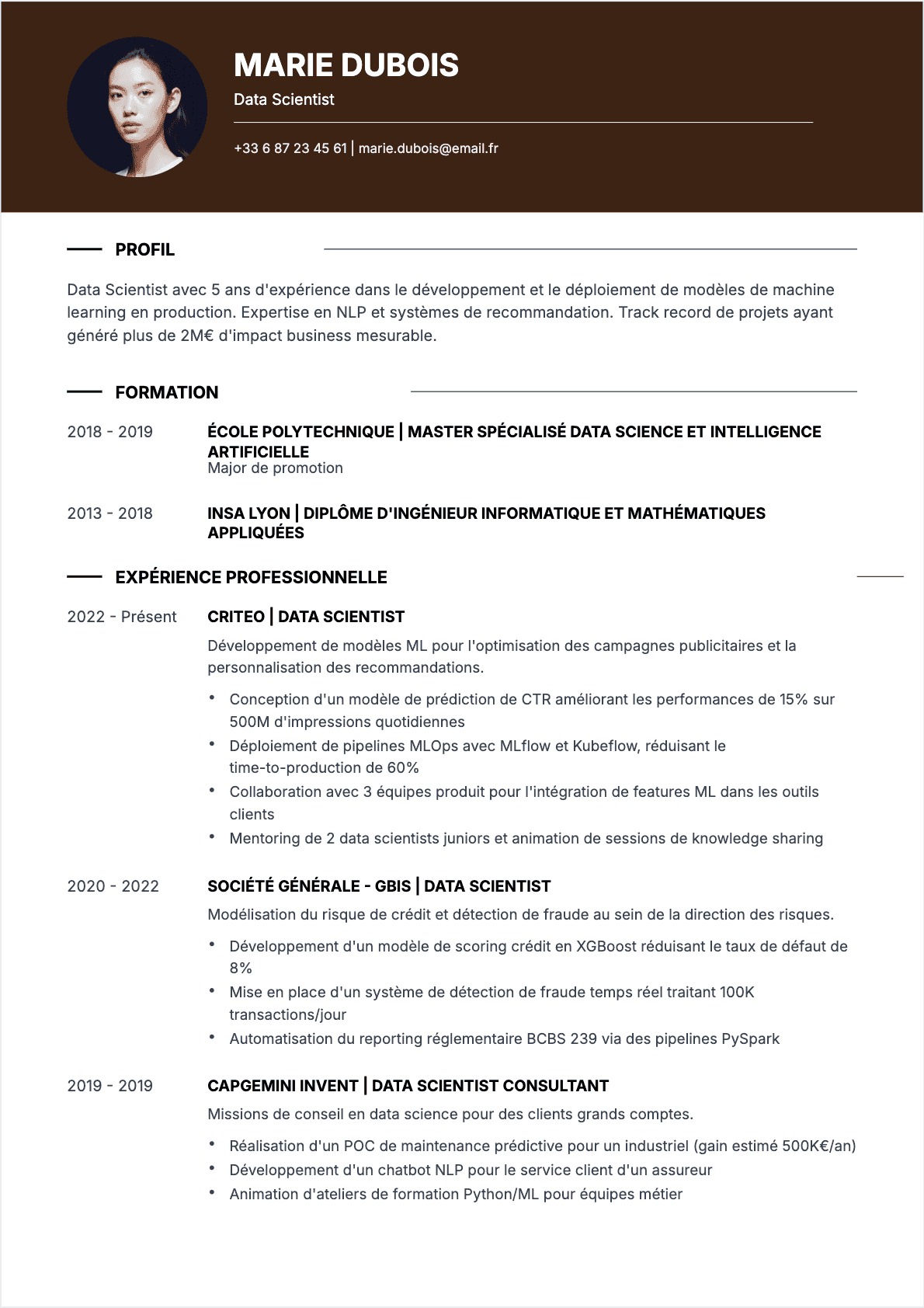
Data Scientist Resume Templates
8 Templates available
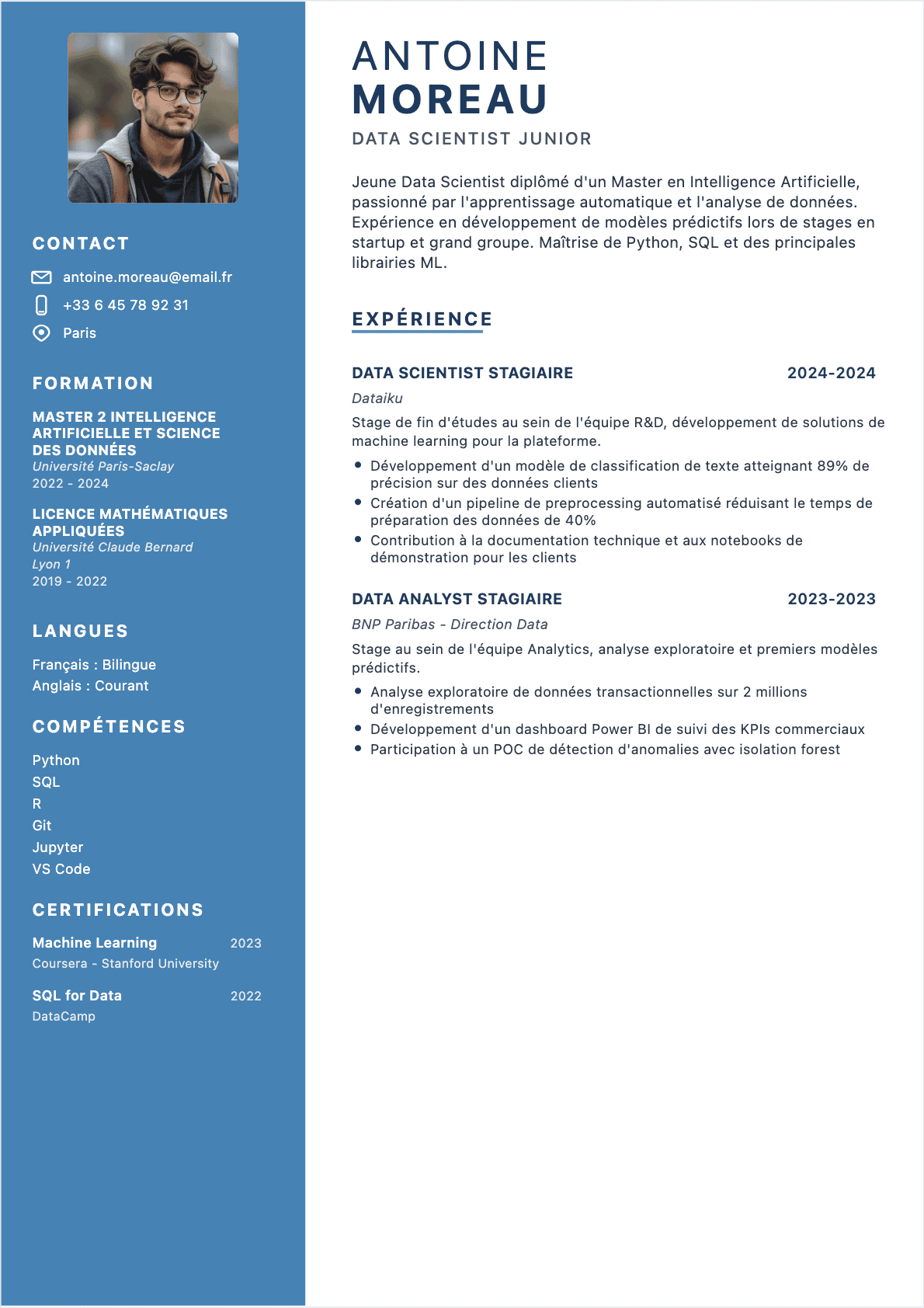
Resume Data Scientist Junior
Data Scientist resume template for Junior profile
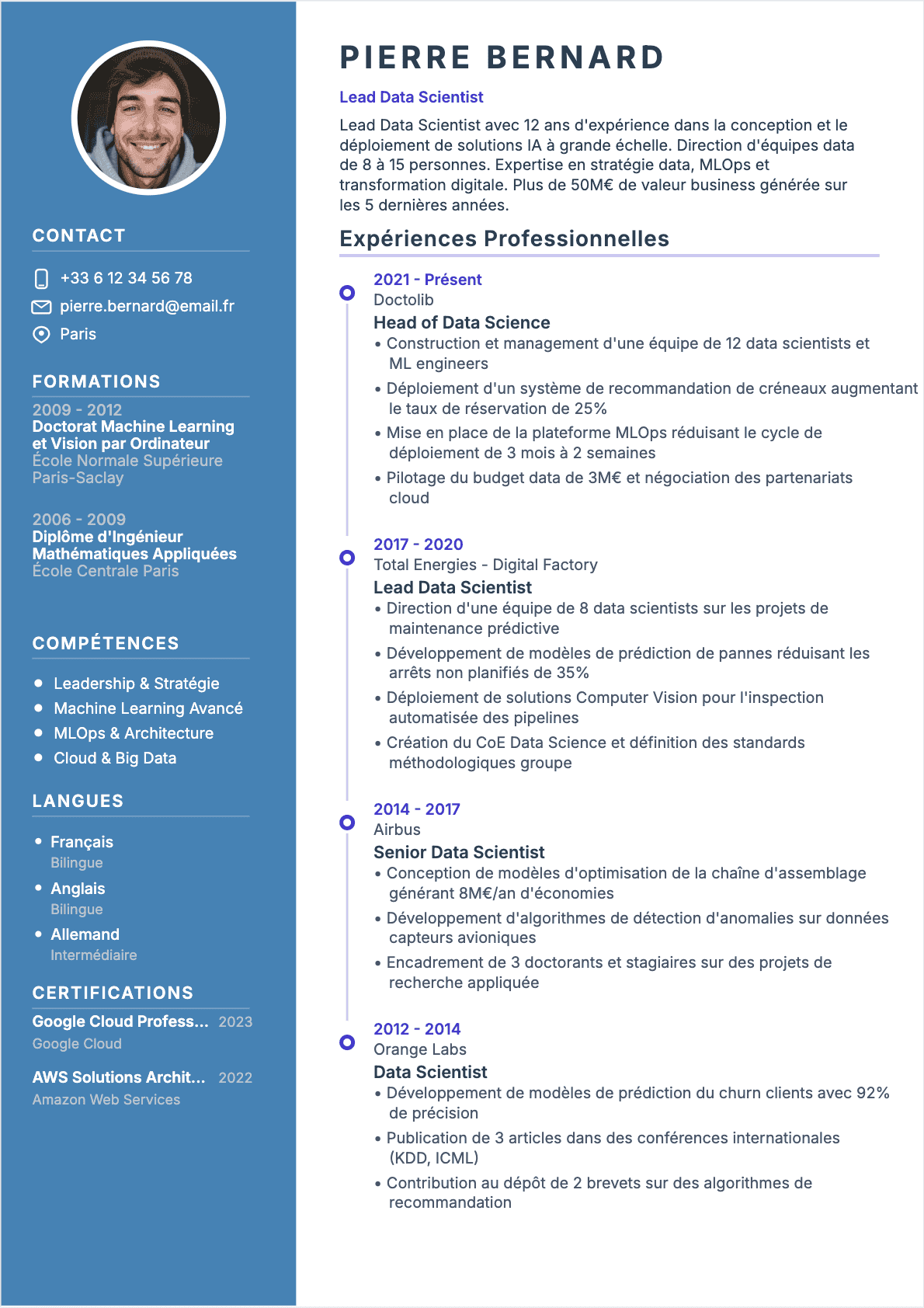
Resume Data Scientist Senior
PopularData Scientist resume template for Senior profile
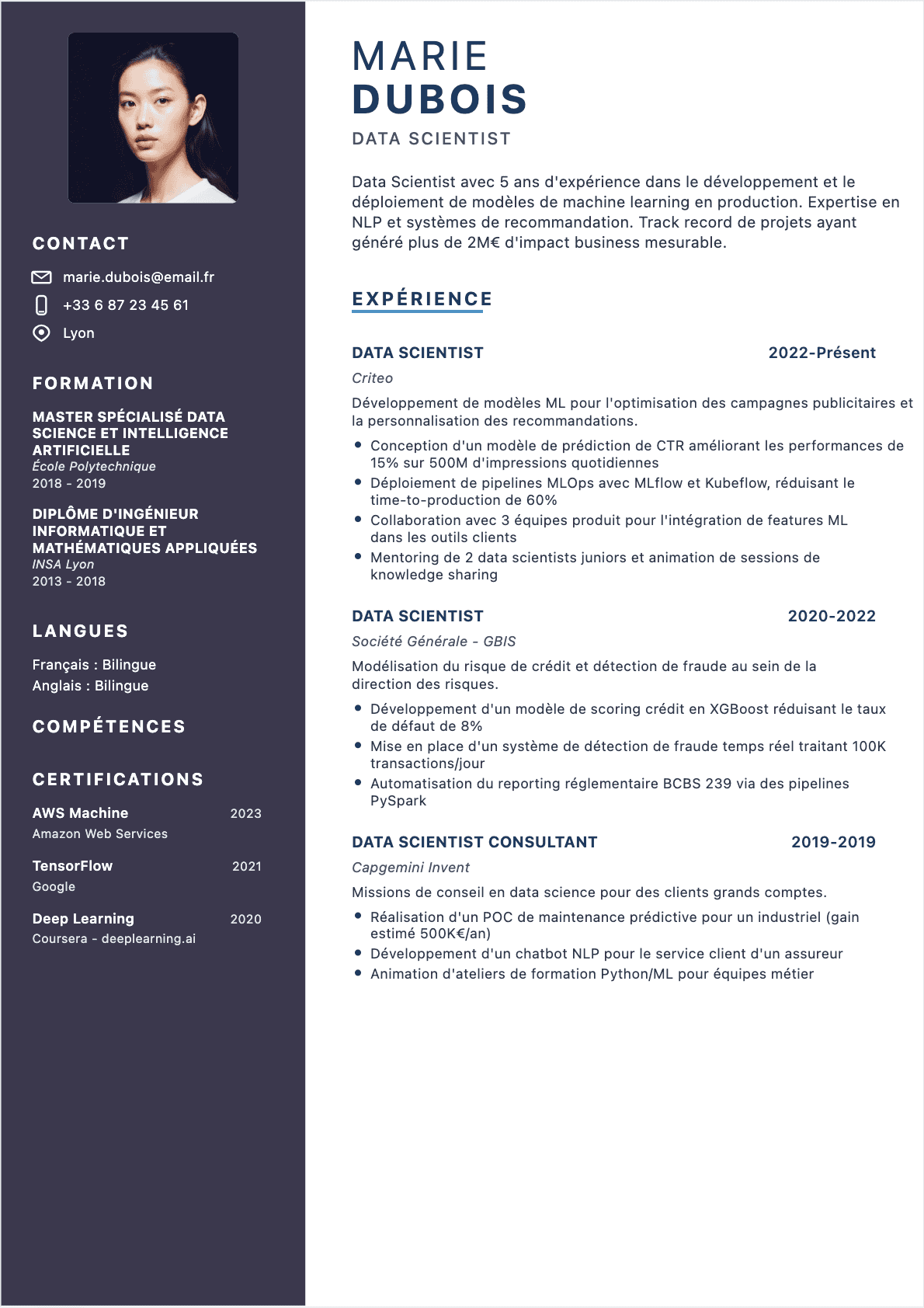
Resume Data Scientist Confirmé
Data Scientist resume template for Confirmé profile
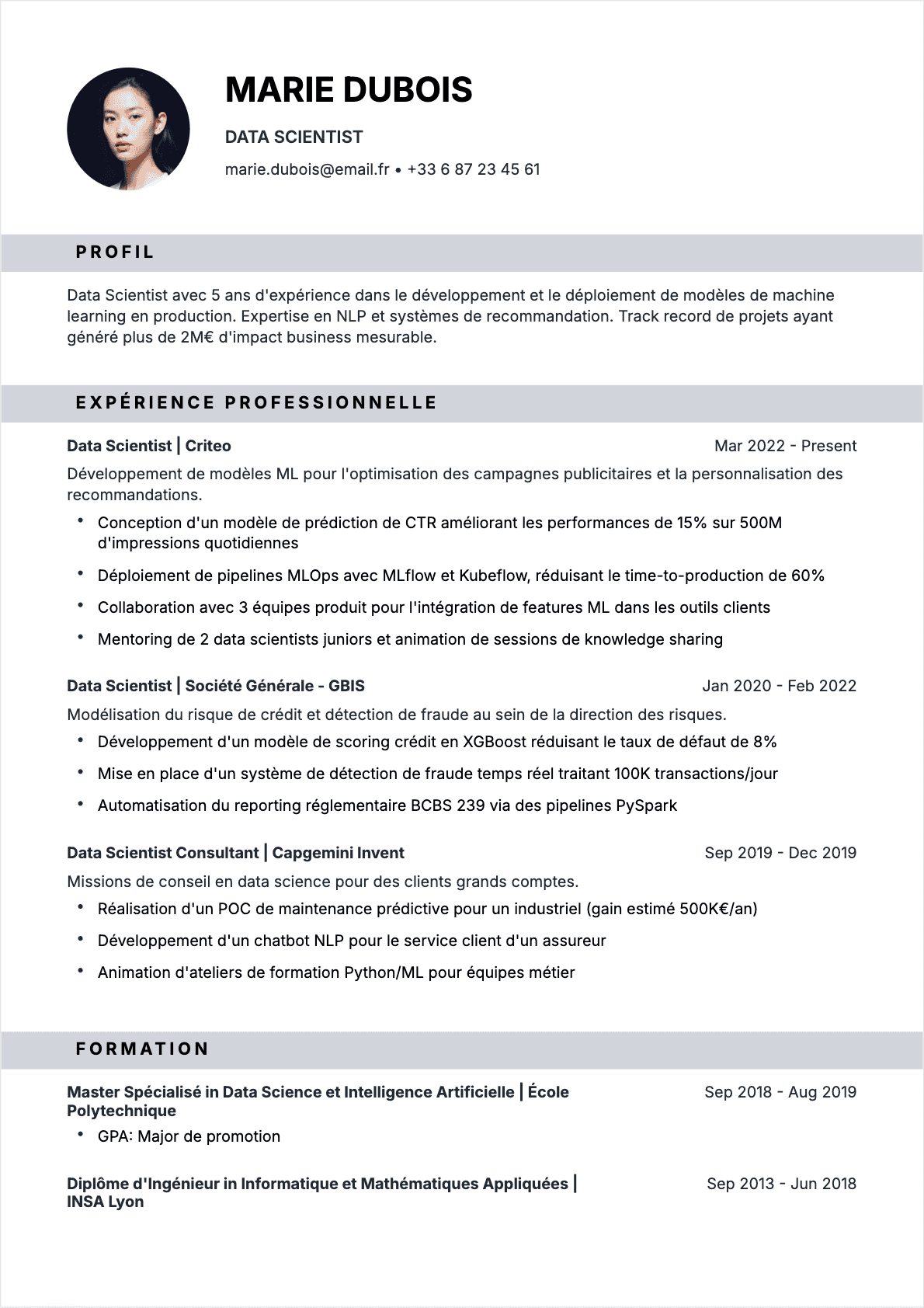
Resume Data Scientist Confirmé
Data Scientist resume template for Confirmé profile
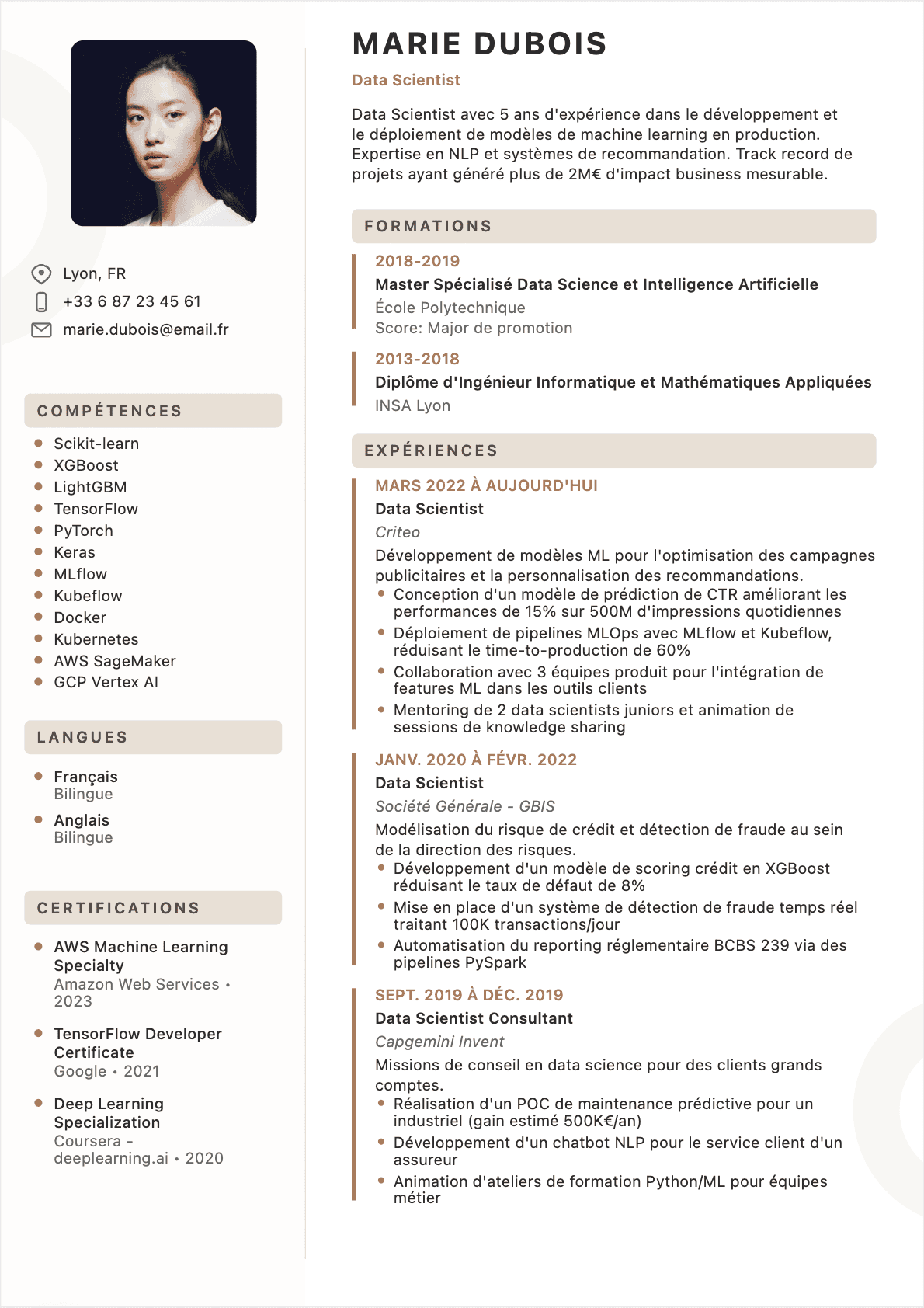
Resume Data Scientist Confirmé
Data Scientist resume template for Confirmé profile
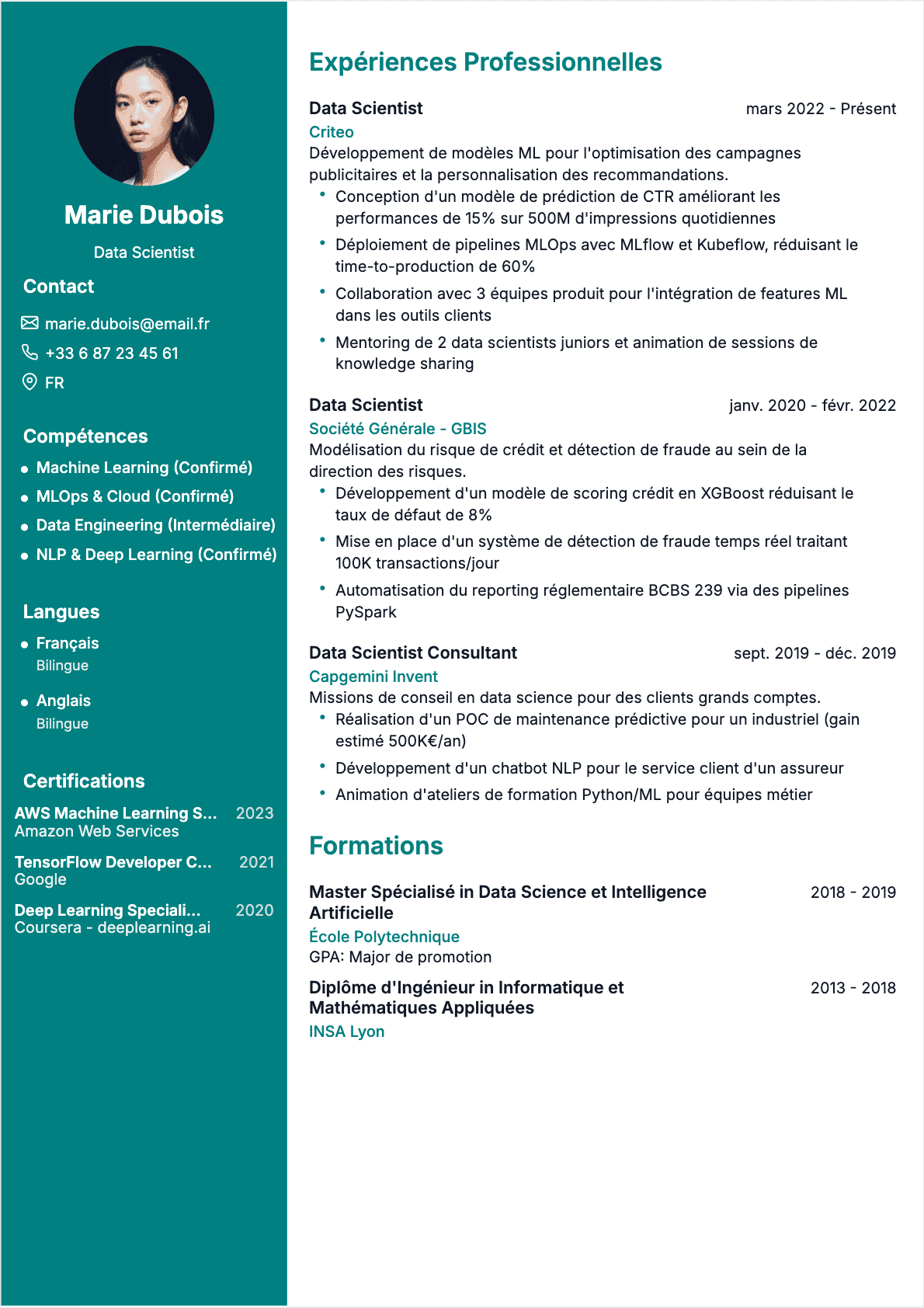
Resume Data Scientist Confirmé
Data Scientist resume template for Confirmé profile
Like one of these Data Scientist resume templates?
Select it, fill in your details and download your resume as PDF.
Data Scientist Resume Examples
Sarah Thompson
Data Scientist
sarah.thompson@email.co.uk
+44 20 7123 4567
Manchester, GB
Data Scientist with 5 years of experience building and deploying production ML systems at scale. Specialising in recommendation systems and NLP, with a proven track record of delivering measurable business impact. Led projects generating over GBP 1.5M in additional revenue.
Work Experience
Senior Data Scientist
Deliveroo
- ●Developed a real-time restaurant ranking algorithm increasing order conversion by 12%
- ●Built demand forecasting models reducing rider idle time by 18% across 150+ cities
- ●Implemented MLOps best practices with automated retraining pipelines and A/B testing framework
Data Scientist
Barclays - Chief Data Office
- ●Built credit scoring models using ensemble methods, improving default prediction by 15%
- ●Created NLP pipeline for automated document classification processing 100K+ documents monthly
- ●Deployed real-time fraud detection system with sub-100ms latency requirements
Data Science Consultant
Accenture Applied Intelligence
- ●Implemented customer lifetime value prediction model for a major retailer
- ●Developed churn prediction system for a telecom client reducing churn by 8%
- ●Led technical workshops on ML fundamentals for client data teams
Education
MSc
University of Oxford
BSc (Hons)
University of Bristol
Skills
Languages
English — Native Speaker
Spanish — Intermediate
Certifications
AWS Machine Learning SpecialtyAmazon Web Services
TensorFlow Developer CertificateGoogle
Professional Scrum Master IScrum.org
Data Scientist role overview
Data Scientists transform raw data into actionable insights that drive business decisions. You'll spend your days building predictive models, analyzing complex datasets, and communicating findings to stakeholders who may not have technical backgrounds. The role sits at the intersection of statistics, programming, and business strategy, requiring you to translate ambiguous business problems into quantifiable analytical questions.
Your typical workday involves writing code in Python or R, querying databases, experimenting with machine learning algorithms, and visualizing results. You'll collaborate closely with product managers, engineers, and business leaders to understand requirements, validate assumptions, and deploy models into production systems. Much of your time goes into data cleaning and preparation—often 60-70% of the work—before you can even begin analysis.
Career progression typically follows this path: Junior Data Scientist (0-2 years) focuses on executing well-defined projects under supervision, Mid-level Data Scientist (3-5 years) owns end-to-end projects and mentors juniors, Senior Data Scientist (6-10 years) defines analytical strategy and leads cross-functional initiatives, and Staff/Principal Data Scientist (10+ years) sets technical direction across multiple teams. Some professionals transition into Data Science Management, Machine Learning Engineering, or specialized roles like Research Scientist.
Salary ranges vary significantly by location and company size. In the United States, Junior Data Scientists earn $85,000-$110,000, Mid-level positions command $115,000-$150,000, and Senior Data Scientists make $150,000-$200,000+. In the United Kingdom, expect £45,000-£60,000 for junior roles, £65,000-£90,000 for mid-level, and £95,000-£140,000 for senior positions. Tech companies and finance firms typically pay 20-40% above these ranges.
Typical daily tasks include:
- Extracting and cleaning data from multiple sources (SQL databases, APIs, data warehouses) to create analysis-ready datasets
- Building and validating predictive models using techniques like regression, classification, clustering, or deep learning
- Creating visualizations and dashboards in tools like Tableau, Power BI, or Plotly to communicate findings
- Collaborating with engineering teams to deploy models into production environments and monitor performance
- Conducting A/B tests and statistical experiments to measure the impact of product changes or business initiatives
- Presenting insights and recommendations to non-technical stakeholders through reports and presentations
Essential skills for a Data Scientist resume
Your resume needs to demonstrate both technical depth and business acumen. Recruiters scan for specific programming languages, statistical methods, and machine learning frameworks because these skills directly determine whether you can execute the role. However, technical skills alone aren't enough—you must show you can translate complex analyses into business value and work effectively across teams.
ATS systems prioritize hard skills with exact keyword matches, so include the specific tools and techniques mentioned in the job description. If the posting mentions 'PyTorch' and you only list 'deep learning frameworks,' the ATS may not make the connection. Place your most relevant technical skills in a dedicated skills section and also weave them naturally into your experience descriptions.
Core skills to highlight:
- Python or R programming: These are the primary languages for data manipulation, statistical analysis, and machine learning implementation—most roles require proficiency in at least one.
- SQL and database querying: You'll extract data from relational databases daily, and complex joins, window functions, and query optimization are essential for working with large datasets.
- Machine learning algorithms: Understanding when to apply regression, decision trees, random forests, gradient boosting, or neural networks demonstrates your ability to select appropriate methods for different problems.
- Statistical analysis and hypothesis testing: Rigorous experimentation requires knowledge of p-values, confidence intervals, A/B testing methodology, and statistical significance to avoid false conclusions.
- Data visualization tools: Creating clear charts in Matplotlib, Seaborn, Tableau, or Looker helps stakeholders understand your findings and makes your insights actionable.
- Cloud platforms (AWS, GCP, or Azure): Modern data infrastructure lives in the cloud, so familiarity with services like S3, Redshift, BigQuery, or Databricks shows you can work in production environments.
- Git version control: Collaborative data science requires tracking code changes, reviewing pull requests, and maintaining reproducible analyses through version control systems.
- Feature engineering and data preprocessing: Transforming raw data into meaningful model inputs often matters more than algorithm selection for model performance.
- Communication and storytelling: You must explain technical concepts to non-technical audiences and frame insights in terms of business impact rather than statistical metrics.
- Problem-solving and critical thinking: Data science projects rarely have clear solutions, so you need to break down ambiguous problems, question assumptions, and iterate on approaches.
- Domain knowledge: Understanding the business context—whether it's e-commerce, healthcare, finance, or marketing—helps you ask better questions and generate more relevant insights.
- Experimentation and scientific method: Designing controlled experiments, identifying confounding variables, and drawing valid causal conclusions separate rigorous data scientists from those who just run algorithms.

How to write a Data Scientist resume step by step
1. Start with a targeted summary that quantifies your impact
Write 2-3 sentences that specify your years of experience, technical specialization, and measurable business outcomes. Instead of 'Data Scientist with experience in machine learning,' write 'Data Scientist with 4 years building recommendation systems and predictive models that increased user engagement by 23% and reduced churn by $1.2M annually.' This immediately shows both technical capability and business value.
2. Structure your experience with project-based bullet points
Each role should contain 4-6 bullets describing specific projects or initiatives, not generic job duties. Follow this formula: Action verb + Technical method + Business context + Quantified result. For example: 'Built gradient boosting model using XGBoost to predict customer lifetime value, enabling marketing team to optimize $2M ad spend and improve ROI by 34%.' This structure passes ATS keyword scans while showing impact.
3. Emphasize the full project lifecycle, not just modeling
Recruiters want to see you can own projects end-to-end. Include bullets about data collection, pipeline building, model deployment, and monitoring—not just algorithm development. Instead of 'Created machine learning models for fraud detection,' write 'Designed and deployed fraud detection system processing 50K daily transactions, including data pipeline in Airflow, XGBoost classification model, and real-time API endpoint, reducing fraudulent charges by 67%.'
4. Quantify everything with specific metrics
Replace vague descriptions with concrete numbers: revenue impact, percentage improvements, dataset sizes, model performance metrics, or time saved. Bad example: 'Improved model accuracy.' Good example: 'Increased recommendation model precision from 0.72 to 0.89 through feature engineering and hyperparameter tuning, resulting in 18% higher click-through rates across 2M daily users.' Numbers make your contributions tangible and memorable.
5. Create a technical skills section optimized for ATS
List skills in categories: Programming Languages (Python, R, SQL), Machine Learning (scikit-learn, TensorFlow, PyTorch), Data Tools (Spark, Airflow, dbt), Visualization (Tableau, Plotly), and Cloud Platforms (AWS, GCP). Include both the general category and specific tools—write 'Machine Learning: scikit-learn, XGBoost, TensorFlow, PyTorch' rather than just 'Machine Learning.' This captures more keyword variations that ATS systems scan for.
6. Include relevant projects if you're early-career
If you have less than 3 years of experience, add a Projects section with 2-3 substantial data science projects. Describe each like a work experience: the problem, your approach, technologies used, and results. 'Built NLP sentiment analysis model using BERT to classify 100K customer reviews with 91% accuracy, deployed as Flask API on AWS EC2' shows practical skills even without formal work experience.
7. Tailor your resume to each job posting
Read the job description carefully and mirror its language in your resume. If the posting emphasizes 'causal inference' and 'experimentation,' make sure those exact phrases appear in your experience bullets where truthful. If they want 'deep learning for computer vision,' highlight your CNN projects prominently. This isn't dishonesty—it's emphasizing the most relevant parts of your background for each role.
Before and after examples:
Before: 'Responsible for analyzing data and creating reports for management team.'
After: 'Analyzed 5M customer transactions using SQL and Python to identify $800K revenue leakage, presented findings to C-suite through interactive Tableau dashboard, leading to process changes that recovered 73% of lost revenue.'
Before: 'Used machine learning to improve business outcomes.'
After: 'Developed random forest model to predict equipment failures 14 days in advance with 85% recall, enabling preventive maintenance that reduced downtime by 120 hours/month and saved $340K annually in emergency repairs.'
Common mistakes on Data Scientist resumes
Listing tools without showing how you applied them to solve problems
Many candidates create a long list of technologies—'Python, R, TensorFlow, PyTorch, scikit-learn, Keras, SQL, Spark'—without demonstrating actual project work. Recruiters see through this immediately. Instead of just listing 'TensorFlow,' write a bullet like 'Implemented convolutional neural network in TensorFlow to classify medical images with 94% accuracy, reducing radiologist review time by 40%.' The tool matters less than what you accomplished with it.
Focusing on model accuracy instead of business impact
Data Scientists often write 'Achieved 95% accuracy on classification model' without explaining why that mattered. Hiring managers care about business outcomes, not statistical metrics in isolation. Bad: 'Built model with 0.89 AUC score.' Good: 'Built credit risk model with 0.89 AUC that approved 12% more qualified applicants while maintaining default rates, generating $2.3M additional annual revenue.' Always connect technical achievements to business results.
Using academic language instead of industry terminology
If you're transitioning from academia, avoid phrases like 'conducted research on' or 'published findings regarding.' Industry roles want 'built,' 'deployed,' 'implemented,' and 'optimized.' Replace 'Investigated the application of ensemble methods for predictive modeling tasks' with 'Built gradient boosting models to predict customer churn, deployed to production serving 50K predictions daily.' The second version sounds like you've done the job before.
Omitting the data engineering and deployment aspects
Many resumes focus exclusively on modeling and analysis while ignoring data pipelines, productionization, and monitoring. This suggests you only work in notebooks and can't deploy solutions. Include bullets about building ETL pipelines, creating APIs, containerizing models with Docker, setting up monitoring dashboards, or collaborating with engineers on deployment. These skills separate data scientists who ship products from those who only run experiments.
Providing no context about data scale or complexity
Writing 'Analyzed customer data to identify trends' tells recruiters nothing about your capabilities. Always specify dataset size, complexity, and constraints. Better: 'Analyzed 15M customer records across 8 data sources using distributed computing in Spark, handling missing data rates up to 30% and identifying 5 key behavioral segments that informed $10M product strategy.' This shows you can handle real-world messy data at scale.
Including every project instead of the most relevant ones
Your resume isn't a complete career history—it's a targeted marketing document. If you're applying for a role in recommendation systems, emphasize your collaborative filtering and ranking projects while minimizing unrelated work. A common mistake is giving equal space to every project you've touched. Dedicate 60-70% of your resume to experience directly relevant to the target role.
Neglecting to show cross-functional collaboration
Data Science is a team sport, but many resumes read like you worked in isolation. Hiring managers want to see you can partner with product managers, engineers, and business stakeholders. Include phrases like 'collaborated with engineering team to deploy,' 'partnered with product managers to define metrics,' or 'presented findings to executive leadership.' This demonstrates you understand the full context of how data science creates value in organizations.
Data Scientist resume trends in 2026
The Data Science hiring market has matured significantly, with companies now seeking specialists rather than generalists who 'do everything with data.' Organizations increasingly hire for specific problem domains—recommendation systems, causal inference, NLP, computer vision, or time series forecasting—rather than generic 'Data Scientist' roles. Your resume should emphasize depth in 1-2 areas rather than surface-level familiarity with dozens of techniques. Highlight your specialization early in your summary and dedicate most of your experience bullets to projects in that domain.
Machine learning operations (MLOps) skills have shifted from nice-to-have to essential. Employers expect Data Scientists to understand model deployment, monitoring, and maintenance, not just notebook-based analysis. Your resume should demonstrate familiarity with tools like MLflow, Kubeflow, or SageMaker for model tracking, Docker and Kubernetes for containerization, and CI/CD pipelines for automated deployment. Include specific examples like 'Implemented automated retraining pipeline that monitored model performance and triggered updates when accuracy dropped below 85%, reducing manual intervention by 90%.'
Large language models and generative AI have created new expectations around NLP capabilities. Even if you're not specializing in NLP, many roles now expect basic familiarity with transformer architectures, prompt engineering, and fine-tuning techniques. If you've worked with GPT models, BERT, or other foundation models—whether for text classification, summarization, or embedding generation—feature this prominently. Companies are actively seeking Data Scientists who can evaluate when to use pre-trained models versus building custom solutions.
The emphasis on causal inference and experimentation has intensified as companies move beyond correlation-based insights. Recruiters specifically search for terms like 'A/B testing,' 'causal inference,' 'difference-in-differences,' 'propensity score matching,' and 'instrumental variables.' If you've designed experiments, calculated treatment effects, or used causal methods, make this explicit. Write bullets like 'Designed and analyzed 15 A/B tests quarterly using Bayesian methods, establishing causal impact of product changes on 3M users and informing $5M feature investment decisions.'
Remote and hybrid work has become standard, but this creates new resume considerations. Highlight your ability to work asynchronously, document your work clearly, and communicate findings through written reports and recorded presentations. Mention experience with collaborative tools like Jupyter notebooks in shared environments, Git workflows for code review, and documentation practices. Companies hiring remotely prioritize candidates who can work independently and communicate effectively without constant synchronous meetings.
Data ethics and responsible AI have moved from buzzwords to practical requirements. If you've worked on fairness metrics, bias detection, model interpretability, or privacy-preserving techniques, include these explicitly. Phrases like 'Evaluated model for demographic bias using fairness metrics, identifying and mitigating 15% disparity in prediction accuracy across user segments' demonstrate awareness of ethical considerations that increasingly matter to employers, especially in regulated industries like finance and healthcare.
The market has also seen increased scrutiny of credentials and practical skills. Companies now frequently include take-home assignments or live coding interviews to verify capabilities, making it crucial that your resume accurately represents your hands-on skills. Don't list technologies you've only used briefly in courses. Focus on tools and methods you've applied in substantial projects where you can discuss trade-offs, challenges, and results in detail during interviews.
Further reading:
Frequently asked questions
Find answers to the most frequently asked questions.
For most candidates, one page is ideal up to ~5 years of experience, and two pages is acceptable for senior roles with multiple shipped models. Prioritize quantified impact, production details, and the most relevant projects. Remove older tools, unrelated coursework, and duplicate bullets to keep scan time low.
Common ATS filters include Python, SQL, machine learning, statistics, A/B testing, feature engineering, model deployment, and MLOps. Add stack-specific keywords that match the job posting (e.g., MLflow, Spark, SageMaker, Databricks). Only include keywords you can defend in interviews with examples and metrics.
Yes, if the work is polished and easy to evaluate. Link to 1–2 projects with a clear README, reproducible environment, and a short summary of results (e.g., AUC 0.83, MAPE 12%). Avoid dumping many links. One strong project that mirrors the target role beats five unfinished notebooks.
Use proxy metrics and operational outcomes: reduced manual effort (hours/week), improved forecast accuracy (MAPE), lowered incident rate, reduced latency, or improved decision quality. If revenue impact is confidential, describe directional effects and adoption, e.g., “used by 35 analysts weekly” or “enabled 14 experiments/quarter.”
In most English-speaking markets, a photo is not expected and may be discouraged, especially in the US and many UK processes. Focus instead on a strong headline, a results-based summary, and clean ATS formatting. If a role explicitly requests a photo due to local norms, follow the employer guidance.
Skills should be a short, scannable list of tools and methods you actually used (Python, SQL, Spark, MLflow, A/B testing). Experience should prove those skills with context and numbers: what you built, at what scale, how you measured performance, and what changed for the business or platform.
Your career deserves a better resume
With CVtoWork, select a template, fill in the fields and download your resume as PDF.
Start creating