CPA Resume
Example, Template & Expert Tips 2026
Updated on April 18, 2026.
Write a CPA resume that passes ATS and wins interviews in 2026. Complete CPA examples, key accounting skills, and quantified achievements for every experience level.
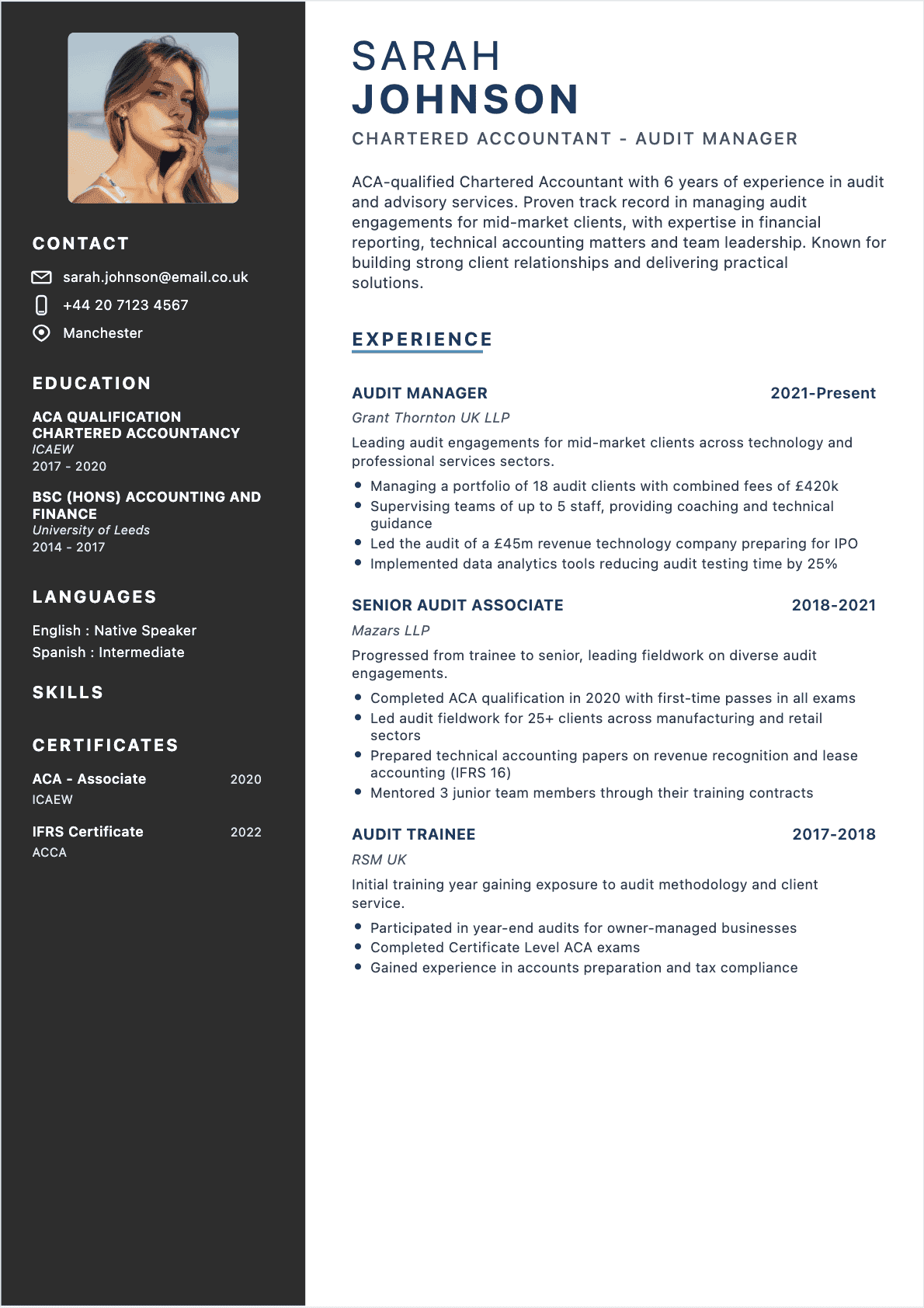
CPA Resume Templates
8 Templates available
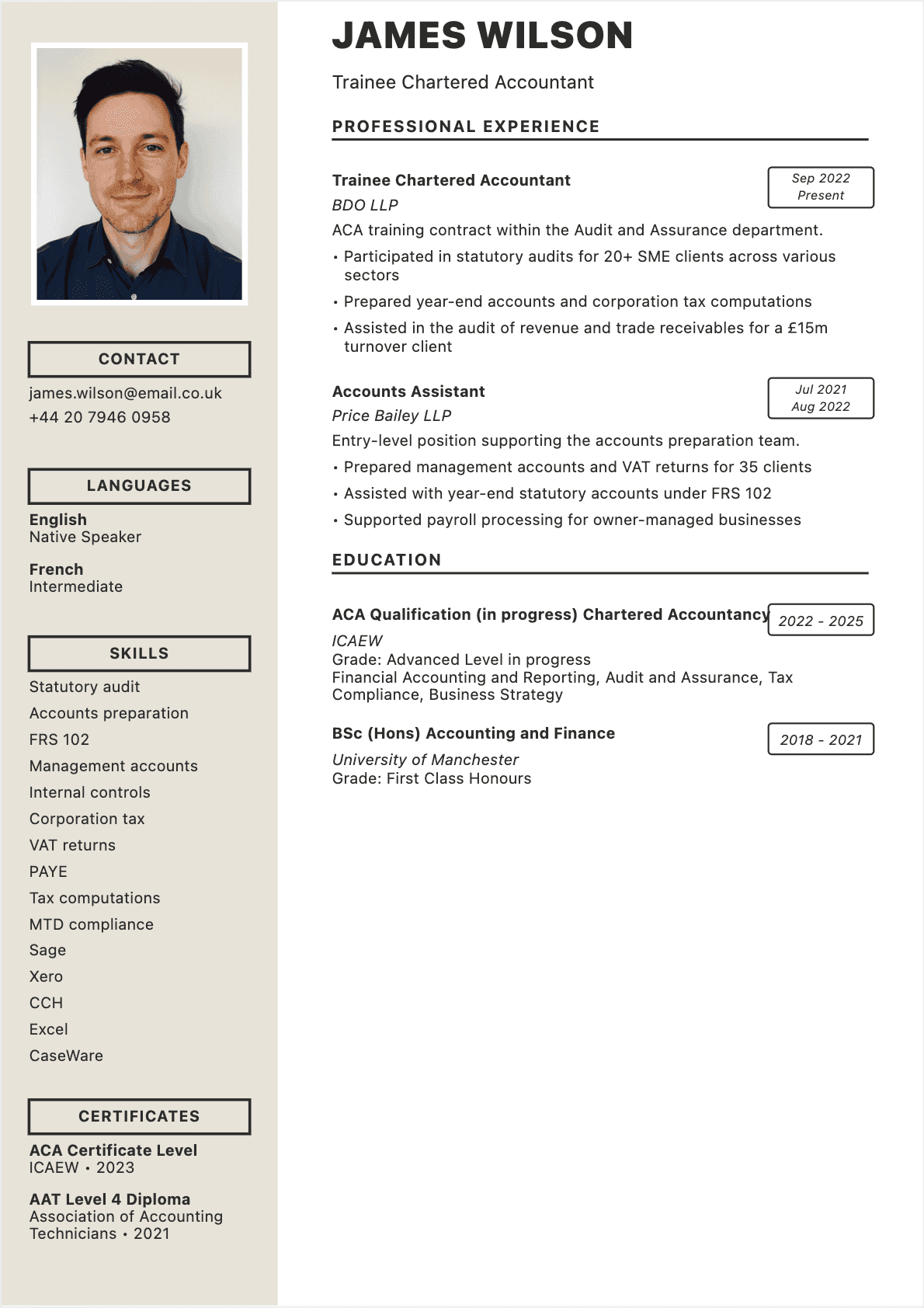
Resume CPA Junior
CPA resume template for Junior profile
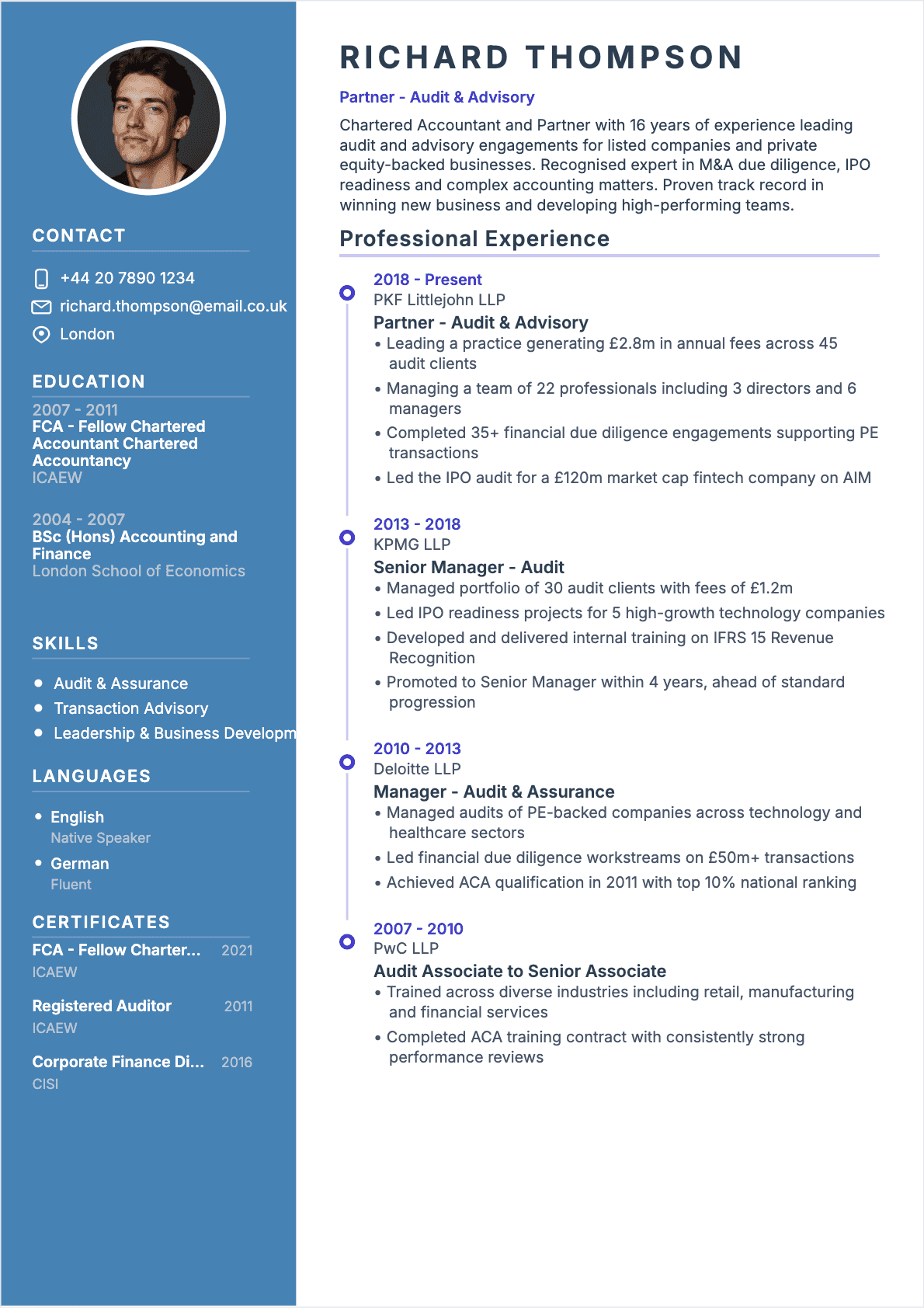
Resume CPA Senior
CPA resume template for Senior profile
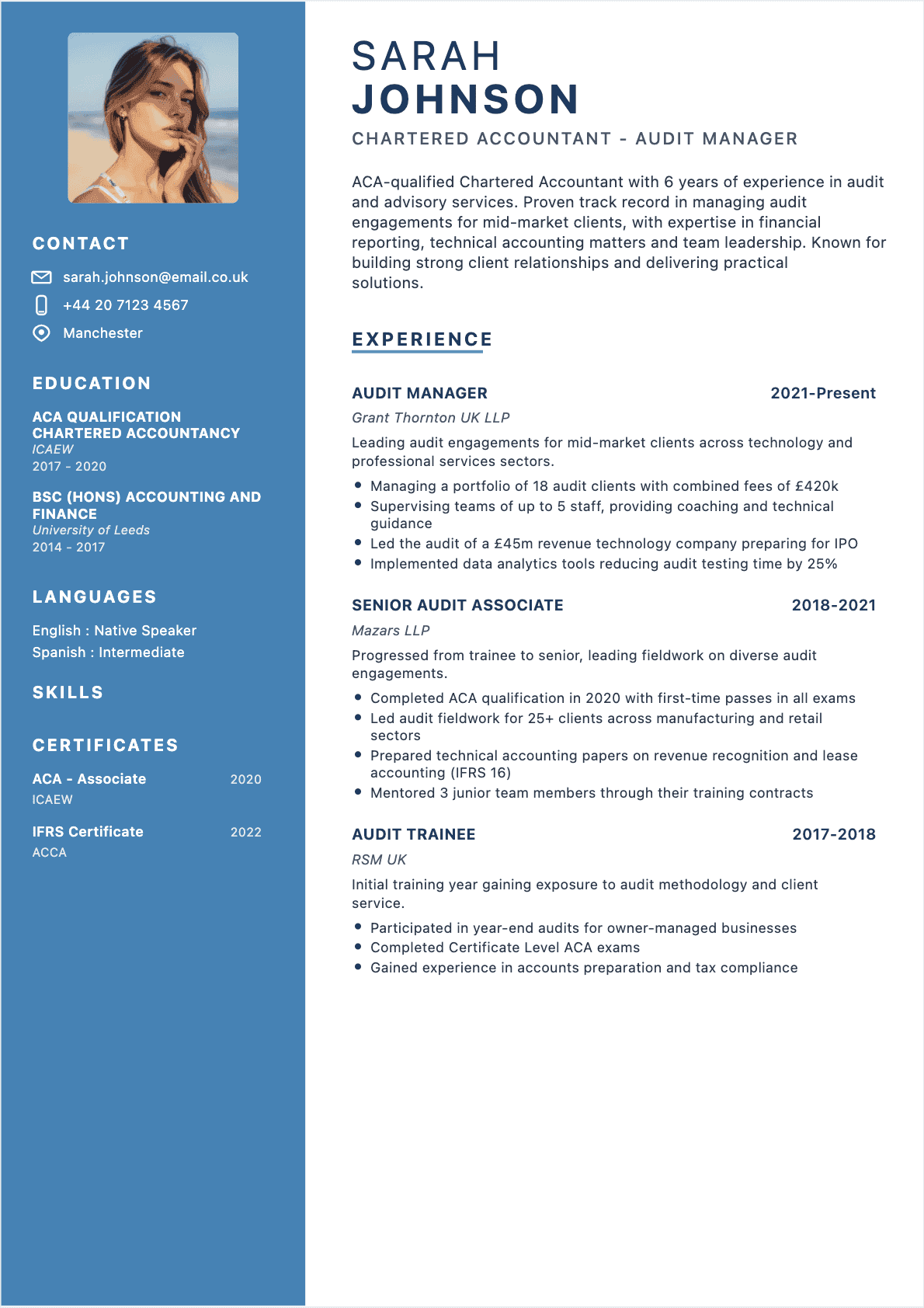
Resume CPA Confirmé
CPA resume template for Confirmé profile
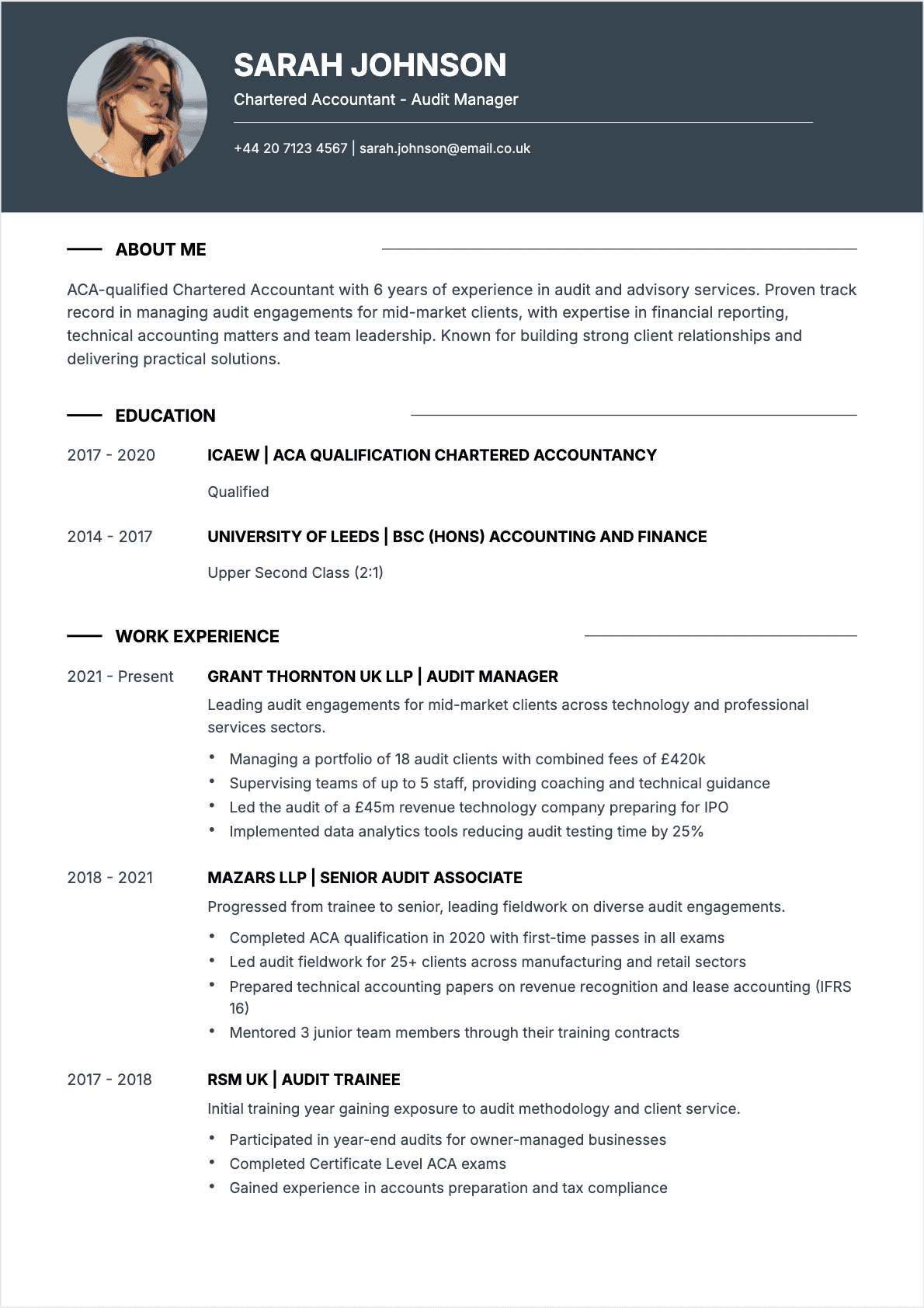
Resume CPA Confirmé
CPA resume template for Confirmé profile
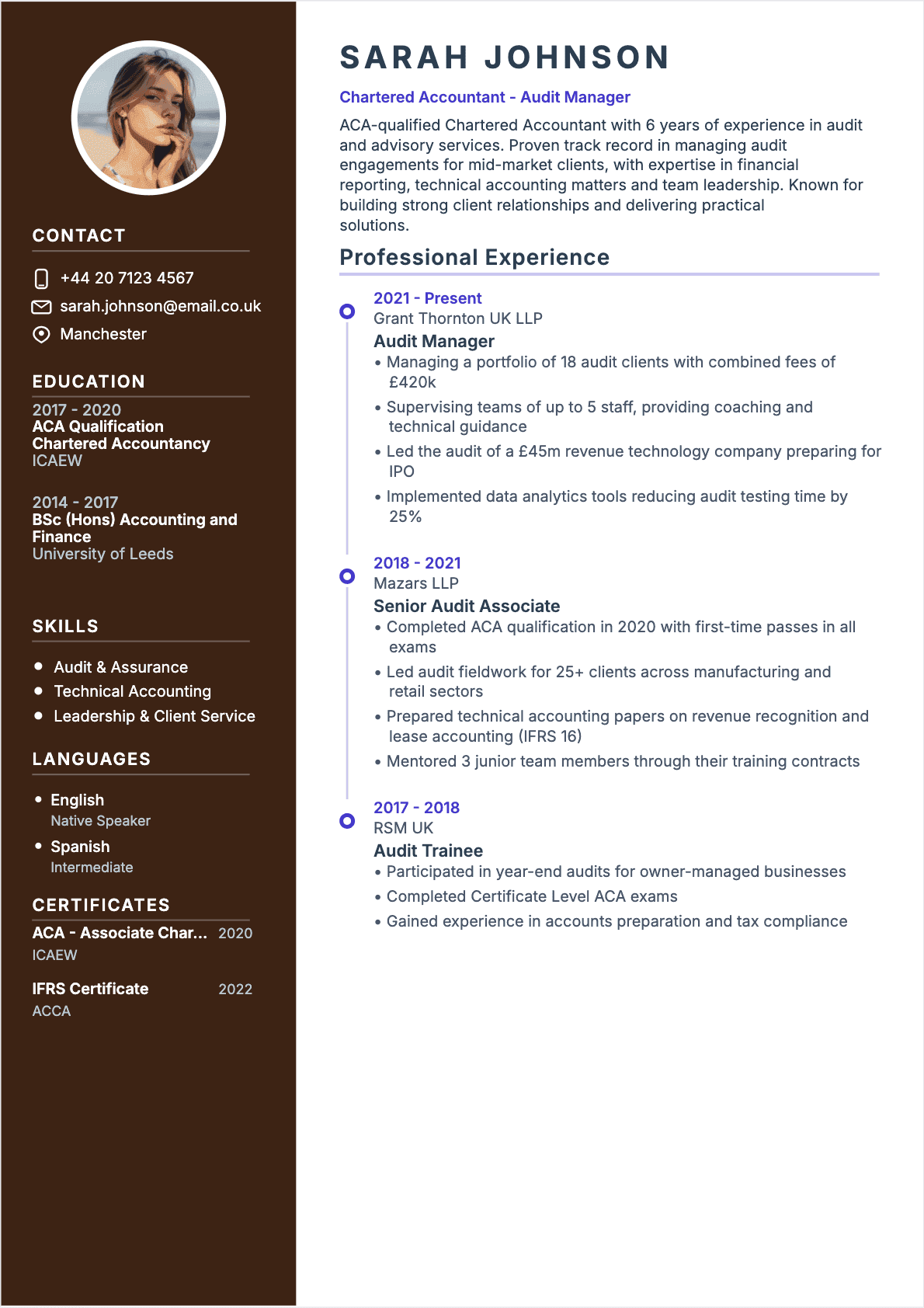
Resume CPA Confirmé
CPA resume template for Confirmé profile
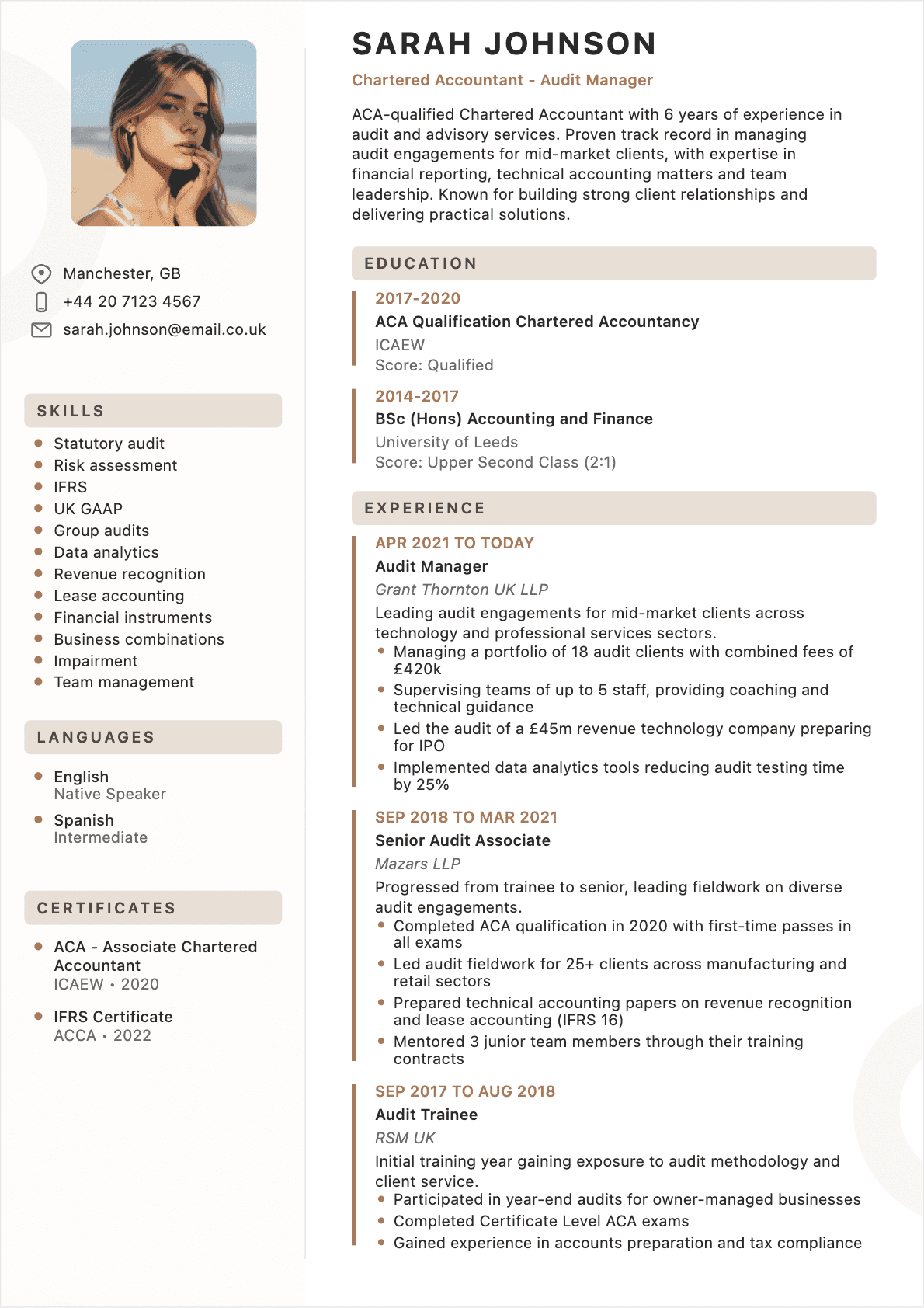
Resume CPA Confirmé
PopularCPA resume template for Confirmé profile
Like one of these CPA resume templates?
Select it, fill in your details and download your resume as PDF.
CPA Resume Examples
Sarah Johnson
Chartered Accountant - Audit Manager
sarah.johnson@email.co.uk
+44 20 7123 4567
Manchester, GB
ACA-qualified Chartered Accountant with 6 years of experience in audit and advisory services. Proven track record in managing audit engagements for mid-market clients, with expertise in financial reporting, technical accounting matters and team leadership. Known for building strong client relationships and delivering practical solutions.
Work Experience
Audit Manager
Grant Thornton UK LLP
- ●Managing a portfolio of 18 audit clients with combined fees of £420k
- ●Supervising teams of up to 5 staff, providing coaching and technical guidance
- ●Led the audit of a £45m revenue technology company preparing for IPO
Senior Audit Associate
Mazars LLP
- ●Completed ACA qualification in 2020 with first-time passes in all exams
- ●Led audit fieldwork for 25+ clients across manufacturing and retail sectors
- ●Prepared technical accounting papers on revenue recognition and lease accounting (IFRS 16)
Audit Trainee
RSM UK
- ●Participated in year-end audits for owner-managed businesses
- ●Completed Certificate Level ACA exams
- ●Gained experience in accounts preparation and tax compliance
Education
ACA Qualification
ICAEW
BSc (Hons)
University of Leeds
Skills
Languages
English — Native Speaker
Spanish — Intermediate
Certifications
ACA - Associate Chartered AccountantICAEW
IFRS CertificateACCA
CPA role overview
Certified Public Accountants serve as trusted financial advisors who ensure accuracy, compliance, and strategic financial planning for businesses and individuals. Your day typically involves analyzing financial statements, preparing tax documents, conducting audits, and advising clients on complex financial decisions. Unlike general accountants, CPAs hold state licensure that allows you to sign audit reports, represent clients before the IRS, and provide attestation services that other accounting professionals cannot perform.
The role demands both technical precision and client-facing communication skills. You might spend your morning reviewing a client's quarterly financials, identifying discrepancies that could trigger an audit, then transition to an afternoon meeting where you explain tax-saving strategies to business owners who lack financial backgrounds. During tax season (January through April), expect 60-70 hour weeks, while the rest of the year typically maintains a more sustainable 45-50 hour schedule.
Career progression typically follows a clear trajectory. Entry-level CPAs (0-3 years) earn between $55,000-$75,000 annually and focus on executing tasks under supervision. Mid-level CPAs (4-7 years) command $75,000-$110,000 and manage client portfolios independently. Senior CPAs and managers (8-15 years) earn $110,000-$160,000 while overseeing teams and complex engagements. Partners and directors at firms can exceed $200,000-$500,000+ depending on firm size and specialization. Industry CPAs (working in corporate finance rather than public accounting) often earn 10-20% less but enjoy better work-life balance.
Typical daily tasks for a CPA include:
- Reviewing and analyzing financial statements to identify errors, inconsistencies, or areas requiring deeper investigation
- Preparing or reviewing tax returns for individuals, corporations, partnerships, and trusts while ensuring compliance with current tax codes
- Conducting audit procedures including testing internal controls, verifying account balances, and documenting findings
- Consulting with clients on financial strategy, tax planning, business valuations, or merger and acquisition due diligence
- Researching complex accounting standards (ASC, IFRS) or tax regulations to resolve technical questions
- Supervising junior accountants and reviewing their work for accuracy and completeness before client delivery
Essential skills for a CPA resume
Your resume must demonstrate both the technical accounting expertise that qualifies you for CPA work and the analytical judgment that separates competent accountants from strategic advisors. Recruiters scan for specific software proficiencies, regulatory knowledge, and evidence of complex problem-solving. Since most firms and corporations use Applicant Tracking Systems (ATS), including exact skill names and industry-standard terminology determines whether a human ever sees your application.
Technical skills prove you can execute the work, while soft skills indicate you'll succeed with clients and teams. For ATS optimization, prioritize skills that appear in the job description verbatim—if the posting mentions 'ASC 606 revenue recognition,' use that exact phrase rather than paraphrasing. The following skills appear most frequently in CPA job postings and carry the highest weight in hiring decisions:
Core CPA skills to highlight:
- GAAP and IFRS expertise - You must demonstrate fluency in accounting standards since every financial statement you touch requires compliance with these frameworks, and errors can result in material misstatements or regulatory penalties.
- Tax preparation and planning - CPAs differentiate themselves through tax work; showing proficiency in individual (1040), corporate (1120), partnership (1065), and trust returns proves you can handle the full scope of tax engagements.
- Audit methodology and internal controls - Whether performing financial statement audits or SOX compliance testing, you need systematic approaches to gathering evidence and assessing risk that meet professional standards.
- Advanced Excel and data analysis - Beyond basic formulas, recruiters want pivot tables, VLOOKUP/XLOOKUP, Power Query, and the ability to analyze datasets with 10,000+ rows to identify trends or anomalies.
- ERP systems (SAP, Oracle, NetSuite) - Corporate accounting roles require extracting data from enterprise systems, and public accounting needs you to understand client systems during audits.
- QuickBooks and Xero - Small business clients predominantly use these platforms, so CPAs serving this market must navigate these systems fluently for bookkeeping review and advisory work.
- Tax software (ProConnect, Lacerte, CCH Axcess) - Efficiency in professional tax software directly impacts your billable hours and capacity to manage client volume during busy season.
- Financial modeling and forecasting - Advisory work requires building projections that help clients make decisions about expansion, financing, or operational changes with confidence in the numbers.
- Written and verbal communication - You translate complex accounting concepts into actionable advice for clients who often lack financial backgrounds, making clarity essential to client retention.
- Attention to detail and quality control - A single transposed digit can cascade into material errors, so recruiters assess whether your work history demonstrates consistent accuracy under pressure.
- Project management and deadline adherence - Managing multiple clients with concurrent deadlines (especially during tax season) requires prioritization skills that prevent bottlenecks and missed filing dates.
- Professional skepticism and analytical thinking - Auditors must question assumptions and verify claims rather than accepting information at face value, a mindset that protects both your firm and clients from fraud or error.

How to write a CPA resume step by step
1. Lead with your CPA credential and relevant certifications prominently
Place 'CPA' directly after your name in the header (e.g., 'Jennifer Martinez, CPA') and create a dedicated certifications section near the top. Include your license number, issuing state, and year obtained. If you hold additional credentials like CMA, CFE, or CGMA, list them here. This immediately signals to both ATS and recruiters that you meet the fundamental qualification.
2. Write a summary that quantifies your specialization and impact
Skip generic statements like 'detail-oriented accounting professional.' Instead, specify your niche and results: 'CPA with 6 years specializing in manufacturing sector audits, having led 40+ financial statement audits totaling $850M in combined client revenue while maintaining zero restatements.' This approach tells recruiters exactly what you do and proves you do it well.
3. Structure your experience section with firm/company context
For each position, include a brief descriptor of the organization (e.g., 'Regional CPA firm serving 200+ small business clients' or 'Fortune 500 pharmaceutical manufacturer with $12B annual revenue'). This context helps recruiters assess whether your experience translates to their environment. Then list your responsibilities and achievements using the formula: action verb + specific task + quantified result.
4. Transform generic duties into quantified achievements
Instead of: 'Prepared tax returns for various clients'
Write: 'Prepared 120+ individual and business tax returns annually, identifying average tax savings of $8,400 per client through strategic deduction optimization and credit application'
Instead of: 'Performed audit procedures'
Write: 'Executed audit testing across 15 manufacturing clients with revenues of $5M-$50M, completing substantive procedures for cash, inventory, and revenue cycles while reducing average audit hours by 18% through improved sampling methodology'
5. Highlight technical proficiencies with specific version numbers and applications
Don't just list 'Microsoft Excel'—specify 'Advanced Excel (pivot tables, Power Query, macros, INDEX-MATCH).' For ERP systems, note which modules you've used: 'SAP FI/CO modules for general ledger, accounts payable, and financial reporting.' This specificity helps you pass ATS filters that search for exact terminology and shows recruiters the depth of your capabilities.
6. Include a dedicated 'Technical Skills' section optimized for ATS
Create a bulleted section listing software, methodologies, and technical knowledge using industry-standard terms. Group related skills: 'Tax Software: Lacerte, ProConnect Tax, CCH Axcess Tax' or 'Accounting Standards: ASC 606, ASC 842, ASC 326, SOX 404.' This section serves as keyword optimization for ATS while giving recruiters a quick reference of your technical toolkit.
7. Demonstrate progression and increasing responsibility
Show career growth through titles, team size, or client complexity. If you've advanced from Staff Accountant to Senior Accountant to Supervisor, make that trajectory clear. If titles didn't change, show growth through metrics: 'Expanded client portfolio from 12 to 28 accounts' or 'Promoted to lead auditor for clients with revenue exceeding $25M (previously capped at $10M).' Progression signals that you consistently deliver results.
8. Add relevant education details and CPA exam scores if impressive
List your degree, institution, and graduation year. If you passed all four CPA exam sections on the first attempt or scored above 85 on any section, mention it—this demonstrates strong technical knowledge and study discipline. Include relevant coursework only if you're within 2-3 years of graduation and it directly relates to the position (e.g., 'Relevant coursework: Advanced Taxation, Forensic Accounting, Financial Statement Analysis').
Common mistakes on CPA resumes
Listing CPA credential without context or verification details
Many candidates write 'CPA' without specifying the state of licensure, year obtained, or license status. Recruiters need to verify credentials, and vague claims raise red flags. Always include: 'CPA (Illinois, License #123.456789, Active)' or 'CPA candidate (3/4 sections passed, FAR pending May 2026).' If you're no longer maintaining your license, don't claim the credential—write 'Former CPA' or omit it entirely to avoid misrepresentation.
Using accounting jargon without demonstrating business impact
Writing 'Performed substantive testing and control evaluations' means nothing to hiring managers unless you connect it to outcomes. The mistake is describing tasks without showing why they mattered. Better: 'Performed substantive testing across 20 audit engagements, identifying $2.3M in financial statement adjustments and preventing 3 potential material misstatements before issuance.' The technical work is there, but now it's tied to real consequences.
Failing to differentiate between tax, audit, and advisory experience
CPAs often work across multiple service lines, but resumes that blur these distinctions confuse recruiters. If you've done both audit and tax work, separate them clearly with subheadings or distinct bullet points. A recruiter hiring for a tax role needs to quickly identify your tax-specific experience without parsing through audit descriptions. Use clear labels: 'Tax Engagements (60% of role)' and 'Audit Engagements (40% of role)' if you split time.
Omitting software proficiency levels or outdated technology
Listing 'QuickBooks' without specifying QuickBooks Online vs. Desktop, or claiming expertise in discontinued software like Peachtree, signals you're not current. Be specific about versions and platforms: 'QuickBooks Online (Advanced Certification, 2024)' or 'Transitioned clients from QuickBooks Desktop to QBO, migrating 5 years of historical data.' If you learned software 8+ years ago and haven't used it since, remove it—recruiters assume listed skills are current.
Writing identical descriptions for different positions at the same firm
If you were promoted from Staff to Senior to Manager at one firm, each role should show distinct responsibilities. The mistake is copying bullet points across positions, which suggests you didn't actually grow. Staff level focuses on execution: 'Prepared workpapers for cash and accounts receivable testing.' Senior level shows independence: 'Managed fieldwork for 8 concurrent audits, supervising 2 staff accountants.' Manager level demonstrates leadership: 'Directed audit strategy for 15-person team across $180M portfolio, presenting findings to client audit committees.'
Neglecting to quantify client portfolio or engagement size
Writing 'Managed multiple clients' tells recruiters nothing about your capacity or experience level. Always quantify: 'Managed portfolio of 18 clients ranging from $2M to $45M in annual revenue' or 'Led audit engagements for publicly-traded clients with market caps between $500M and $3B.' These numbers help recruiters assess whether your background matches their firm's client profile and complexity level.
Including irrelevant pre-accounting work experience without connection
If you worked retail or food service before becoming a CPA, don't dedicate three bullet points to that experience unless you can connect it to accounting skills. Either condense it to one line ('Previous experience in retail management, 2015-2018') or draw explicit connections: 'Managed daily cash reconciliations and deposit preparation for $40K weekly revenue, developing attention to detail that later supported audit work.' Otherwise, that space is better used for relevant accounting achievements.
CPA resume trends in 2026
The accounting profession is experiencing a significant shift as automation handles routine tasks and CPAs move toward advisory and strategic roles. Firms are hiring fewer staff accountants for data entry and reconciliation work, instead seeking CPAs who can interpret automated outputs, identify anomalies, and provide strategic recommendations. Your resume needs to demonstrate analytical thinking and advisory experience, not just technical task completion. Highlight instances where you've used technology to improve processes or advised clients on decisions beyond basic compliance.
Data analytics and AI tool proficiency have become differentiators
Top firms now expect CPAs to work with data visualization tools (Power BI, Tableau), understand SQL basics for querying financial databases, and use AI-assisted audit tools that flag unusual transactions. Resumes that mention 'analyzed 50,000+ transactions using ACL Analytics to identify 12 high-risk entries for detailed review' or 'implemented Power BI dashboards reducing client financial reporting time from 5 days to 8 hours' immediately signal you're adapting to modern accounting. If you've taken courses in data analytics or Python for accountants, include them—these skills are rapidly moving from 'nice to have' to 'expected.'
ESG reporting and sustainability accounting are creating new specializations
Companies face increasing pressure to report environmental, social, and governance metrics with the same rigor as financial statements. CPAs with experience in ESG assurance, carbon accounting, or sustainability reporting frameworks (GRI, SASB, TCFD) are commanding premium salaries. If you've worked on any ESG-related engagements, even peripherally, highlight this experience. The field is new enough that even limited exposure positions you ahead of most candidates.
Remote work has permanently changed CPA hiring patterns
While tax season still requires intensive collaboration, many firms now offer hybrid arrangements with 2-3 office days weekly, and some roles are fully remote. Your resume should address this by emphasizing remote collaboration skills: 'Managed 22-client portfolio entirely remotely during 2024-2025, maintaining 96% client satisfaction rating through proactive video consultations and cloud-based document sharing.' However, be aware that audit roles requiring physical inventory observation or client site visits remain largely in-person, so tailor your remote work emphasis to the role type.
Advisory and fractional CFO work are growing faster than traditional compliance
Small and mid-sized businesses increasingly hire CPAs for fractional CFO services, strategic planning, and financial modeling rather than just tax preparation. If you've provided advisory services—helping clients with pricing strategy, profitability analysis, cash flow forecasting, or business valuations—emphasize these experiences prominently. Resumes that position you as a strategic partner rather than a compliance technician align with where the profession is heading and where the highest compensation growth exists.
Specialized industry knowledge commands higher value than generalist experience
Firms are prioritizing CPAs with deep expertise in specific sectors: healthcare (especially medical practices and hospital systems), technology startups (409A valuations, equity compensation), construction (percentage-of-completion accounting, prevailing wage compliance), or nonprofits (Form 990, grant accounting). If you've concentrated in one industry, structure your resume to lead with that specialization. A 'Healthcare Accounting Specialist' with 8 years in medical practice management is more marketable than a generalist with 12 years across random industries, even with less total experience.
Further reading:
Frequently asked questions
Find answers to the most frequently asked questions.
Include your CPA status and state prominently. Adding the license number is optional and depends on privacy preference and local norms; many candidates omit it. If you include it, place it in a “Certifications” line under your name with “Active” status and state to help recruiters screen quickly.
For 0–7 years of experience, one page is usually sufficient if your bullets are quantified and relevant. For senior CPAs, managers, or specialized roles (SOX, technical accounting, complex consolidations), two pages can be appropriate. Prioritize recent, high-impact work and keep older roles concise.
Use keywords that reflect the job description and your real experience: Certified Public Accountant (CPA), GAAP, month-end close, account reconciliations, internal controls, SOX, audit planning, variance analysis, consolidations, ASC 606, tax compliance, and your ERP (SAP, NetSuite, Oracle). Place them naturally in bullets.
Highlight audit-facing responsibilities: preparing PBC packages, coordinating with external auditors, resolving requests, documenting controls, and reducing audit adjustments. Quantify outcomes like fewer open items, faster turnaround, or reduced fees. Mention standards you applied (GAAP, SOX) and the size/complexity of the environment.
In the US, do not include a photo; it is uncommon and can raise bias concerns. In the UK, it’s still usually not needed, though it may be seen occasionally. If you apply internationally, follow local conventions, but when in doubt for English-language CPA roles, skip the photo.
Use ranges and operational metrics: close cycle days, number of entities, reconciliation count, PBC turnaround time, on-time filing rate, or percentage reduction in adjustments. For financial figures, use approximate values (e.g., “identified $0.5M exposure”) or percentages. Keep it accurate and defensible.
Your career deserves a better resume
With CVtoWork, select a template, fill in the fields and download your resume as PDF.
Start creating