Communications Specialist Resume
Example, Template & Expert Tips 2026
Updated on April 18, 2026.
Write a Communications Specialist CV that passes ATS and wins interviews: proven structure, quantified achievements, keywords, and 2026-ready examples.
Communications Specialist Resume Templates
8 Templates available
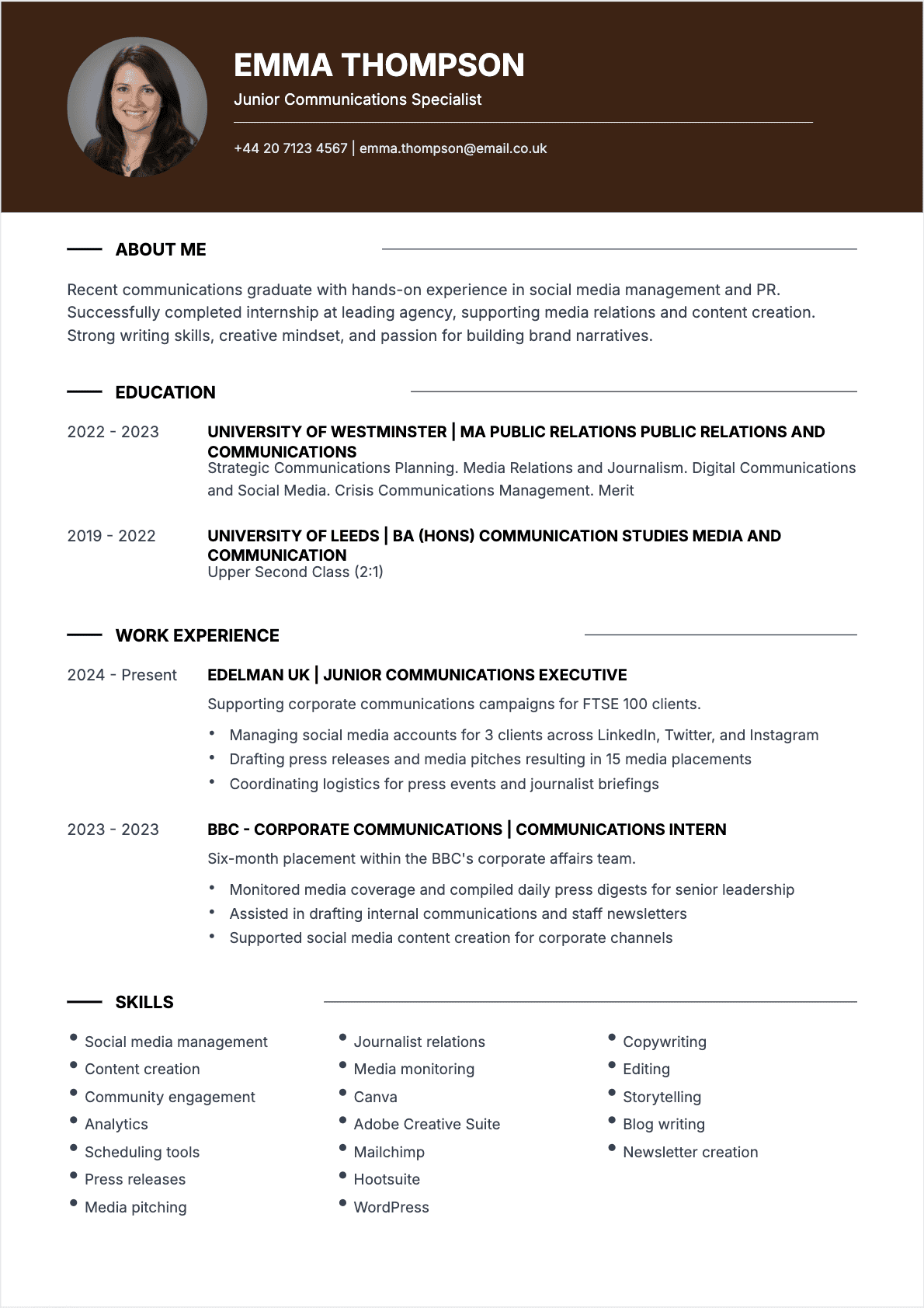
Resume Communications Specialist Junior
Communications Specialist resume template for Junior profile
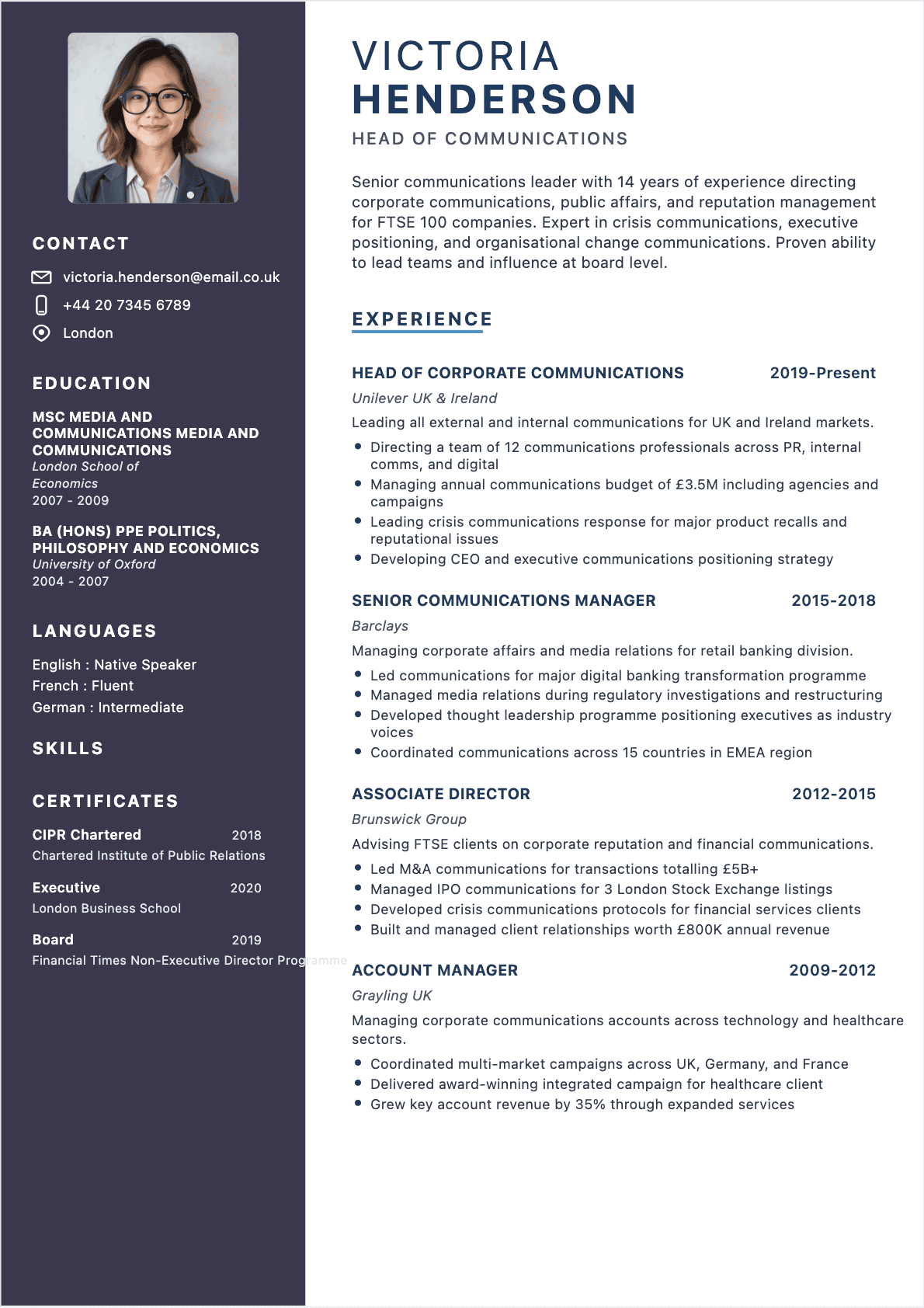
Resume Communications Specialist Senior
Communications Specialist resume template for Senior profile
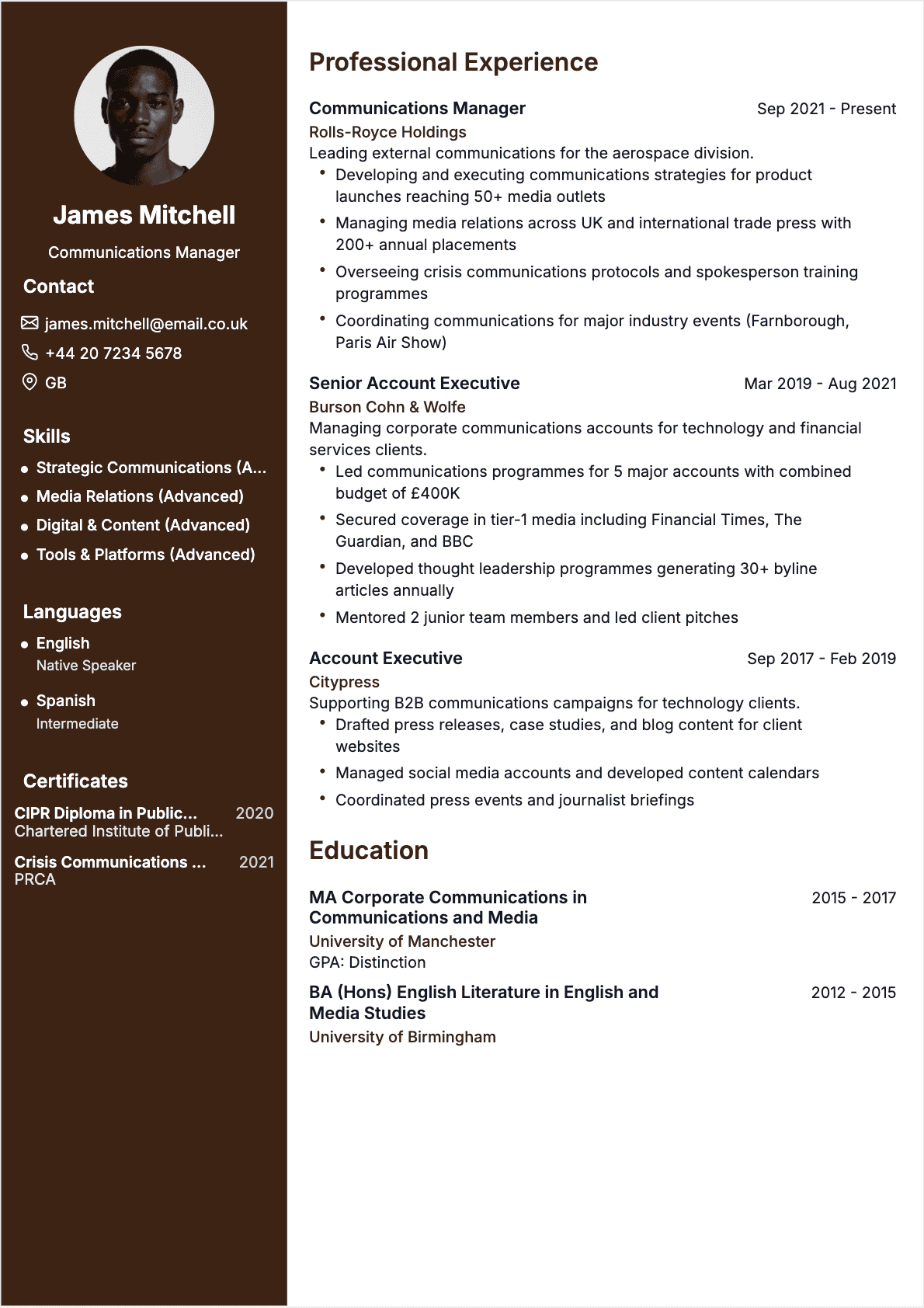
Resume Communications Specialist Confirmé
Communications Specialist resume template for Confirmé profile
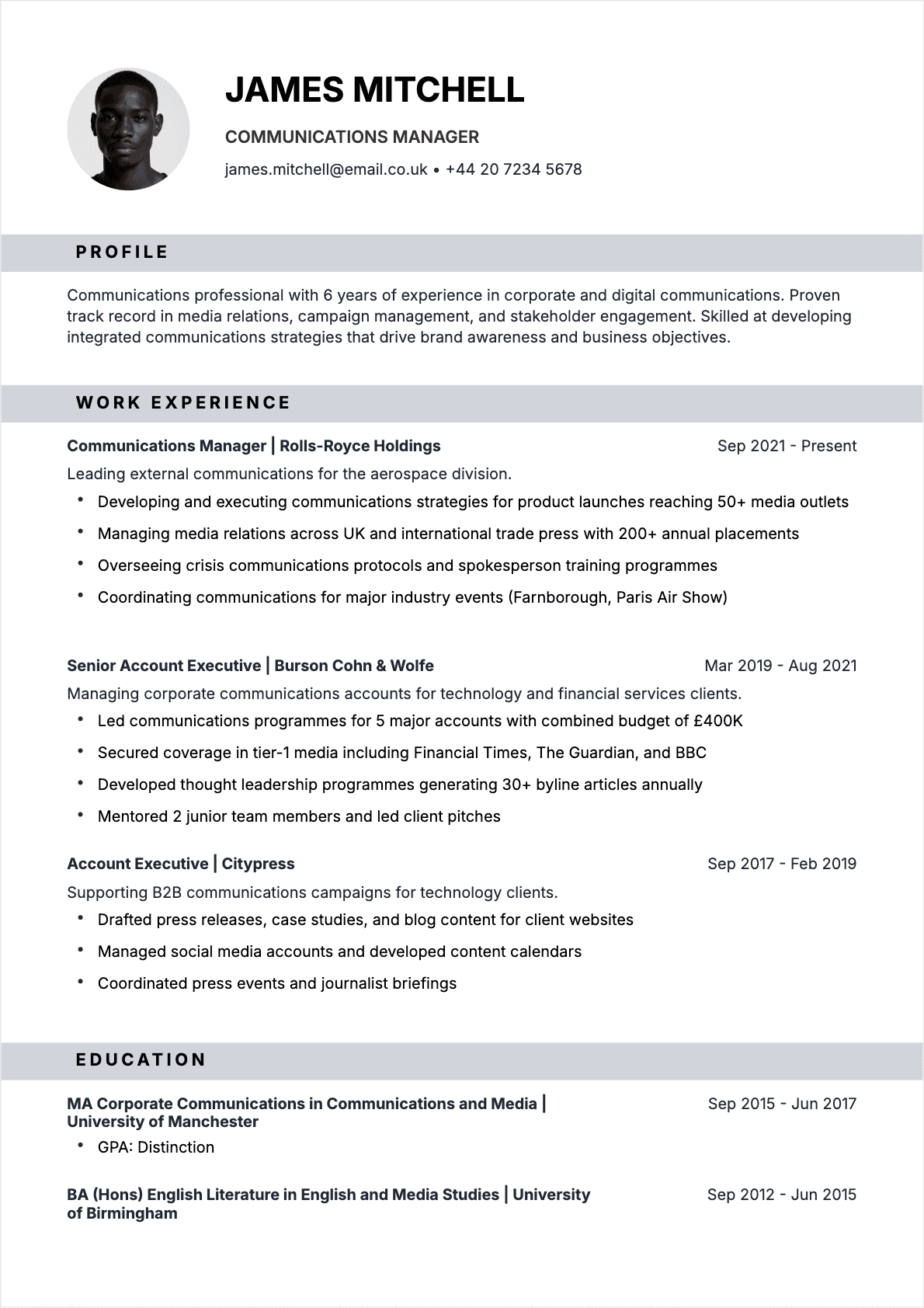
Resume Communications Specialist Confirmé
PopularCommunications Specialist resume template for Confirmé profile
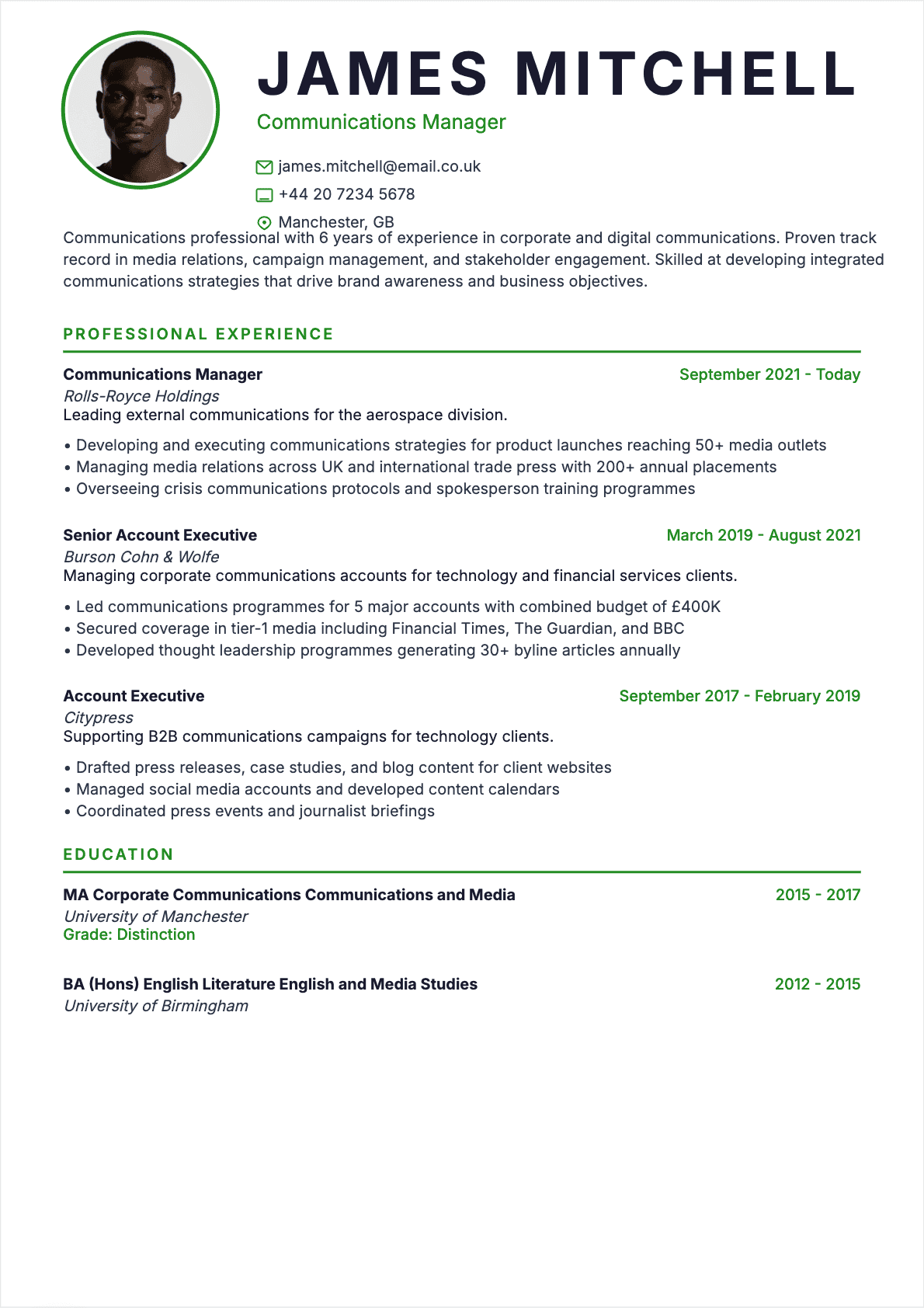
Resume Communications Specialist Confirmé
Communications Specialist resume template for Confirmé profile
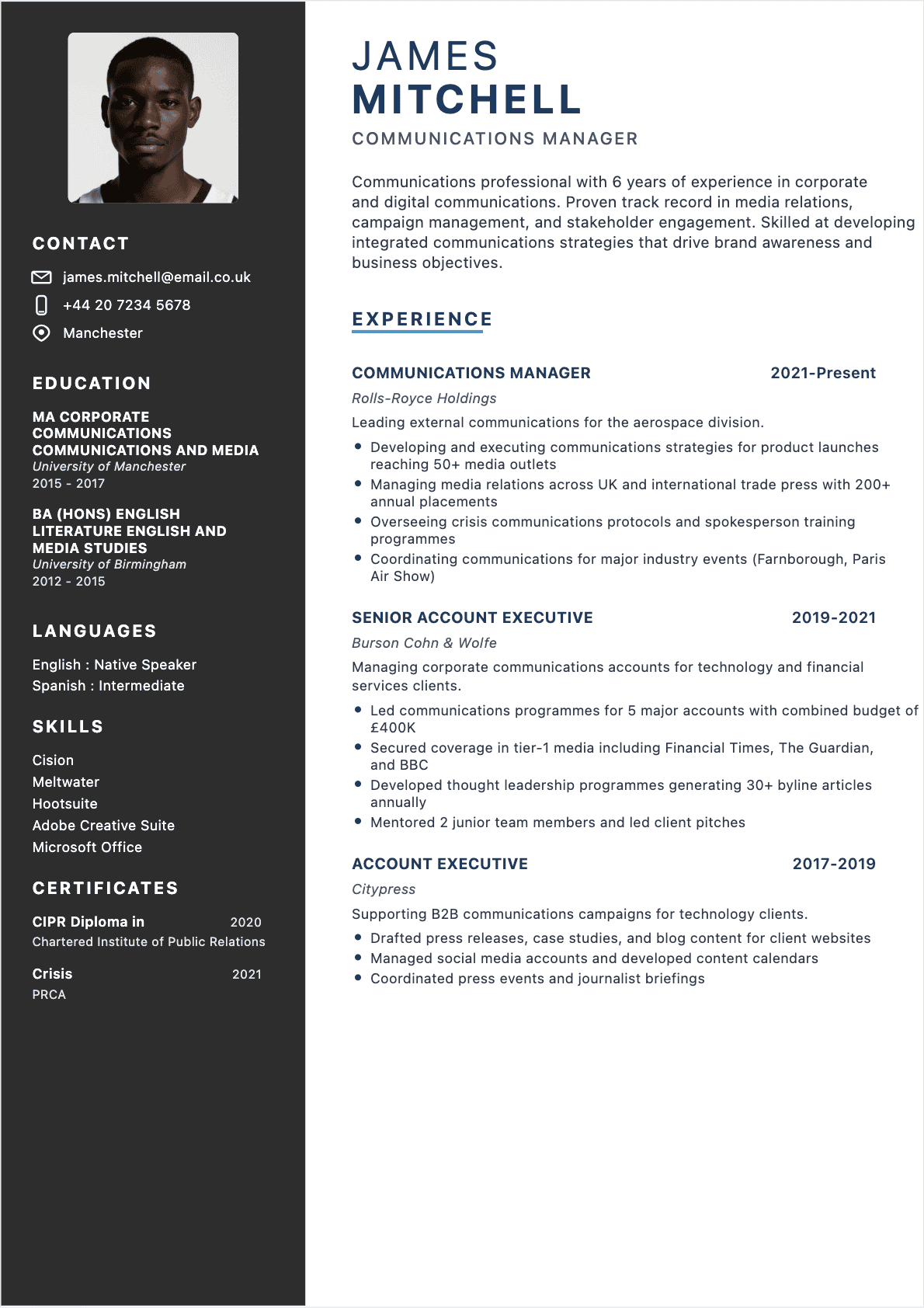
Resume Communications Specialist Confirmé
Communications Specialist resume template for Confirmé profile
Like one of these Communications Specialist resume templates?
Select it, fill in your details and download your resume as PDF.
Communications Specialist Resume Examples
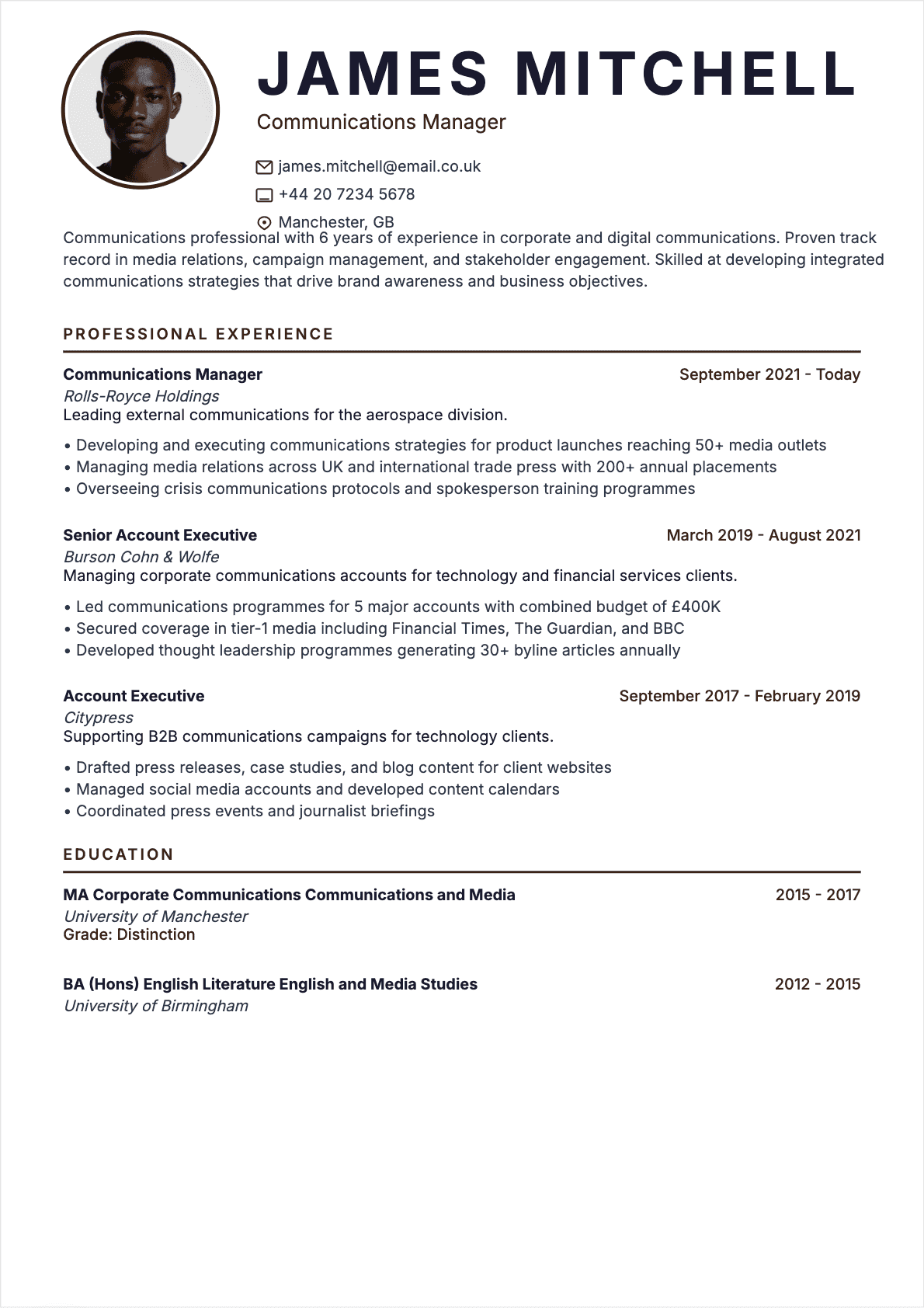
James Mitchell
Communications Manager
james.mitchell@email.co.uk
+44 20 7234 5678
Manchester, GB
Communications professional with 6 years of experience in corporate and digital communications. Proven track record in media relations, campaign management, and stakeholder engagement. Skilled at developing integrated communications strategies that drive brand awareness and business objectives.
Work Experience
Communications Manager
Rolls-Royce Holdings
- ●Developing and executing communications strategies for product launches reaching 50+ media outlets
- ●Managing media relations across UK and international trade press with 200+ annual placements
- ●Overseeing crisis communications protocols and spokesperson training programmes
Senior Account Executive
Burson Cohn & Wolfe
- ●Led communications programmes for 5 major accounts with combined budget of £400K
- ●Secured coverage in tier-1 media including Financial Times, The Guardian, and BBC
- ●Developed thought leadership programmes generating 30+ byline articles annually
Account Executive
Citypress
- ●Drafted press releases, case studies, and blog content for client websites
- ●Managed social media accounts and developed content calendars
- ●Coordinated press events and journalist briefings
Education
MA Corporate Communications
University of Manchester
BA (Hons) English Literature
University of Birmingham
Skills
Languages
English — Native Speaker
Spanish — Intermediate
Certifications
CIPR Diploma in Public RelationsChartered Institute of Public Relations
Crisis Communications CertificationPRCA
Communications Specialist role overview
A Communications Specialist serves as the strategic voice of an organization, crafting and distributing messages across multiple channels to engage audiences, build brand reputation, and support business objectives. You'll spend your days writing press releases, managing social media content, coordinating with journalists, developing internal communications, and measuring the impact of your messaging campaigns. This role sits at the intersection of storytelling, strategy, and data analysis, requiring you to balance creative content development with measurable business outcomes.
The scope of this position varies significantly by organization size and industry. In corporate environments, you might focus on investor relations, crisis communications, or executive messaging. At nonprofits, you'll often champion causes through donor communications and advocacy campaigns. Tech companies typically emphasize product launches and thought leadership, while government agencies require expertise in public affairs and regulatory communications. Regardless of sector, you'll collaborate extensively with marketing, HR, legal, and leadership teams to ensure message consistency and compliance.
Career progression typically follows a clear trajectory. Entry-level Communications Coordinators (£24,000-£32,000) handle tactical execution like social media posting and media monitoring. Mid-level Communications Specialists (£32,000-£45,000) develop strategies, manage campaigns, and often supervise junior staff. Senior Communications Managers (£45,000-£65,000) lead departments, advise C-suite executives, and oversee crisis response. Director-level roles (£65,000-£90,000+) set organizational communication strategy and manage substantial budgets. Many professionals also transition into related fields like public relations, content marketing, or corporate affairs.
Typical daily tasks include:
- Drafting press releases, blog posts, newsletters, and executive speeches tailored to specific audiences and channels
- Monitoring media coverage and social media mentions to identify opportunities and potential reputation risks
- Coordinating with designers, videographers, and external agencies to produce multimedia content
- Responding to media inquiries and maintaining relationships with journalists in relevant beats
- Analyzing campaign performance metrics (engagement rates, reach, sentiment) and adjusting strategies accordingly
- Managing internal communication platforms like intranets, town halls, and employee newsletters to maintain workforce alignment
Essential skills for a Communications Specialist resume
Your resume must demonstrate both the creative abilities to craft compelling narratives and the analytical skills to measure their impact. Recruiters scan for specific technical competencies that prove you can execute campaigns from concept through measurement, while also looking for interpersonal skills that indicate you'll collaborate effectively across departments and manage stakeholder expectations during high-pressure situations.
For ATS optimization, prioritize hard skills in your skills section and work experience bullets. Systems scan for specific tools ("Hootsuite," "Cision," "Google Analytics") and concrete abilities ("media relations," "crisis communications," "content strategy"). However, don't neglect soft skills—weave them into your achievement statements by showing how you applied them to deliver results.
Core competencies to highlight:
- Media Relations - Building and maintaining journalist relationships directly impacts your ability to secure earned media coverage and manage your organization's public narrative during both routine announcements and crisis situations.
- Content Management Systems (WordPress, Drupal, SharePoint) - Most organizations require you to publish content directly to websites and intranets, making CMS proficiency essential for timely, accurate communications.
- Social Media Management Platforms (Hootsuite, Sprout Social, Buffer) - These tools allow you to schedule posts, monitor conversations, and analyze performance across multiple channels from a single dashboard, significantly improving efficiency.
- Media Monitoring Software (Meltwater, Cision, Mention) - Tracking brand mentions, competitor activity, and industry trends enables proactive communications and helps quantify your PR impact through metrics like share of voice.
- AP Style and Editorial Standards - Consistent, error-free writing following recognized style guides demonstrates professionalism and reduces revision cycles with stakeholders and media outlets.
- Crisis Communication Planning - Organizations need specialists who can develop response protocols, draft holding statements, and coordinate cross-functional teams when reputation-threatening situations emerge.
- Data Analysis and Reporting (Google Analytics, native platform analytics) - Translating engagement metrics into strategic insights proves your campaigns deliver ROI and informs future communication investments.
- Stakeholder Management - You'll regularly balance competing priorities from executives, legal teams, and external partners, requiring diplomacy and the ability to advocate for communication best practices.
- Video and Multimedia Production Basics - Understanding video editing, graphic design principles, and accessibility requirements helps you brief creative teams effectively and produce simple assets independently.
- Email Marketing Platforms (Mailchimp, Constant Contact, HubSpot) - Designing, segmenting, and analyzing email campaigns remains central to both external marketing and internal employee communications.
- Project Management - Coordinating multi-channel campaigns with numerous stakeholders and deadlines requires strong organizational systems and tools like Asana, Monday, or Trello.
- SEO Fundamentals - Writing web content that ranks in search results extends your message reach and demonstrates understanding of how audiences discover information online.

How to write a Communications Specialist resume step by step
1. Lead with a results-focused professional summary
Write 3-4 lines that immediately establish your specialization and quantified impact. Instead of "Experienced communications professional with strong writing skills," try "Communications Specialist with 5+ years developing integrated campaigns that increased media mentions by 340% and employee engagement scores by 28 points. Expertise in crisis management, executive communications, and data-driven content strategy across healthcare and technology sectors." This approach passes ATS keyword scans while giving human recruiters concrete reasons to continue reading.
2. Structure your work experience with the CAR method (Challenge-Action-Result)
Each bullet should tell a mini-story. Weak example: "Managed social media accounts." Strong example: "Rebuilt dormant social media presence following brand crisis, developing content calendar and engagement protocols that grew followers from 8,200 to 34,000 in 11 months and improved sentiment scores from 42% to 79% positive." Notice how the strong version specifies the challenge (dormant presence, brand crisis), your actions (content calendar, protocols), and measurable outcomes (follower growth, sentiment improvement).
3. Quantify everything possible, even soft outcomes
Numbers make your achievements scannable and credible. Beyond obvious metrics like "secured 47 media placements" or "increased newsletter open rates from 18% to 31%," quantify scope and scale: "Managed communications for 12-person executive team," "Coordinated 6 product launches annually," or "Maintained relationships with 85+ journalists across trade and national outlets." When exact numbers aren't available, use ranges or percentages to show magnitude.
4. Customize your skills section for each application
Review the job posting and identify 8-12 required skills you possess. List these using the exact terminology from the posting—if they say "media monitoring," don't write "press tracking." Organize into categories like "Communications Strategy," "Digital Tools," and "Content Creation" to improve readability. Place this section high on your resume (right after your summary) since ATS systems often weight early-page keywords more heavily.
5. Showcase relevant projects and campaigns
If you have space, add a "Key Projects" or "Notable Campaigns" section highlighting 2-3 major initiatives. Format: "Campaign Name | Organization | Date" followed by 2-3 bullets describing objectives, your role, and results. Example: "Employee Return-to-Office Communications Campaign | TechCorp | Jan-Mar 2024" with bullets like "Developed 8-week multi-channel campaign (email, intranet, town halls, FAQ microsite) addressing 2,400 employees' concerns about hybrid work transition" and "Achieved 94% policy awareness rate and reduced HR inquiry volume by 67% through proactive messaging."
6. Include relevant certifications and professional development
List credentials that validate your expertise: "Accreditation in Public Relations (APR)," "Certified Content Marketing Specialist," "Crisis Communication Certificate." Also mention relevant coursework or training in emerging areas like "AI-Assisted Content Creation Workshop" or "Data Visualization for Communicators." These signals show you're investing in staying current, which matters in a rapidly evolving field.
7. Tailor your resume format to pass ATS while remaining readable
Use a clean, single-column layout with standard fonts (Arial, Calibri, Georgia). Avoid tables, text boxes, headers/footers, and graphics that confuse parsing software. Save as a .docx file unless the posting specifically requests PDF. Use standard section headings like "Professional Experience" and "Education" rather than creative alternatives like "My Journey" or "Where I've Made Impact." Remember that your resume must satisfy both algorithmic screening and human review.
8. Proofread with communications-specific scrutiny
As a communications professional, typos and grammatical errors are particularly damaging to your credibility. Read your resume aloud to catch awkward phrasing. Verify that all company names, job titles, and proper nouns are correctly capitalized. Check that your verb tenses are consistent (past tense for previous roles, present tense for current position). Have a colleague review it specifically for AP Style compliance if that's standard in your industry.
Common mistakes on Communications Specialist resumes
Listing responsibilities instead of demonstrating impact
The most frequent error is describing what you were supposed to do rather than what you actually achieved. Writing "Responsible for internal communications" tells recruiters nothing about your effectiveness. Instead, show outcomes: "Redesigned monthly employee newsletter, increasing average read time from 1.2 to 4.7 minutes and achieving 89% open rate (vs. 34% industry benchmark)." Recruiters hire based on proven results, not job descriptions they could find on any posting.
Failing to demonstrate strategic thinking
Many resumes present Communications Specialists as purely tactical executors—posting to social media, distributing press releases, updating websites. While execution matters, hiring managers want evidence that you understand the "why" behind communications. Bad: "Posted daily content to LinkedIn and Twitter." Good: "Developed platform-specific content strategy prioritizing LinkedIn for B2B thought leadership and Twitter for real-time customer service, resulting in 156% increase in qualified lead referrals from social channels." The second version shows you made strategic choices tied to business goals.
Using vague, unmeasurable language
Communications professionals should know better, yet resumes often include phrases like "improved brand awareness," "enhanced reputation," or "strengthened stakeholder relationships" without any supporting evidence. These claims are meaningless without quantification. How much did awareness improve? Among which audience? Measured how? Replace vague assertions with specific metrics: "Increased unaided brand awareness from 23% to 41% among target demographic (18-34 urban professionals) per Q4 brand tracking study."
Neglecting to show cross-functional collaboration
Communications Specialists rarely work in isolation, yet many resumes fail to demonstrate partnership skills that are critical to the role. Recruiters want to see that you can work with legal on compliance, with marketing on campaign alignment, with HR on sensitive employee matters, and with executives on high-stakes messaging. Include bullets like: "Partnered with legal and product teams to develop FDA-compliant messaging for medical device launch, balancing regulatory requirements with customer-friendly language across 12 communication touchpoints."
Ignoring industry-specific context
A Communications Specialist in healthcare faces different challenges than one in technology or finance, yet many resumes present generic experience applicable to any sector. If you're applying within a specific industry, emphasize relevant expertise. For healthcare: "Developed patient-facing materials meeting plain language and health literacy standards for audiences with varying education levels." For finance: "Crafted investor communications and earnings materials in compliance with SEC disclosure requirements and stock exchange regulations." This specificity signals you understand the unique constraints and audiences of that sector.
Overlooking crisis communication experience
Even if you haven't managed a major corporate crisis, omitting any experience with sensitive, time-critical, or reputation-protecting communications is a missed opportunity. Recruiters specifically look for this capability. Include examples like: "Served on crisis communication response team during product recall, drafting customer notifications, FAQ documents, and media statements within 4-hour activation window" or "Managed communications during unexpected CEO departure, coordinating messaging to employees, customers, and media to maintain stakeholder confidence."
Presenting outdated skills or ignoring digital evolution
Resumes that emphasize print newsletters, press kit assembly, or traditional media relations without mentioning digital channels signal you haven't kept pace with the field's evolution. While traditional skills still matter, your resume must demonstrate digital fluency. Ensure you're highlighting experience with social media analytics, digital content formats (video, podcasts, interactive content), influencer relations, and online reputation management. A 2026 Communications Specialist resume without substantial digital experience raises serious questions about your relevance.
Communications Specialist resume trends in 2026
The communications field is experiencing significant transformation as artificial intelligence tools become standard workflow components. Employers now expect specialists to use AI writing assistants for drafting initial content, sentiment analysis tools for monitoring brand perception, and predictive analytics for identifying emerging issues before they become crises. Your resume should demonstrate comfort with these technologies while emphasizing the uniquely human skills—strategic judgment, cultural sensitivity, stakeholder empathy—that AI cannot replicate. Mention specific AI tools you've used (ChatGPT for ideation, Grammarly Business for consistency, Synthesia for video production) alongside the strategic decisions you made that the technology couldn't.
Data literacy has become non-negotiable
Communications teams are increasingly expected to prove ROI with the same rigor as marketing and sales departments. Top employers want specialists who can move beyond vanity metrics (likes, impressions) to business impact measures (lead generation, employee retention, reputation value). Your resume should showcase experience with analytics platforms, A/B testing, attribution modeling, and translating data into executive-ready insights. Highlight achievements like "Developed communications dashboard tracking 14 KPIs across channels, enabling data-driven budget reallocation that improved cost-per-engagement by 43%" or "Conducted sentiment analysis of 12,000+ customer comments to identify product messaging gaps, informing Q3 campaign strategy."
Employee communications expertise commands premium value
The shift to hybrid work, ongoing talent competition, and increased focus on workplace culture have elevated internal communications from an afterthought to a strategic priority. Organizations are hiring specialists specifically for employee engagement, change management communications, and culture-building initiatives. If you have this experience, feature it prominently. Employers particularly value expertise in digital workplace tools (Slack, Teams, Workplace from Meta), video communication skills for distributed teams, and experience measuring employee sentiment and engagement through surveys and listening programs.
Specialized industry knowledge differentiates candidates
As communications becomes more complex and regulated, generalists are losing ground to specialists with deep sector expertise. Healthcare organizations want communicators who understand HIPAA, patient privacy, and health literacy. Financial services firms need specialists versed in SEC regulations and investor relations protocols. Technology companies seek communicators who can explain complex products to non-technical audiences. Your resume should emphasize industry-specific credentials, terminology, and achievements rather than presenting yourself as capable of working in any sector. This specialization typically commands 15-25% higher compensation than generalist roles.
Remote work has expanded opportunity but intensified competition
Many communications roles now offer remote or hybrid options, allowing you to apply for positions beyond your geographic area. However, this also means you're competing with candidates nationwide or globally. Your resume must work harder to differentiate you. Emphasize unique combinations of skills ("crisis communications + healthcare + Spanish fluency"), measurable achievements that prove remote work effectiveness ("Managed 11-person distributed communications team across 6 time zones, maintaining 94% project on-time delivery rate"), and experience with asynchronous communication tools essential for remote collaboration.
Authenticity and transparency skills are explicitly sought
Following years of corporate scandals, social movements, and increased stakeholder activism, organizations need communicators who can help them engage authentically on sensitive topics. Job postings increasingly mention "purpose-driven communications," "ESG reporting," "DEI communications," and "stakeholder capitalism messaging." Your resume should demonstrate experience addressing complex, potentially controversial topics with nuance and authenticity. Examples might include: "Led development of company's first climate commitment communications, balancing ambitious goals with honest assessment of current gaps" or "Developed inclusive language guidelines adopted across 2,400-person organization, providing practical alternatives to 47 commonly-used non-inclusive terms."
Further reading:
Frequently asked questions
Find answers to the most frequently asked questions.
Yes—ideally in the header and again in a short “Portfolio” section. Add 2–4 relevant samples (press release, byline, newsletter, campaign landing page) and attach one metric for each (pick-up, open rate, CTR, registrations). If work is confidential, use redacted PDFs or describe the asset and outcomes.
Choose KPIs that match the channels in the job ad. PR roles: earned mentions/quarter, tier-1 coverage, share of voice, message pull-through. Internal comms: open rate, intranet CTR, town hall attendance, adoption metrics. Digital/content: sessions, conversions, time on page, subscriber growth.
Most candidates should target 1 page for under 5–6 years of experience and 2 pages for more senior profiles or complex international scopes. Prioritize the last 8–10 years, keep bullets outcome-led, and move older roles to a short “Additional Experience” section if needed.
For internal communications, lead with employee engagement, change communications, leadership cadence, and channel governance (newsletter, intranet, town halls). For PR, lead with media relations outcomes (coverage, tier quality, share of voice), pitching approach, spokesperson briefs, and crisis communications readiness. Mirror the job’s keywords.
It depends on the country. In the US, avoid photos to reduce bias risk and match hiring norms. In the UK, it’s generally optional but uncommon for corporate roles. When applying internationally, follow the local standard and keep the header focused on contact details and portfolio links.
Describe your role and the process rather than sensitive details. Mention artifacts (holding statement, Q&A, escalation path), timing (e.g., “within 2 hours”), stakeholders (legal, leadership), and outcomes (faster approvals, reduced misinformation, consistent messaging). Keep client or incident specifics anonymized if required.
Your career deserves a better resume
With CVtoWork, select a template, fill in the fields and download your resume as PDF.
Start creating