Chief Financial Officer Resume
Example, Template & Expert Tips 2026
Updated on April 18, 2026.
Write a CFO resume that lands interviews in 2026: structure, ATS keywords, quantified achievements, and examples to prove board impact.
Chief Financial Officer Resume Templates
8 Templates available
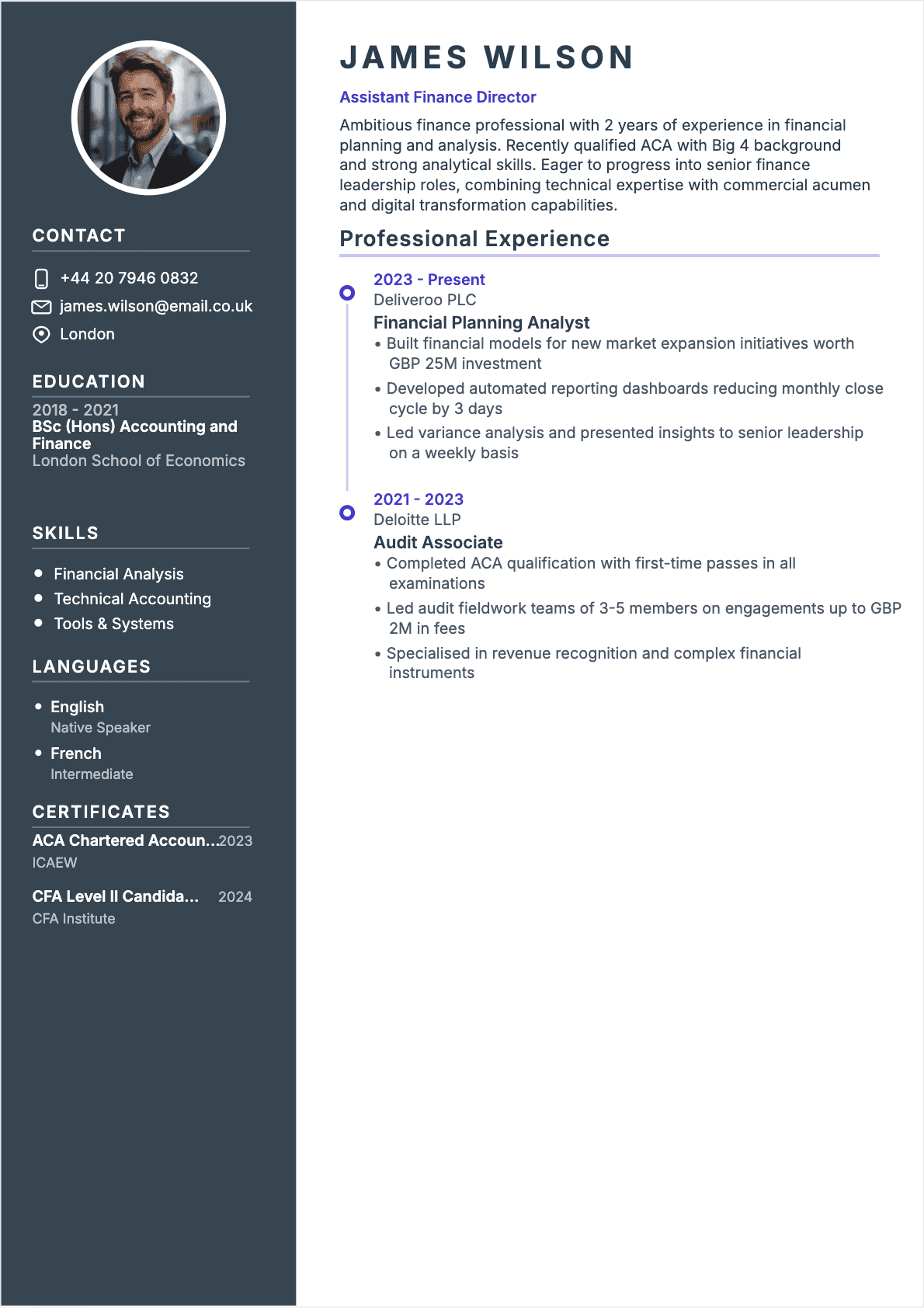
Resume Chief Financial Officer Junior
Chief Financial Officer resume template for Junior profile
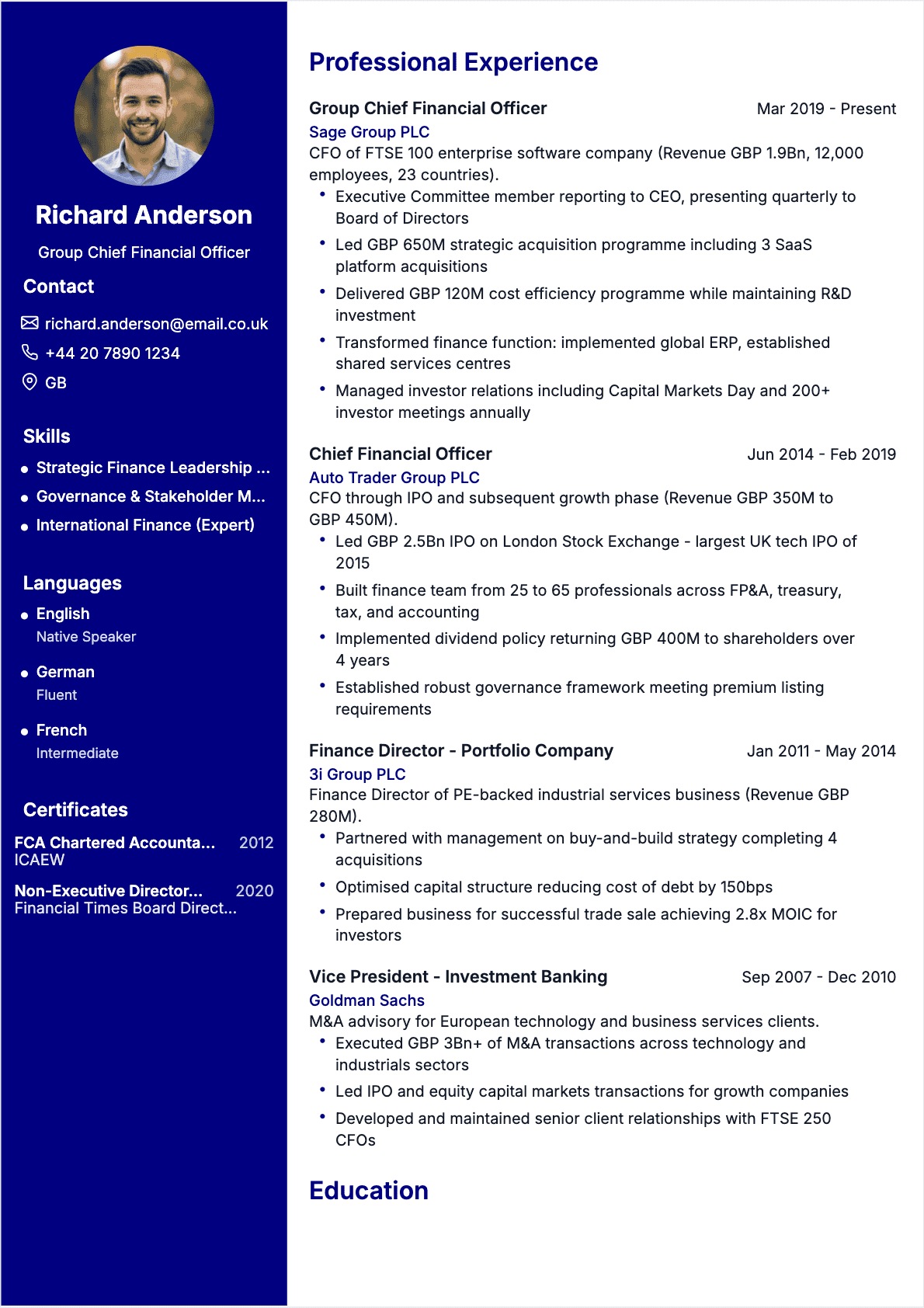
Resume Chief Financial Officer Senior
Chief Financial Officer resume template for Senior profile
Resume Chief Financial Officer Confirmé
Chief Financial Officer resume template for Confirmé profile
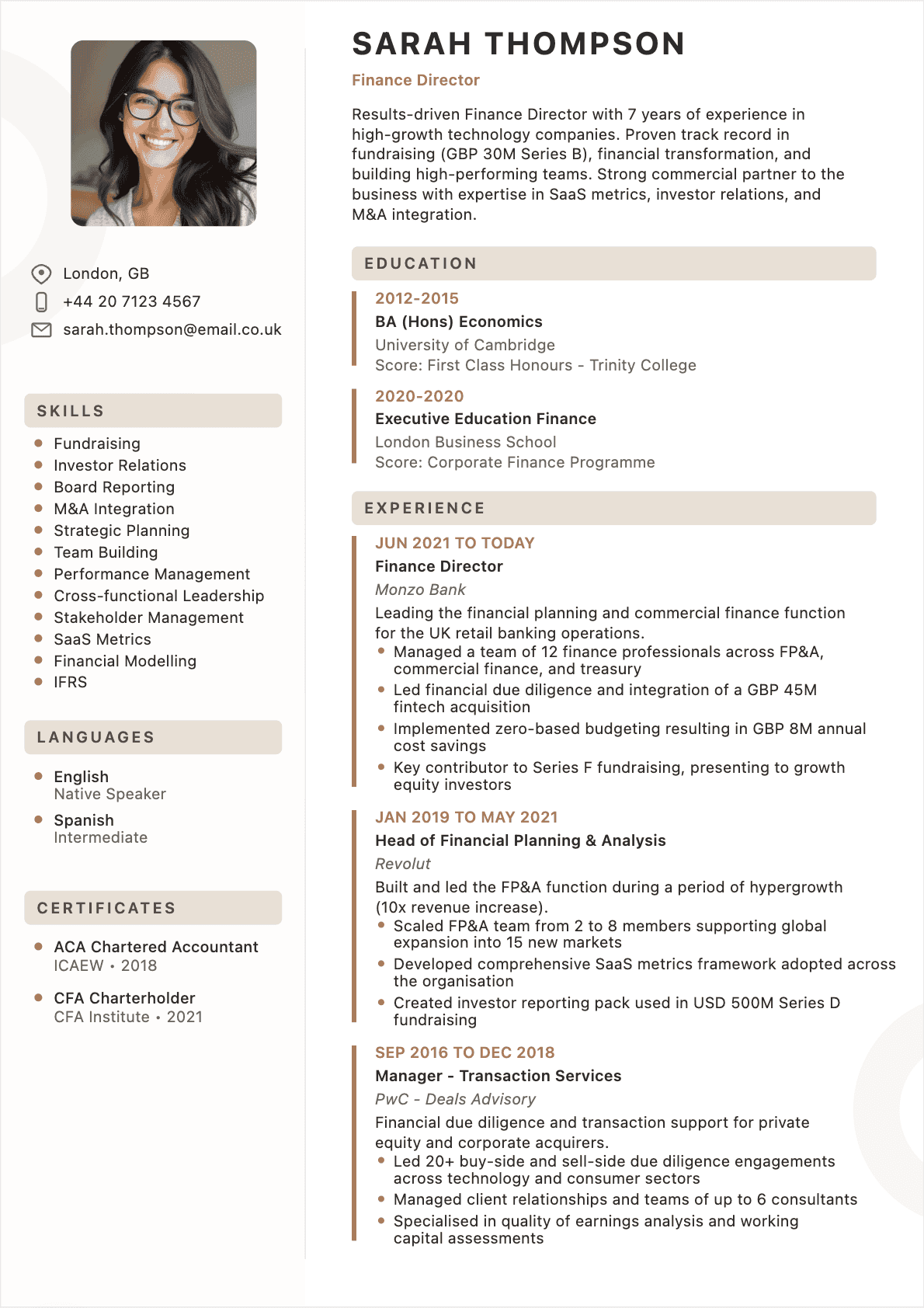
Resume Chief Financial Officer Confirmé
PopularChief Financial Officer resume template for Confirmé profile
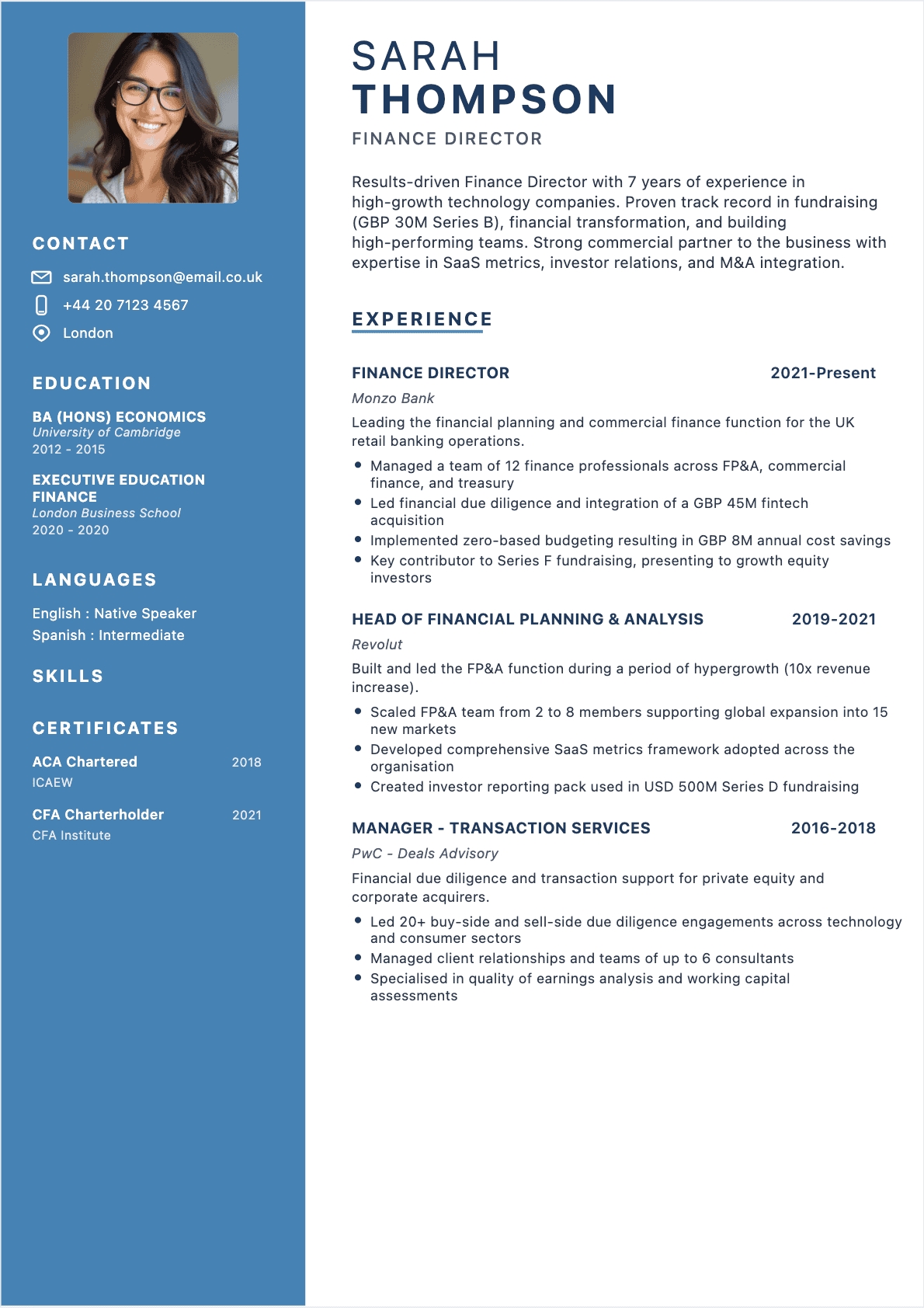
Resume Chief Financial Officer Confirmé
Chief Financial Officer resume template for Confirmé profile
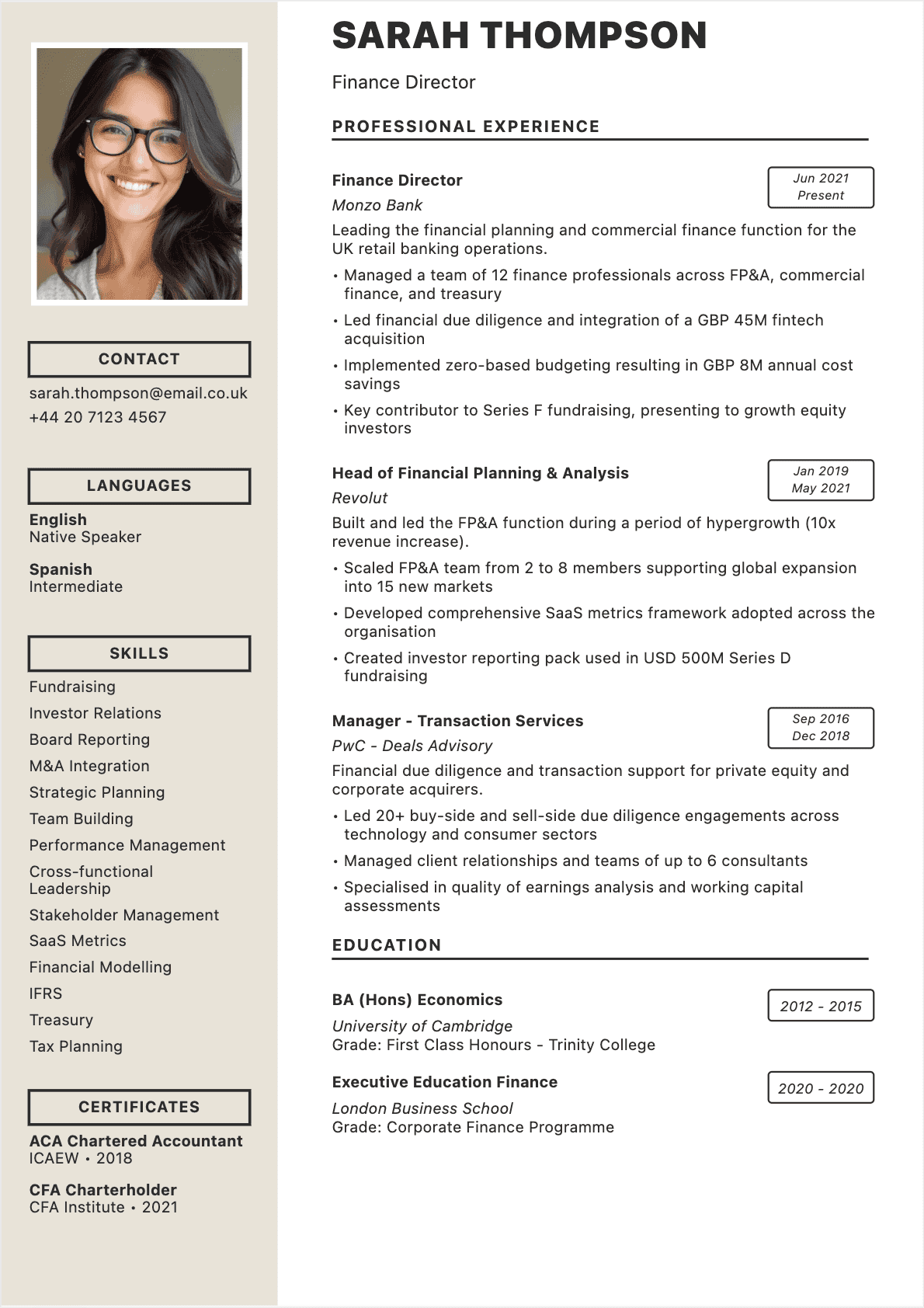
Resume Chief Financial Officer Confirmé
Chief Financial Officer resume template for Confirmé profile
Like one of these Chief Financial Officer resume templates?
Select it, fill in your details and download your resume as PDF.
Chief Financial Officer Resume Examples
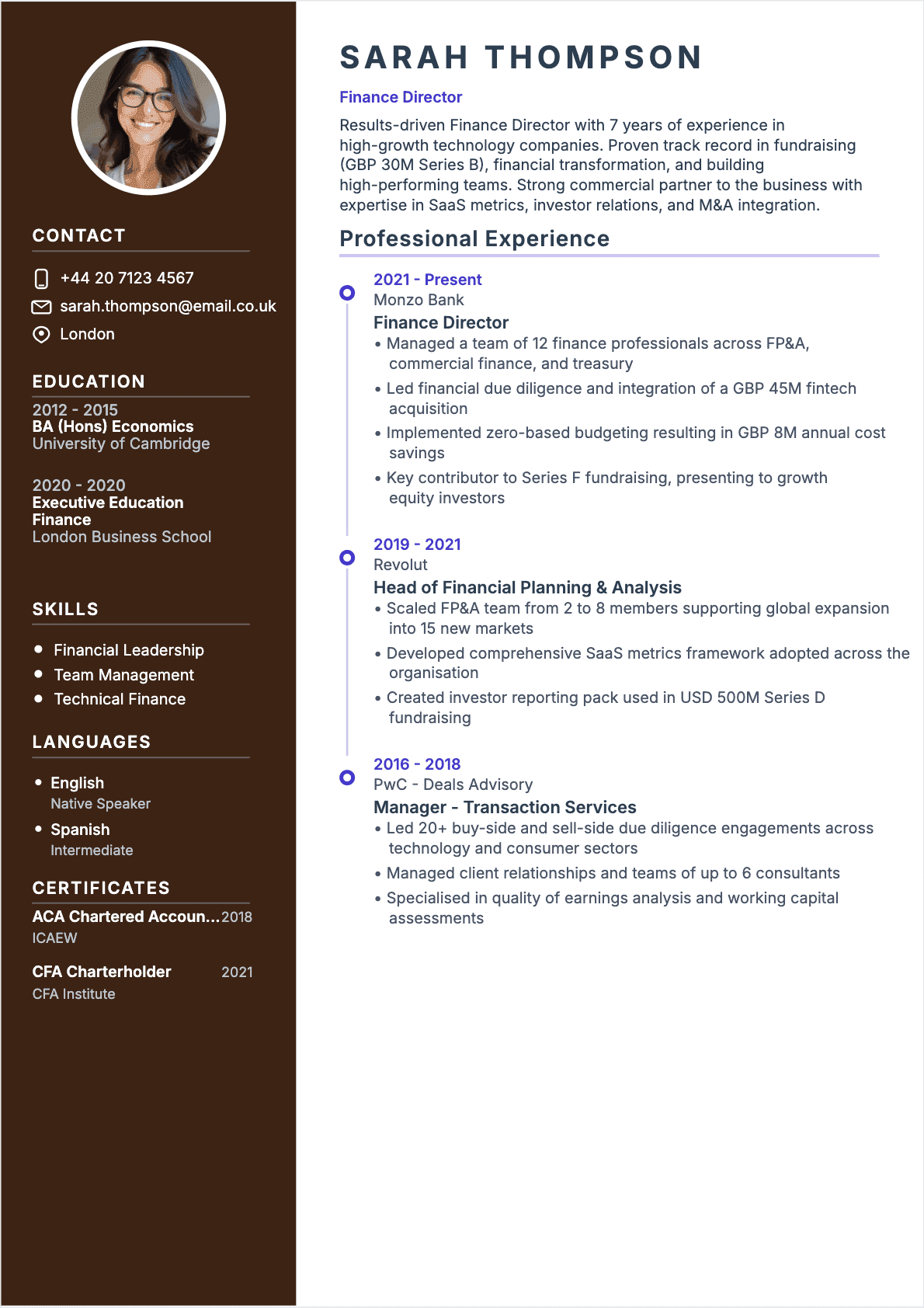
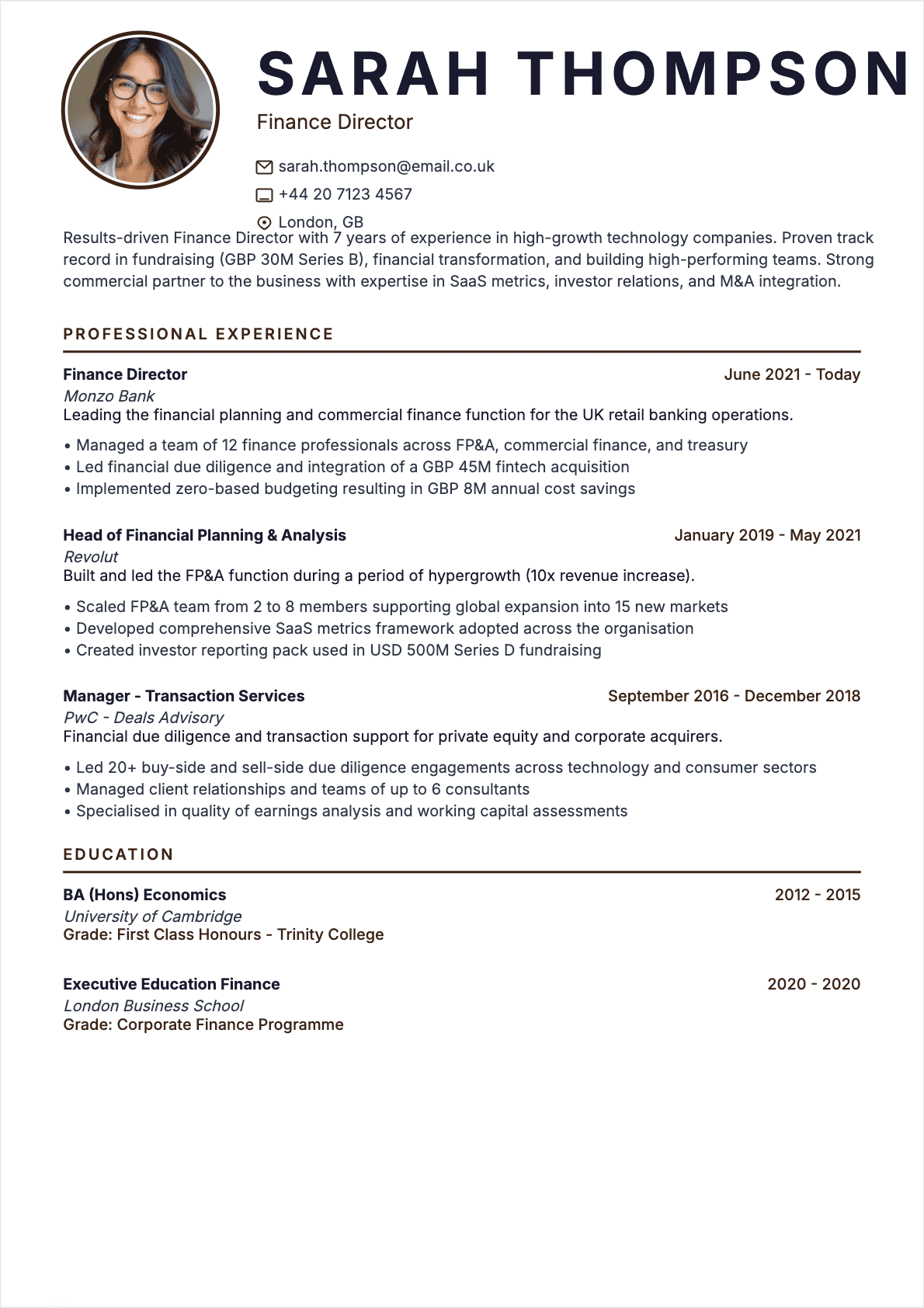
Sarah Thompson
Finance Director
sarah.thompson@email.co.uk
+44 20 7123 4567
London, GB
Results-driven Finance Director with 7 years of experience in high-growth technology companies. Proven track record in fundraising (GBP 30M Series B), financial transformation, and building high-performing teams. Strong commercial partner to the business with expertise in SaaS metrics, investor relations, and M&A integration.
Work Experience
Finance Director
Monzo Bank
- ●Managed a team of 12 finance professionals across FP&A, commercial finance, and treasury
- ●Led financial due diligence and integration of a GBP 45M fintech acquisition
- ●Implemented zero-based budgeting resulting in GBP 8M annual cost savings
Head of Financial Planning & Analysis
Revolut
- ●Scaled FP&A team from 2 to 8 members supporting global expansion into 15 new markets
- ●Developed comprehensive SaaS metrics framework adopted across the organisation
- ●Created investor reporting pack used in USD 500M Series D fundraising
Manager - Transaction Services
PwC - Deals Advisory
- ●Led 20+ buy-side and sell-side due diligence engagements across technology and consumer sectors
- ●Managed client relationships and teams of up to 6 consultants
- ●Specialised in quality of earnings analysis and working capital assessments
Education
BA (Hons)
University of Cambridge
Executive Education
London Business School
Skills
Languages
English — Native Speaker
Spanish — Intermediate
Certifications
ACA Chartered AccountantICAEW
CFA CharterholderCFA Institute
Chief Financial Officer role overview
A Chief Financial Officer sits at the strategic heart of an organization, translating financial data into business decisions that shape company direction. You're not just managing numbers—you're the executive who tells the board whether a $50M acquisition makes sense, how to structure debt to fuel expansion, or when to pivot strategy based on cash flow projections. Your day alternates between high-stakes board presentations, one-on-one sessions with the CEO on capital allocation, and deep analytical work reviewing divisional performance metrics.
The CFO role has expanded dramatically beyond traditional accounting oversight. Modern CFOs own investor relations, drive digital transformation initiatives, lead M&A due diligence, and increasingly serve as the data authority for the entire organization. You're expected to forecast market shifts, assess geopolitical risks to supply chains, and advise on everything from cybersecurity investments to ESG reporting frameworks. In mid-sized companies ($100M-$500M revenue), you might still be hands-on with month-end close processes; in enterprises, you're managing a finance organization of 50-200 people across FP&A, treasury, tax, and accounting functions.
Career progression typically follows this path: Financial Analyst → Senior Analyst → Finance Manager → Director of FP&A or Controller → VP of Finance → CFO. Some CFOs come through the Controller track (accounting-heavy), others through FP&A (strategy-focused), and increasingly through corporate development or investment banking. The jump to CFO usually requires 15-20 years of finance experience, though high-growth tech companies sometimes promote faster. Many CFOs eventually transition to CEO roles, join private equity firms as operating partners, or serve on multiple boards.
Compensation varies significantly by company size and industry. In the United States, CFOs at companies with $50M-$100M revenue typically earn $200K-$300K base plus 40-60% bonus and equity. At $500M-$1B companies, total compensation ranges from $400K-$700K. Fortune 500 CFOs command $1M-$3M+ in total compensation. Public company CFOs receive substantial equity packages that vest over 3-4 years. Industry matters: technology and financial services CFOs earn 20-30% more than manufacturing or non-profit sector equivalents at similar revenue levels.
Typical daily responsibilities include:
- Reviewing overnight treasury positions and foreign exchange exposures across 12-15 currencies, approving hedging strategies with the treasury team
- Leading the weekly executive committee meeting, presenting updated 13-week cash flow forecasts and variance analysis against quarterly targets
- Meeting with investment bankers or institutional investors about upcoming debt refinancing, equity raises, or M&A opportunities
- Reviewing draft 10-Q filings with the Controller and external audit team, ensuring revenue recognition aligns with new accounting standards
- Analyzing divisional P&Ls with business unit leaders, challenging assumptions in their annual operating plans and capital expenditure requests
- Conducting one-on-ones with direct reports (VP FP&A, Controller, Treasurer, VP Tax) to remove blockers and develop their leadership capabilities
Essential skills for a Chief Financial Officer resume
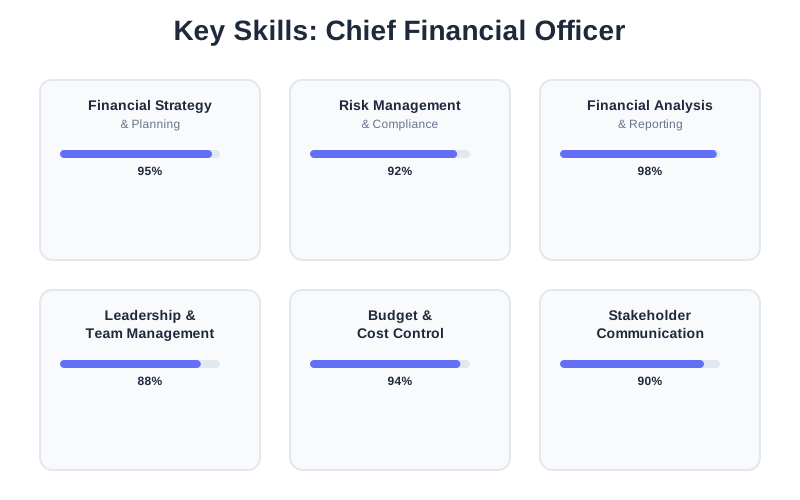
CFO resumes must demonstrate both technical mastery and executive leadership capabilities. Boards and CEOs hire CFOs who can translate complex financial scenarios into clear strategic recommendations, so your resume needs to show you've operated at the intersection of finance and business strategy. The skills that matter most are those that prove you can protect company assets, fuel growth, and provide the financial intelligence that drives better decisions across the organization.
ATS systems for executive roles scan for specific technical competencies and leadership indicators. Prioritize skills like 'financial planning & analysis,' 'GAAP/IFRS,' 'investor relations,' and 'M&A' in your skills section and throughout your experience bullets. Many companies use executive search platforms that weight industry-specific terms heavily—if you're targeting SaaS companies, include 'ARR forecasting' and 'Rule of 40'; for manufacturing, emphasize 'working capital optimization' and 'cost accounting.'
Critical skills to feature prominently:
- Financial Planning & Analysis (FP&A): Building multi-year financial models that stress-test scenarios, guide capital allocation, and set realistic growth targets—this is the foundation of strategic CFO work and appears in 87% of CFO job descriptions.
- GAAP/IFRS Expertise: Ensuring financial statements withstand audit scrutiny and comply with evolving standards like ASC 606 (revenue recognition) and ASC 842 (lease accounting)—critical for public companies and pre-IPO organizations.
- Capital Markets & Fundraising: Executing debt and equity raises, managing banking relationships, and structuring deals that optimize the balance sheet—essential for growth-stage and PE-backed companies.
- Mergers & Acquisitions: Leading buy-side and sell-side due diligence, modeling accretion/dilution, and managing post-merger integration—60% of CFOs are directly involved in M&A strategy.
- Investor Relations: Communicating financial performance to institutional investors, analysts, and board members with clarity and credibility—public company CFOs spend 20-30% of their time on IR activities.
- Enterprise Risk Management: Identifying financial, operational, and compliance risks, then building frameworks to monitor and mitigate them—increasingly important as boards focus on cyber, ESG, and supply chain risks.
- Treasury & Cash Management: Optimizing working capital, managing multi-currency cash positions, and ensuring adequate liquidity across business cycles—poor cash management remains a top reason for business failure.
- Systems Implementation: Overseeing ERP implementations (NetSuite, SAP, Oracle) and integrating financial systems with operational platforms—digital transformation is now a core CFO responsibility.
- Team Leadership & Development: Building high-performing finance organizations, mentoring future leaders, and creating a culture of analytical rigor—CFOs typically manage 15-150 people depending on company size.
- Board Communication: Presenting complex financial information to board members with varying financial literacy, facilitating audit committee meetings, and providing decision-ready recommendations—this separates CFOs from VPs of Finance.
- Strategic Business Partnering: Working alongside the CEO and business unit leaders to shape strategy, not just report on results—modern CFOs are co-pilots, not scorekeepers.
- Regulatory & Compliance Oversight: Ensuring SOX compliance, managing external audits, and staying ahead of SEC reporting requirements—public company CFOs face personal liability for financial misstatements.
How to write a Chief Financial Officer resume step by step
1. Lead with an executive summary that quantifies your financial impact
Skip generic objective statements. Your summary should immediately establish your level: company sizes you've scaled, transaction values you've managed, and the financial outcomes you've delivered. Write 3-4 lines that answer: What size organizations have you led finance for? What major transactions or transformations have you executed? What's your superpower (capital efficiency, M&A, turnarounds)?
Example: 'CFO with 18 years scaling finance organizations for $200M-$800M B2B software companies through hypergrowth and successful exits. Led financial operations through $340M Series D, two acquisitions totaling $125M, and IPO readiness achieving 95% gross margins and 40% EBITDA. Built FP&A infrastructure supporting 60% YoY growth while reducing close cycle from 15 to 5 days.'
2. Structure your experience section around business outcomes, not job duties
Each role should open with a context-setting line that establishes company size, your scope, and reporting structure. Then use 4-6 bullets that emphasize strategic initiatives and measurable results. Boards care about how you've driven valuation, managed risk, and enabled growth—not that you 'oversaw accounting operations.'
Instead of: 'Responsible for all financial planning, accounting, and reporting functions for technology company.' Write: 'Directed 45-person finance organization across FP&A, accounting, tax, and treasury for $380M ARR SaaS platform (8,000 customers, 1,200 employees), reporting to CEO and Board of Directors.'
3. Quantify everything with specific metrics that prove board-level impact
Use numbers that matter to investors and boards: revenue growth rates, EBITDA margins, cash runway extensions, valuation increases, cost savings as percentage of revenue, days sales outstanding improvements, and successful audit outcomes. Include deal sizes, fundraising amounts, and the scale of teams you've built.
Instead of: 'Improved financial processes and reporting accuracy.' Write: 'Redesigned financial close process reducing cycle time from 12 to 4 days while implementing automated reconciliations that eliminated $2.3M in annual audit fees and achieved zero material weaknesses across three consecutive SOX audits.'
4. Highlight transactions and transformational projects prominently
Create a dedicated bullet for each major transaction (fundraising, M&A, IPO preparation) or transformation (ERP implementation, carve-out, turnaround). These are the experiences that differentiate CFO candidates. Include the financial outcome or strategic rationale, not just the activity.
Example: 'Orchestrated $180M Series C financing led by Sequoia and Andreessen Horowitz at $1.2B post-money valuation, building investor pipeline of 40+ institutional funds and negotiating terms that preserved founder control while extending cash runway to 48 months.'
5. Demonstrate cross-functional leadership and strategic influence
Show how you've shaped company strategy beyond finance. Include examples of pricing strategy changes, market expansion decisions informed by your analysis, or operational improvements you championed. This proves you're a business leader who happens to run finance, not just a technical expert.
Instead of: 'Worked with sales team on forecasting.' Write: 'Partnered with CRO to redesign sales compensation structure and implement usage-based pricing model, driving 28% increase in average contract value and improving revenue predictability (95% forecast accuracy vs. 73% prior).'
6. Include board experience, certifications, and technical systems
List any board positions (even advisory boards or non-profit boards) in a separate section—this signals peer recognition of your executive capabilities. Your CPA, CFA, or MBA should be prominent. Create a technical skills section listing ERP systems (SAP, Oracle, NetSuite), BI tools (Tableau, Power BI), and specialized software (Adaptive Insights, Anaplan) you've implemented or used.
7. Tailor your resume for company stage and industry
A CFO resume for a pre-IPO tech company should emphasize capital raising, unit economics, and scaling infrastructure. For a PE-backed manufacturer, highlight operational improvements, working capital management, and buy-and-build strategies. For a turnaround situation, lead with cost restructuring and cash preservation. Review the job description for clues about their biggest challenges.
8. Keep it to two pages maximum with clear visual hierarchy
Executive recruiters spend 30-45 seconds on initial resume screening. Use bold headers for company names and titles, bullet points for achievements, and white space strategically. Your most recent 10-15 years should occupy 80% of the space. Roles from 20+ years ago can be condensed to a single line with title and company unless they're highly relevant.
Common mistakes on Chief Financial Officer resumes
Listing responsibilities instead of demonstrating strategic impact. The biggest mistake CFO candidates make is writing a resume that reads like a job description. Stating that you 'managed financial planning and analysis' or 'oversaw accounting operations' tells recruiters nothing about your caliber. They assume any CFO does these things. What they want to know is: Did you transform the FP&A function to support faster decision-making? Did you reduce the accounting team's workload through automation while improving accuracy? Bad example: 'Managed all aspects of financial reporting and compliance.' Good example: 'Restructured financial reporting framework implementing driver-based models and automated dashboards, reducing executive reporting preparation time by 60 hours monthly while improving forecast accuracy from 82% to 96%.'
Failing to establish company context and scope. Executive recruiters need to quickly assess whether your experience matches their client's scale. A resume that says 'CFO at TechCorp' without indicating company size, growth stage, or complexity makes evaluation impossible. Always include revenue size, employee count, funding stage, or other scope indicators. Bad: 'CFO, Manufacturing Company, 2018-Present.' Good: 'CFO, $420M revenue industrial equipment manufacturer (3 facilities, 850 employees, PE-backed), reporting to CEO and Sponsor Board, 2018-Present.' This immediately tells recruiters if your experience is relevant.
Overemphasizing technical accounting at the expense of business leadership. Many CFOs who came up through the Controller track make their resume too accounting-heavy. While technical competence matters, boards hire CFOs primarily for strategic thinking and business partnership. If your resume focuses heavily on month-end close, journal entries, and accounting standards without showing how you influenced business strategy, you'll be perceived as a strong Controller, not a CFO. Balance is essential: roughly 60% of your bullets should focus on strategic initiatives, growth enablement, and cross-functional leadership, with 40% on technical excellence and operational efficiency.
Using vague language instead of specific financial metrics. Phrases like 'significantly improved profitability' or 'enhanced cash position' are meaningless without numbers. CFOs deal in precise figures daily—your resume should reflect this. Specify percentage improvements, dollar amounts, basis point changes, and timeframes. Bad: 'Improved working capital management.' Good: 'Reduced cash conversion cycle from 67 to 41 days through AP/AR optimization and inventory management improvements, freeing $18M in working capital redeployed to growth initiatives.' The specific numbers prove you can drive measurable outcomes.
Neglecting to showcase transaction experience. Many CFO roles specifically require M&A, fundraising, or IPO experience. If you've led these transactions but they're buried in generic bullets, recruiters will miss them. Give each significant transaction its own bullet with the financial details. Include deal values, valuation multiples, your specific role, and the strategic outcome. Example: 'Led acquisition of competitor for $87M (6.2x revenue multiple), managing due diligence, financing through $60M debt package, and integration of 180 employees, achieving projected $12M cost synergies within 18 months.'
Including outdated or irrelevant early-career details. Your resume shouldn't chronicle your entire career from entry-level analyst roles 25 years ago. Recruiters care about your last 15 years of progressively senior experience. If you have more than 20 years of experience, consolidate early roles into a single 'Early Career' section with just titles and companies. The exception: if an early role is with a prestigious company (Goldman Sachs, McKinsey) or highly relevant to the target role, you can keep it visible but limit it to one line.
Writing in passive voice or third person. Executive resumes should be direct and action-oriented. Avoid phrases like 'Was responsible for' or 'Duties included.' Start bullets with strong action verbs: directed, transformed, executed, architected, negotiated, spearheaded. Bad: 'Was responsible for the oversight of a team of 30 finance professionals.' Good: 'Built and led 30-person finance organization across FP&A, accounting, and treasury, developing two direct reports into VP-level leaders promoted within 24 months.'
Chief Financial Officer resume trends in 2026
The CFO role continues to expand beyond traditional finance boundaries. Companies now expect their CFO to be the chief data officer, technology strategist, and often the primary voice on ESG and sustainability initiatives. Resumes that only showcase financial stewardship without demonstrating technology fluency or strategic business partnership are increasingly filtered out. The most competitive candidates show they've driven digital transformation, implemented AI-powered forecasting tools, or built data infrastructure that serves the entire organization—not just finance.
AI and automation skills have become table stakes. CFOs who've implemented machine learning for revenue forecasting, automated financial close processes, or deployed AI-powered analytics platforms have a significant advantage. Companies want to see specific examples: 'Implemented Workday Adaptive Planning with embedded AI forecasting models, reducing planning cycle time from 6 weeks to 10 days while improving accuracy by 23%' is far more compelling than generic 'systems experience.' The CFOs getting hired in 2026 can articulate how they've used technology to make their teams more strategic and less transactional. If you haven't led a significant finance systems transformation in the past 5 years, your resume may signal you're behind the curve.
ESG reporting and sustainability metrics are now core CFO competencies. With SEC climate disclosure rules and increasing investor focus on environmental and social governance, CFOs need to demonstrate experience with non-financial reporting frameworks. Resumes should highlight any experience with ESG reporting standards (GRI, SASB, TCFD), carbon accounting, or sustainability-linked financing. Example: 'Established ESG reporting framework aligned with SASB standards, securing $100M sustainability-linked credit facility with 25bps interest rate reduction tied to carbon intensity targets.' Even if your experience is limited, showing awareness of these requirements matters.
Private equity and venture capital experience commands premium value. As PE firms have deployed record amounts of capital, CFOs with experience in PE-backed environments or who've worked directly with financial sponsors are in high demand. Your resume should explicitly state if you've worked with PE sponsors, managed to value creation plans, or executed buy-and-build strategies. Specific language matters: 'Partnered with Vista Equity Partners on 100-day value creation plan, executing operational improvements that expanded EBITDA margins from 18% to 29% ahead of exit.' This signals you understand the PE playbook and can execute under sponsor oversight.
Remote and distributed finance teams are now standard. The pandemic permanently changed finance operations. CFOs who've successfully built and managed distributed teams, implemented cloud-based financial systems accessible from anywhere, and maintained strong internal controls in remote environments demonstrate adaptability. Your resume should address this if relevant: 'Transitioned 35-person finance team to fully distributed model across 8 states, implementing cloud-based close process and virtual controls that maintained SOX compliance and reduced close cycle by 3 days.' Companies worry about control environments in remote settings—show you've solved this.
Fractional and interim CFO experience is increasingly valued. Many executives now include fractional CFO work or interim assignments on their resumes, and it's no longer seen as a gap filler. In fact, exposure to multiple companies, industries, or situations (turnarounds, rapid growth, pre-IPO) can make you more attractive. If you've done fractional work, frame it strategically: 'Fractional CFO for three high-growth SaaS companies ($15M-$40M ARR), building FP&A infrastructure, leading Series A/B fundraising totaling $85M, and recruiting permanent finance leaders.' This shows versatility and current market engagement.
Diversity, equity, and inclusion initiatives are appearing on CFO resumes. Forward-thinking CFOs are highlighting their role in building diverse teams, closing pay equity gaps, and ensuring inclusive practices in finance organizations. This might include: 'Redesigned recruiting and promotion processes increasing finance leadership diversity from 15% to 43% women and underrepresented minorities over 3 years, while reducing voluntary turnover from 22% to 8%.' Boards increasingly view DEI as a business imperative, and CFOs who've made measurable progress stand out.
Further reading:
Frequently asked questions
Find answers to the most frequently asked questions.
In most markets, a CFO CV should be two pages to cover scope, governance, and value creation without compressing key numbers. Use page one for headline, top achievements, and the most recent roles. Page two can hold earlier leadership roles, education, and certifications. Keep it skimmable: 4–6 bullets per role, each with a metric.
Prioritize metrics that reflect the CFO mandate: cash (DSO/DPO, working capital, FCF, runway), profitability (gross margin, EBITDA, cost-to-serve), predictability (forecast accuracy, variance), governance (close days, audit adjustments), and capital structure (debt size, interest savings, covenant headroom). Tie each metric to your actions and timeframe.
You can still show board-adjacent work: preparing monthly packs for the CEO and investors, leading audit committee materials, presenting KPIs in QBRs, or running lender update calls. Write it explicitly: “Produced monthly investor pack for PE sponsor,” “Presented forecast scenarios to CEO/CRO,” or “Led annual audit planning with Big 4.” Add outcomes like faster decisions or reduced surprises.
Yes, but keep it outcome-focused. Mention the standard and what it enabled: audit quality, revenue recognition compliance, consolidation accuracy, or reduced adjustments. Example: “Owned IFRS reporting across 6 entities; reduced audit PBC turnaround from 10 to 6 days.” Avoid deep standards references unless the job is heavily technical (public company, complex revenue).
Highlight value creation and reporting cadence: weekly cash reporting, 13-week cash flow, working-capital actions, pricing/margin analytics, and rapid close. Add terms like “covenant compliance,” “run-rate EBITDA,” and “data-room readiness.” Quantify levers (e.g., DSO -14 days, EBITDA +320 bps) and show speed of execution (e.g., ERP rollout in 7 months).
No. Prioritize the last 10–15 years and the roles that demonstrate CFO readiness: controllership, FP&A leadership, treasury, or multi-entity oversight. Older roles can be summarized in a short “Earlier experience” section with 1–2 lines each. The goal is clarity and relevance, not completeness.
Your career deserves a better resume
With CVtoWork, select a template, fill in the fields and download your resume as PDF.
Start creating