Chief Accountant Resume
Example, Template & Expert Tips 2026
Updated on April 18, 2026.
Write a Chief Accountant CV that passes ATS: proven bullet points, key skills, tools, and quantified results to improve interview callbacks in 2026.
Chief Accountant Resume Templates
8 Templates available
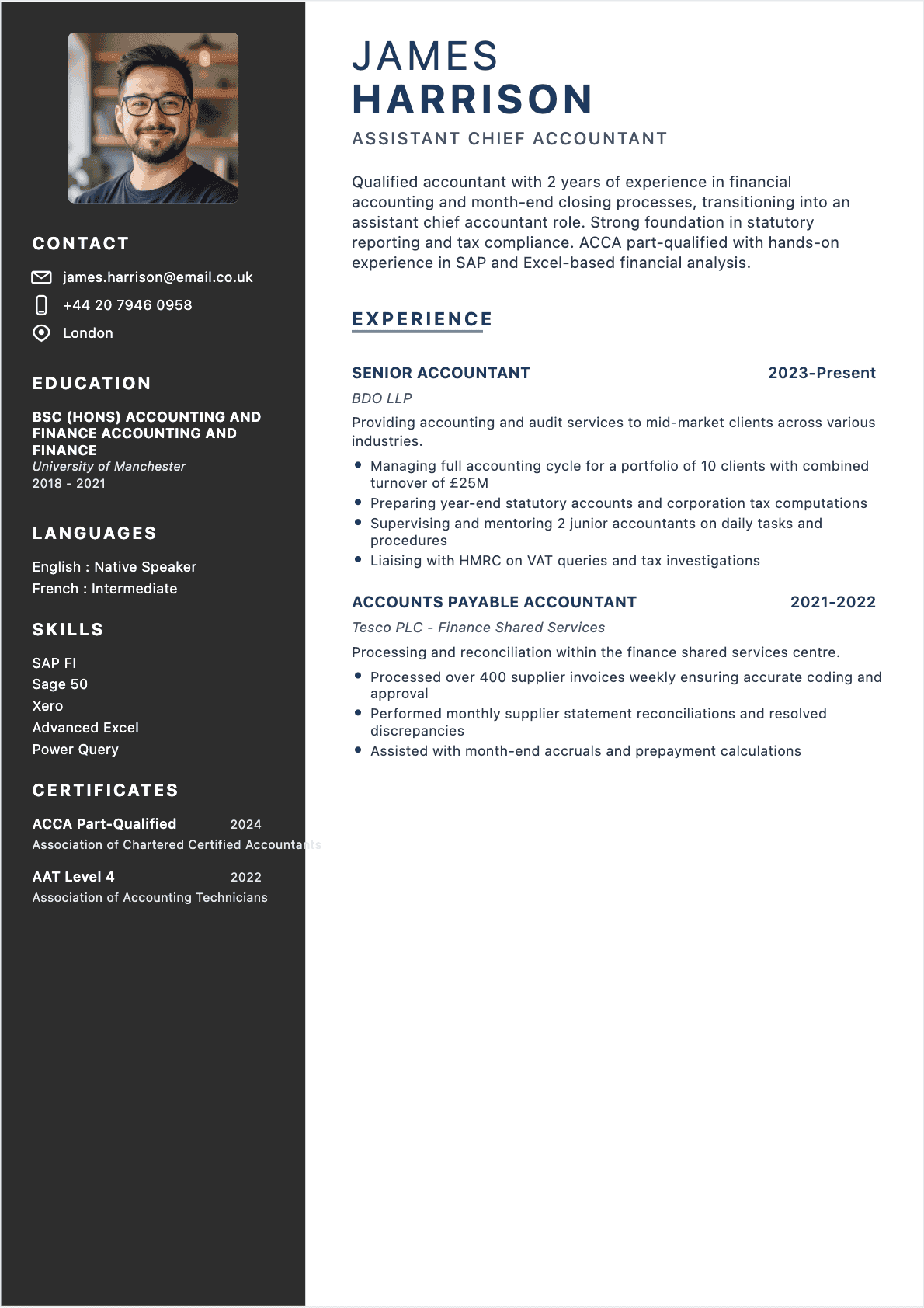
Resume Chief Accountant Junior
PopularChief Accountant resume template for Junior profile
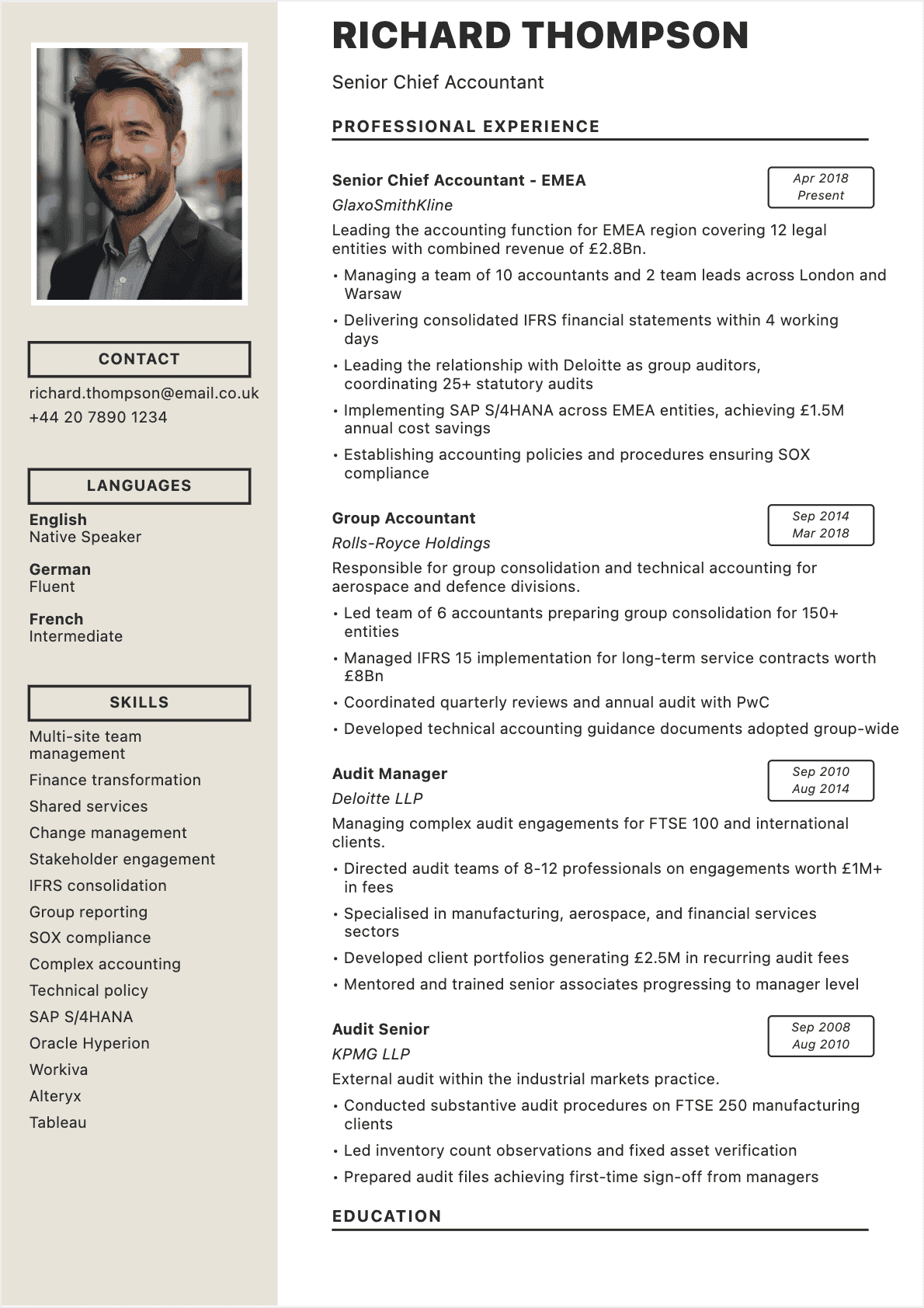
Resume Chief Accountant Senior
Chief Accountant resume template for Senior profile
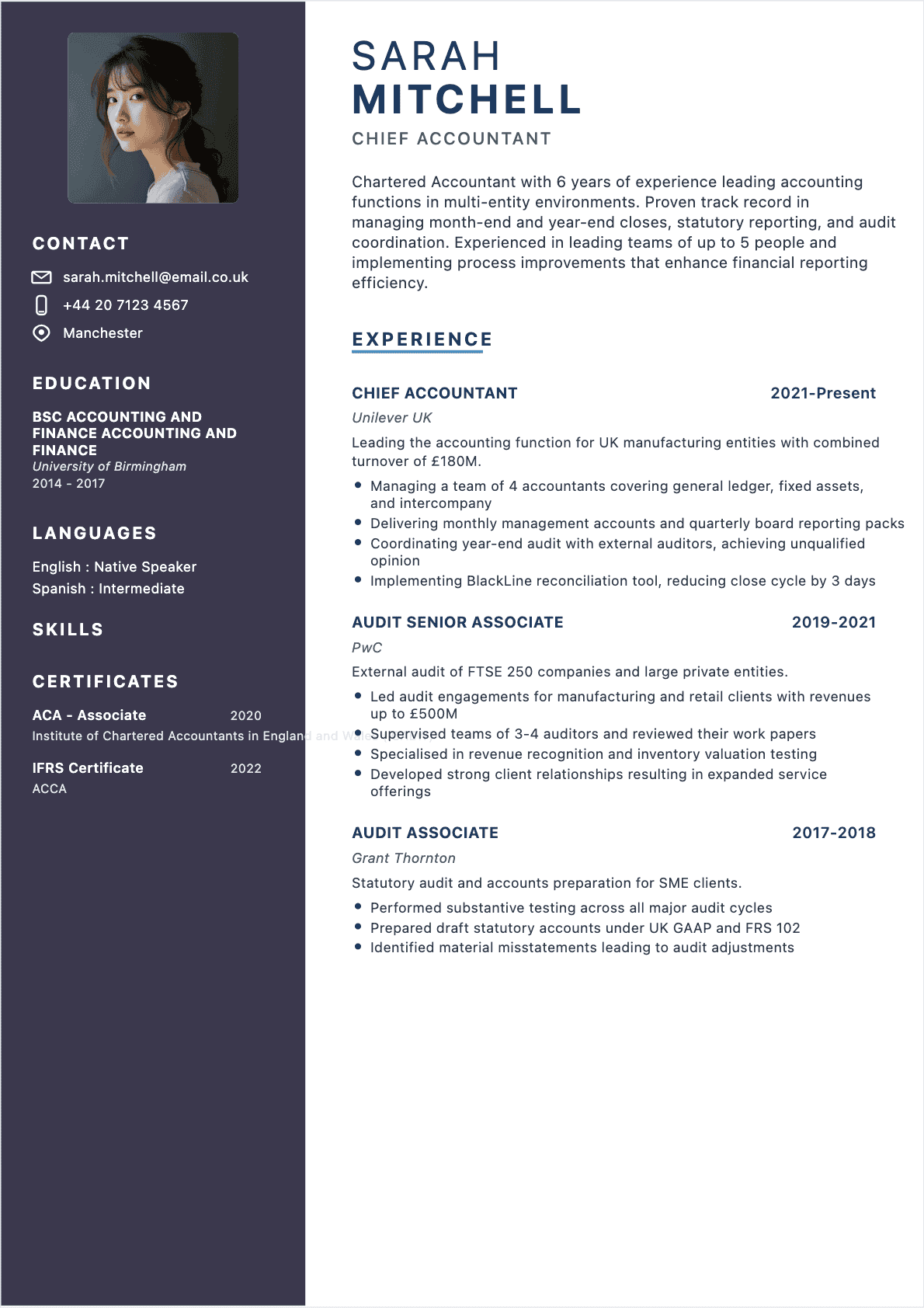
Resume Chief Accountant Confirmé
Chief Accountant resume template for Confirmé profile
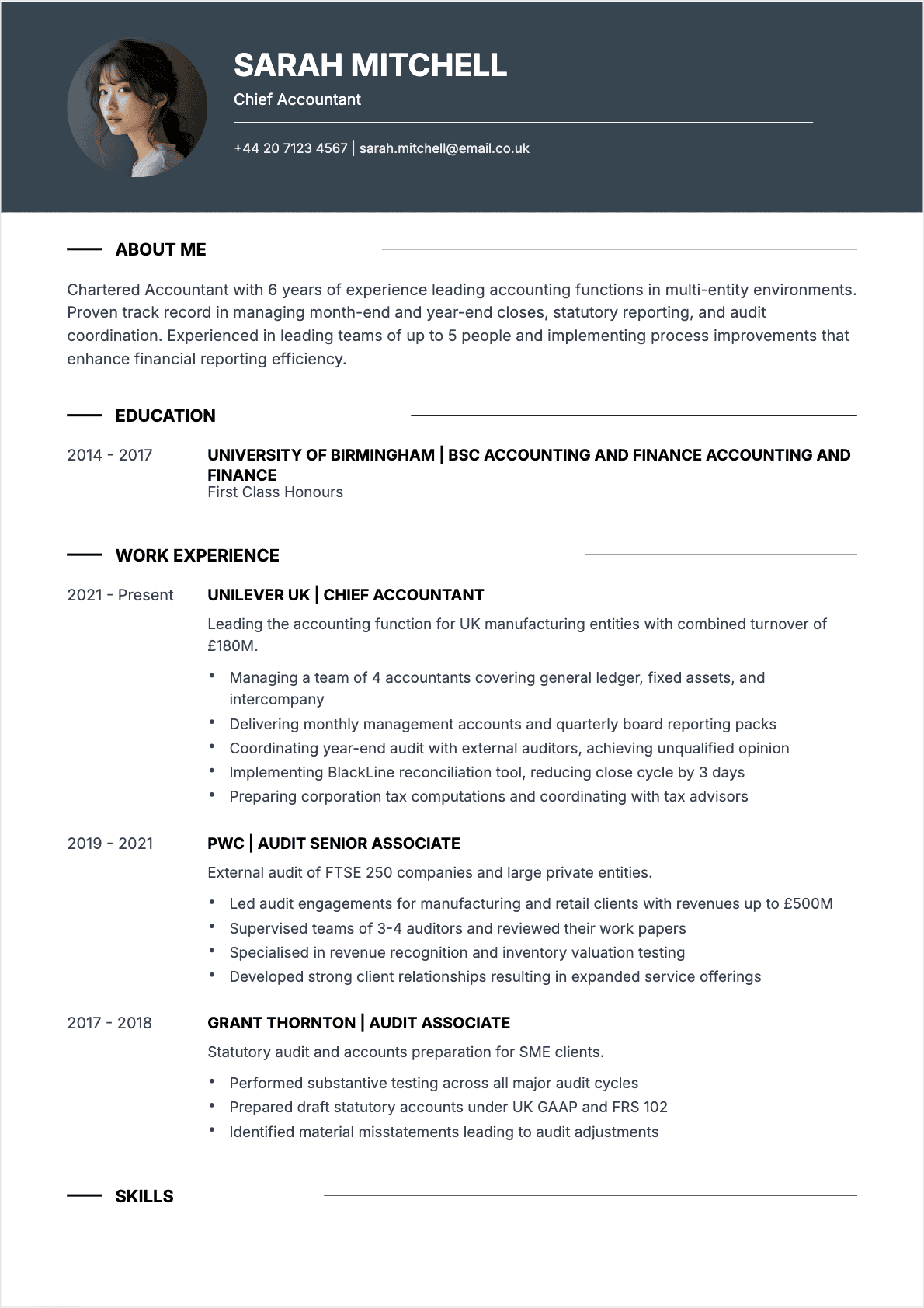
Resume Chief Accountant Confirmé
Chief Accountant resume template for Confirmé profile
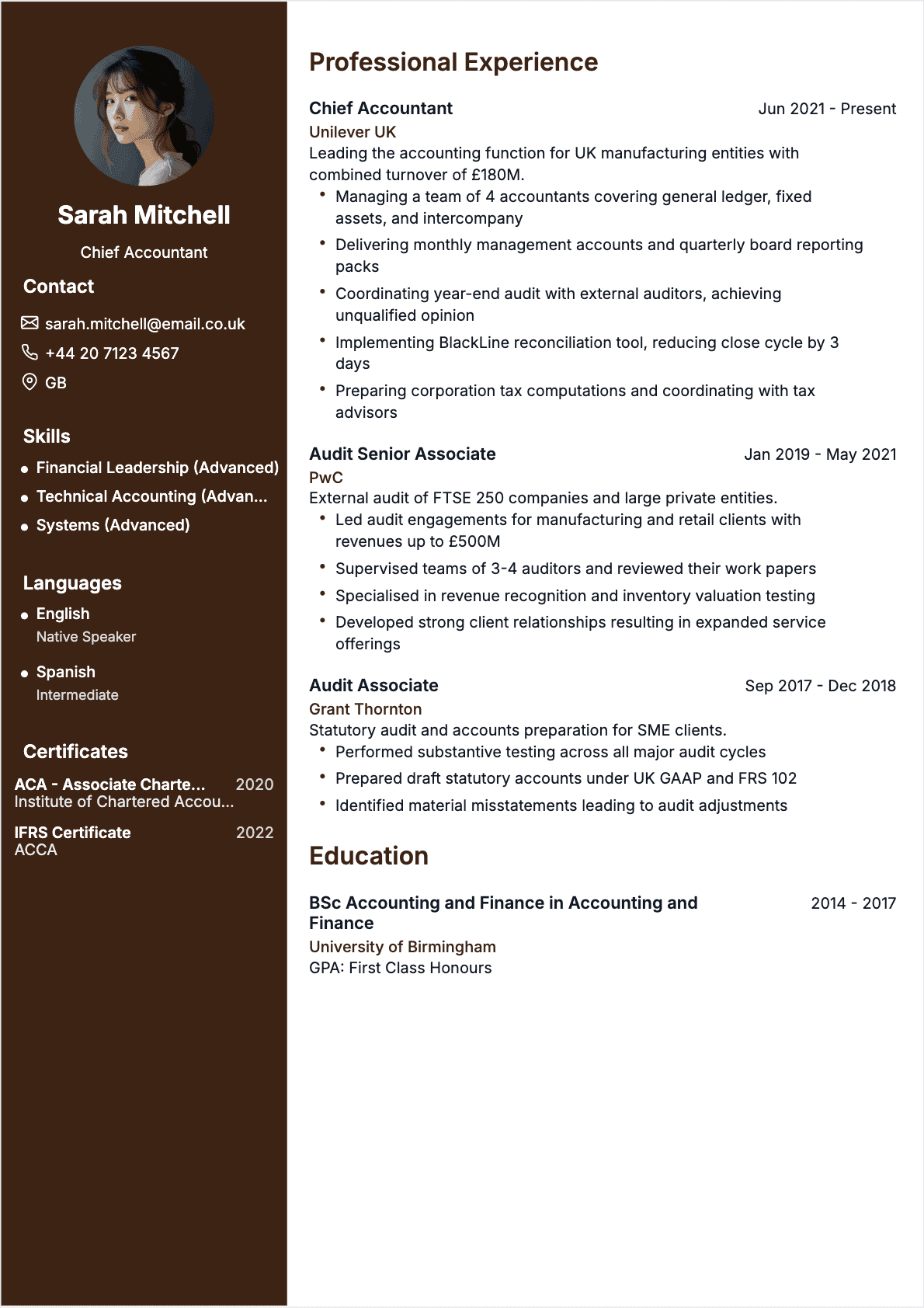
Resume Chief Accountant Confirmé
Chief Accountant resume template for Confirmé profile
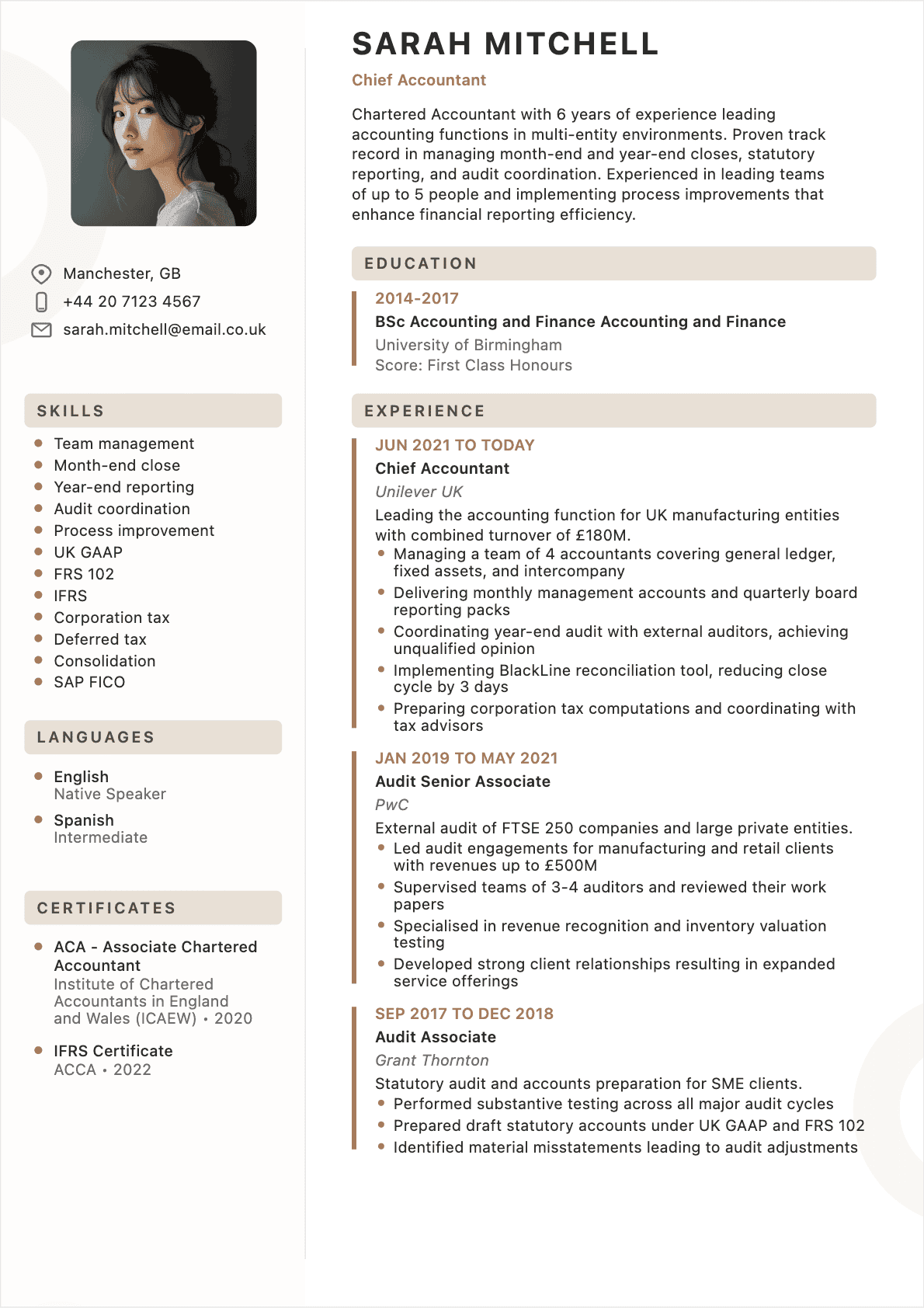
Resume Chief Accountant Confirmé
Chief Accountant resume template for Confirmé profile
Like one of these Chief Accountant resume templates?
Select it, fill in your details and download your resume as PDF.
Chief Accountant Resume Examples
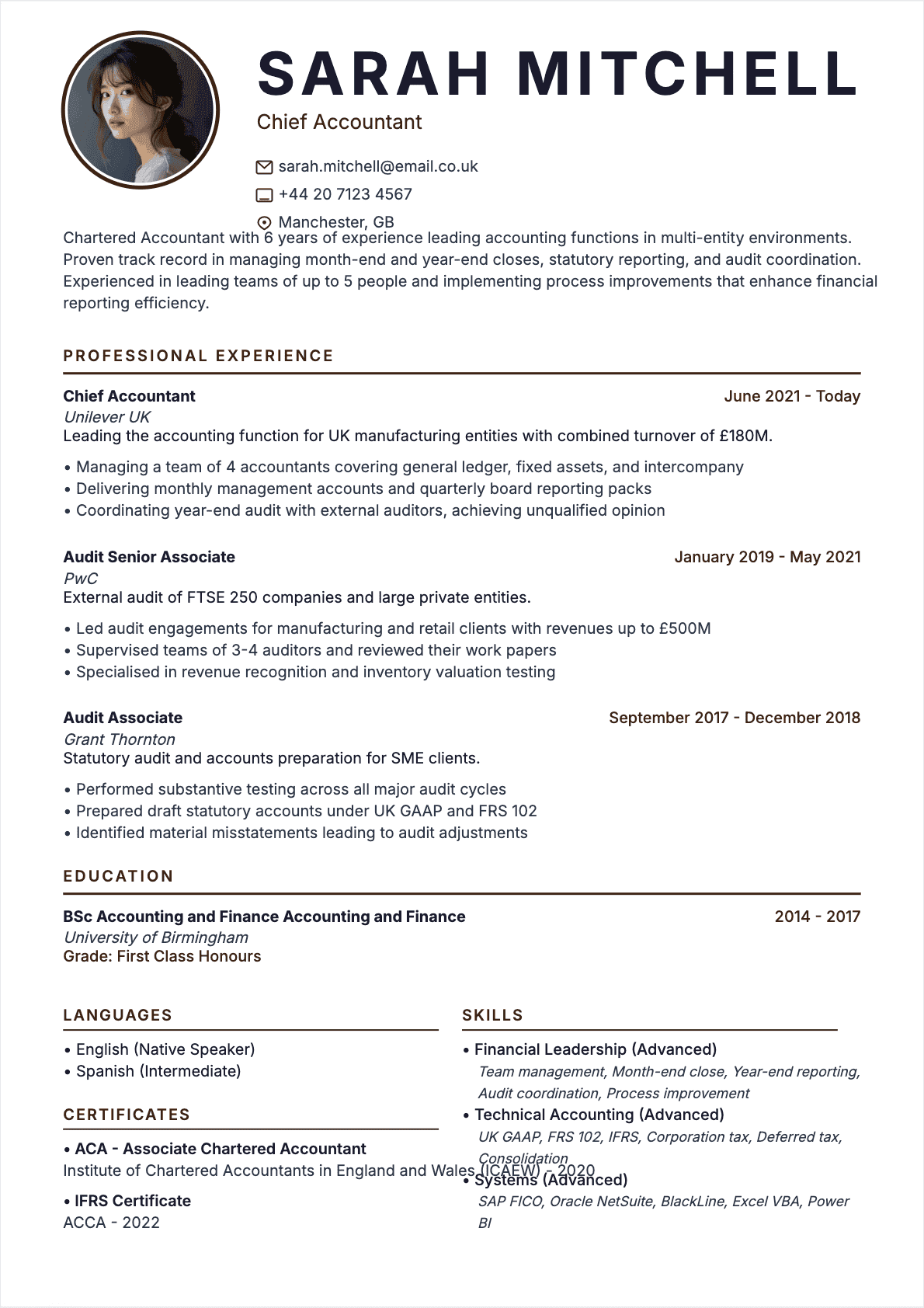
Sarah Mitchell
Chief Accountant
sarah.mitchell@email.co.uk
+44 20 7123 4567
Manchester, GB
Chartered Accountant with 6 years of experience leading accounting functions in multi-entity environments. Proven track record in managing month-end and year-end closes, statutory reporting, and audit coordination. Experienced in leading teams of up to 5 people and implementing process improvements that enhance financial reporting efficiency.
Work Experience
Chief Accountant
Unilever UK
- ●Managing a team of 4 accountants covering general ledger, fixed assets, and intercompany
- ●Delivering monthly management accounts and quarterly board reporting packs
- ●Coordinating year-end audit with external auditors, achieving unqualified opinion
Audit Senior Associate
PwC
- ●Led audit engagements for manufacturing and retail clients with revenues up to £500M
- ●Supervised teams of 3-4 auditors and reviewed their work papers
- ●Specialised in revenue recognition and inventory valuation testing
Audit Associate
Grant Thornton
- ●Performed substantive testing across all major audit cycles
- ●Prepared draft statutory accounts under UK GAAP and FRS 102
- ●Identified material misstatements leading to audit adjustments
Education
BSc Accounting and Finance
University of Birmingham
Skills
Languages
English — Native Speaker
Spanish — Intermediate
Certifications
ACA - Associate Chartered AccountantInstitute of Chartered Accountants in England and Wales (ICAEW)
IFRS CertificateACCA
Chief Accountant role overview
A Chief Accountant holds the senior-most technical accounting position in an organization, sitting between the accounting team and the CFO or Finance Director. You're responsible for ensuring the accuracy and integrity of all financial records, overseeing month-end and year-end close processes, and guaranteeing compliance with accounting standards like IFRS or GAAP. Unlike a Financial Controller who focuses on strategic planning, you concentrate on the technical execution of accounting operations and the quality of financial data.
Your day revolves around supervising accounting staff, reviewing complex journal entries, reconciling balance sheet accounts, and preparing financial statements for management review. You'll spend significant time liaising with external auditors, implementing accounting policies, and troubleshooting discrepancies in financial records. The role demands both technical accounting expertise and people management skills, as you're typically leading a team of 3-15 accountants depending on company size.
Career progression typically follows this path: Senior Accountant → Chief Accountant → Financial Controller → Finance Director → CFO. Some Chief Accountants specialize in particular industries (manufacturing, retail, financial services) or transition into audit management roles. The position serves as a critical stepping stone to executive finance leadership, where you'll have proven your ability to maintain accurate books and manage accounting operations under pressure.
Salary ranges vary by company size and location, but in the UK, Chief Accountants earn between £45,000-£65,000 at smaller firms, £60,000-£85,000 at mid-sized companies, and £80,000-£120,000+ at large corporations or financial institutions. In the US, expect $75,000-$95,000 for smaller organizations, $90,000-$130,000 for mid-market companies, and $120,000-$180,000 at enterprise level. Additional benefits often include performance bonuses of 10-20% and professional development allowances for maintaining certifications.
Typical daily responsibilities include:
- Reviewing and approving journal entries prepared by accounting staff, ensuring proper account coding and supporting documentation
- Reconciling complex balance sheet accounts including intercompany transactions, fixed assets, and accruals
- Supervising month-end close activities, ensuring deadlines are met and financial statements are accurate
- Coordinating with external auditors during quarterly reviews and annual audits, preparing requested schedules and explanations
- Implementing and updating accounting policies to reflect changes in accounting standards or business operations
- Analyzing variances between actual results and budgets, investigating significant discrepancies and reporting findings to management
Essential skills for a Chief Accountant resume
Your resume must demonstrate both technical accounting proficiency and leadership capabilities. Recruiters scan for specific accounting software experience, knowledge of relevant accounting frameworks, and evidence of team management. ATS systems prioritize hard skills like software names and certifications, so include these prominently in both your skills section and work experience descriptions.
The technical skills matter because they directly impact your ability to maintain accurate financial records and comply with regulations. Soft skills like attention to detail and communication separate adequate candidates from exceptional ones—you'll need to explain complex accounting treatments to non-finance stakeholders and catch errors that junior staff miss. Balance both skill types throughout your CV to pass ATS screening while appealing to human recruiters.
Core skills to highlight:
- IFRS/GAAP expertise - Essential for ensuring financial statements comply with applicable accounting standards and can withstand audit scrutiny
- ERP systems (SAP, Oracle, NetSuite, Microsoft Dynamics) - These platforms house all financial data; proficiency means you can extract reports, configure workflows, and troubleshoot posting issues
- Advanced Excel/spreadsheet modeling - Critical for building reconciliations, analyzing large datasets, creating pivot tables, and automating repetitive calculations
- Financial statement preparation - Demonstrates your ability to produce accurate balance sheets, income statements, and cash flow statements under tight deadlines
- Month-end/year-end close management - Shows you can coordinate multiple team members, prioritize tasks, and deliver complete financials on schedule
- Audit coordination and preparation - Proves you understand what auditors need, can prepare supporting schedules efficiently, and resolve audit findings professionally
- Team supervision and training - Indicates you can develop junior staff, delegate effectively, and maintain team productivity during peak periods
- Account reconciliation (complex) - Particularly for intercompany, foreign currency, or multi-entity consolidations that require advanced technical knowledge
- Internal controls design and testing - Shows you can identify control weaknesses, implement preventive measures, and document processes for compliance
- Tax compliance fundamentals - While not a tax specialist, you need to understand VAT/sales tax, corporate tax provisions, and deferred tax calculations
- Business intelligence tools (Power BI, Tableau) - Increasingly important for visualizing financial data and creating executive dashboards
- Process improvement and automation - Demonstrates you actively seek efficiencies rather than maintaining status quo, reducing close time and manual work
For ATS optimization, prioritize exact software names (spell out 'Generally Accepted Accounting Principles' at least once alongside 'GAAP'), professional certifications (ACA, ACCA, CPA, CIMA), and industry-specific terminology like 'three-way match', 'consolidation', or 'intercompany eliminations'.

How to write a Chief Accountant resume step by step
1. Start with a results-focused professional summary
Write 3-4 lines highlighting your years of experience, team size managed, and one quantified achievement. Instead of 'Experienced Chief Accountant with strong technical skills', write 'Chief Accountant with 8 years managing teams of 6-12 staff, reducing month-end close time from 12 to 7 days while maintaining zero material audit adjustments across 4 consecutive years.' Include your primary accounting framework (IFRS/GAAP) and industry if specialized.
2. Structure your work experience with clear metrics
For each role, include your title, company name, dates, and 4-6 bullet points emphasizing scope and results. Start bullets with action verbs like 'supervised', 'reconciled', 'implemented', or 'reduced'. Every bullet should answer: what did you do, how did you do it, and what was the measurable outcome? Quantify team size, transaction volumes, account values, time savings, or error reductions.
3. Transform generic duties into achievement statements
Instead of 'Responsible for month-end close', write 'Directed month-end close for $45M revenue manufacturing company, coordinating 8 accountants across AP, AR, and GL to deliver complete financials by day 5 each month.' Instead of 'Prepared financial statements', write 'Prepared consolidated financial statements for parent company and 3 subsidiaries, implementing new intercompany elimination process that reduced consolidation time by 40%.' The difference is specificity and impact.
4. Showcase technical systems and tools in context
Don't just list software in a skills section—demonstrate how you used it. Write 'Migrated accounting operations from QuickBooks to NetSuite ERP, configuring chart of accounts, designing 15+ custom reports, and training 6 staff members, completing transition 2 weeks ahead of schedule with zero data loss.' This proves proficiency while showing project management ability.
5. Highlight audit results and compliance achievements
Auditors provide third-party validation of your work quality. Include statements like 'Coordinated annual external audits with Big Four firm, preparing 50+ supporting schedules and achieving unqualified opinion with zero material adjustments for 3 consecutive years' or 'Resolved 12 prior-year audit findings by implementing new reconciliation procedures and strengthening segregation of duties controls.'
6. Emphasize process improvements and efficiency gains
Chief Accountants are expected to optimize operations, not just maintain them. Document improvements: 'Automated bank reconciliation process using ERP workflow tools, reducing manual effort from 16 hours to 3 hours monthly and eliminating recurring reconciliation errors.' Or 'Redesigned accrual process to capture expenses in correct period, reducing year-end adjusting entries by 60% and improving forecast accuracy.'
7. Include relevant certifications and continuing education
List professional qualifications prominently: ACA, ACCA, CPA, CIMA, or CMA depending on your location. Include the year obtained and any specializations. Add recent continuing professional development courses, especially in new accounting standards (IFRS 16, ASC 842), technical skills (advanced Excel, Power BI), or leadership training. These demonstrate commitment to staying current.
8. Tailor your CV for each application
Read the job description carefully and mirror the language used. If they emphasize 'consolidation experience', ensure that word appears in your CV. If they mention specific software like SAP or Oracle, highlight your experience with that system. Adjust your professional summary to emphasize the aspects most relevant to that particular role—industry experience, company size, or specific technical challenges they mention.
Before/after examples:
Weak: 'Managed accounting team and prepared monthly reports'
Strong: 'Supervised team of 7 accountants processing 2,500+ monthly transactions, delivering complete management accounts with variance analysis by day 6 of each month'
Weak: 'Responsible for reconciliations and journal entries'
Strong: 'Reconciled 45+ balance sheet accounts totaling $28M monthly, identifying and correcting $340K in mispostings during Q1 2024 that prevented material misstatement'
Weak: 'Worked with auditors during year-end audit'
Strong: 'Coordinated 3-week year-end audit with Deloitte, preparing 60+ PBC items and resolving 8 audit queries within 48 hours, contributing to clean audit opinion and zero management letter comments'
Common mistakes on Chief Accountant resumes
Listing duties without demonstrating scope or complexity
Many candidates write 'prepared financial statements' or 'performed reconciliations' without context. Recruiters need to understand the scale: Are you reconciling 10 accounts or 100? Is this a single entity or multi-company consolidation? Are the statements for a $2M startup or a $500M division? Always include transaction volumes, dollar amounts, entity counts, or team sizes. A good version: 'Prepared consolidated financial statements for holding company with 5 operating subsidiaries across 3 countries, managing intercompany eliminations totaling $12M quarterly.'
Failing to differentiate from Senior Accountant responsibilities
Chief Accountant is a leadership role, but many CVs read like Senior Accountant descriptions focused solely on technical tasks. You must demonstrate people management, process ownership, and decision-making authority. Include how many staff you supervise, training you provide, or policies you establish. Show you're not just executing tasks but directing accounting operations and making judgment calls on complex technical issues.
Omitting audit outcomes and compliance results
Your ability to produce audit-ready financials is a key differentiator. Candidates often mention 'worked with auditors' but don't state the results. Did you receive a clean opinion? Were there material weaknesses? How many adjustments did auditors propose? Stating 'Achieved unqualified audit opinion with zero material adjustments for 4 consecutive years' provides concrete evidence of your technical accuracy and control environment quality.
Using vague efficiency claims without measurements
Writing 'improved month-end close process' means nothing without specifics. How much faster is it now? What was the baseline? What exactly did you change? Instead write: 'Reduced month-end close from 10 business days to 6 by implementing daily transaction reviews, automating 3 recurring journal entries, and establishing clear task deadlines for team members.' The specific actions and measurable results make the achievement credible.
Neglecting to mention ERP systems or showing outdated software
In 2026, Chief Accountants must be proficient in modern ERP systems. Listing only QuickBooks or basic accounting software suggests you haven't worked at scale. If your experience is primarily with older systems, emphasize transferable skills and any exposure to current platforms through training or side projects. Recruiters specifically search for SAP, Oracle, NetSuite, Microsoft Dynamics, or Workday—ensure these appear if you've used them.
Ignoring industry-specific accounting knowledge
Different industries have unique accounting treatments: revenue recognition in SaaS, inventory valuation in manufacturing, loan loss provisioning in banking, or grant accounting in nonprofits. If you have industry specialization, make it prominent. Generic accounting experience is less valuable than demonstrated expertise in the sector where you're applying. Include industry-specific terminology and regulations relevant to your background.
Presenting a static career without growth or learning
If your CV shows the same responsibilities across multiple years without progression, it suggests stagnation. Demonstrate continuous improvement: new systems implemented, additional entities added to your scope, team expansion, new technical standards adopted, or certifications earned. Show you've grown in technical depth, leadership capability, or business understanding throughout your career.
Chief Accountant resume trends in 2026
The Chief Accountant role is experiencing significant transformation as automation handles routine tasks and the position evolves toward more analytical and strategic responsibilities. Companies now expect Chief Accountants to not only ensure accuracy but also provide insights from financial data, identify trends, and recommend operational improvements. Your resume should reflect this shift by emphasizing analytical capabilities, business partnering, and technology adoption alongside traditional technical accounting skills.
Automation and AI are reshaping daily responsibilities
Robotic process automation (RPA) now handles many repetitive tasks like data entry, standard journal entries, and basic reconciliations. Leading companies use AI-powered tools for invoice processing, expense categorization, and anomaly detection. This doesn't eliminate the Chief Accountant role—it elevates it. Employers want candidates who can implement these technologies, oversee automated processes, and focus on exception handling and complex judgments. Highlight any experience with automation tools, process digitization, or implementing AI-assisted accounting solutions. Mention specific platforms like BlackLine for reconciliations, Stampli for AP automation, or Trintech for close management.
Data analytics and visualization skills are becoming essential
Finance leaders increasingly expect Chief Accountants to present financial information visually and analyze trends beyond standard reports. Proficiency in Power BI, Tableau, or similar tools is moving from 'nice to have' to 'required' at progressive companies. Your resume should demonstrate you can build dashboards, perform variance analysis, identify patterns in financial data, and communicate findings to non-finance stakeholders. Include examples like 'Created Power BI dashboard tracking 12 key financial metrics, enabling management to identify cost overruns 2 weeks earlier than previous monthly reporting cycle.'
ESG reporting and sustainability accounting are emerging priorities
Environmental, Social, and Governance (ESG) reporting requirements are expanding globally, and Chief Accountants are often tasked with implementing measurement systems and ensuring data accuracy for sustainability disclosures. Familiarity with frameworks like GRI, SASB, or TCFD is increasingly valuable. If you have any experience with carbon accounting, social impact measurement, or ESG data collection, feature it prominently. This specialized knowledge differentiates you from candidates with purely traditional accounting backgrounds.
Remote and hybrid work considerations
The accounting function has proven surprisingly adaptable to remote work, but this creates new expectations. Employers want Chief Accountants who can manage distributed teams, maintain controls in a remote environment, and work effectively with cloud-based systems. Your resume should demonstrate comfort with digital collaboration tools, experience managing remote staff, or success implementing cloud accounting systems. Mention specific achievements like 'Led accounting team of 9 across 3 locations through fully remote operations during system migration, maintaining all close deadlines and control effectiveness.'
Continuous close and real-time reporting expectations
The traditional month-end close is evolving toward continuous accounting, where reconciliations and reviews happen throughout the month rather than in a frantic period-end rush. Forward-thinking companies expect Chief Accountants to implement daily or weekly accounting cycles, reducing the traditional close window. Highlight any experience reducing close timelines, implementing continuous reconciliation processes, or moving toward real-time financial visibility. This demonstrates you're aligned with modern finance operations rather than maintaining outdated practices.
Emphasis on business partnering and commercial awareness
Chief Accountants are no longer expected to simply report numbers but to understand what drives them. Employers value candidates who understand the business model, can explain financial results in operational terms, and partner with department heads to improve performance. Your resume should show you've worked cross-functionally, provided financial insights that influenced business decisions, or helped non-finance managers understand their financial impact. This business acumen is what separates transactional accountants from strategic finance professionals.
Further reading:
Frequently asked questions
Find answers to the most frequently asked questions.
Aim for 1 page if you have under 7 years of experience, and 2 pages if you lead teams, manage multi-entity reporting, or have significant audit/control scope. Prioritize quantified close, reconciliations, reporting, and audit outcomes over long task lists and older roles.
Common ATS keywords include month-end close, general ledger, account reconciliations, financial reporting, IFRS/US GAAP, consolidation, intercompany, audit coordination, SOX/ICFR, and statutory accounts. Match them to your scope and tools (SAP, Oracle, NetSuite, BlackLine) in bullets.
Use evidence: team size you guided, work you reviewed, and deadlines you owned. Examples include “reviewed 25 reconciliations/month,” “trained 2 accountants,” or “ran close stand-ups.” Add outcomes like fewer late items, reduced recon aging, and faster PBC responses.
In most US hiring processes, a photo is not recommended. In the UK it is usually optional but still uncommon in corporate finance. Focus space on metrics, scope, and tools. If you apply in a market where photos are standard, follow local norms and keep the photo professional.
Use ranges and operational metrics: number of entities, close days, volume of journal entries, reconciliation count, % completion, and audit findings trend. For financial metrics, use rounded figures (e.g., “$150–200M revenue”) or relative improvements (e.g., “audit adjustments -35%”).
List the ERP in Skills, then prove it in Experience bullets with actions and outcomes: “Automated 15 recurring JEs in NetSuite,” “built a Power BI close tracker,” or “implemented BlackLine matching rules.” This shows applied skill, not just exposure.
Your career deserves a better resume
With CVtoWork, select a template, fill in the fields and download your resume as PDF.
Start creating