Business Developer Resume
Example, Template & Expert Tips 2026
Updated on April 18, 2026.
Create a winning account manager CV with our examples, templates and expert tips. Learn how to showcase client management skills and sales achievements.
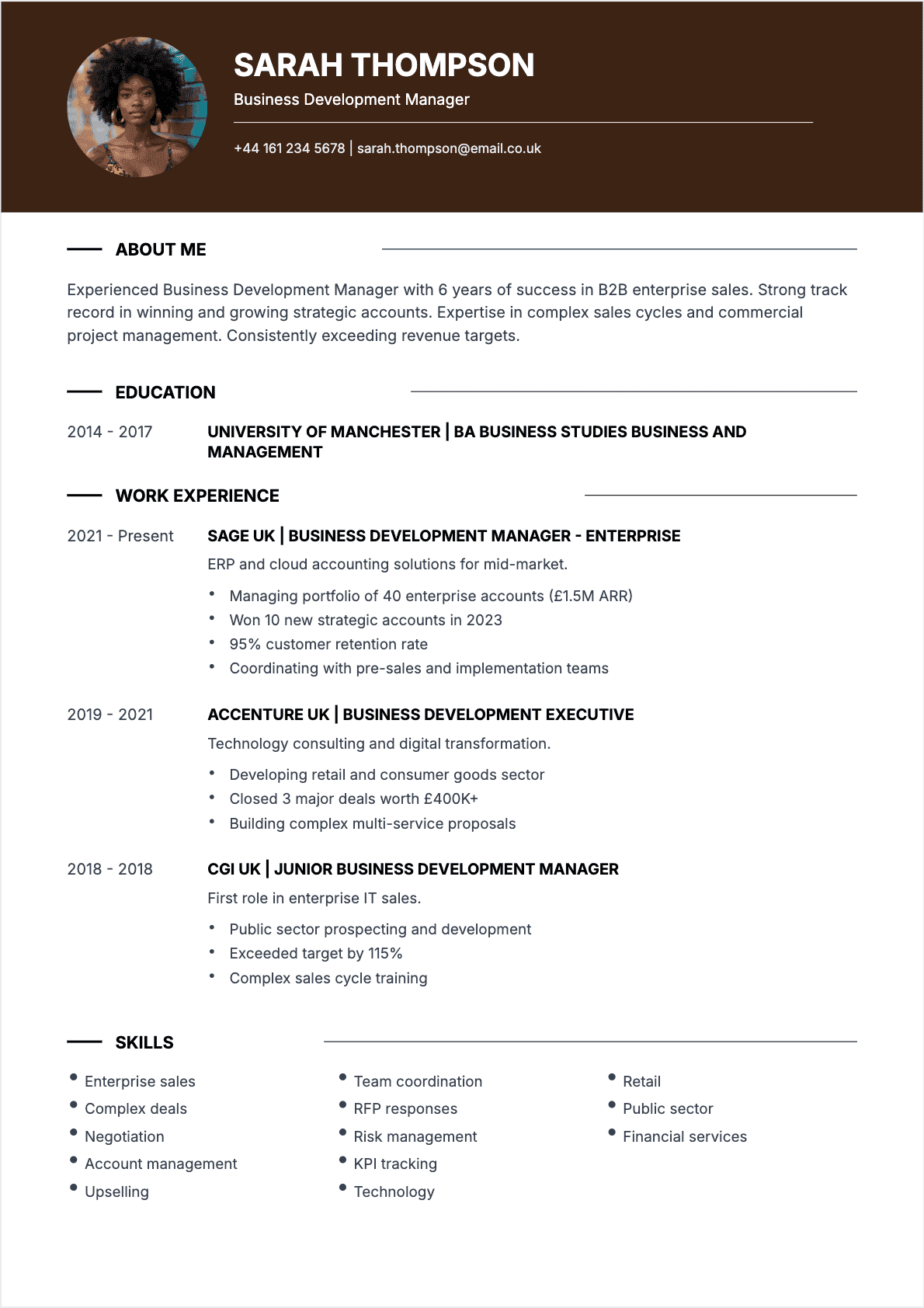
Business Developer Resume Templates
8 Templates available
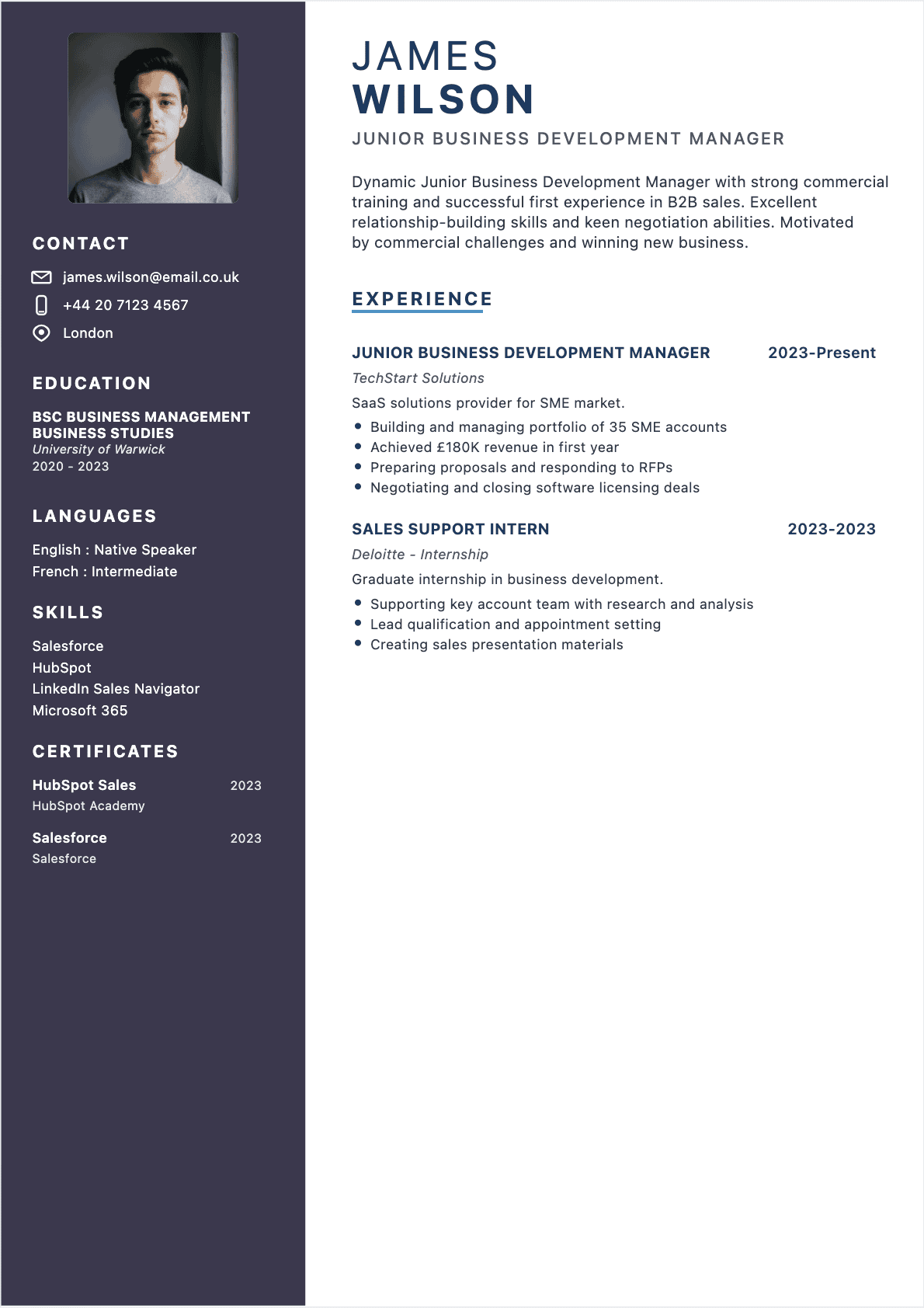
Resume Business Developer Junior
Business Developer resume template for Junior profile
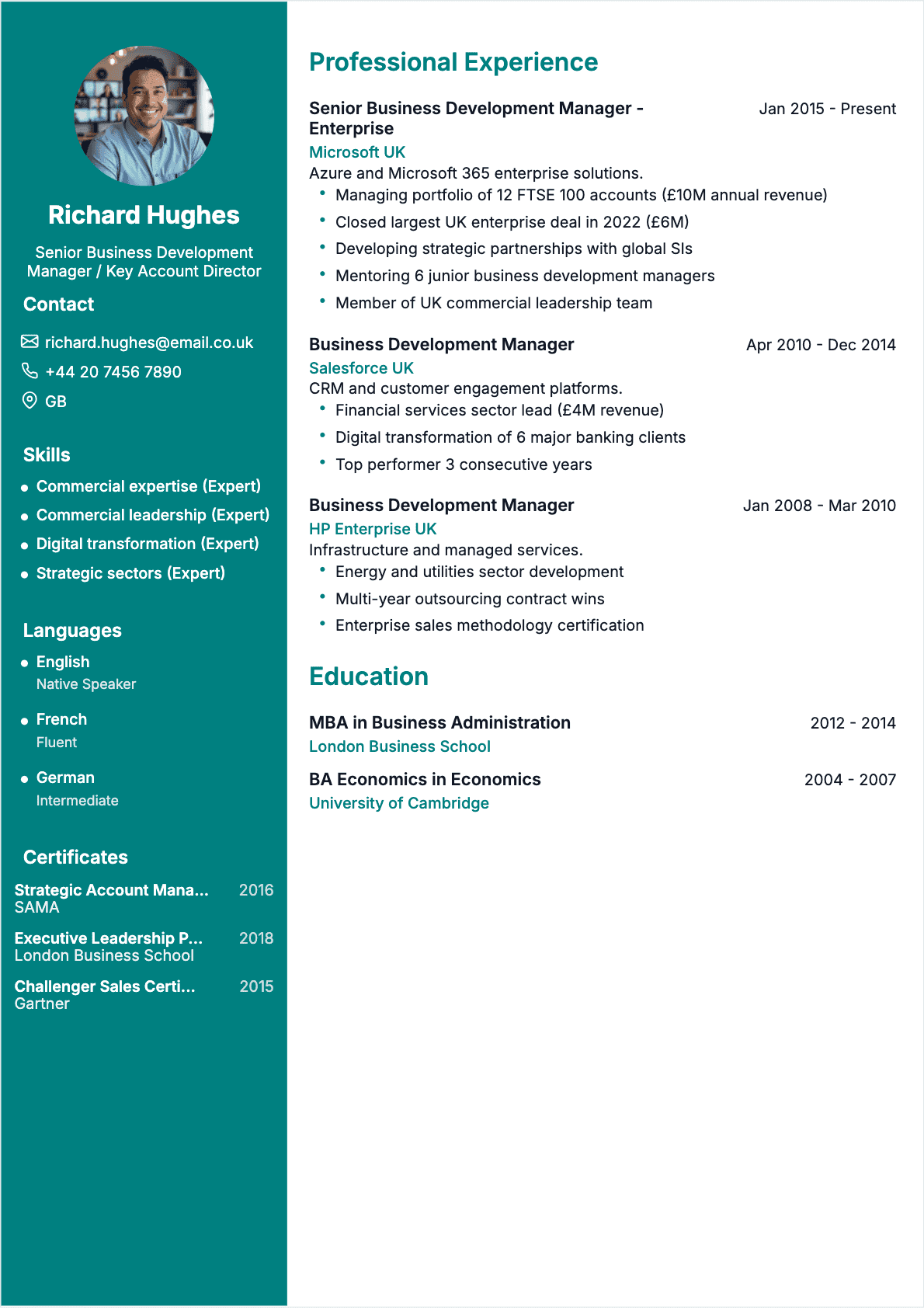
Resume Business Developer Senior
Business Developer resume template for Senior profile
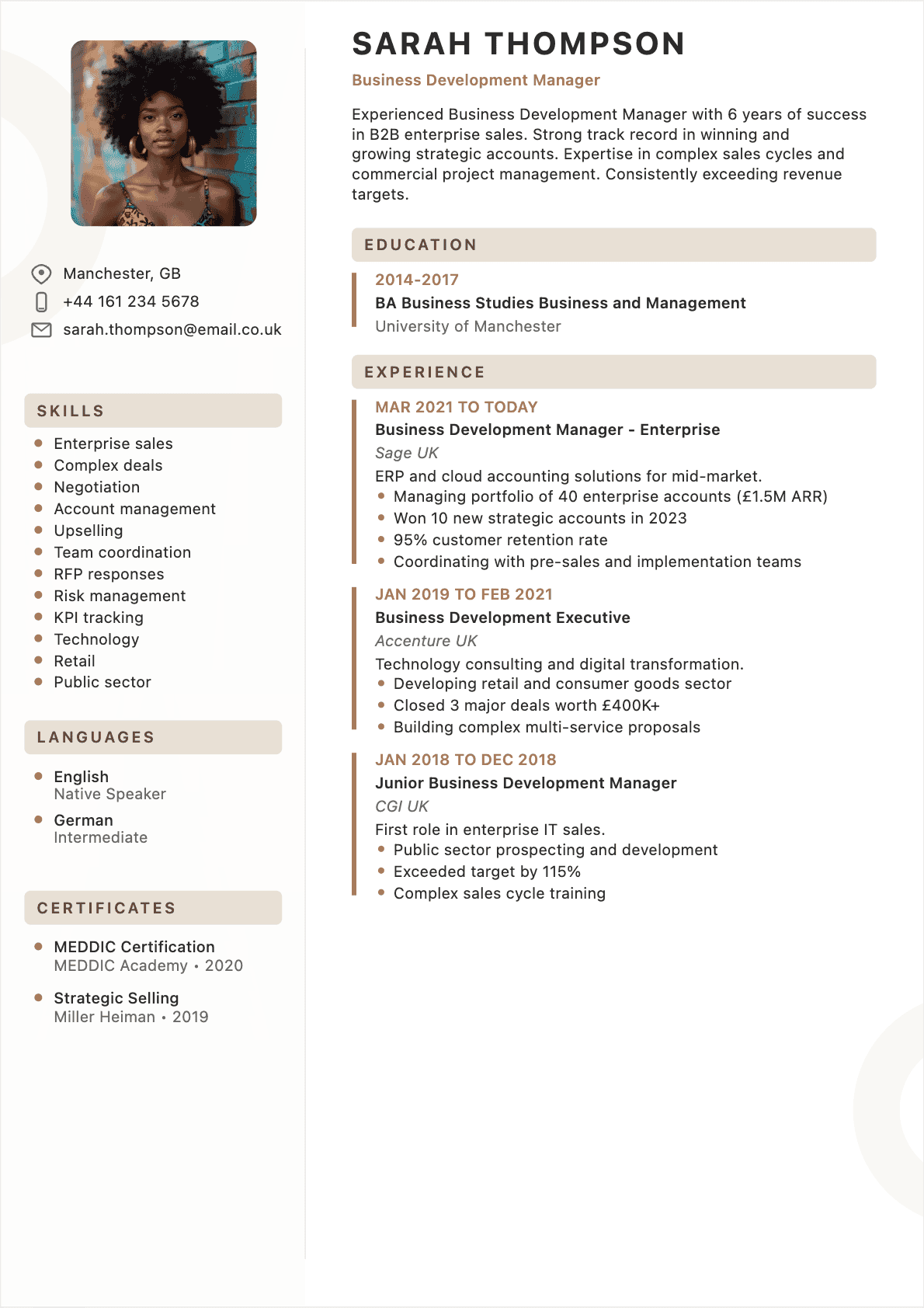
Resume Business Developer Confirmé
Business Developer resume template for Confirmé profile
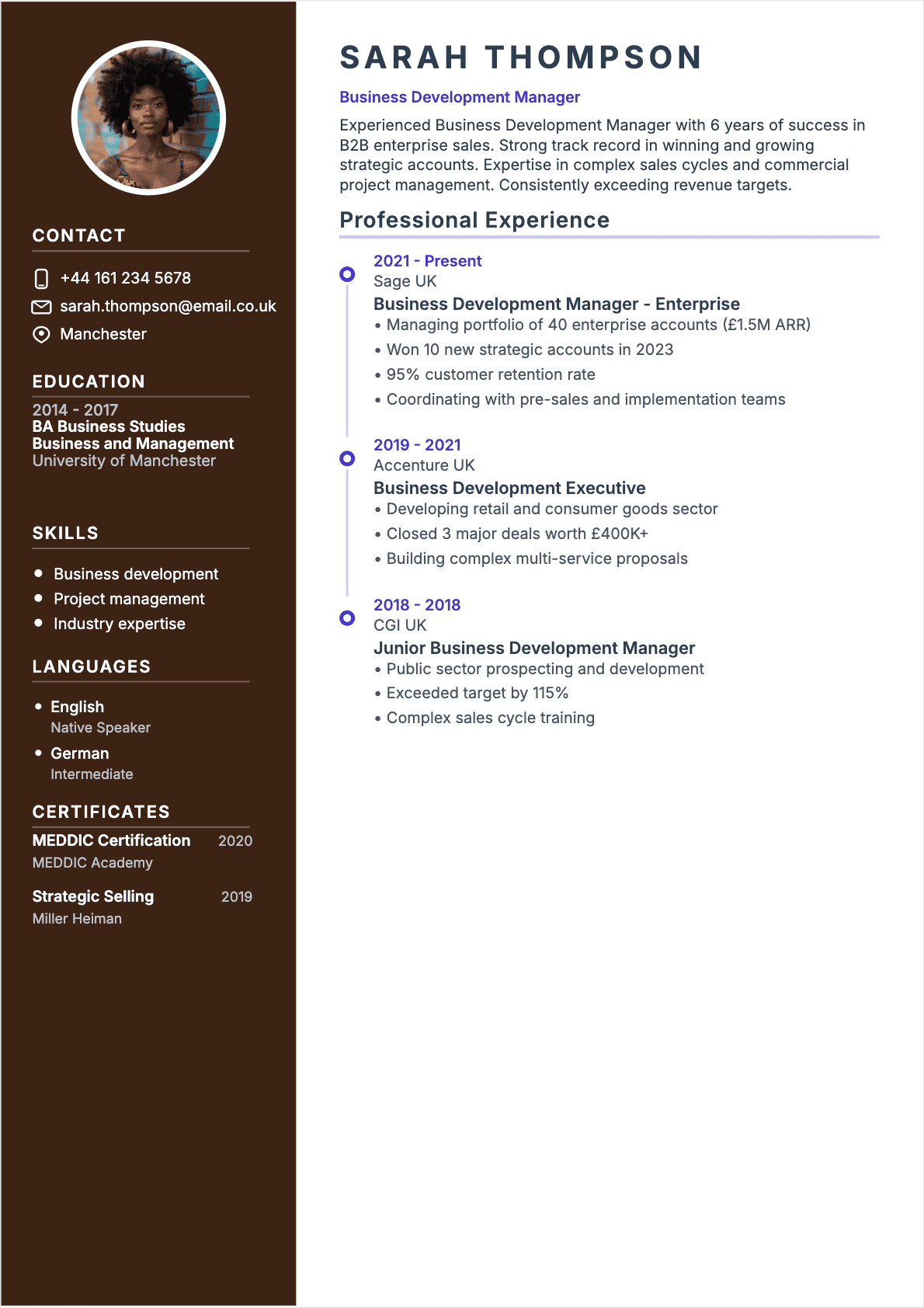
Resume Business Developer Confirmé
PopularBusiness Developer resume template for Confirmé profile
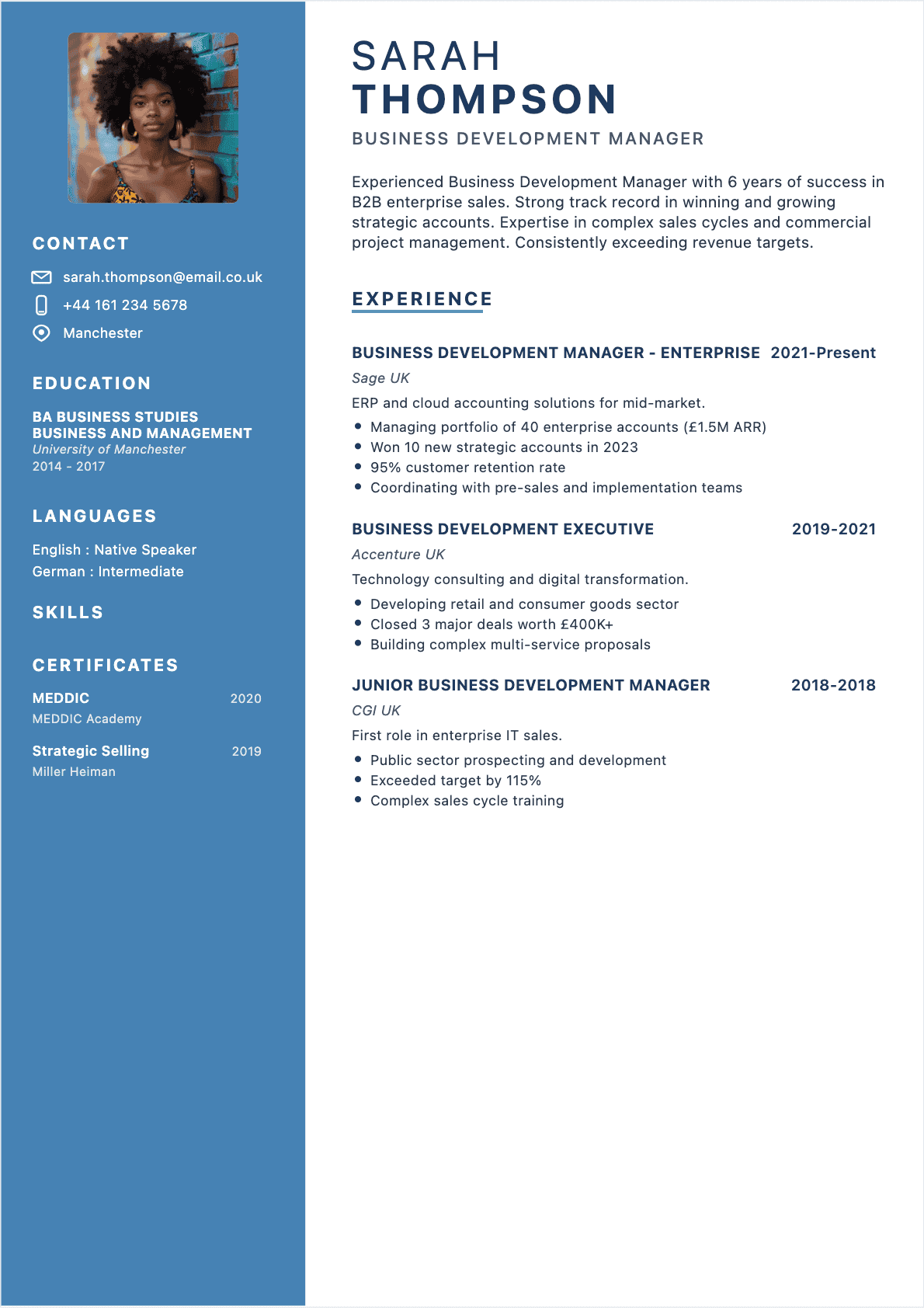
Resume Business Developer Confirmé
Business Developer resume template for Confirmé profile
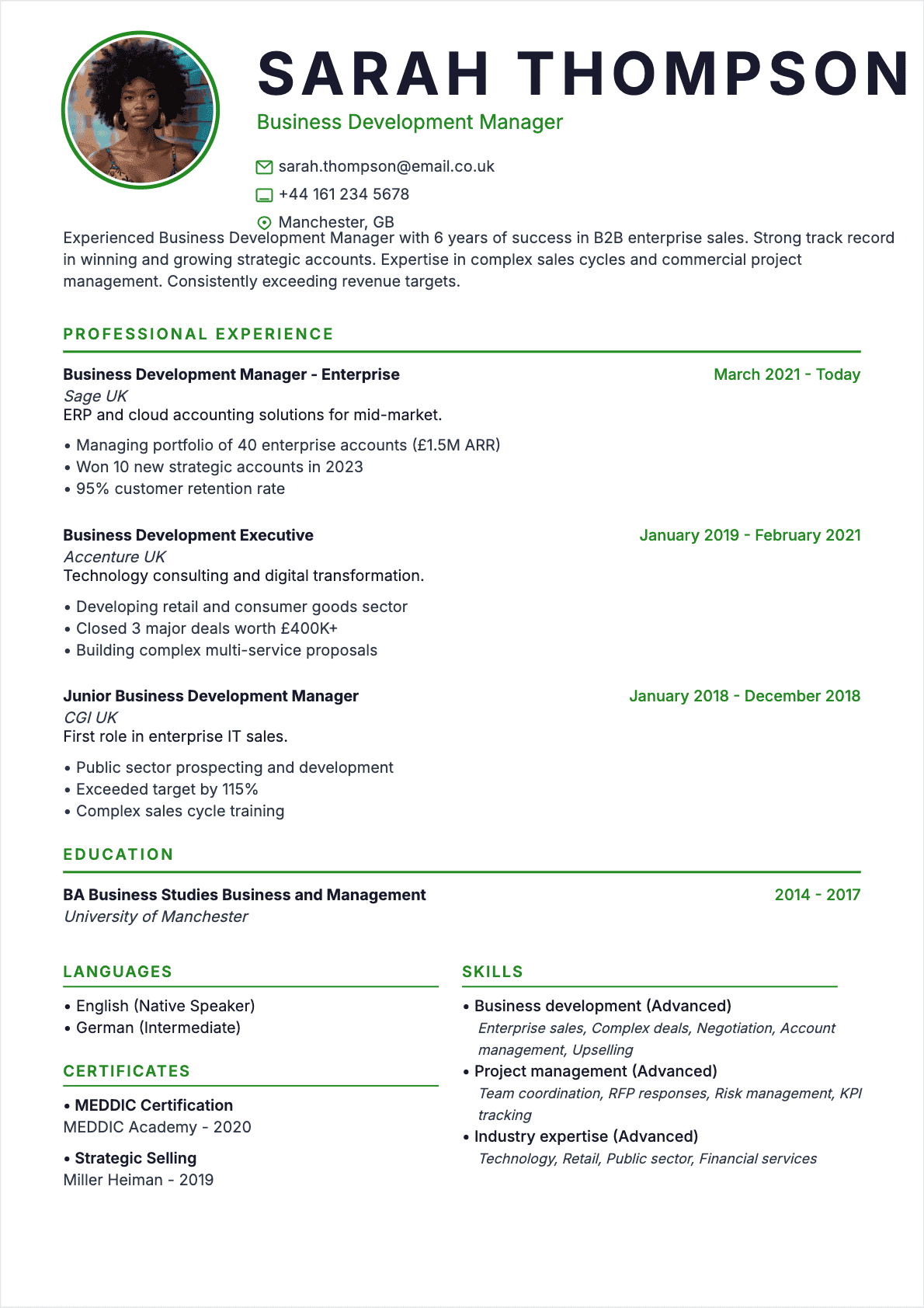
Resume Business Developer Confirmé
Business Developer resume template for Confirmé profile
Like one of these Business Developer resume templates?
Select it, fill in your details and download your resume as PDF.
Business Developer Resume Examples
Sarah Thompson
B2B Sales Executive
sarah.thompson@email.co.uk
+44 161 496 0852
Manchester, GB
Dynamic Sales Executive with 5 years of experience in B2B sales and client portfolio development. Expertise in full sales cycle from prospecting to customer retention. Consistently exceeding sales targets. Excellent interpersonal skills with strong negotiation abilities.
Work Experience
Sales Executive - Key Accounts
Grainger UK
- ●Managing portfolio of 75 industrial clients (£720K)
- ●Acquired 18 new accounts annually
- ●32% conversion rate on qualified opportunities
Territory Sales Representative
Bunzl UK
- ●Covered North West England territory
- ●Increased territory revenue by 28%
- ●Conducted on-site product demonstrations
Inside Sales Representative
Office Depot UK
- ●Managed 120 SME accounts
- ●Handled 45 sales calls daily
- ●Trained in telephone sales techniques
Education
BA Business Management
University of Leeds
Skills
Languages
English — Native Speaker
Spanish — Intermediate
Certifications
SPIN Selling CertificationHuthwaite International
Salesforce Sales Cloud ConsultantSalesforce
Business Developer role overview
A Business Developer identifies and creates new revenue opportunities by building strategic partnerships, entering new markets, and expanding the client base. Unlike account managers who nurture existing relationships, you're focused on growth—researching prospects, initiating conversations, and converting leads into long-term business relationships. Your day typically starts with market research and prospecting, followed by outreach calls, proposal development, and meetings with potential partners or clients.
The role requires a unique blend of strategic thinking and hands-on execution. You'll spend considerable time analyzing market trends, competitor activities, and potential partnership opportunities. This research informs your outreach strategy and helps you craft compelling value propositions. You're not just selling a product or service—you're building business cases that demonstrate mutual value and long-term growth potential.
Business Developers work across industries, from tech startups seeking rapid expansion to established corporations entering new markets. Your responsibilities extend beyond simple sales targets. You'll collaborate with product teams to shape offerings based on market feedback, work with legal on partnership agreements, and coordinate with marketing to develop campaigns targeting new segments. Success means thinking several steps ahead, understanding how today's partnership could open doors to entire market segments tomorrow.
Career progression typically follows this path: Junior Business Developer (1-2 years) earning £25,000-£35,000, Mid-level Business Developer (3-5 years) earning £40,000-£55,000, Senior Business Developer (5-8 years) earning £60,000-£80,000, and Head of Business Development or VP of Growth (8+ years) earning £85,000-£120,000+. Many Business Developers transition into strategic roles like Director of Partnerships, Chief Growth Officer, or even entrepreneurship, having gained deep insights into market dynamics and deal structuring.
Typical daily tasks include:
- Researching and identifying potential clients, partners, or market opportunities through industry reports, LinkedIn, and competitive analysis
- Conducting 8-12 outreach calls or emails to qualified prospects, personalizing each approach based on company research
- Attending 2-3 discovery meetings or pitch presentations with decision-makers to understand needs and present solutions
- Collaborating with internal teams (product, marketing, legal) to develop proposals, pricing structures, and partnership agreements
- Updating CRM systems with detailed notes on prospect interactions, deal stages, and next steps
- Analyzing pipeline metrics and adjusting strategies based on conversion rates, deal velocity, and market response
Essential skills for a Business Developer resume
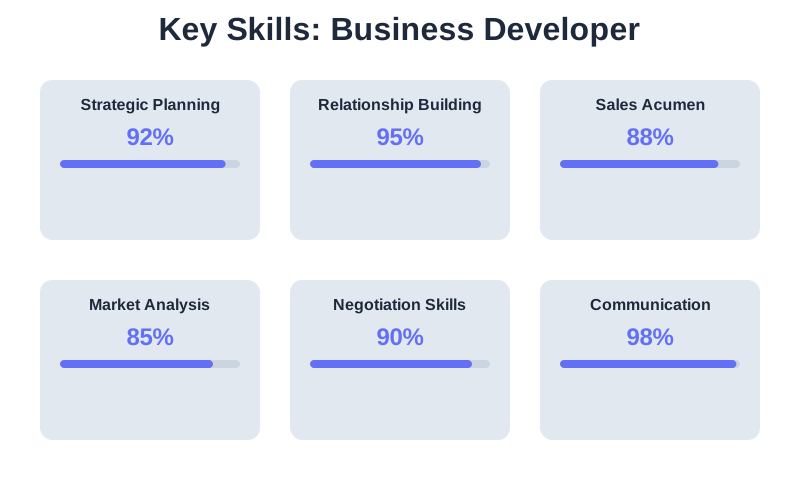
Your resume needs to demonstrate both the strategic thinking that identifies opportunities and the execution skills that close deals. Recruiters scan for evidence of revenue generation, market expansion, and relationship-building capabilities. The skills you highlight should tell a story of someone who can independently drive growth while collaborating across departments.
Technical competencies matter significantly in modern business development. Proficiency with CRM platforms like Salesforce or HubSpot isn't just about data entry—it demonstrates your ability to manage complex pipelines, forecast accurately, and make data-driven decisions. Similarly, understanding of sales methodologies (SPIN, Challenger, Solution Selling) shows you approach business development systematically rather than relying solely on personality.
Soft skills differentiate good Business Developers from exceptional ones. The ability to build rapport quickly, handle rejection constructively, and negotiate win-win agreements can't be automated. Recruiters specifically look for evidence of resilience, strategic thinking, and cross-functional collaboration. When listing skills, provide context that proves you've applied them successfully in real business situations.
Core Business Developer skills to highlight:
- Lead generation and prospecting: Ability to identify high-value opportunities through market research, social selling, and strategic networking that fills your pipeline with qualified prospects
- CRM proficiency (Salesforce, HubSpot, Pipedrive): Managing deal flow, tracking touchpoints, and generating reports that inform strategy and demonstrate accountability to leadership
- Market research and analysis: Evaluating industry trends, competitor positioning, and customer needs to identify untapped opportunities and refine your value proposition
- Consultative selling: Moving beyond transactional sales to understand prospect challenges deeply and position your solution as strategic rather than commodity
- Proposal development and presentation: Creating compelling business cases with ROI calculations, implementation timelines, and clear value propositions that resonate with C-level decision-makers
- Contract negotiation: Structuring agreements that balance company profitability with client value, understanding legal implications, and finding creative solutions to deal obstacles
- Strategic partnership development: Identifying and cultivating relationships with complementary businesses that can drive mutual growth through co-marketing, referrals, or integrated solutions
- Financial acumen: Understanding pricing models, profit margins, customer lifetime value, and payback periods to make informed decisions about which opportunities to pursue
- Stakeholder management: Coordinating with product, marketing, legal, and finance teams to move deals forward while managing expectations across departments
- Communication and storytelling: Articulating complex value propositions clearly, adapting your message for different audiences, and building narratives that inspire action
- Resilience and adaptability: Maintaining momentum through rejection, adjusting strategies based on market feedback, and staying motivated during long sales cycles
- Data analysis and reporting: Interpreting pipeline metrics, conversion rates, and market signals to optimize your approach and demonstrate ROI to leadership
For ATS optimization, prioritize skills mentioned in the job description and include both the full term and acronym (e.g., 'Customer Relationship Management (CRM)'). Technical skills like specific CRM platforms, sales methodologies, and industry knowledge should appear in your skills section and be reinforced with concrete examples in your experience bullets.
How to write a Business Developer resume step by step
1. Lead with a results-focused professional summary
Your opening 3-4 lines should immediately communicate your value through specific achievements. Instead of 'Experienced Business Developer seeking new opportunities,' write 'Business Developer who expanded market presence across EMEA, securing 23 strategic partnerships worth £4.2M ARR and achieving 156% of annual target.' Include your years of experience, specialization (B2B SaaS, manufacturing, fintech), and one standout metric that proves your impact.
2. Quantify every achievement in your experience section
Business development is fundamentally about numbers—revenue generated, partnerships secured, markets entered, pipeline value. Transform vague statements into compelling evidence. Instead of 'Responsible for identifying new business opportunities,' write 'Identified and qualified 180+ prospects through targeted LinkedIn outreach and industry events, converting 34 into active opportunities worth £2.8M in potential revenue.' Include conversion rates, deal sizes, growth percentages, and time frames that demonstrate efficiency.
3. Structure bullets using the CAR method (Challenge-Action-Result)
Each bullet should tell a mini-story that showcases your problem-solving ability. For example: 'Facing stagnant growth in traditional channels (Challenge), developed and executed account-based marketing strategy targeting 50 enterprise accounts (Action), resulting in 12 new partnerships and £1.6M in first-year revenue (Result).' This structure helps recruiters understand not just what you did, but why it mattered and how you think strategically.
4. Highlight cross-functional collaboration and strategic initiatives
Business Developers don't work in isolation. Demonstrate your ability to drive projects that require buy-in from multiple departments. Instead of 'Worked with marketing team,' write 'Partnered with product and marketing teams to develop industry-specific solution packages, enabling entry into healthcare vertical and securing 8 new clients in first quarter.' This shows strategic thinking and organizational influence beyond individual deal-making.
5. Include relevant tools, methodologies, and industry knowledge
Create a dedicated skills section that combines technical proficiencies with industry expertise. List specific CRM platforms you've used (with years of experience), sales methodologies you've applied (MEDDIC, BANT), and any industry certifications or specialized knowledge. If you've worked in regulated industries like finance or healthcare, mention your understanding of compliance requirements—this can be a significant differentiator.
6. Showcase continuous learning and market awareness
Include a section for relevant certifications, courses, or professional development that demonstrates you stay current with industry trends. Certifications like 'HubSpot Sales Software Certification,' 'Strategic Account Management Association (SAMA) training,' or industry-specific credentials show commitment to professional growth. If you've attended major industry conferences or contributed thought leadership (articles, speaking engagements), include these as they demonstrate market credibility.
7. Tailor your resume for each application using job description keywords
Extract key phrases from the job posting and incorporate them naturally into your resume. If the role emphasizes 'SaaS experience' and 'enterprise sales,' ensure these terms appear in your summary and experience bullets where truthful. However, don't just list keywords—embed them in achievement statements. Instead of a skills list including 'enterprise sales,' write 'Closed 15 enterprise sales deals averaging £180K contract value with 6-month average sales cycle.'
8. Keep formatting clean and ATS-friendly
Use standard section headings (Professional Experience, Education, Skills), avoid tables or graphics that confuse parsing software, and save as a .docx or PDF (check the application instructions). Use consistent date formatting (MM/YYYY), and ensure your contact information is clearly visible at the top. Your resume should be scannable by both software and humans—use bullet points, white space, and clear hierarchies to guide the reader's eye to your most impressive achievements.
Before and after examples:
Weak: 'Managed client relationships and identified new business opportunities in the technology sector.'
Strong: 'Cultivated relationships with 40+ technology decision-makers, identifying cross-sell opportunities that generated £890K in additional revenue and improved client retention by 23%.'
Weak: 'Responsible for developing partnerships with other companies.'
Strong: 'Negotiated and closed 7 strategic channel partnerships with complementary SaaS providers, creating new distribution channels that contributed 18% of annual revenue (£1.2M) within first year.'
Common mistakes on Business Developer resumes
Listing responsibilities instead of achievements
The most frequent error is describing what you were supposed to do rather than what you actually accomplished. Writing 'Responsible for generating new business leads' tells recruiters nothing about your effectiveness. Did you generate 10 leads or 1,000? What was the conversion rate? Instead, write 'Generated 450+ qualified leads through targeted outreach campaigns, achieving 28% meeting conversion rate and closing 34 deals worth £2.1M.' Business development is results-driven, and your resume must reflect that with specific metrics at every opportunity.
Failing to differentiate between sales and business development
Many candidates blur the line between closing existing opportunities and creating new ones. Business development emphasizes market expansion, partnership creation, and strategic opportunity identification—not just working through an established pipeline. If you're applying for a Business Developer role, emphasize how you identified white space opportunities, entered new markets, or built partnerships from scratch. Recruiters in this field specifically look for entrepreneurial thinking and market creation abilities, not just quota attainment.
Using vague language about 'relationship building'
Phrases like 'built strong relationships with key stakeholders' are meaningless without context. What type of stakeholders? How did these relationships translate to business outcomes? Instead, write 'Established C-level relationships with 15 Fortune 500 companies through industry conferences and targeted outreach, converting 6 into pilot programs worth £750K.' The specificity demonstrates both your networking ability and your focus on outcomes, not just activity.
Neglecting to show strategic thinking and market knowledge
Business Developers need to demonstrate they understand market dynamics, not just individual transactions. Avoid resumes that read like a series of disconnected deals. Instead, show how you analyzed market trends, identified emerging opportunities, or adapted strategies based on competitive intelligence. For example: 'Identified underserved mid-market segment through competitive analysis, developed targeted value proposition, and captured 12% market share within 18 months through focused account-based approach.'
Omitting collaboration and cross-functional impact
Business development rarely happens in isolation, yet many resumes fail to show how candidates work across organizations. Recruiters want to see that you can influence product roadmaps, align with marketing on campaigns, and coordinate with legal on complex agreements. Include examples like 'Collaborated with product team to develop industry-specific features based on prospect feedback, enabling entry into financial services vertical and securing 5 new enterprise clients worth £1.8M ARR.'
Including irrelevant early career details
If you're a mid-level or senior Business Developer, your resume shouldn't dedicate equal space to your first retail or administrative job. Focus 80% of your content on the most recent 5-7 years and roles directly relevant to business development. A single line acknowledging earlier experience is sufficient: 'Additional experience includes customer service and sales support roles (2015-2017).' This keeps your resume focused on what matters most to hiring managers.
Forgetting to address industry-specific requirements
Business development varies significantly across industries. A Business Developer in SaaS needs different skills than one in manufacturing or professional services. If you're applying to a specific sector, your resume must reflect relevant experience. Don't make recruiters guess whether your pharmaceutical business development experience translates to fintech. Address it directly: 'Transitioning from healthcare business development with transferable skills in complex stakeholder management, regulatory environment navigation, and consultative selling to enterprise clients.'
Business Developer resume trends in 2026
The Business Developer role is evolving rapidly as companies face increased pressure to find efficient growth channels in uncertain economic conditions. Organizations are moving away from spray-and-pray approaches toward highly targeted, account-based strategies that require deeper market intelligence and more sophisticated relationship-building. Your resume needs to reflect this shift by emphasizing quality over quantity—demonstrating how you've identified and converted high-value opportunities rather than simply generating large volumes of unqualified leads.
AI-powered prospecting and personalization tools are becoming standard
Employers now expect Business Developers to be proficient with AI-enhanced platforms like Clay, Apollo.io, and Cognism that automate research and initial outreach. However, the human element remains critical—your resume should show how you've used these tools to work smarter, not just faster. Highlight examples like 'Implemented AI-powered lead scoring system that improved qualification accuracy by 40%, allowing focus on 60 high-probability accounts that generated 65% of annual revenue.' The trend is toward augmented intelligence, where technology handles data gathering and you focus on strategic relationship-building and complex negotiations.
Revenue operations alignment is increasingly important
The traditional divide between sales, marketing, and customer success is dissolving into integrated revenue operations. Business Developers who understand the full customer journey—from awareness through expansion—are more valuable than those focused solely on initial acquisition. Demonstrate cross-functional experience and metrics that extend beyond first sale: 'Developed partnership framework that not only secured initial contracts averaging £200K but also established expansion pathways resulting in 180% net revenue retention across partner-sourced accounts.'
Industry specialization commands premium compensation
Generalist Business Developers face increasing competition, while those with deep expertise in specific sectors (fintech, healthcare technology, climate tech, AI/ML solutions) command 15-25% higher compensation. Your resume should emphasize any vertical expertise, regulatory knowledge, or technical understanding that differentiates you. If you've developed expertise in emerging sectors, make this prominent: 'Specialized in AI/ML business development with deep understanding of model deployment challenges, data privacy requirements, and ROI frameworks specific to enterprise AI adoption.'
Remote and hybrid work has expanded talent pools but raised performance expectations
With 68% of Business Developer roles now offering remote or hybrid options, geographic constraints have diminished but competition has intensified. Companies hiring remotely expect higher levels of self-direction, digital communication skills, and results accountability. Your resume should demonstrate success in remote environments: 'Built £3.2M pipeline entirely through virtual channels including LinkedIn, video prospecting, and digital events, achieving 32% close rate without in-person meetings.' Emphasize your proficiency with virtual collaboration tools and your ability to build relationships without relying on face-to-face interaction.
Data literacy and analytical skills are non-negotiable
Top employers expect Business Developers to interpret market data, analyze pipeline health, and make evidence-based decisions about resource allocation. Basic CRM proficiency isn't enough—you need to show comfort with analytics platforms, forecasting models, and performance metrics. Include examples like 'Analyzed 18 months of pipeline data to identify optimal prospect profiles, reducing average sales cycle from 8 months to 5.5 months while improving win rate from 18% to 27%.' The ability to translate data into strategy separates strategic Business Developers from transactional ones.
Sustainability and ethical business practices influence hiring decisions
Companies increasingly want Business Developers who can articulate ESG (Environmental, Social, Governance) value propositions and identify partnership opportunities aligned with sustainability goals. If you've worked on green initiatives, social impact partnerships, or ethical sourcing relationships, highlight these. This trend is particularly strong in Europe and among enterprise buyers who face their own sustainability commitments and need partners who understand these priorities.
Further reading:
Frequently asked questions
Find answers to the most frequently asked questions.
Account managers maintain relationships with existing clients, develop retention strategies, identify upselling and cross-selling opportunities, negotiate contract renewals and collaborate with internal teams to ensure client satisfaction. The primary focus is achieving revenue targets whilst building lasting commercial relationships.
Key account managers handle strategic high-value clients with complex contracts and longer sales cycles. They have greater decision-making autonomy, negotiate directly with C-level executives and develop customised commercial plans. Traditional account managers handle broader portfolios with standard contracts and more structured processes.
In the UK and US, photos are generally not recommended and can trigger unconscious bias. Focus instead on strong content and professional formatting. If applying to European companies, check local conventions as photos may be expected in some markets.
For junior and mid-level profiles, one page is sufficient. For senior account managers with over 10 years experience, two pages are acceptable. The fundamental rule is including only information relevant to the specific position, eliminating dated or non-pertinent experiences.
Combine technical competencies (CRM, data analysis, forecasting) with soft skills (negotiation, communication, problem solving). Always include specific tools like Salesforce or HubSpot. Adapt skills to job posting requirements and support them with concrete examples in the experience section.
Use the CAR format (Challenge-Action-Result) for each achievement. Start with action verbs, quantify results with specific numbers and contextualise business impact. Highlight portfolio size, targets achieved, clients acquired and successful initiatives implemented.
Your career deserves a better resume
With CVtoWork, select a template, fill in the fields and download your resume as PDF.
Start creating