Accounting Assistant Resume
Example, Template & Expert Tips 2026
Updated on April 18, 2026.
Write an Accounting Assistant CV that passes ATS: proven summary, skills, and bullet examples with metrics to speed up interviews and shortlists.
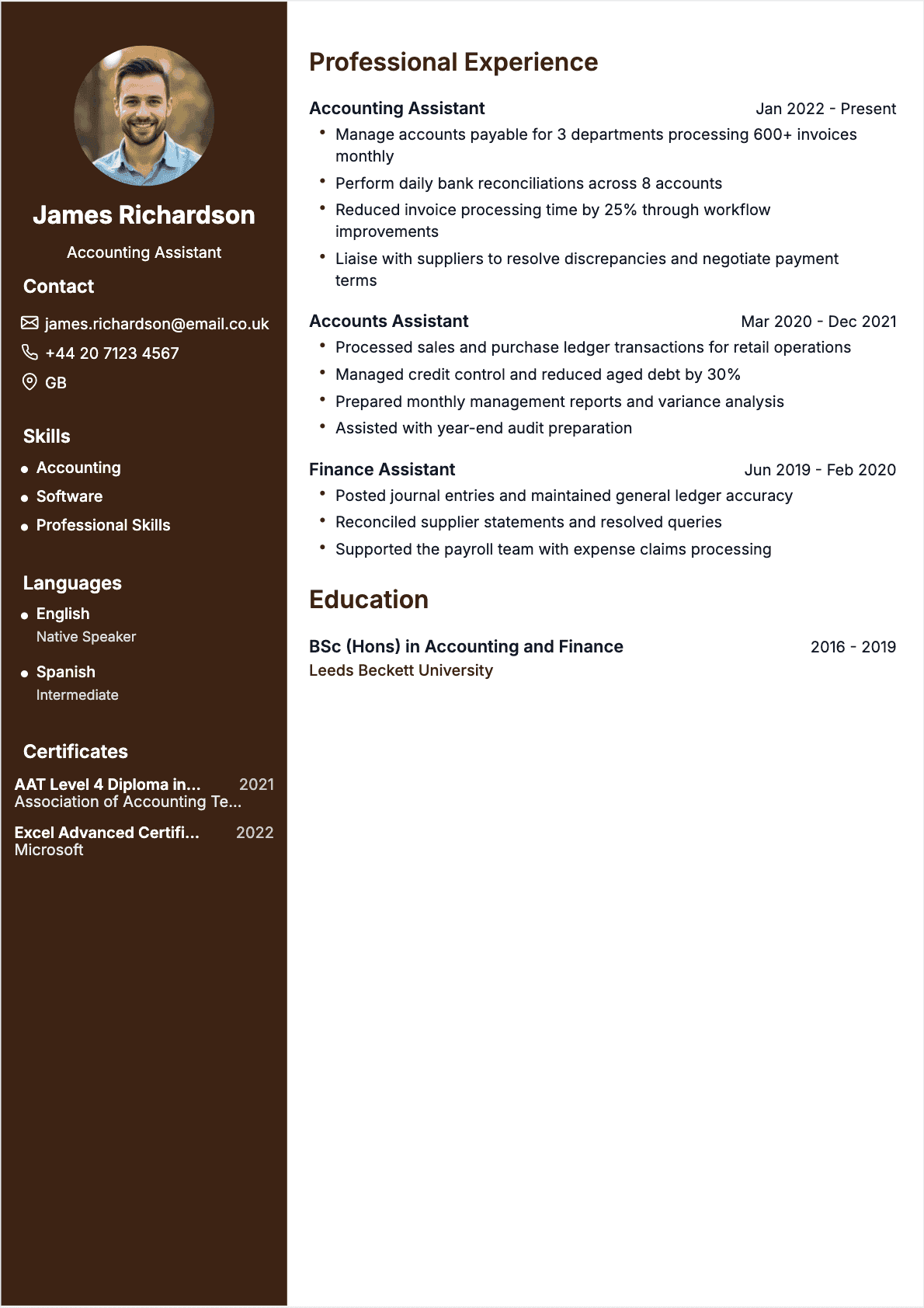
Accounting Assistant Resume Templates
8 Templates available
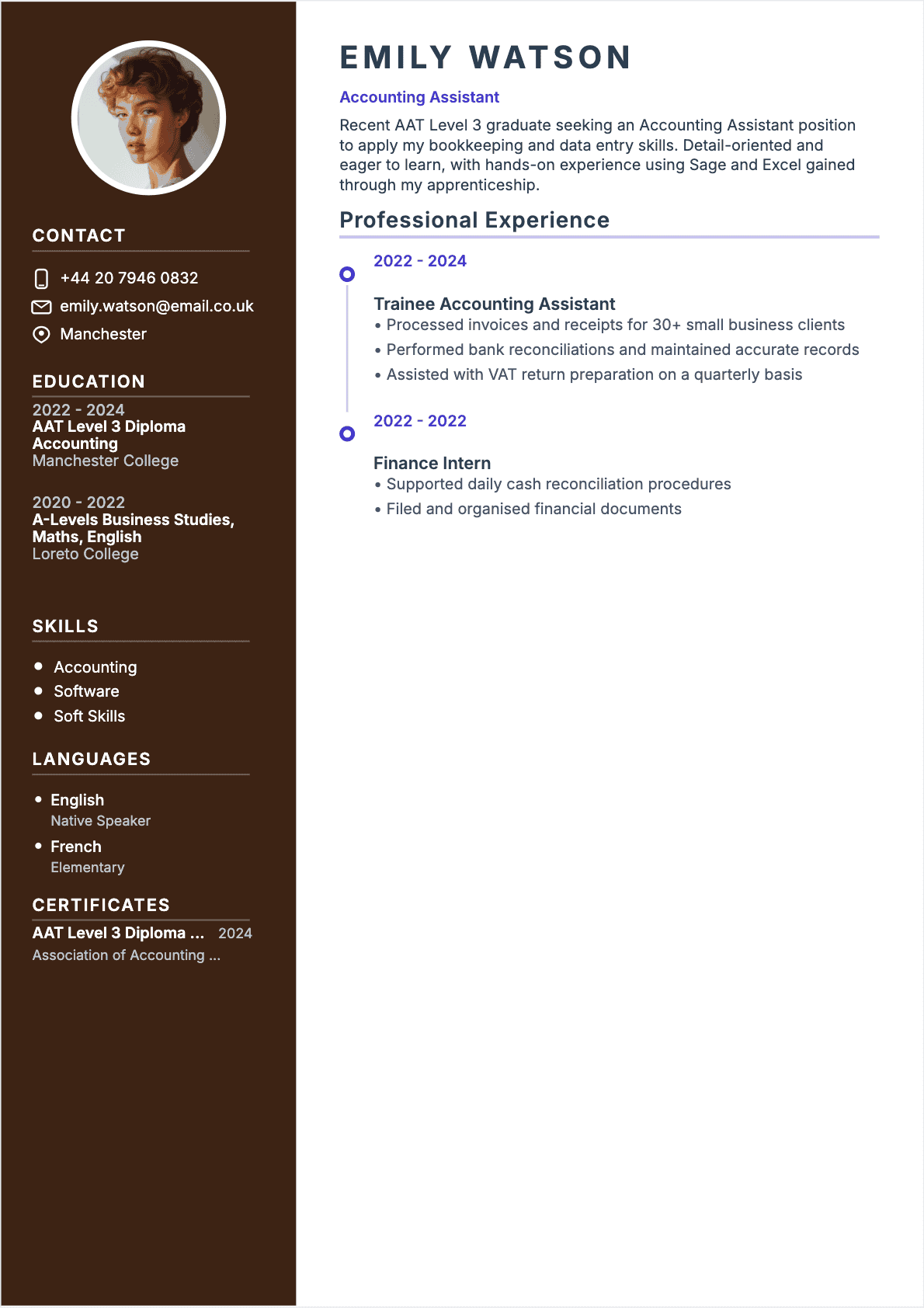
Resume Accounting Assistant Junior
Accounting Assistant resume template for Junior profile
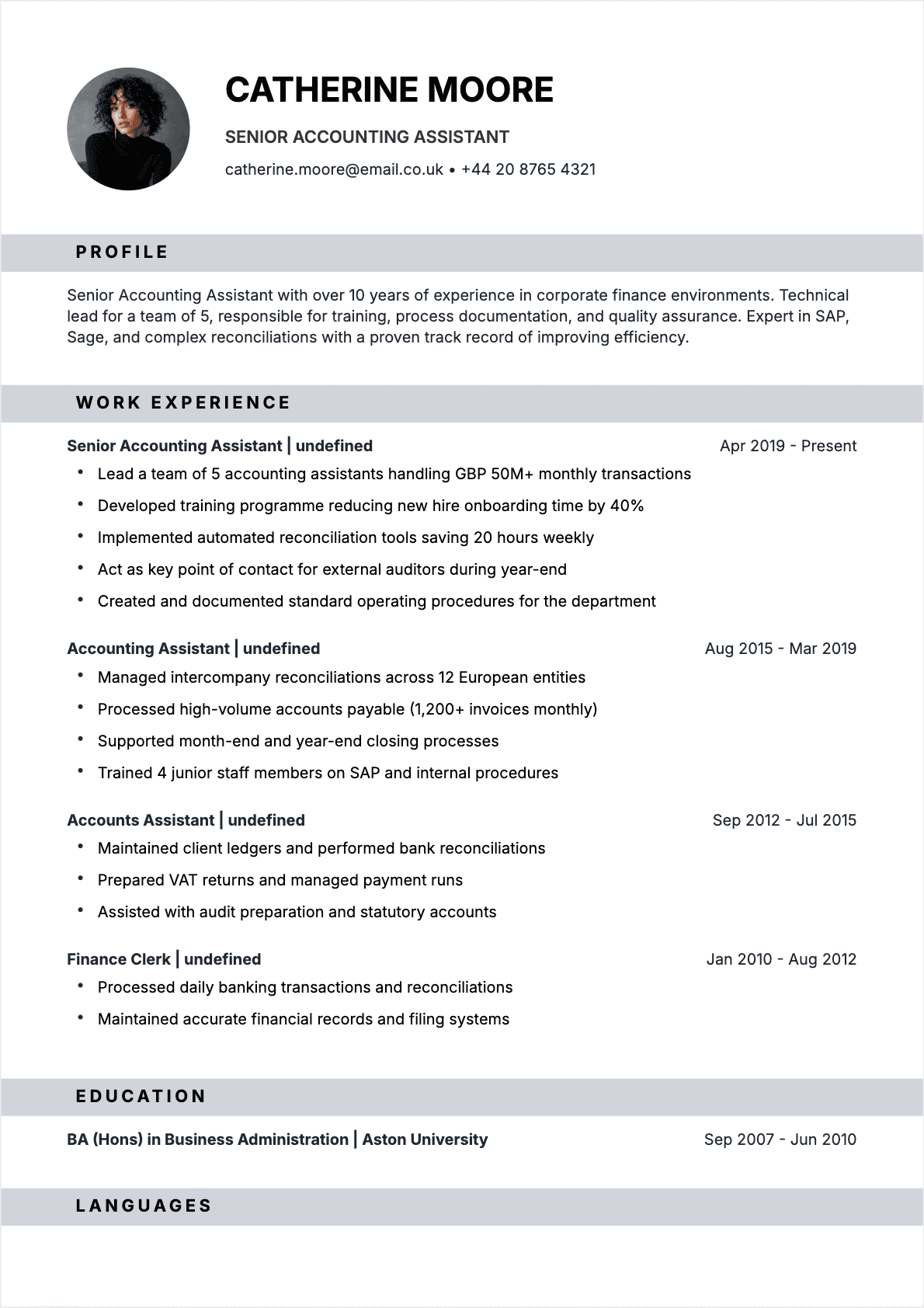
Resume Accounting Assistant Senior
Accounting Assistant resume template for Senior profile
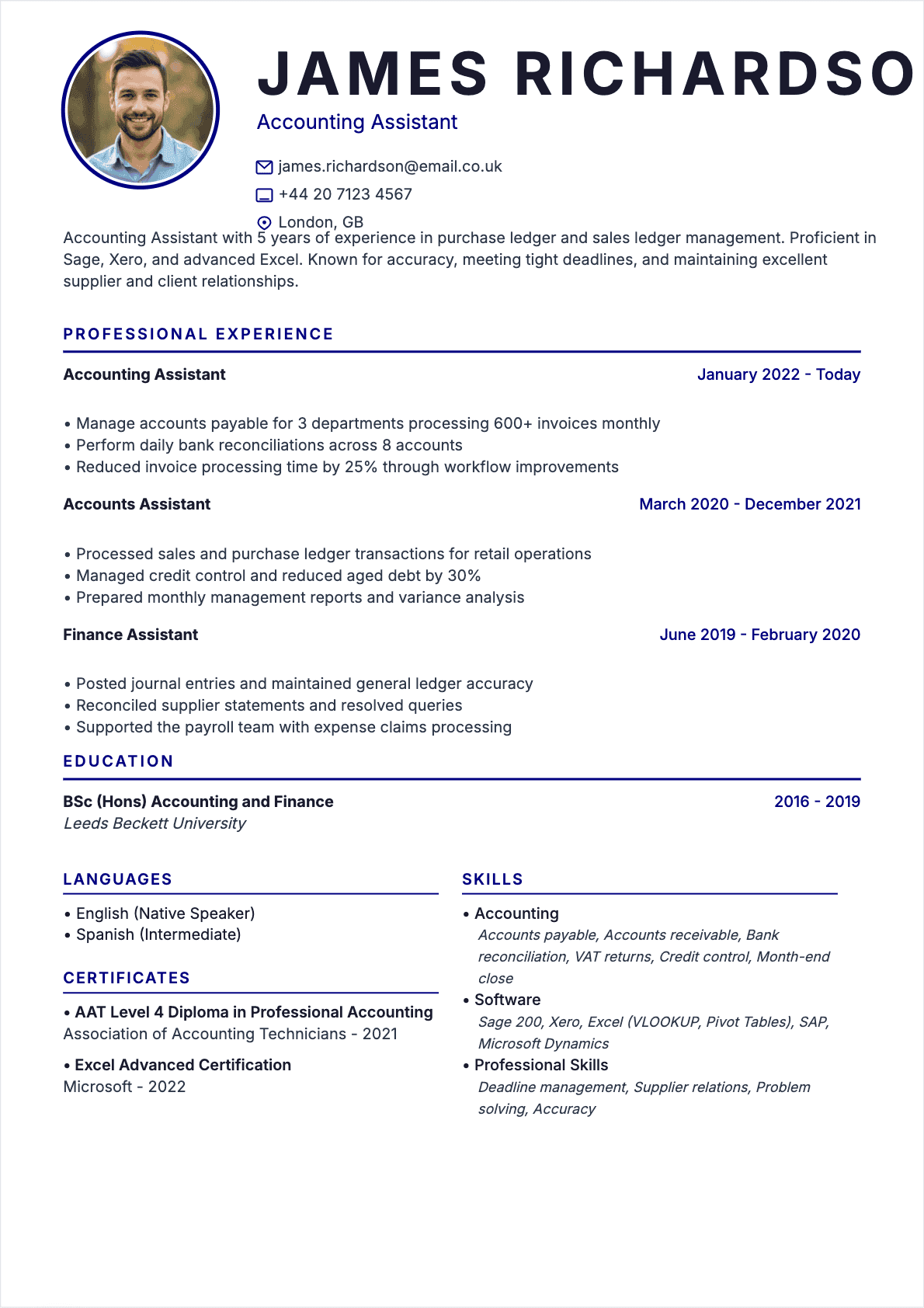
Resume Accounting Assistant Confirmé
Accounting Assistant resume template for Confirmé profile
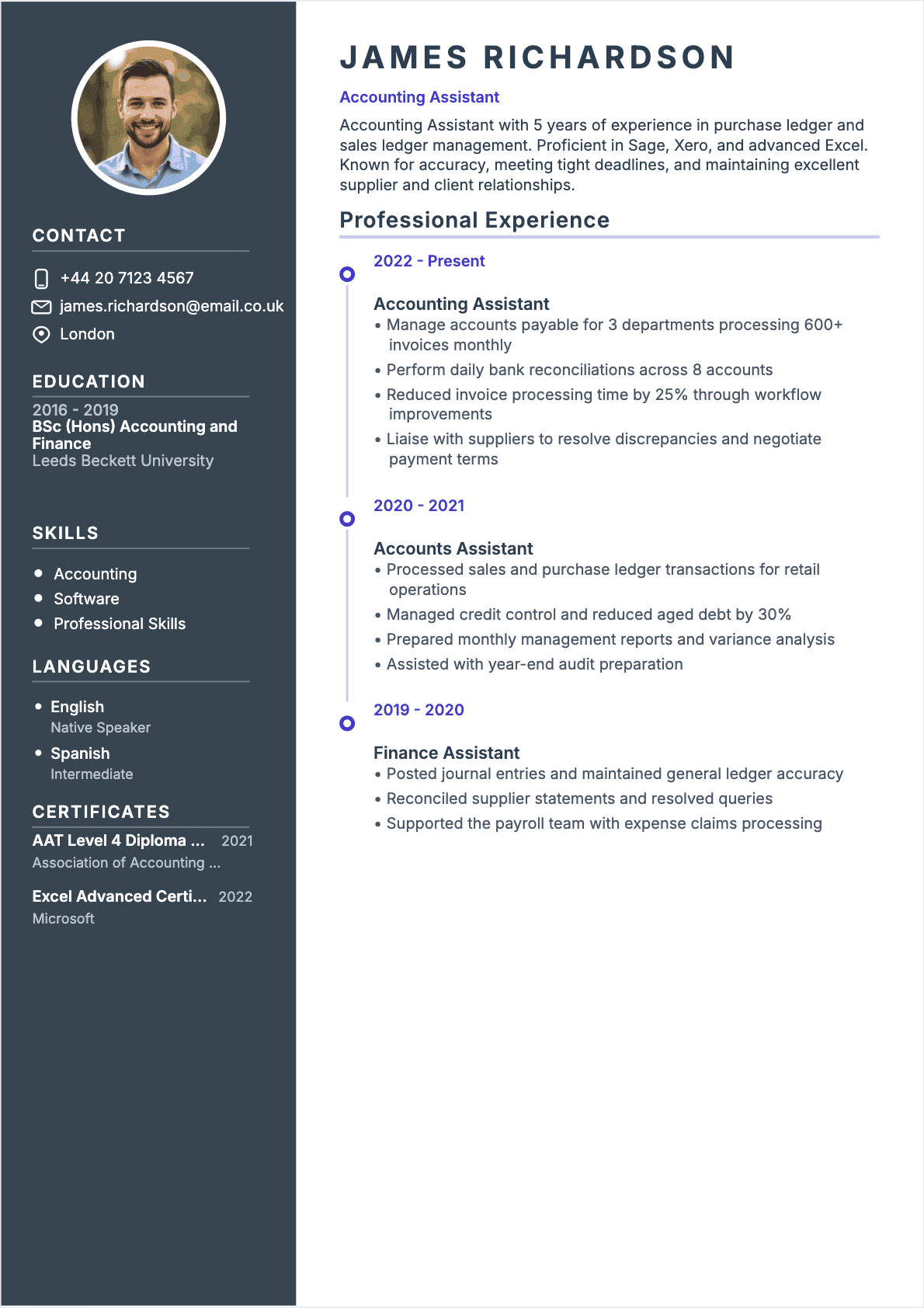
Resume Accounting Assistant Confirmé
Accounting Assistant resume template for Confirmé profile
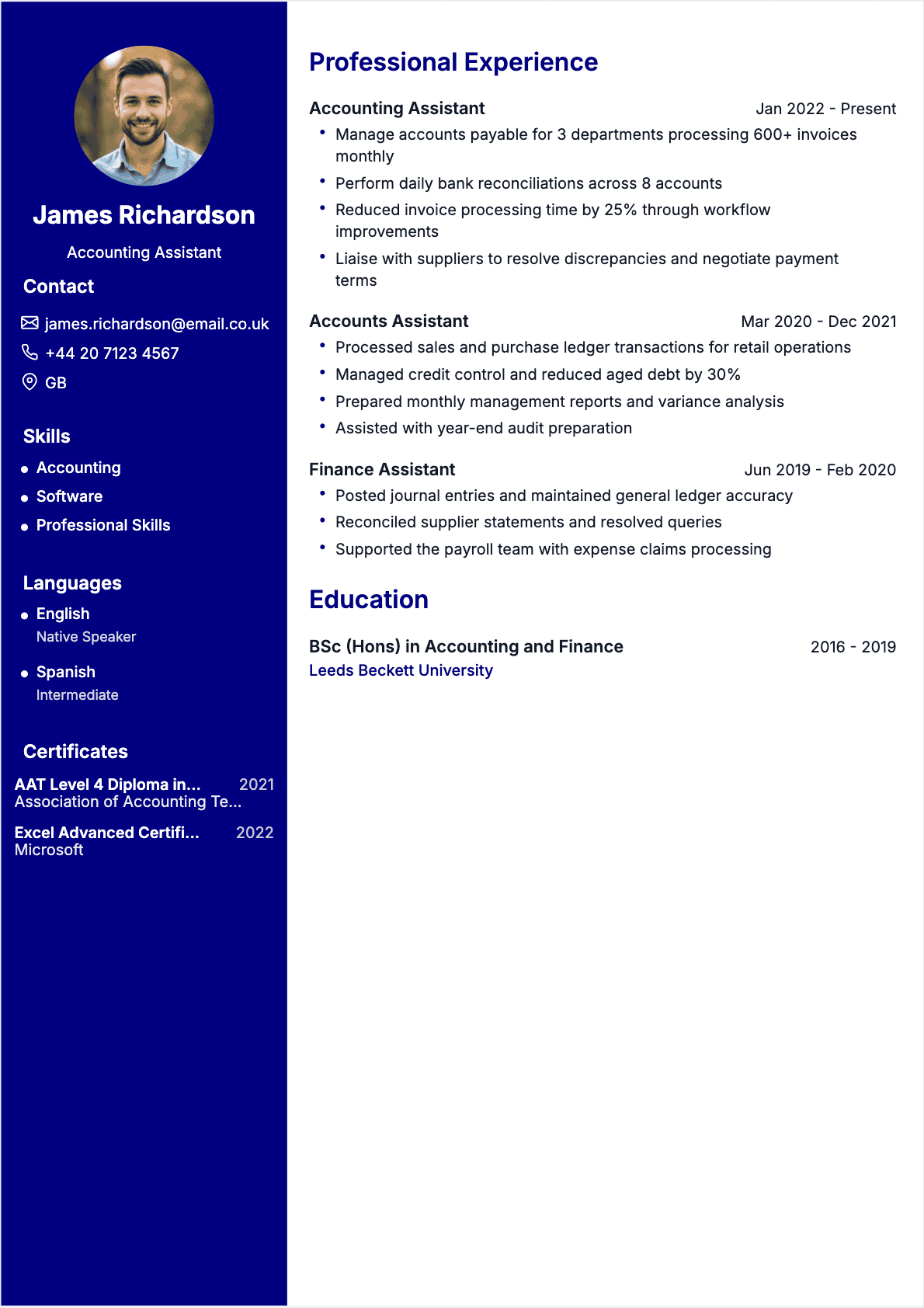
Resume Accounting Assistant Confirmé
Accounting Assistant resume template for Confirmé profile
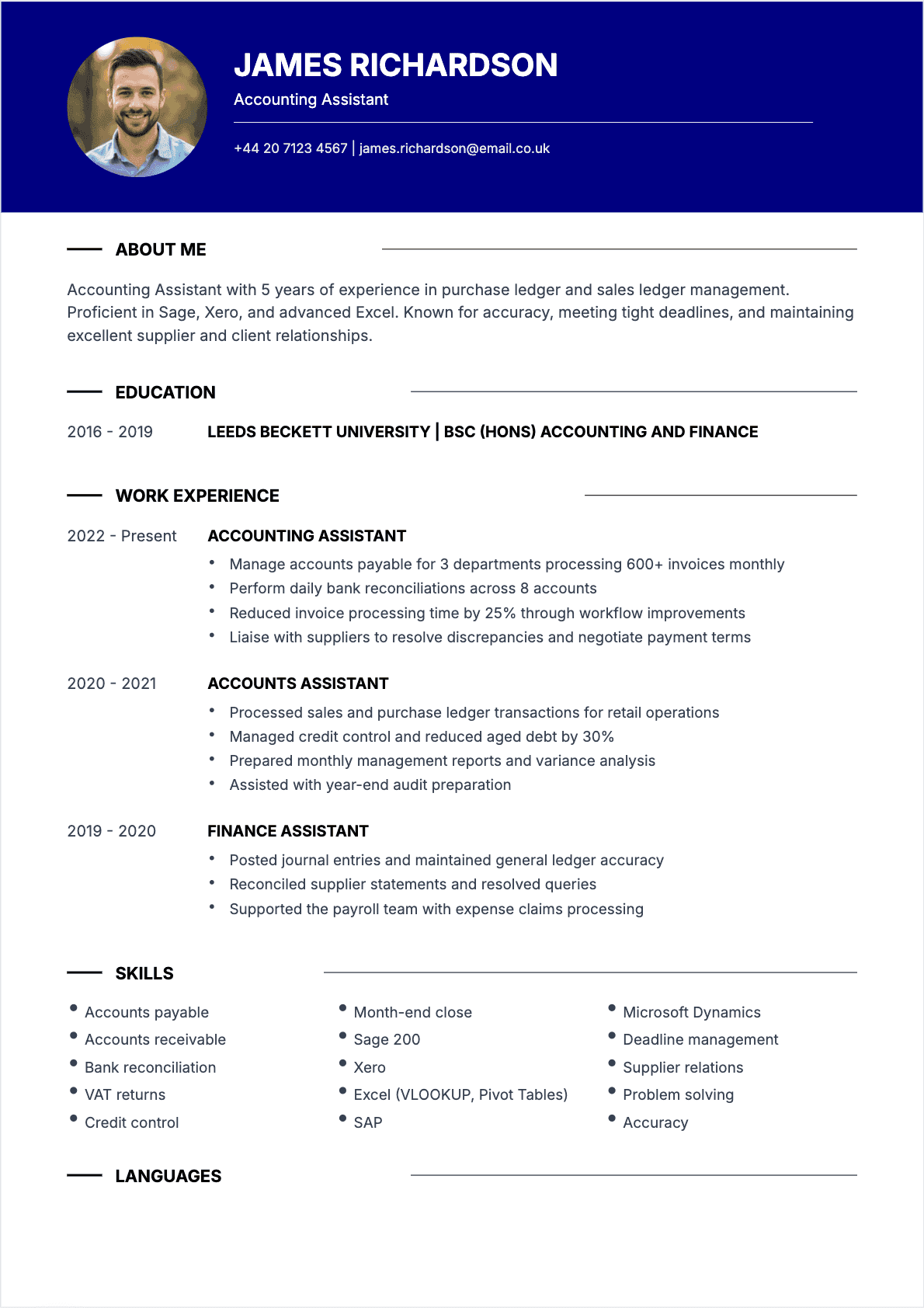
Resume Accounting Assistant Confirmé
Accounting Assistant resume template for Confirmé profile
Like one of these Accounting Assistant resume templates?
Select it, fill in your details and download your resume as PDF.
Accounting Assistant Resume Examples
James Richardson
Accounting Assistant
james.richardson@email.co.uk
+44 20 7123 4567
London, GB
Accounting Assistant with 5 years of experience in purchase ledger and sales ledger management. Proficient in Sage, Xero, and advanced Excel. Known for accuracy, meeting tight deadlines, and maintaining excellent supplier and client relationships.
Work Experience
Accounting Assistant
- ●Manage accounts payable for 3 departments processing 600+ invoices monthly
- ●Perform daily bank reconciliations across 8 accounts
- ●Reduced invoice processing time by 25% through workflow improvements
Accounts Assistant
- ●Processed sales and purchase ledger transactions for retail operations
- ●Managed credit control and reduced aged debt by 30%
- ●Prepared monthly management reports and variance analysis
Finance Assistant
- ●Posted journal entries and maintained general ledger accuracy
- ●Reconciled supplier statements and resolved queries
- ●Supported the payroll team with expense claims processing
Education
BSc (Hons)
Leeds Beckett University
Skills
Languages
English — Native Speaker
Spanish — Intermediate
Certifications
AAT Level 4 Diploma in Professional AccountingAssociation of Accounting Technicians
Excel Advanced CertificationMicrosoft
Accounting Assistant role overview
An Accounting Assistant serves as the operational backbone of finance departments, handling the day-to-day transactional work that keeps financial records accurate and current. You'll spend your days processing invoices, reconciling accounts, managing expense reports, and ensuring that every financial transaction is properly documented and categorized. This role sits at the intersection of data entry precision and financial understanding, requiring both meticulous attention to detail and a solid grasp of basic accounting principles.
The position typically reports to senior accountants, controllers, or finance managers, and you'll work closely with accounts payable and receivable teams. Your responsibilities extend beyond simple data entry—you're often the first line of defense in catching discrepancies, identifying potential issues, and maintaining the integrity of financial data that executives rely on for decision-making. Many Accounting Assistants also interact with vendors, clients, and other departments to resolve billing questions or gather missing documentation.
Career progression in this field follows a clear trajectory. After 1-2 years as an Accounting Assistant, you can advance to Senior Accounting Assistant or Staff Accountant roles. From there, the path opens to Accounts Payable/Receivable Manager, Senior Accountant, or specialized positions like Tax Accountant or Financial Analyst. Many professionals use this role as a launching pad while pursuing certifications like CPA or CMA, which significantly accelerate career advancement.
Salary expectations vary by experience and location. Entry-level Accounting Assistants in the United States typically earn between $35,000 and $42,000 annually, while those with 2-4 years of experience can expect $42,000 to $52,000. Senior Accounting Assistants with 5+ years of experience often earn $52,000 to $62,000, with higher ranges in major metropolitan areas or specialized industries like finance or healthcare.
Typical daily tasks include:
- Processing and coding 30-50 vendor invoices daily, ensuring proper GL account assignment and approval workflows
- Reconciling bank statements and credit card transactions, investigating and resolving discrepancies within 48 hours
- Preparing and submitting employee expense reimbursements, verifying receipts and policy compliance
- Maintaining accounts receivable records, following up on overdue invoices, and applying customer payments
- Assisting with month-end close procedures, including journal entries, accruals, and account reconciliations
- Organizing and filing financial documents in compliance with company retention policies and audit requirements
Essential skills for an Accounting Assistant resume
Your resume needs to showcase both technical accounting competencies and the soft skills that enable you to work effectively in fast-paced finance environments. Applicant Tracking Systems scan for specific technical skills and software proficiencies, so including these exact terms can mean the difference between getting interviewed and getting filtered out. However, recruiters also want to see evidence that you can communicate with non-finance colleagues, manage competing deadlines, and maintain accuracy under pressure.
The most critical skills fall into three categories: accounting software proficiency, fundamental accounting knowledge, and organizational capabilities. Companies increasingly use specialized platforms beyond basic spreadsheets, and demonstrating familiarity with industry-standard tools immediately signals that you'll require less training. Meanwhile, your understanding of debits, credits, and financial statement relationships shows you're not just a data entry clerk but someone who comprehends the 'why' behind the work.
Core skills to highlight on your resume:
- QuickBooks or Xero proficiency – Most small to mid-sized companies use these platforms for core accounting functions, and hands-on experience reduces onboarding time by weeks
- Accounts Payable/Receivable processing – The bread-and-butter of the role; specify your daily invoice volume and error rates to demonstrate efficiency
- Bank reconciliation – Shows you can identify discrepancies and maintain accurate cash position records, critical for financial reporting
- Excel or Google Sheets (intermediate to advanced) – VLOOKUP, pivot tables, and formula creation are non-negotiable; specify which functions you use regularly
- General Ledger understanding – Knowledge of account structures, chart of accounts, and how transactions flow through financial statements
- Month-end close procedures – Experience with accruals, deferrals, and reconciliations demonstrates you understand the full accounting cycle
- Compliance and documentation – Familiarity with SOX requirements, audit trails, and retention policies shows you protect the company from regulatory risk
- ERP systems (SAP, Oracle, NetSuite) – Larger organizations use these enterprise platforms; any exposure is worth mentioning
- Attention to detail – Quantify this with error rates or accuracy percentages rather than just claiming you're 'detail-oriented'
- Time management – Accounting has hard deadlines; mention your ability to process X transactions while meeting month-end close schedules
- Communication skills – You'll explain financial matters to non-finance staff and resolve vendor disputes; give examples of cross-departmental collaboration
- Problem-solving – Highlight instances where you identified discrepancies, researched issues, and implemented solutions independently
For ATS optimization, prioritize the specific software and systems mentioned in the job posting. If the listing mentions 'NetSuite' three times, that term should appear in your skills section and work experience. Technical accounting terms like 'three-way match,' 'accrual accounting,' and 'GL coding' also score well with ATS algorithms because they're industry-specific and difficult to fake.

How to write an Accounting Assistant resume step by step
1. Start with a results-focused summary that includes your processing volume
Your summary should immediately establish your experience level and quantify your daily workload. Instead of 'Detail-oriented Accounting Assistant with 3 years of experience,' write 'Accounting Assistant with 3+ years processing 200+ monthly invoices with 99.7% accuracy, supporting month-end close for $15M revenue company.' This approach tells recruiters exactly what capacity you can handle and proves your reliability with metrics.
2. List technical skills with proficiency levels and context
Create a dedicated skills section that specifies your expertise level with each tool. Rather than simply listing 'QuickBooks, Excel, SAP,' write 'QuickBooks Online (3 years, daily use for AP/AR), Excel (advanced: pivot tables, VLOOKUP, macros), SAP FI module (1 year, invoice processing and vendor management).' This specificity helps ATS matching and shows recruiters you're not padding your resume with keywords.
3. Structure work experience bullets with the action-metric-impact formula
Each bullet point should follow this pattern: what you did + how much/how many + what result it produced. For example, instead of 'Responsible for accounts payable,' write 'Processed 180+ vendor invoices weekly totaling $400K, reducing payment cycle time from 45 to 30 days through workflow optimization.' The metric proves scope, and the impact shows business value.
4. Highlight month-end close contributions with specific tasks
Month-end close experience is crucial for this role. Detail your specific responsibilities: 'Completed 12 monthly bank reconciliations for 5 accounts totaling $2.3M, identifying and resolving discrepancies within 24 hours to support timely financial reporting.' This demonstrates you understand the urgency and precision required during close periods.
5. Include process improvements or efficiency gains you've implemented
Accounting Assistants who identify better ways to work are highly valued. Document any improvements: 'Redesigned expense report filing system, reducing reimbursement processing time by 35% and decreasing missing receipt follow-ups by 60%.' Even small optimizations show initiative and business thinking beyond routine tasks.
6. Quantify your accuracy and compliance record
Financial roles demand precision, so prove yours with numbers: 'Maintained 99.5% invoice coding accuracy across 2,400+ annual transactions, with zero audit findings during 2-year tenure.' If you've supported audits, mention it: 'Prepared documentation for annual external audit, providing requested records within 48-hour turnaround for 100% of requests.'
7. Add relevant certifications and ongoing education
Include any accounting coursework, software certifications, or professional development. 'Completed 40-hour QuickBooks ProAdvisor certification' or 'Currently pursuing Associate's degree in Accounting (12 credits completed)' shows commitment to the profession. Even LinkedIn Learning courses in Excel or accounting principles demonstrate initiative.
8. Tailor your resume to each job posting's specific requirements
Read the job description carefully and mirror its language. If it emphasizes 'vendor relationship management,' ensure that exact phrase appears in your experience. If it mentions 'high-volume transaction processing,' quantify your volume using similar terminology. This isn't about lying—it's about highlighting the relevant parts of your experience using the employer's vocabulary.
Before/After Examples:
Weak: 'Handled accounts payable and accounts receivable duties for the company'
Strong: 'Managed full-cycle AP for 85 vendors and AR for 120 clients, processing $1.2M in monthly transactions with 99% on-time payment rate'
Weak: 'Assisted with month-end closing procedures'
Strong: 'Executed 8 monthly account reconciliations and prepared 15+ journal entries during close, contributing to consistent 5-business-day close completion'
Weak: 'Used Excel for various accounting tasks'
Strong: 'Built Excel tracking models using pivot tables and VLOOKUP functions to monitor 200+ open POs, reducing duplicate orders by 40%'
Common mistakes on Accounting Assistant resumes
Listing software without demonstrating actual proficiency
Many candidates list 'QuickBooks, SAP, Excel' in their skills section but provide no evidence of using these tools in their work experience. Recruiters see through this immediately. If you claim QuickBooks expertise, your bullets should reference specific tasks you performed in the software: 'Generated 25+ monthly vendor aging reports in QuickBooks to prioritize payment schedules.' Without context, recruiters assume you only have superficial exposure or took a single training course.
Using vague language instead of transaction volumes
Phrases like 'processed invoices' or 'handled accounts payable' tell recruiters nothing about your capacity. An Accounting Assistant who processes 20 invoices monthly is very different from one who handles 200 weekly. Always quantify: 'Processed 45-60 daily invoices' or 'Managed AP for 120+ vendors with monthly spend of $850K.' These numbers help recruiters assess whether your experience matches their company's scale.
Focusing on duties instead of accuracy and efficiency metrics
Your resume shouldn't read like a job description. Recruiters know what Accounting Assistants do—they want to know how well you do it. Instead of 'Reconciled bank accounts monthly,' write 'Reconciled 4 bank accounts totaling $3.2M monthly with zero unresolved discrepancies for 18 consecutive months.' The accuracy metric and consistency record prove reliability, which is paramount in accounting roles.
Omitting month-end close experience or timing details
Month-end close is when accounting departments are under maximum pressure, and your ability to perform during this period is critical. Don't just mention you 'participated in month-end close'—specify your contributions and timing: 'Completed assigned reconciliations within 2 business days of month-end, supporting team's consistent 5-day close target.' This shows you understand the urgency and can deliver under deadline pressure.
Neglecting to mention cross-functional communication
Accounting Assistants don't work in isolation. You're constantly interacting with operations teams about invoice questions, with vendors about payment status, or with employees about expense reports. Failing to highlight these interactions makes you seem like a pure data entry person. Include bullets like: 'Resolved 30+ monthly vendor payment inquiries, reducing escalations to AP Manager by 50%' or 'Collaborated with 6 department heads to implement new expense policy, conducting training sessions for 45 employees.'
Including irrelevant work history without connecting it to accounting skills
If you're transitioning from retail or hospitality into accounting, don't just list your previous jobs without context. Draw explicit connections: 'Managed daily cash reconciliation for $15K in retail transactions, identifying and resolving discrepancies within 1%—skills directly applicable to bank reconciliation processes.' This helps recruiters see the transferable skills rather than wondering why a restaurant server is applying for accounting positions.
Failing to address employment gaps or frequent job changes
Accounting roles require trustworthiness and stability. If you have gaps or multiple short-term positions, address them proactively. Use a brief note in your summary: 'Returned to workforce after 18-month caregiving period, completed QuickBooks certification to update skills' or use a functional resume format that emphasizes skills over chronology. Unexplained gaps in a field that handles money raise red flags, so provide context.
Accounting Assistant resume trends in 2026
The Accounting Assistant role is experiencing significant transformation as automation handles routine data entry while expanding the strategic aspects of the position. Companies now expect Accounting Assistants to do more than process transactions—they want analytical thinking and the ability to work alongside AI tools that flag anomalies or suggest coding. Your resume should reflect familiarity with modern accounting technology and demonstrate you're prepared for this evolution rather than threatened by it.
Cloud-based accounting platforms have become the standard, with QuickBooks Online, Xero, and NetSuite dominating the market. Employers increasingly expect Accounting Assistants to be comfortable with cloud systems from day one, as remote and hybrid work arrangements make desktop software impractical. Highlighting experience with cloud platforms and mentioning your ability to work in distributed teams signals you're aligned with current operational models. Additionally, API integrations between banking systems, expense management tools like Expensify or Concur, and accounting software mean you'll need to understand how data flows between systems rather than manually entering everything.
Data analytics skills are becoming differentiators for Accounting Assistant candidates. While you don't need to be a data scientist, the ability to create meaningful reports, identify trends in spending patterns, or spot unusual transactions adds significant value. Employers want Accounting Assistants who can answer questions like 'Why did office supply expenses increase 30% this quarter?' rather than simply recording the transactions. Mentioning experience with Excel dashboards, Power BI basics, or even just thoughtful analysis in your current role demonstrates this capability.
Cybersecurity awareness and fraud prevention have moved from IT concerns to accounting fundamentals. With the rise of business email compromise scams and fraudulent invoice schemes, companies now look for Accounting Assistants who understand verification protocols and can spot red flags. Your resume should mention any experience with dual authorization processes, vendor verification procedures, or fraud detection. Phrases like 'Implemented three-way match verification process, preventing 2 fraudulent payment attempts totaling $18K' show you're security-conscious.
The shift toward remote and hybrid work has created new expectations around communication and documentation. Accounting Assistants who can clearly document their work, communicate asynchronously through project management tools, and maintain accuracy without in-person supervision are highly valued. If you have remote work experience, emphasize it: 'Maintained 99.2% accuracy while working remotely, using Slack and Asana to coordinate with 5-person finance team across 3 time zones.' This addresses a key concern employers have about remote accounting work.
Professional development and certification pursuit have become more important as the role becomes more complex. While a full CPA isn't expected for Accounting Assistants, employers increasingly favor candidates who are actively building their knowledge. Mentioning that you're pursuing an accounting degree, have completed relevant certifications (QuickBooks ProAdvisor, Microsoft Excel Specialist), or regularly take continuing education courses signals ambition and commitment. Many job postings now explicitly state 'pursuing accounting degree' as a preferred qualification.
Finally, industry specialization is creating niche opportunities. Accounting Assistants with experience in specific sectors—healthcare billing and coding, construction job costing, nonprofit fund accounting, or e-commerce revenue recognition—can command premium salaries. If you have industry-specific knowledge, make it prominent in your resume summary and throughout your experience bullets. This specialization is particularly valuable as companies seek candidates who understand their unique compliance requirements and operational challenges.
Further reading:
Frequently asked questions
Find answers to the most frequently asked questions.
Use internships, campus roles, or part-time work to prove transferable finance routines: handling cash, issuing receipts, tracking expenses, or reconciling simple logs. Add relevant coursework (financial accounting, Excel) and 2–3 quantified mini-projects, such as “built an Excel budget tracker for 120 transactions with 0 formula errors.”
Aim for one page if you have under 5 years’ experience, and two pages if you have broader scope (multi-entity, audit support, advanced reconciliations). Prioritise recent roles and measurable outputs. Remove unrelated details and keep bullets to 3–5 per role, each with a metric and tool when possible.
In most English-speaking markets, a photo is optional and often discouraged in the US. If you’re applying in the UK, it’s still generally unnecessary. Use the space for a KPI snapshot and tools. If a photo is requested by a local norm, keep it professional and avoid large formats.
Recruiters typically prioritise AP/AR fundamentals, bank reconciliations, month-end support, Excel reporting, and reliability in follow-ups. Add evidence of controls (approval workflows, documentation) and your systems stack (QuickBooks, Xero, Sage, NetSuite, SAP). Show scale: invoices/month, reconciliations/month, and accuracy rate.
Break it into the steps you owned and attach metrics: capture/entry, coding, matching, approvals, exceptions, and payment runs. Example: “3-way matched 420 PO invoices/month; reduced exception queue by 35% by fixing GRN mismatches with procurement.” This shows depth beyond “processed invoices.”
Use keywords that reflect the workflow: accounts payable, accounts receivable, invoice processing, three-way match, purchase orders, bank reconciliation, journal entries, month-end close, general ledger coding, cash application, vendor management, and Excel PivotTables. Add your software names where truthful, since many ATS filters check them.
Your career deserves a better resume
With CVtoWork, select a template, fill in the fields and download your resume as PDF.
Start creating