Accountant Resume
Example, Template & Expert Tips 2026
Updated on April 18, 2026.
Write a CV Accountant CV that passes ATS: strong summary, quantified achievements, accounting keywords, skills, tools, and real examples to get interviews.
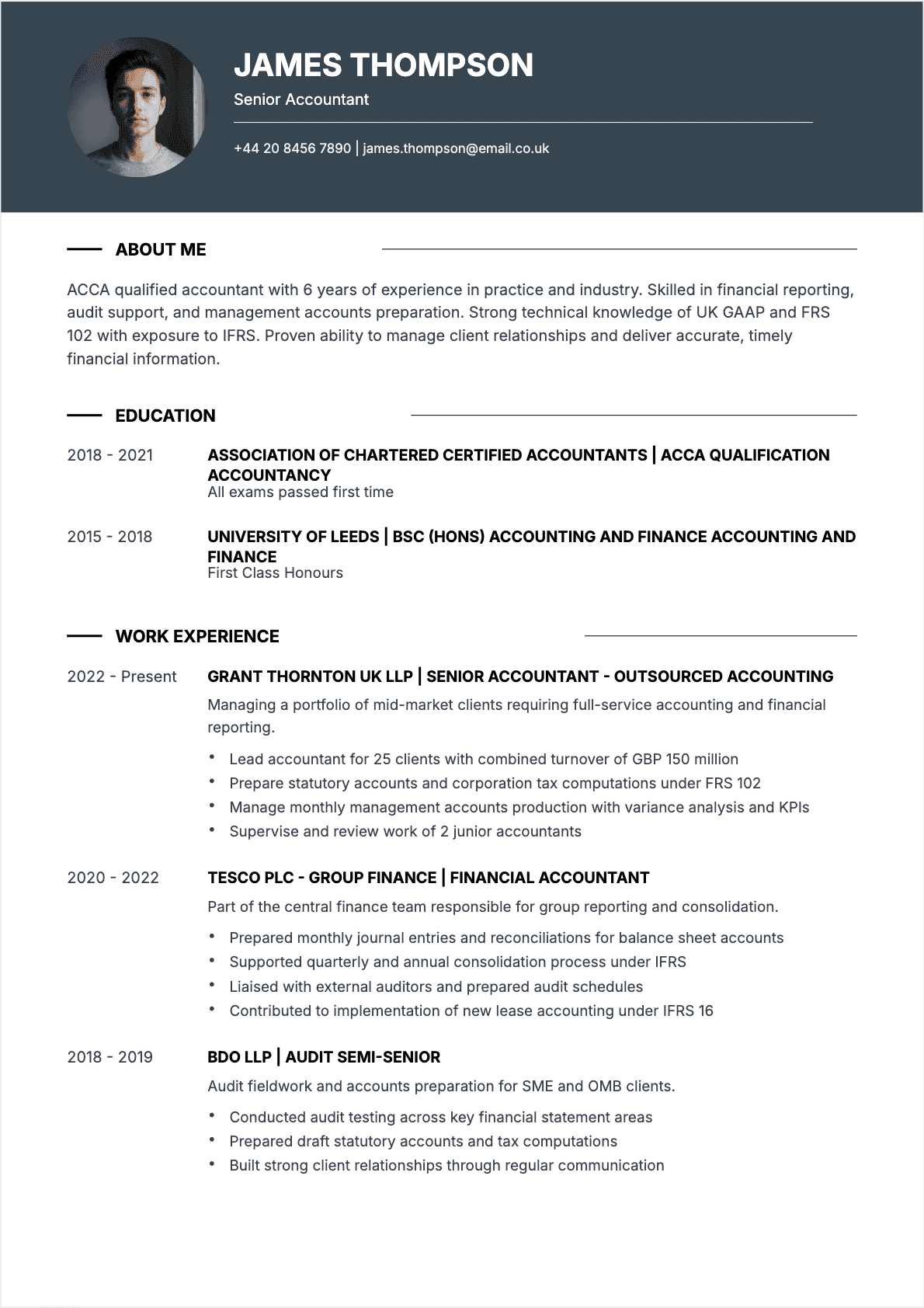
Accountant Resume Templates
8 Templates available
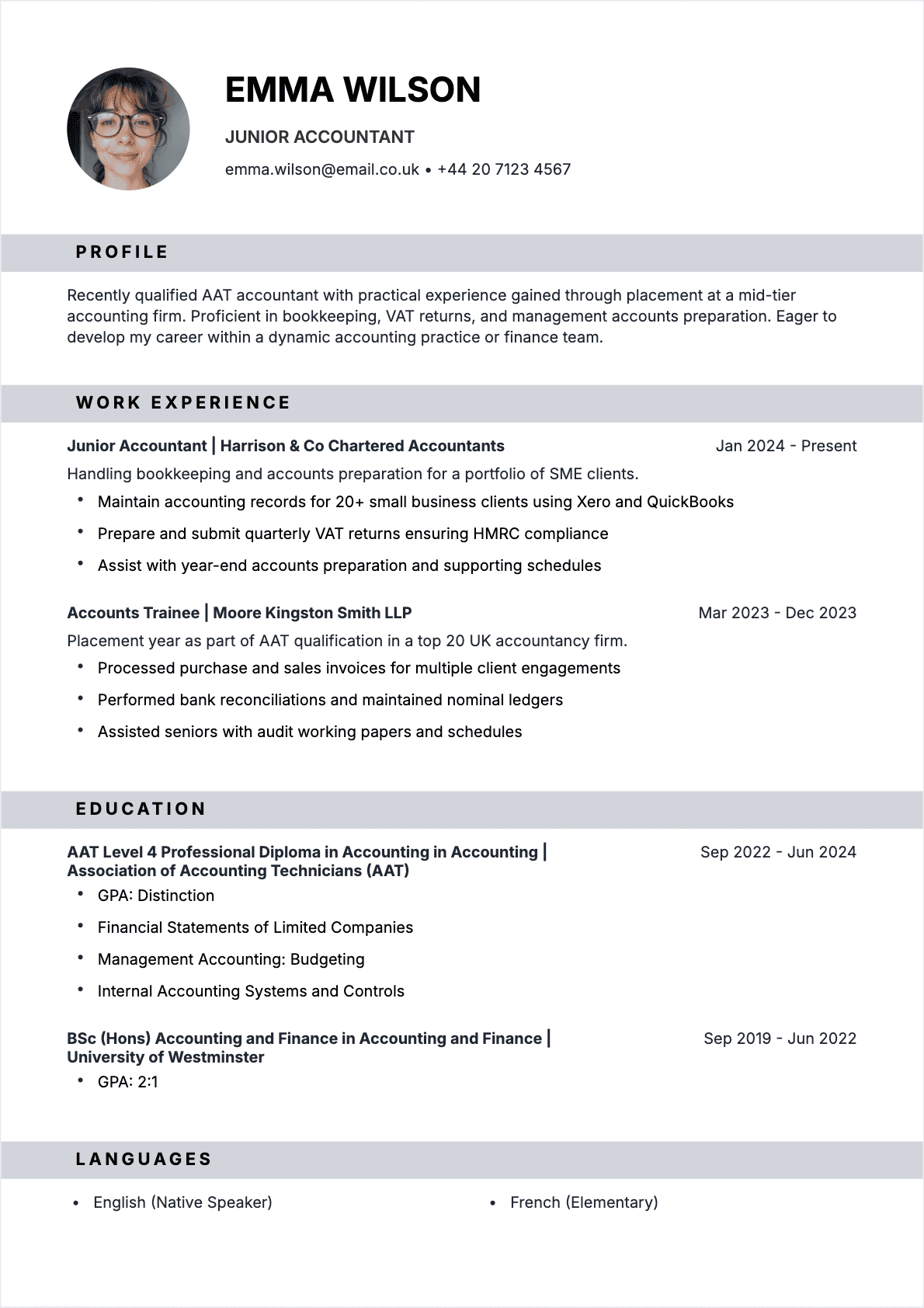
Resume Accountant Junior
Accountant resume template for Junior profile
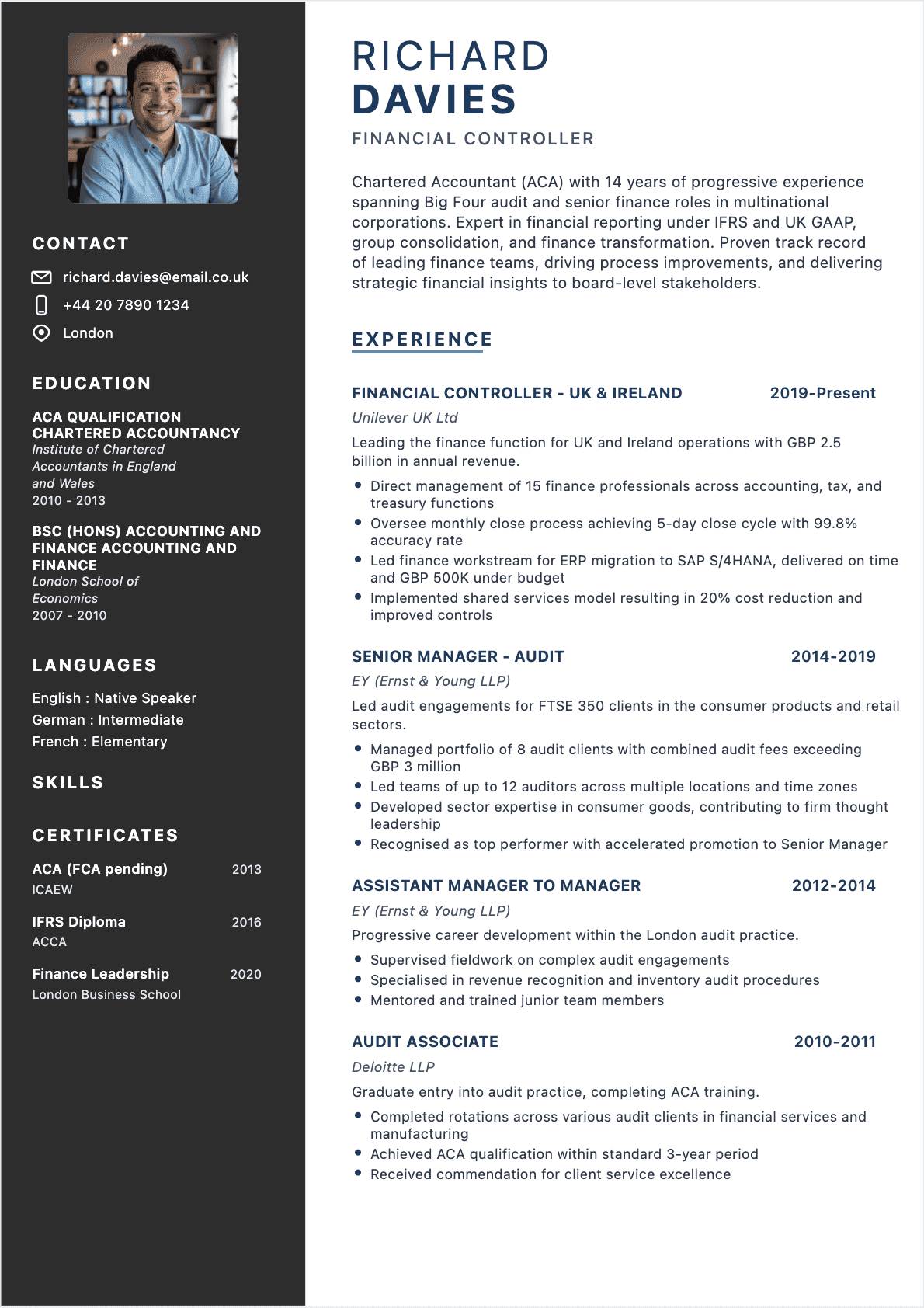
Resume Accountant Senior
PopularAccountant resume template for Senior profile
Resume Accountant Confirmé
Accountant resume template for Confirmé profile
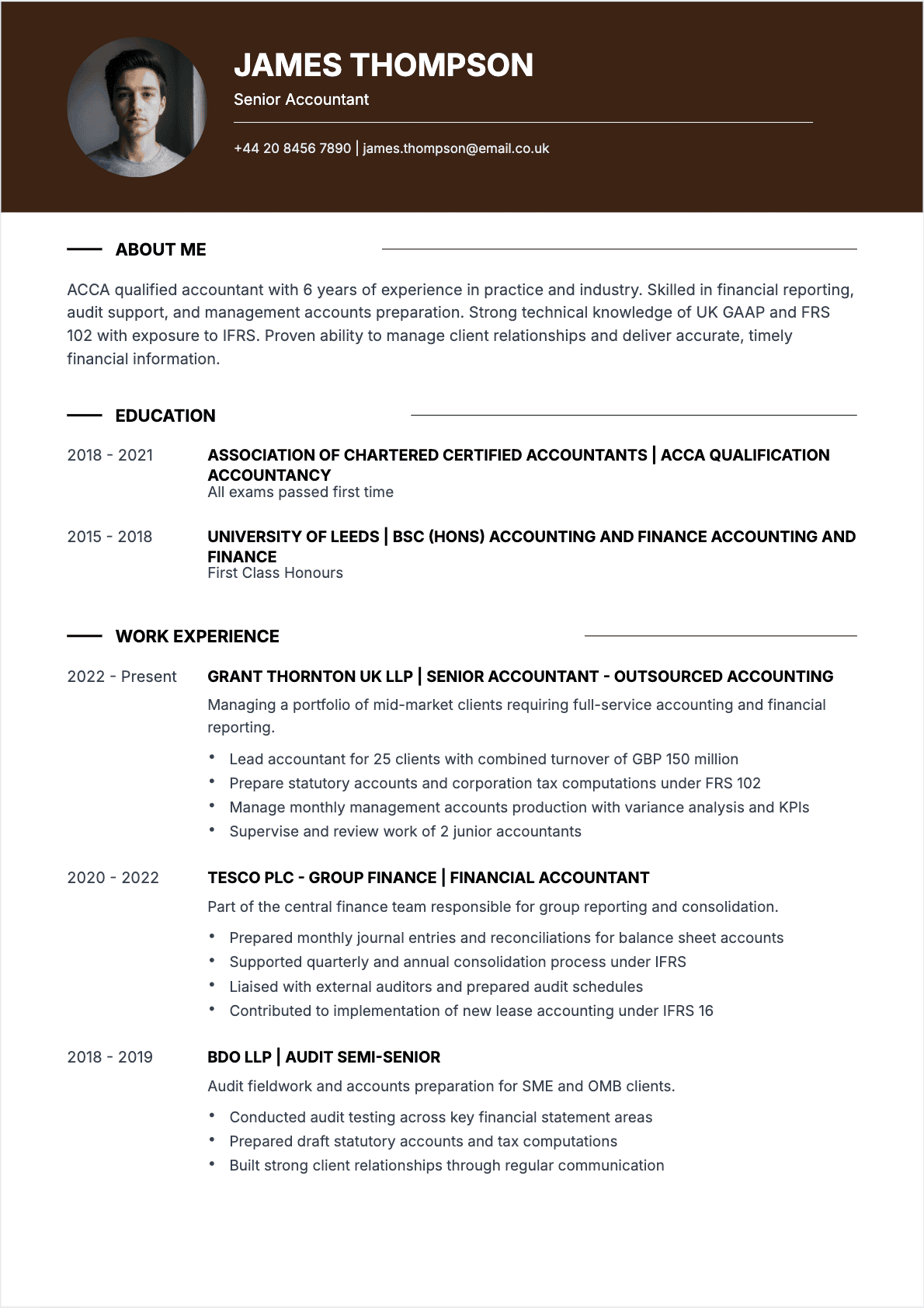
Resume Accountant Confirmé
Accountant resume template for Confirmé profile
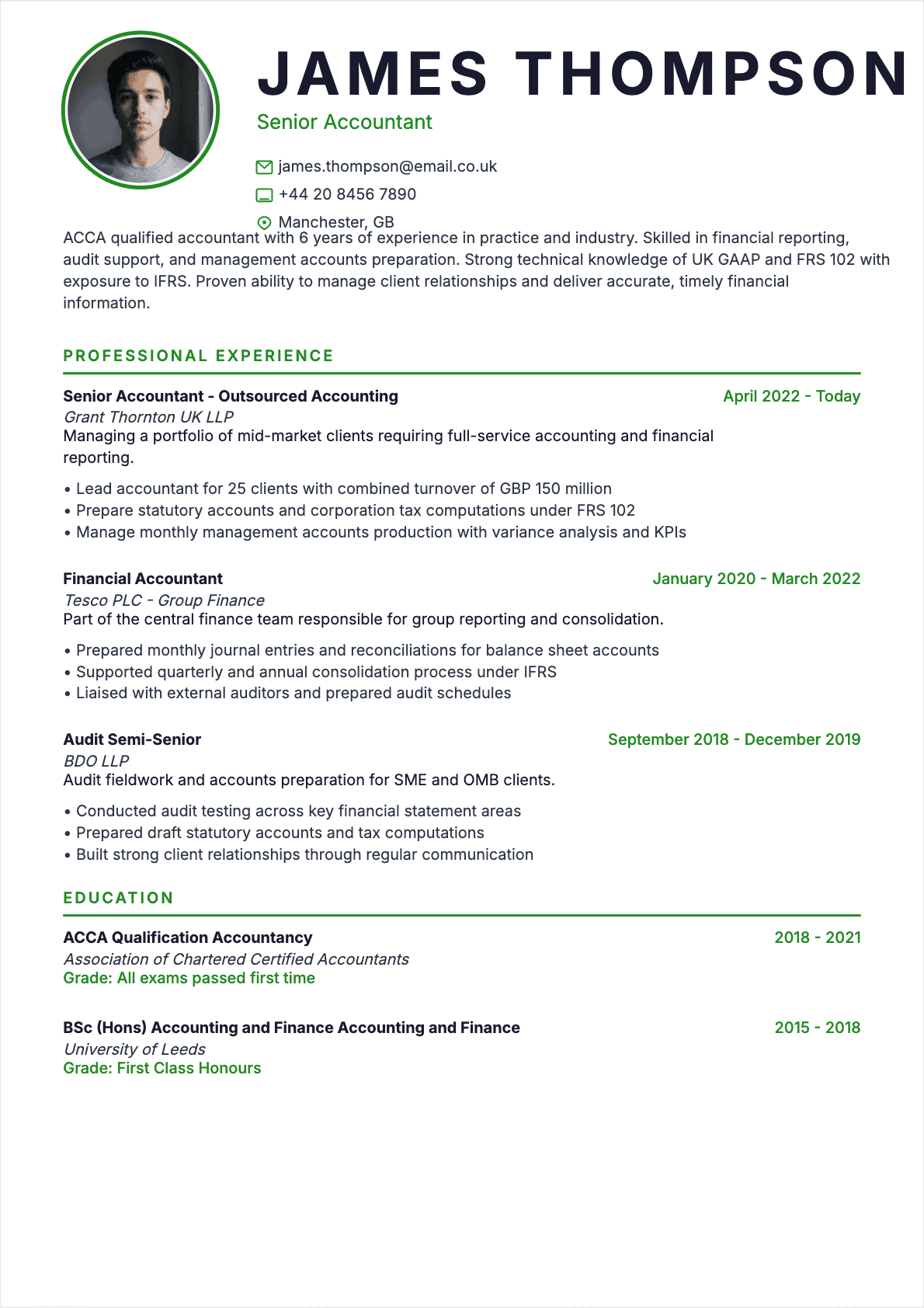
Resume Accountant Confirmé
Accountant resume template for Confirmé profile
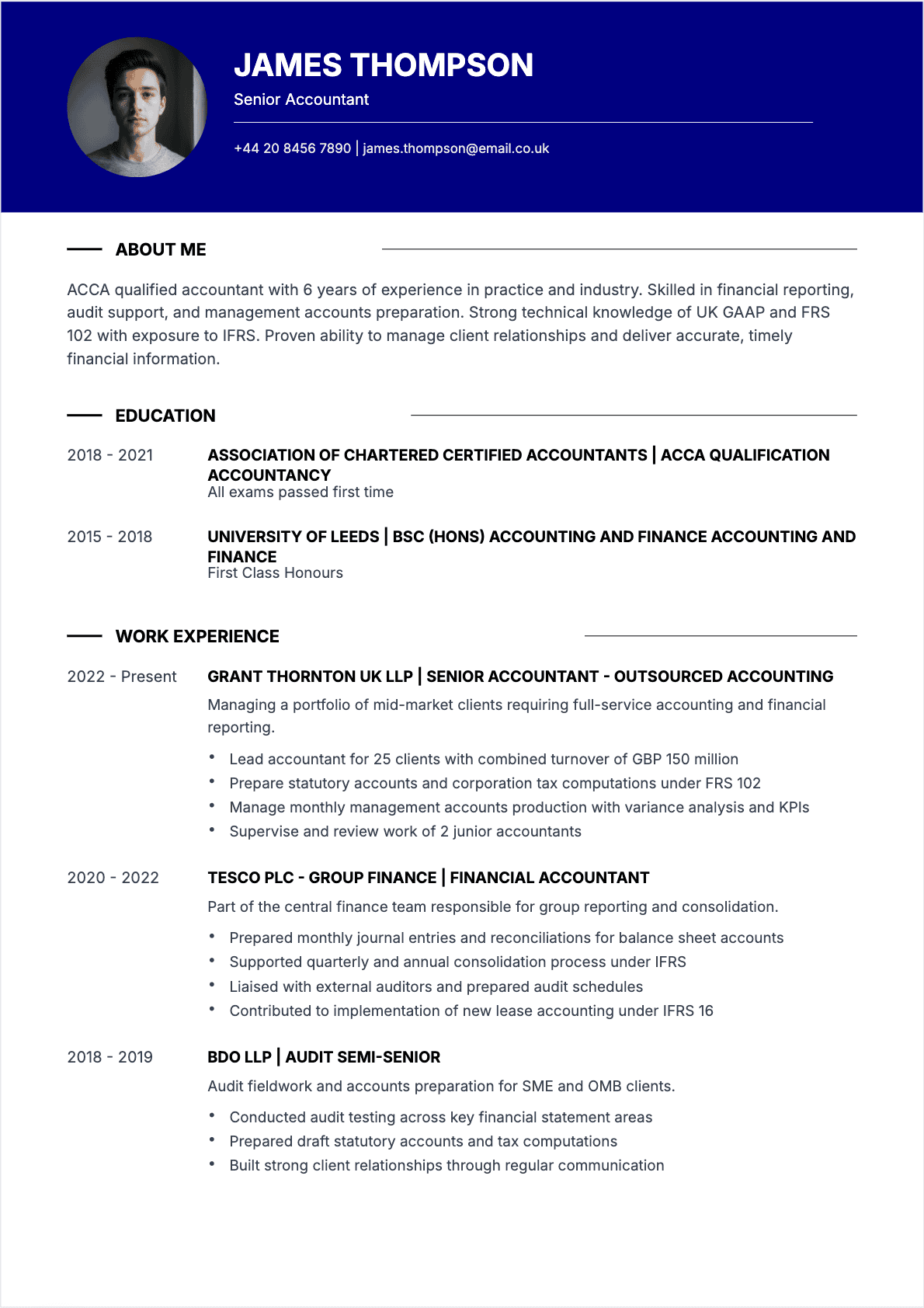
Resume Accountant Confirmé
Accountant resume template for Confirmé profile
Like one of these Accountant resume templates?
Select it, fill in your details and download your resume as PDF.
Accountant Resume Examples
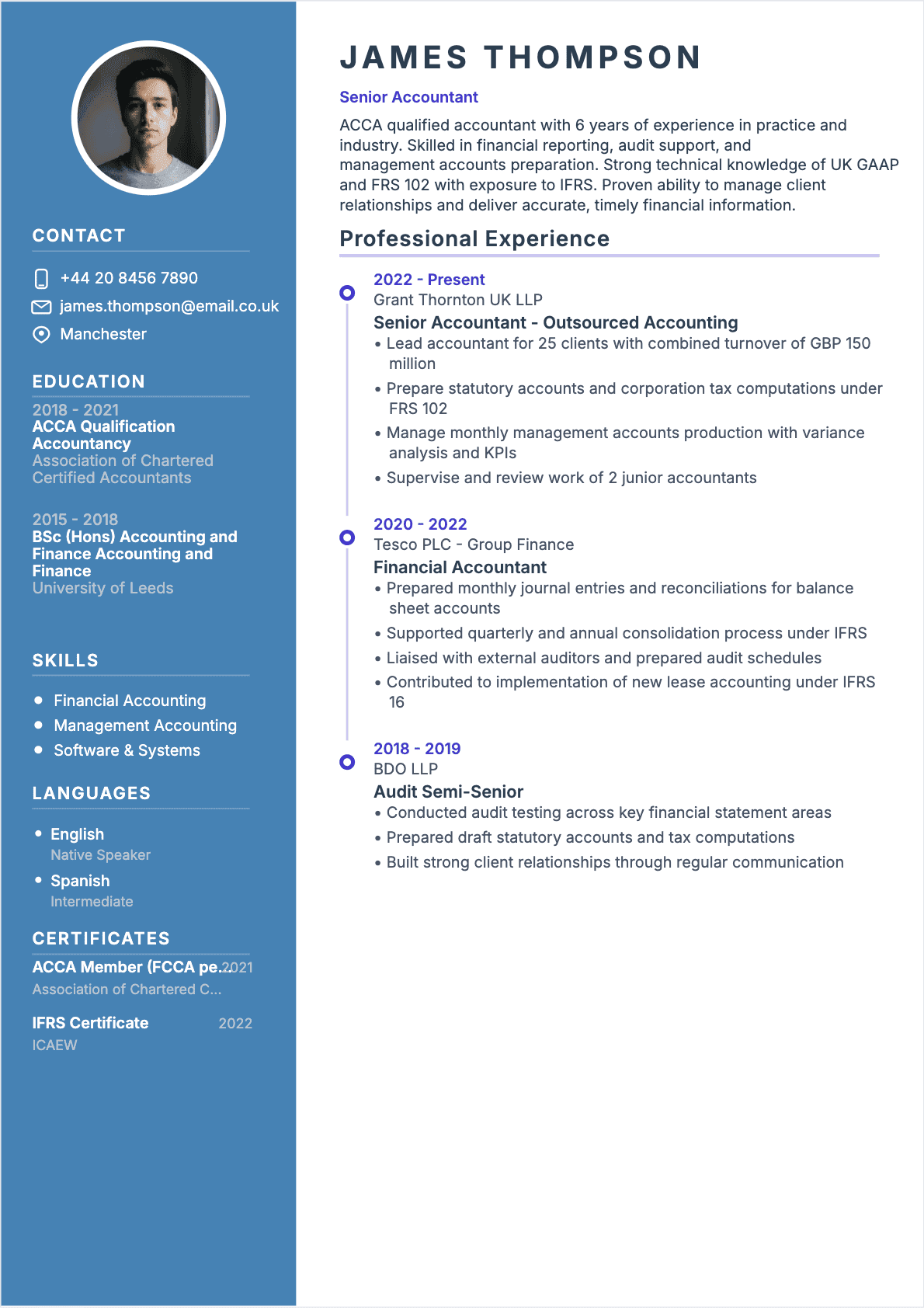
James Thompson
Senior Accountant
james.thompson@email.co.uk
+44 20 8456 7890
Manchester, GB
ACCA qualified accountant with 6 years of experience in practice and industry. Skilled in financial reporting, audit support, and management accounts preparation. Strong technical knowledge of UK GAAP and FRS 102 with exposure to IFRS. Proven ability to manage client relationships and deliver accurate, timely financial information.
Work Experience
Senior Accountant - Outsourced Accounting
Grant Thornton UK LLP
- ●Lead accountant for 25 clients with combined turnover of GBP 150 million
- ●Prepare statutory accounts and corporation tax computations under FRS 102
- ●Manage monthly management accounts production with variance analysis and KPIs
Financial Accountant
Tesco PLC - Group Finance
- ●Prepared monthly journal entries and reconciliations for balance sheet accounts
- ●Supported quarterly and annual consolidation process under IFRS
- ●Liaised with external auditors and prepared audit schedules
Audit Semi-Senior
BDO LLP
- ●Conducted audit testing across key financial statement areas
- ●Prepared draft statutory accounts and tax computations
- ●Built strong client relationships through regular communication
Education
ACCA Qualification
Association of Chartered Certified Accountants
BSc (Hons) Accounting and Finance
University of Leeds
Skills
Languages
English — Native Speaker
Spanish — Intermediate
Certifications
ACCA Member (FCCA pending)Association of Chartered Certified Accountants
IFRS CertificateICAEW
Accountant role overview
Accountants serve as the financial backbone of organizations, managing everything from daily transaction recording to complex financial reporting and tax compliance. Your typical day involves analyzing financial data, preparing statements, reconciling accounts, and ensuring that every number aligns with regulatory standards. Whether you work in public accounting, corporate finance, or as an independent consultant, you're responsible for maintaining the financial health and transparency of the business.
The role varies significantly depending on your specialization. Management accountants focus on internal financial planning and budgeting, helping executives make strategic decisions. Public accountants work with multiple clients, handling audits, tax preparation, and consulting services. Corporate accountants maintain the books for a single organization, managing payroll, accounts payable/receivable, and financial reporting. Regardless of specialization, accuracy and attention to detail define your work.
Career progression typically follows a clear path: starting as a Junior Accountant or Accounts Assistant, moving to Accountant or Senior Accountant after 3-5 years, then advancing to Accounting Manager or Financial Controller. Many accountants pursue professional certifications like ACCA, CIMA, or CPA, which significantly accelerate career advancement. The most ambitious professionals eventually reach CFO or Finance Director positions, overseeing entire financial departments.
Salary ranges reflect experience and qualifications. Junior Accountants in the UK typically earn £22,000-£30,000, while mid-level Accountants with 3-5 years experience command £32,000-£45,000. Senior Accountants and those with professional certifications earn £45,000-£65,000, with Accounting Managers and Financial Controllers reaching £60,000-£85,000. Specialized roles in forensic accounting or international tax can exceed £100,000 for experienced professionals.
Typical daily tasks include:
- Processing and recording financial transactions across multiple accounts and systems
- Reconciling bank statements and investigating discrepancies in financial records
- Preparing monthly, quarterly, and annual financial statements for management review
- Managing accounts payable and receivable, including invoice processing and payment runs
- Calculating and filing VAT returns, corporation tax, and other regulatory submissions
- Analyzing financial data to identify trends, variances, and opportunities for cost savings
Essential skills for an Accountant resume
Your resume needs to demonstrate both technical accounting expertise and the soft skills that enable you to communicate complex financial information effectively. Applicant Tracking Systems scan for specific accounting software, qualifications, and technical competencies, so including the right keywords determines whether a human ever sees your application. However, recruiters also want evidence that you can work under pressure during month-end close, explain financial concepts to non-financial colleagues, and maintain accuracy when processing thousands of transactions.
Technical skills prove you can do the job from day one. Employers want to see proficiency in industry-standard software and familiarity with accounting principles and regulations. But soft skills often differentiate candidates with similar qualifications—your ability to meet tight deadlines, spot errors before they become problems, and collaborate with other departments matters just as much as your technical knowledge.
Critical skills to highlight:
- Financial reporting and statement preparation – demonstrates your ability to produce accurate P&L, balance sheets, and cash flow statements that stakeholders rely on for decision-making
- Accounting software proficiency (Sage, Xero, QuickBooks, SAP) – ATS systems specifically scan for these tools, and employers need someone who can start contributing immediately without extensive training
- Tax compliance and VAT/GST knowledge – shows you understand regulatory requirements and can handle submissions without external support, saving the company consulting fees
- Month-end and year-end close processes – proves you can manage time-sensitive workflows and deliver accurate results under pressure
- Reconciliation and variance analysis – indicates strong attention to detail and the analytical skills to identify and resolve discrepancies
- Excel and data analysis – essential for manipulating large datasets, creating pivot tables, and building financial models that inform business strategy
- Budgeting and forecasting – demonstrates strategic thinking beyond basic bookkeeping, showing you can contribute to financial planning
- Audit preparation and compliance – particularly valuable for senior roles, proving you can work with external auditors and maintain proper documentation
- Attention to detail and accuracy – the foundation of accounting work, where a single misplaced decimal can have significant consequences
- Time management during peak periods – critical during tax season, year-end close, and audit periods when multiple deadlines converge
- Communication skills for financial translation – the ability to explain complex financial information to non-financial managers in clear, actionable terms
- Problem-solving and analytical thinking – shows you can investigate discrepancies, identify root causes, and implement solutions rather than just recording numbers
For ATS optimization, prioritize technical skills and software names in your skills section and work experience. Include specific accounting standards you've worked with (GAAP, IFRS), regulatory frameworks (SOX compliance, FRS 102), and any professional certifications or partial qualifications (ACCA part-qualified, CPA candidate).

How to write an Accountant resume step by step
1. Start with a results-focused professional summary
Your opening statement should immediately convey your accounting specialization, years of experience, and most impressive achievement. Instead of generic statements like 'Detail-oriented accountant seeking opportunities,' write something specific: 'ACCA-qualified Management Accountant with 6 years experience reducing financial close time by 40% through process automation and implementing Xero across 3 business units.' This tells recruiters exactly what you bring to the table in the first five seconds.
2. Quantify every achievement with financial metrics
Accounting is a numbers profession, so your resume should reflect this. Transform vague responsibilities into measurable accomplishments. Instead of 'Responsible for accounts payable,' write 'Processed £2.3M in monthly supplier payments across 200+ vendors, reducing late payment fees by 85% through improved workflow management.' Include percentages, currency amounts, time savings, and error reduction rates wherever possible. These numbers prove your impact and pass ATS keyword scans.
3. Structure your work experience with accounting-specific action verbs
Begin each bullet point with strong verbs that reflect accounting work: reconciled, audited, forecasted, analyzed, implemented, streamlined, prepared, filed, calculated, or managed. Follow with the specific task, then the quantified result. Example: 'Reconciled 15 bank accounts daily with 99.8% accuracy, identifying and resolving £47,000 in discrepancies during Q4 2023.' This structure shows what you did, how you did it, and why it mattered.
4. Include technical skills and software in context
Don't just list software in your skills section—demonstrate how you used it to achieve results. Instead of simply stating 'Proficient in SAP,' write 'Utilized SAP FI/CO modules to automate journal entries for 12 cost centers, reducing manual data entry by 60 hours monthly.' This approach satisfies ATS keyword requirements while showing practical application. Mention specific modules, versions, or advanced features you've mastered.
5. Highlight relevant certifications and continuous learning
Professional qualifications carry significant weight in accounting. Create a dedicated certifications section listing your ACCA, CIMA, CPA, or ACA status, including the year obtained and any specializations. If you're part-qualified, state exactly how far through you are: 'ACCA Part-Qualified (9 of 13 exams completed).' Also include recent training in new accounting standards, software certifications, or specialized courses in areas like forensic accounting or international tax.
6. Tailor your resume to each job description
Read the job posting carefully and mirror the language used. If they mention 'statutory reporting,' use that exact phrase rather than 'financial statements.' If they list 'NetSuite experience' as required, ensure NetSuite appears in your resume if you've used it. Customize your professional summary and top 3-4 bullet points for each application to match the employer's priorities. This significantly improves your ATS score and shows recruiters you've read their requirements.
7. Address employment gaps or career changes transparently
If you've transitioned from bookkeeping to qualified accounting, frame it as progression: 'Advanced from Bookkeeper to Management Accountant after completing CIMA certification, taking on responsibility for £8M budget management and strategic financial planning.' If you have gaps, briefly explain them in your cover letter rather than leaving recruiters guessing. Accountants are expected to be transparent, so apply that principle to your own career narrative.
Before and after examples:
Weak: 'Handled month-end close and prepared reports for management.'
Strong: 'Led month-end close process for £12M revenue business, delivering management accounts within 5 working days and reducing close time from 12 to 7 days through standardized reconciliation templates.'
Weak: 'Experienced with tax returns and VAT.'
Strong: 'Prepared and filed quarterly VAT returns totaling £340K annually with 100% on-time submission record, and completed corporation tax computations for 3 subsidiary companies, achieving £28K in tax savings through capital allowance optimization.'
Common mistakes on Accountant resumes
Listing responsibilities instead of achievements
The most frequent error is describing what the job entailed rather than what you accomplished. Writing 'Responsible for accounts receivable' tells recruiters nothing about your effectiveness. Did you reduce days sales outstanding? Improve collection rates? Process a specific volume of invoices? Transform every responsibility into a measurable outcome. Recruiters reviewing 50 accountant resumes can't differentiate candidates who simply list duties—they need to see evidence of your impact on financial performance.
Omitting specific accounting software and tools
Many accountants assume their technical skills are implied or list software generically. Writing 'accounting software' instead of 'Sage 50, Xero, and QuickBooks Online' means your resume fails ATS scans searching for those specific tools. Employers want to know exact platforms, modules, and versions. If you've used SAP, specify whether it was S/4HANA, FI, CO, or other modules. This specificity matters because training time and licensing costs factor into hiring decisions.
Failing to demonstrate progression and increasing responsibility
Your resume should show clear career development. If you've been an 'Accountant' for 8 years across three companies with identical bullet points, recruiters question why you haven't advanced. Show progression through increased budget responsibility, team leadership, more complex reporting, or additional qualifications. Even within the same role, demonstrate how your responsibilities expanded: 'Initially managed accounts for 1 division (£3M revenue), expanded to oversee 4 divisions (£15M revenue) after implementing consolidated reporting system.'
Using outdated or irrelevant experience
If you qualified 15 years ago, recruiters don't need to know about your training contract tasks in detail. Focus your resume on the last 10-12 years and recent achievements. Similarly, if you're applying for management accounting roles, extensive detail about your audit training from 2008 wastes valuable space. Tailor your experience to match the role you're pursuing. A single line acknowledging earlier career foundation is sufficient: 'Previous experience includes 3 years in audit with Deloitte (2006-2009).'
Neglecting to address regulatory knowledge and compliance
Accountants work within strict regulatory frameworks, but many resumes fail to mention which standards and regulations they've applied. Specify whether you've worked with IFRS, UK GAAP, FRS 102, or US GAAP. Mention compliance experience with SOX, GDPR for financial data, or industry-specific regulations. If you've prepared accounts for Companies House filing, handled HMRC investigations, or supported external audits, these details prove you understand the compliance dimension of accounting work.
Poor formatting that obscures key information
Accounting requires precision and organization—your resume should reflect these qualities. Inconsistent date formats, misaligned columns, or cluttered layouts suggest carelessness. Use clear section headings, consistent formatting for dates and currency, and adequate white space. Many accountants cram too much information into dense paragraphs that recruiters skip. Break content into scannable bullet points with clear hierarchy. Your resume's visual organization demonstrates the same attention to detail you'll bring to financial statements.
Ignoring soft skills and business impact
Technical accounting skills get you past ATS, but soft skills get you hired. Failing to demonstrate communication, deadline management, or cross-functional collaboration makes you appear as someone who just processes numbers in isolation. Include examples of presenting financial information to boards, training non-financial staff, or working with operations teams to improve cost management. Show that you understand accounting's role in supporting business decisions, not just maintaining compliance.
Accountant resume trends in 2026
The accounting profession is experiencing significant transformation as automation handles routine tasks and employers seek accountants who can provide strategic financial insights. Companies increasingly want accountants who understand data analytics and can extract business intelligence from financial information, not just record transactions. Your resume should demonstrate adaptability to new technologies while maintaining the core competencies that define accounting excellence.
Cloud accounting platforms have become standard
Proficiency in cloud-based systems like Xero, QuickBooks Online, and NetSuite is now expected rather than optional. Employers want accountants comfortable with real-time financial data, automated bank feeds, and collaborative platforms where multiple users access information simultaneously. If your experience centers on legacy desktop software, highlight any cloud migration projects you've participated in or emphasize your ability to learn new systems quickly. Many job descriptions specifically request 'cloud accounting experience,' making this a critical ATS keyword.
Data analysis and visualization skills differentiate candidates
Advanced Excel skills remain essential, but employers increasingly value accountants who can use Power BI, Tableau, or similar tools to create visual dashboards that make financial data accessible to non-financial stakeholders. The ability to analyze trends, build predictive models, and present insights visually sets you apart from accountants who only produce traditional reports. If you've created automated reporting dashboards, built financial models for scenario planning, or used data analytics to identify cost-saving opportunities, these examples demonstrate forward-thinking capabilities.
Automation and AI are reshaping routine accounting work
Rather than fearing automation, successful accountants position themselves as professionals who implement and oversee these tools. Employers want to know you've worked with automated invoice processing, AI-powered expense categorization, or robotic process automation for reconciliations. Highlight any experience implementing automation tools, training systems, or redesigning processes to incorporate technology. Frame yourself as someone who uses automation to eliminate manual errors and focus on higher-value analysis rather than someone whose role might be automated away.
ESG reporting and sustainability accounting are emerging specializations
Environmental, Social, and Governance reporting is transitioning from voluntary to mandatory for many organizations. Accountants with knowledge of carbon accounting, sustainability metrics, or ESG reporting frameworks have a competitive advantage. If you've been involved in any sustainability reporting, carbon footprint calculations, or social impact measurement, include this experience. Even basic familiarity with ESG concepts signals awareness of emerging regulatory requirements.
Remote and hybrid work has become standard
The accounting profession adapted successfully to remote work, and many positions now offer flexibility. However, this means your resume competes in a broader geographic market. Emphasize your experience with remote collaboration tools, virtual month-end close processes, or managing accounting workflows across distributed teams. If you've maintained accuracy and met deadlines while working remotely, this demonstrates reliability in flexible work arrangements. Conversely, if a role requires office presence for physical document handling or face-to-face stakeholder meetings, be prepared to address your location and availability.
Continuous professional development is non-negotiable
Employers expect accountants to maintain current knowledge of changing tax laws, accounting standards, and regulatory requirements. Your resume should show recent professional development: courses completed, webinars attended, or new certifications earned. If you're pursuing additional qualifications, mention your progress. This demonstrates commitment to staying current in a profession where outdated knowledge creates compliance risks. Include any specialized training in areas like cryptocurrency accounting, international tax, or forensic accounting that align with emerging business needs.
Further reading:
Frequently asked questions
Find answers to the most frequently asked questions.
Aim for one page if you have under 5 years of experience, and two pages if you have 5+ years or multi-entity scope. Prioritize recent roles and quantify impact (close timeline, reconciliations, audit outcomes). Remove repetitive task bullets and keep a compact skills/tools section.
In the US, avoid adding a photo; it is not expected and can create bias concerns. In the UK it is usually optional, but still uncommon in finance. Use the space for keywords, tools (SAP/NetSuite), and quantified outcomes (close D+6, reconciliation completion rate).
Use keywords that match the job description and your real experience: month-end close, general ledger, journal entries, accruals, prepayments, balance sheet reconciliations, AP/AR, IFRS or US GAAP, audit support, and your ERP (SAP FI, NetSuite, Dynamics 365, QuickBooks).
Use operational finance metrics: close cycle time (D+8 to D+6), reconciliation on-time rate (80% to 96%), number/value of aged items cleared (e.g., £310k), reduction in manual journals (e.g., -30%), fewer audit adjustments, or fewer posting errors after controls were implemented.
Not always. Many roles accept a Bachelor’s or Master’s degree plus relevant experience in close and reconciliations. However, ACCA/ACA can significantly improve shortlisting, especially for UK roles, audit-heavy environments, or promotion tracks. If you are part-qualified, state papers passed and expected completion date.
Avoid vague labels like “advanced.” Instead, list specific functions and outcomes: Power Query for data cleansing, PivotTables for reporting packs, XLOOKUP for mapping, and templates for recurring journals. Add a line showing scale (e.g., automated 14 journals; built a monthly pack used by 6 stakeholders).
Your career deserves a better resume
With CVtoWork, select a template, fill in the fields and download your resume as PDF.
Start creating