CV Training Coordinator: write a job-winning CV in 2025
Learn how to build a Training Coordinator CV that passes ATS screening and convinces hiring managers. Get role-specific keywords, measurable achievement examples, skills, and a structure that fits L&D, HR, and compliance training roles.
Key Takeaways
A Training Coordinator sits at the operational core of Learning and Development: scheduling, stakeholder alignment, LMS data integrity, vendor coordination, and audit-ready reporting. In 2025, many organizations run hybrid training portfolios (ILT, VILT, eLearning) and track completion closely for compliance and performance.
Across mid-sized companies, it’s common to coordinate 20–60 sessions per month and support 300–2,000 learners per quarter, while maintaining 95–99% LMS data accuracy and improving completion rates by 10–25% through reminders and streamlined enrollment workflows.
A strong Training Coordinator CV must demonstrate :
- measurable operational outcomes (completion rate, attendance, cost per learner, CSAT)
- mastery of LMS workflows and reporting (enrollments, transcripts, catalogs, audits)
- stakeholder coordination across HR, SMEs, managers, and external vendors
Use the guide below to structure your Curriculum Vitae, choose the right keywords, and turn coordination work into results.
CV Examples - CV Training Coordinator
Discover our CV templates adapted to all experience levels. Each example is ATS-optimized.

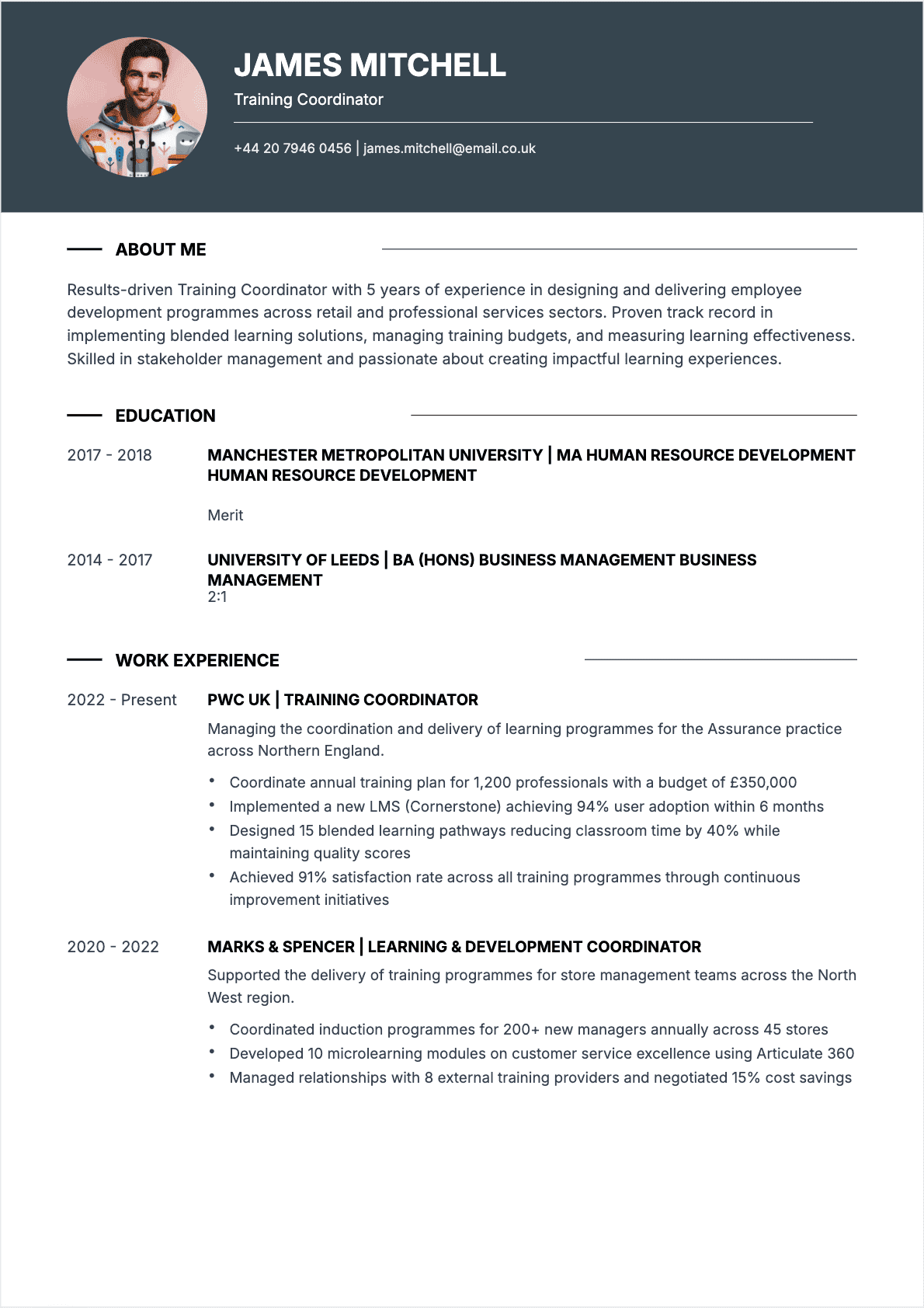
CV Training Coordinator Beginner
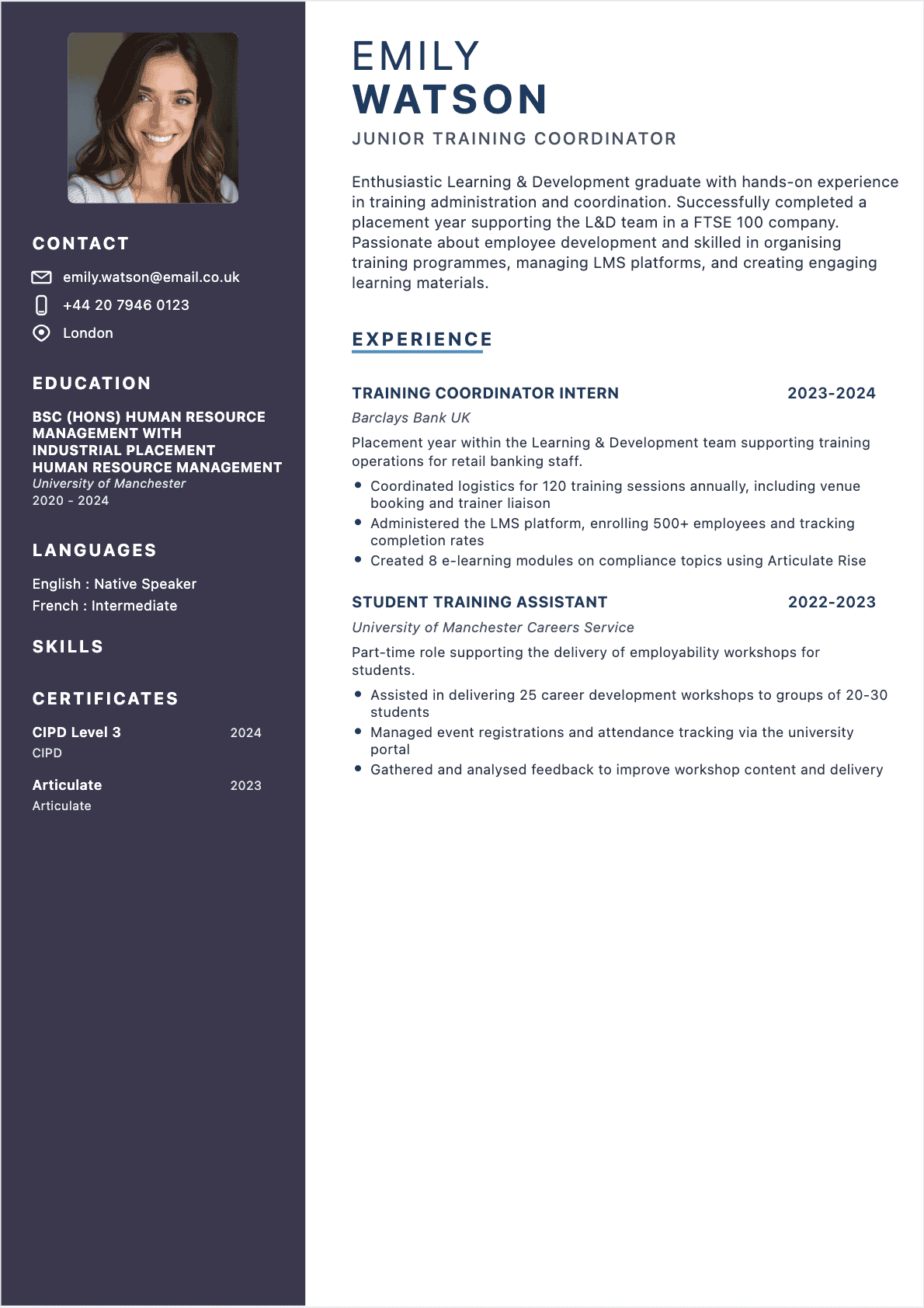
Ideal if you’re early-career: highlight internships, LMS exposure, training logistics, and measurable project support (sessions scheduled, attendance rate, feedback scores, and admin accuracy).
Utiliser
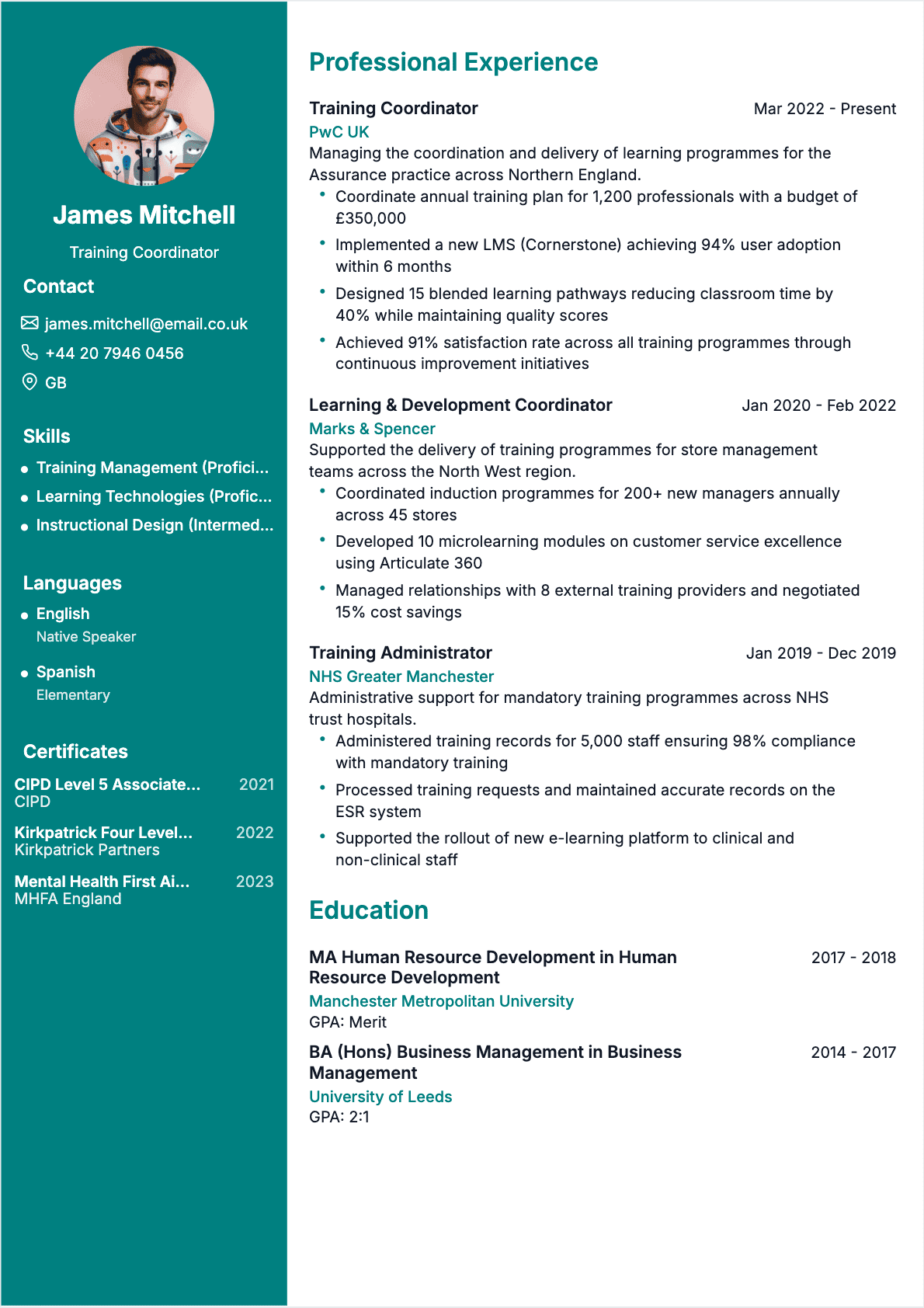
CV Training Coordinator Intermediate
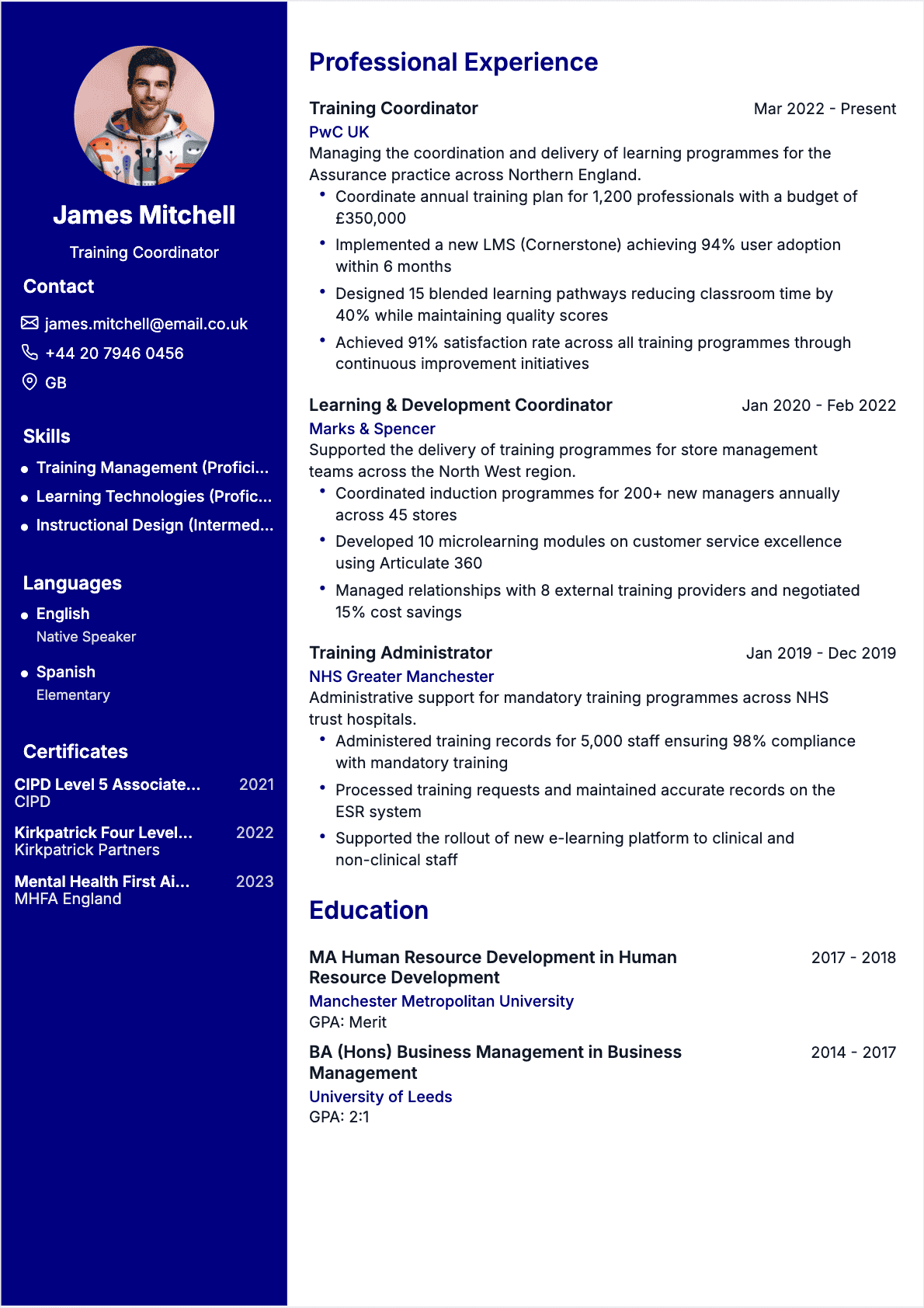
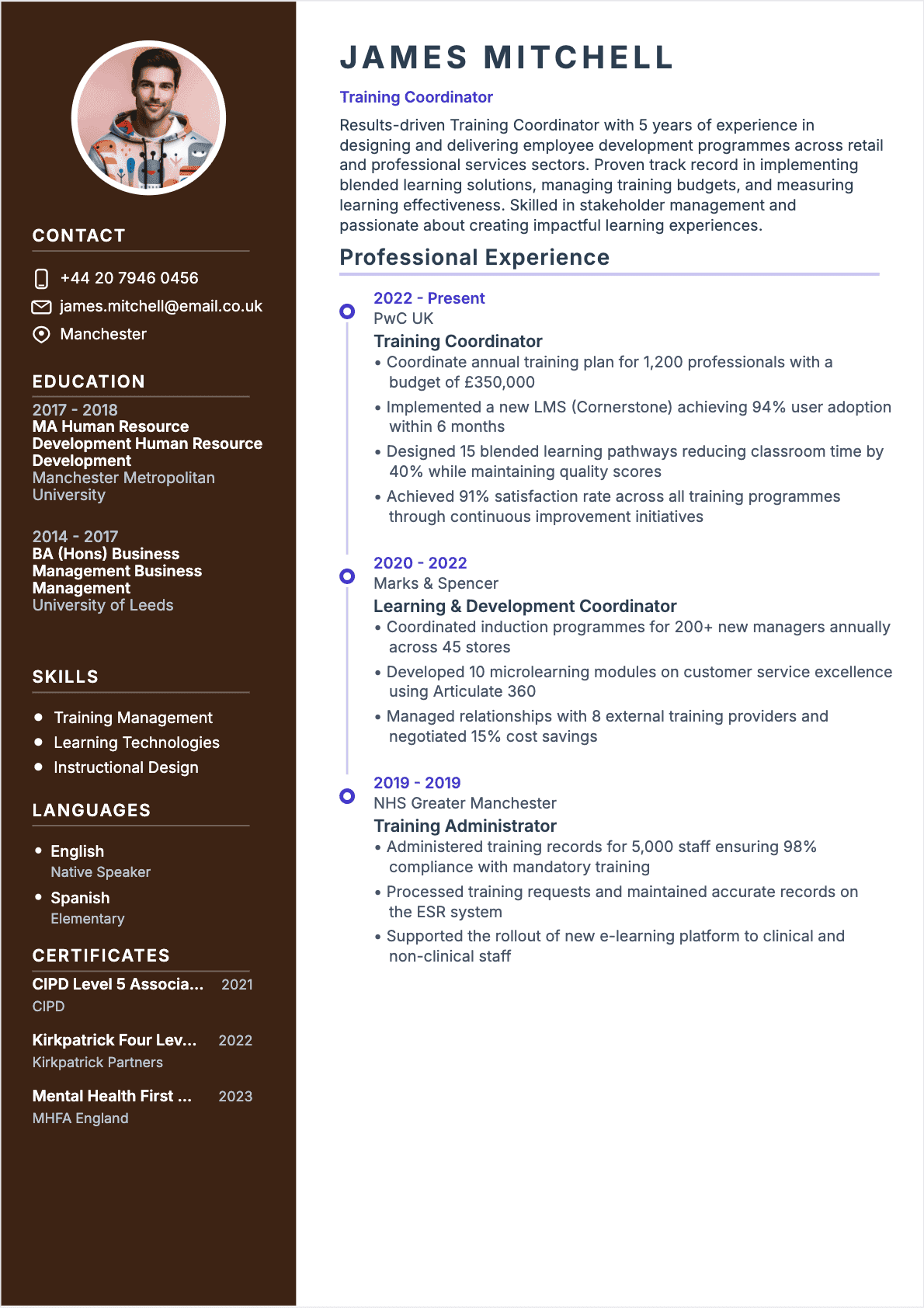
For 3–7 years: show end-to-end coordination, vendor management, LMS reporting, training calendars, stakeholder communication, and quantified impact on completion rates, costs, and learner satisfaction.
Utiliser
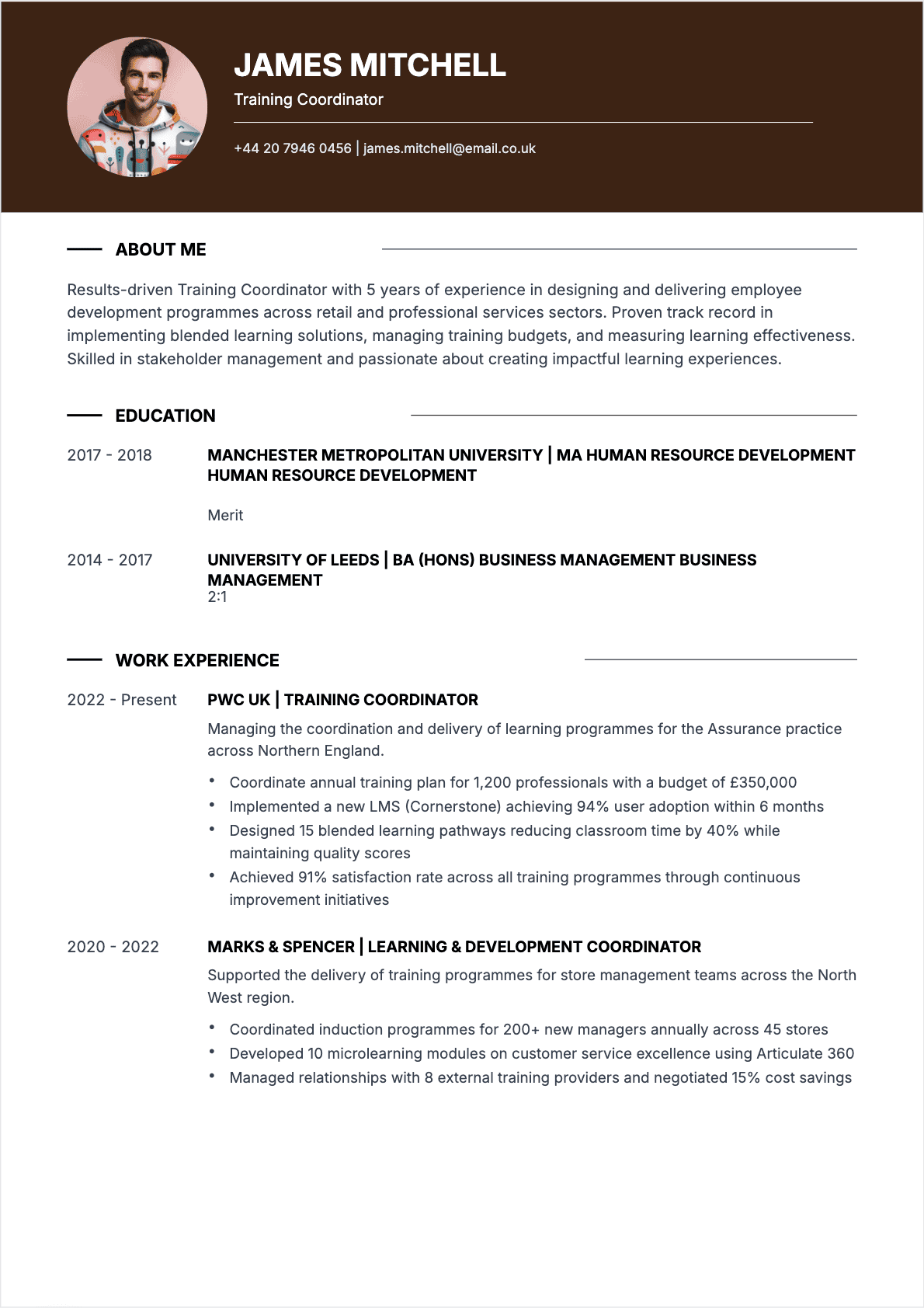
CV Training Coordinator Senior
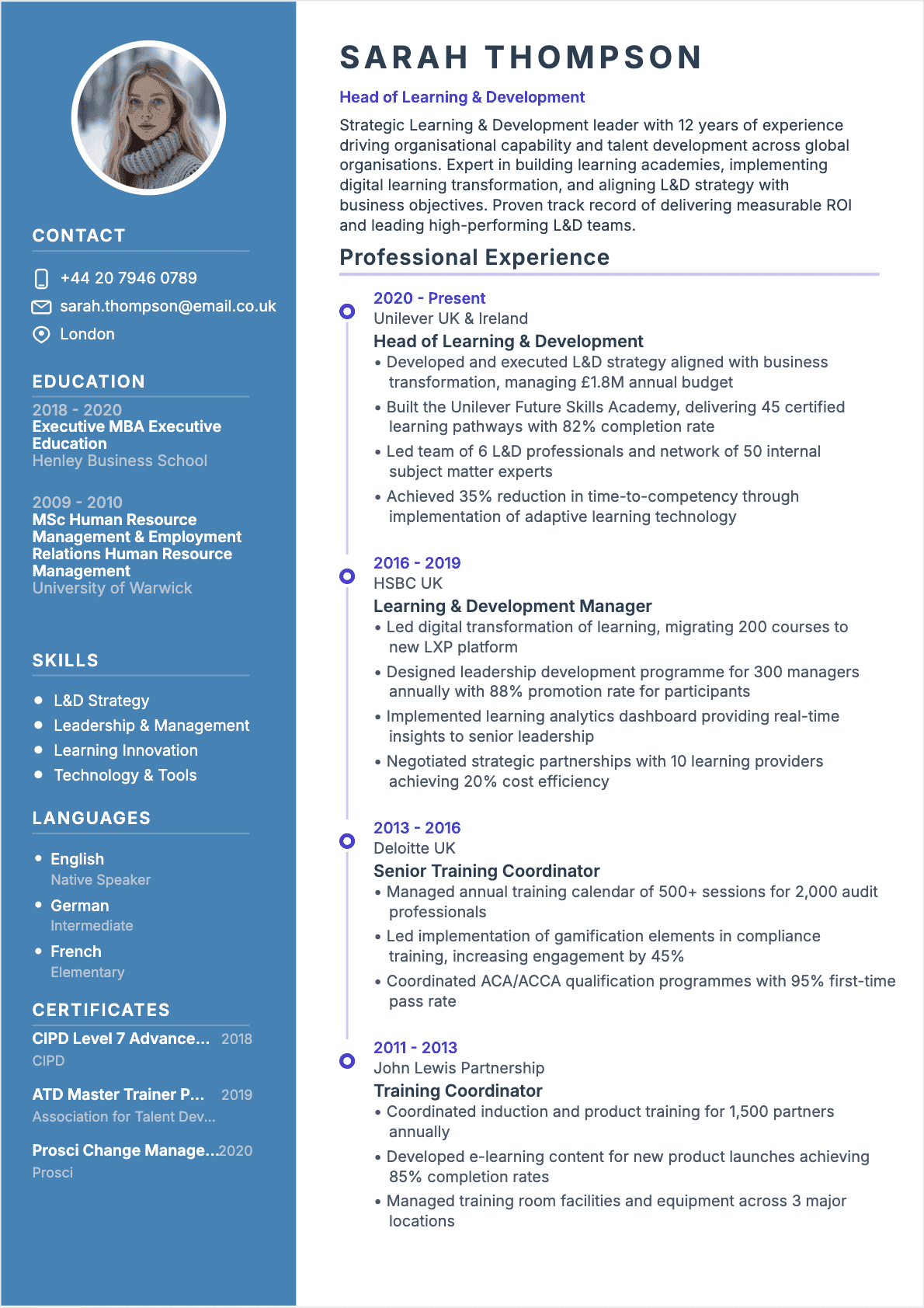
For senior profiles: emphasize program governance, budget ownership, global rollouts, compliance tracking, advanced analytics, process automation, and leadership of coordinators with measurable operational KPIs.
UtiliserPerfect CV Checklist - CV Training Coordinator
Check each item to ensure your CV is complete and optimized.
Professional Summary - CV Training Coordinator
The professional summary is the first thing recruiters see. It should summarize your profile in a few impactful lines.
“Training Coordinator with 5+ years in manufacturing L&D, coordinating 45–55 monthly ILT/VILT sessions for 900+ employees. Improved compliance completion from 82% to 96% in 6 months using Cornerstone LMS, automated reminders, and Excel dashboards; reduced no-shows by 18%.”
“Motivated, dynamic and passionate Training Coordinator, available immediately, ready to learn and support the team with all training tasks.”
Why is it effective?
Le bon exemple est efficace car il :
- states scope and seniority clearly (5+ years, 45–55 sessions/month, 900+ learners)
- proves business value with before/after metrics (82% to 96% completion; 18% fewer no-shows)
- names real tools used for execution (Cornerstone LMS, Excel dashboards) instead of vague “IT skills”
- stays aligned with the role’s KPIs (attendance, compliance, operational efficiency)
Le mauvais exemple échoue car il :
- relies on generic adjectives with no evidence or context
- provides no volume, timelines, or outcomes (no sessions, learners, or metrics)
- doesn’t mention an LMS, reporting, or coordination processes
- focuses on availability rather than contribution and measurable results
Professional experience examples
Here are examples of professional experiences. Note how results are quantified.
Training Coordinator (Learning & Development)
GSK, Philadelphia
Coordinated a hybrid training portfolio for a 1,200-employee site, partnering with HRBPs, QA, and operations leaders. Managed Cornerstone LMS enrollments, training calendars, vendor facilitators, and monthly metrics reviews; supported compliance-critical curricula and audit readiness.
Key Achievements
Key skills for your resume
Here are the technical and soft skills most sought after by recruiters.
Hard skills (Training Coordinator)
Technical Skills
- Training calendar and logistics (rooms, VILT links, rosters, materials)
- LMS administration (enrollments, curricula, transcripts, reporting)
- Cornerstone OnDemand (LMS)
- Microsoft Excel (pivot tables, formulas, dashboards)
- Training metrics (completion, attendance, cost per learner, CSAT/NPS)
- Compliance training tracking and audit documentation
- Vendor coordination (quotes, SOWs, invoicing, facilitator scheduling)
- Survey design and evaluation reporting (Level 1–2, action tracking)
Soft skills
Soft Skills
- Operational prioritization across competing deadlines
- Stakeholder management with HR, SMEs, managers, and vendors
- Clear written communication (instructions, reminders, SOPs)
- Attention to detail for learner records and compliance evidence
- Problem-solving under last-minute scheduling changes
- Service orientation toward learners and facilitators
- Data-driven decision-making from training dashboards
- Confidentiality when handling employee data
ATS Keywords to Include
ATS systems filter CVs based on specific keywords. Include these terms to maximize your chances.
ATS Tip
Click on a keyword to copy it. ATS systems filter CVs based on these exact terms.
Mots-clés importants
Hiring Sectors
Discover the most promising sectors for your career.
Technology and SaaS
Manufacturing and industrial
Healthcare and life sciences
Financial services and insurance
Retail and customer service
Consulting and professional services
Education & Degrees
Training Coordinator roles are typically open to candidates with a Bachelor’s degree in Human Resources, Business Administration, Education, or a related field, but many employers prioritize hands-on L&D operations experience. Coursework in learning evaluation, project management, HRIS/LMS systems, and data analysis is directly useful for the day-to-day work.
Possible pathways include starting in HR administration, talent development support, or operations coordination, then moving into L&D coordination with increasing ownership of calendars, vendors, and reporting. If your degree isn’t HR-focused, strengthen your Curriculum Vitae with LMS projects, Excel dashboards, and measurable improvements in completion, attendance, or training cost.
Recommended Degrees
- Bachelor’s degree in Human Resources
- Bachelor’s degree in Business Administration
- Bachelor’s degree in Education
- Master’s degree in Human Resources Management
- Master’s degree in Organizational Development
- MBA (Human Capital / People Management focus)
Languages
Languages can be a differentiator for Training Coordinators in multinational environments, shared-service L&D teams, or companies delivering training to distributed frontline populations. Clear written English is essential for instructions, reminders, and policy-aligned communications that affect compliance completion.
- coordinating training across regions and time zones with local HR and site leaders
- supporting facilitator briefings and learner communications in multiple languages
- maintaining consistent LMS catalogs and course descriptions across locales
Present your level using a simple label (Native/Fluent/Proficient/Intermediate) and add proof when possible (e.g., TOEFL/IELTS, internal assessment, or work experience delivering training operations in that language).
English
Native
Spanish
Proficient (professional working level)
French
Intermediate
Recommended certifications
Certifications are rarely mandatory for Training Coordinators, but they can strengthen credibility in L&D operations, training delivery fundamentals, and project coordination. Prioritize credentials that match the job posting: LMS experience, training evaluation, HR foundations, or project management.
Treat certifications as a bonus and connect each one to outcomes (better reporting, smoother scheduling, improved completion).
Mistakes to avoid
Listing tasks without operational KPIs
Many Training Coordinator CVs read like a job description: “scheduled sessions, sent invites, updated the LMS.” Recruiters and HR managers need proof that your coordination improved outcomes. Without metrics, they can’t compare your impact to other candidates, and ATS scoring may be weaker if you miss keyword-rich results.
Toujours inclure :
- training volume (e.g., 40 sessions/month; 600 learners/quarter; 12 sites supported)
- quality metrics (attendance rate, completion rate, CSAT/NPS, data accuracy)
- efficiency metrics (cycle time to schedule, cost per learner, vendor savings)
Use this formula: Action + scope + tool + measurable result (with timeframe).
Ignoring ATS keywords and LMS terminology
If you don’t match the language used in the posting, your Curriculum Vitae can be filtered out even with relevant experience. Training roles often rely on specific terms (LMS, ILT/VILT, curricula, transcripts, compliance, evaluation) that ATS systems look for.
À éviter : "Managed platforms and training tools; handled reporting and admin."
À privilégier : "Administered Cornerstone LMS: enrollments, curricula assignments, transcript audits, ILT/VILT rosters, and monthly completion reporting for 1,200 employees."
Keep your wording truthful, but align it with real system features and processes.
Weak evidence of compliance and audit readiness
In regulated sectors, training coordination is tied to audit outcomes. A CV that doesn’t mention recordkeeping discipline can look risky, even if you did the work. Show how you tracked due dates, handled overdue follow-ups, and produced evidence quickly and consistently.
À mentionner :
- how you maintained training records (transcripts, sign-in sheets, completion proofs)
- your reporting rhythm (weekly overdue report; monthly compliance dashboard)
- how you handled escalations (manager follow-up; HRBP visibility; documented actions)
Poor structure and hard-to-scan formatting
Training coordination is detail-heavy; messy formatting suggests messy execution. Long paragraphs, inconsistent dates, and missing tool names make your CV slower to read and easier to reject. A clean structure helps both ATS parsing and human scanning.
Checklist :
- consistent date format and role titles (Month YYYY – Month YYYY)
- bullet points focused on outcomes, not narrative
- a dedicated Tools section (LMS, Excel, Teams/Zoom, SharePoint, survey tools)
Expert tips
- 1
Build a KPI snapshot : Add 3–5 lines near the top (sessions/month, learners supported, compliance completion improvement, no-show reduction, savings) so recruiters see scale before reading details.
- 2
Name the LMS and what you did in it : Write “Cornerstone: curricula assignments, enrollments, transcript audits, ILT rosters, reports” rather than only listing the tool name.
- 3
Show your reporting routine : Mention weekly overdue reporting, monthly dashboards, and stakeholder reviews; include numbers like “12 departments” or “6 site leaders” to prove coordination complexity.
- 4
Translate logistics into outcomes : Scheduling is not “admin” if you link it to attendance, cycle time, and learner experience (e.g., “cut scheduling lead time from 10 to 6 days”).
- 5
Use role-specific action verbs : Coordinated, administered, tracked, reconciled, standardized, automated, escalated, validated, and reported reflect real Training Coordinator work better than vague verbs.
- 6
Include data quality controls : Add evidence like “99% accuracy on LMS rosters” or “monthly transcript reconciliation” to reassure hiring teams in compliance-heavy environments.
- 7
Tailor bullets to the training modality : If the role is VILT-heavy, emphasize Zoom/Teams production and breakout logistics; if ILT-heavy, focus on room capacity, materials, and onsite constraints.
Frequently asked questions
Find answers to the most frequently asked questions.
In English-speaking markets (especially the US), a photo is typically not recommended due to bias and compliance considerations. Focus on clear formatting, keywords, and quantified outcomes. If you apply in regions where photos are common, follow local norms and keep it professional, but never let a photo replace strong metrics.
Aim for 1 page if you have under 5 years of experience and your scope is straightforward. Use 2 pages if you coordinate multi-site programs, manage vendors/budgets, or have 7+ years with measurable results. Prioritize recent, relevant achievements and keep older roles to 2–3 bullets.
The most scanned keywords are LMS administration, training coordination, compliance training, ILT/VILT, training calendar management, reporting, and evaluations. Add the exact LMS name (Cornerstone, Workday Learning, SAP SuccessFactors) plus metrics terms like completion rate, attendance, and audit readiness to match postings.
Operational roles still generate measurable outcomes. Track and report improvements such as fewer no-shows, faster scheduling lead times, higher completion rates, better CSAT, and fewer data errors. You can also quantify volume (sessions, learners, sites) and efficiency (hours saved through templates or automation).
List the LMS, Excel level, collaboration tools, and any survey/reporting stack you used. Typical tools include Cornerstone/Workday Learning/SuccessFactors, Excel (pivot tables), Teams/Zoom, SharePoint, and survey tools like Qualtrics or Microsoft Forms. Only list tools you can use independently.
For L&D roles, emphasize learner experience, evaluations, session design support, and stakeholder partnership with managers. For compliance roles, prioritize audit readiness, due-date tracking, transcript accuracy, and escalation processes. In both cases, quantify outcomes (completion, attendance, cycle time, savings) and name the LMS workflows you owned.
Create your Training Coordinator CV in minutes
Use our CV builder to structure your Training Coordinator Curriculum Vitae, add ATS keywords, and turn coordination work into quantified achievements recruiters can compare quickly.
Create my Resume