CV Traffic Manager: a 2025 guide with examples and ATS keywords
Learn how to write a Traffic Manager CV that recruiters can scan in seconds: the right structure, measurable campaign achievements, and the ATS keywords used for paid media, acquisition, and growth roles.
Key Takeaways
A Traffic Manager is expected to translate spend into measurable growth. In 2025, hiring managers increasingly screen for candidates who can run multi-channel acquisition while maintaining tracking quality in a privacy-first context (cookie restrictions, consent requirements, modeled conversions). At the same time, budgets are scrutinized: teams want predictable CAC, stable ROAS, and clear incrementality rather than “vanity” traffic.
A strong Traffic Manager CV must demonstrate:
- Business impact (revenue, pipeline, customer acquisition cost, lifetime value signals)
- Operational excellence (pacing, forecasting, reporting cadence, experimentation)
- Measurement mastery (GA4, GTM, pixels, attribution, consent and data quality)
Use the guide below to structure your Curriculum Vitae around outcomes, keywords, and proof of tool proficiency.
CV Examples - CV Traffic Manager
Discover our CV templates adapted to all experience levels. Each example is ATS-optimized.

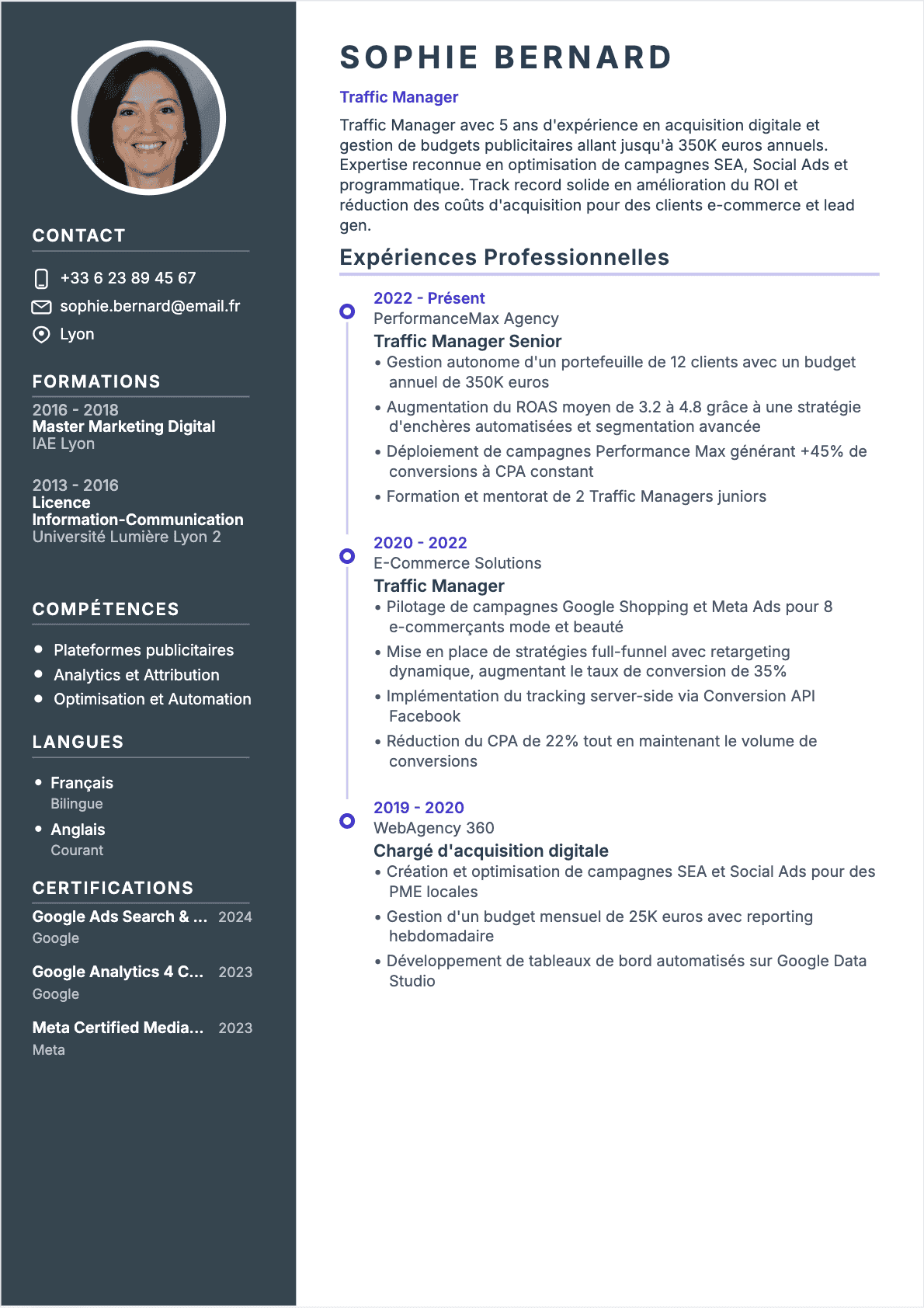
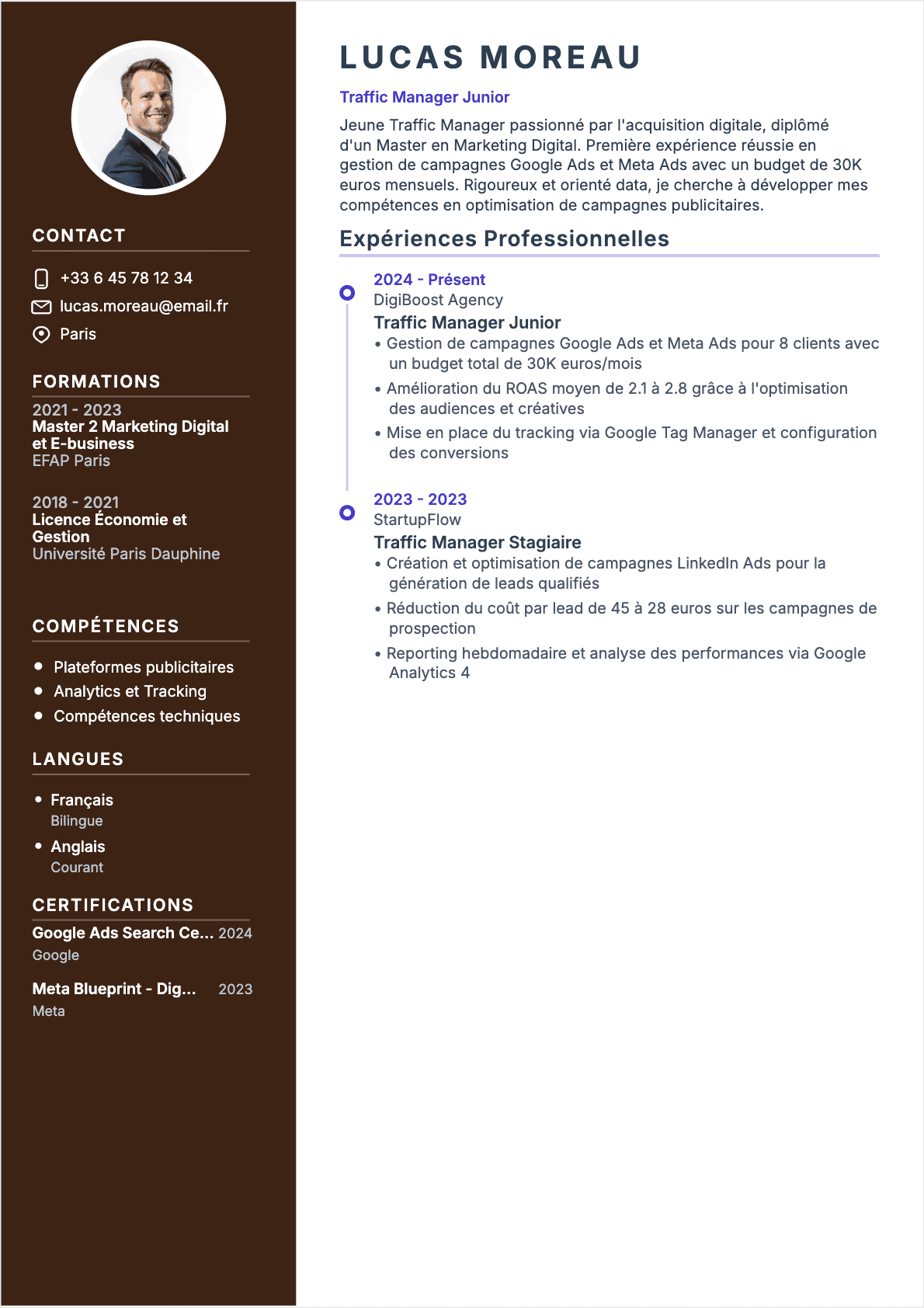
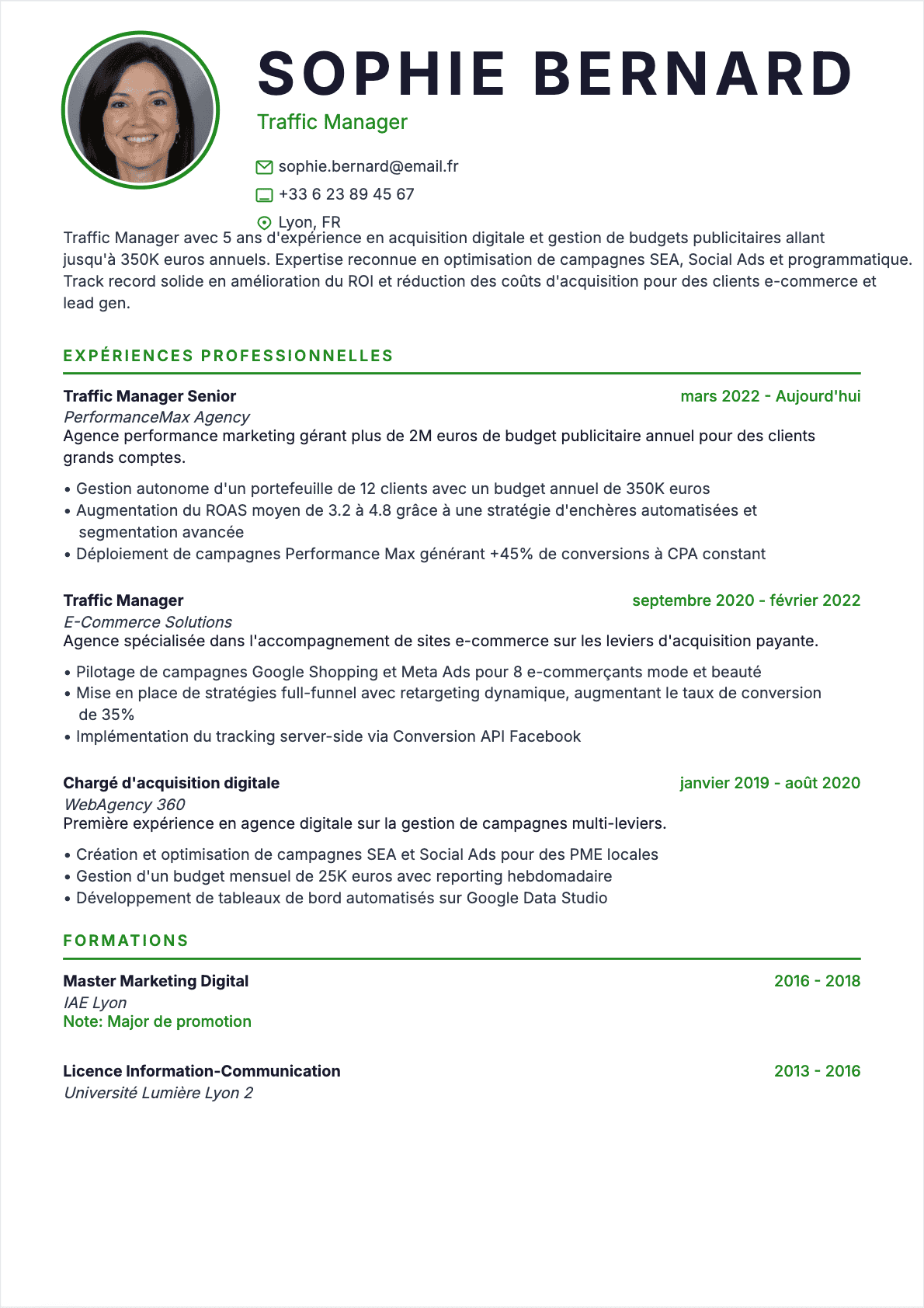
CV Traffic Manager Beginner
Designed for junior profiles and graduates targeting acquisition roles. Highlights internships, channel basics, tracking foundations, and measurable wins like CTR lifts and CPA reductions.
Utiliser
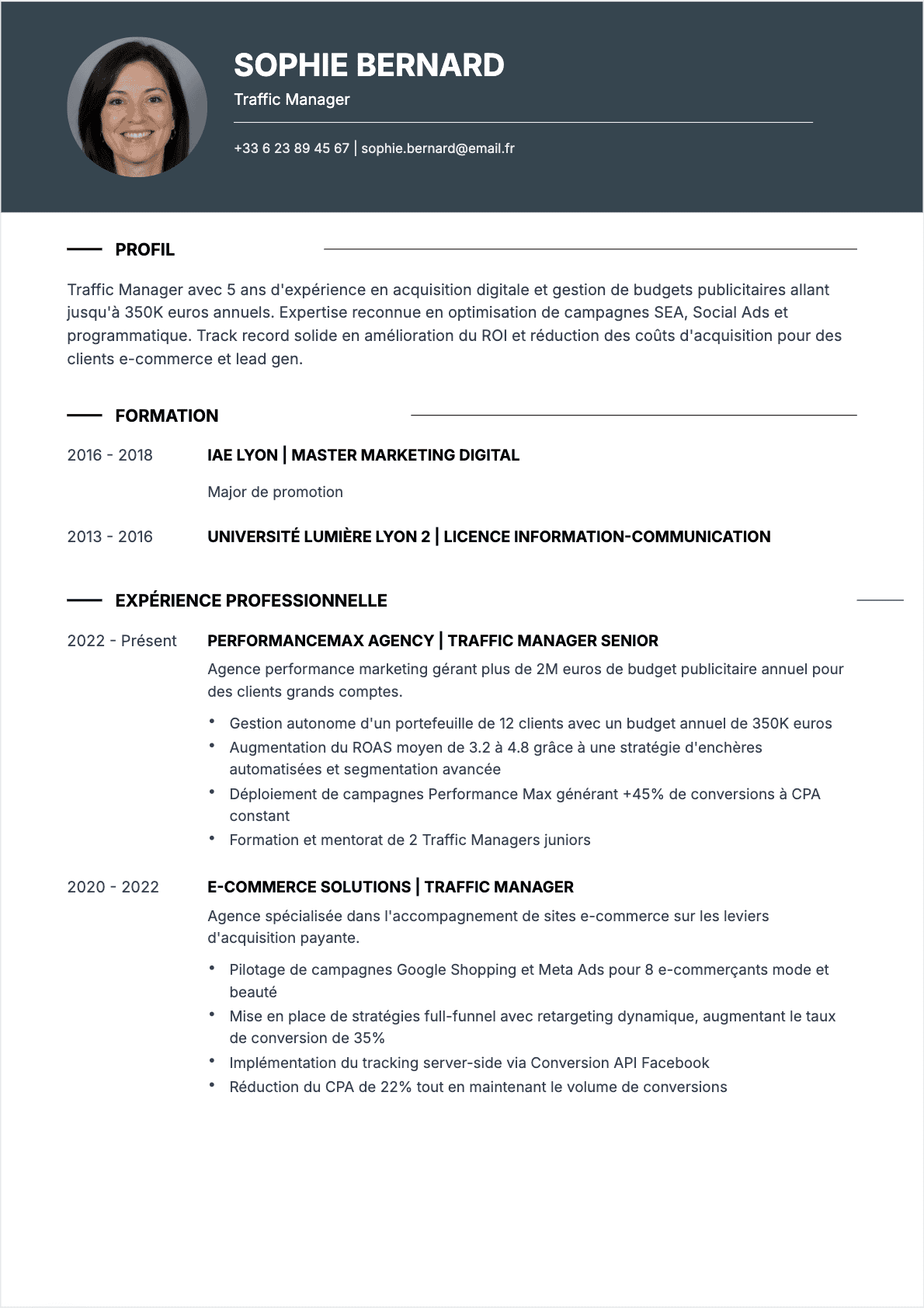
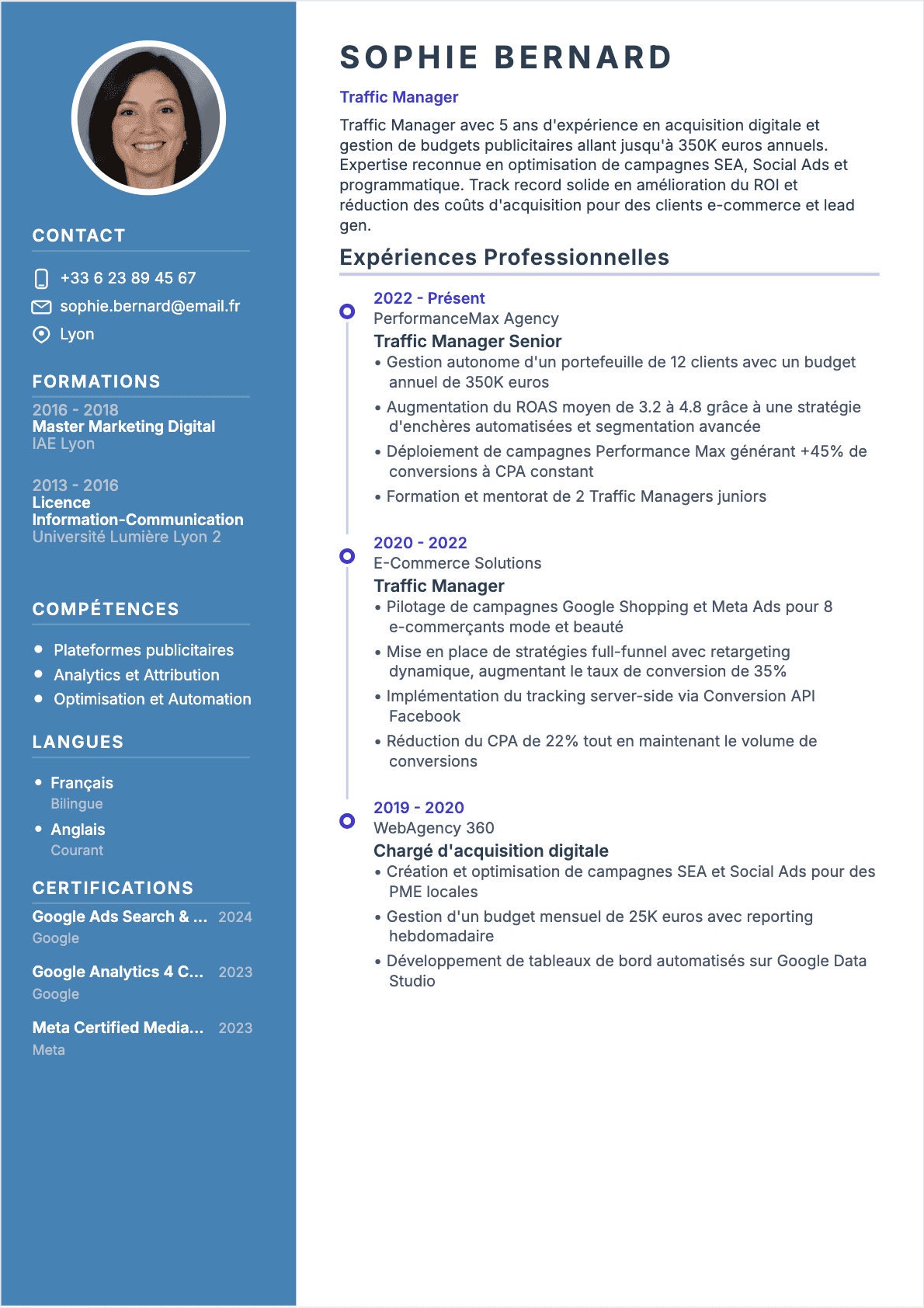
CV Traffic Manager Intermediate
For 3–7 years’ experience managing multi-channel budgets. Emphasizes ROAS/CPA optimisation, experimentation, attribution, stakeholder management, and cross-functional work with SEO, CRM, and product.
Utiliser
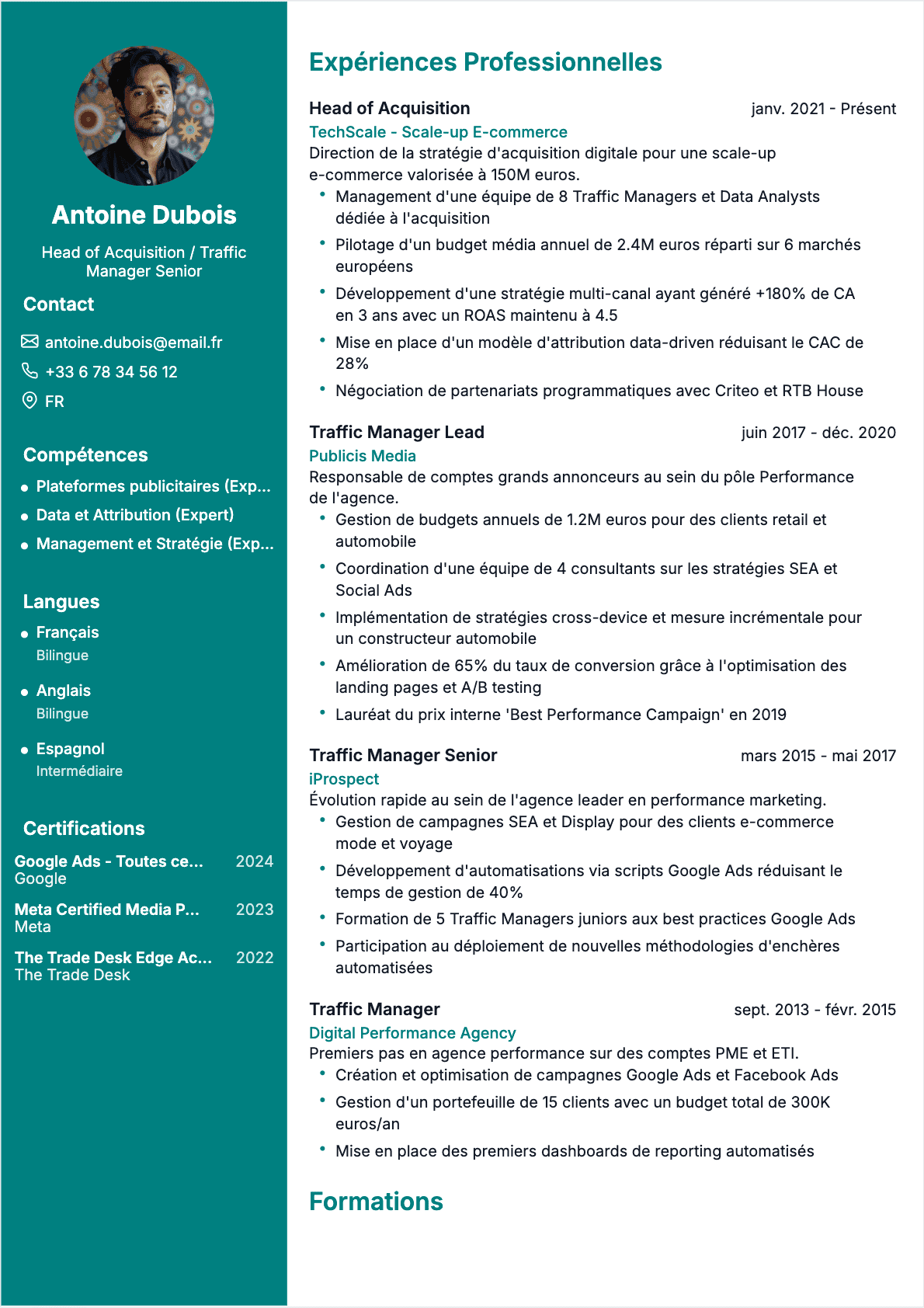
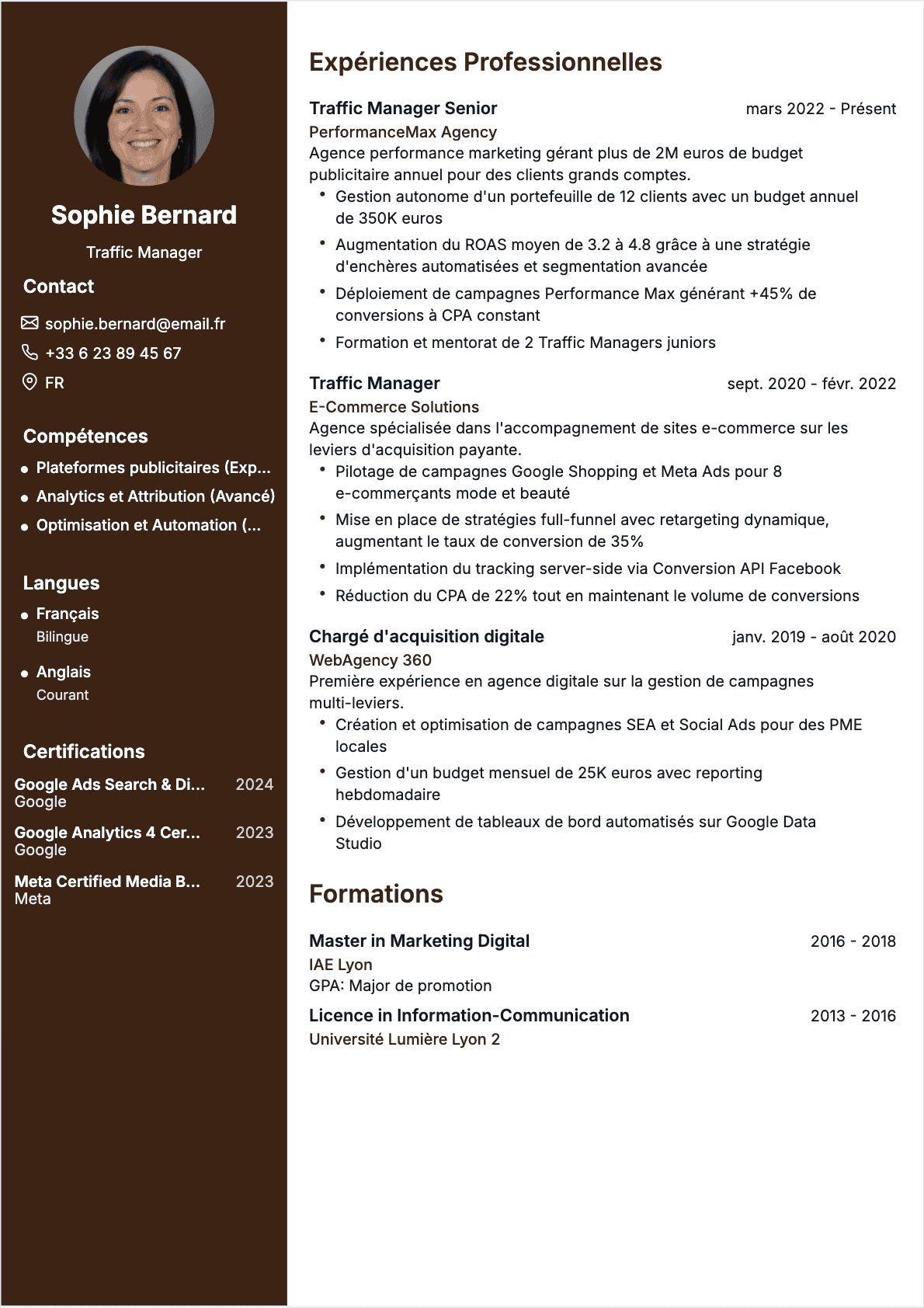
CV Traffic Manager Senior
For senior owners of acquisition strategy and budget governance. Focus on forecasting, incrementality, team leadership, vendor management, and scaling spend while protecting CAC, LTV, and brand safety.
UtiliserPerfect CV Checklist - CV Traffic Manager
Check each item to ensure your CV is complete and optimized.
Professional Summary - CV Traffic Manager
The professional summary is the first thing recruiters see. It should summarize your profile in a few impactful lines.
“Traffic Manager with 6+ years in e-commerce and marketplaces, managing €250K/month across Google Ads, Meta, and affiliates. Improved blended ROAS from 3.1 to 4.0 and cut CAC by 18% through audience segmentation, feed optimisation, and GA4/GTM tracking fixes.”
“Motivated and dynamic Traffic Manager, passionate about digital marketing, available immediately, good team player, ready to take on new challenges.”
Why is it effective?
The good example works because it:
- States seniority and context (6+ years, e-commerce/marketplaces) so recruiters can calibrate scope quickly
- Quantifies budget ownership and impact (€250K/month, ROAS 3.1→4.0, CAC -18%) instead of listing tasks
- Names concrete levers (segmentation, feed optimisation, tracking fixes) that explain how results were achieved
- Includes recognized tools (Google Ads, Meta, GA4, GTM) that match ATS filters and day-to-day requirements
The bad example fails because it:
- Uses vague claims with no evidence (no channels, no budget, no outcomes)
- Contains clichés that don’t differentiate you from other applicants
- Doesn’t mention measurement or tooling, which are core to the role
- Gives availability/teamwork but not performance, strategy, or execution capability
Professional experience examples
Here are examples of professional experiences. Note how results are quantified.
Traffic Manager (Paid Media)
Deliveroo, London
Owned acquisition for UK & IE across Paid Search, Paid Social, and affiliate partners. Managed £180K–£260K monthly spend within a 6-person growth pod (creative, analytics, CRM). Focus: CAC stability, app installs, and first-order revenue with reliable GA4 measurement.
Key Achievements
Key skills for your resume
Here are the technical and soft skills most sought after by recruiters.
Technical skills (Traffic Manager)
Technical Skills
- Paid media campaign setup and optimisation (Search, Shopping, Social, Display)
- Budget pacing, forecasting, and bid strategy management
- GA4 reporting and event-based measurement
- Google Tag Manager implementation (pixels, triggers, variables, QA)
- Attribution and incrementality basics (data-driven attribution, lift tests)
- Feed management for Shopping (Merchant Center rules, titles, custom labels)
- Conversion rate optimisation collaboration (landing pages, forms, funnel diagnostics)
- Dashboarding in Looker Studio (blended ROAS/CAC, cohort and geo views)
Core behaviours recruiters look for
Soft Skills
- Prioritisation under budget and time constraints
- Analytical writing (clear insights, not just charts)
- Stakeholder management with sales, product, and creative teams
- Experiment design discipline (hypothesis, success metrics, learning log)
- Attention to tracking details and QA
- Negotiation with vendors and partners
- Structured problem solving under performance pressure
- Ownership of weekly operating rhythm (pacing, alerts, action plans)
ATS Keywords to Include
ATS systems filter CVs based on specific keywords. Include these terms to maximize your chances.
ATS Tip
Click on a keyword to copy it. ATS systems filter CVs based on these exact terms.
Mots-clés importants
Hiring Sectors
Discover the most promising sectors for your career.
E-commerce & retail
SaaS & B2B software
Marketplaces & mobility
Fintech & insurance
Travel & hospitality
Agencies (media & performance)
Education & Degrees
Traffic Manager roles typically favour candidates with a marketing, business, or analytics education plus evidence of hands-on campaign execution. In the UK and US markets, recruiters commonly accept a Bachelor’s degree as a baseline, while growth-focused teams value practical experience and tool mastery more than a prestigious school.
Common pathways include marketing degrees, data/analytics programs, or business studies complemented by internships in performance marketing. If you lack a specialised degree, compensate with certifications (Google Ads, GA4), a portfolio of dashboards, and quantified results from campaigns you managed.
Recommended Degrees
- Bachelor’s degree in Marketing
- Bachelor’s degree in Business Administration
- Bachelor’s degree in Data Analytics or Statistics
- Master’s degree in Digital Marketing
- Master’s degree in Marketing Analytics
- MBA (Marketing or Strategy elective)
Languages
Languages matter for Traffic Managers because campaigns, platforms, and stakeholders are often international. Even in a single-country role, you may work with global creative teams, multilingual landing pages, or customer support insights that affect conversion. In agencies, language skills can expand the accounts you can manage and improve briefing quality with local teams.
- Cross-border campaign launches (localisation, geo rules, legal constraints)
- International keyword research and ad copy review
- Partner and vendor management across regions
Present your level clearly and add proof where possible (tests or certifications), especially for client-facing roles.
English
Native
French
Fluent (CEFR C1 equivalent)
Spanish
Intermediate
Recommended certifications
Certifications are not mandatory for Traffic Managers, but they are a strong signal for ATS and hiring managers when your experience is early-stage or you are switching industries. Prioritise Google Ads and GA4 to validate platform and measurement competence. Add vendor certifications only if they match the channels in the job description.
Mistakes to avoid
Listing responsibilities without performance outcomes
A Traffic Manager CV that reads like a job description (“managed campaigns”, “optimised ads”, “reported weekly”) won’t pass a performance interview. Recruiters need proof that your decisions improved efficiency, growth, or data reliability. Replace generic bullets with results and the lever you used (bidding, targeting, creative testing, landing pages, feed work, tracking fixes). If confidentiality is a concern, use ranges and percentages.
Always include :
- Budget scope (per month/quarter) and channels owned
- 2–4 core metrics (ROAS, CAC/CPA, CVR, revenue, pipeline)
- The optimisation lever and timeframe (what you changed, when, and why)
Keep this formula: Action + lever + metric + baseline → outcome + timeframe.
Weak measurement section (or none at all)
In 2025, measurement is a hiring filter. If your CV doesn’t mention GA4, GTM, pixels, consent, or attribution, you may be screened out even with strong campaign experience. You don’t need to claim you are a developer; you do need to show you can QA events, align conversions with business goals, and work with analytics/product teams.
À éviter : "Handled tracking and analytics for campaigns."
À privilégier : "Implemented GA4 purchase and lead events via GTM, reduced event duplication from 9% to 2%, and aligned conversions with Google Ads enhanced conversions."
This shows ownership, concrete tooling, and measurable data-quality impact.
Overusing tools as a keyword list
Tool lists without context can look inflated. ATS may pick them up, but hiring managers will test depth quickly. Instead, connect tools to what you delivered: dashboards, pacing, attribution decisions, feed rules, or experimentation logs. If you used a tool lightly, position it honestly (e.g., “basic reporting” vs “admin-level implementation”).
À mentionner :
- Primary tools you used weekly (platform + analytics + reporting)
- What you built or changed with them (dashboards, tracking, automations)
- The business metric affected (time saved, accuracy, ROAS/CAC)
Sending one generic CV to every role
Traffic Manager roles vary: some are e-commerce ROAS-driven, others are B2B pipeline-driven, and some focus on app growth or marketplaces. A one-size CV can miss the role’s success metrics and keywords. Align your summary, achievements, and skills with the job’s main channel mix and KPI set.
Checklist :
- Mirror the job’s KPI language (ROAS vs CAC vs SQL volume)
- Reorder bullets so the most relevant channel appears first
- Update ATS keywords to match platforms mentioned in the posting
Expert tips
- 1
Open with a performance snapshot : Add one line under your header with channels, monthly spend, and one headline KPI (e.g., “£200K/month, ROAS 4.0, CAC -18%”) to set context instantly.
- 2
Use baselines, not only end results : Write “CPA £42 → £34” or “CVR 3.4% → 4.1%” so recruiters understand scale and credibility, not just a percentage.
- 3
Show pacing discipline : Mention how you managed budget variance (e.g., within ±3%) and how often you reallocated spend across channels based on marginal returns.
- 4
Prove measurement ownership : Add one bullet about GA4/GTM, pixel QA, or consent impacts. Data quality improvements (discrepancy reduction) are strong differentiators.
- 5
Include one experiment story : Briefly document one test (hypothesis, change, metric, result). Example: new audience segment improved CTR by 22% with flat CPA.
- 6
Tailor keywords to the channel mix : If the role is Search-heavy, highlight Shopping feeds, match types, and scripts; if Social-heavy, highlight creative testing, cohorts, and landing-page alignment.
- 7
Keep reporting readable : Prefer 4–6 strong bullets per role with numbers, then link tools and levers. Avoid dense paragraphs that hide the metrics recruiters scan for.
Frequently asked questions
Find answers to the most frequently asked questions.
Use a clean, ATS-friendly layout: one column, clear headings, and consistent dates. Put a quantified summary at the top, then a “Key achievements” section, then experience. Most candidates should keep it to one page (up to two pages if you manage large budgets across multiple regions).
Prioritise KPIs tied to business outcomes: ROAS, CAC/CPA, revenue, and conversion rate. Add supporting metrics like CTR, CPC, CPM, impression share, and retention/LTV indicators when relevant. Always include timeframe and baseline so results are interpretable (e.g., “CAC -18% in 6 months”).
Describe concrete ownership: setting up GA4 events, QA in GTM preview mode, pixel troubleshooting, UTM governance, and aligning conversions with business definitions. Add one measurable impact such as reduced discrepancies, faster reporting cycles, or higher conversion coverage via enhanced conversions. Keep claims scoped to what you actually did.
If you apply in the US, skip the photo. In the UK, it’s typically optional, but many companies still prefer no photo to reduce bias. Use the space for performance signals instead: channels, budgets, and one standout metric. Follow the norm of the country and the employer.
For e-commerce, emphasise ROAS, revenue, Shopping feeds, and conversion rate optimisation. For B2B, focus on lead quality, CPL, MQL-to-SQL rate, pipeline value, and CRM alignment (e.g., Salesforce). Reorder bullets and keywords so the primary KPI and funnel stage in the job ad appear first.
Use ranges and percentages: “six-figure monthly budget” or “€120K–€180K/month,” plus relative impact like “ROAS +29%” or “CAC -18%.” You can also quantify operational outputs: number of campaigns, markets managed, reporting cadence, and data-quality metrics like discrepancy reduction.
Build your Traffic Manager CV in minutes
Use our CV builder to structure your Traffic Manager CV, add ATS keywords, and turn campaign work into quantified achievements that recruiters can review quickly.
Create my Resume