CV Salesperson: resume example & template (2025)
Use this guide to write a sales representative resume that proves quota impact. You’ll get a resume example, a practical template, ATS keywords, and metric ideas to quantify revenue, pipeline, and customer outcomes.
Key Takeaways
A sales resume isn’t judged on effort; it’s judged on evidence. In many markets, sales representatives are still among the fastest-hired roles because revenue teams directly affect growth and retention. In 2025, many employers tightened headcount and raised expectations: more pipeline per rep, higher forecast accuracy, and stronger customer outcomes, with fewer “nice-to-have” hires.
A good CV Salesperson resume must demonstrate:
- Quota impact with specific sales figures (revenue, pipeline, win rate)
- Repeatable sales techniques (discovery, objection handling, closing)
- Tool-based execution (CRM, sequences, reporting) that improves sales performance
This guide gives you a resume example, a practical template, and step-by-step instructions to write a sales representative resume that passes ATS screening and earns interviews.
CV Examples - CV Salesperson
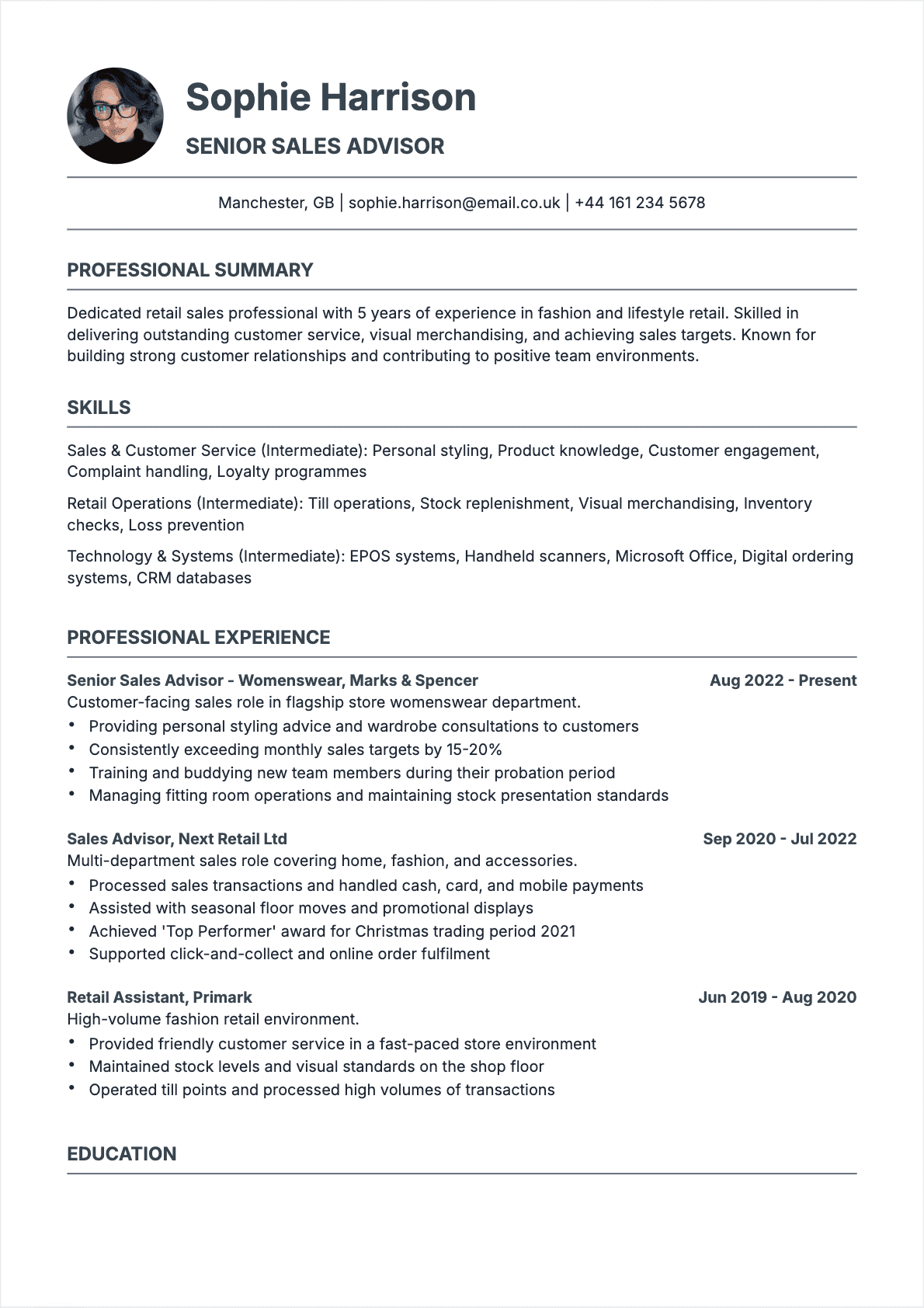
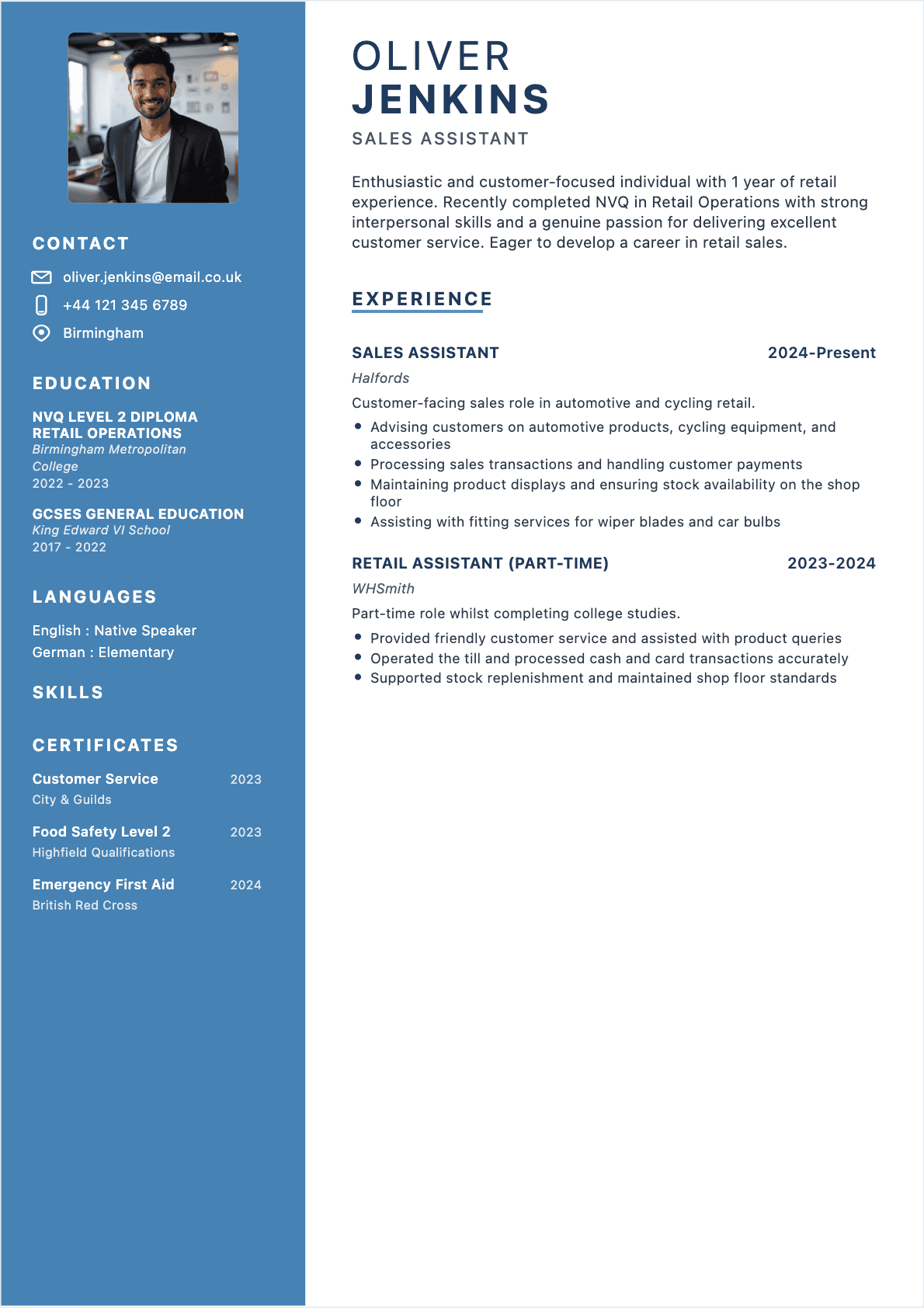
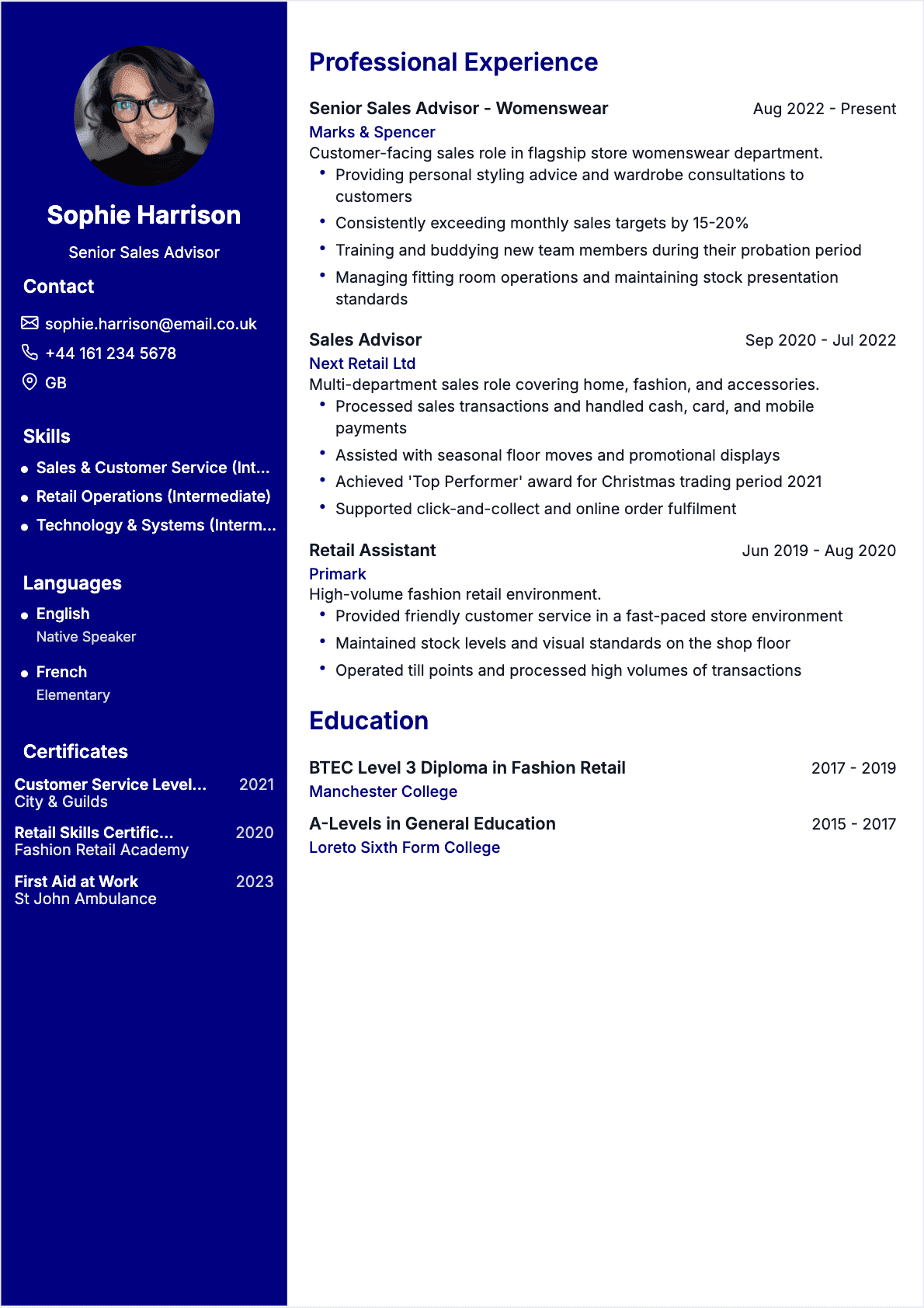
Discover our CV templates adapted to all experience levels. Each example is ATS-optimized.

CV Salesperson Beginner
For junior profiles and recent grads: highlight product knowledge, structured prospecting, CRM hygiene, and early wins like meetings booked and conversion rate improvements with clear, verifiable metrics.
Utiliser
CV Salesperson Intermediate
For 3–7 years’ experience: emphasize quota attainment, pipeline creation, negotiation outcomes, and account growth, backed by specific sales figures, tools (CRM), and repeatable sales strategies.
Utiliser
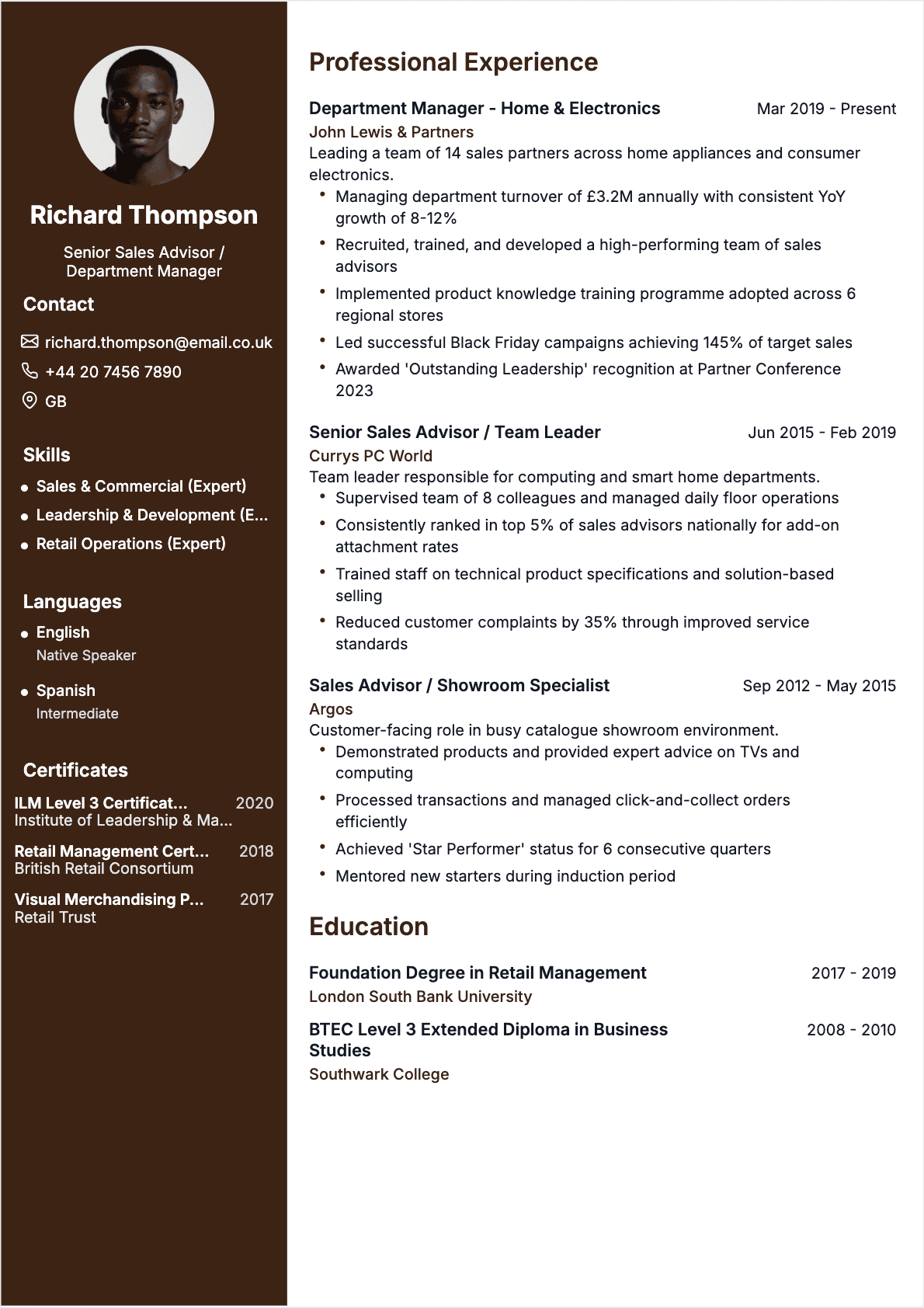
CV Salesperson Senior
For senior profiles with leadership: showcase territory strategy, forecasting accuracy, complex deal cycles, coaching, and cross-functional sales and marketing alignment, quantified by revenue, margin, and retention impact.
UtiliserPerfect CV Checklist - CV Salesperson
Check each item to ensure your CV is complete and optimized.
Professional Summary - CV Salesperson
The professional summary is the first thing recruiters see. It should summarize your profile in a few impactful lines.
“Sales representative with 6 years of experience in B2B SaaS (mid-market), averaging 118% quota attainment across 12 quarters. Built $3.4M pipeline in 2024, increased sales through strategic outbound sequences (HubSpot) and disciplined Salesforce reporting; strong negotiation and multi-stakeholder deal management.”
“Motivated, dynamic, passionate salesperson available immediately, looking for a challenging role to grow and help the company succeed.”
Why is it effective?
The good example is effective because it:
- Leads with a measurable track record (118% quota attainment over 12 quarters) instead of personality claims
- Adds concrete scope (B2B SaaS, mid-market, pipeline value) so recruiters can map you to the sales role
- Names real tools (HubSpot, Salesforce) and the business outcome they supported (pipeline creation, reporting discipline)
- Uses keywords hiring teams expect in sales representative resume examples (quota, pipeline, negotiation, deal management)
The bad example fails because it:
- Uses clichés that don’t predict performance (motivated, dynamic, passionate)
- Omits numbers, segment, and sales cycle context, so the resume can’t be benchmarked
- Doesn’t reference tools, sales strategies, or a customer problem you solve
- Sounds interchangeable and won’t stand out in a stack of resume samples
Professional experience examples
Here are examples of professional experiences. Note how results are quantified.
Sales Representative (Mid-Market)
Gong.io, London
Owned a mid-market territory (UK&I) selling sales enablement software to 200–2,000 employee companies. Partnered with 1 SDR and 1 solutions consultant; typical sales cycle 45–90 days. Focus: pipeline creation, multi-threaded deals, and renewal-to-expansion handoffs.
Key Achievements
Key skills for your resume
Here are the technical and soft skills most sought after by recruiters.
Hard skills and tools (Sales)
Technical Skills
- Pipeline generation (outbound + inbound conversion tracking)
- Discovery frameworks (SPICED / MEDDPICC-informed questioning)
- Salesforce (CRM hygiene, dashboards, opportunity stages)
- HubSpot Sales Hub (sequences, templates, activity reporting)
- Negotiation and pricing discipline (discount governance)
- Territory and account planning (ICP, TAM, prioritization)
- Forecasting and KPI reporting (commit/best case, variance analysis)
- Product demos and value messaging (ROI narrative, use cases)
Soft skills that show up in results
Soft Skills
- Active listening in discovery to surface measurable business pain
- Clear communication skills in writing (follow-ups, recap emails)
- Stakeholder management across finance, ops, and IT
- Resilience under rejection with consistent activity volume
- Structured time management to protect prospecting blocks
- Curiosity to learn product, industry, and competitor context fast
- Collaboration with sales team, marketing, and customer success
- Attention to detail in CRM data and next-step commitments
ATS Keywords to Include
ATS systems filter CVs based on specific keywords. Include these terms to maximize your chances.
ATS Tip
Click on a keyword to copy it. ATS systems filter CVs based on these exact terms.
Mots-clés importants
Hiring Sectors
Discover the most promising sectors for your career.
B2B SaaS and software
Retail sales and specialty stores
Financial services and insurance
Pharmaceutical sales
Medical device sales
Real estate sales and new home sales consultant teams
Education & Degrees
For sales representatives, education matters most when it supports credibility: business fundamentals, data literacy, communication, and domain knowledge (healthcare, finance, tech). Employers rarely screen only for a diploma, but they do compare candidates on structure, writing quality, and evidence of sales experience.
Common paths include business degrees, marketing coursework, or industry-specific programs (e.g., life sciences for pharmaceutical sales). If your degree is not business-related, compensate by highlighting training, certifications, and quantified work experience in the experience section.
Recommended Degrees
- Bachelor’s degree in Business Administration
- Bachelor’s degree in Marketing
- Bachelor’s degree in Economics
- Master’s degree in Management
- Master’s degree in Marketing Analytics
- MBA (Sales / Strategy focus)
Languages
Languages can materially impact revenue when your territory spans multiple countries, when you sell to global procurement, or when you support multinational customer success handoffs. Even in a single-country role, a second language can widen your book of business and speed up trust-building during discovery and negotiation.
- Selling into EMEA accounts with mixed stakeholder teams
- Coordinating sales and marketing campaigns across regions
- Handling customer relationship management touchpoints during renewals
Present your level consistently and add proof (test score, bilingual territory, or percentage of deals run in that language).
English
Native
French
Proficient (DELF B2)
Spanish
Intermediate
Recommended certifications
Certifications are not mandatory for most salesperson roles, but they can strengthen credibility—especially for entry-level sales representative profiles or for tool-heavy environments. Prioritize certifications that prove you can operate the CRM, run a pipeline, and communicate value in a structured way. Treat them as a bonus that supports your quantified achievements, not a replacement.
Mistakes to avoid
Listing responsibilities instead of sales outcomes
Many sales representative resume examples fail because the work experience reads like a job description: “made calls, followed up, maintained CRM.” Hiring managers can’t infer sales performance from tasks. Replace activity-only bullets with impact: quota attainment, pipeline value, win rate, or retention. If you worked retail sales, translate outcomes into units per transaction, conversion rate, and add-on rate.
Always include :
- Quota or target context (monthly/quarterly, amount or %)
- Funnel metric (meetings booked, SQLs, win rate, cycle length)
- Business result (ARR, revenue, margin, retention, NPS or CSAT proxy)
Use this formula: Action + Scope + Method/Tool + Metric + Business outcome.
Using a template that breaks ATS parsing
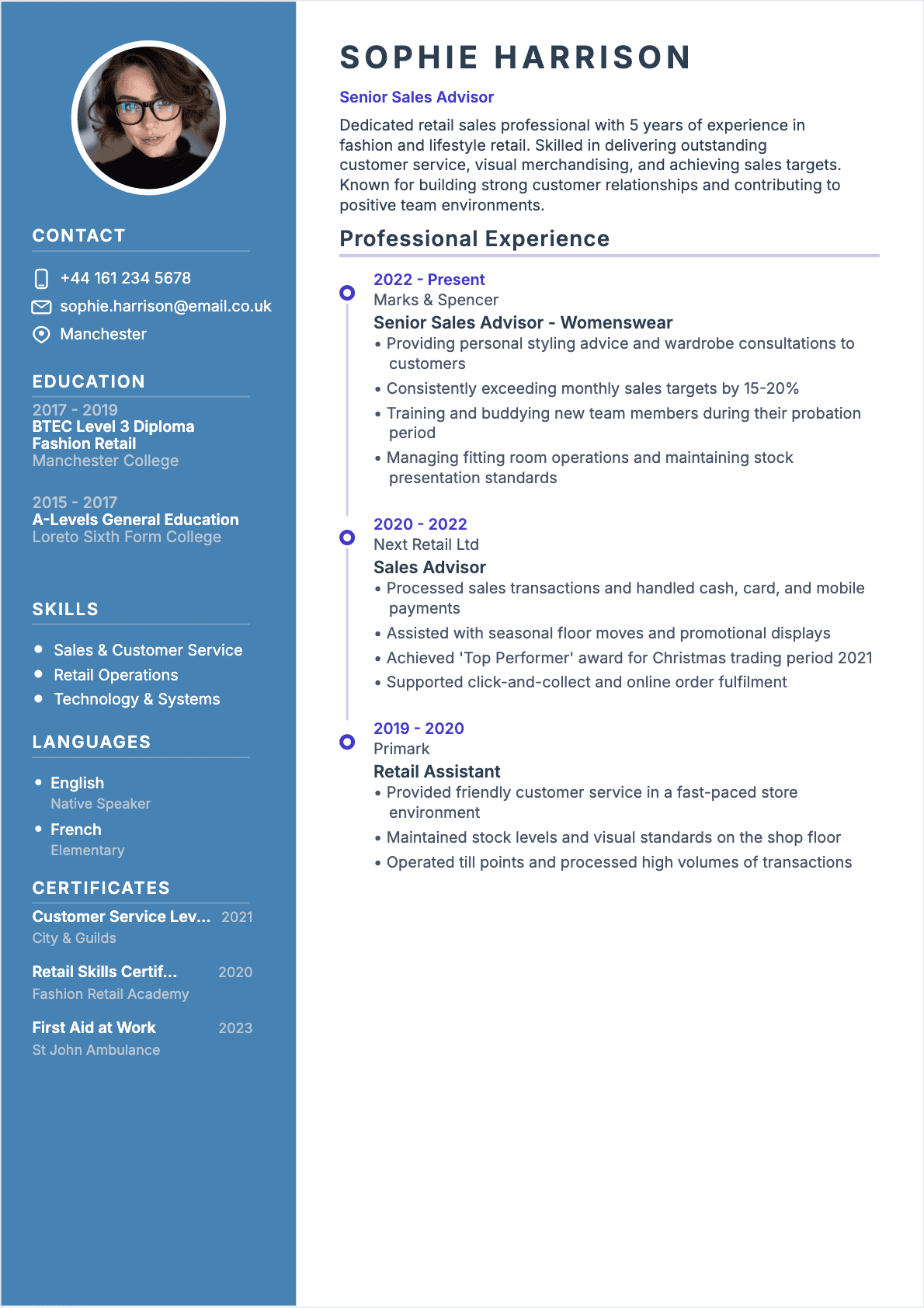
A visually heavy resume template can hide your value if the ATS can’t read your sections. Columns, text boxes, and icons often scramble titles, dates, and skills section keywords. Keep design clean and prioritize readability over decoration; the goal is to be searchable for “sales representatives,” “CRM,” and role-specific keywords.
À éviter : "Two-column layout with skills inside a sidebar and dates in a floating text box."
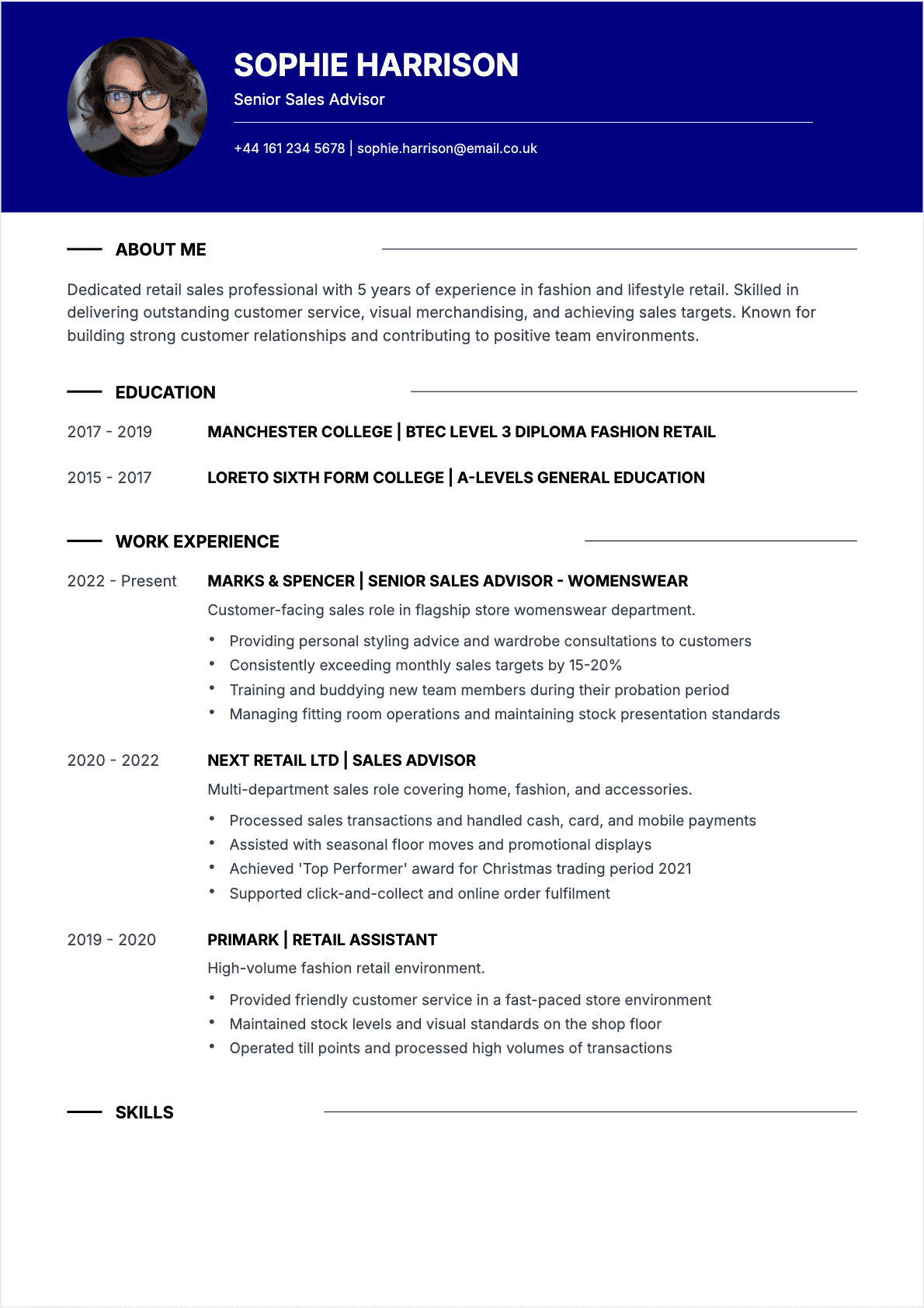
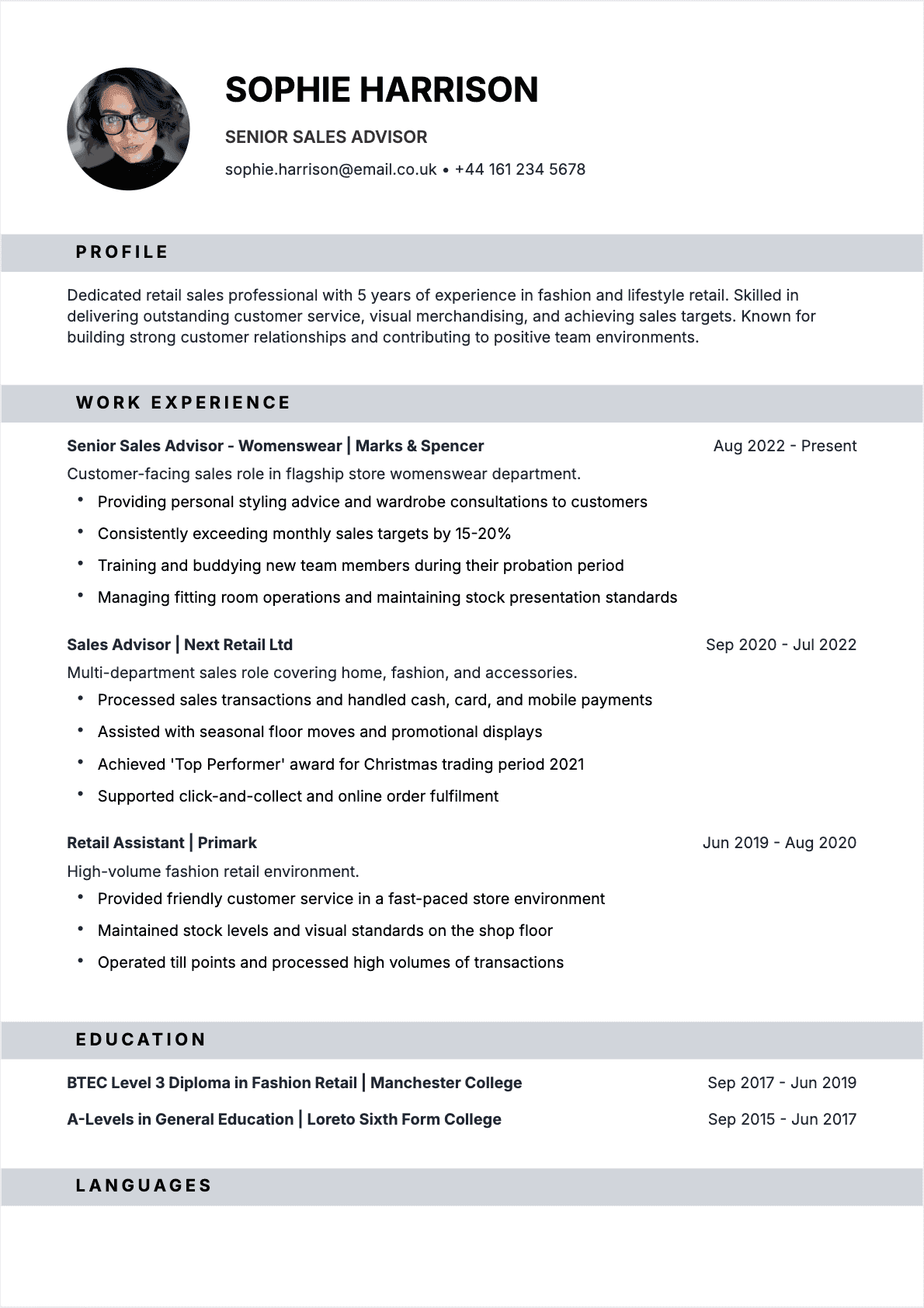
À privilégier : "Single-column resume format with clear headings (Summary, Work Experience, Skills, Education) and standard date formatting."
You can still look modern: use spacing, consistent typography, and one accent color—without sacrificing parsing.
Missing context about your sales role and territory
Numbers without context can be misleading. “Closed $800k” means different things in SMB versus enterprise. Add the segment, ACV range, cycle length, and whether you were inbound, outbound, or channel-based. This helps recruiters compare you to other sales representatives and match you to the right sales representative positions.
À mentionner :
- Segment and ICP (SMB/mid-market/enterprise, industry)
- Deal metrics (ACV, sales cycle, win rate, top 3 competitors)
- Coverage model (solo AE, paired with SDR/CSM, team-based selling)
Generic skills lists without proof
A long list of sales skills can hurt if it looks copied. Keep the skills section focused (8–12 items) and reinforce it with proof in bullets. For example, if you list “negotiation,” show reduced discounting or improved margin. If you list “CRM,” show improved data quality or forecast accuracy.
Checklist :
- Does each key skill appear in your work experience at least once?
- Did you include tool names exactly as employers write them (Salesforce, HubSpot)?
- Did you avoid vague traits and keep skills tied to sales techniques and outcomes?
Expert tips
- 1
Start with a one-line headline : Add your role + segment + core metric (e.g., “Mid-market sales representative | 118% quota attainment”) so the top of your resume communicates value in 5 seconds.
- 2
Quantify your sales with range-based metrics : If you can’t share exact revenue, use realistic ranges (e.g., “$900k–$1.1M ARR”) and include the period and quota to keep credibility.
- 3
Tune keywords to the job description : Copy the employer’s wording for sales techniques, CRM, and customer relationship management to help ATS matching while keeping your resume readable.
- 4
Show sales through effective process : Mention discovery structure, follow-up cadence, and handoffs to customer success; process signals you can replicate performance, not just got lucky.
- 5
Use action verbs that imply revenue impact : Prefer “closed,” “negotiated,” “expanded,” “renewed,” “converted,” “forecasted,” and “increased sales” over “assisted” or “helped.”
- 6
Add a small ‘Key Deals’ subsection : 2–3 bullets with vertical, deal size, and cycle length. It’s a fast way to show specific sales experience without oversharing sensitive details.
- 7
Pair your resume with a targeted cover letter : A short cover letter with your resume can explain territory fit, why you can meet sales goals, and how you’ll ramp in the first 30–60 days.
Frequently asked questions
Find answers to the most frequently asked questions.
In sales, a CV (often called a resume in the US) is a one- to two-page document that proves revenue impact and selling capability. Strong sales representatives use it to show quota attainment, pipeline creation, and customer outcomes with metrics. Your resume should also include tools (CRM), sales techniques, and a clear resume format that ATS can read.
Start by choosing a clean template, then write a short resume summary with your segment, years of sales experience, and one headline metric. In work experience, lead each role with quota context and quantify results (ARR, pipeline, win rate). Mirror the job description keywords, and keep a focused skills section with tools like Salesforce or HubSpot.
A CV salesperson role typically includes prospecting, qualifying leads, running discovery, presenting solutions, negotiating terms, and closing deals while managing a CRM. Depending on the industry, it may also cover retail sales floor execution, account management, or field territory coverage. Your resume should show how you exceeded sales targets and supported customer satisfaction and retention.
Include a mix of sales skills and tool skills: prospecting, discovery, objection handling, negotiation, forecasting, and account planning, plus CRM expertise (Salesforce, HubSpot). Add communication skills and interpersonal skills only if you back them with outcomes (higher conversion rate, reduced churn, improved forecast accuracy). Keep the skills section concise and relevant to the role.
Use a resume summary if you already have measurable sales experience; it should state your segment, strengths, and results (quota attainment, revenue, pipeline). Use a resume objective only for an entry-level sales representative resume when you lack direct experience—then emphasize transferable achievements, training, and the sales techniques you’ve practiced (role plays, CRM projects).
Most sales representative resume examples perform best at one page for 0–7 years of experience and two pages for experienced sales professionals with complex territories, leadership, or enterprise deals. Prioritize impact bullets over task lists. If you add a second page, fill it with quantified work experience, key deals, and tools—not extra fluff or repeated skills.
Build your CV Salesperson resume with a proven template
Use our resume builder to pick a clean template, add ATS keywords, and generate a sales representative resume that highlights quota results, pipeline, and CRM skills in minutes.
Create my Resume