Human Resources

Recruiter resume: template, format, and examples (2026)

This guide shows you how to write a recruiter resume that passes an applicant tracking system, matches a job description, and convinces recruiters and hiring managers with measurable hiring results.

12 min de lectureUpdated December 12, 2025

Key Takeaways

A recruiter resume needs to prove you can deliver hiring results, not just “run processes”. In 2025, many teams tightened headcount and asked recruiters to fill fewer roles but faster, with stronger pipelines and better candidate experience—so your resume must show efficiency and quality with numbers.

A strong recruiter resume should demonstrate:

  • measurable recruitment impact (time-to-fill, hires, funnel conversion, offer acceptance)
  • tools and methods (ATS, LinkedIn Recruiter, sourcing, structured interviews)
  • partnership with hiring managers and clear communication across stakeholders

Use the sections below as a practical template to tailor your resume to a specific job and improve your job search outcomes.

CV Examples - Recruiter Resume

Discover our CV templates adapted to all experience levels. Each example is ATS-optimized.

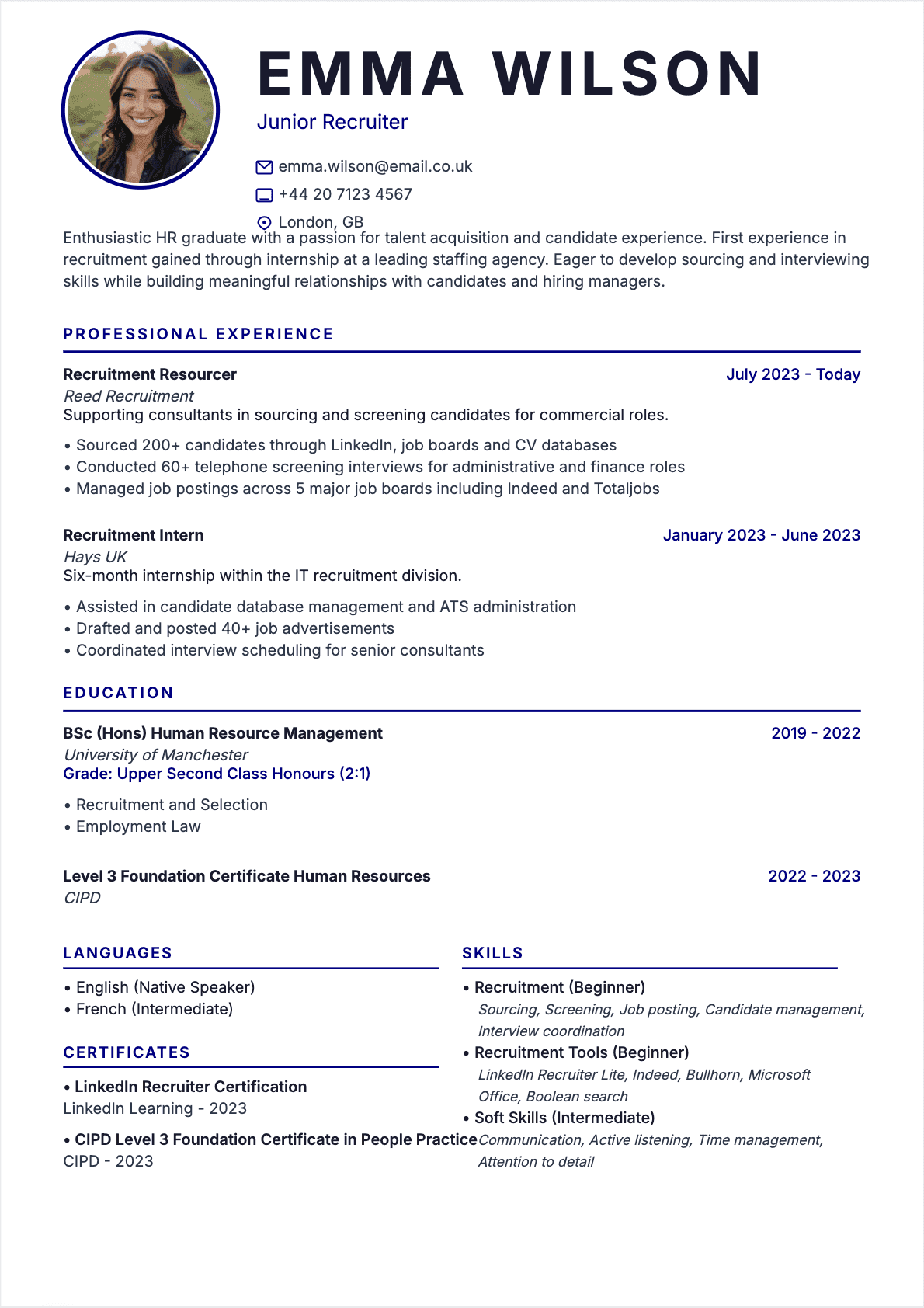
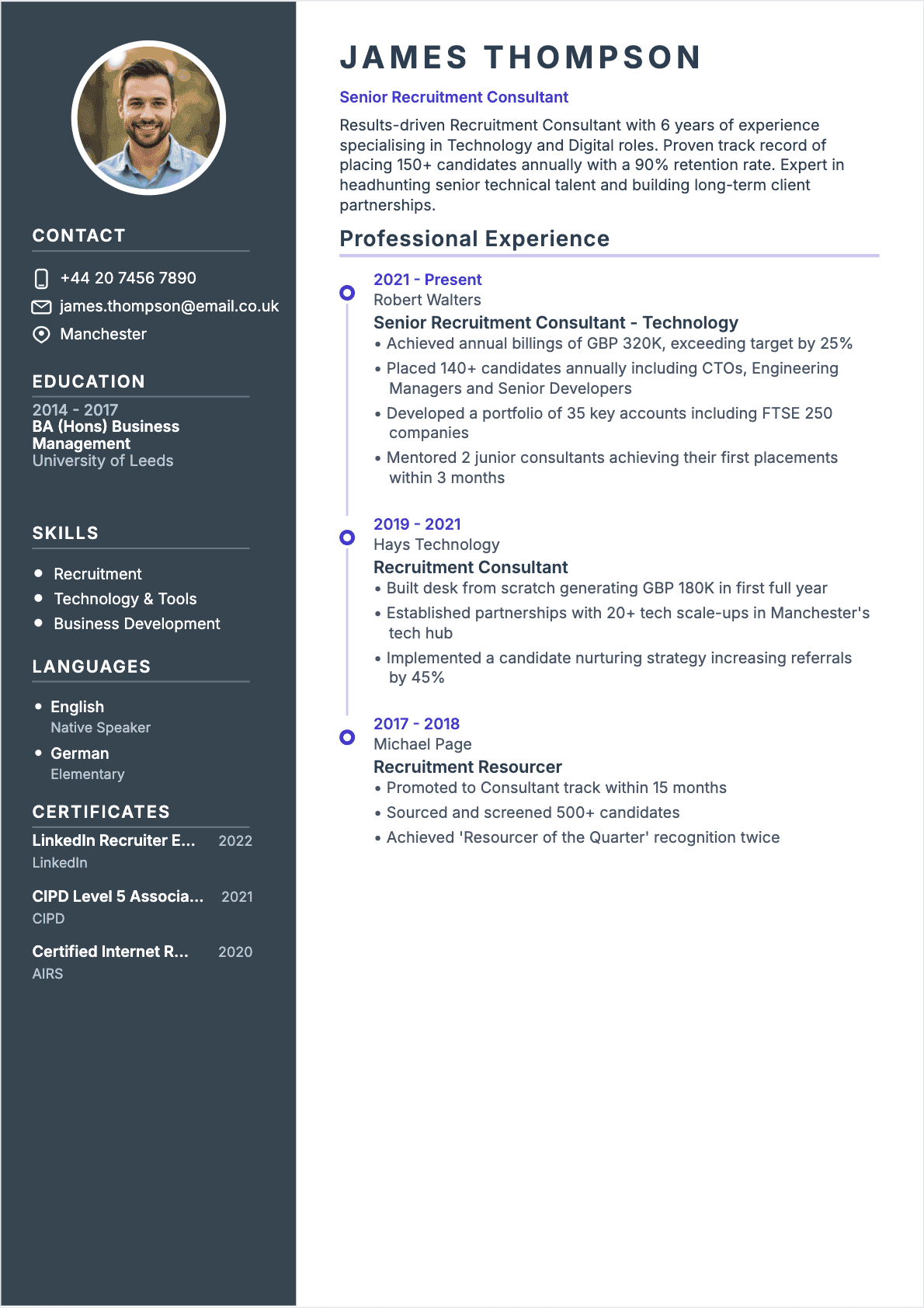
Entry-level Recruiter Resume

For junior recruiters and graduates: highlight transferable skills, sourcing projects, internships, and ATS-ready formatting. Include metrics like outreach volume, response rate, and time-to-schedule.

Utiliser

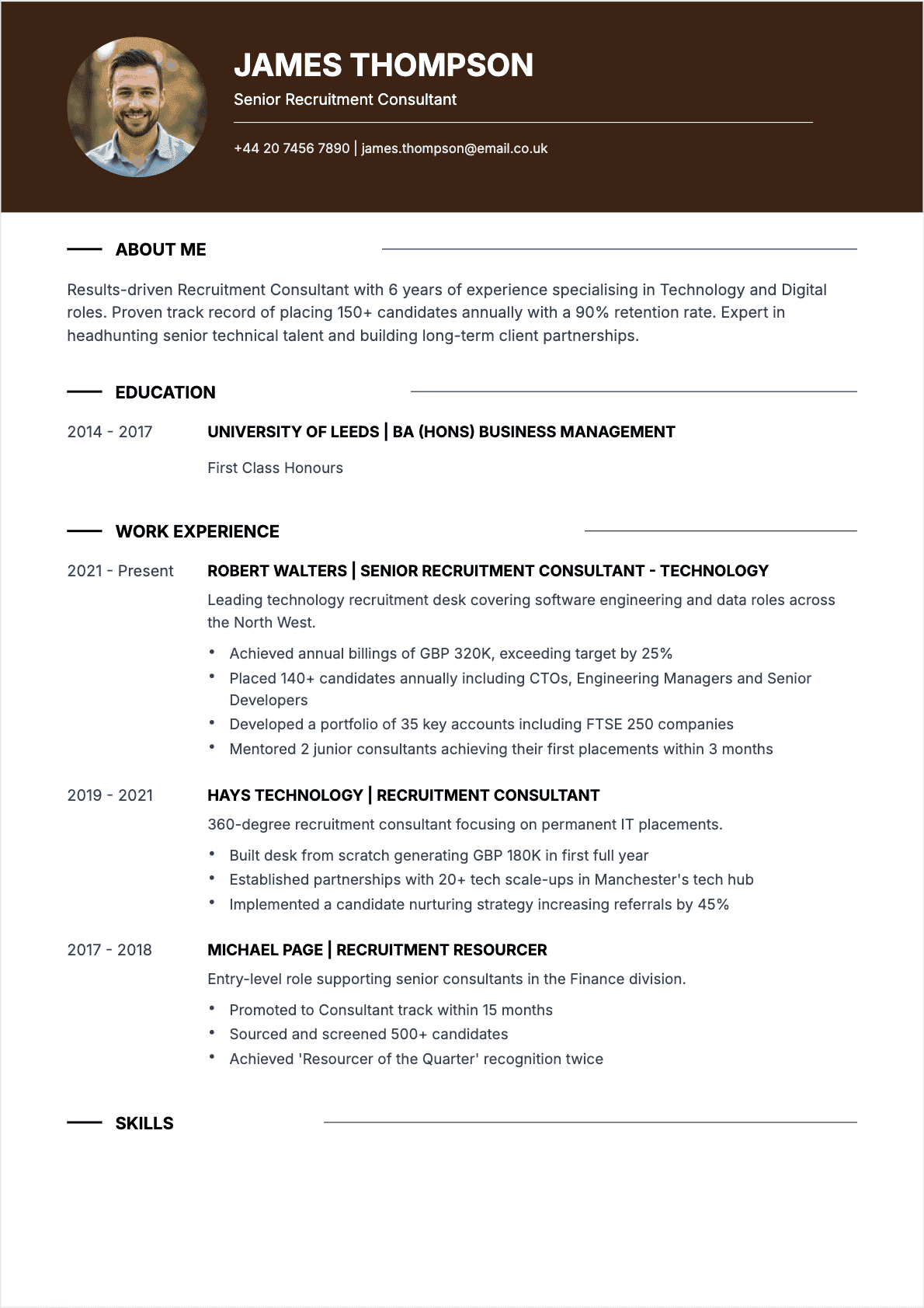
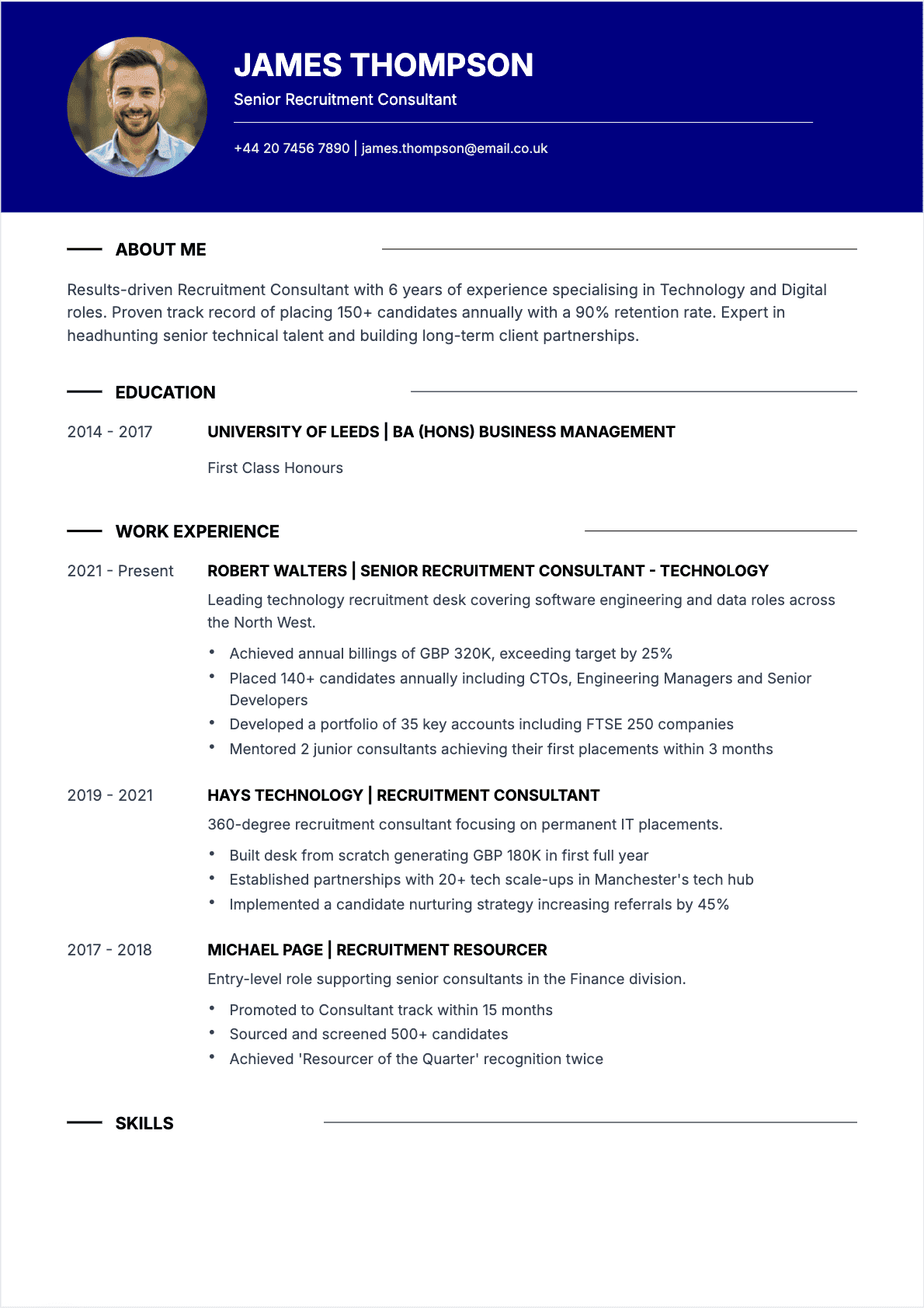
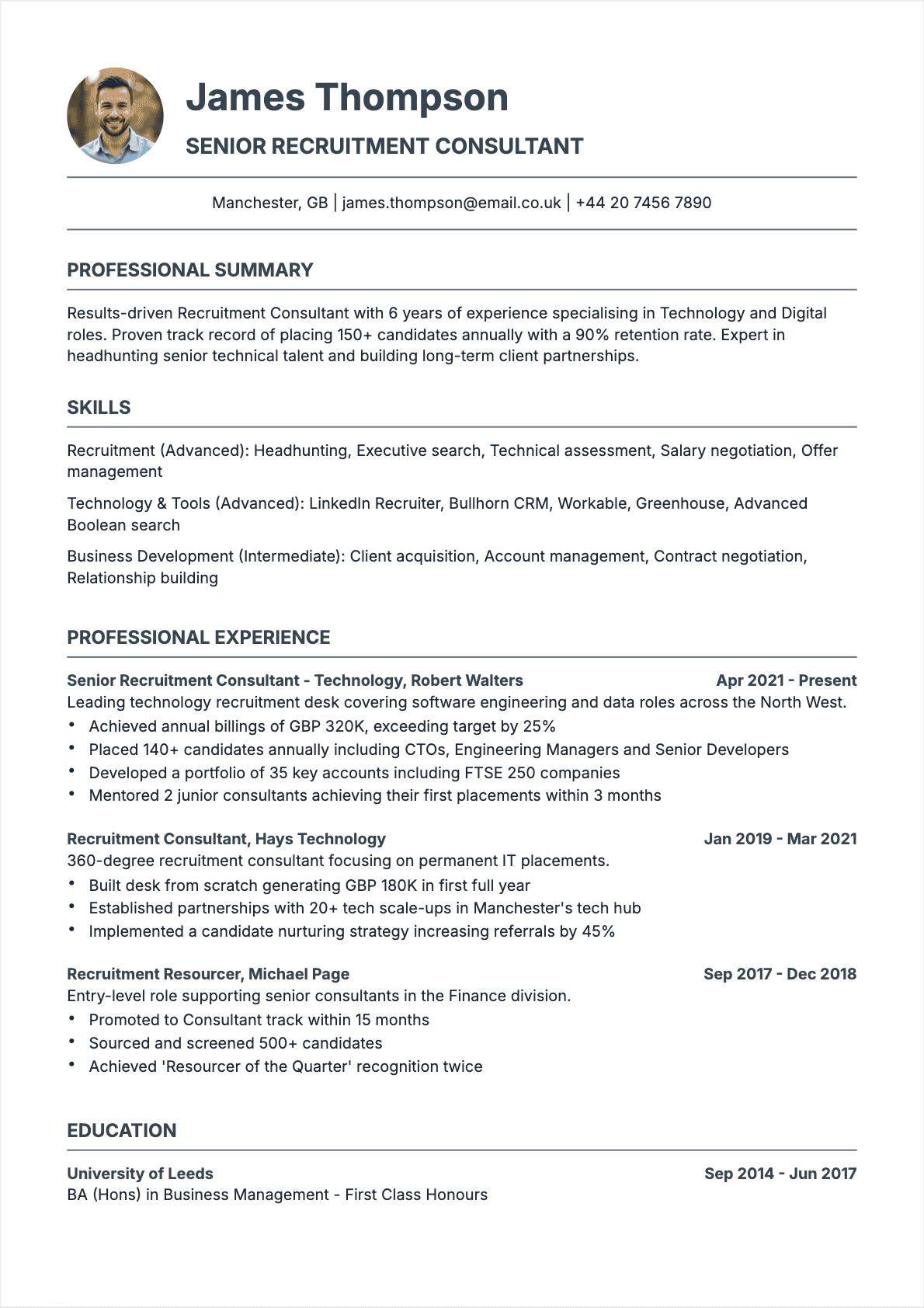
Recruiter Resume (3–7 years)

For recruiters with proven ownership: show req load, funnel conversion, offer acceptance, stakeholder management, and tools. Add quantified impact across hiring cycles, quality-of-hire signals, and process improvements.

Utiliser

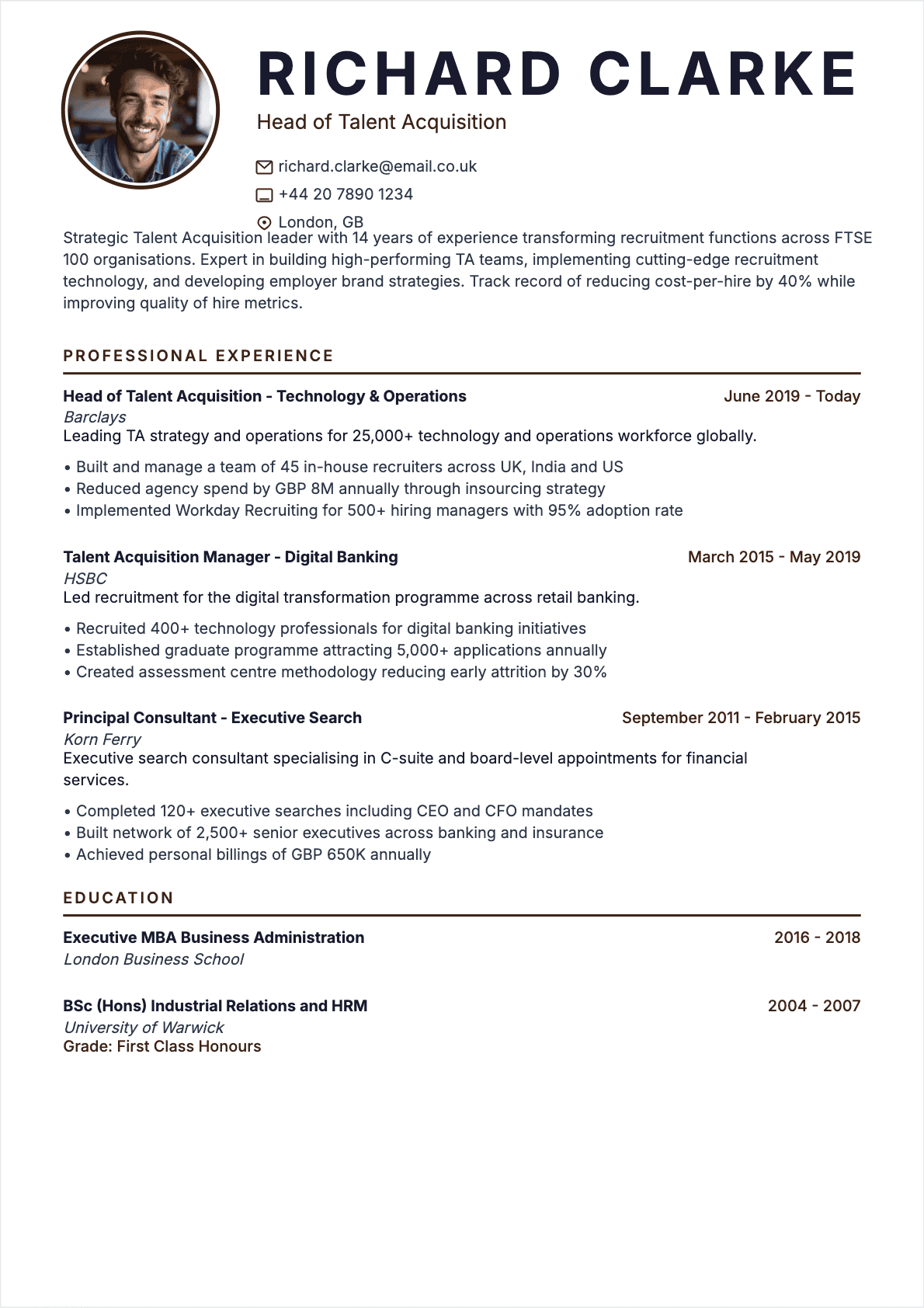
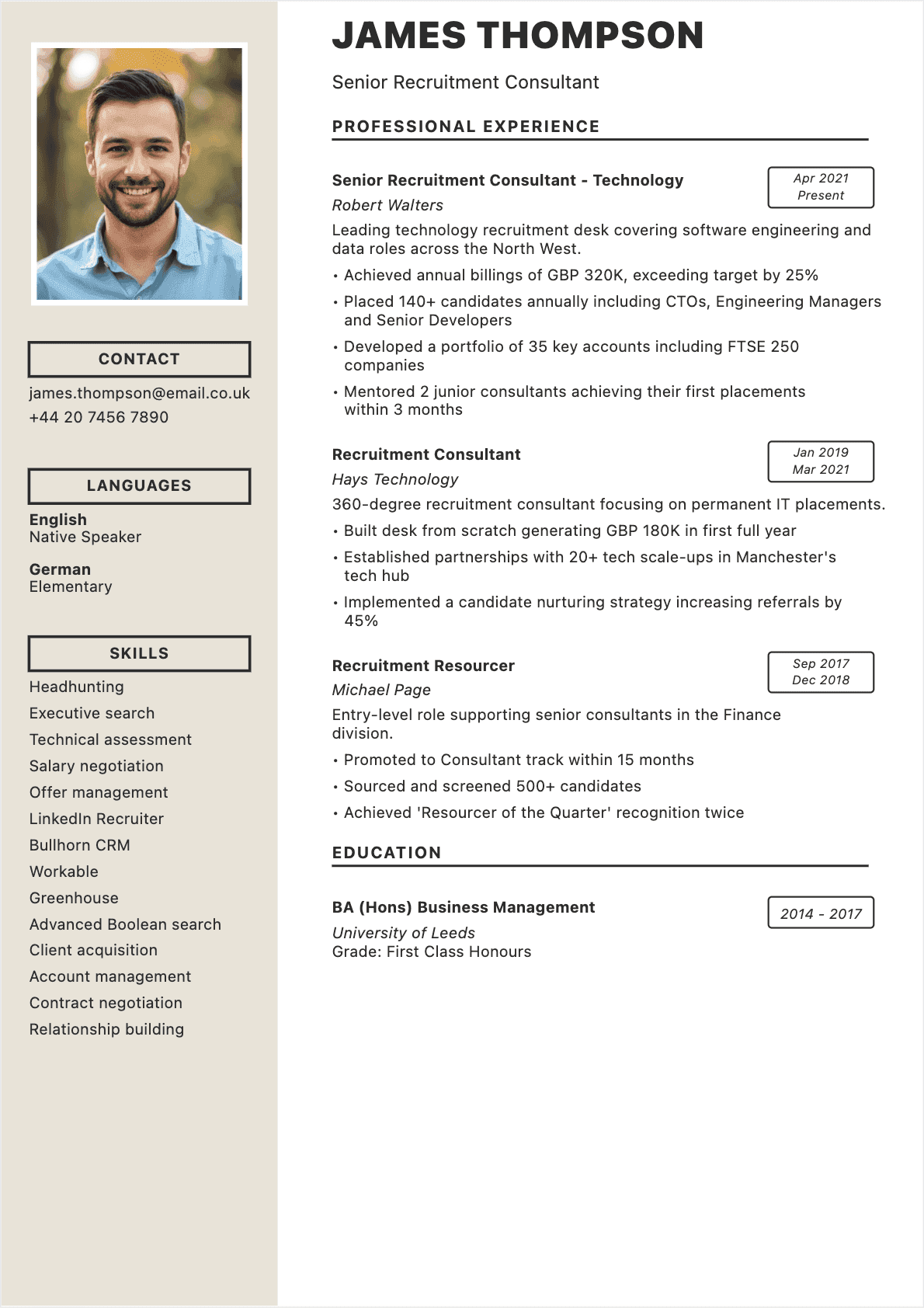
Senior Recruiter Resume

For senior profiles: emphasize strategic recruitment, headcount delivery, leadership, workforce planning, and complex hiring. Prove outcomes with pipeline health, time-to-fill reduction, and cross-functional influence.

Utiliser

Perfect CV Checklist - Recruiter Resume

Check each item to ensure your CV is complete and optimized.

Your Progress0%

Professional Summary - Recruiter Resume

The professional summary is the first thing recruiters see. It should summarize your profile in a few impactful lines.

Good example

Recruiter with 6+ years in tech and healthcare recruitment, managing 18–25 open reqs per quarter and delivering 62 hires in 12 months. Improved time-to-fill from 47 to 34 days and raised offer acceptance to 92% using Greenhouse, LinkedIn Recruiter, and structured scorecards.

Bad example

Motivated, dynamic, passionate recruiter looking for a new opportunity. Available immediately, strong team player, ready to take on challenges.

Why is it effective?

Le bon exemple est efficace car il :

  • donne un périmètre clair : “18–25 open reqs per quarter” au lieu d’un titre vague
  • prouve l’impact avec des chiffres : “62 hires”, “47 to 34 days”, “92%”
  • ajoute des outils crédibles : Greenhouse, LinkedIn Recruiter, scorecards
  • annonce un contexte sectoriel : tech et healthcare, utile pour un recruteur qui recrute sur un marché précis

Le mauvais exemple échoue car il :

  • utilise des clichés au lieu d’éléments vérifiables
  • ne mentionne aucun KPI de recrutement
  • n’indique ni secteur ni type de postes
  • ne contient aucun keyword utile pour un applicant tracking system

Professional experience examples

Here are examples of professional experiences. Note how results are quantified.

Corporate Recruiter

Randstad Sourceright, Austin, TX

Apr 2022 – Nov 2025

Supported a 1,200-employee SaaS client across Sales, Customer Success, and G&A hiring. Managed 20–30 requisitions simultaneously with a 4-person recruitment pod, weekly hiring manager calibrations, and standardized scorecards.

Key Achievements

Delivered 118 hires in 18 months across 14 job titles; maintained 96% hiring manager satisfaction (quarterly survey, n=48)
Reduced median time-to-fill from 45 to 33 days by rebuilding pipelines and tightening interview loops (−27%)
Raised onsite-to-offer conversion from 22% to 31% by improving screening rubrics and aligning job requirements in intake
Improved candidate response rate from 18% to 27% through A/B tested outreach sequences and clearer role value propositions

Key skills for your resume

Here are the technical and soft skills most sought after by recruiters.

Hard skills to include on a recruiter resume

Technical Skills

  • Full-cycle recruiting (intake to offer)
  • Boolean sourcing and talent mapping
  • LinkedIn Recruiter
  • Greenhouse ATS
  • Candidate screening and structured interview scorecards
  • Offer management and compensation alignment
  • Recruiting analytics (time-to-fill, pass-through, source ROI)
  • Employer branding and job ad optimization

Soft skills that strengthen a recruiter resume

Soft Skills

  • Stakeholder alignment and expectation management
  • Clear written communication (email, briefs, feedback)
  • Negotiation and closing
  • Prioritization across competing reqs
  • Active listening during intake and screening
  • Candidate experience ownership
  • Conflict handling between interviewers
  • Data storytelling with hiring metrics

ATS Keywords to Include

ATS systems filter CVs based on specific keywords. Include these terms to maximize your chances.

ATS Tip

Click on a keyword to copy it. ATS systems filter CVs based on these exact terms.

Mots-clés importants

Hiring Sectors

Discover the most promising sectors for your career.

1

Technology & SaaS

2

Healthcare & Life Sciences

3

Manufacturing & Industrial

4

Financial Services

5

Retail & Consumer

6

Staffing agencies & RPO

Education & Degrees

Recruiter roles rarely require a single “perfect” degree, but your education should support business fluency and credibility with hiring managers. Common paths include business, psychology, HR, or communications, plus hands-on recruitment experience through internships, campus recruiting, or agency work.

If you are an entry-level recruiter, treat projects as practical experience: sourcing sprints, event recruiting, or a mini-pipeline built for a particular job. If you are experienced, keep education concise and prioritize measurable outcomes in the experience section.

Recommended Degrees

  • Bachelor’s degree in Human Resources Management
  • Bachelor’s degree in Business Administration
  • Bachelor’s degree in Psychology
  • Master’s degree in Human Resources (MHRM)
  • Master’s degree in Organizational Psychology
  • MBA (focus on HR or Strategy)

Languages

Languages can be a direct hiring advantage for a recruiter, especially when your job market includes multi-site teams or international candidates. They help you qualify applicants faster, build trust in interviews, and negotiate offers with fewer misunderstandings.

  • Global sourcing and outreach for hard-to-fill roles
  • Coordinating interviews across regions and time zones
  • Supporting hiring managers in multilingual environments

On your resume, use a simple level (Native/Fluent/Proficient/Intermediate) and add a recognized test only if it is recent and relevant.

🇬🇧

English

Native

🇪🇸

Spanish

Fluent (DELE C1)

🇫🇷

French

Proficient (DELF B2)

Recommended certifications

Certifications are not mandatory for every recruiter job, but they can validate your qualification when you change sectors or move into senior responsibilities. Prioritize well-known credentials that signal HR fundamentals, sourcing depth, and ethical practice. List only certifications you can verify with an ID or credential link.

SHRM Certified Professional (SHRM-CP)
HRCI Professional in Human Resources (PHR)
AIRS Certified Internet Recruiter (CIR)
AIRS Certified Social Sourcing Recruiter (CSSR)
Certified Staffing Professional (CSP) – American Staffing Association
ATD Certified Professional in Talent Development (CPTD)

Mistakes to avoid

Writing a task list instead of recruiting outcomes

Many recruiter resumes read like a process manual: “posted jobs, screened candidates, scheduled interviews”. Recruiters and hiring managers already know the workflow; they want proof you can deliver results under constraints (volume, speed, quality, stakeholder pressure).

Toujours inclure :

  • funnel metrics (sourced, screened, onsite, offered) and conversion rates
  • time metrics (time-to-fill, time-to-slate, time-to-offer)
  • scope indicators (req load, departments, job titles, locations)

A simple rule: every bullet point should contain an action + a number + a business outcome.

Ignoring ATS-friendly resume format

A recruiter resume must be readable by an applicant tracking system and by humans in under 30 seconds. Columns, icons, graphics, and text boxes can break parsing, causing missing keywords or scrambled dates. Poor format also makes your resume look inconsistent next to your LinkedIn profile.

À éviter : "Two-column resume with logos, skill bars, and tables that hide keywords."

À privilégier : "Single-column resume format with clear headings (Summary, Experience, Skills, Education) and standard date formatting (MMM YYYY)."

Keep the layout clean, export as PDF, and sanity-check by copying into a plain text editor.

Not tailoring your resume to the specific job description

If you send the same recruiter resume to every role, you will miss keywords from the job and look misaligned. One company may need high-volume recruiting; another may need executive search or technical recruitment. Tailor your resume to match the recruiter role you are applying for.

À mentionner :

  • “keywords from the job” (tools, job requirements, and stakeholder context)
  • relevant experience by sector (tech, healthcare, manufacturing) and hiring type
  • the right achievements (speed vs quality vs scale) for that particular job

Under-selling communication and documentation

Recruiting is communication-heavy: intake notes, email follow-ups, candidate feedback, and debrief summaries. If your resume doesn’t show strong communication skills, you appear risky—especially for roles with multiple interviewers or compliance constraints.

Checklist :

  • mention calibrated intake meetings and written scorecards
  • show examples of alignment artifacts (pipeline reports, weekly updates)
  • quantify candidate experience (NPS, drop-off reduction, response time)

Expert tips

  • 1

    Use a tight resume summary : Aim for 45–55 words with your years of experience, sector, core recruitment skills, and one quantified win. Add 2–3 tools (ATS, LinkedIn) that match the job description.

  • 2

    Build an ATS-first skills section : Create a simple skills section with 10–14 keywords (ATS, sourcing, screening, stakeholder management). Avoid charts; prioritize exact terms recruiters scan for.

  • 3

    Turn work experience into a funnel story : In each role, show req volume, hiring types, and one metric per stage (response rate, onsite-to-offer, offer acceptance). This makes your resume instantly credible.

  • 4

    Prove tool depth, not tool name-dropping : For Greenhouse/Lever/Workday, add scale (e.g., “managed 25 reqs”, “built 8 scorecards”, “ran weekly pipeline reports”). It reads like hands-on experience.

  • 5

    Align resume and LinkedIn profile : Same job titles and dates, and replicate 2–3 top achievements. Recruiters often cross-check your resume against your LinkedIn profile within minutes.

  • 6

    Add a cover letter only when it adds signal : Use a cover letter when switching sectors, explaining your transferable skills and why your recruiting experience fits the role. Keep it to 180–220 words.

  • 7

    Be careful when using AI : If using AI to draft bullets, verify every metric, tool, and job title. A hiring manager will spot inconsistencies between your resume, interview answers, and references.

Frequently asked questions

Find answers to the most frequently asked questions.

In recruitment, a CV is the candidate’s document summarizing experience, skills, education, and qualifications. Recruiters use it to assess fit against the job requirements, check timelines, and shortlist applicants. In the US, most employers expect a resume; in academia or some countries, CVs are longer and more detailed.

CV stands for “curriculum vitae,” Latin for “course of life.” In many regions it refers to a professional document similar to a resume. The meaning depends on the job market: in the US, a CV is typically used for academic, research, or medical roles, while most other jobs use a resume.

A resume is usually 1–2 pages and tailored to a specific job, focusing on relevant experience and achievements. A CV can be longer and more comprehensive, listing publications, research, and detailed history. For a recruiter job in the US, a concise recruiter resume in an ATS-friendly format is typically the best choice.

Yes. You can hire a resume writer or use a resume builder with a resume template. Choose providers who show recruiter resume example work, explain their process, and ask for the job description up front. Expect to pay roughly $150–$600 depending on seniority, turnaround, and LinkedIn optimization.

Recruiters scan a resume for job titles, recency, scope (req volume), and keywords that match the job description. They also look for measurable results like hires, time-to-fill, and conversion rates. Many teams use an applicant tracking system to parse the resume, so clean format and exact terms matter.

For most job seekers, 1 page works up to about 5–7 years of experience; 2 pages is acceptable for a senior recruiter resume with multiple employers, leadership, or specialized recruiting experience. Prioritize relevance: keep the experience section focused on outcomes and remove older roles that don’t support the specific job.

Create your recruiter resume in minutes

Pick a recruiter resume template, add quantified recruiting wins, and export an ATS-friendly PDF. Use our resume builder to tailor your resume to each job description and upload your resume with confidence.

Create my Resume