Health & Medical

CV Psychologist : Psychologist CV & Resume Guide 2026

This guide shows you how to write a psychologist resume or CV with a clear format, strong resume summary, and measurable clinical impact. You’ll get templates, skills lists, and psychologist resume examples to tailor to each job.

13 min readUpdated December 12, 2025

Key Takeaways

Recruiters and hiring managers expect a psychologist resume or CV that proves clinical competence, ethical practice, and measurable outcomes. In many outpatient clinics, a full-time clinician delivers 20–30 therapy sessions per week; hospital consult roles may complete 6–10 assessments weekly. Your document must make that scope visible in seconds while staying compliant with privacy and professional standards.

A strong CV Psychologist resume should demonstrate :

  • Evidence-based patient care with outcome tracking (e.g., PHQ-9 change over time)
  • Clear clinical experience (settings, populations, and supervision) including internship hours
  • Solid documentation habits and tools (EHR, telehealth, standardized assessments)

Below, you’ll find a practical format, psychologist resume examples, and templates you can adapt to each role.

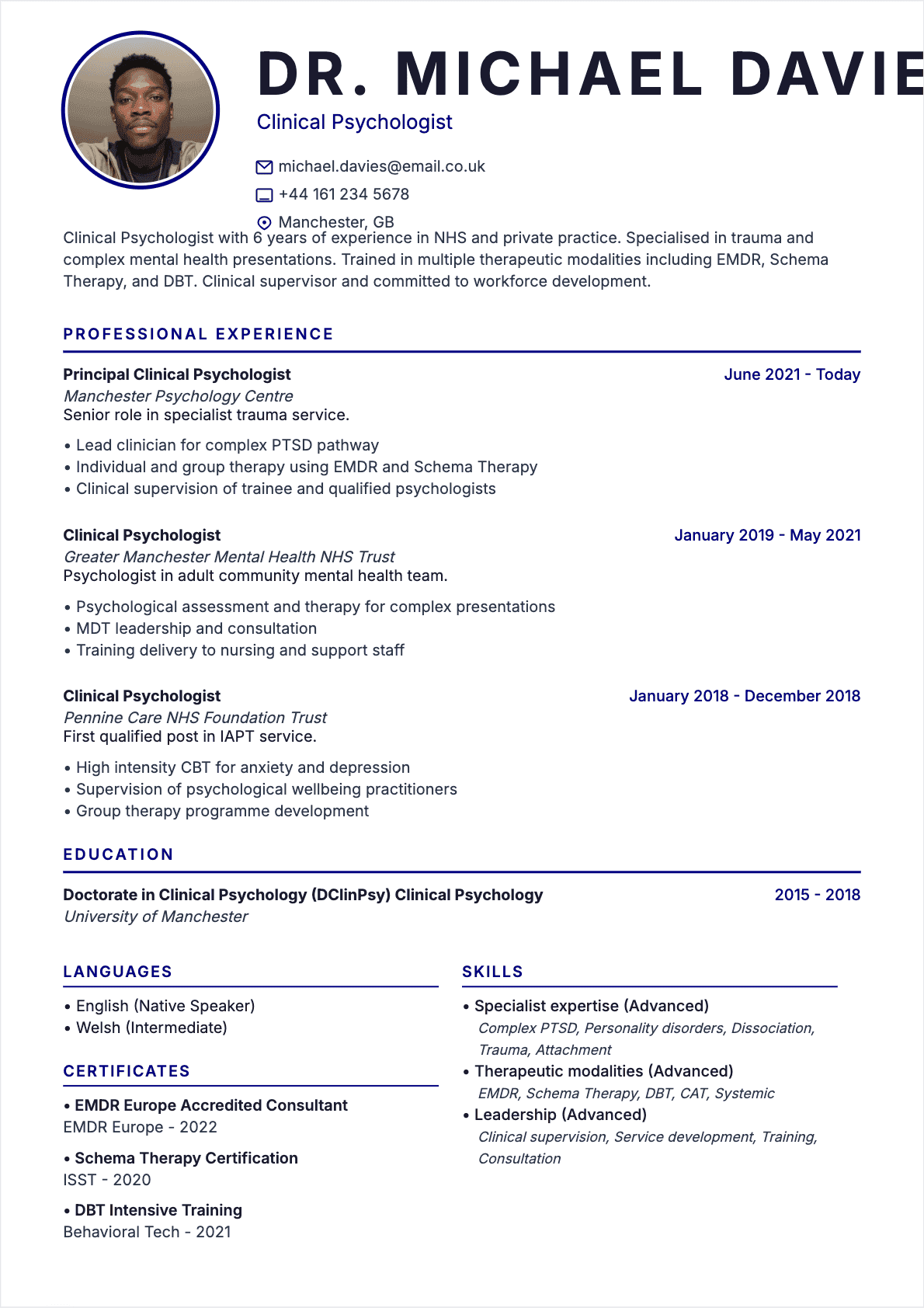
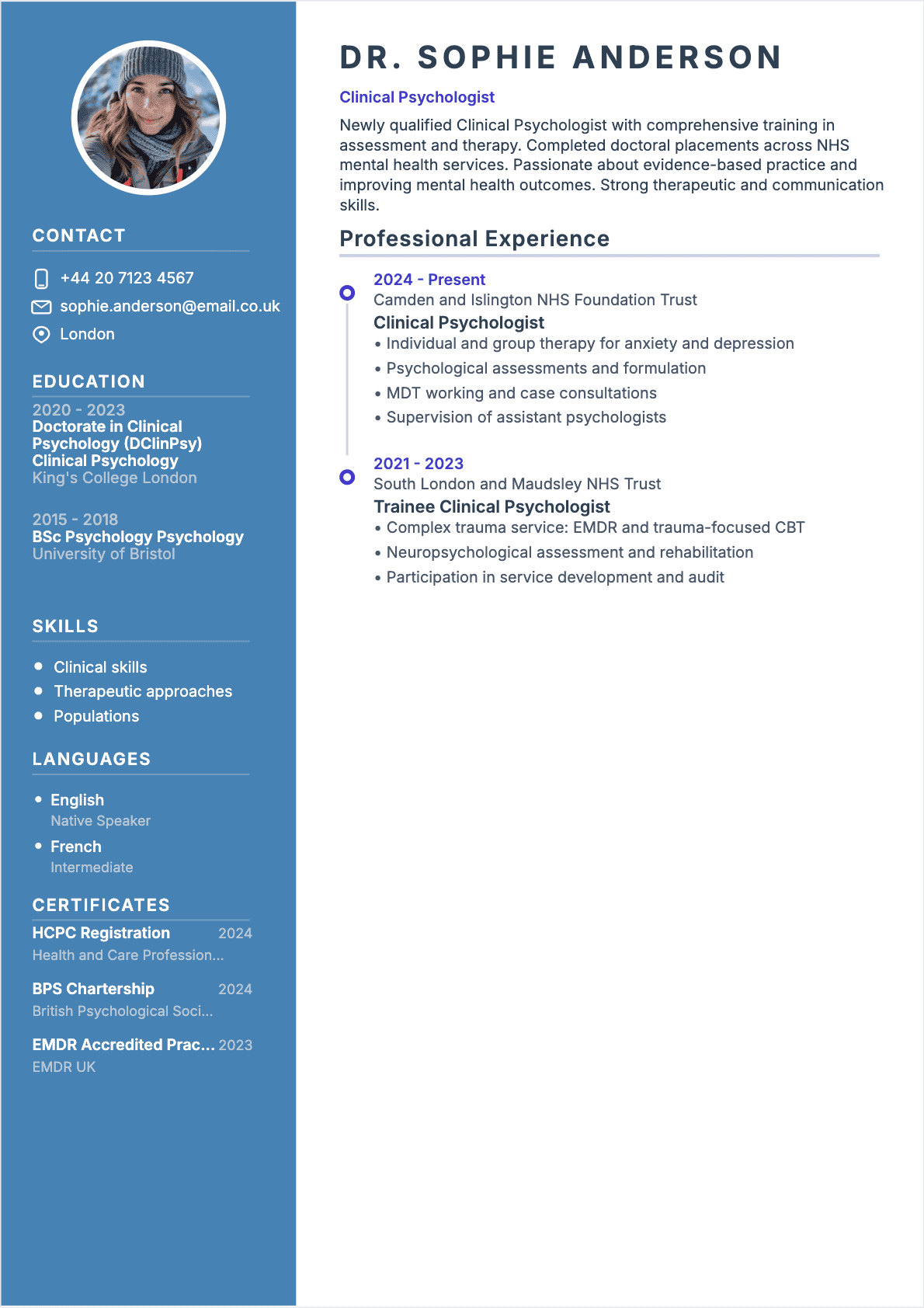
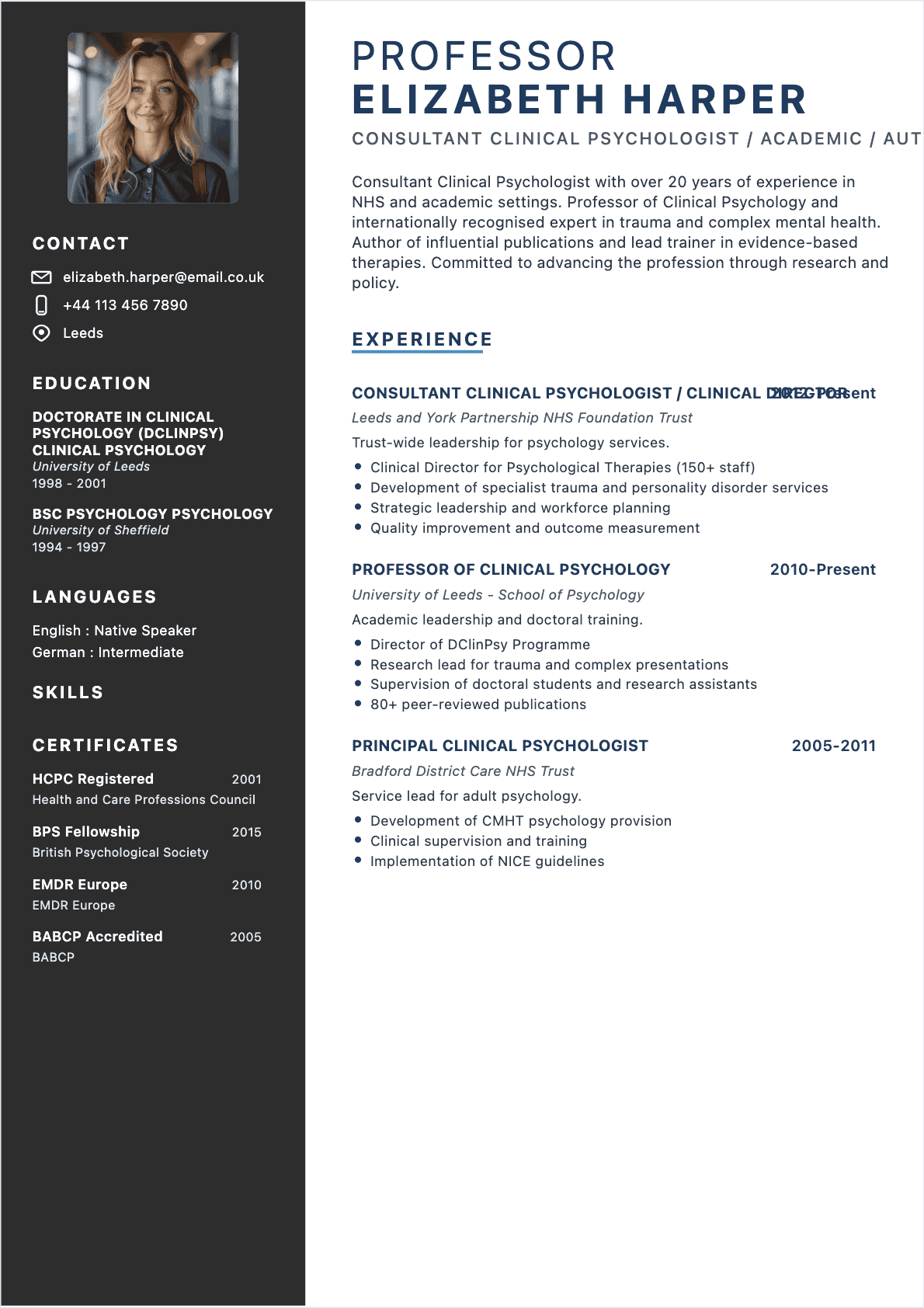
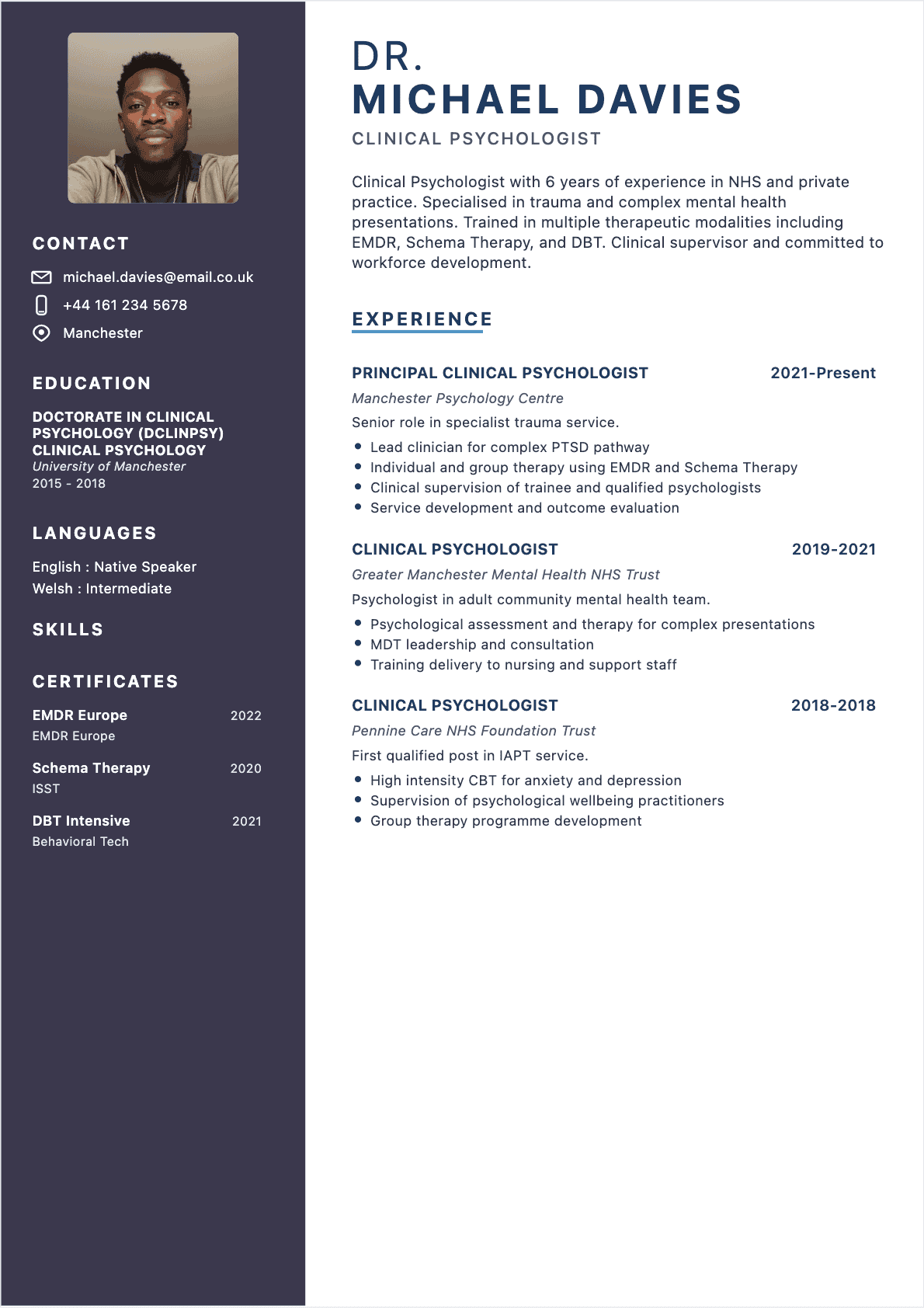
CV Examples - CV Psychologist

Discover our CV templates adapted to all experience levels. Each example is ATS-optimized.

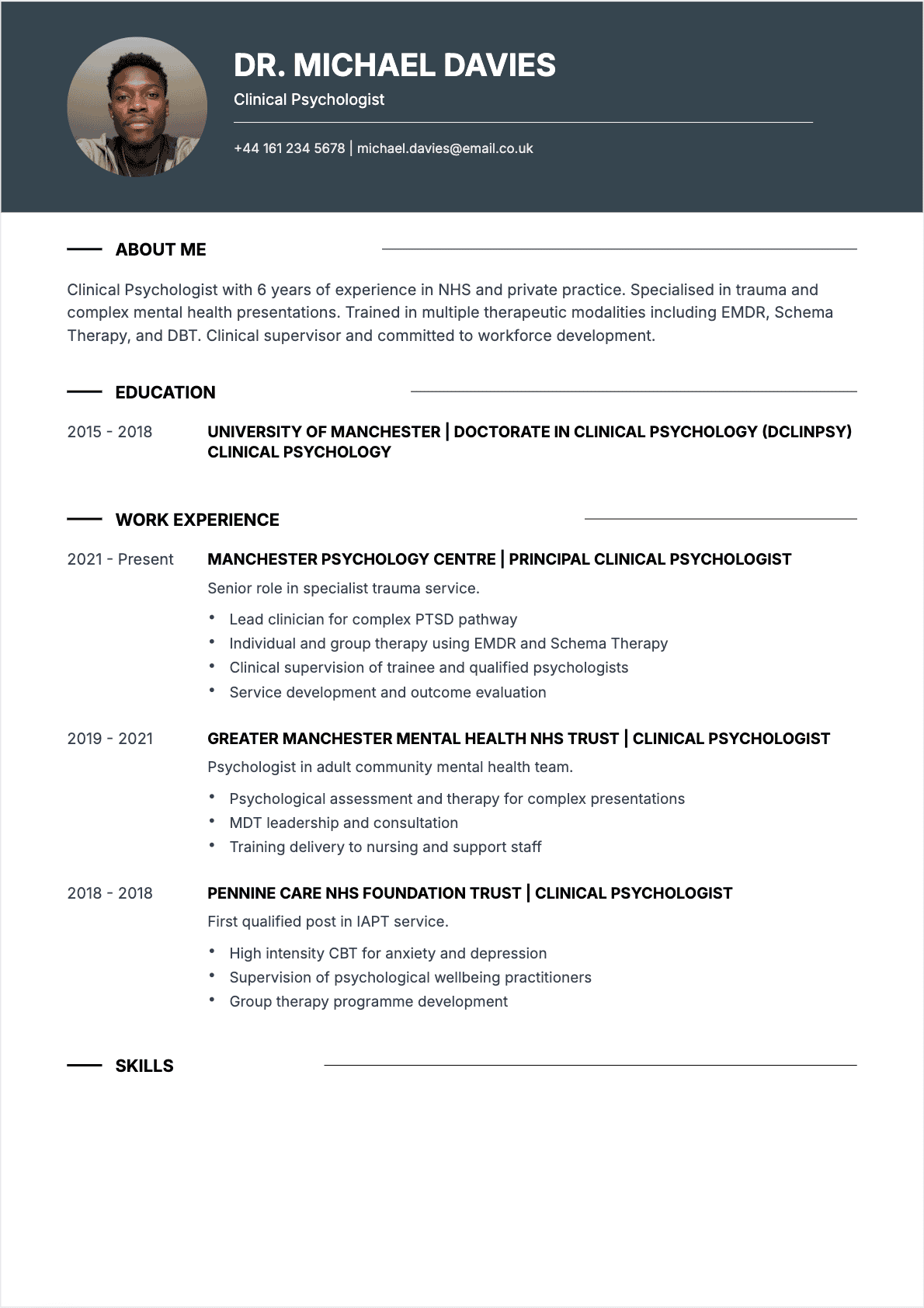
CV Psychologist Beginner

For early-career profiles and recent graduates: highlight internship hours, supervised clinical experience, core assessments, and measurable outcomes from placements, research, or volunteer work in mental health settings.

Utiliser

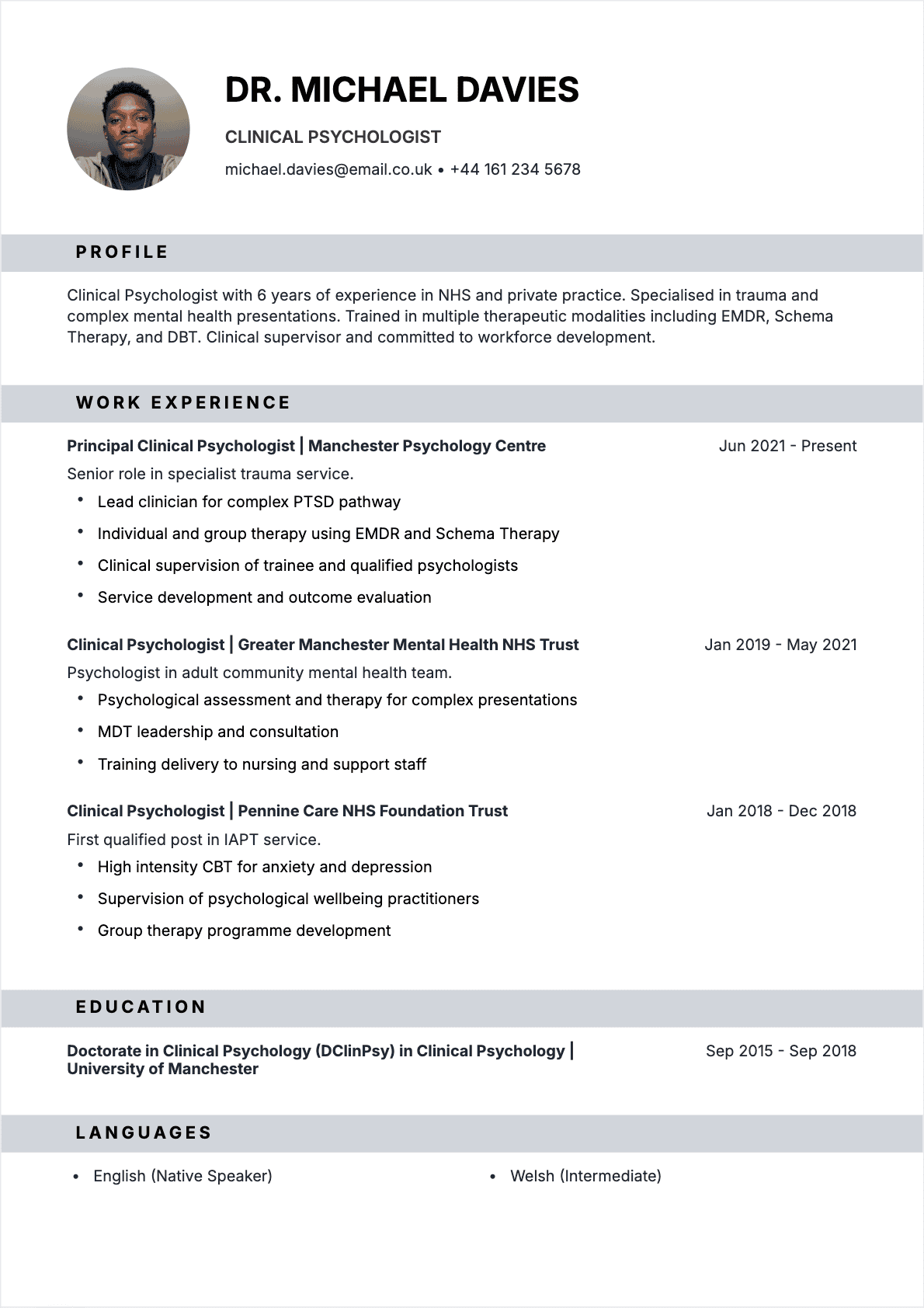
CV Psychologist Intermediate

For 3–7 years’ experience: emphasize caseload size, therapy sessions delivered, evidence-based protocols, interdisciplinary care, and patient satisfaction results, plus tools like TherapyNotes or Epic for documentation.

Utiliser

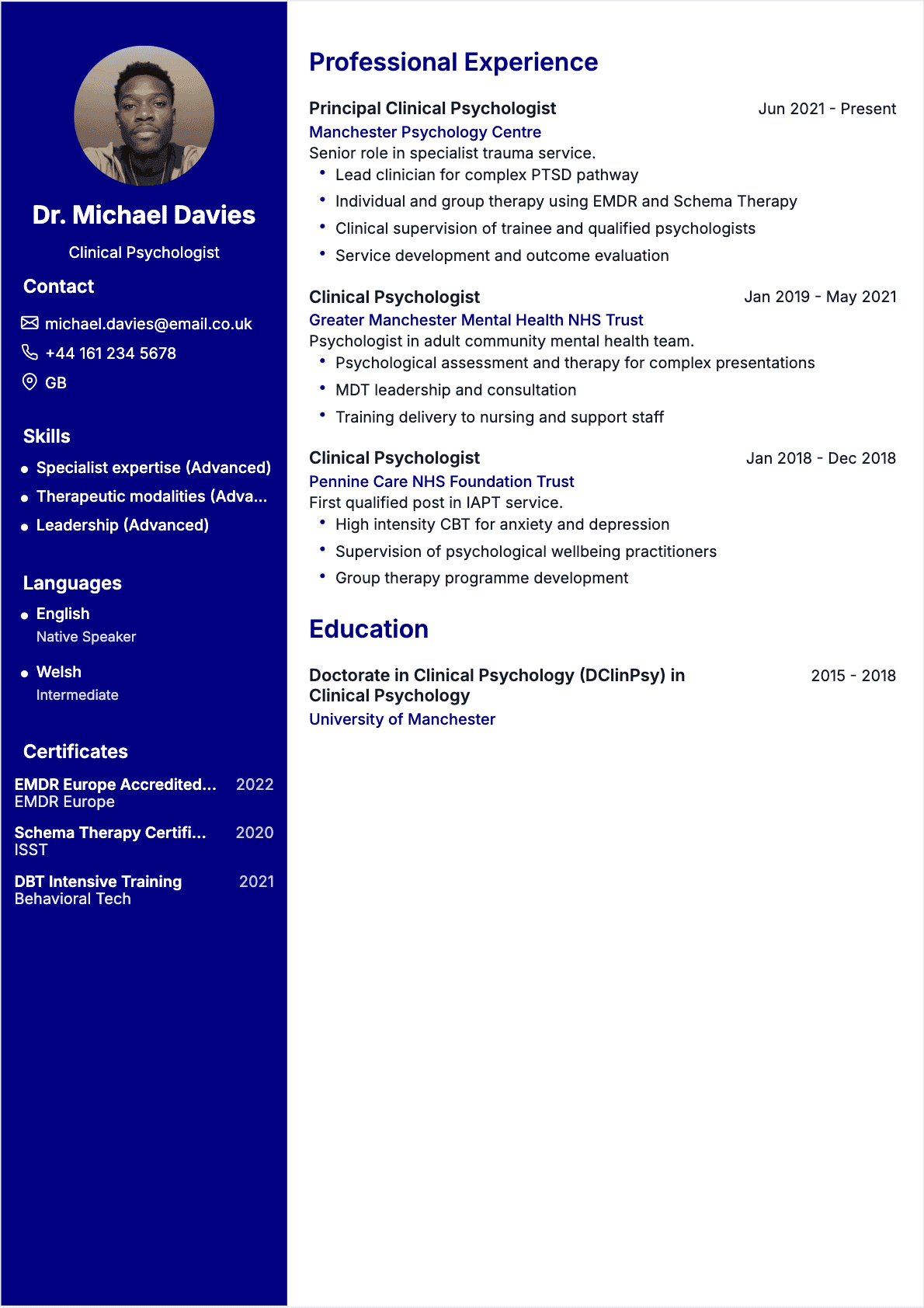
CV Psychologist Senior

For senior psychologists: showcase clinical leadership, supervision hours, program outcomes, quality improvement, research and teaching experience, and governance work, supported by audit metrics and compliance indicators.

Utiliser

Perfect CV Checklist - CV Psychologist

Check each item to ensure your CV is complete and optimized.

Your Progress0%

Professional Summary - CV Psychologist

The professional summary is the first thing recruiters see. It should summarize your profile in a few impactful lines.

Good example

Licensed Psychologist with 6+ years in outpatient clinical psychology, delivering 1,200+ therapy sessions and 180+ psychological evaluations. Reduced no-show rate by 22% through reminders and brief screening workflows. Skilled in CBT, DBT-informed care, and trauma-informed practice; tools: TherapyNotes, Epic, SPSS.

Bad example

Motivated and dynamic psychologist, passionate about helping people, available immediately, with strong communication and a proven track record in psychology.

Why is it effective?

The good example is effective because it :

  • Specifies experience level and setting (6+ years, outpatient clinical psychology) so the recruiter can place you fast
  • Quantifies scope (1,200+ therapy sessions; 180+ evaluations) instead of vague “extensive experience”
  • Adds business-relevant impact (22% no-show reduction) with a concrete mechanism
  • Names real tools and methods (TherapyNotes, Epic, SPSS; CBT; trauma-informed care) that map to applicant tracking systems

The bad example fails because it :

  • Uses clichés (motivated, dynamic, passionate) that don’t differentiate you
  • Gives no clinical metrics (caseload, sessions, outcomes) to assess performance
  • Omits specialization and population, so it can’t match a specific resume format or job description
  • Adds “proven track record” without proof, which hiring managers typically discount

Professional experience examples

Here are examples of professional experiences. Note how results are quantified.

Clinical Psychologist

Kaiser Permanente, San Diego

June 2020 – November 2025

Outpatient behavioral health team of 12 clinicians serving adults with mood and anxiety disorders. Managed a 28–32 patient caseload, delivered individual and group therapy sessions, and completed structured assessments in collaboration with primary care.

Key Achievements

Delivered 1,350+ therapy sessions/year on average while maintaining clinical documentation within 24 hours for 93% of visits
Improved PHQ-9 response rate by 18% by integrating measurement-based care and brief screeners at intake
Reduced no-show rate from 17% to 13% in 6 months through reminder workflows and same-week rescheduling
Co-led 10-week stress reduction program; post-program patient satisfaction increased by 14 points (internal survey)

Key skills for your resume

Here are the technical and soft skills most sought after by recruiters.

Hard skills (clinical and technical)

Technical Skills

  • Psychological assessment and test administration (WAIS-IV, MMPI-2)
  • Diagnostic formulation using DSM-5-TR
  • TherapyNotes (EHR and clinical documentation)
  • Epic (behavioral health documentation workflows)
  • Treatment planning and measurable goal setting
  • CBT protocols (anxiety, depression, insomnia)
  • Risk assessment and crisis intervention (suicidality, safety planning)
  • Outcome measurement and reporting (PHQ-9, GAD-7, PCL-5)

Soft skills for clinical effectiveness

Soft Skills

  • Therapeutic alliance building across diverse populations
  • Structured clinical interviewing and active listening
  • Clear, non-stigmatizing documentation
  • Interdisciplinary communication with physicians and social work
  • Boundary management and ethical decision-making
  • De-escalation and calm response under time constraints
  • Supervision readiness (receiving and applying feedback)
  • Psychoeducation and group facilitation

ATS Keywords to Include

ATS systems filter CVs based on specific keywords. Include these terms to maximize your chances.

ATS Tip

Click on a keyword to copy it. ATS systems filter CVs based on these exact terms.

Mots-clés importants

Hiring Sectors

Discover the most promising sectors for your career.

1

Hospitals and outpatient behavioral health clinics

2

Community mental health centers

3

Private practice and group practices

4

Schools and university counseling services

5

Employee Assistance Programs (EAP) and occupational health

6

Correctional facilities and forensic services

Education & Degrees

Most psychologist roles require graduate education plus supervised clinical practice. For clinical roles, a PhD or PsyD is common, alongside formal internship and postdoctoral hours aligned to licensure requirements. If you target hospitals or academic medical centers, emphasize clinical practice plus research and teaching experience; for private practice, highlight outcomes, referral sources, and documentation quality.

Different pathways exist: clinical psychology, counseling psychology, school psychology, or health psychology. Whatever the route, prioritize accredited programs, supervised placements, and evidence-based coursework that matches the job you are applying for.

Recommended Degrees

  • Doctor of Psychology (PsyD) in Clinical Psychology
  • PhD in Clinical Psychology
  • Master’s degree in Psychology (pre-doctoral pathway)
  • Bachelor’s in Psychology
  • Graduate Certificate in Trauma-Informed Care
  • Postdoctoral Fellowship in Clinical Psychology

Languages

Languages matter in psychology because rapport, informed consent, and risk assessment depend on nuance. In community clinics, bilingual providers often carry mixed caseloads with interpreters and must document language access. In hospitals, multilingual skills help during consults and crisis evaluations. In research and teaching, English is required for publications and conference work, often following APA conventions.

Present your level clearly (Native/Fluent/Proficient/Intermediate) and add a certification when available. If you use interpreters, mention experience collaborating with language services.

🇬🇧

English

Native

🇪🇸

Spanish

Proficient (ACTFL Advanced Low)

🇫🇷

French

Intermediate

Recommended certifications

Certifications are not always mandatory, but they can strengthen a psychologist CV by proving specialization and standardized training. Licensure is typically required for independent clinical practice, while board certification and modality credentials are strong differentiators for competitive roles.

ABPP Board Certification (American Board of Professional Psychology)
EPPP (Examination for Professional Practice in Psychology) – Passed
EMDRIA Certified Therapist (EMDR International Association)
Academy of Cognitive and Behavioral Therapies (A-CBT) Certification
QPR Suicide Prevention Gatekeeper Certification
Mental Health First Aid (MHFA) Certification

Mistakes to avoid

Using an unclear resume format that hides clinical scope

When your resume format mixes roles, dates, and settings, the recruiter can’t quickly infer your work history, caseload, or level of autonomy. That often leads to “not a fit” decisions in under 30 seconds, especially when applicant tracking systems can’t parse inconsistent headings.

Always include :

  • Setting and population (outpatient adults, inpatient psych, school-based)
  • Volume metrics (sessions/week, evaluations/month, caseload range)
  • Licensure and supervision context (independent vs supervised practice)

Keep a reverse chronological order layout with consistent titles: Role, Organization, City, Dates, then measurable outcomes.

Listing therapy modalities without evidence or outcomes

Writing “CBT, DBT, behavioral therapy, trauma” without context reads like keyword stuffing. Hiring managers want proof you can apply protocols to real patient care and track progress.

À éviter : "Provided CBT and trauma therapy to many clients with great results."

À privilégier : "Delivered CBT for panic disorder to a caseload of 24; 62% achieved ≥50% reduction on GAD-7 within 8 sessions (n=45)."

Tie each modality to a population, a measurable outcome, and your role in treatment planning.

Forgetting internship and supervised hours details

Early-career candidates often under-document internship and practicum work, which is a missed opportunity. Your internship can be your strongest proof of clinical experience if you quantify it and specify supervision.

À mentionner :

  • Total hours (e.g., 1,500 practicum hours; 600 direct service)
  • Supervision structure (individual + group supervision hours/month)
  • Assessment and intervention types (intakes, batteries, group therapy sessions)

Including sensitive patient details or violating confidentiality

Psychology hiring teams value ethics. A resume that contains identifying patient stories, names, or overly specific case details can raise immediate risk flags. Use de-identified, aggregate data and describe populations broadly.

Checklist :

  • Remove any identifiable details (names, rare conditions tied to one case)
  • Use ranges and aggregates (n=60, 20–30 sessions/week)
  • Keep notes on compliance (HIPAA training, documentation standards)

Expert tips

  • 1

    Choose a resume format first : Use reverse chronological order for clinical roles; keep headings stable so applicant tracking systems parse licensure, experience, and education without errors.

  • 2

    Write a measurable resume summary : Add years, setting, and two metrics (sessions delivered, assessments completed). Then list 2–3 tools (EHR, tests, analytics) to anchor credibility.

  • 3

    Mirror the job description : Copy key terms like “measurement-based care” or “crisis intervention” and prove them with one quantified bullet each, not with repeated keyword lists.

  • 4

    Showcase your skills with proof : For each core skill (assessment, treatment planning, documentation), add a metric: turnaround time, outcome score change, adherence rate, or satisfaction results.

  • 5

    Separate clinical vs research : If you have research and teaching experience, create a distinct section with APA-style citations, posters, and grants so the resume serves both clinical and academic reviewers.

  • 6

    Keep it readable : Use 10–12 pt fonts (Times New Roman or Calibri), consistent spacing, and one page for most resumes; a longer curriculum vitae is acceptable for academia.

  • 7

    Attach a targeted cover letter : Use the cover letter to explain fit for the setting (hospital, school, private practice) and to clarify licensure timeline, relocation, or supervision needs.

Frequently asked questions

Find answers to the most frequently asked questions.

A psychologist CV for clinical roles should prioritize licensure, clinical experience, and outcomes. Use a clean format with reverse chronological order, list populations and settings, and quantify scope (e.g., 25 sessions/week, 8 assessments/month). Add validated tools (PHQ-9, WAIS-IV), EHR experience, and any relevant certification or supervision credentials.

A resume is typically 1–2 pages focused on role fit: clinical impact, skills, and recent experience. A curriculum vitae is a fuller record used more often in academia and research, including publications, posters, teaching, grants, and professional affiliations. Many psychologists keep both and customize the resume for each job.

Most psychologist resumes perform best at one page for early to mid-career candidates and up to two pages for senior clinicians with leadership or program work. Use space for quantified achievements (sessions delivered, outcomes, satisfaction). If you’re applying for faculty roles, use a longer CV and keep the resume concise.

Include coursework when it adds job-relevant proof, usually for a resume with no experience or when changing specialties. List 4–6 advanced courses (e.g., Psychological Evaluation, Trauma, Health Psychology) and connect them to clinical skills. For experienced clinicians, coursework is less valuable than outcomes and clinical experience.

A cover letter is strongly recommended for psychologist roles because it clarifies setting fit, licensure timeline, and scope of practice. Use 3 short paragraphs: why this employer, how your clinical experience matches the job description, and what outcomes you achieved. Keep it aligned to the same keywords as your resume.

Use standard section headings (Summary, Experience, Education, Skills), avoid text boxes, and keep formatting simple. Save as PDF unless the employer requests Word. Mirror role keywords such as clinical psychology, treatment planning, crisis intervention, and outcome measurement, and support each with metrics to satisfy both ATS parsing and human review.

Create your CV Psychologist resume in minutes

Use our resume builder to pick a psychologist template, insert ATS keywords, and generate a clean CV or resume tailored to your clinical experience, internship history, and outcomes.

Create my Resume