Health & Medical

CV Pharmacist : Pharmacist resume template 2025

Build a pharmacist resume that recruiters can scan in 30 seconds. Use an ATS-friendly format, measurable achievements, and the right pharmacy keywords for retail pharmacist and clinical pharmacist roles.

12 min readUpdated December 12, 2025

Key Takeaways

In today’s job market, a pharmacist resume is screened quickly: many recruiters spend 20–40 seconds on the first pass, and applicant tracking systems (ATS) can filter you out before a human reads your CV. At the same time, pharmacy teams operate at scale. A busy retail pharmacy may process 250–450 prescriptions per day and administer 60–150 immunizations per week during peak season, so employers look for proof you can deliver accuracy under volume.

A good CV of CV Pharmacist must demonstrate:

  • Safe dispensing habits with measurable patient safety outcomes (interventions, error reduction, near-miss capture)
  • Pharmacy operations ownership (workflow, inventory, third-party resolution) tied to throughput and service metrics
  • Patient care capabilities (patient counseling, medication therapy management, adherence support) aligned to the pharmacist role

Use the guide below to choose the right resume format, select keywords from the job listing, and build a standout pharmacist resume with specific examples.

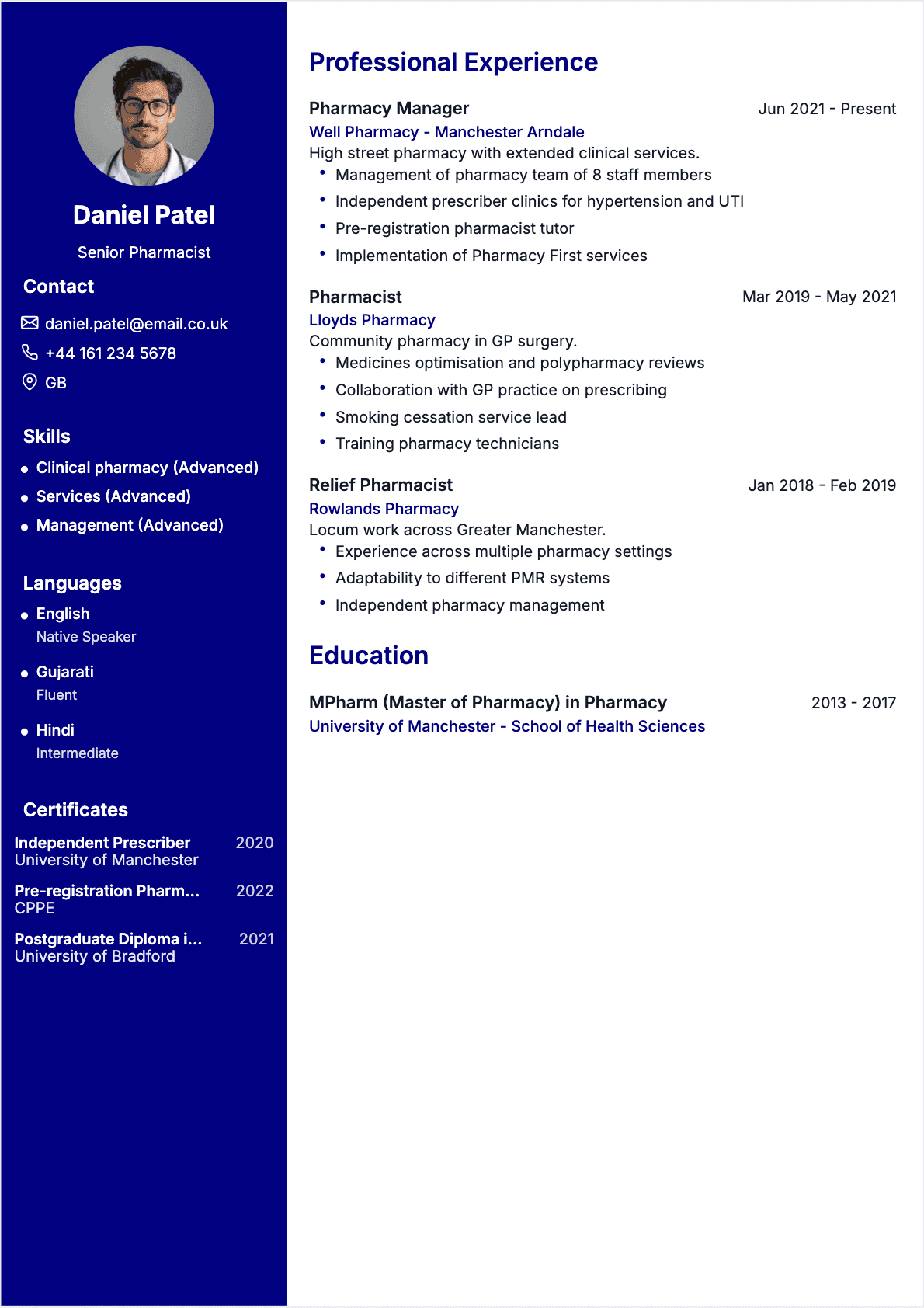
CV Examples - CV Pharmacist

Discover our CV templates adapted to all experience levels. Each example is ATS-optimized.

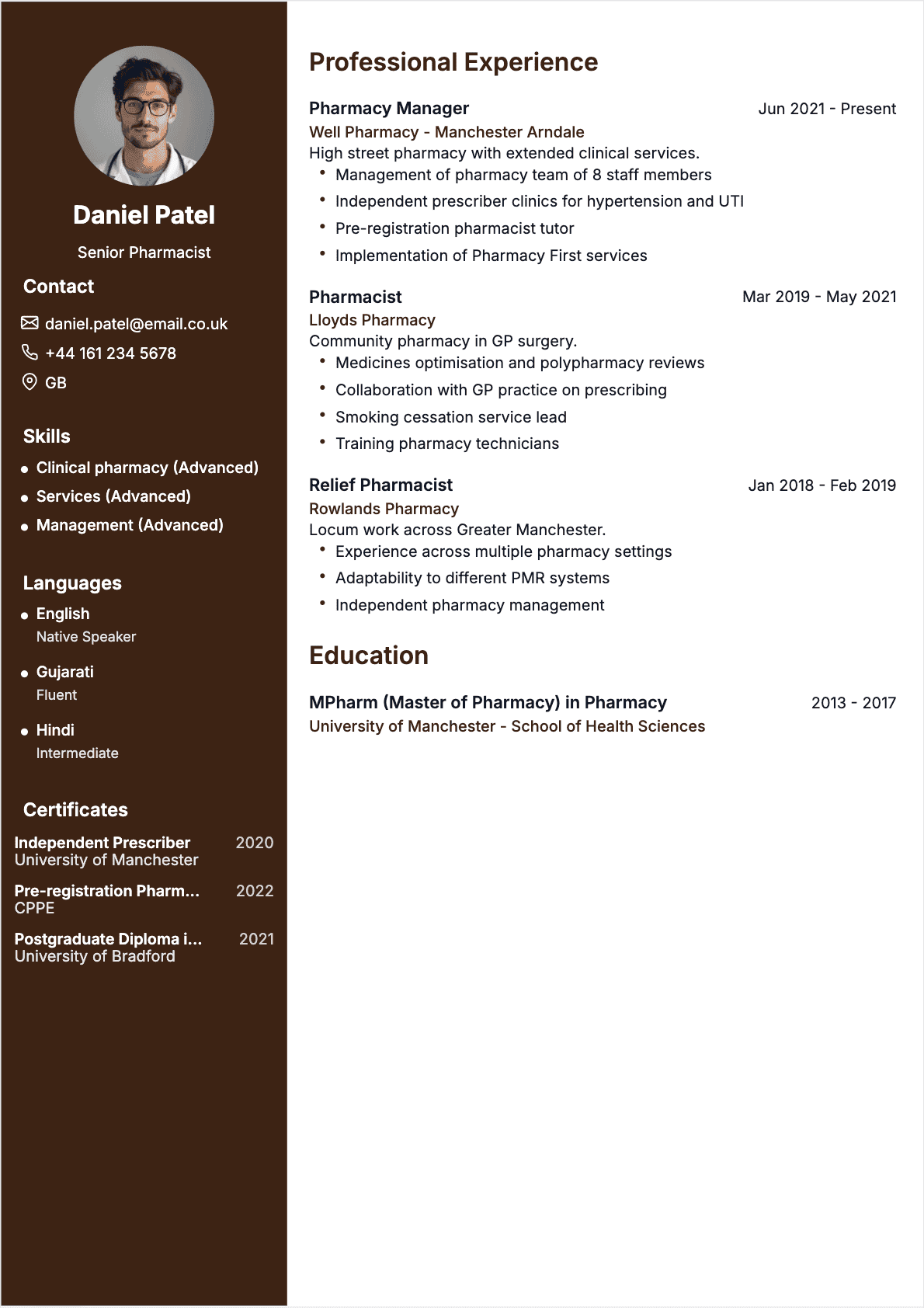
CV Pharmacist Beginner

For new grads and junior pharmacists: clear resume format, rotation highlights, preceptor feedback, and safe-dispensing skills. Includes internship metrics, MTM exposure, and ATS keywords.

Utiliser

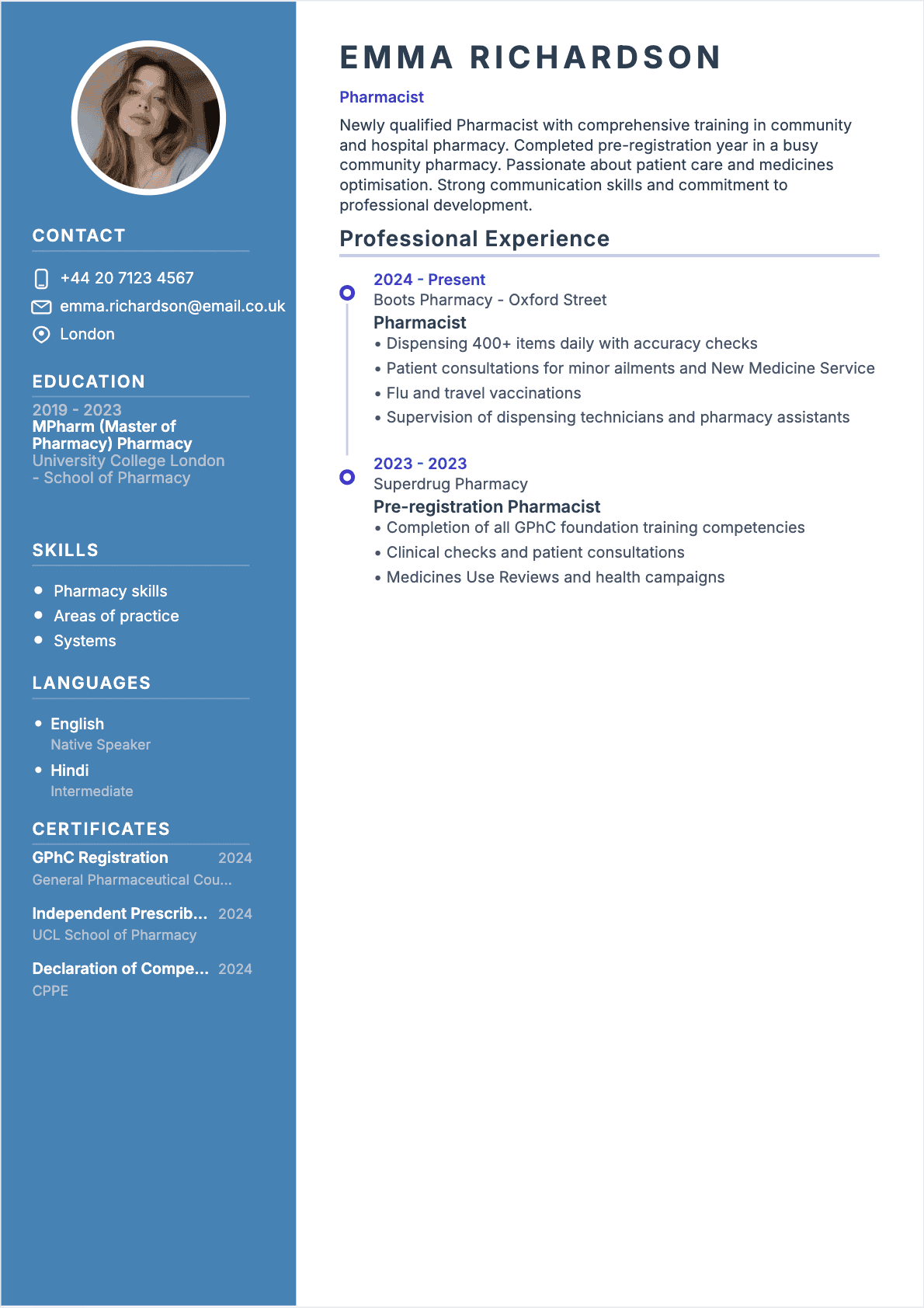
CV Pharmacist Intermediate

For 3–7 years’ experience: show scope, volumes, and outcomes. Emphasize patient counseling, immunizations, MTM, inventory accuracy, and pharmacy operations improvements using recognized systems.

Utiliser

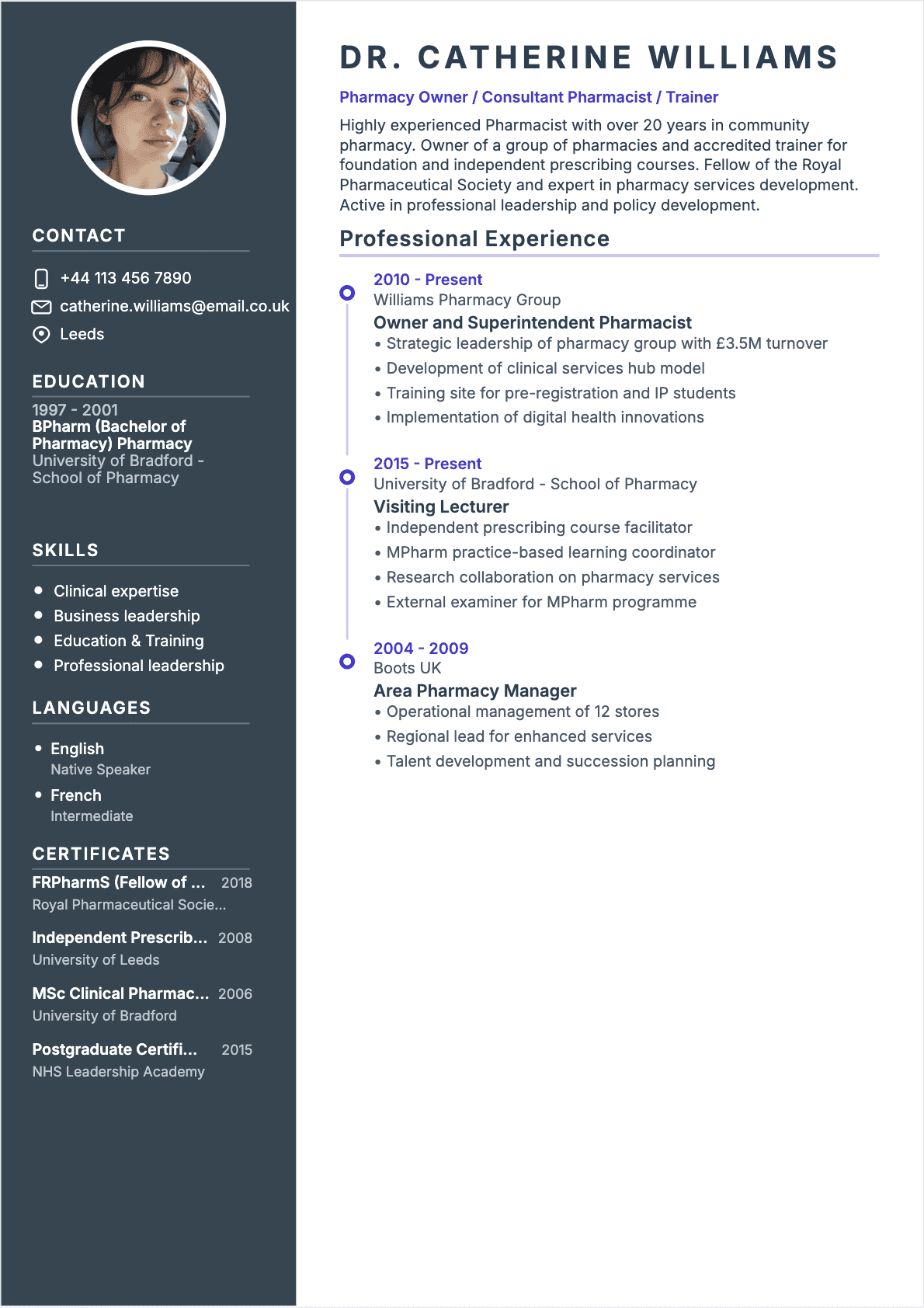
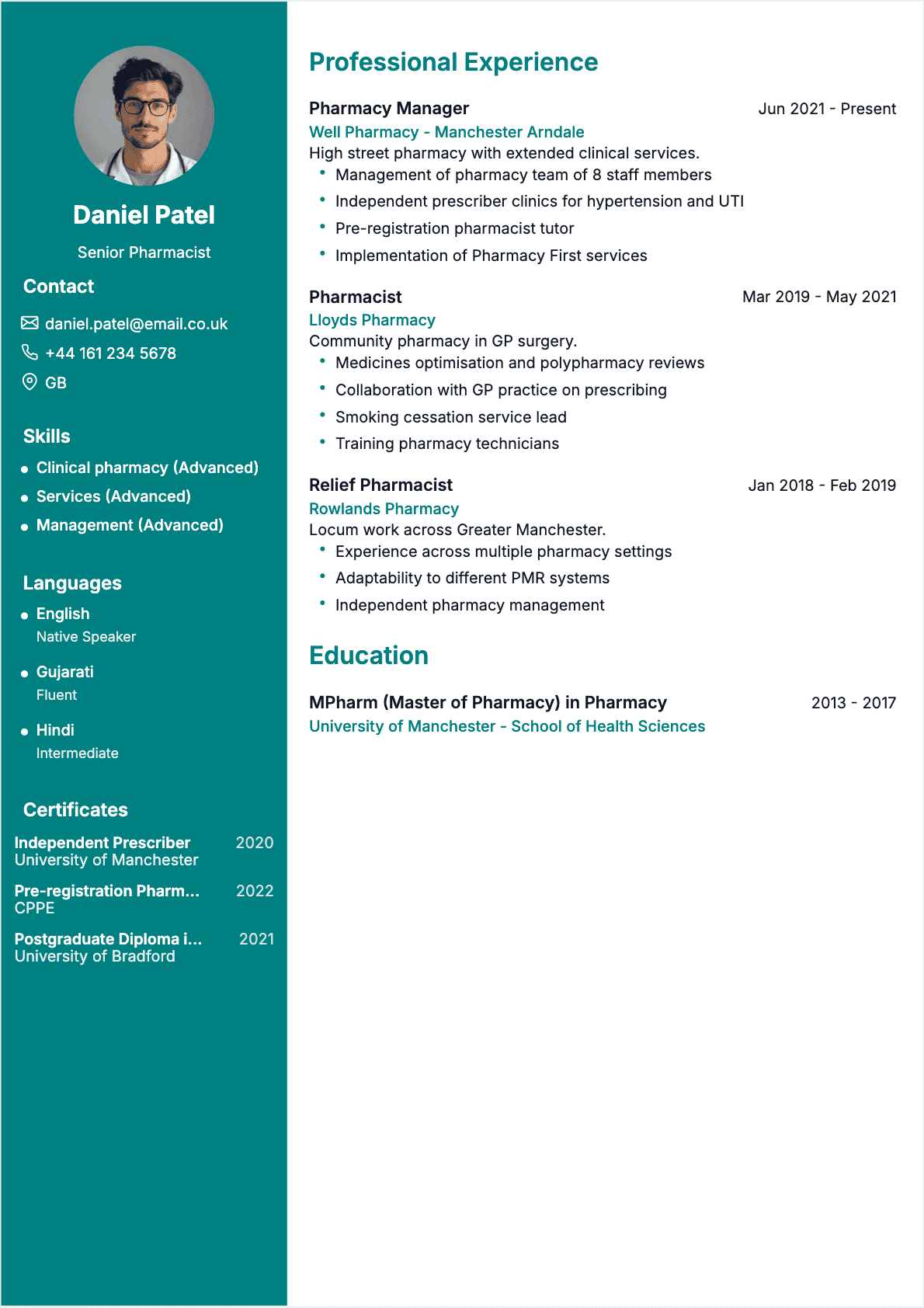
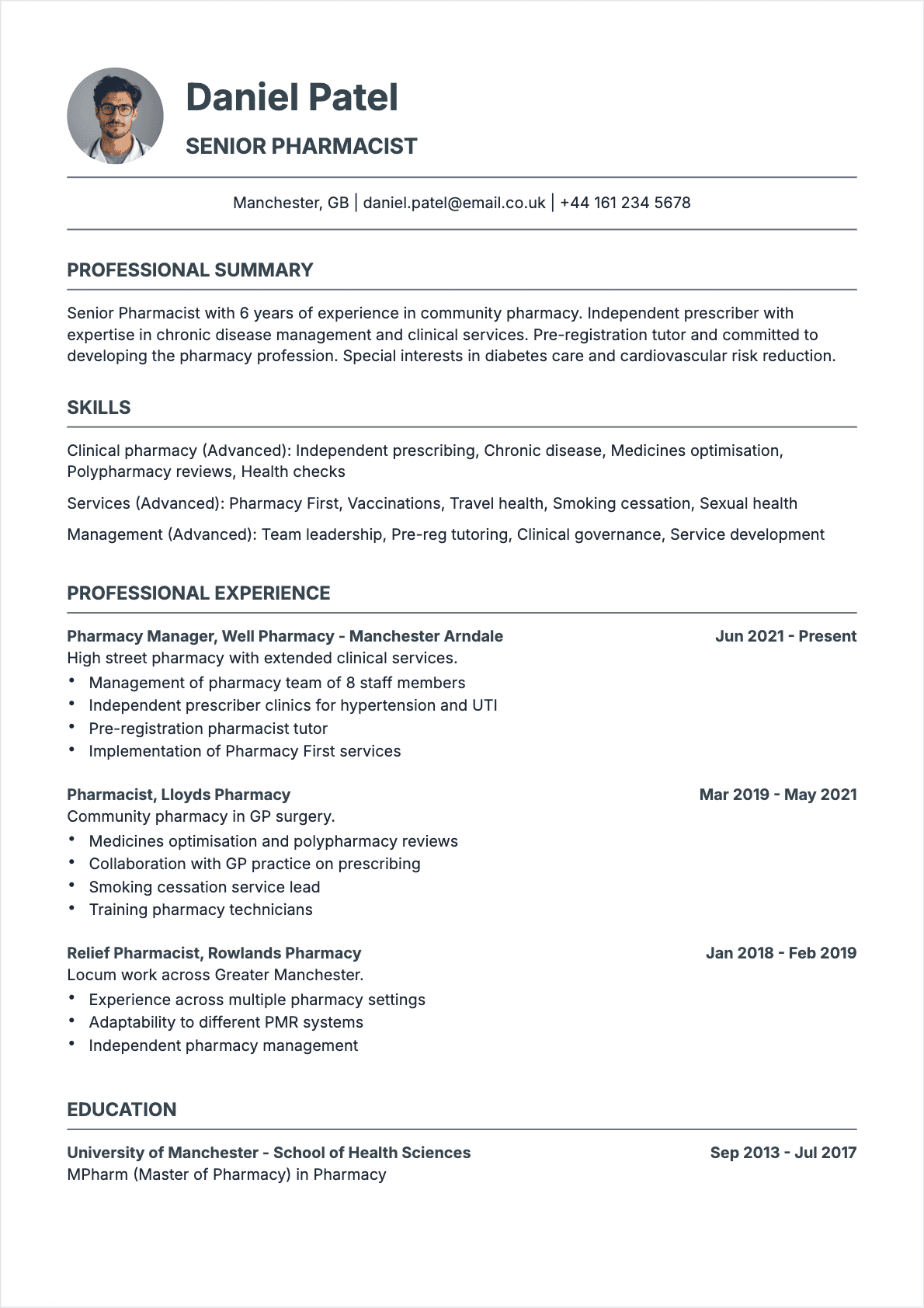
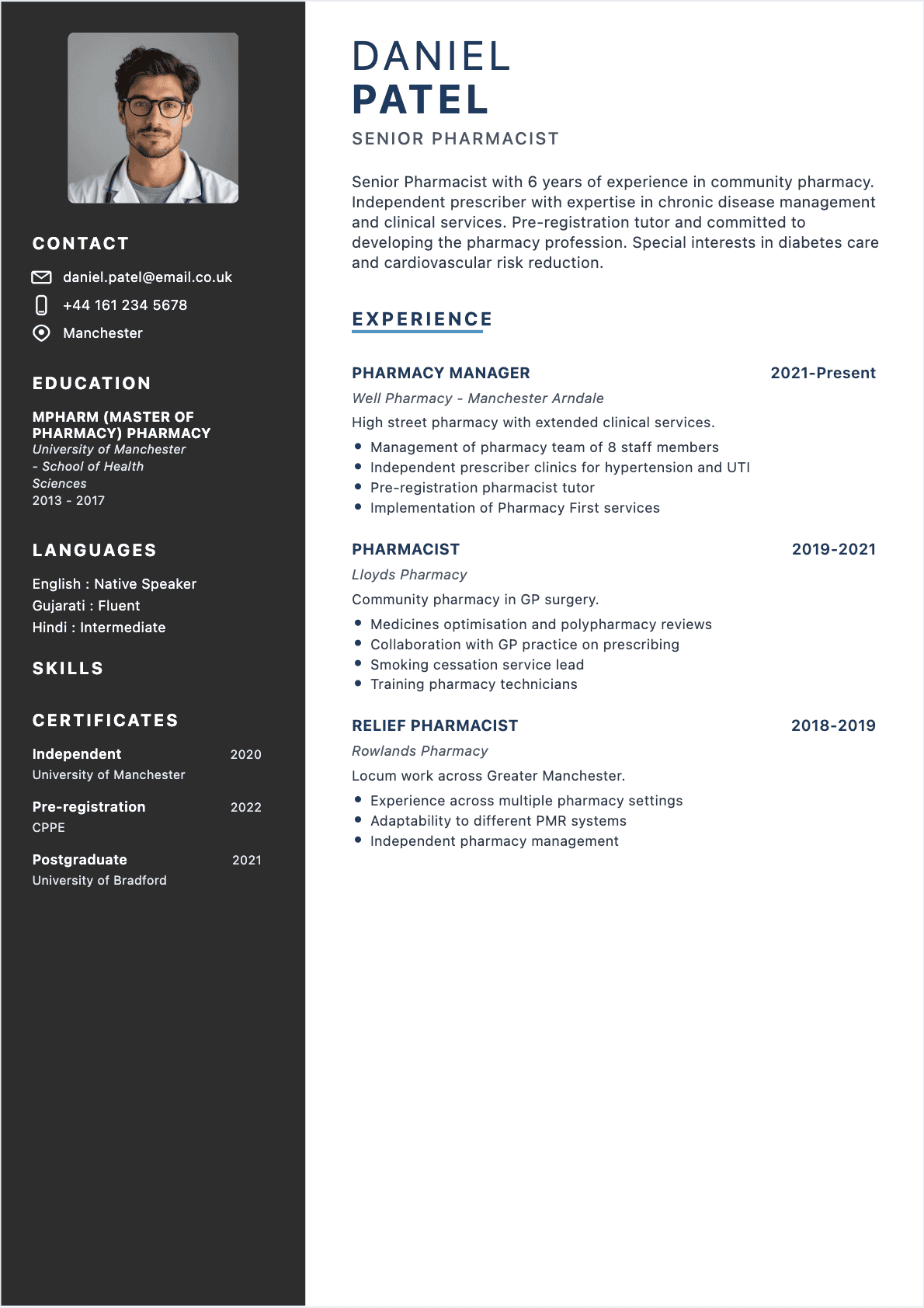
CV Pharmacist Senior

For senior pharmacists and leads: highlight leadership skills, medication safety programs, audit readiness, clinical interventions, and cross-site standardization. Quantify error reduction, throughput gains, and training impact.

Utiliser

Perfect CV Checklist - CV Pharmacist

Check each item to ensure your CV is complete and optimized.

Your Progress0%

Professional Summary - CV Pharmacist

The professional summary is the first thing recruiters see. It should summarize your profile in a few impactful lines.

Good example

Licensed pharmacist with 6+ years in retail and ambulatory pharmacy, verifying 320 Rx/day and leading MTM for 45–60 cases/month. Reduced dispensing rework by 22% via DUR standardization and barcode workflow. Proficient with PioneerRx, Epic Willow, and Pyxis; strong record in immunization delivery (1,800+ vaccines/year).

Bad example

Motivated, dynamic, passionate pharmacist seeking a position. Great team player, available immediately, eager to learn and provide excellent service.

Why is it effective?

The good example is effective because it:

  • States scope with numbers (e.g., “verifying 320 Rx/day”) so a recruiter can benchmark workload
  • Connects skills and experience to outcomes (e.g., “reduced dispensing rework by 22%”) and shows it was impactful
  • Names real pharmacy systems (PioneerRx, Epic Willow, Pyxis) that matter for onboarding speed
  • Shows patient care range (MTM volume + immunizations/year) that matches common pharmacist job requirements

The bad example fails because it:

  • Uses clichés instead of evidence (“motivated”, “passionate”) and adds no proof of competence
  • Omits the pharmacist’s license, pharmacy setting, and measurable work experience
  • Provides no keywords from the job description (MTM, DUR, patient safety, clinical pharmacy)
  • Makes it hard for the recruiter to assess fit, level, and operational readiness

Professional experience examples

Here are examples of professional experiences. Note how results are quantified.

Staff Pharmacist

CVS Pharmacy, Austin, TX

May 2019 – October 2025

High-volume retail pharmacy supporting a diverse patient population. Worked with 6 pharmacy technicians and 2 pharmacists per shift, balancing verification, immunizations, third-party resolution, and patient counseling while meeting service-level targets.

Key Achievements

Verified an average of 300–360 prescriptions/day with a documented near-miss capture rate improving by 18% after implementing a double-check pause at final verification
Delivered 1,900 immunizations in 12 months (influenza, COVID-19, shingles) while maintaining 98% on-time appointment adherence
Completed 520 MTM reviews/year and increased CMR completion from 62% to 79% by standardizing outreach scripts and follow-up scheduling
Reduced out-of-stock incidents by 25% through ABC inventory cycle counts and reorder point adjustments for top 60 fast-movers

Key skills for your resume

Here are the technical and soft skills most sought after by recruiters.

Hard skills (pharmacy and clinical)

Technical Skills

  • Medication therapy management (MTM) documentation and follow-up
  • Drug utilization reviews (DUR) and clinical interventions
  • Epic Willow (EHR/pharmacy module)
  • PioneerRx (pharmacy management system)
  • Immunization administration (adult and pediatric per protocol)
  • Medication reconciliation and transitions-of-care support
  • Controlled substance compliance and perpetual inventory reconciliation
  • Workflow optimization (verification queues, tech utilization, barcode scanning)

Soft skills that show up in outcomes

Soft Skills

  • Patient counseling that improves adherence (teach-back, risk communication)
  • Prioritization under competing queues (verification, drop-off, calls, vaccinations)
  • Closed-loop communication with prescribers and nursing teams
  • De-escalation in high-stress customer service situations
  • Coaching and feedback for pharmacy technician performance
  • Documentation discipline (clear notes, audit-ready interventions)
  • Attention management (error-proofing, double-check habits, interruption control)
  • Structured handoffs (SBAR-style updates for clinical escalations)

ATS Keywords to Include

ATS systems filter CVs based on specific keywords. Include these terms to maximize your chances.

ATS Tip

Click on a keyword to copy it. ATS systems filter CVs based on these exact terms.

Mots-clés importants

Hiring Sectors

Discover the most promising sectors for your career.

1

Retail pharmacy (chain and independent)

2

Hospital pharmacy and health systems

3

Ambulatory care clinics

4

Long-term care pharmacy

5

Specialty pharmacy

6

Pharmaceutical industry (medical affairs, pharmacovigilance)

Education & Degrees

Pharmacy employers typically expect a clear education path plus current licensure. In the US, the most common requirement is a Doctor of Pharmacy (PharmD), while other markets may accept a Bachelor’s degree paired with registration exams and supervised practice. If you are early career, make rotations and residency experience easy to scan: clinical pharmacy exposure, therapy management cases, and any medication safety work.

Different routes can be valuable: PharmD + community practice for retail pharmacist roles, PGY1 for hospital pharmacy, and PGY2 for specialized tracks like oncology. If your experience is strong, keep education concise and shift space to quantified achievements and relevant skills.

Recommended Degrees

  • Doctor of Pharmacy (PharmD)
  • Bachelor’s in Pharmaceutical Sciences
  • Master’s in Clinical Pharmacy
  • MBA (Healthcare Management)
  • PhD in Pharmacology
  • Postgraduate Year One (PGY1) Pharmacy Residency (certificate)

Languages

Languages help when your pharmacist role includes patient care across diverse patient populations, counseling on complex regimens, or coordinating with caregivers. They also support clearer communication during therapy management, medication reconciliation, and escalations where misunderstanding can affect patient safety.

  • Community pharmacy counseling for bilingual households
  • Hospital pharmacy interactions with interpreters and multidisciplinary teams
  • Specialty pharmacy adherence calls and prior authorization communication

Present your level using a consistent scale (Native/Fluent/Proficient/Intermediate) and add a recognized certificate when available.

🇬🇧

English

Native

🇪🇸

Spanish

Proficient (ACTFL OPI available upon request)

🇫🇷

French

Intermediate (DELF B1)

Recommended certifications

Certifications are not always mandatory, but they can be decisive for screening. For clinical pathways, board certified credentials show validated expertise; for retail pharmacist roles, immunization credentials and MTM training often match the job listing. List the credential body, year, and active status when possible.

BCPS (Board Certified Pharmacotherapy Specialist) – BPS
BCOP (Board Certified Oncology Pharmacist) – BPS
BCGP (Board Certified Geriatric Pharmacist) – BPS
APhA Pharmacy-Based Immunization Delivery Certificate
AHA Basic Life Support (BLS) Provider
APhA Medication Therapy Management Certificate Training Program

Mistakes to avoid

Using a generic resume that ignores the job description

A generic pharmacist resume often misses keywords from the job listing (for example, “clinical pharmacy”, “medication therapy management”, or “pharmacy operations”). Recruiters and ATS tools then struggle to match your CV to the pharmacist position, even if you have relevant experience. Your goal is not to repeat the posting, but to mirror the language for core requirements and show proof with metrics.

Always include :

  • The exact software and workflow terms used in the posting (e.g., Epic Willow, Pyxis, MTM platform)
  • 3–5 aligned skills in your skills section (hard skills and soft skills)
  • 2–3 quantified bullets that map to the role (volume, safety, service metrics)

Use this formula: “Action + pharmacy context + tool/process + measurable result.”

Listing duties without measurable outcomes

“Dispensed medications” and “provided counseling” describe baseline expectations, not performance. A recruiter needs to see how you improved accuracy, throughput, patient care, or compliance. Convert duties into impact statements by adding volume, quality, and time metrics.

To avoid : "Responsible for filling prescriptions and helping customers."

To prioritize : "Verified 320 Rx/day, resolved 25–35 third-party rejects/shift, and improved same-day pickup rate from 84% to 91% by redesigning queue triage."

This shift makes your pharmacist resume more credible and more searchable.

Hiding license, board certified status, or scope of practice

In pharmacy, licensure is a hard gate. If your license details are buried, your CV may be screened out fast. The same applies to board certified credentials (BCPS, BCOP) and authorizations like immunization administration. Put the essentials near the top and be explicit about what you are permitted to do.

To mention :

  • License: state, license number (if customary), and expiration date
  • Immunization authority and training provider (APhA) with active status
  • Board certification(s) with issuing body (BPS) and year earned

Choosing a format that fails ATS parsing

Many pharmacy cvs look good visually but break in applicant tracking systems: multi-column layouts, icons, text boxes, and headers/footers can hide key information. Use a clean resume template, consistent headings, and standard date formatting. Save as PDF unless the portal requests DOCX.

Checklist :

  • One-column layout with clear section titles (Summary, Work Experience, Education, Certifications, Skills)
  • Bullets with plain symbols and no tables for core content
  • Final pass for spelling and grammatical errors, especially drug names and abbreviations

Expert tips

  • 1

    Use a proven pharmacist resume format : Lead with Summary, Licenses/Certifications, Skills, then Work Experience. Recruiters typically scan license + setting + metrics before they read full bullets.

  • 2

    Quantify patient care : Add MTM volume, CMR completion rate, adherence outcomes, or counseling volume per shift. Numbers help your resume stand out without long paragraphs.

  • 3

    Show medication safety behaviors : Include DUR, high-alert medication checks, barcode scanning, near-miss reporting, and any medication safety initiative tied to a measurable change.

  • 4

    Name the systems you used : Pharmacy software (Epic Willow, PioneerRx, Pyxis/Omnicell) should appear in Skills and in bullets, so ATS and recruiters can confirm tool fit.

  • 5

    Balance hard skills and soft skills : Pair technical skills (dispense, inventory, DUR) with communication skills that affect outcomes (prescriber calls, patient counseling, de-escalation).

  • 6

    Tailor to retail pharmacist vs clinical pharmacist : Retail emphasizes throughput, vaccinations, third-party, and service metrics; clinical pharmacy emphasizes interventions, therapy management, and team collaboration.

  • 7

    Add one “impact” line per role : Include one bullet that shows improvement (error reduction, turnaround time, adherence, stockouts). This signals ownership beyond routine tasks.

Frequently asked questions

Find answers to the most frequently asked questions.

In pharmacy, a CV (curriculum vitae) is a detailed record of education, training, publications, and clinical experience, often used for academic, residency, or hospital roles. A resume is shorter and optimized for a specific pharmacist job. If the posting “requires a CV,” include full training, rotations, and professional development.

Start from the job description, then choose an ATS-friendly format and add your license at the top. Build sections in this order: summary, licenses/certifications, key skills, work experience, education, and professional development. Use specific examples with metrics such as Rx/day, immunizations/month, or MTM cases/quarter.

A healthcare CV is a comprehensive document that tracks your clinical training, credentials, and contributions over time (education, residencies, certifications, research, and presentations). It is common for clinical pharmacist roles, hospital pharmacy, and academic settings. A resume is typically a targeted 1–2 page document for hiring.

For most pharmacist roles in retail or general practice, a resume is usually 1–2 pages. A true CV for residency, academic, or research-focused clinical pharmacy can be 2–5+ pages depending on publications and presentations. Keep it readable: prioritize recent, relevant experience and remove duplicates.

If the application allows it, a tailored cover letter can improve response rates, especially for competitive clinical pharmacist or specialty pharmacy openings. Use it to connect your skills and experience to the employer’s needs: patient safety, therapy management, or pharmacy operations. Keep it to 200–300 words and reference 1–2 measurable wins.

Copy core keywords from the job listing into your skills section and work experience bullets, without stuffing. Match terminology (e.g., “medication therapy management” vs “MTM”) and include the pharmacy software they name. Use standard headings and a simple resume template so applicant tracking systems can parse your CV accurately.

Create your CV Pharmacist resume in minutes

Use our builder to apply a clean resume template, add ATS keywords, and turn your pharmacy experience into quantified achievements recruiters can compare quickly.

Create my Resume