Payroll Specialists Resume: Payroll Specialist Resume Example (2026)
Use this guide to write a payroll specialist resume that proves accuracy, compliance, and speed. Get a ready-to-adapt template, ATS keywords, and measurable bullet examples for payroll specialists at every level.
Key Takeaways
Payroll accuracy is a business-critical control: a single input mistake can trigger payroll issues, employee dissatisfaction, and compliance exposure. Across mid-sized organizations, payroll teams often process 5,000–20,000 transactions per month (hours, overtime, bonuses, deductions), and even a 0.5% error rate creates recurring rework.
In 2025, hiring managers increasingly expect payroll specialists to combine reliable payroll process execution with data skills (Excel, reporting) and clear audit trails. A strong resume must show scope (headcount, pay frequency, states), tools (ADP, Workday, UKG), and measurable outcomes.
A good Payroll Specialist resume must demonstrate :
- accurate and timely payroll processing with quantified accuracy and deadlines
- payroll tax and compliance knowledge relevant to payroll
- payroll software proficiency and reconciliation capability
Follow the sections below to build a payroll specialist resume that stands up to ATS filters and payroll audits.
CV Examples - Payroll Specialist Resume
Discover our CV templates adapted to all experience levels. Each example is ATS-optimized.

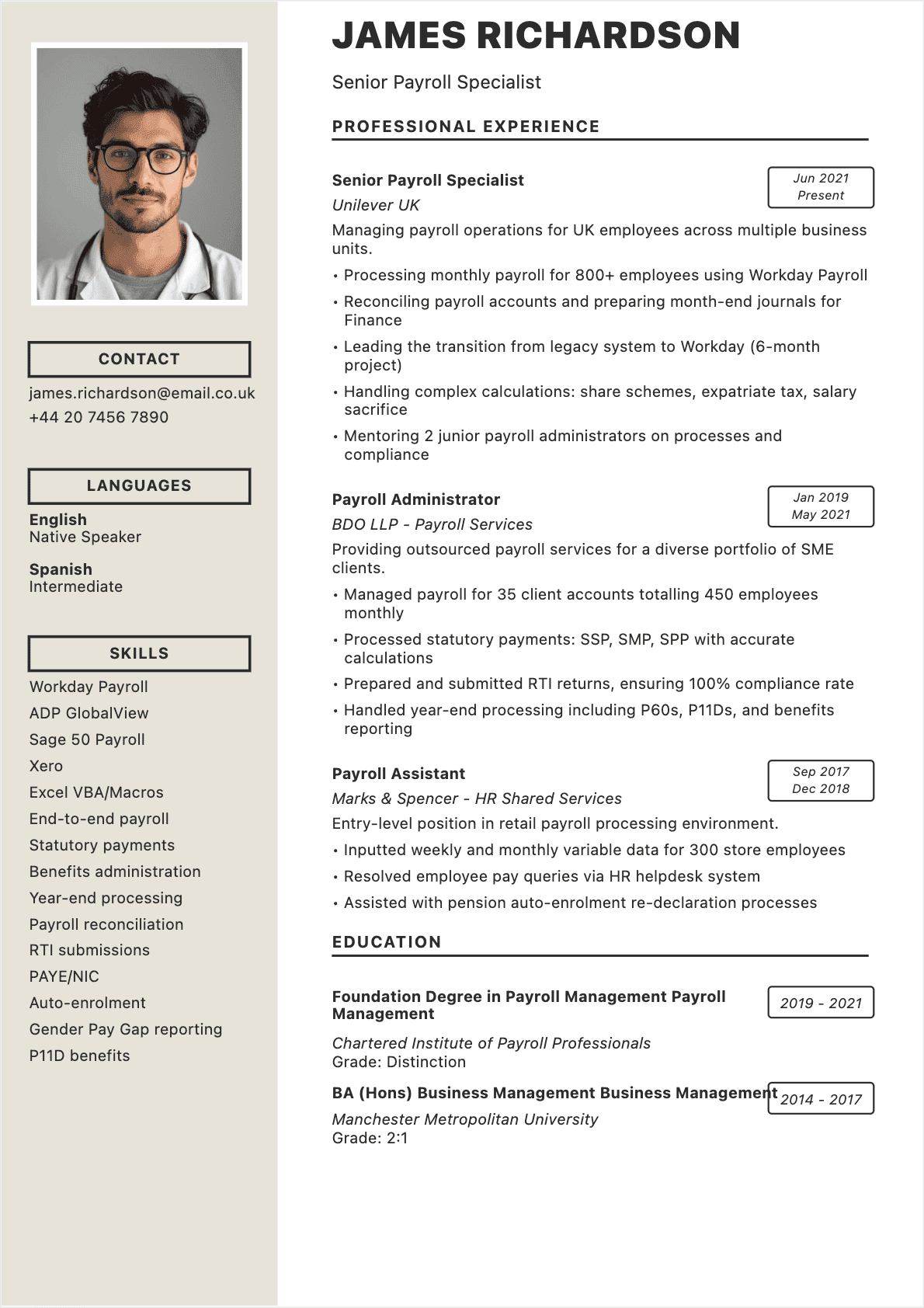
Payroll Specialist Resume Beginner
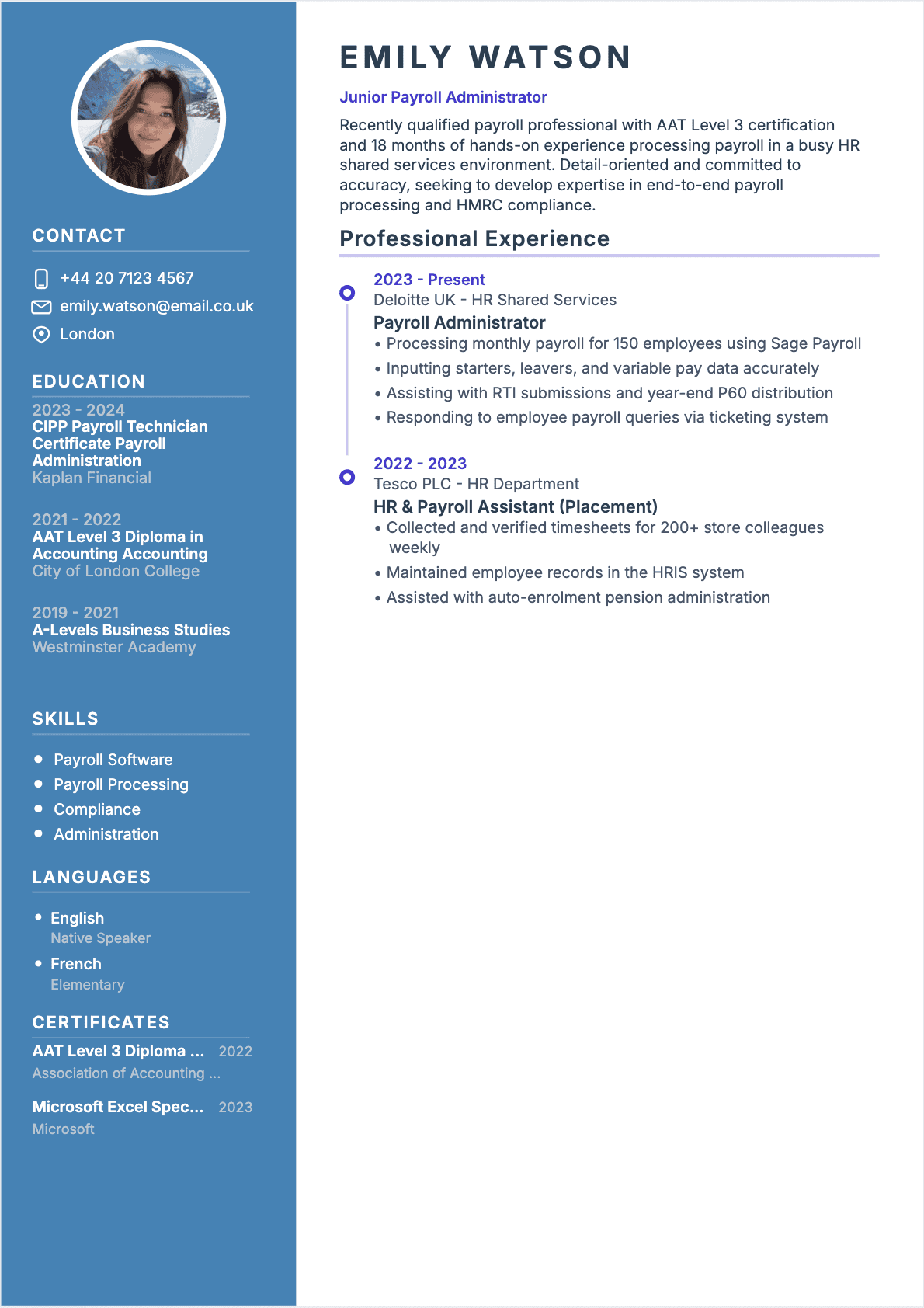
A payroll specialist resume template for new graduates and junior profiles: highlight payroll fundamentals, Excel, timekeeping data, and error-free processing in supervised cycles.
Utiliser
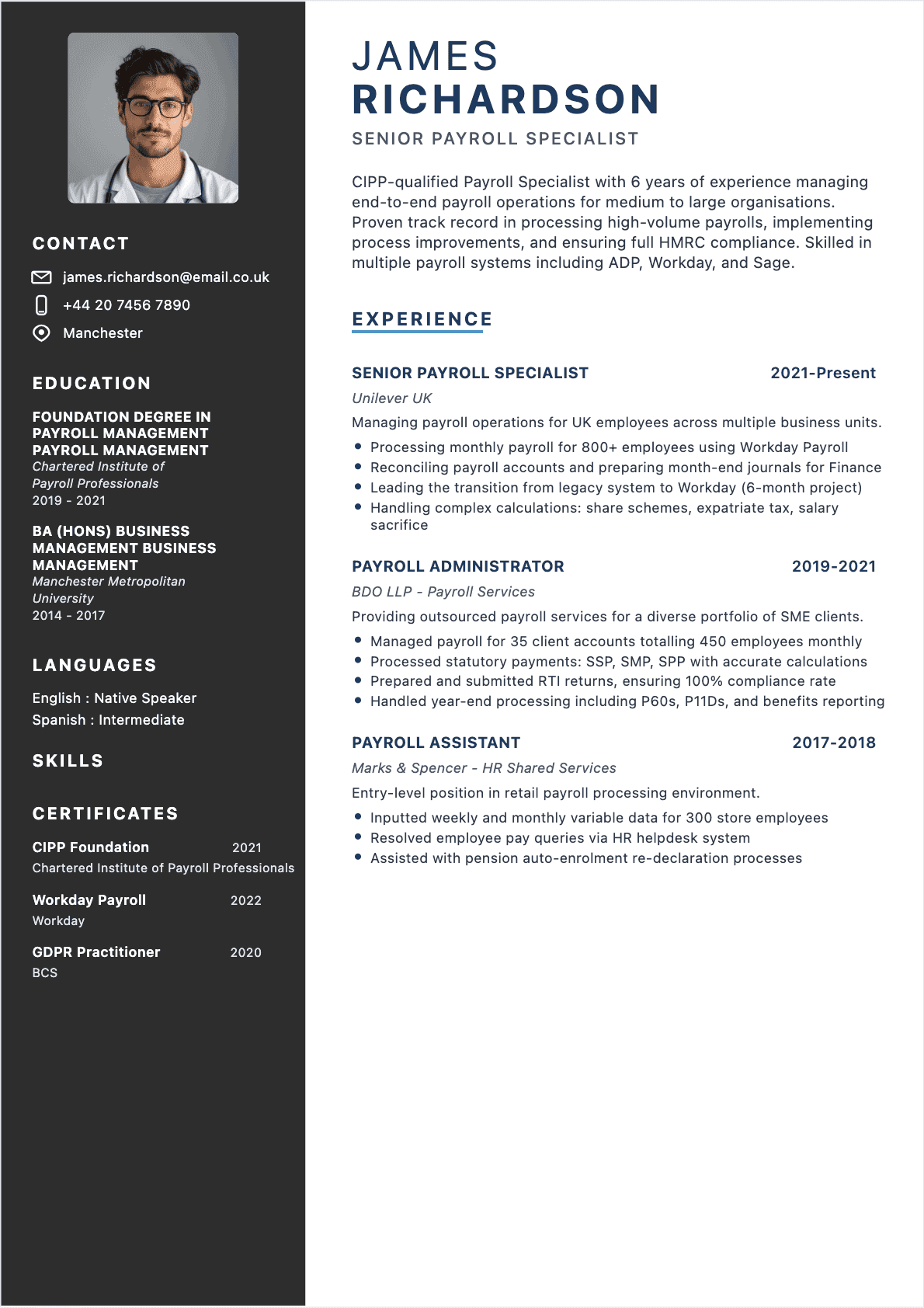
Payroll Specialist Resume Intermediate
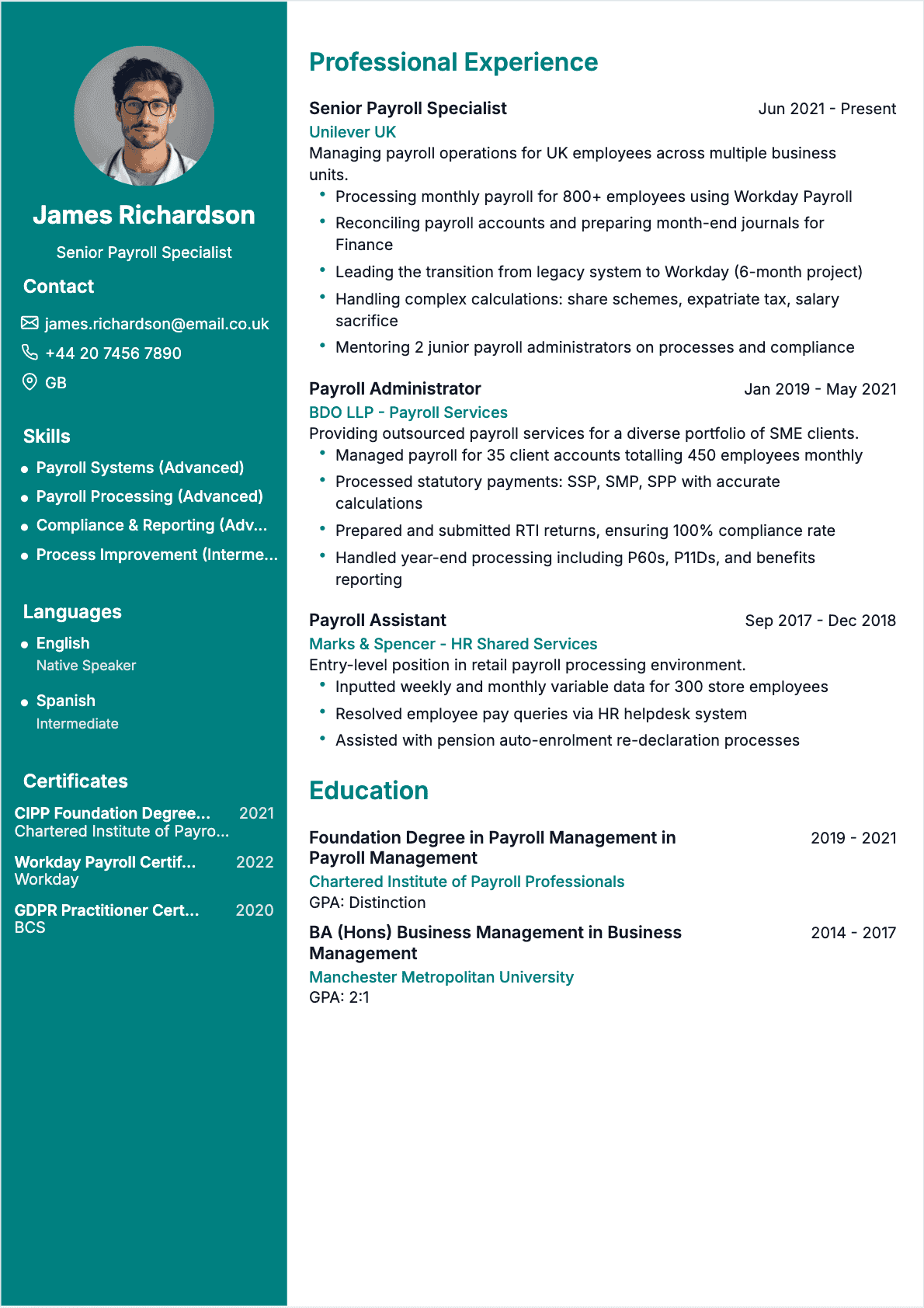
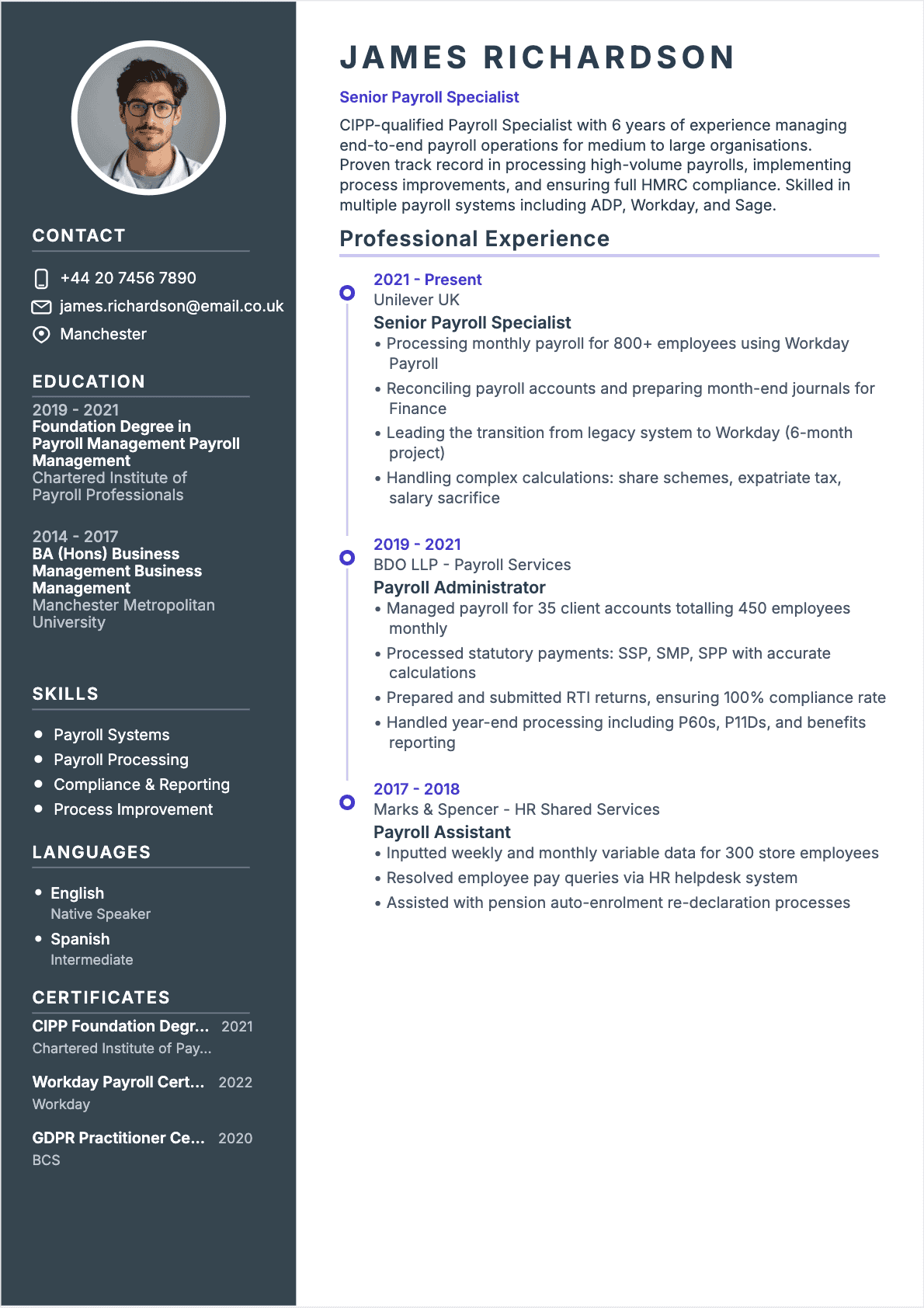
For 3–7 years’ experience: emphasize end-to-end payroll process, audit trails, payroll tax, reconciliations, multi-state exposure, and measurable reductions in payroll errors and cycle time.
Utiliser
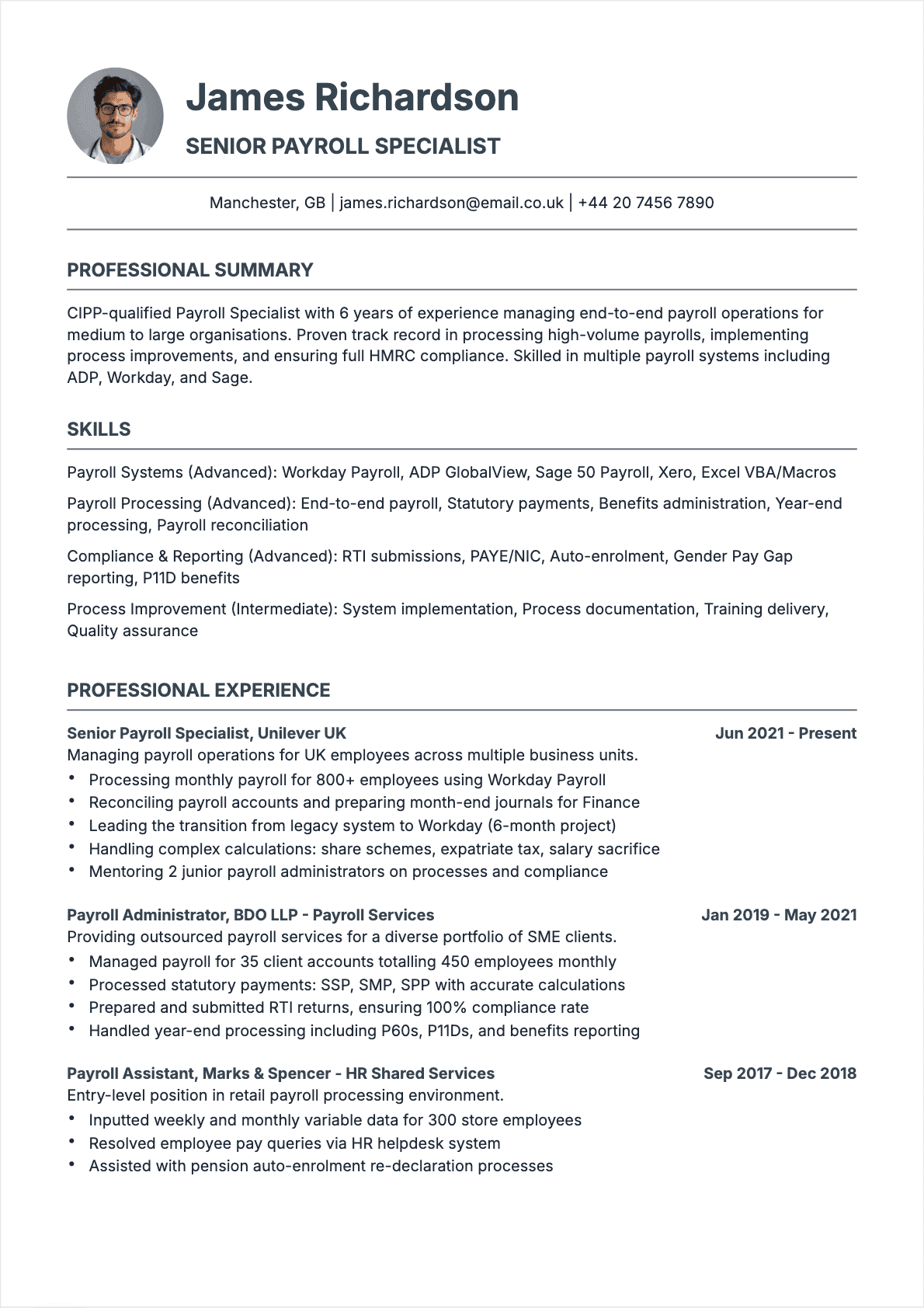
Payroll Specialist Resume Senior
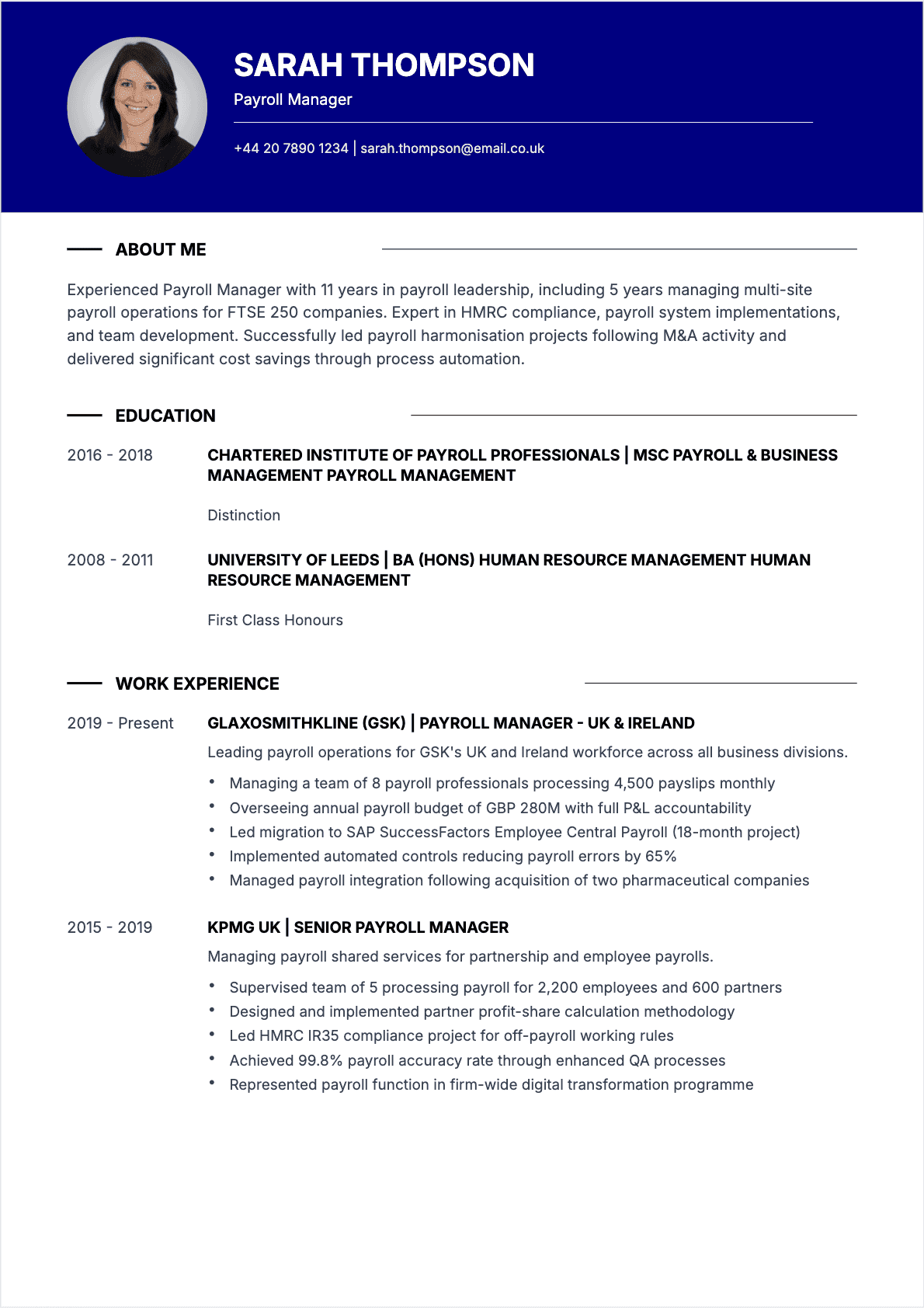
For senior payroll specialists: demonstrate leadership in payroll operations, system implementations, SOX-ready controls, complex benefits deductions, stakeholder management, and large-population payroll accuracy KPIs.
UtiliserPerfect CV Checklist - Payroll Specialist Resume
Check each item to ensure your CV is complete and optimized.
Professional Summary - Payroll Specialist Resume
The professional summary is the first thing recruiters see. It should summarize your profile in a few impactful lines.
“Payroll Specialist with 5 years of experience in payroll for retail and distribution, processing bi-weekly payroll for 300 employees across 8 states. Improved payroll accuracy from 98.9% to 99.7% by tightening timecard validations and reconciliations in ADP Workforce Now, using Excel Power Query for variance checks.”
“Motivated, dynamic, and passionate payroll specialist, available immediately and ready to take on any task with a positive attitude.”
Why is it effective?
The good example is effective because it :
- anchors scope with a clear perimeter (300 employees, bi-weekly payroll, 8 states)
- includes a measurable result (accuracy from 98.9% to 99.7%) instead of vague claims
- names real tools used in daily work (ADP Workforce Now, Excel Power Query)
- shows the payroll specialist role impact on controls (timecard validations, reconciliations)
The bad example fails because it :
- relies on clichés instead of evidence (motivated, dynamic, passionate)
- gives no payroll process context (no pay frequency, no headcount, no jurisdictions)
- omits payroll systems and data skills the hiring manager screens for
- contains no outcomes (no reduction in payroll errors, no cycle-time improvement)
Professional experience examples
Here are examples of professional experiences. Note how results are quantified.
Payroll Specialist
NorthPeak Retail Group, Chicago, IL
Owned payroll operations for a multi-site retail workforce. Managed payroll inputs from Time & Attendance and HRIS, partnered with Finance for reconciliations, and supported compliance documentation for internal audits during quarterly close.
Key Achievements
Key skills for your resume
Here are the technical and soft skills most sought after by recruiters.
Hard skills for a Payroll Specialist resume
Technical Skills
- End-to-end payroll processing (bi-weekly, semi-monthly, monthly payroll)
- Payroll tax basics (W-2, state withholding, local payroll rules)
- ADP Workforce Now
- Workday Payroll
- UKG Pro (UltiPro) payroll
- Excel (PivotTables, Power Query, XLOOKUP, reconciliations)
- Garnishments, benefits deductions, and retro calculations
- Audit support (SOX-ready controls, documentation, variance analysis)
Soft skills that hiring managers look for
Soft Skills
- Precision under tight deadlines on pay-close days
- Clear written communication for employee payroll questions
- Structured problem solving for payroll discrepancies
- Confidentiality handling employee compensation data
- Stakeholder management with HR, Finance, and managers
- Prioritization when multiple payroll issues hit at once
- Process discipline (checklists, controls, approvals)
- Calm escalation handling during payroll cut-off
ATS Keywords to Include
ATS systems filter CVs based on specific keywords. Include these terms to maximize your chances.
ATS Tip
Click on a keyword to copy it. ATS systems filter CVs based on these exact terms.
Mots-clés importants
Hiring Sectors
Discover the most promising sectors for your career.
Healthcare systems and hospitals
Manufacturing and distribution
Retail and multi-site operations
Technology and SaaS companies
Payroll outsourcing providers and shared services
Public sector and higher education
Education & Degrees
For payroll specialists, employers typically value a solid base in accounting, business administration, or human resources, plus hands-on experience with payroll systems. A Bachelor’s degree is common, but not mandatory if you can show reliable processing, reconciliations, and compliance awareness.
Paths include Business/HR degrees, accounting-focused programs, or transitioning from AP/AR, HR coordinator, or timekeeping roles. If your degree is not payroll-related, offset it with a certified payroll credential (FPC or CPP), system training (ADP/Workday), and quantified achievements.
Recommended Degrees
- Bachelor’s degree in Accounting
- Bachelor’s degree in Human Resources Management
- Bachelor’s degree in Business Administration
- Associate degree in Accounting
- Master’s degree in Human Resources (optional for leadership)
- Graduate Certificate in Payroll Management
Languages
Languages help payroll specialists communicate with employees, interpret local payroll requirements, and coordinate with global HR or finance teams. Even in domestic roles, Spanish can reduce back-and-forth for payroll questions in retail, logistics, and healthcare.
- Supporting employee inquiries during onboarding and open enrollment
- Coordinating multi-site operations with local payroll contacts
- Working with vendors or shared services in another region
Present your level with a simple scale (Native/Fluent/Proficient/Intermediate) and add proof when possible (work context, training, or consistent business use).
English
Native
Spanish
Intermediate
French
Proficient
Recommended certifications
Certifications are not always required, but they are a strong differentiator for payroll specialists because they signal compliance knowledge and process rigor. If you handle payroll tax, audits, or complex deductions, a certified payroll credential can directly improve credibility with a hiring manager.
FPC is a solid early-career target; CPP is often preferred for experienced payroll professionals.
Mistakes to avoid
Writing a resume with no payroll scope
A payroll specialist resume must quickly show scale. If you don’t state headcount, pay frequency, and jurisdictions, a hiring manager can’t assess whether you can process payroll at their complexity level. “Handled payroll” reads the same for 40 employees and for 4,000 employees, but the operational risk is not comparable.
Always include :
- employee population and pay cadence (e.g., 300 bi-weekly)
- jurisdictions (single-state vs multi-state payroll, local payroll)
- payroll system and Time & Attendance source
Use this formula: Scope + system + control + metric (accuracy, timeliness, reduction in payroll errors).
Listing tools without explaining how you used them
ATS may index software names, but recruiters still need proof of application. “Excel” or “ADP” alone doesn’t show whether you ran reconciliations, built reports, or simply entered data. Connect each tool to a payroll process step and a measurable result.
To avoid : "Used Excel and ADP to do payroll tasks."
To prioritize : "Built Excel variance checks (Power Query) to reconcile ADP gross-to-net totals, cutting payroll discrepancies by 18% in two quarters."
This turns software into evidence of payroll management and risk reduction.
Copy-pasting the job description into your experience bullets
Hiring teams spot copy-paste immediately, and it can reduce credibility. Your resume should mirror the job description keywords, but your bullets must be specific to your work experience as a payroll professional: what you processed, what broke, what you fixed, and what improved.
To mention :
- what you process payroll for (population, pay groups, union/non-union if applicable)
- which payroll issues you resolved (retro pay, garnishments, timecard exceptions)
- what changed after your action (reduced payroll processing time, fewer payroll errors)
Skipping final checks and submitting a resume with avoidable errors
Payroll specialists are evaluated on precision. Typos, inconsistent dates, and mismatched numbers signal careless handling of data. Before you apply, run a structured quality check like you would before a pay close: validate dates, totals, formatting, and consistency across sections.
Checklist :
- ensure every role has a clear period, city/state, and tool stack
- confirm metrics are plausible and consistent (same headcount across bullets)
- verify resume format (fonts, spacing, alignment) exports cleanly to PDF
Expert tips
- 1
Use a payroll specialist resume template : Start from a clean template with predictable headings and ATS-friendly formatting; it keeps the focus on controls, compliance, and measurable outcomes rather than design noise.
- 2
Front-load your scope : Put headcount, pay frequency, and jurisdictions near the top of your resume summary so a hiring manager can size your experience in payroll within 10 seconds.
- 3
Show audit readiness : Add one bullet about documentation, approvals, and reconciliations; payroll specialists are trusted when they can explain the payroll process and the evidence behind it.
- 4
Quantify cycle-time improvements : Track payroll processing time, rework tickets, or exception rates; even a 15–20% improvement is meaningful in recurring payroll operations.
- 5
Balance hard and soft skills : Include payroll tax, systems, and Excel in the skills section, then add confidentiality and escalation handling as soft skills tied to real payroll issues.
- 6
Tailor your resume to the posting : Match the employer’s payroll system, pay cadence, and compliance needs; customize your resume by swapping the most relevant 2–3 bullets per application.
- 7
Add a short payroll specialist cover letter when stakes are high : For senior roles or system implementations, a targeted cover letter can clarify your controls mindset and stakeholder approach without bloating the resume.
Frequently asked questions
Find answers to the most frequently asked questions.
Start with scope: headcount, pay frequency, and jurisdictions. Then add a resume summary with one quantified improvement (accuracy, timeliness, reduction in payroll errors). In experience, show end-to-end payroll steps, reconciliations, and compliance touchpoints. Name the payroll system (ADP, Workday, UKG) and tie each tool to outcomes.
Prioritize payroll processing, reconciliations, payroll tax basics, garnishments, time and attendance workflows, and audit documentation. Add payroll software proficiency (ADP Workforce Now, Workday Payroll, UKG Pro) plus Excel skills used for variance checks. Keep soft skills specific: confidentiality, deadline discipline, and structured issue resolution.
Use a reverse-chronological resume format in most cases: it makes your recent payroll cycles, systems, and compliance exposure easy to verify. Keep one page if you have under 7 years of experience; two pages is acceptable for senior payroll specialist profiles with implementations, audits, or multi-state complexity.
Extract the posting’s keywords: payroll system, pay frequency, states, benefits deductions, and reporting needs. Then swap in 2–3 bullets that match those exact requirements, using the same phrasing where accurate. Keep metrics consistent with your scope, and ensure your resume templates don’t hide key terms in graphics.
Not always, but certified payroll credentials strongly help when roles include payroll tax, audit support, or complex deductions. FPC is a strong early-career signal; CPP is a credible standard for experienced payroll specialists. If you’re not certified yet, list it as “In progress” with an expected exam date.
Use related experience: timekeeping, HR coordination, accounting support, data entry with controls, or customer service handling sensitive records. Add a skills section focused on Excel and process discipline, and include coursework or projects (mock payroll reconciliations). If possible, pursue FPC to show commitment and baseline payroll knowledge.
Build your Payroll Specialist resume in minutes
Use our resume builder to generate ATS-ready payroll specialist resumes, choose a clean template, and tailor each version to the job description with quantified payroll results.
Create my Resume