Health & Medical

CV Registered Nurse: nurse resume template for 2025

Use this registered nurse resume guide to choose the right resume format, write an ATS-friendly resume summary, quantify work experience, and tailor key skills for ICU, ER, med-surg, and outpatient nurse positions.

13 min de lectureUpdated December 12, 2025

Key Takeaways

Writing a nurse resume in 2025 is less about listing nursing duties and more about proving outcomes: safety, efficiency, and patient experience. In the U.S., hospitals track metrics like HCAHPS patient satisfaction, falls per 1,000 patient-days, and readmission rates—numbers you can reflect on your resume.

A strong CV Registered Nurse resume must demonstrate:

  • measurable impact on patient safety and quality (falls, CLABSI/CAUTI, med errors)
  • reliable clinical judgment under acuity (triage, escalation, rapid response)
  • clean documentation and workflow discipline in the EHR (Epic, Cerner, MEDITECH)

This guide shows you how to create a nursing resume that stands out with an ATS-ready template, a resume example, and specific, quantifiable resume bullets for different nurse positions.

CV Examples - CV Registered Nurse

Discover our CV templates adapted to all experience levels. Each example is ATS-optimized.

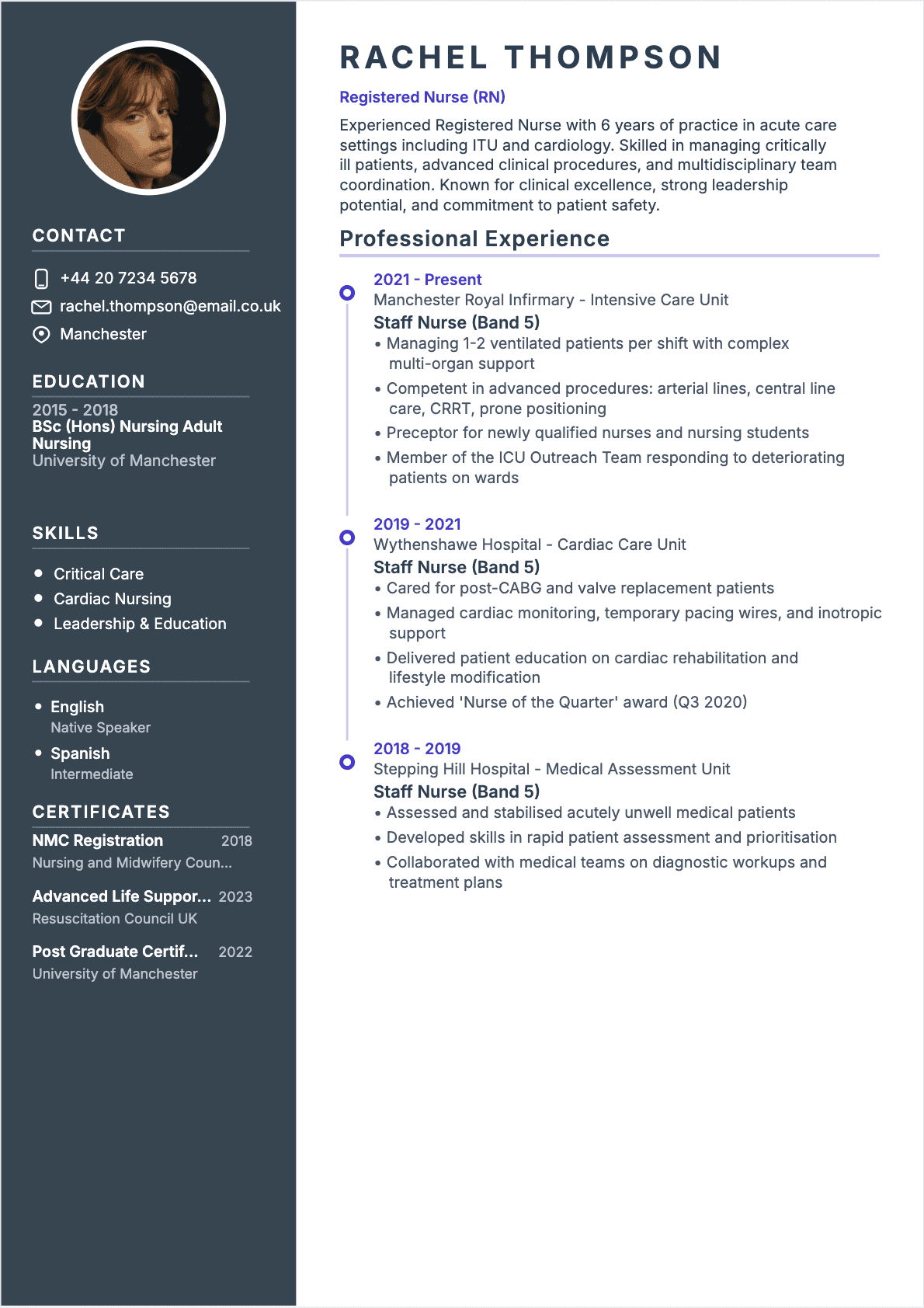
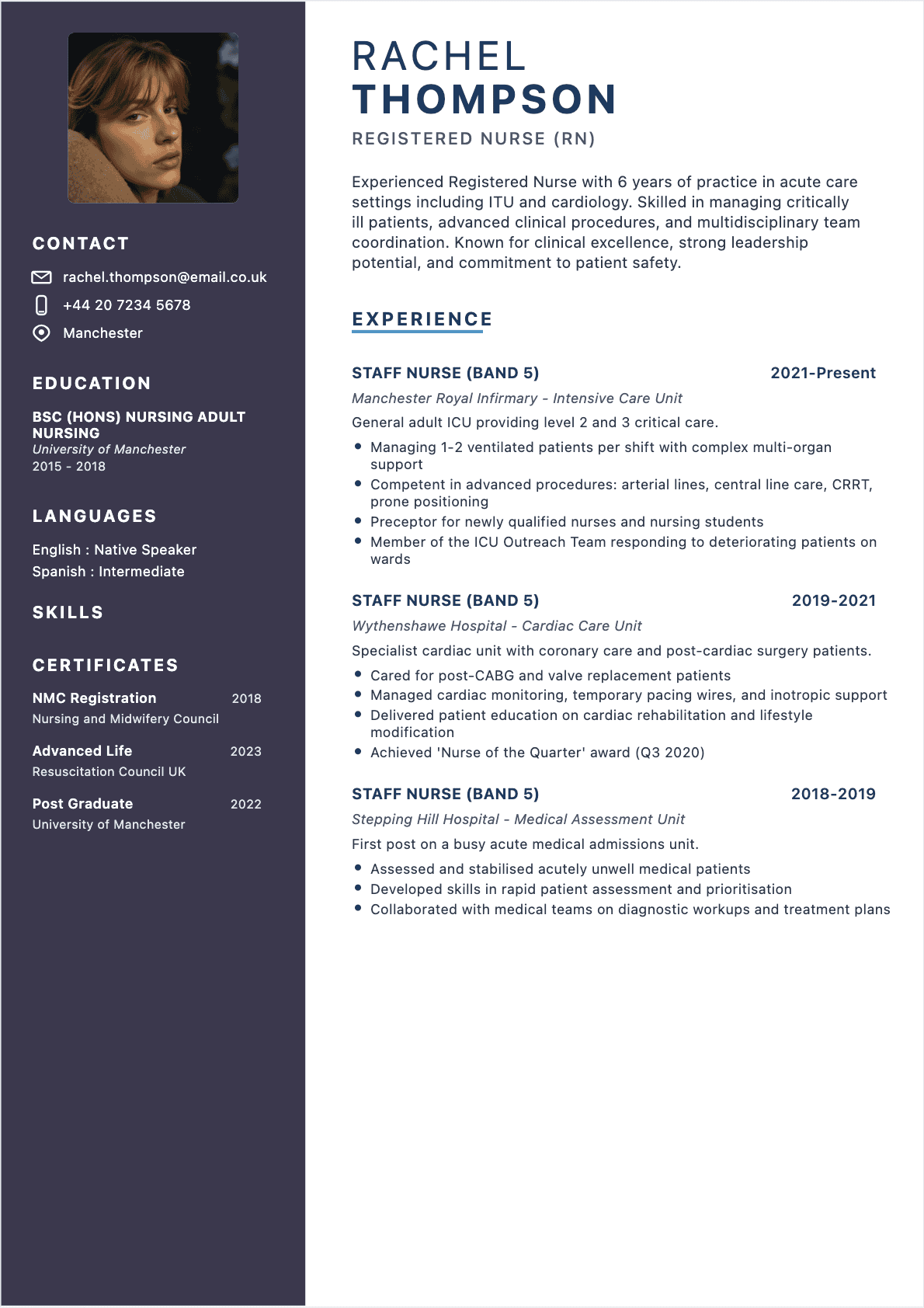
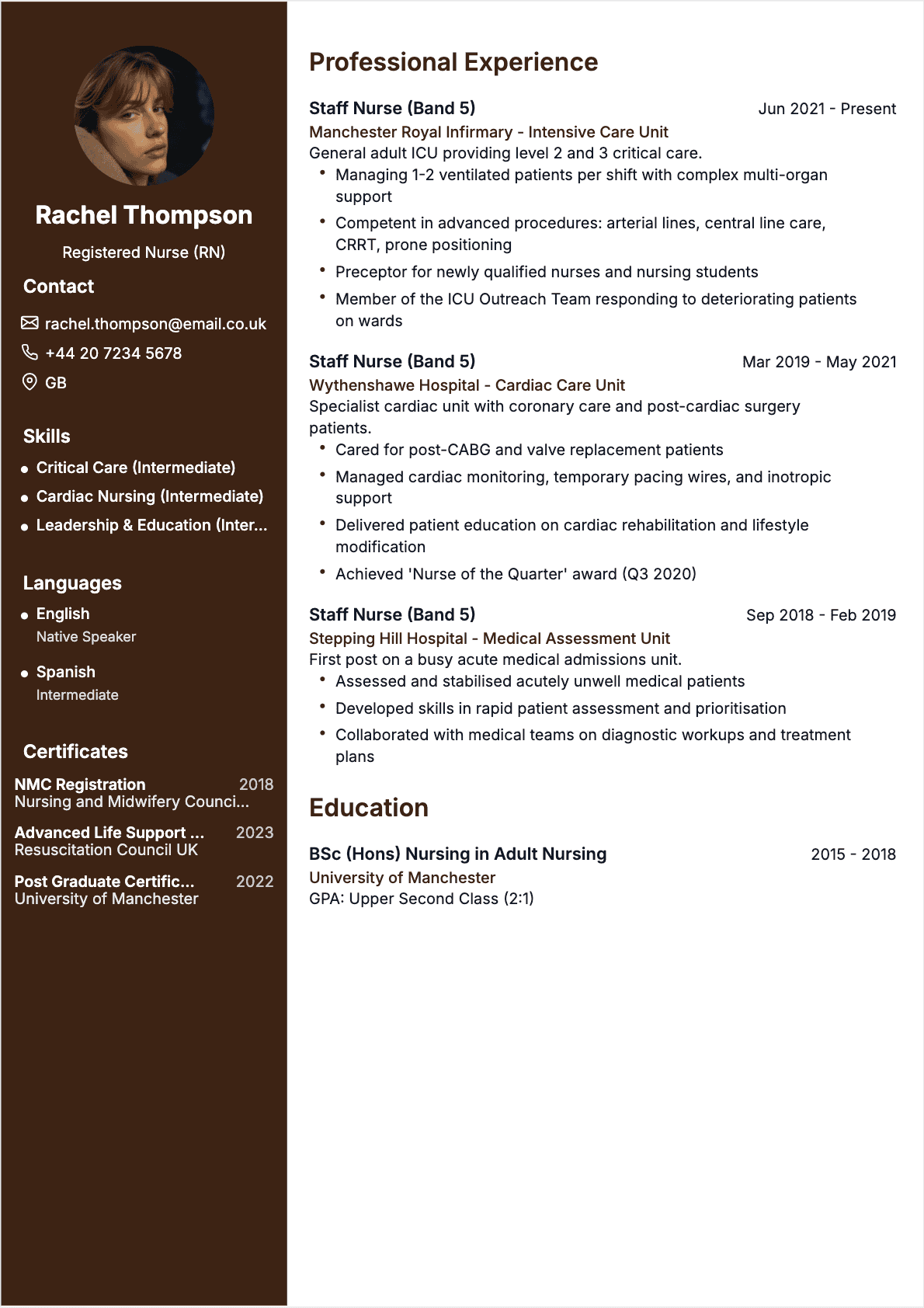
Registered Nurse Resume Template (Beginner)

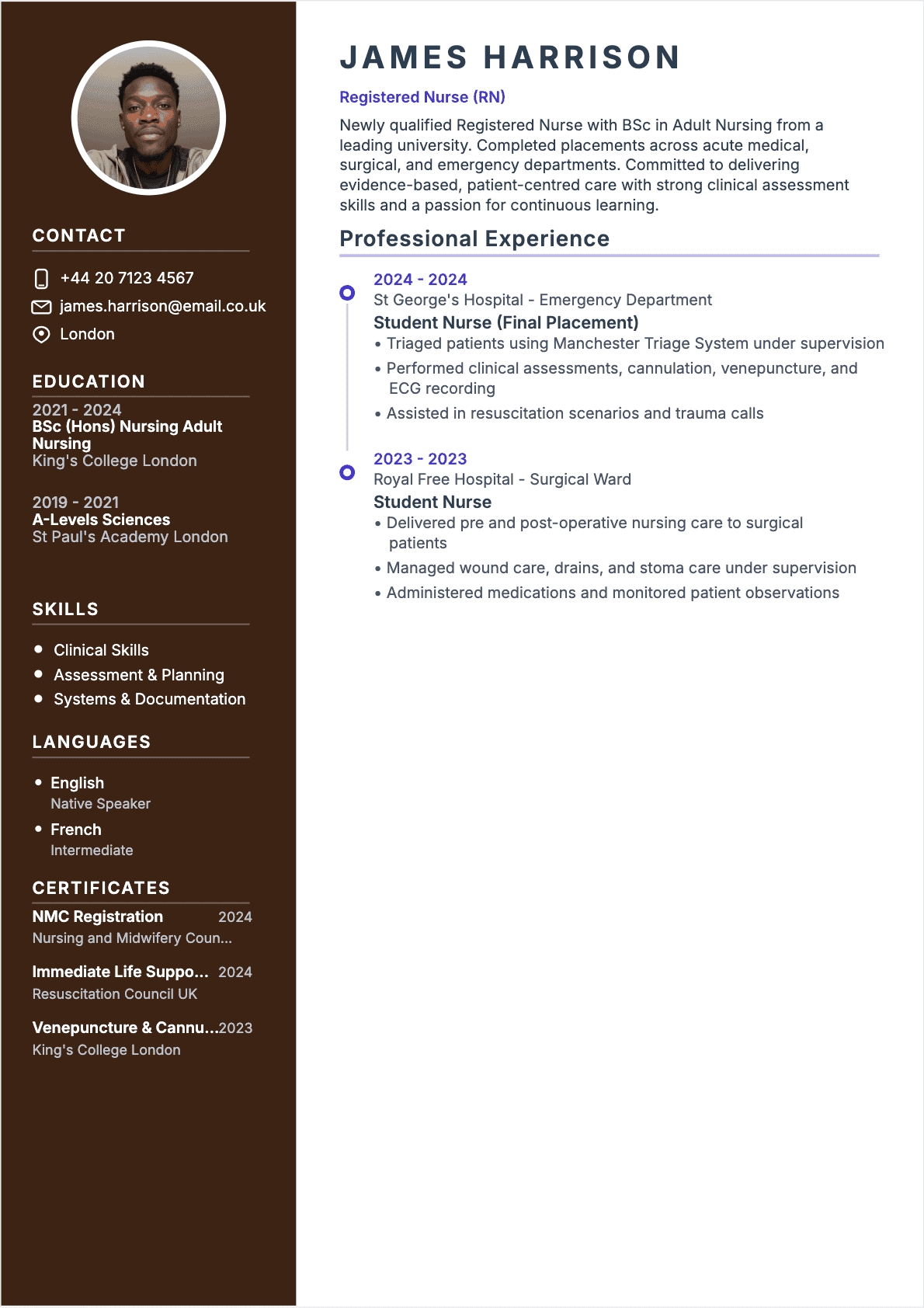
For new nurses and new graduates: highlight clinical rotations, preceptorship hours, BLS/ACLS progress, and measurable outcomes like patient education completion and documentation accuracy.

Utiliser

Registered Nurse Resume Template (Intermediate)

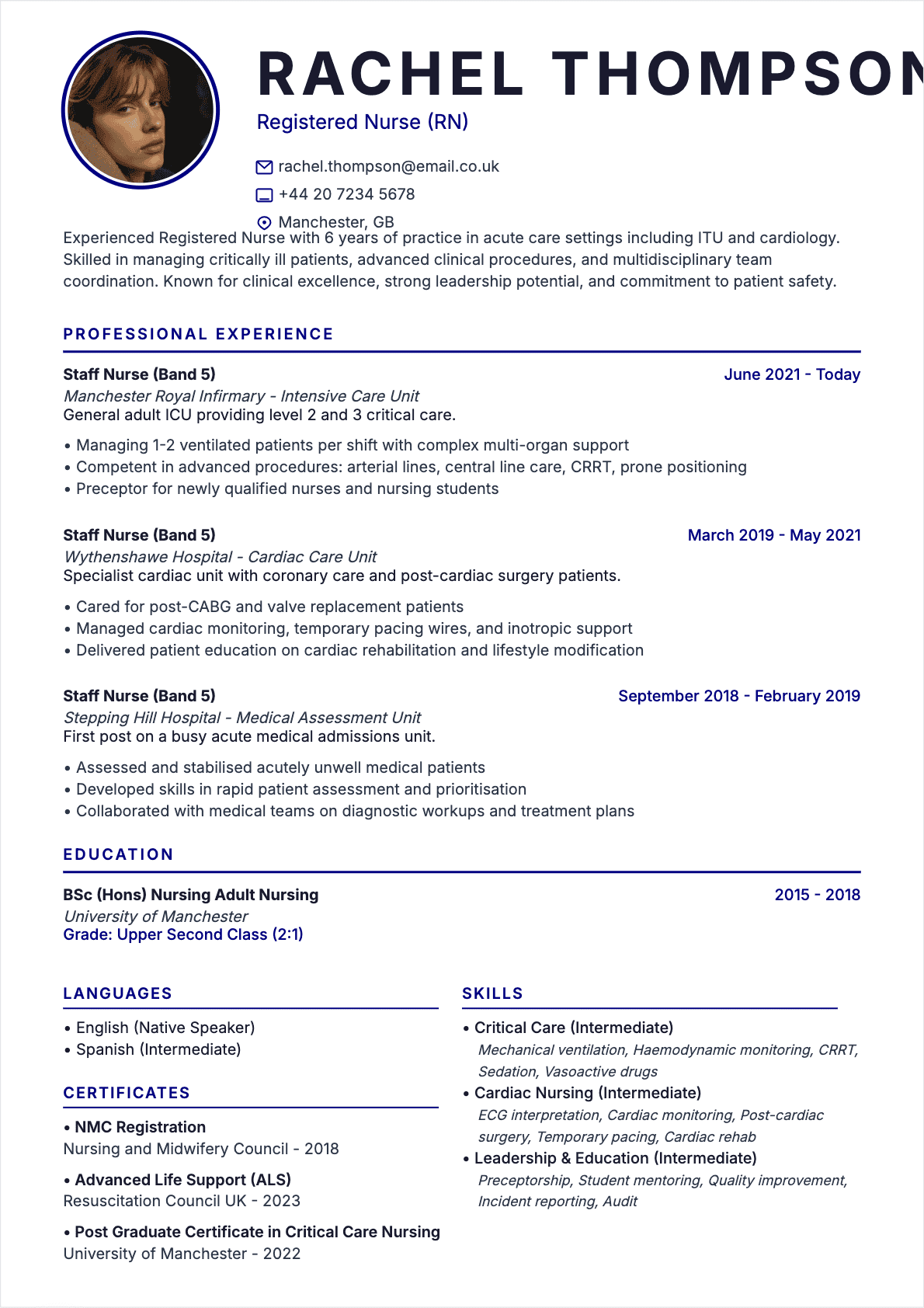
For 3–7 years: emphasize specialty impact, charge relief shifts, reduced falls/CLABSI, throughput metrics, and EHR proficiency (Epic/Cerner) aligned to the job description.

Utiliser

Registered Nurse Resume Template (Senior)

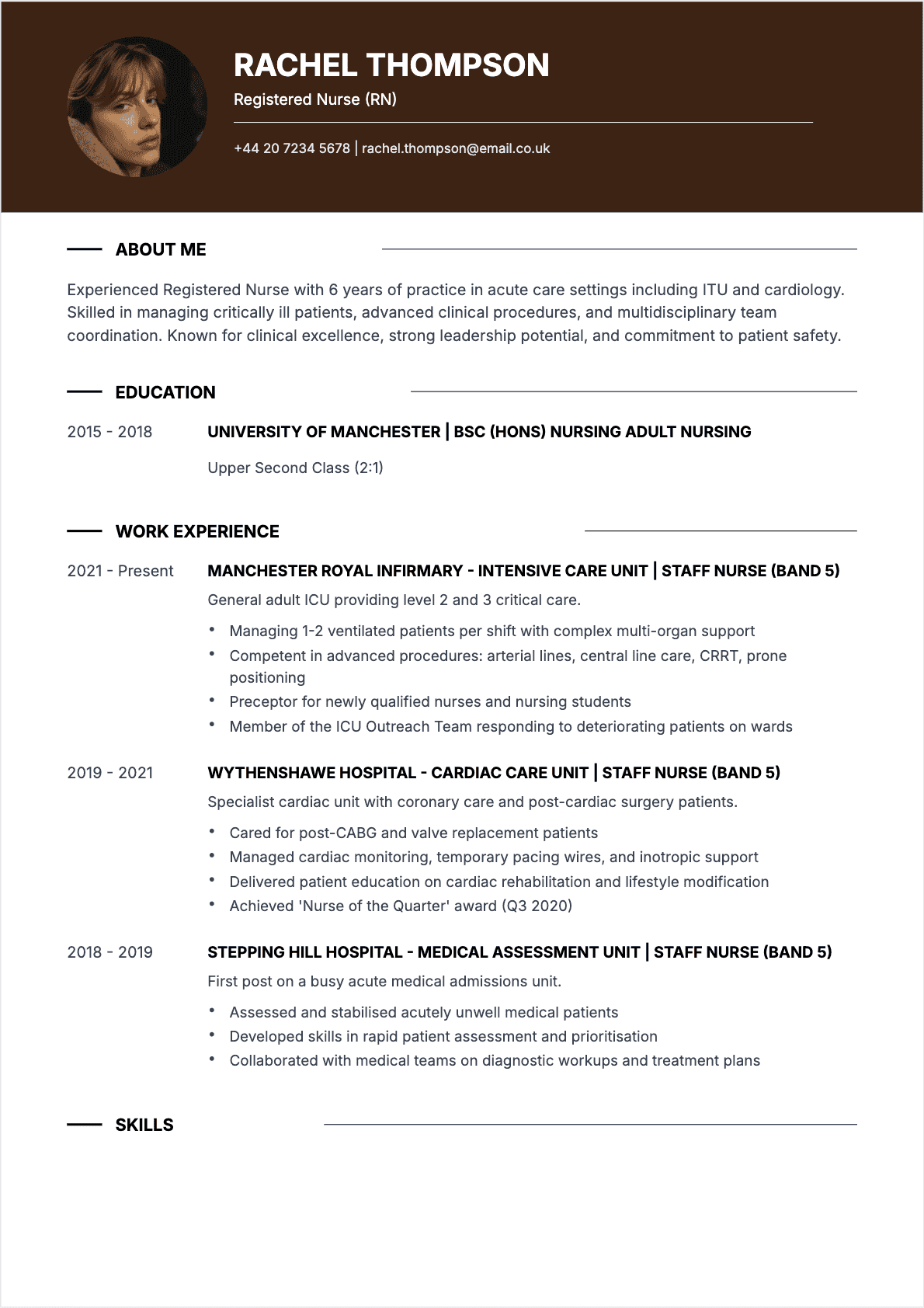
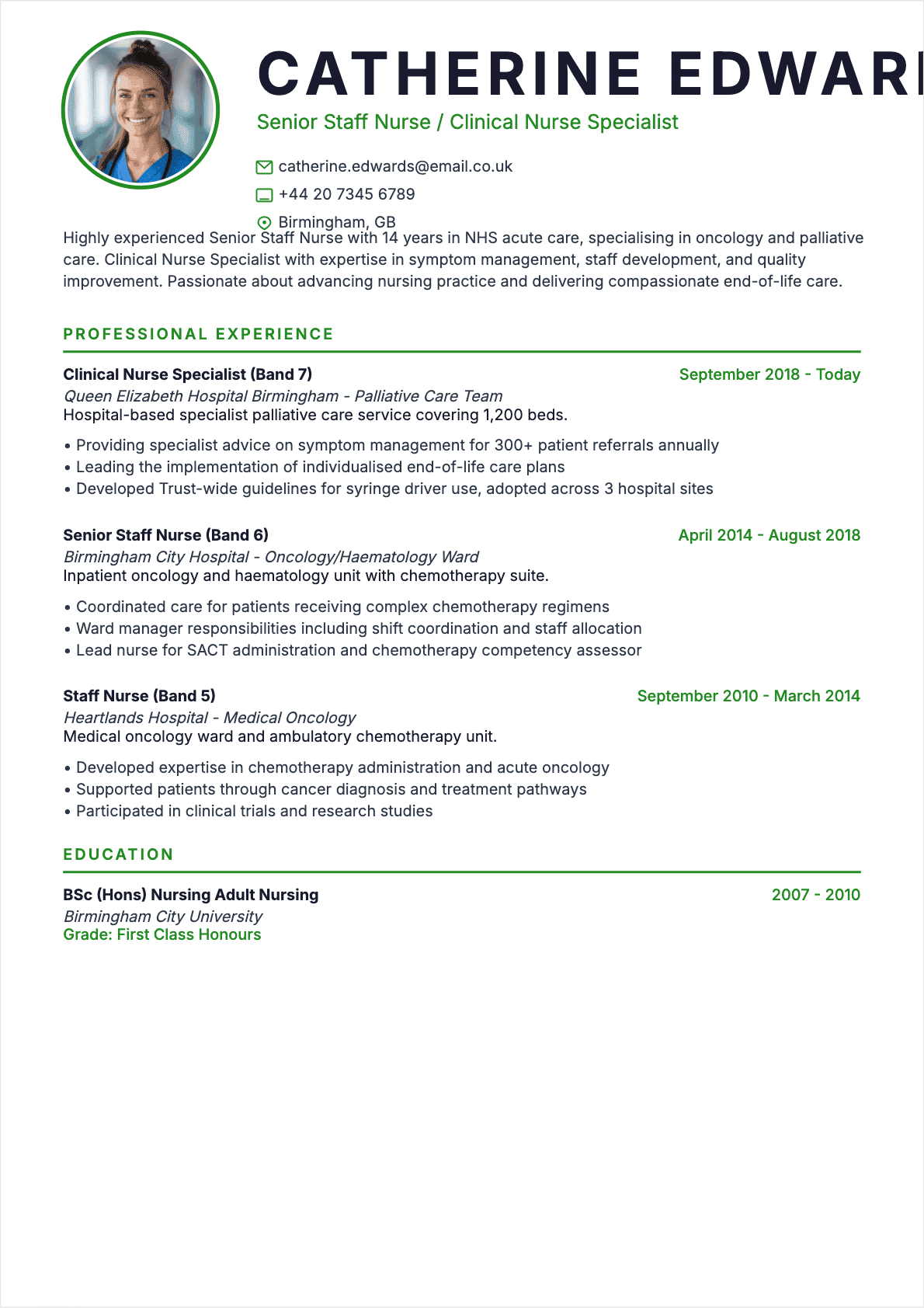
For senior RNs and leaders: focus on unit-level results, staffing and precepting, quality improvement, policy compliance, and cross-functional leadership improving safety and patient satisfaction.

Utiliser

Perfect CV Checklist - CV Registered Nurse

Check each item to ensure your CV is complete and optimized.

Your Progress0%

Professional Summary - CV Registered Nurse

The professional summary is the first thing recruiters see. It should summarize your profile in a few impactful lines.

Good example

Registered nurse with five years of experience in a 36-bed med-surg/telemetry unit, managing 1:5 ratios and rapid response escalation. Reduced falls 18% in 12 months via hourly rounding and bed alarm compliance; improved discharge education completion from 72% to 90%. Advanced Epic documentation, SBAR handoffs, and ACLS/BLS.

Bad example

Motivated, dynamic, passionate nurse available immediately, eager to learn and provide the best care to patients in any unit.

Why is it effective?

The good example is effective because it:

  • states scope and context (36-bed unit, ratios) so recruiters can map your experience to their nurse positions
  • proves outcomes with concrete examples (falls down 18%, education completion up to 90%)
  • includes job-relevant tools and protocols (Epic, SBAR, ACLS/BLS) to match applicant tracking filters
  • shows clinical decision-making signals (rapid response escalation) tied to patient safety

The bad example fails because it:

  • uses vague claims with no evidence or metrics
  • doesn’t mention a nursing specialty, setting, or patient population
  • omits clinical skills, EHR tools, and certifications
  • reads like a generic profile that won’t align with a job description

Professional experience examples

Here are examples of professional experiences. Note how results are quantified.

Registered Nurse (Med-Surg/Telemetry)

HCA Healthcare, Nashville, TN

May 2020 – Nov 2025

Provided direct patient care on a 36-bed med-surg/telemetry floor within a 400+ bed hospital. Collaborated with a 7–9 RN/CNA team per shift, supported rapid response events, and ensured safe throughput during high census while maintaining documentation quality in Epic.

Key Achievements

Reduced patient falls from 3.1 to 2.5 per 1,000 patient-days (−19%) by standardizing hourly rounding and bed alarm audits.
Improved bedside shift report compliance from 68% to 92% within 10 weeks using SBAR prompts and peer coaching.
Cut average discharge documentation completion time from 45 to 32 minutes (−29%) by building Epic SmartPhrases and checklist workflows.
Maintained medication scanning compliance at 98%+ for 6 consecutive months, lowering near-miss events reported to the unit safety huddle.

Key skills for your resume

Here are the technical and soft skills most sought after by recruiters.

Hard skills and clinical tools for a nurse resume

Technical Skills

  • Head-to-toe patient assessment and focused reassessments
  • IV insertion, venipuncture, and infusion pump management
  • Epic (EHR) documentation and medication administration record (eMAR)
  • Cerner Millennium (EHR) and order management workflows
  • Telemetry rhythm interpretation and escalation criteria
  • Wound care (staging, dressing selection, negative pressure basics)
  • Infection prevention and control (PPE, isolation precautions, bundle compliance)
  • SBAR handoff and closed-loop communication in rapid response

Soft skills that hiring managers expect from nurses

Soft Skills

  • Prioritization under competing acuity and interruptions
  • De-escalation with distressed patients and families
  • Clear, concise shift-to-shift handoff communication
  • Patient advocacy and ethical decision-making
  • Interdisciplinary coordination with physicians, RT, PT/OT, case management
  • Attention to detail for medication safety and allergy verification
  • Coaching and precepting using teach-back and competency checklists
  • Resilience through high census, staffing changes, and critical incidents

ATS Keywords to Include

ATS systems filter CVs based on specific keywords. Include these terms to maximize your chances.

ATS Tip

Click on a keyword to copy it. ATS systems filter CVs based on these exact terms.

Mots-clés importants

Hiring Sectors

Discover the most promising sectors for your career.

1

Acute care hospitals

2

Emergency department and trauma centers

3

Intensive care unit (ICU)

4

Outpatient clinics and ambulatory surgery centers

5

Skilled nursing facilities and rehabilitation

6

Home health and hospice

Education & Degrees

For a registered nurse resume, your education should quickly confirm you meet licensure requirements and show specialty direction. In the U.S., most employers accept an ADN or a Bachelor’s, but a bachelor of science in nursing can open doors to magnet hospitals, residency programs, and advancement.

Common paths include ADN-to-RN, BSN programs, or accelerated BSN for career changers. If you’re a new graduate, list clinical rotations (hours and units) to add practical experience. If you’re an experienced nurse, keep education concise and let professional experience and credentials carry the weight.

Recommended Degrees

  • Bachelor of Science in Nursing (BSN)
  • Associate Degree in Nursing (ADN)
  • Master of Science in Nursing (MSN)
  • Doctor of Nursing Practice (DNP)
  • Bachelor’s in a related field + Accelerated BSN
  • Postgraduate Certificate (Nursing Leadership or Education)

Languages

Languages can be a differentiator in nursing roles where patient understanding directly affects adherence, safety, and readmissions. Even in English-speaking hospitals, bilingual nurses can improve patient education and reduce interpretation delays during triage or discharge.

  • emergency department triage and rapid consent discussions
  • inpatient discharge teaching and medication reconciliation
  • community health, home health, pediatrics, and geriatric care

On your resume, state an honest level (Native/Fluent/Proficient/Intermediate) and add proof when possible (formal coursework, workplace use, or standardized tests).

🇬🇧

English

Native

🇪🇸

Spanish

Proficient (daily patient education and triage)

🇫🇷

French

Intermediate

Recommended certifications

Certifications help your nurse resume pass applicant tracking filters and signal readiness for specific nursing roles. Some are baseline (BLS), others are unit-dependent (ACLS for telemetry/ICU/ED), and specialty credentials can differentiate experienced nurses.

List the issuing body and expiration dates when relevant, especially for life support credentials.

BLS Provider (American Heart Association)
Advanced Cardiac Life Support (ACLS) (American Heart Association)
Pediatric Advanced Life Support (PALS) (American Heart Association)
NIH Stroke Scale (NIHSS) Certification
Certified Medical-Surgical Registered Nurse (CMSRN) (MSNCB)
CCRN (Adult) (AACN Certification Corporation)

Mistakes to avoid

Using a generic nurse resume that ignores the job description

Many nurse resumes fail because they don’t mirror the job posting language. Recruiters and applicant tracking systems compare your resume to the job description: unit type, patient population, required credentials, and required clinical skills. If your resume summary and skills section use different terms (or skip them), you may be screened out before a human reads it.

Always include :

  • the target unit or nursing specialty (ICU nurse, operating room nurse, med-surg, school nurse)
  • the matching credentials (BLS/ACLS/PALS, state license, certified nursing if requested)
  • the EHR and workflow keywords (Epic, Cerner, SBAR, infection prevention and control)

Keep this rule: “One resume for each application, rewritten from the posting in 15 minutes.”

Writing work experience as tasks instead of outcomes

A list of nursing tasks (“administered meds”, “monitored vitals”) doesn’t show how well you performed. Hiring managers already know baseline care nursing duties; they want evidence you improved safety, efficiency, or patient satisfaction. Your experience section should combine scope (ratios, unit size) with measurable results.

À éviter : "Responsible for patient care and documentation."

À privilégier : "Managed 1:5 ratios on telemetry; sustained 98% medication scanning compliance and reduced discharge delays by 13% through Epic workflow standardization."

This turns routine work into a resume example that proves impact.

Forgetting the credential details that validate you as a registered nurse

A registered nurse resume must make licensure and compliance easy to verify. Omitting license state, license type, or expiration forces recruiters to chase information and can slow screening. The same is true for life support certifications and specialty requirements (e.g., NIHSS for stroke units).

À mentionner :

  • RN license (state, compact status if applicable, expiration)
  • BLS/ACLS/PALS with issuing organization and expiration month/year
  • unit-specific requirements (NIHSS, telemetry competency, vaccine/fit-test status if requested)

Choosing a resume format that breaks ATS parsing

A visually complex resume template can look great but fail in applicant tracking. Tables, text boxes, multi-column layouts, and icons may cause your work experience dates or certifications to be misread. Nurses often lose interviews because the system can’t parse their license line or skills section.

Checklist :

  • use one-column layout with standard headings (Summary, Work Experience, Education, Certifications, Skills)
  • save as PDF only if the application allows; otherwise submit a clean .docx
  • keep dates consistent (Mon YYYY – Mon YYYY) and avoid headers/footers for critical info

Expert tips

  • 1

    Build bullets around safety metrics : Use falls per 1,000 patient-days, medication scanning %, CLABSI/CAUTI rates, and discharge education completion to anchor resume bullets in outcomes.

  • 2

    Make your resume readable in 15 seconds : Put license + core certifications at the top, then a tight resume summary. Recruiters typically screen 30–60 resumes per role.

  • 3

    Use the right nurse resume template for your level : New nurses lean on rotations and capstones; experienced nurses lead with unit scope, leadership, and quality improvement results.

  • 4

    Name tools and protocols, not just skills : List Epic/Cerner, SBAR, NIHSS, telemetry, and infection prevention bundles to match keyword filters in applicant tracking.

  • 5

    Tailor your resume to the unit : An ICU nurse bullet set differs from an operating room nurse or school nurse. Swap 6–10 skills and 3–5 bullets to match the nursing specialty.

  • 6

    Keep length intentional : A one-page resume can work for new graduates; a two-page resume is acceptable for experienced nurses with certifications, precepting, and unit projects.

  • 7

    Add a nurse cover letter when switching specialties : Use the cover letter to explain the transition and highlight transferable clinical skills, preceptorship, and outcomes tied to the new unit.

Frequently asked questions

Find answers to the most frequently asked questions.

CV stands for curriculum vitae. In nursing, a CV is typically longer and more detailed than a resume, often used for academic, research, teaching, or leadership roles. A resume is usually 1–2 pages and focuses on clinical work experience, key skills, and outcomes. In U.S. hospitals, most nurse positions ask for a resume.

Start with license and certifications, then a resume summary with your years of experience, unit type, and measurable outcomes. In the work experience section, add ratios, patient population, and 3–6 quantified achievements per role. Include EHR tools like Epic or Cerner, plus core skills (SBAR, infection prevention). Match your wording to the job description.

Most clinical nursing jobs use a resume, especially for bedside roles in hospitals, clinics, and home health. A CV is more common for nurse educator roles, research positions, grant-funded programs, or academic settings. If a job posting doesn’t specify, submit a resume template that is ATS-friendly and keep it focused on clinical impact and certifications.

Not exactly. A resume is a concise marketing document focused on relevant professional experience and key skills for a specific role. A CV is a comprehensive record that can include publications, presentations, research, teaching, and detailed training history. For registered nurse hiring, the resume is usually the default unless the employer requests a CV.

For new graduates and new nurses, a one-page resume is often enough if it includes clinical rotations, certifications, and a focused skills section. For experienced nurses, a two-page resume is acceptable when you have multiple roles, specialty credentials (CCRN, CMSRN), precepting, and quality projects. Keep every line relevant to the role.

Yes, it’s standard to list your name followed by credentials (for example, “Taylor Jordan, RN, BSN”) as long as you are currently licensed. Also add a separate license line with state, license number if requested, and expiration. This helps applicant tracking and recruiters verify eligibility quickly, especially for multi-state or compact license hiring.

Create your CV Registered Nurse resume in minutes

Use our ATS-friendly nurse resume template, plug in quantified work experience, and export a clean PDF or DOCX tailored to each job posting in 2025.

Create my Resume