CV HR Specialist: ATS-friendly resume guide (2025)
Learn how to write a CV HR Specialist that recruiters can scan in seconds and ATS can parse correctly. Use measurable HR results, the right keywords, and clean formatting for hiring, employee relations, and HR operations roles.
Key Takeaways
HR Specialist roles in 2025 increasingly sit at the intersection of employee experience, compliance, and data quality. Many mid-size employers now expect HR to operate with service-level targets: for example, closing HR tickets within 48–72 hours, delivering onboarding at scale, and keeping payroll error rates below 0.5%.
In this market, recruiters screen for HRIS fluency, measurable operational outcomes, and risk awareness. Your CV HR Specialist should demonstrate :
- End-to-end HR operations ownership (onboarding, employee data changes, policy administration)
- HRIS accuracy and reporting capability (dashboards, headcount, attrition, compliance metrics)
- Employee relations support with documented outcomes (case handling, resolution time, policy adherence)
Use the guide below to structure your resume, choose the right keywords, and translate HR work into business results.
CV Examples - CV HR Specialist
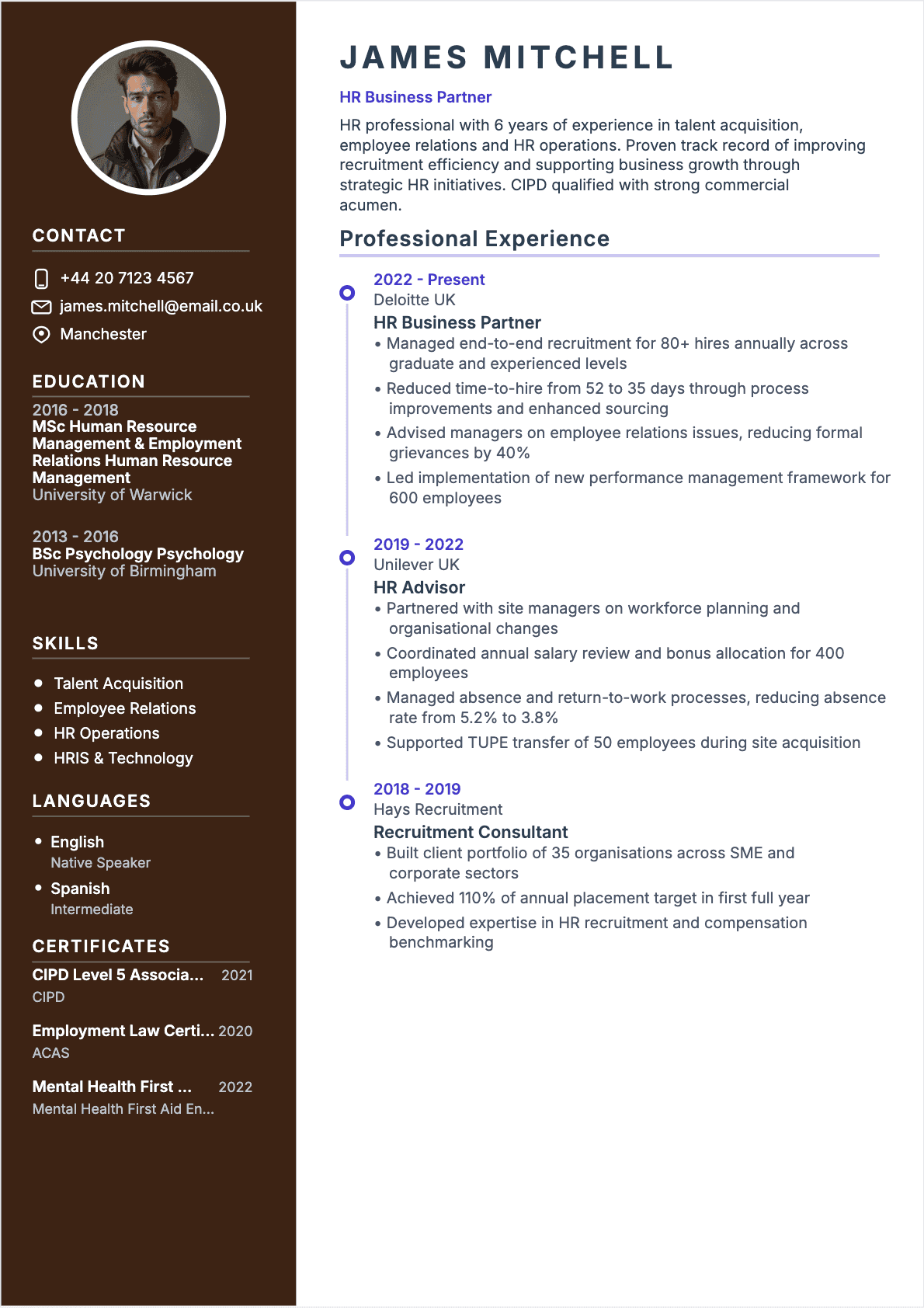
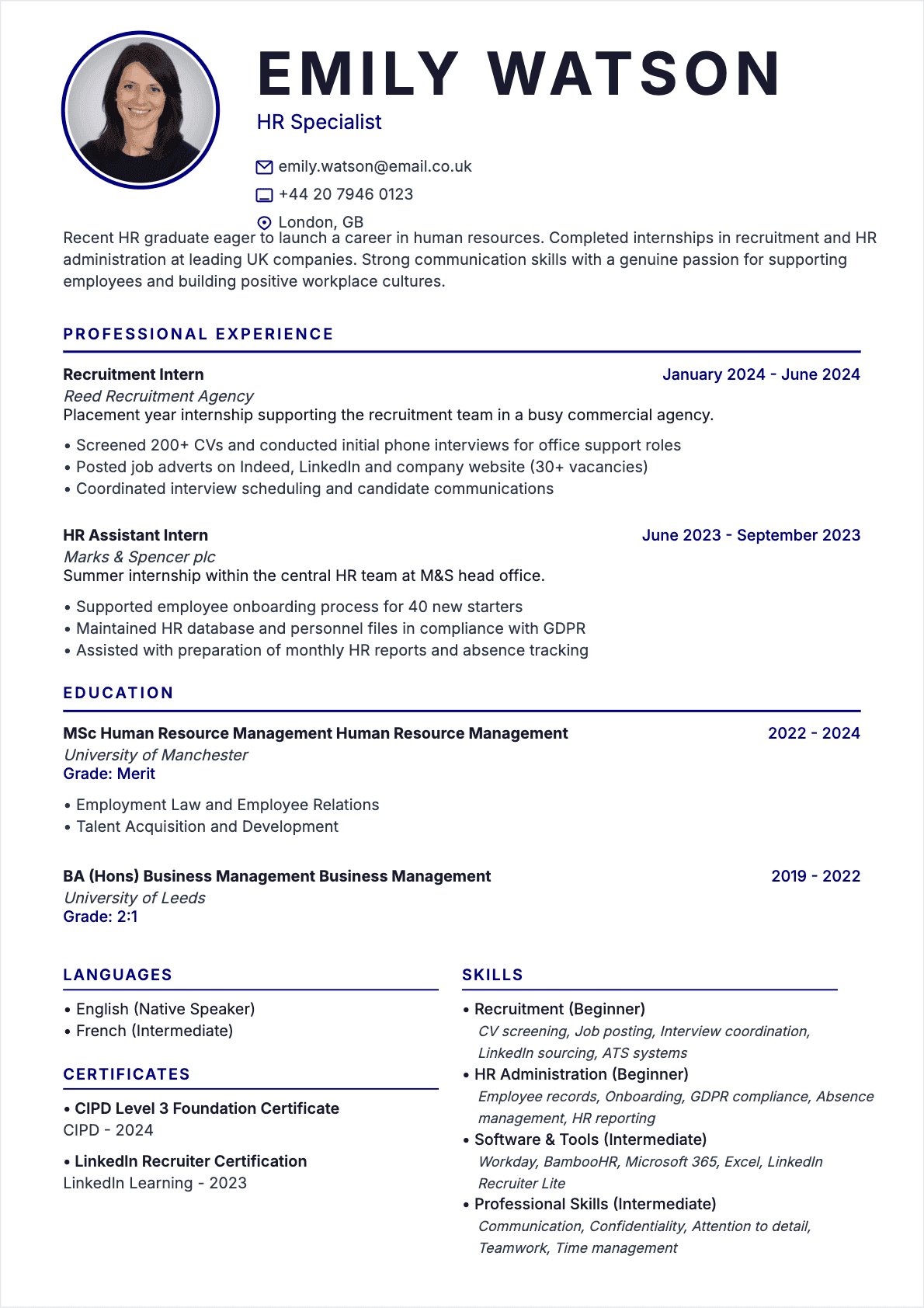
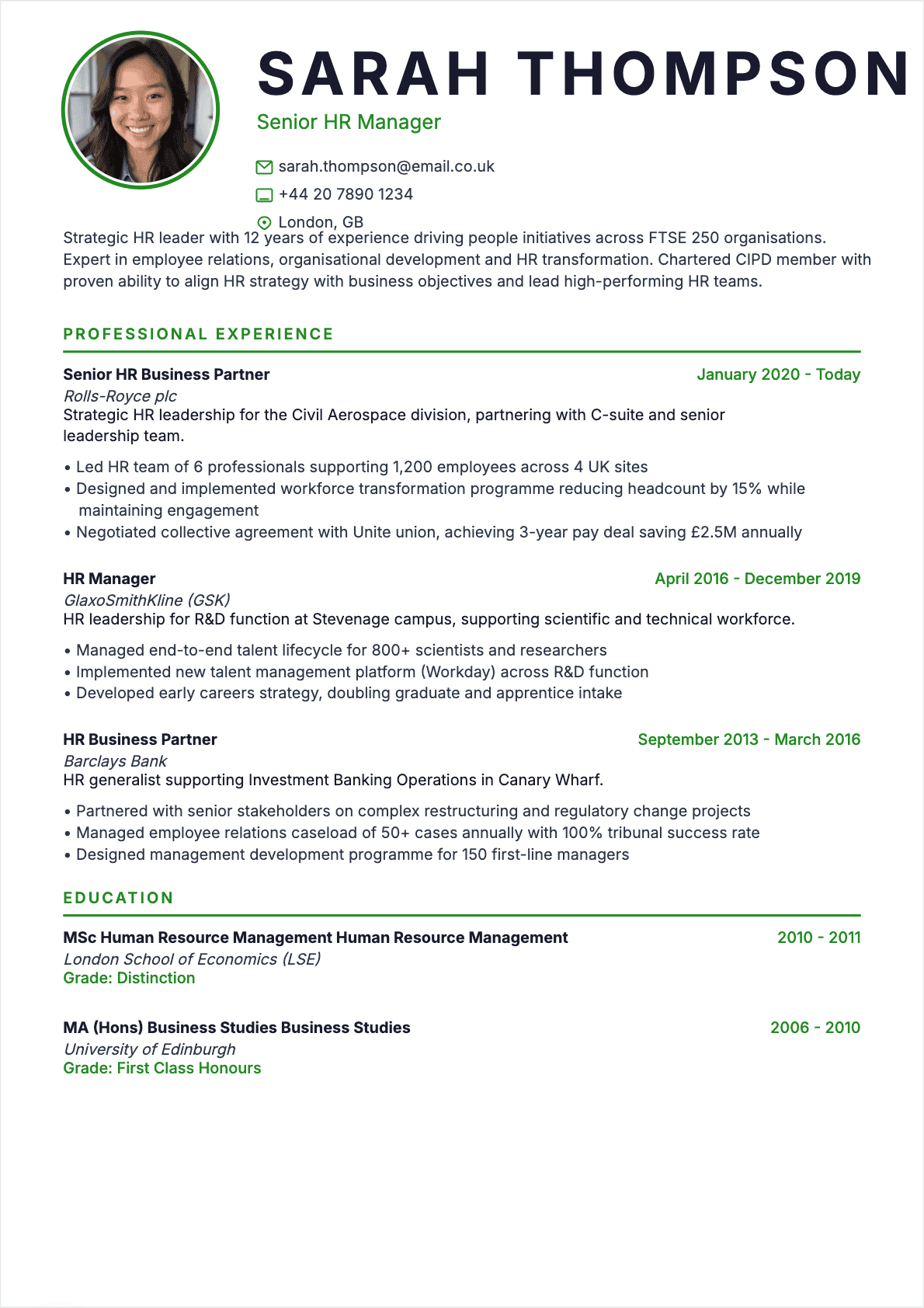
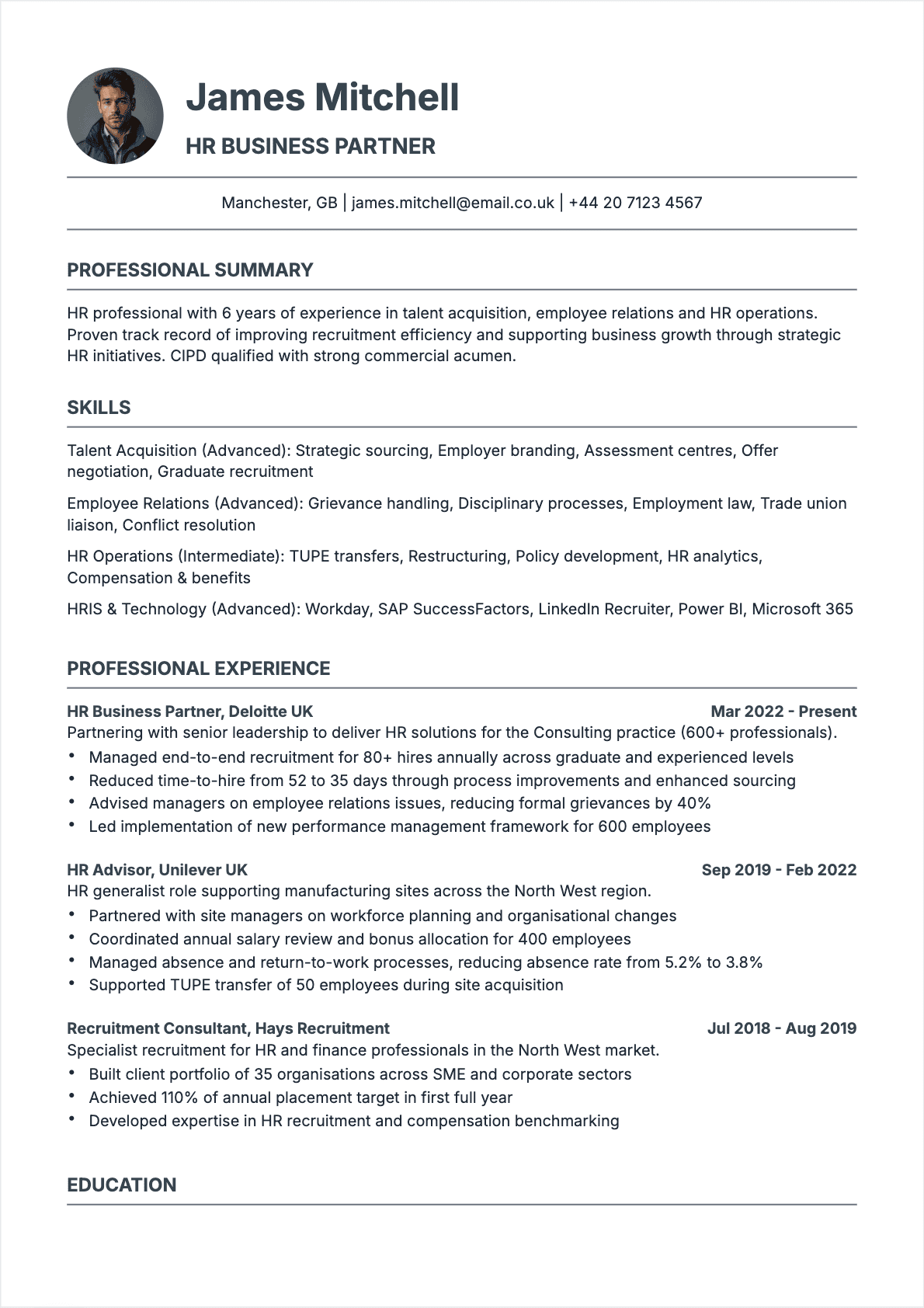
Discover our CV templates adapted to all experience levels. Each example is ATS-optimized.

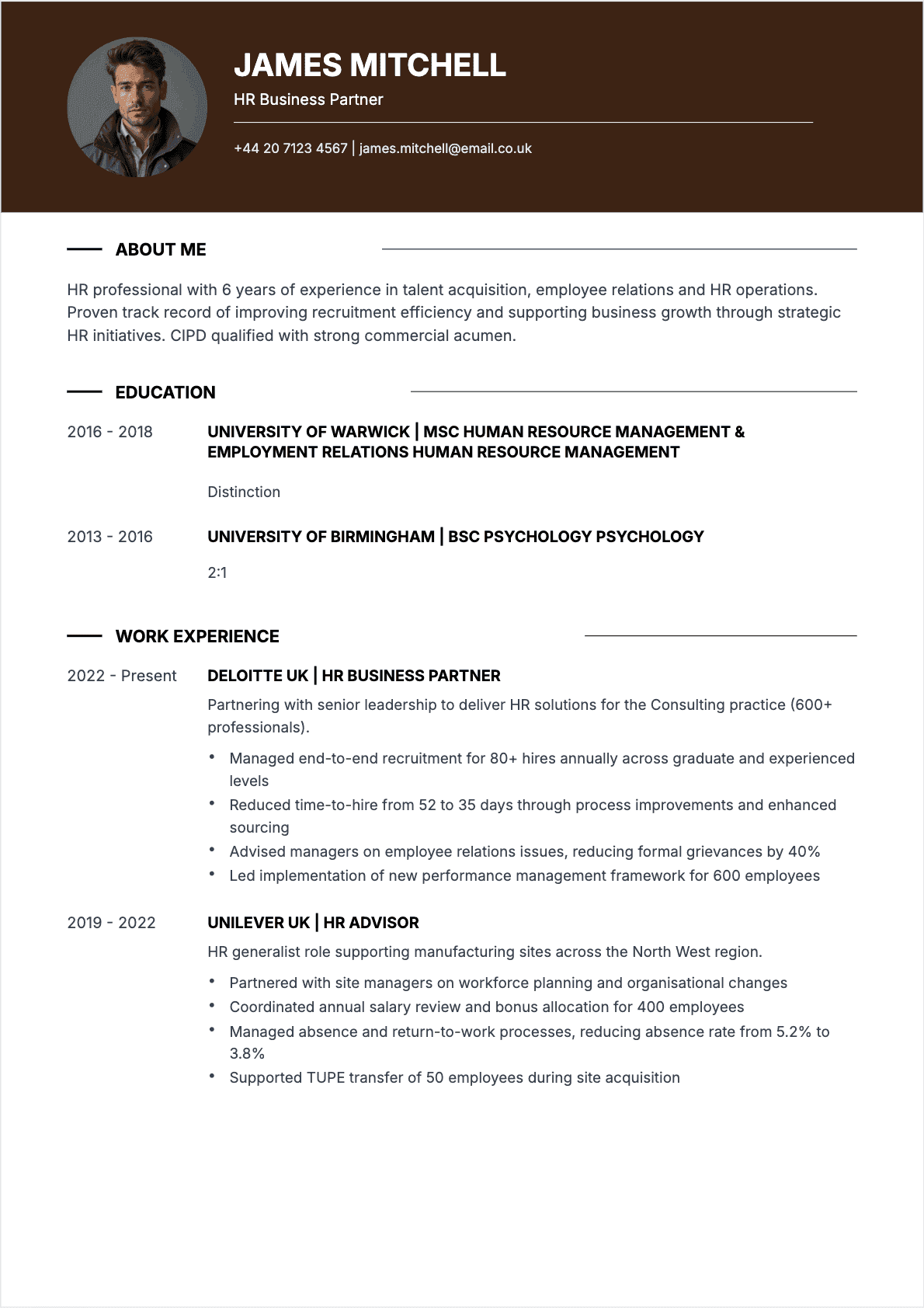
CV HR Specialist Beginner
For recent graduates and junior HR coordinators. Highlight internships, HRIS basics, recruitment support, compliance awareness, and quantified admin throughput to prove operational readiness.
Utiliser
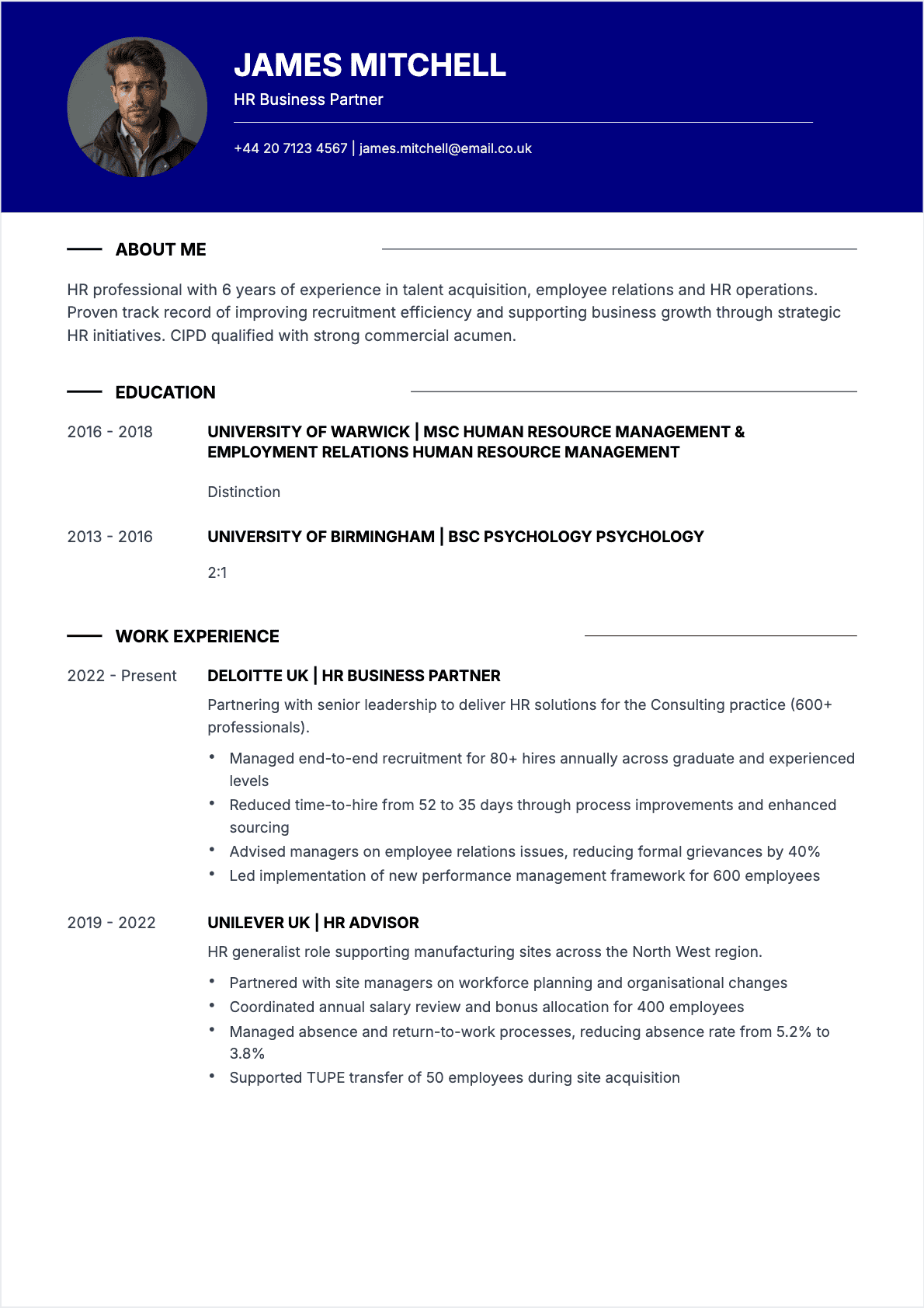
CV HR Specialist Intermediate
For 3–7 years’ experience. Emphasize HR operations ownership, onboarding programs, employee relations cases, HR reporting, and measurable reductions in time-to-hire, errors, and ticket backlog.
Utiliser
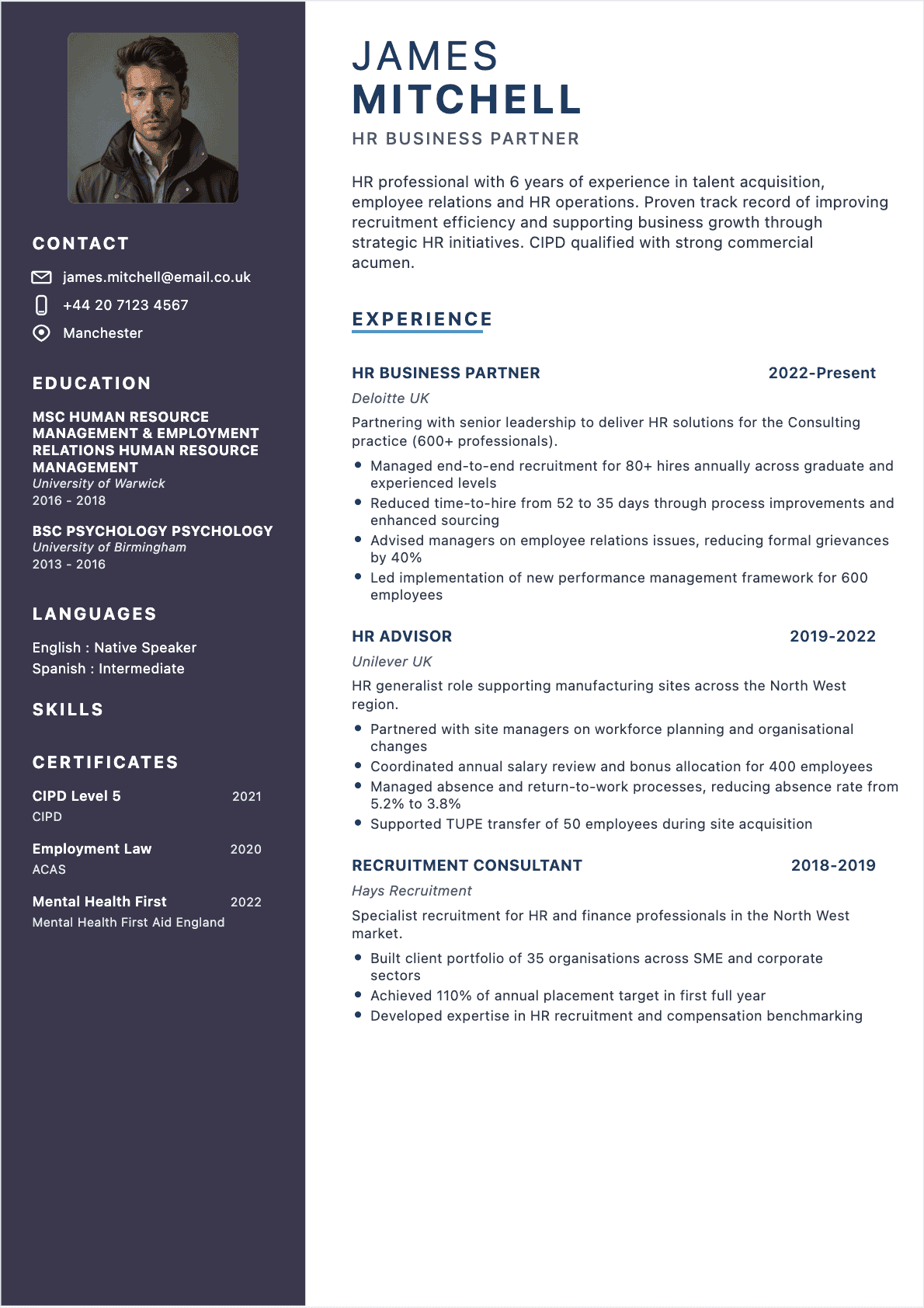
CV HR Specialist Senior
For senior specialists leading projects. Showcase policy rollouts, HRIS implementation, compliance audits, cross-site stakeholder management, and business outcomes like attrition reduction and improved HR SLA performance.
UtiliserPerfect CV Checklist - CV HR Specialist
Check each item to ensure your CV is complete and optimized.
Professional Summary - CV HR Specialist
The professional summary is the first thing recruiters see. It should summarize your profile in a few impactful lines.
“HR Specialist with 5+ years in retail and distribution, supporting 850 employees across 4 sites. Reduced onboarding cycle time by 28% and cut HR ticket backlog by 35% by standardizing workflows in Workday and ServiceNow. Strong in employee relations, compliance (GDPR), and HR reporting (Excel, Power BI).”
“Motivated and dynamic HR professional, passionate about people, available immediately, looking for a new challenge where I can learn and grow.”
Why is it effective?
The good example is effective because it :
- States seniority and context (5+ years, retail/distribution, 850 employees) so scope is clear
- Adds measurable outcomes (28% cycle time, 35% backlog) rather than listing responsibilities
- Names relevant domains (employee relations, compliance) aligned with common HR Specialist job ads
- Includes real tools (Workday, ServiceNow, Excel, Power BI) that strengthen ATS matching
The bad example fails because it :
- Uses vague adjectives instead of a defined HR scope or target role
- Provides no metrics (no volume, no time, no quality indicators)
- Omits tools and HR processes recruiters search for in ATS
- Focuses on personal intent (“learn and grow”) rather than employer outcomes
Professional experience examples
Here are examples of professional experiences. Note how results are quantified.
HR Specialist (People Operations)
Capgemini, London
Supported HR operations for a 1,200-employee business unit across the UK and Ireland. Worked in a shared services team of 9, partnering with 40+ line managers. Owned onboarding, HRIS transactions, case triage, and monthly HR reporting with strict compliance and SLA targets.
Key Achievements
Key skills for your resume
Here are the technical and soft skills most sought after by recruiters.
Hard skills (HR Specialist)
Technical Skills
- HR operations (employee lifecycle administration, documentation, workflows)
- Employee relations support (case tracking, outcome documentation)
- Workday (HCM basics, transactions, reporting)
- SAP SuccessFactors (employee data management, reporting)
- Recruitment coordination (scheduling, offers, background checks)
- Onboarding and offboarding (checklists, right-to-work, access coordination)
- HR reporting (Excel pivot tables, Power BI dashboards)
- Compliance and data privacy (GDPR handling, audit support)
Soft skills
Soft Skills
- Stakeholder management with managers and shared services
- Confidentiality and sound judgement with sensitive cases
- Conflict de-escalation and structured problem solving
- Prioritization in high-volume HR ticket environments
- Clear writing (policies, employee communications, case notes)
- Attention to detail (data accuracy, payroll inputs, documentation)
- Process improvement mindset (SOPs, templates, workflow simplification)
- Coaching managers on policy and procedures
ATS Keywords to Include
ATS systems filter CVs based on specific keywords. Include these terms to maximize your chances.
ATS Tip
Click on a keyword to copy it. ATS systems filter CVs based on these exact terms.
Mots-clés importants
Hiring Sectors
Discover the most promising sectors for your career.
Technology and SaaS
Healthcare providers and pharma
Manufacturing and industrial
Retail and consumer goods
Professional services and consulting
Financial services and insurance
Education & Degrees
HR Specialist hiring in 2025 typically values a solid foundation in employment law, HR operations, and data handling, plus comfort with HRIS tools. A formal degree helps, but strong internships, shared-services experience, or exposure to high-volume environments can compensate when paired with measurable results.
Common routes include a Bachelor’s degree (HR, business, psychology), a Master’s in HRM, or professional pathways such as CIPD. If you are transitioning from admin, payroll, or recruitment coordination, show how your experience maps to employee lifecycle processes and compliance.
Recommended Degrees
- Bachelor’s Degree in Human Resources Management
- Bachelor’s Degree in Business Administration
- Master’s Degree in Human Resource Management (HRM)
- Master’s Degree in Organizational Psychology
- Postgraduate Diploma in Human Resources
- MBA (Human Resources concentration)
Languages
Languages strengthen an HR Specialist profile when your scope includes multi-site teams, EMEA stakeholders, or shared services delivery. They help in onboarding sessions, policy communication, and employee relations documentation where clarity reduces risk and rework.
- Supporting international hires and mobility paperwork
- Handling employee queries across sites or countries
- Coordinating with global HR shared services and recruiters
Present your level using clear proficiency labels and add evidence (daily use, business writing, or a recognized test score) when relevant.
English
Native
French
Fluent (professional use in HR administration and employee support)
Spanish
Intermediate
Recommended certifications
Certifications are not always mandatory for HR Specialist roles, but they can significantly improve credibility—especially for compliance-heavy environments or when you lack a dedicated HR degree. Prioritize recognized HR bodies first (SHRM, HRCI, CIPD), then add targeted credentials for privacy, analytics, or change management.
Mistakes to avoid
Listing HR tasks without scale or outcomes
Many HR Specialist CVs read like job descriptions: “handled onboarding, supported payroll, managed queries.” The issue is that recruiters cannot see volume, complexity, or impact. HR is operational by nature, so scale is your credibility: headcount supported, cases handled, tickets closed, or accuracy improvements.
Without numbers, your experience looks interchangeable with junior admin work. Replace tasks with results and context to show you can operate at pace and reduce risk.
Always include :
- Headcount and sites supported (e.g., 650 employees across 3 locations)
- Operational volume (e.g., 40 tickets/week, 25 onboardings/month)
- Quality or speed metric (e.g., 0.6% data error rate, 96% SLA)
Keep this rule: scope + action + metric + tool.
Using non-ATS formatting that breaks parsing
HR roles are often screened via ATS, and complex layouts can hide your keywords and dates. Tables, text boxes, icons, and multi-column sections commonly cause missing job titles or unreadable timelines. If the system cannot parse your HRIS skills or your employment dates, you may be filtered out before a human review.
To avoid : "Skills inside a two-column table with icons and no text labels"
To prefer : "Single-column headings (Experience, Skills, Education) with bullet points and standard date formats (MMM YYYY – MMM YYYY)"
Keep formatting clean, predictable, and readable in PDF and DOCX exports.
Not showing compliance and data handling discipline
HR Specialists work with sensitive employee data, and employers look for risk awareness. If your CV never mentions compliance, privacy, or audit support, it can signal inexperience—even if you handled these topics daily. You do not need to sound legalistic; you need to show that you follow process, document decisions, and protect data.
To mention :
- Data privacy practices (GDPR handling, access controls, retention awareness)
- Right-to-work or eligibility checks (where relevant to your market)
- Audit support or policy adherence (e.g., file completeness, documentation standards)
Sending a generic CV to every HR Specialist job
HR Specialist can mean shared services, ER-heavy, HRIS-focused, or recruitment operations depending on the company. A generic CV often misses key keywords and over-emphasizes irrelevant tasks, reducing ATS match and recruiter confidence.
Checklist :
- Mirror the job title and top 6–10 keywords from the posting (HR operations, onboarding, HRIS, employee relations)
- Reorder bullets to match the role’s priority (e.g., ER first for ER roles, reporting first for analytics roles)
- Swap in the right metrics (time-to-hire for recruitment ops, SLA for shared services, error rate for HRIS/payroll)
Expert tips
- 1
Build a metrics bank : Track your monthly HR volumes (tickets closed, onboardings, contract changes, error rates). Reuse the most relevant 3–5 metrics per application to prove operational impact quickly.
- 2
Name the HRIS and modules : Write tools exactly as employers do: Workday HCM, SAP SuccessFactors, ServiceNow HR. This improves ATS matching and signals you can be productive with minimal ramp-up.
- 3
Show your scope in one line : Add headcount, sites, and countries in each role description. Example: “Supported 900 employees across 4 sites (UK/IE) in a shared services model.”
- 4
Use compliance language carefully : Mention GDPR, right-to-work checks, and audit support without over-claiming legal authority. Focus on process adherence, documentation quality, and escalation discipline.
- 5
Make ER experience concrete : Instead of “supported employee relations,” specify case volume, themes, and outcomes (resolution time, documentation, manager guidance) while respecting confidentiality.
- 6
Keep the summary technical : Include years, sector, HR domains, one measurable result, and tools. Skip personality descriptors and focus on what you deliver in HR operations.
- 7
Skip a photo for US-focused roles : In the US it is typically avoided. If applying in the UK, it is optional; only include it if it is professional and does not reduce the document’s readability.
Frequently asked questions
Find answers to the most frequently asked questions.
For most HR Specialist profiles, aim for 1 page under 7 years of experience and 2 pages if you have complex scope (multi-country, HRIS projects, ER exposure). Prioritize measurable bullets, core HR domains, and HRIS tools. Remove older roles that do not add HR operations or compliance value.
Use role-relevant terms that appear in postings: HR operations, HRIS, Workday, SAP SuccessFactors, onboarding, employee relations, payroll administration, benefits administration, HR compliance, and HR analytics. Place keywords naturally in Skills and Experience bullets, and make sure dates and job titles are in a standard format.
Avoid names and sensitive details. Use anonymized, measurable framing: number of cases supported per year, categories (attendance, grievance, conduct), your role (triage, documentation, manager guidance), and outcomes (time to close, documentation completeness). Mention escalation and policy adherence to show risk control.
If you are applying in the US, generally do not include a photo. In the UK it is optional; in many international contexts it varies. When in doubt, prioritize a clean ATS-friendly layout. If a photo is included, keep it professional and ensure it does not push key content onto an extra page.
Use volume and turnaround metrics even for internships: number of interviews scheduled per week, onboarding files processed, HR tickets logged, or employee queries resolved. Add quality metrics like document accuracy, checklist completion rate, or processing time. Tie your work to tools used (Excel, HRIS, ATS).
A reverse-chronological format is usually best because it makes dates, titles, and progression easy to verify and ATS-friendly. Use a short skills section to highlight HRIS and HR domains, but keep proof in your Experience bullets. A fully skills-based CV can raise questions about timeline gaps.
Create your CV HR Specialist in minutes (2025)
Use our CV builder to generate an ATS-friendly HR Specialist resume with the right structure, keywords, and quantified bullet points—then export a clean PDF ready for applications.
Create my Resume