CV Nursing Assistant : Nursing Assistants Resume Examples 2025
Build a nursing assistants resume that matches the job description, highlights patient care results with numbers, and uses an ATS-ready template. Includes skills, certifications, and copy-ready resume sections.
Key Takeaways
Nursing assistants are among the highest-volume frontline hires in healthcare, with many facilities recruiting year-round to cover 24/7 staffing, seasonal peaks, and turnover. In a typical 25–35 bed unit, a CNA may support 8–14 patients per shift and complete 40+ documented care tasks—so hiring teams need proof you can deliver safe, consistent care at pace.
A strong CV Nursing Assistant resume is not a list of duties. It is evidence: workload, accuracy, patient safety, and teamwork with nursing staff using reliable communication protocols.
Un bon CV de CV Nursing Assistant doit démontrer :
- Direct patient care skills (ADLs, mobility, hygiene, vital signs) aligned to your unit type
- Documentation quality in an electronic health record and clean handoffs to the medical team
- Measurable outcomes (on-time rounding, reduced falls/skin issues, strong patient satisfaction)
Use the guide below to build your resume section by section with metrics, keywords, and a modern template.
CV Examples - CV Nursing Assistant
Discover our CV templates adapted to all experience levels. Each example is ATS-optimized.

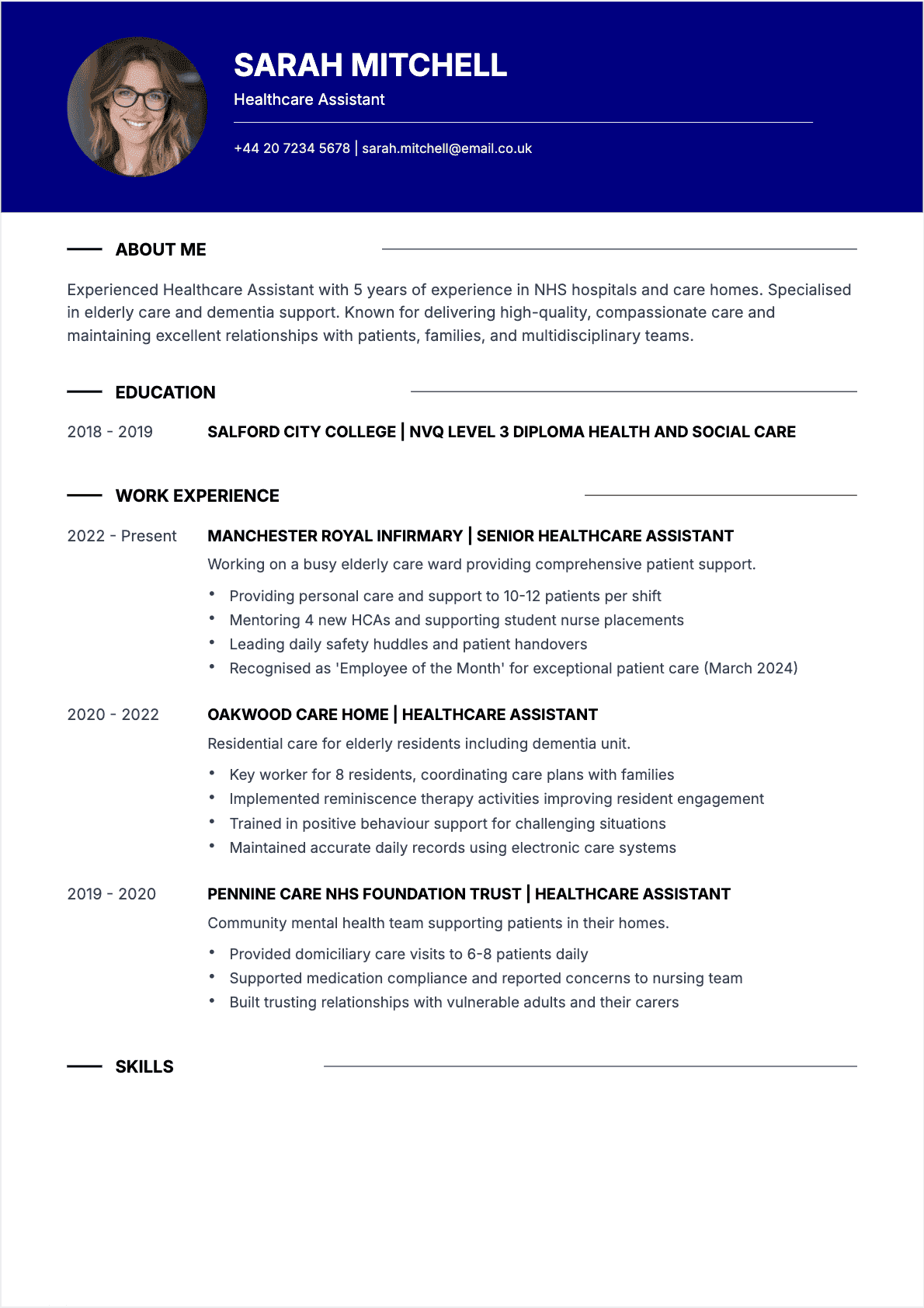
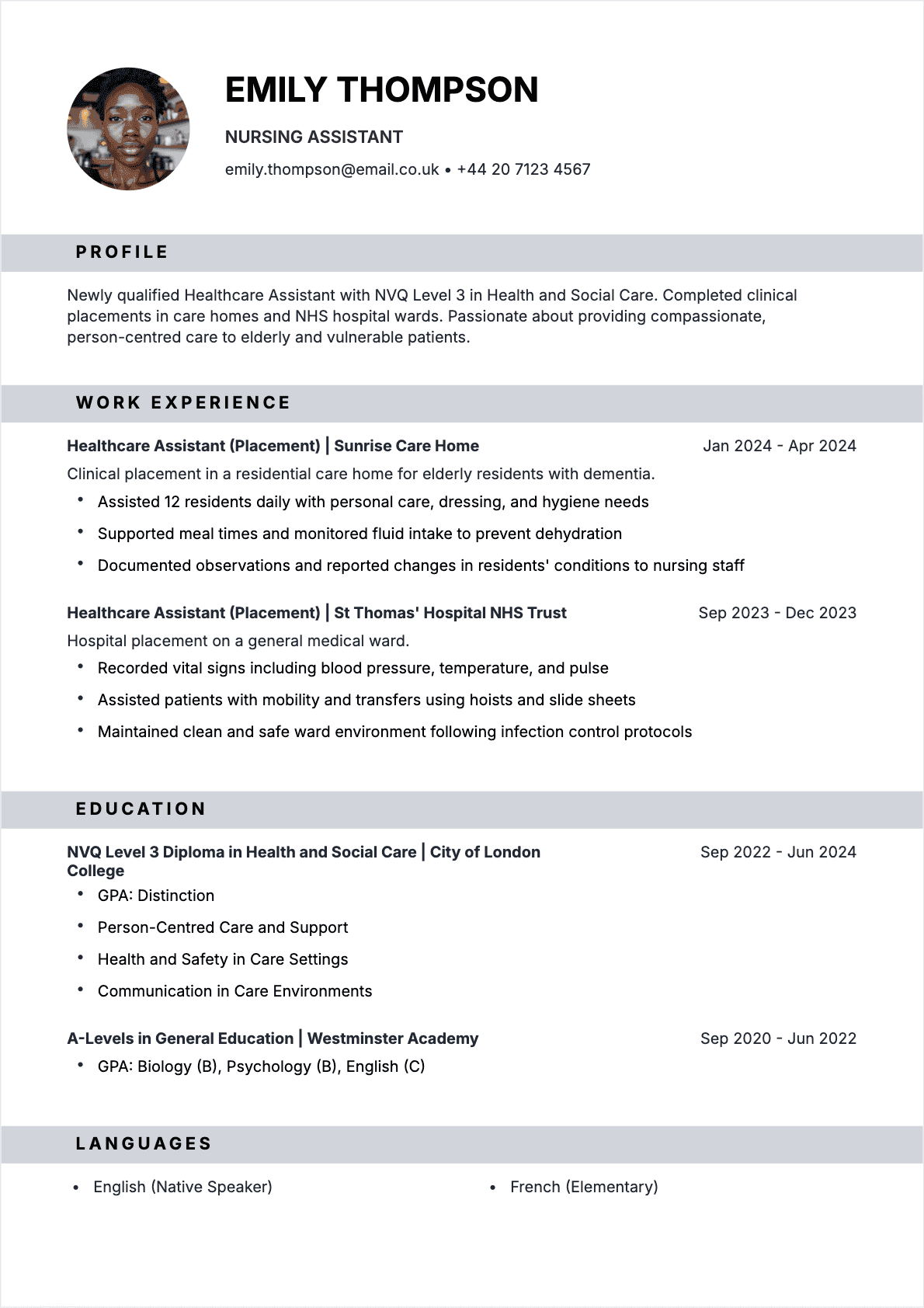
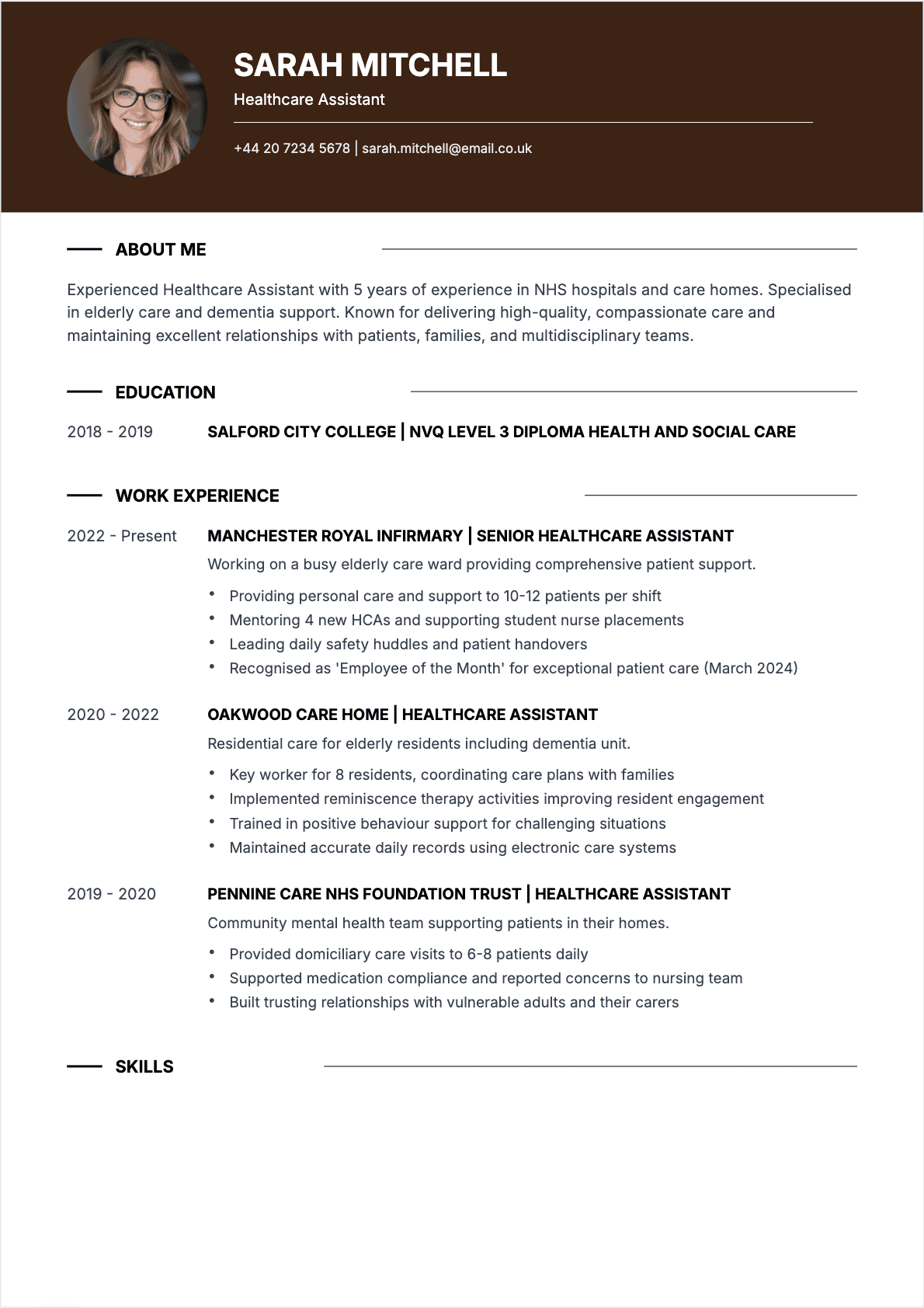
CV Nursing Assistant Beginner
Entry-level template to present clinical rotations, caregiver experience, and core patient care skills (ADLs, vital signs, infection control). Optimized for CNA postings and ATS screening.
Utiliser
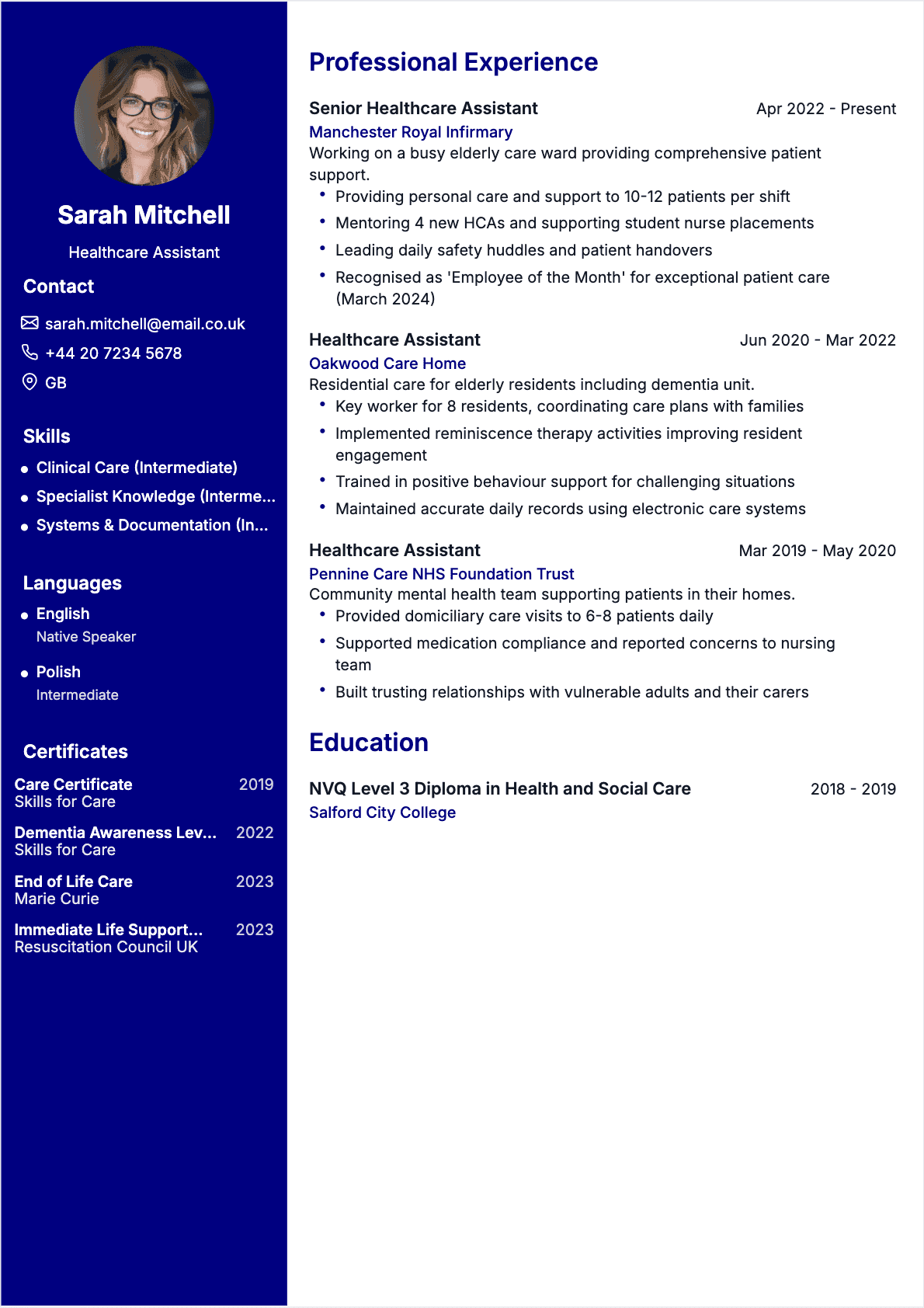
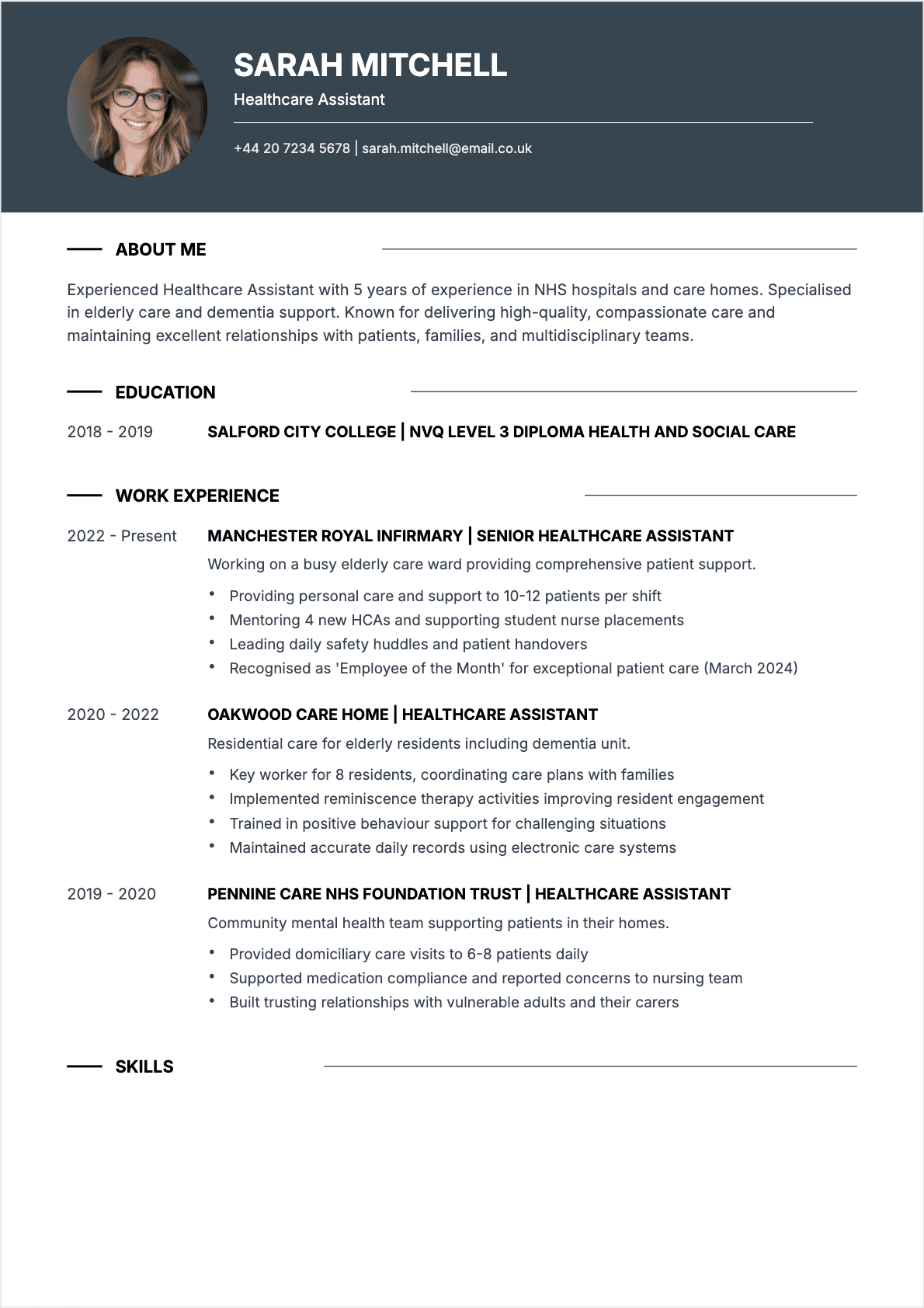
CV Nursing Assistant Intermediate
For 3–7 years: emphasizes workload volume, safety metrics, and EHR documentation. Built to showcase teamwork with nursing staff, patient satisfaction, and consistent performance across shifts.
Utiliser
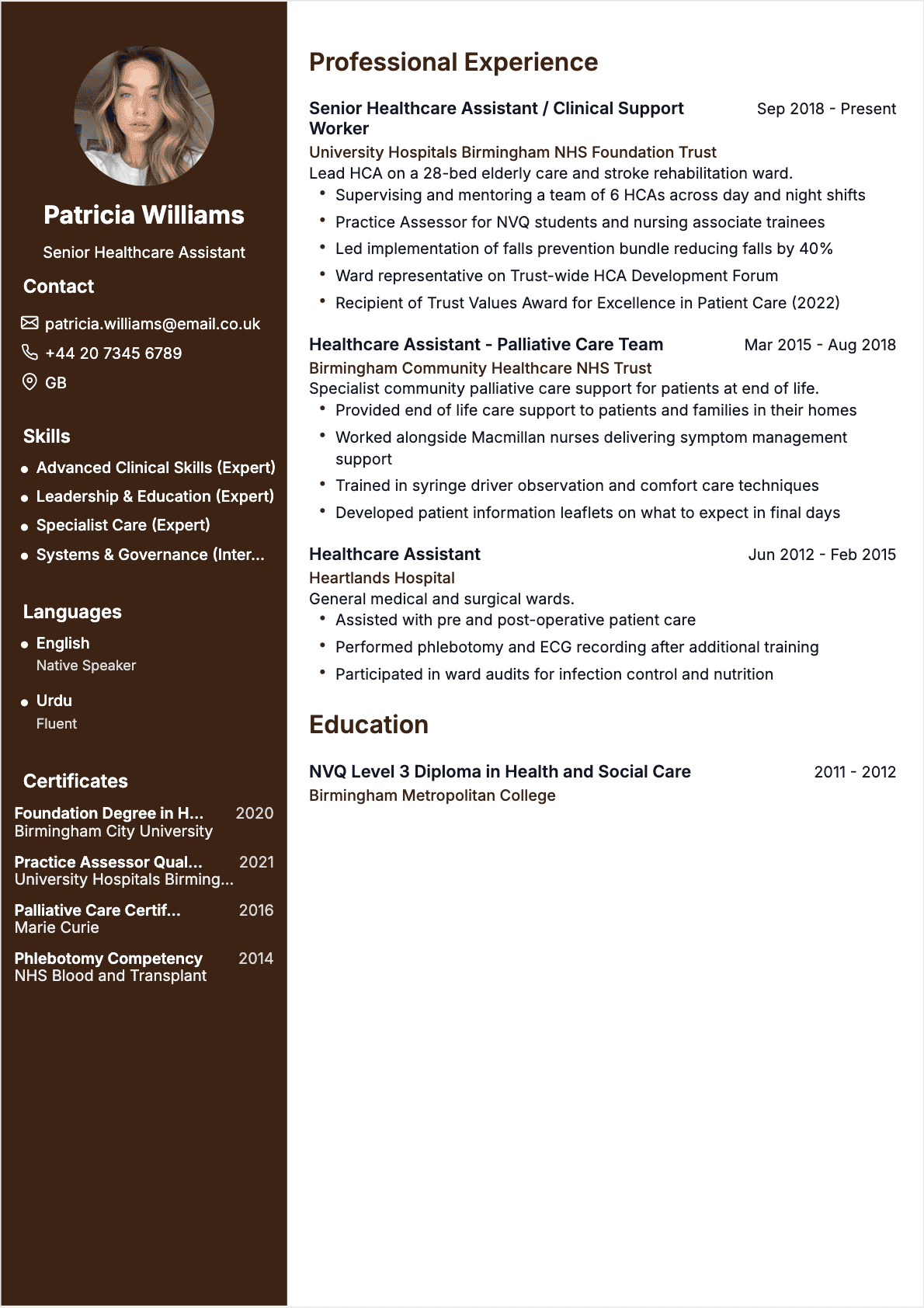
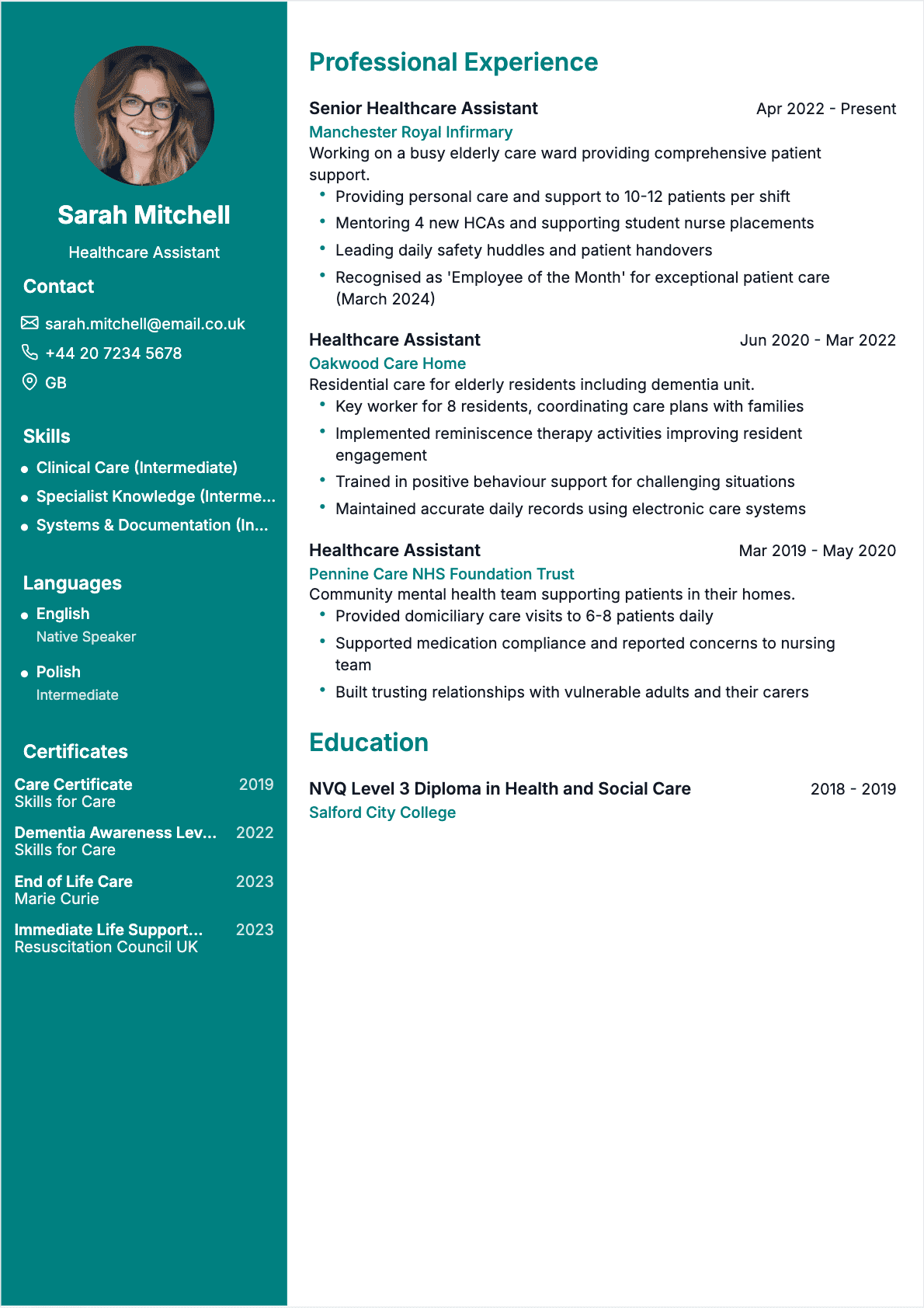
CV Nursing Assistant Senior
Senior template highlighting charge-support duties, precepting, dementia care, and quality initiatives. Focus on quantified outcomes: falls reduction, timely rounding, and stronger documentation compliance.
UtiliserPerfect CV Checklist - CV Nursing Assistant
Check each item to ensure your CV is complete and optimized.
Professional Summary - CV Nursing Assistant
The professional summary is the first thing recruiters see. It should summarize your profile in a few impactful lines.
“Certified Nursing Assistant with 5 years of experience in providing care in hospital and nursing home units (10–12 patients/shift). Strong patient care skills in ADLs, vitals, and safe transfers; documented 45+ tasks/shift in Epic and PointClickCare and helped cut call-light response time by 18%.”
“Motivated, dynamic, and passionate nursing assistant available immediately, ready to help patients and learn quickly in any environment.”
Why is it effective?
Le bon exemple est efficace car il :
- Identifies scope and setting (hospital + nursing home) and signals fit for common nursing assistant role requirements
- Quantifies workload and impact (patients/shift, 45+ tasks, 18% faster response) to prove performance
- Names real tools (Epic, PointClickCare) and practical skills and experience recruiters screen for
- Uses job-relevant keywords naturally, which helps ATS match a targeted resume to keywords from the job
Le mauvais exemple échoue car il :
- Uses clichés instead of responsibilities and achievements a manager can verify
- Gives zero numbers, so the resume emphasizes personality rather than outcomes
- Lacks unit context (LTC, med-surg, pediatric nursing, rehab), making it hard to place you
- Doesn’t show certifications on your resume, tools, or patient safety competence
Professional experience examples
Here are examples of professional experiences. Note how results are quantified.
Certified Nursing Assistant (CNA) – Med-Surg
HCA Healthcare, Jacksonville, FL
Supported a 32-bed med-surg unit on day/night rotation within a 6-person CNA team and 12 RNs. Covered 10–12 patients per shift, focusing on ADLs, mobility, vital signs, and EHR documentation under high throughput and frequent admissions/discharges.
Key Achievements
Key skills for your resume
Here are the technical and soft skills most sought after by recruiters.
Hard skills (clinical & tools)
Technical Skills
- Activities of daily living (ADLs): bathing, toileting, feeding, grooming
- Vital signs monitoring: BP, temperature, pulse, respirations, SpO₂
- Epic (EHR documentation)
- PointClickCare (LTC charting, ADL tracking)
- Safe patient handling: gait belt, Hoyer lift, slide board transfers
- Intake/output (I&O) tracking and rounding logs
- Infection prevention: PPE, isolation precautions, hand hygiene auditing
- Skin integrity support: repositioning schedules and pressure ulcer prevention
Soft skills that hiring managers evaluate
Soft Skills
- Clear shift handoffs using SBAR-style updates
- De-escalation and calm presence with confused or distressed patients
- Prioritization under high task volume and time constraints
- Respectful patient communication and privacy awareness (HIPAA mindset)
- Teamwork with registered nurse direction and multidisciplinary rounding
- Situational awareness for patient safety risks (falls, elopement, aspiration)
- Accurate reporting of abnormal findings and timely escalation
- Family communication within scope and facility policy
ATS Keywords to Include
ATS systems filter CVs based on specific keywords. Include these terms to maximize your chances.
ATS Tip
Click on a keyword to copy it. ATS systems filter CVs based on these exact terms.
Mots-clés importants
Hiring Sectors
Discover the most promising sectors for your career.
Hospitals (med-surg, telemetry, float pools)
Nursing home and long-term care (LTC)
Skilled nursing facilities (SNF)
Home health and private duty care
Rehabilitation centers (post-acute)
Assisted living and memory care
Education & Degrees
Nursing assistant pathways vary by country and employer, but recruiters consistently want proof of safe patient handling, infection control, and supervised clinical experience. In the US, many candidates complete a state-approved Nurse Aide training program (often 4–12 weeks) followed by a competency exam to become a certified nursing assistant.
You can also enter through adult education centers, community colleges, or employer-sponsored programs in long-term care facilities. If you have limited formal education, lean on clinical experience: rotations, externships, home care, or volunteer roles with documented patient contact.
Recommended Degrees
- State-Approved Nursing Assistant Training Program (CNA Program)
- High School Diploma or GED
- Patient Care Technician (PCT) Certificate
- Health Sciences Certificate (Community College)
- Associate Degree in Nursing (ADN) coursework (in progress)
- Bachelor's Degree (any field) + CNA certification (if applicable)
Languages
Languages can be a practical advantage for nursing assistants because patient understanding affects safety, comfort, and compliance. In many urban hospitals and long-term care settings, bilingual CNAs help reduce misunderstandings during ADLs, pain checks, and discharge instructions (within scope).
- Communicating with patients and families during admissions and daily rounding
- Supporting dementia caregiving where tone and clarity reduce agitation
- Coordinating with a multicultural medical team across shifts
Present your level clearly (Native/Fluent/Proficient/Intermediate) and add a medical context when relevant (e.g., “Fluent Spanish – patient intake and bedside communication”).
English
Native
Spanish
Proficient
Haitian Creole
Intermediate
Recommended certifications
Certifications on your resume are often the fastest screening shortcut for hiring teams. A certified nursing assistant credential is typically required; CPR/BLS is frequently required in hospitals and strongly preferred in post-acute care. Add dementia and safety certificates as differentiators, especially for a nursing home or memory care setting.
Mistakes to avoid
Listing duties instead of measurable results
Many nursing assistant resumes repeat the same bullet points (“helped patients,” “took vitals”) and look identical. The issue is that hiring managers can’t tell your pace, reliability, or impact on patient safety. Replace generic tasks with volume, accuracy, and outcomes: patients per shift, transfers per day, documentation timeliness, and safety contributions.
Toujours inclure :
- Patient load (e.g., 10–12 patients/shift) and shift type (day/night, float)
- Documentation metrics (e.g., 95–98% on-time charting) and EHR used
- Safety outcomes (falls, skin integrity checks, isolation compliance)
A simple formula: Action verb + scope + tool + metric + result.
Using an ATS-hostile layout
Two-column designs, icons, text boxes, and header graphics can break parsing, so the ATS may misread dates, job titles, or your certified nursing assistant credential. If your application disappears, it’s often formatting—not experience. Use a clean template with standard headings and avoid placing critical information in the page header.
À éviter : "CNA | 2021–2025" placed inside a graphic banner with icons and no plain text
À privilégier : "Certified Nursing Assistant (CNA) — HCA Healthcare | Apr 2021 – Nov 2025" as standard text
This is the fastest way to make your resume readable by both software and humans.
Missing scope-of-practice clarity
Facilities want safe delegation. If your resume blurs boundaries (e.g., implying medication administration when your role didn’t allow it), you can be screened out. Be precise: what you observed, documented, assisted with, and escalated to the RN/physician.
À mentionner :
- Vital signs, I&O, mobility assistance, and ADLs completed independently
- What you reported (abnormal vitals, new confusion, skin issues) and to whom
- Unit type (rehab, med-surg, memory care) and patient population (geriatrics, pediatrics)
Not tailoring keywords to each posting
CNA job ads vary: one may prioritize dementia care, another may prioritize telemetry support or isolation precautions. Sending one generic resume reduces match rate because ATS scoring relies on keywords from the job and role-specific phrasing.
Checklist :
- Mirror the posting’s terms (e.g., “PointClickCare,” “safe patient handling,” “rounding”) where truthful
- Reorder bullets so the most relevant skills appear at the top of your resume
- Keep a “master resume,” then create a targeted resume in 10–15 minutes per application
Expert tips
- 1
Choose one target setting : Decide if you’re applying to hospital, SNF, or home health; then adjust patient ratios, tools, and achievements so your resume to show fit is immediate.
- 2
Use a metrics bank : Track your typical patients/shift, transfers/day, and charting volume. Add at least 4 numbers per role so assistant resumes don’t read like generic task lists.
- 3
Name the EHR : Epic, Cerner, and PointClickCare are concrete signals. Pair them with what you charted (ADLs, vitals, I&O) to showcase your skills and reduce onboarding risk.
- 4
Write a sharp resume objective only if needed : If you have no experience, a brief resume objective can frame clinical training, volunteer hours, and the unit type you’re targeting.
- 5
Strengthen the skills section : Use 6–10 relevant skills, mixing clinical skills and communication skills. Avoid vague traits; write skills and knowledge that can be observed on shift.
- 6
Add one differentiator : Dementia training, pressure ulcer prevention, or bilingual bedside communication can make your resume stand out in nursing home settings and high-demand units.
- 7
Run a resume checker : Before applying, test parsing and keyword coverage. Even simple checks can prevent missing dates, mismatched titles, or unreadable certifications on your resume.
Frequently asked questions
Find answers to the most frequently asked questions.
Often optional, but useful when you’re changing settings (e.g., home care to hospital) or have employment gaps. Keep it to 150–250 words, reference the job description, and add 2 quantified examples (patients/shift, documentation accuracy, safety outcomes). If the posting requests it, submit one.
Copy the posting into a notes doc, highlight repeated terms (unit type, EHR, ADLs, dementia care, transfers), and reflect those exact phrases where truthful. Then reorder bullets so the most relevant responsibilities and achievements appear first. This helps both ATS scoring and human scanning.
Lead with education and clinical experience: CNA program, clinical hours, skills check-offs, and supervised rotations. Add healthcare-adjacent roles (caregiver, dietary aide) with numbers (clients/week, tasks/shift). Use a short resume objective, and include certifications (CNA, BLS) at the top.
In the US, a resume is the standard and is usually 1 page; a CV is longer and more common in academia. If an employer asks for a nursing assistant cv, you can still use a one-page resume format, but add optional sections like training hours, volunteer work, and extra courses if relevant.
Most nursing assistant resumes should be 1 page for 0–7 years. If you have 8–10+ years, multiple facilities, and specialized units (rehab, memory care), 2 pages can be acceptable—only if every bullet is relevant, quantified, and tailored to the posting.
Start with your Certified Nursing Assistant credential (state registry). Add BLS (AHA) if you have it, plus facility-relevant training like dementia care (NCCAP CDP), HIPAA, and OSHA Bloodborne Pathogens. List the issuing organization and expiration dates to reduce compliance questions.
Build your CV Nursing Assistant resume in minutes
Use our resume builder to choose a clean template, add CNA-ready sections, and generate bullet points with metrics. Export as PDF and apply with a targeted resume.
Create my Resume