CV Physician : Physician CV guide 2026
This guide shows you how to write a physician cv (curriculum vitae) with the right sections, medical training details, and quantified accomplishments. Use a clear format, a template, and role-specific keywords to help employers and recruiters shortlist you faster.
Key Takeaways
A physician cv is more than a hiring document: it is the record that supports recruitment, credentialing, and (in academic settings) promotion decisions. In the US, the AAMC has projected a physician shortage of 37,800 to 124,000 physicians by 2034, which means employers move fast—but still expect precise, verifiable information.
A strong CV Physician should demonstrate:
- Clinical scope and outcomes using measurable data (volume, safety, access)
- Training and licensure details that credentialing teams can audit
- Academic output (publication, presentation) and leadership impact where relevant
Use this guide to choose the right format, select a template, and turn day-to-day responsibilities into quantified accomplishments.
CV Examples - CV Physician
Discover our CV templates adapted to all experience levels. Each example is ATS-optimized.

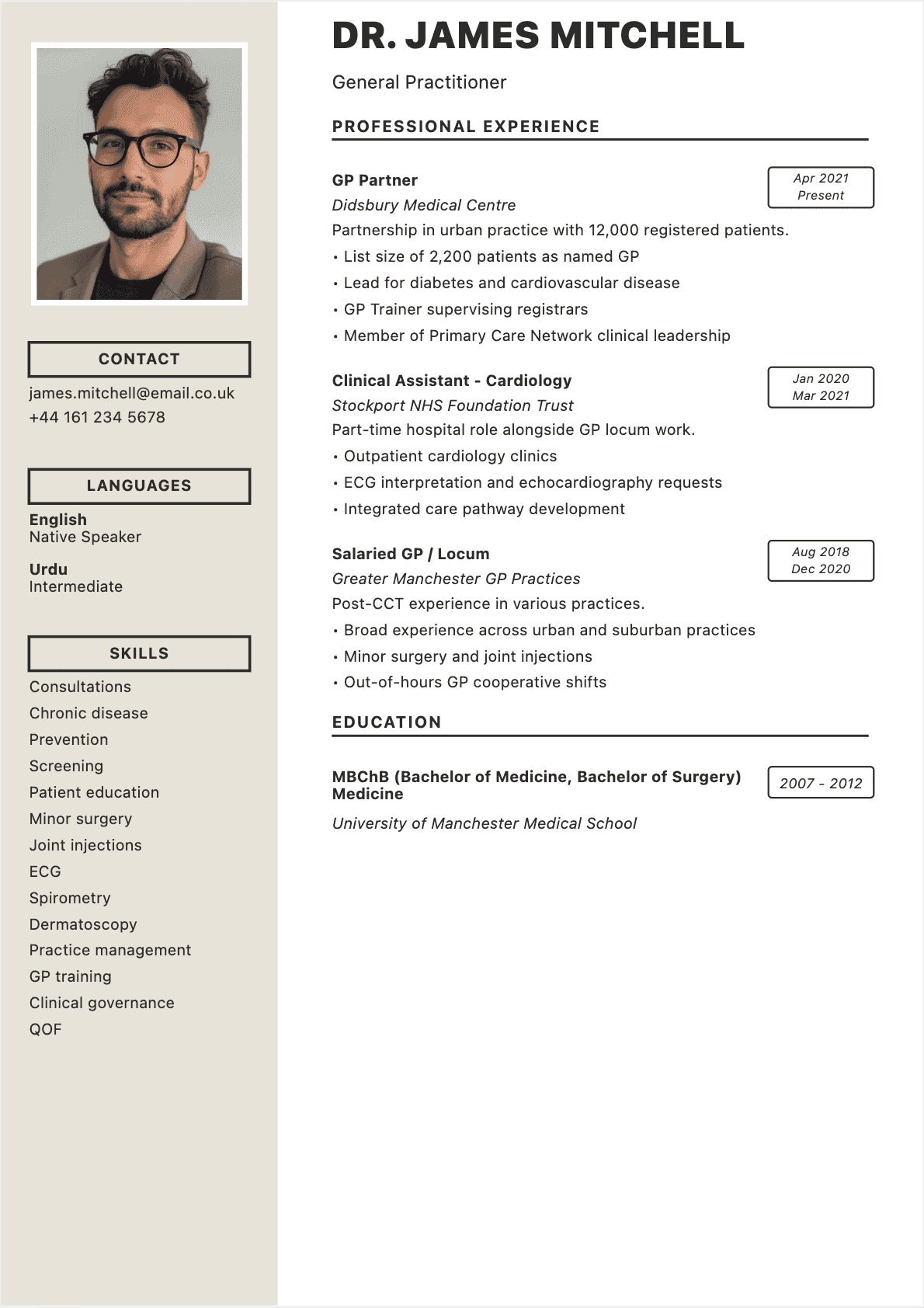
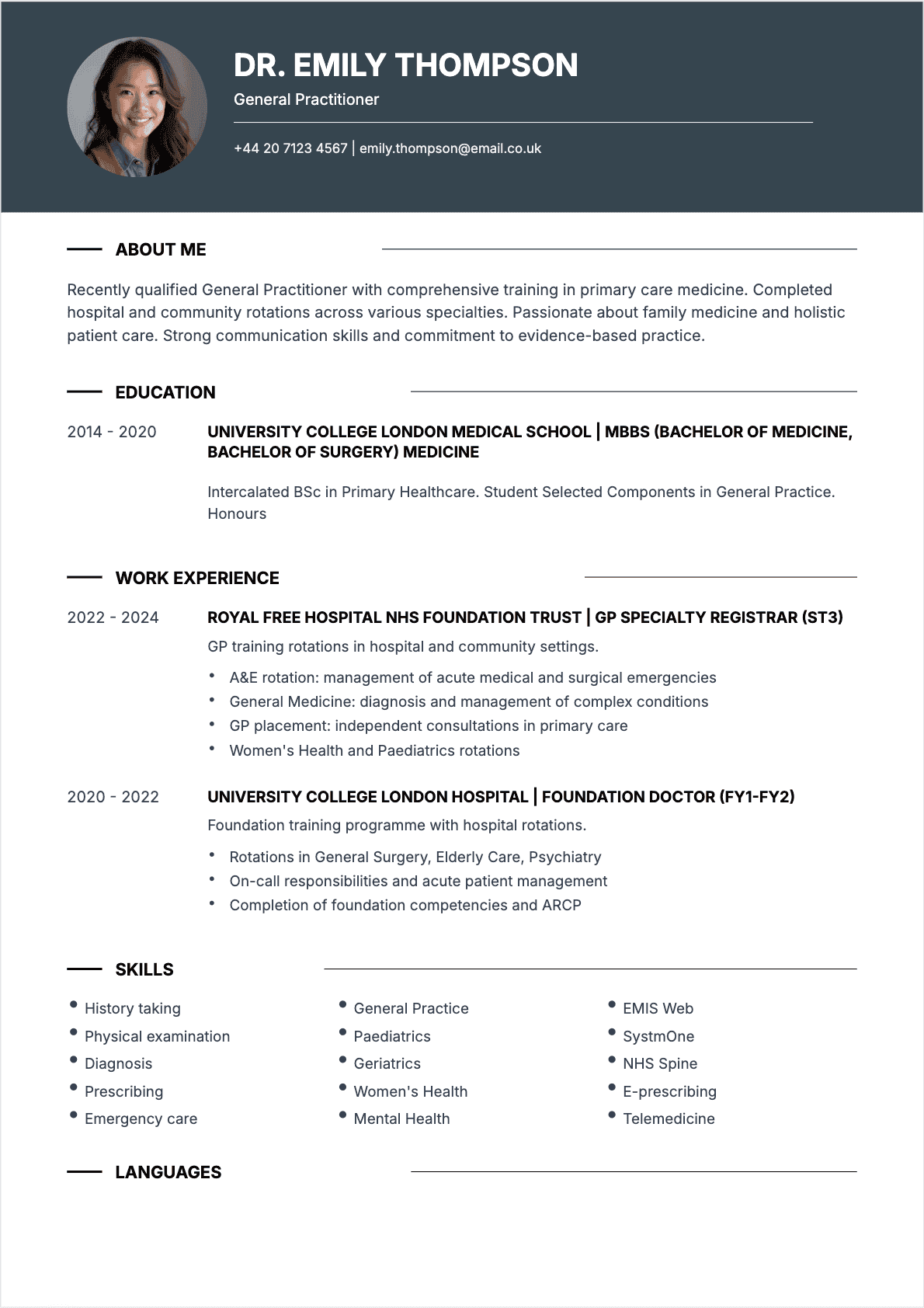
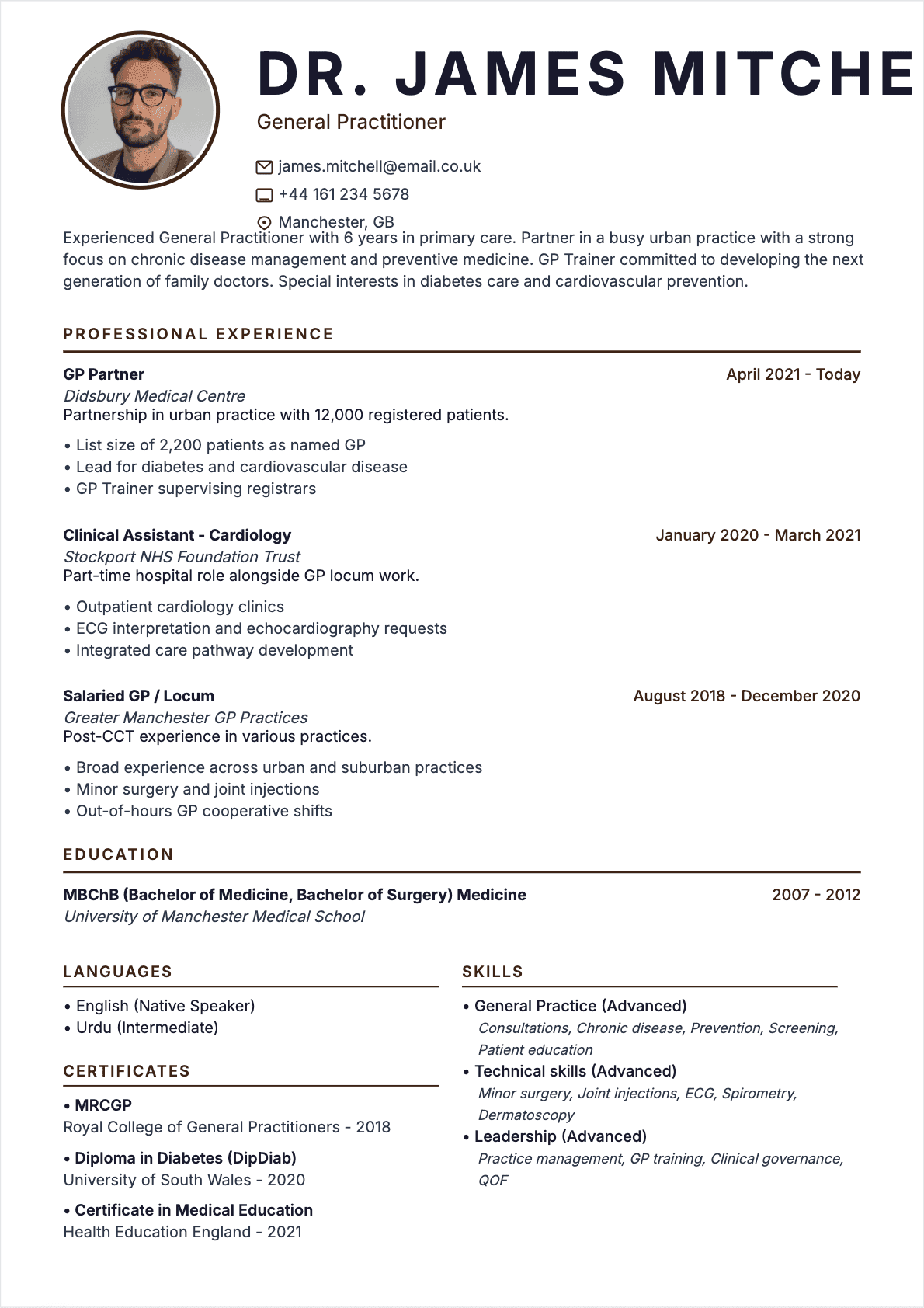
CV Physician Beginner
For medical students, residents, and new physician profiles: clear training timeline, supervised clinical exposure, board exam milestones, and measurable quality or research contributions in a one-page-to-two-page structure.
Utiliser
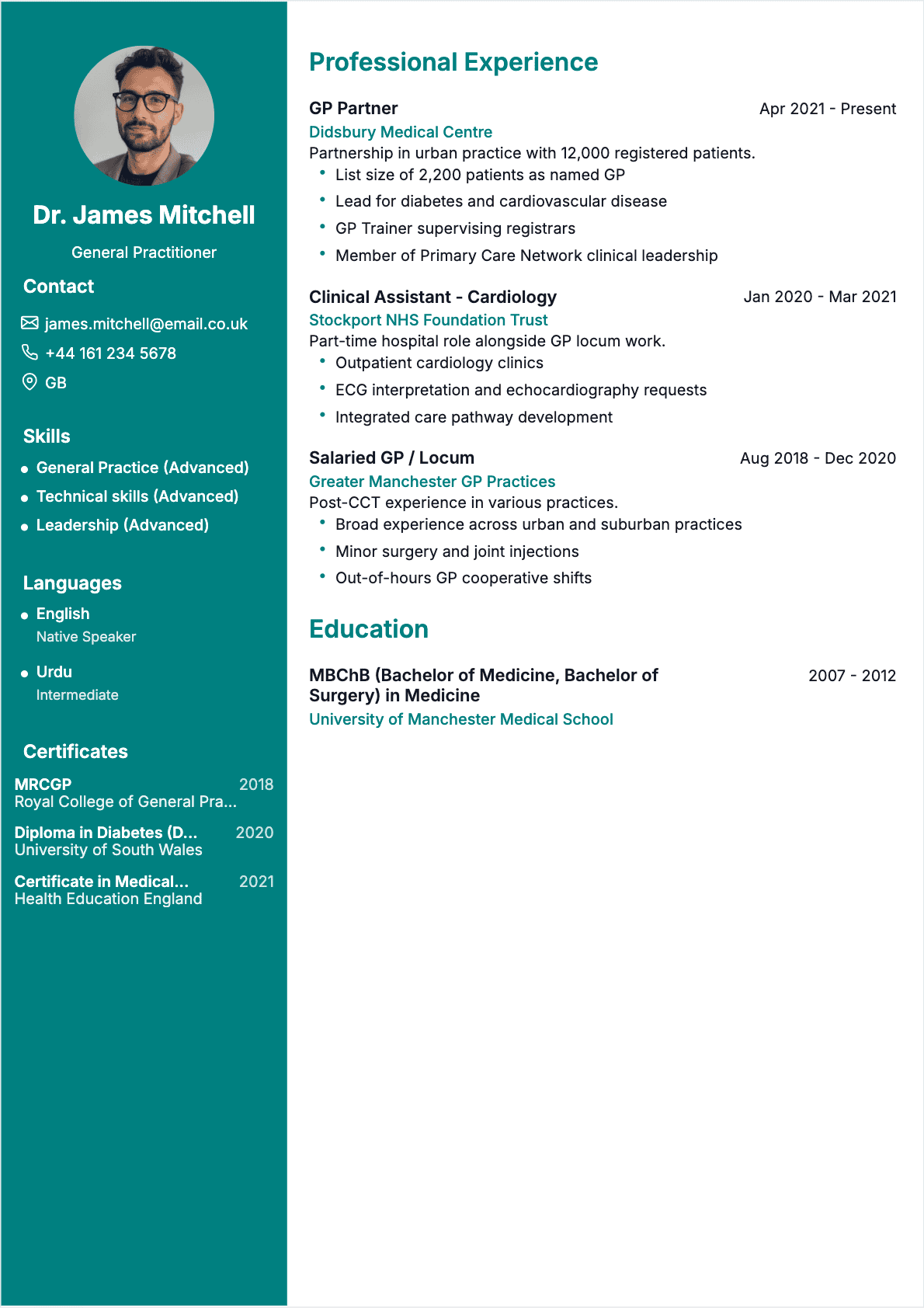
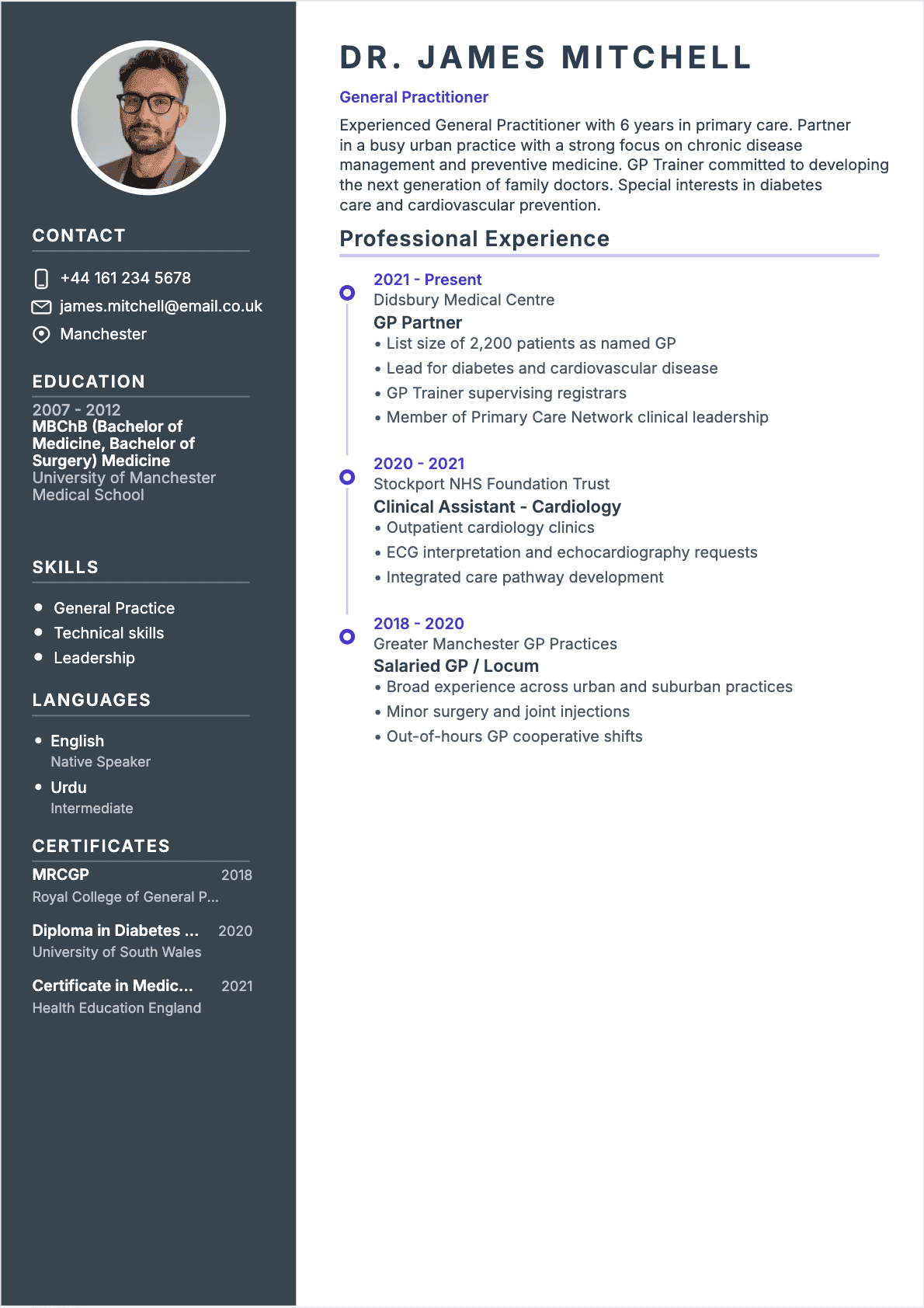
CV Physician Intermediate
For 3–7 years’ experience: emphasize independent clinical scope, leadership roles, throughput and safety metrics, publications, and committee work. Built to communicate impact to an employer and credentialing teams.
Utiliser
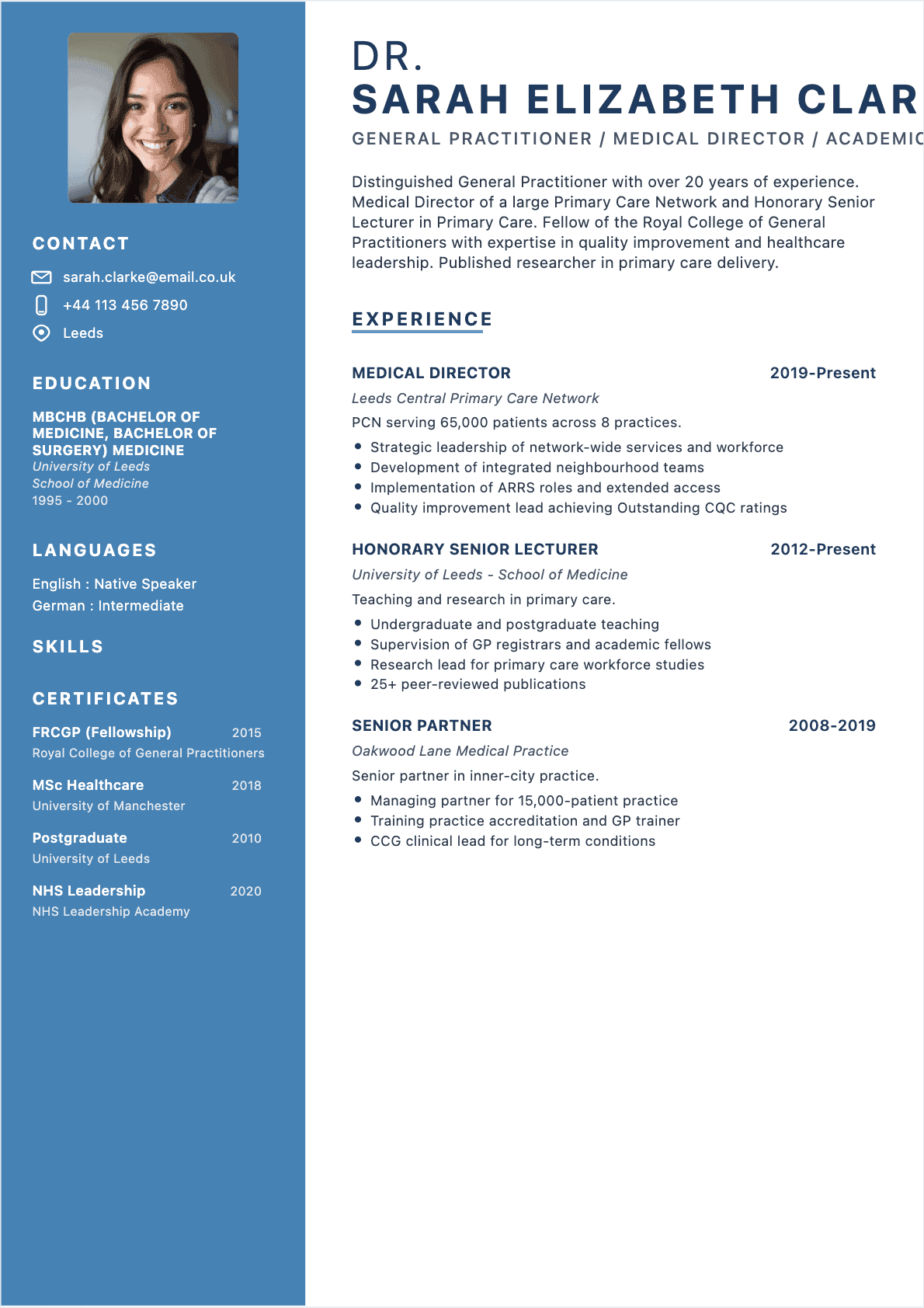
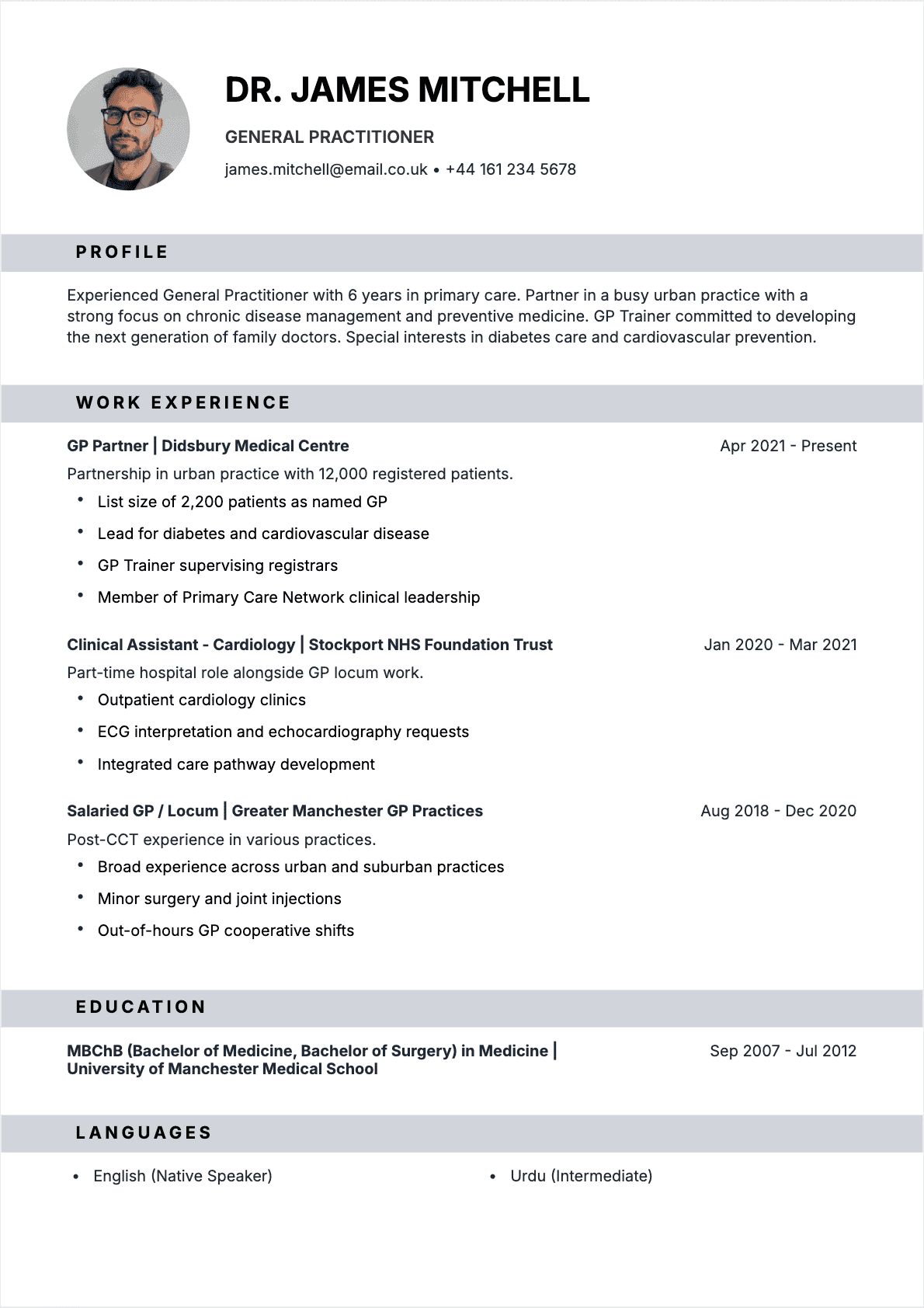
CV Physician Senior
For senior physicians: highlight service line leadership, faculty appointment activity, promotion readiness, outcomes dashboards, grants, and system-wide initiatives. Optimized for academic medicine and executive recruitment workflows.
UtiliserPerfect CV Checklist - CV Physician
Check each item to ensure your CV is complete and optimized.
Professional Summary - CV Physician
The professional summary is the first thing recruiters see. It should summarize your profile in a few impactful lines.
“Board-eligible internal medicine physician with 6+ years across residency and attending roles in a 450-bed health system. Managed 18–22 inpatients/day, reduced 30-day readmissions from 14.2% to 11.9%, and improved sepsis bundle compliance to 86% using Epic, Power BI, and multidisciplinary QI methods.”
“Motivated, dynamic, passionate physician seeking a challenging role. Great team player, available immediately, and willing to learn anything.”
Why is it effective?
Le bon exemple est efficace car il :
- Donne un niveau et un périmètre vérifiables (résidence + rôle d’attending, type d’établissement)
- Chiffre l’impact clinique (readmissions, conformité sepsis) au lieu de décrire seulement la responsabilité
- Cite des outils concrets (Epic, Power BI) pour crédibiliser la contribution
- Met en avant des résultats utiles à l’employer (qualité, sécurité, performance)
Le mauvais exemple échoue car il :
- Utilise des clichés sans preuve (“motivated”, “dynamic”, “passionate”)
- Ne précise ni spécialité, ni volume, ni contexte clinique
- Ne contient aucun accomplishment mesurable
- Ne donne aucun élément différenciant pour distinguer le candidate
Professional experience examples
Here are examples of professional experiences. Note how results are quantified.
Attending Physician, Internal Medicine (Hospitalist)
HCA Healthcare, Austin, TX
Hospitalist in a 300-bed community hospital with a 10-physician group. Covered day shifts and cross-coverage; collaborated with ICU, ED, and case management to improve length of stay, reduce readmissions, and standardize sepsis pathways.
Key Achievements
Key skills for your resume
Here are the technical and soft skills most sought after by recruiters.
Hard skills (clinical, technical, documentation)
Technical Skills
- Inpatient and outpatient clinical management (adult medicine)
- Differential diagnosis, evidence-based treatment planning
- Electronic Health Records (Epic)
- Electronic Health Records (Cerner)
- Quality improvement (PDSA, root cause analysis)
- Clinical documentation improvement (CDI) practices
- Procedural skills aligned to specialty (e.g., central line assistance, paracentesis—if applicable)
- Research methods (IRB process, data abstraction, manuscript preparation)
Soft skills (how you work with patients and teams)
Soft Skills
- Clear risk communication with patients and families
- Structured clinical handoffs (SBAR-style clarity)
- Interdisciplinary coordination with nursing, pharmacy, case management
- Prioritization under time constraints and fluctuating census
- Conflict de-escalation in high-stress clinical settings
- Teaching and supervision of residents and medical students
- Ethical decision-making and boundary setting
- Reliability in documentation, follow-through, and patient transitions
ATS Keywords to Include
ATS systems filter CVs based on specific keywords. Include these terms to maximize your chances.
ATS Tip
Click on a keyword to copy it. ATS systems filter CVs based on these exact terms.
Mots-clés importants
Hiring Sectors
Discover the most promising sectors for your career.
Academic medical centers
Community hospitals and health systems
Private practice groups
Federally Qualified Health Centers (FQHCs)
Telemedicine providers
Government and public health organizations
Education & Degrees
Physician training is evaluated as a continuum, so your education section should read like an audit trail: undergraduate degree, medical school, residency, and any fellowship or chief resident role. If you are applying in academic medicine, include research training and teaching appointments; if you are applying to community practice, keep the focus on clinical training, supervision level, and scope.
Different routes exist (MD, DO, MBBS), but clarity matters more than prestige: list institution, city, dates, and key distinctions (honors, tracks, scholarly concentrations). If you are early-career, education can sit above experience; mid-career and beyond, let outcomes and leadership lead.
Recommended Degrees
- Doctor of Medicine (MD)
- Doctor of Osteopathic Medicine (DO)
- MBBS (Bachelor of Medicine, Bachelor of Surgery)
- Master of Public Health (MPH)
- Master of Science in Clinical Investigation (MSCI)
- Bachelor’s degree in Biology, Biochemistry, or related field
Languages
Languages can affect patient safety, consent quality, and care access—especially in emergency care, primary care, and hospital discharge planning. If you work with multilingual populations, documenting proficiency helps a prospective employer plan coverage and compliance (use of interpreters, bilingual documentation policies).
- Direct patient encounters and informed consent discussions
- Coordination with families, community resources, and care transitions
- Academic collaboration and conference participation
Present your level clearly and add a recognized test when relevant (for example, OET or IELTS for international mobility). Avoid overstating: your cv should match real clinical communication ability.
English
Native
Spanish
Fluent
French
Intermediate (DELF B1)
Recommended certifications
Certifications are screened early in recruitment and credentialing, so list them with dates (and expiration when applicable). Some are mandatory for practice setting (BLS/ACLS), while board certification or eligibility is a major differentiator. For international pathways, ECFMG status can be decisive.
Mistakes to avoid
Leaving credentialing details vague or inconsistent
A physician cv is often used as a source document for credentialing, so missing or inconsistent dates create delays and can trigger extra verification. Small gaps (a 3-month mismatch between residency end date and first attending role) can stall onboarding, especially when the recruiter hands your document to medical staff services.
Toujours inclure :
- Full legal name used for licensing, plus NPI (if you have one) and state license status
- Exact training dates (month/year) for medical school, residency, fellowship
- Board status (certified vs board-eligible) with year and specialty
Use one rule everywhere: Month YYYY, and keep the same structure for every entry to make it audit-friendly.
Writing responsibilities instead of accomplishments
Many cvs describe what the role required (“provided inpatient care”) but fail to prove impact. Employers compare candidates quickly; without measurable outcomes, your document becomes interchangeable. Translate responsibilities into changes you drove: access, safety, cost, teaching, or research outputs.
À éviter : "Responsible for rounding on patients and completing notes."
À privilégier : "Rounded on 18–22 patients/day; achieved 95% same-day note completion and improved discharge before noon from 28% to 41% over 6 months."
This makes the contribution comparable and credible across organizations.
Mixing academic content without clear structure
Combining publications, committee work, teaching, and clinical roles in one block forces the reader to hunt for relevant information. In academic settings, reviewers evaluate scholarship and faculty contribution; in non-academic roles, they want clinical scope and operational fit. Separate sections so each reader finds what they need in seconds.
À mentionner :
- Publications and presentations with consistent citation format and dates
- Teaching roles (instructor, preceptor, curriculum contributions) with hours or learner counts
- Leadership roles and committee memberships with outcomes (policy change, protocol adoption)
Using an ATS-unfriendly layout
Complex columns, text boxes, and graphics can break parsing, especially when an employer uses older applicant tracking systems or when a recruiter copies text into a credentialing platform. Your cv should be readable as plain text without losing meaning.
Checklist :
- Use simple headings, one column, and consistent bullets
- Keep section titles standard (Education, Experience, Certifications)
- Export to PDF and confirm copy/paste keeps line order and dates intact
Expert tips
- 1
Use a master CV plus a tailored version : Keep one comprehensive document, then tailor a role-specific cv for each job search by reordering sections and selecting the most relevant clinical metrics and leadership roles.
- 2
Quantify clinical scope safely : Add volume ranges and definitions (e.g., “18–22 inpatients/day, day shift”) and avoid patient-identifying details; numbers should be aggregate and defensible.
- 3
Show EHR and data fluency : Name the EHR (Epic, Cerner) and include one analytics tool (Power BI, Excel) to signal you can support quality dashboards and documentation projects.
- 4
Make research readable : For each publication or abstract, add your role (first author/co-author), journal or conference, year, and PMID/DOI when available.
- 5
Match the employer’s model : If the posting emphasizes throughput, include LOS and discharge metrics; if it emphasizes value-based care, include readmissions, follow-up rates, and patient access improvements.
- 6
Respect reverse chronological order : List information in reverse chronological order so the newest responsibility, appointment, or promotion is visible first without extra scanning.
- 7
Plan a periodic update : Set a recurring calendar reminder to update your cv quarterly; add new committee work, presentations, and outcomes while details are fresh and verifiable.
Frequently asked questions
Find answers to the most frequently asked questions.
A physician cv is typically more detailed than a resume and functions as a professional biography: it documents training, licensure, publications, teaching, and leadership. A resume is shorter and more marketing-focused. For clinical hiring, your cv must support verification, so dates, locations, and board status should be precise and consistent.
Use a clean, one-column format with standard headings and month/year dates. Put contact information at the top, then education and training, then experience, then certifications and licenses. Credentialing teams look for a consistent document structure, clear institutions and cities, and an audit trail that matches primary source verification.
There is no fixed length of a cv, but mid-career physicians are often effective at 3–6 pages depending on publications and leadership scope. Prioritize relevance: keep older training concise, group minor activities, and highlight outcomes and roles tied to the prospective position. Academic candidates may be longer due to scholarship.
Yes, but curate them. Include the most relevant publication items (recent, clinical, guideline-related, or quality improvement work) and keep formatting consistent. One short section is enough. Community employers typically prioritize clinical fit and teamwork, but publications can distinguish you as a candidate and support leadership credibility.
Often, yes—especially when changing specialty focus, relocating, or targeting a faculty appointment. A cover letter can explain the role you want, your clinical niche, and why the organization fits. Keep it one page and align it with your cv accomplishments. See our cover letter resource: /cover-letter.
Update your cv every 3–6 months, or immediately after major events (new certification, committee appointment, presentation, promotion). Maintaining an up-to-date document reduces stress during recruitment and makes credentialing faster. Keep a running list of outcomes, teaching hours, and QI metrics so updates take minutes, not days.
Build your CV Physician cv in minutes
Use CVtoWork to create a physician cv with the right format, specialty keywords, and quantified accomplishments. Start from a template, export to PDF, and tailor fast for each employer.
Create my Resume