CV Chief Financial Officer: executive CFO guide 2025
Build a Chief Financial Officer CV that stands up to board scrutiny and ATS filters. Use the right structure, CFO keywords, and quantified financial outcomes across FP&A, treasury, and reporting to secure interviews.
Key Takeaways
A Chief Financial Officer role in 2025 is judged on measurable outcomes: cash, predictability, governance, and decision support. Hiring committees and boards typically compare candidates on scope (revenue, headcount, entities), complexity (multi-country, IFRS/US GAAP), and repeatable operating cadence (close, forecast, KPI reviews).
Across mid-market and PE-backed companies, CFO searches often prioritize value creation levers such as improving working capital by 10–20 days, shortening month-end close from 10 to 5 days, raising forecast accuracy from ~70% to 90%+, and delivering EBITDA margin gains of 200–500 bps through pricing and cost discipline.
A strong Chief Financial Officer CV must demonstrate:
- Board-ready financial leadership with clear accountability for reporting, controls, and risk
- Quantified value creation across cash, profitability, and capital structure
- Modern finance tooling (ERP, consolidation, planning, BI) tied to tangible cycle-time and accuracy gains
Use the guide below to turn your experience into a CFO narrative that recruiters can scan in 30 seconds and boards can trust in a final-round panel.
CV Examples - CV Chief Financial Officer
Discover our CV templates adapted to all experience levels. Each example is ATS-optimized.

CV Chief Financial Officer Beginner
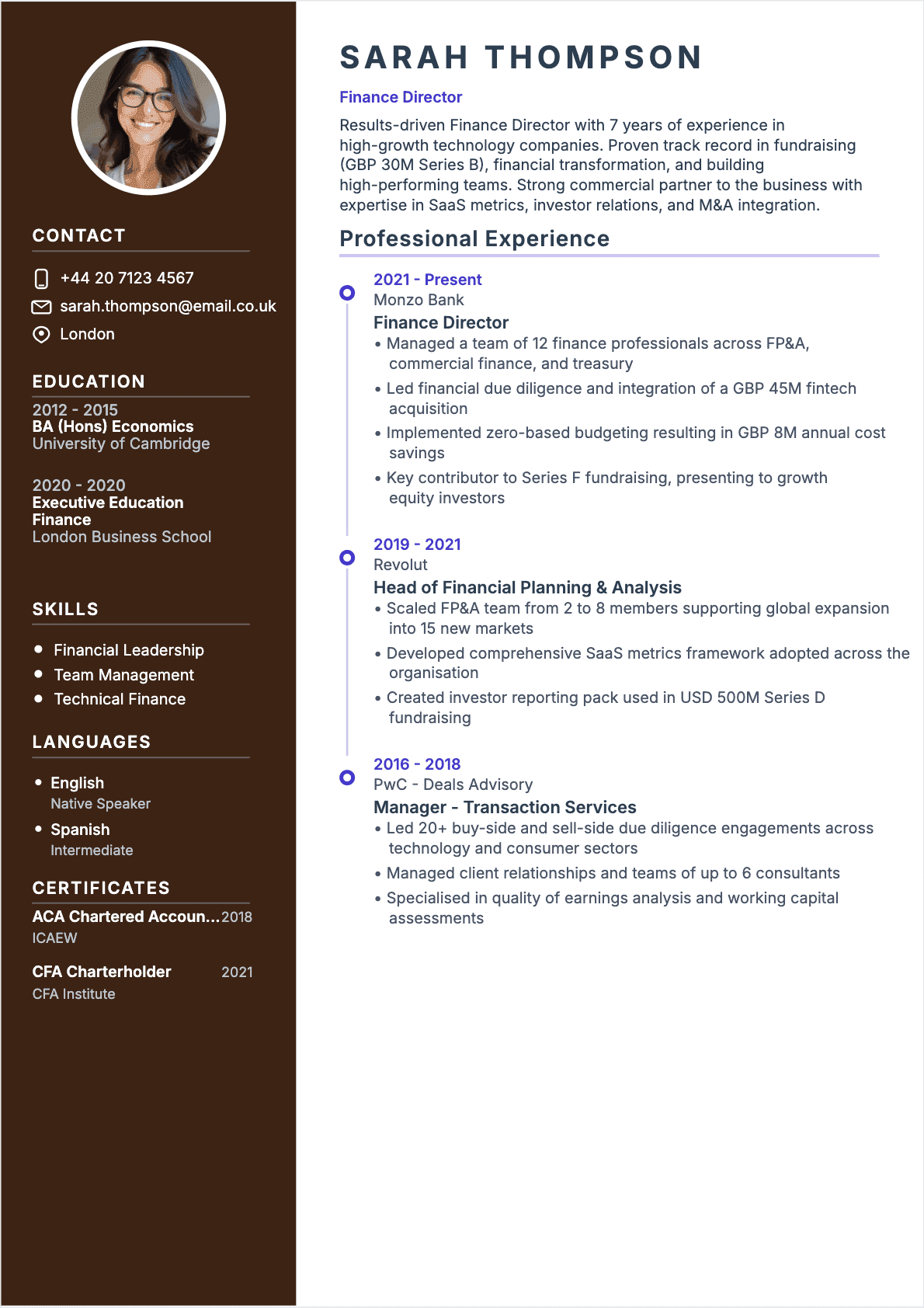
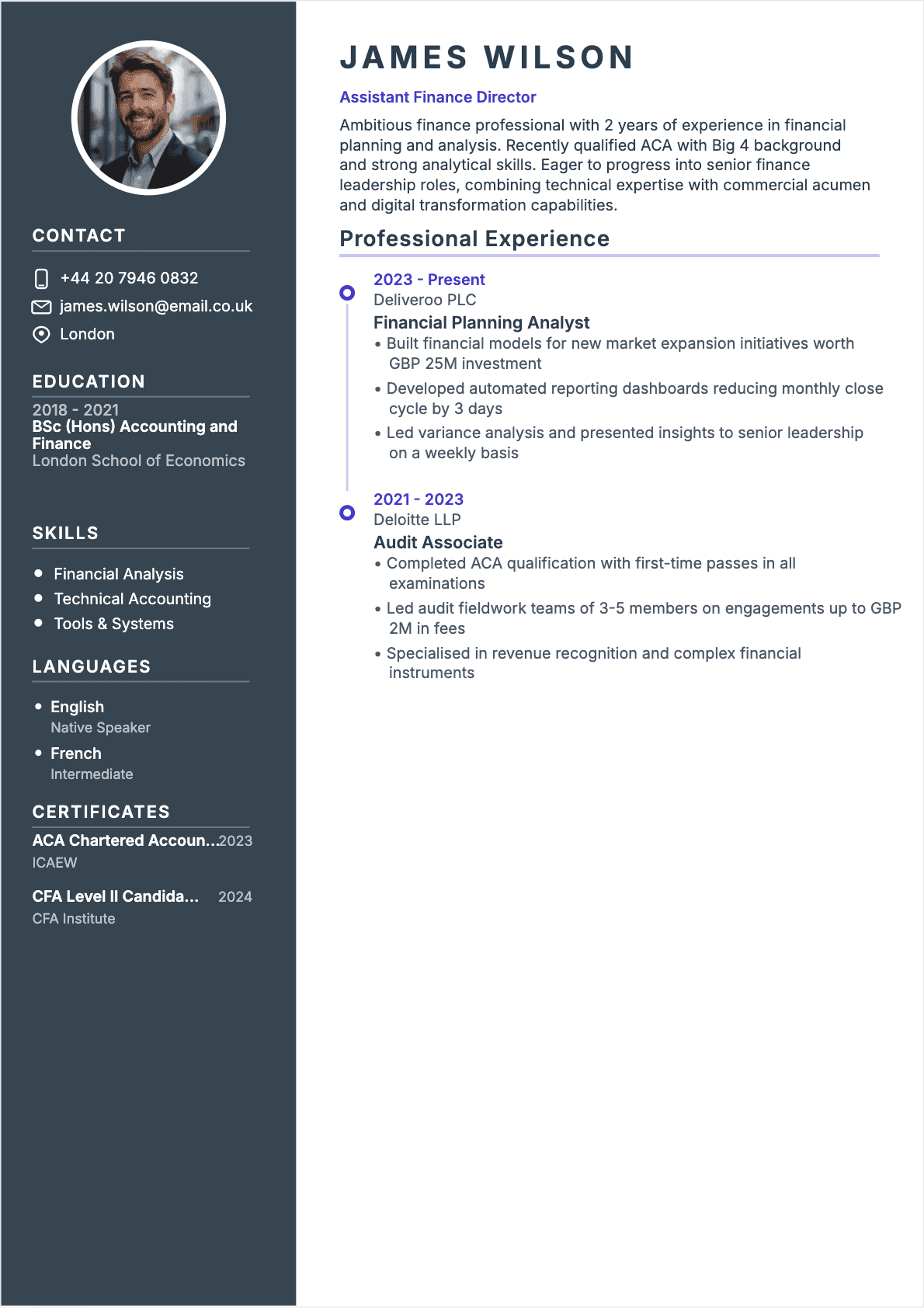
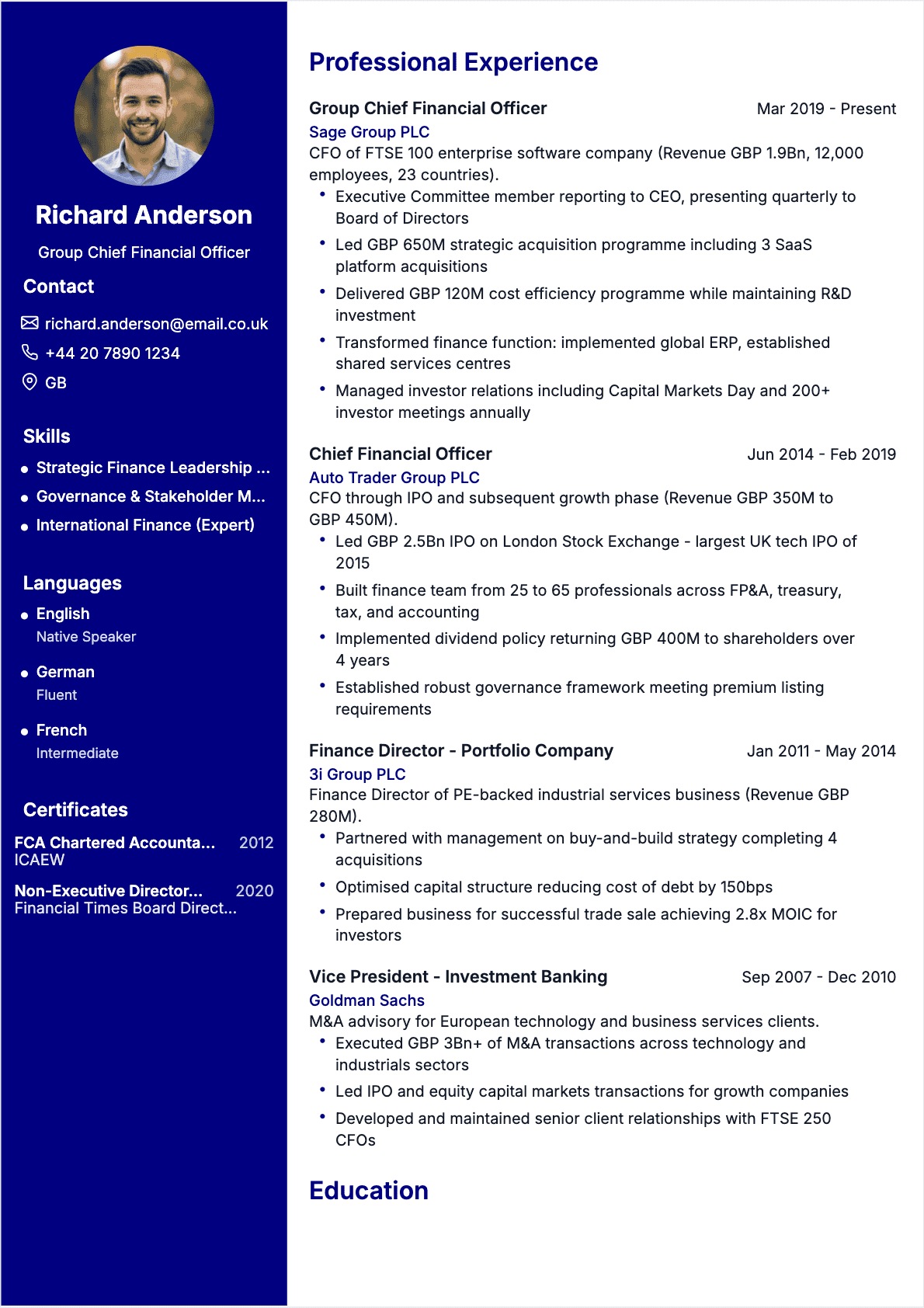
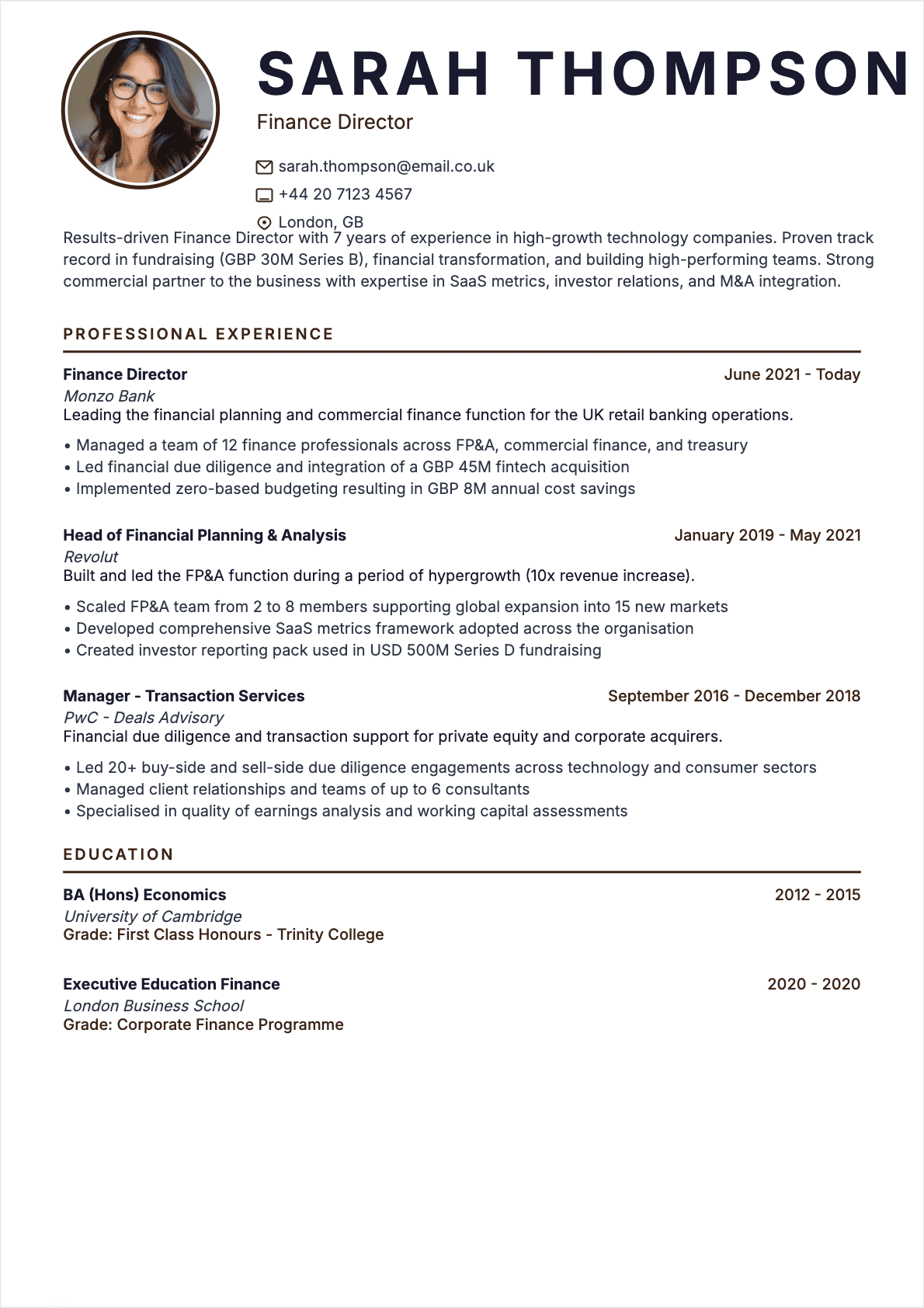
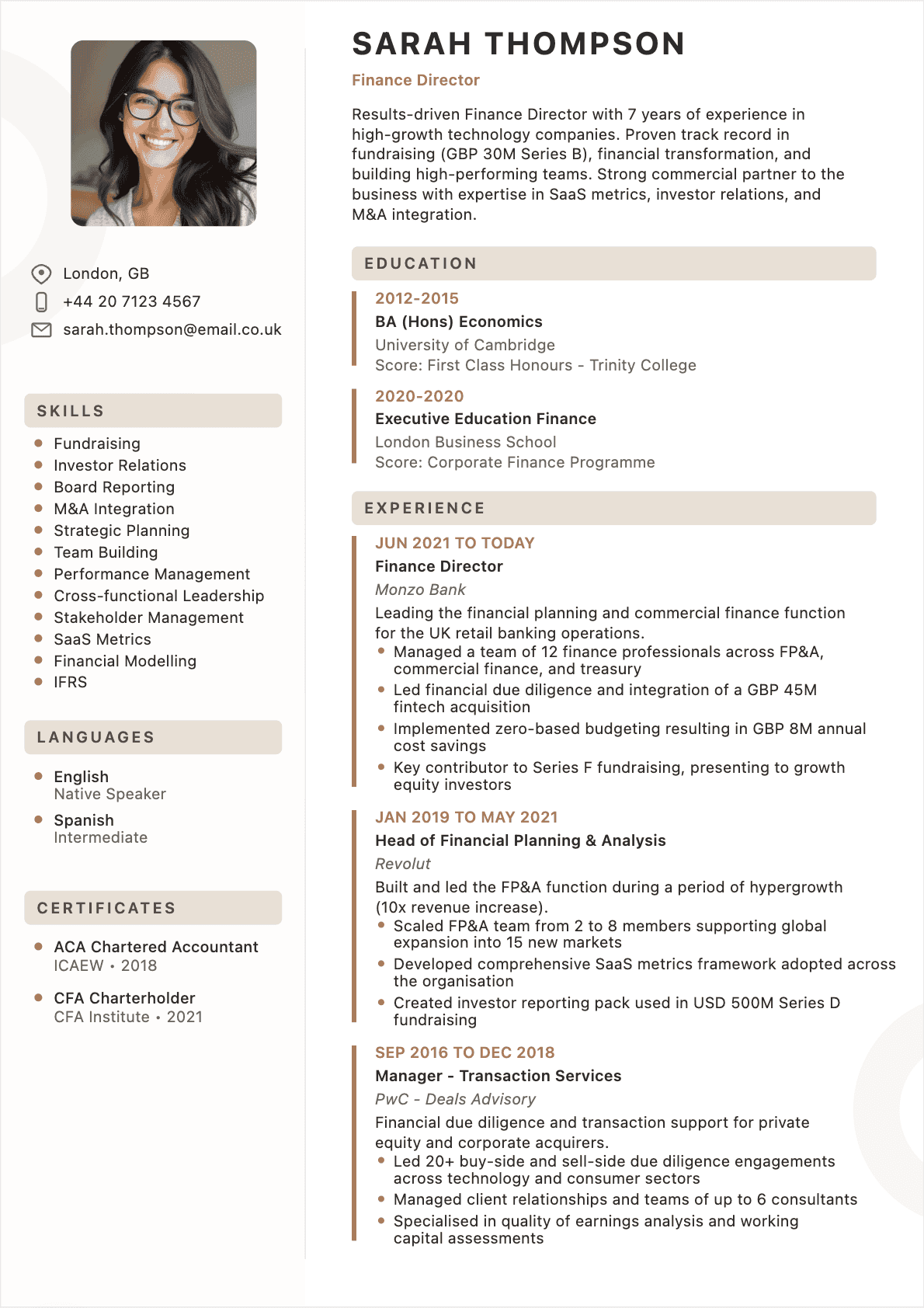
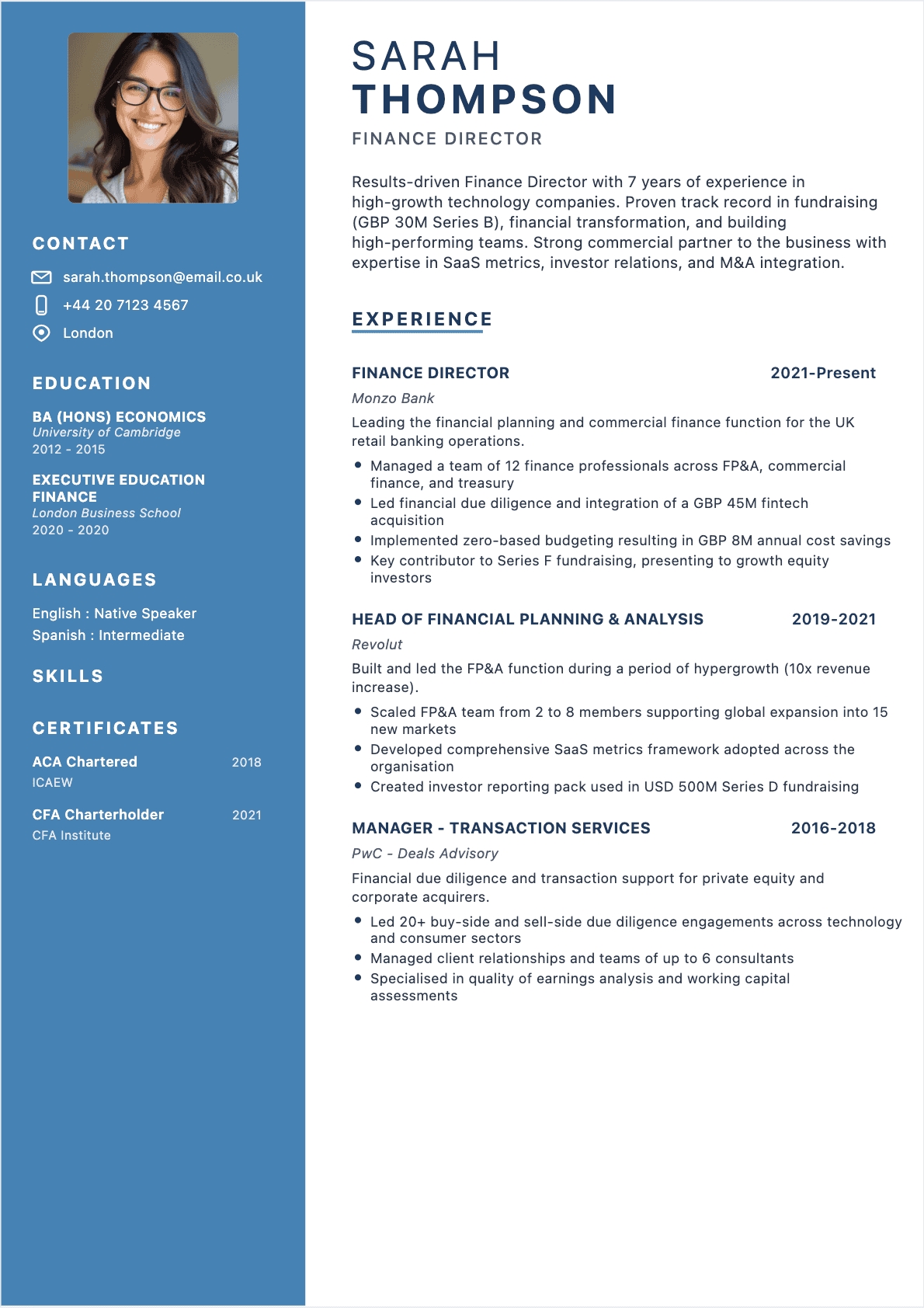
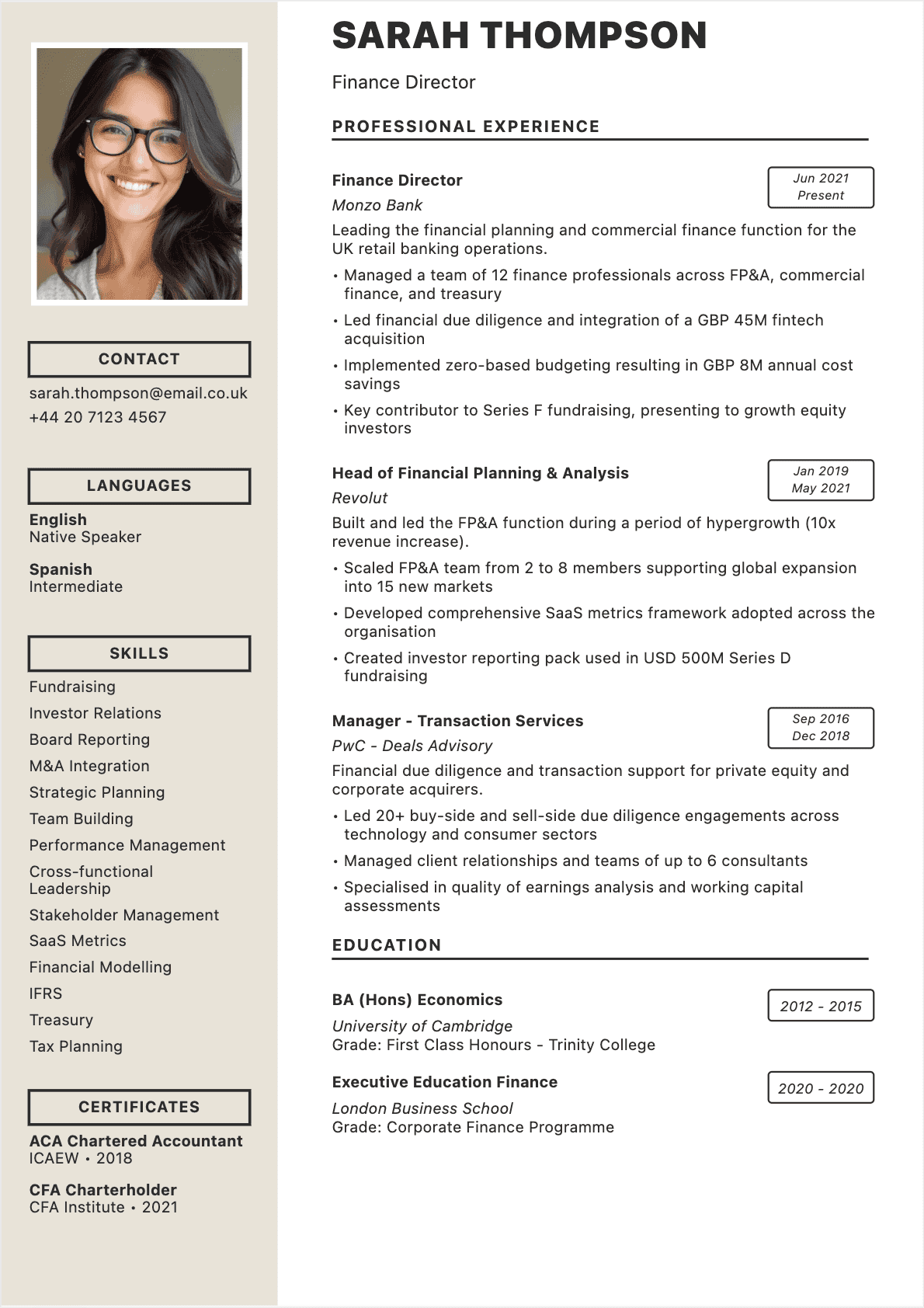
For finance leaders moving into a first CFO scope: highlight controllership, FP&A ownership, audit readiness, and 2–3 quantified wins with modern tools used in close and planning.
Utiliser
CV Chief Financial Officer Intermediate
For 3–7 years in executive finance roles: show multi-entity reporting, budget ownership, debt/working-capital improvements, and measurable outcomes from system rollouts and process controls.
Utiliser
CV Chief Financial Officer Senior
For seasoned CFOs: emphasize board reporting, M&A and refinancing track record, cash discipline, compliance (SOX/IFRS/US GAAP), and enterprise-scale KPIs across revenue, margin, and cash.
UtiliserPerfect CV Checklist - CV Chief Financial Officer
Check each item to ensure your CV is complete and optimized.
Professional Summary - CV Chief Financial Officer
The professional summary is the first thing recruiters see. It should summarize your profile in a few impactful lines.
“Chief Financial Officer with 12+ years in SaaS and PE-backed scale-ups (USD 120M revenue). Led refinancing and covenant reset, cutting interest cost by 1.6 pts and extending runway from 9 to 18 months. Built FP&A and controllership teams (18 FTE), implemented NetSuite + Adaptive Planning, and reduced close from 9 to 5 days.”
“Dynamic and motivated finance professional, passionate about numbers, available immediately, seeking a new challenge as CFO in a growing company.”
Why is it effective?
Le bon exemple est efficace car il :
- Quantifies scope and credibility (industry + revenue + team size), e.g., “USD 120M revenue” and “18 FTE”
- States executive outcomes with board-relevant metrics, e.g., interest cost reduced by 1.6 points and runway extended by 9 months
- Names real systems to signal execution capability, e.g., NetSuite and Workday Adaptive Planning
- Shows operational cadence impact, e.g., close reduced from 9 to 5 days (speed and control)
Le mauvais exemple échoue car il :
- Uses vague claims with no proof (no revenue, no cash, no governance outcomes)
- Relies on clichés instead of executive impact (“dynamic”, “passionate”)
- Doesn’t mention standards, stakeholders, or complexity (audit, lenders, board)
- Gives a generic objective that could fit any finance job, not a CFO mandate
Professional experience examples
Here are examples of professional experiences. Note how results are quantified.
Chief Financial Officer
NimbusHR (B2B SaaS), London
Owned finance for a PE-backed SaaS scale-up (USD 110–130M revenue, 6 entities, UK/US/EU). Led a team of 18 across FP&A, accounting, tax, and payroll; delivered board packs, audit, treasury, and pricing profitability analysis during rapid expansion.
Key Achievements
Key skills for your resume
Here are the technical and soft skills most sought after by recruiters.
Technical skills to list on a Chief Financial Officer CV
Technical Skills
- Financial reporting (IFRS / US GAAP) and statutory accounts oversight
- FP&A: driver-based budgeting, rolling forecasts, scenario modeling
- Oracle NetSuite (ERP)
- Workday Adaptive Planning (planning & forecasting)
- Treasury: liquidity planning, hedging, bank relationship management
- M&A: due diligence, valuation support, integration planning
- Internal controls, audit management, and SOX readiness
- BI and performance reporting (Power BI dashboards, KPI operating cadence)
Executive skills that matter for CFO hiring panels
Soft Skills
- Board-level communication and concise narrative building
- Stakeholder management with investors, lenders, and auditors
- Negotiation (credit terms, covenants, vendor contracts)
- Decision-making under uncertainty using scenarios and guardrails
- Cross-functional leadership with Sales, Product, Operations, HR
- Prioritization across competing initiatives and constrained resources
- Talent development for controllership, FP&A, tax, and payroll
- Governance mindset: risk framing, controls, and accountability
ATS Keywords to Include
ATS systems filter CVs based on specific keywords. Include these terms to maximize your chances.
ATS Tip
Click on a keyword to copy it. ATS systems filter CVs based on these exact terms.
Mots-clés importants
Hiring Sectors
Discover the most promising sectors for your career.
Private equity-backed portfolio companies
SaaS and technology
Manufacturing and industrials
Healthcare and life sciences
Financial services and fintech
Retail and consumer goods
Education & Degrees
CFO hiring panels rarely select on diploma alone, but they do expect strong foundations in accounting, corporate finance, and governance. The most common routes include a Bachelor’s degree in Accounting/Finance, followed by a Master’s in Finance, an MBA, or a specialized Master’s in Accounting. Many CFOs also come through audit firms (Big 4) or controllership paths before expanding into FP&A, treasury, and commercial finance.
If your degree is not finance-focused, compensate with recognized certifications (CPA/ACCA/CMA) and show outcomes that demonstrate command of reporting, cash, and risk. Prioritize education entries that support the CFO mandate: standards knowledge (IFRS/US GAAP), capital allocation, and leadership exposure.
Recommended Degrees
- Master’s in Finance
- MBA (Finance or Strategy concentration)
- Bachelor’s in Accounting
- Master’s in Accounting
- Master’s in Business Analytics (for FP&A / BI focus)
- Bachelor’s in Economics
Languages
Languages can be a real differentiator for CFO roles with multi-country operations, global audits, or cross-border financing. English is typically the working language for investor reporting and lender negotiations, while additional languages help when integrating acquisitions, managing shared service centers, or working with local regulators and statutory auditors.
- Investor relations and board communication across regions
- Cross-border M&A and post-merger integration with local finance teams
- Multi-country statutory filings and coordination with external auditors
Present your level using a clear proficiency label and add a proof point when possible (e.g., a test score, or “conducted quarterly lender calls in English”). Avoid overstating: CFO interviews quickly test precision and nuance.
English
Native
French
Fluent (used for audit coordination and statutory reporting)
Spanish
Intermediate
Recommended certifications
Certifications are not always mandatory for a CFO, but they strongly increase credibility—especially for reporting quality, controllership leadership, and governance. For US-focused roles, CPA is often a major advantage; internationally, ACCA is widely recognized. Treasury, FP&A, and capital markets credentials can be valuable depending on the mandate.
Mistakes to avoid
Listing responsibilities instead of board-relevant outcomes
A CFO CV that reads like a job description forces the reader to guess your impact. Boards and CEOs hire CFOs for outcomes: cash discipline, reporting reliability, predictable forecasts, and capital structure decisions. If your bullets start with “Responsible for” and don’t include numbers, your profile will be screened out early—especially in PE-backed processes.
Toujours inclure :
- Scope (revenue, entities, geographies, team size, budget size)
- A cash or profitability metric (DSO, FCF, EBITDA margin, runway)
- A governance metric (close time, audit findings, control improvements)
A useful rule: each role should contain at least 2 “money” metrics and 1 “control” metric.
Using generic tools lists without showing what changed
Writing “SAP, NetSuite, Power BI” is not enough for an executive search. Recruiters want to know whether you led implementation, improved cycle time, or increased forecast quality. Tools are only credible when tied to a business outcome and adoption story.
À éviter : "Implemented ERP and improved reporting."
À privilégier : "Led NetSuite rollout across 6 entities in 7 months; standardized COA and automated revenue recognition, reducing manual journal entries by 35% and cutting close by 4 days."
This framing proves you can execute transformation, not just “use software.”
Hiding complexity: standards, audit, and compliance
CFO candidates often understate how they handled audits, technical accounting, controls, and risk. In 2025, many companies face tighter lender requirements, more scrutiny on revenue recognition, and higher expectations around segregation of duties and access controls. If you omit this, you look like a commercial finance lead rather than a CFO.
À mentionner :
- Reporting standards (IFRS/US GAAP) and audit outcomes (e.g., unqualified opinion)
- Control framework and improvements (SOX readiness, key controls, remediation)
- Risk topics you owned (FX exposure, credit risk, covenant monitoring)
Overloading the CV and losing the executive narrative
A CFO CV is not a repository of every project. If it exceeds two pages with dense text, key outcomes disappear. Your goal is a clear executive narrative: what problem you were hired to solve, what levers you pulled, and what changed in cash, predictability, and governance.
Checklist :
- First half-page shows scope + top 3 quantified outcomes
- Every role has 4–6 bullets, each with a metric or business consequence
- Remove low-signal details (basic Excel, generic “teamwork”, long course lists)
Expert tips
- 1
Lead with scope : In the first lines, state revenue, number of entities, geographies, and team size. This helps recruiters benchmark you against the role’s complexity in under 10 seconds.
- 2
Quantify cash first : Add at least two cash metrics (DSO, DPO, inventory days, runway, FCF). Many CFO searches are triggered by liquidity pressure or refinancing deadlines.
- 3
Show the operating cadence : Mention your management rhythm: weekly KPI review, monthly forecast, quarterly board pack. Include cycle time (close days) and forecast accuracy improvements.
- 4
Name stakeholder outcomes : Reference lenders, investors, and auditors with results (interest margin reduced, covenant headroom increased, audit adjustments reduced). It signals executive presence and credibility.
- 5
Make systems credible : Pair each major tool with a deliverable: “Adaptive Planning driver model,” “NetSuite multi-entity consolidation,” or “Power BI KPI suite used in QBRs.”
- 6
Use CFO keywords naturally : Integrate terms like FP&A, working capital, treasury, financial reporting, IFRS/US GAAP, SOX, M&A within achievements so ATS matching stays high without keyword stuffing.
- 7
Avoid a US-style photo : For US applications, remove photos to avoid bias issues. For UK roles it’s optional, but only include if requested by local norms or the employer.
Frequently asked questions
Find answers to the most frequently asked questions.
In most markets, a CFO CV should be two pages to cover scope, governance, and value creation without compressing key numbers. Use page one for headline, top achievements, and the most recent roles. Page two can hold earlier leadership roles, education, and certifications. Keep it skimmable: 4–6 bullets per role, each with a metric.
Prioritize metrics that reflect the CFO mandate: cash (DSO/DPO, working capital, FCF, runway), profitability (gross margin, EBITDA, cost-to-serve), predictability (forecast accuracy, variance), governance (close days, audit adjustments), and capital structure (debt size, interest savings, covenant headroom). Tie each metric to your actions and timeframe.
You can still show board-adjacent work: preparing monthly packs for the CEO and investors, leading audit committee materials, presenting KPIs in QBRs, or running lender update calls. Write it explicitly: “Produced monthly investor pack for PE sponsor,” “Presented forecast scenarios to CEO/CRO,” or “Led annual audit planning with Big 4.” Add outcomes like faster decisions or reduced surprises.
Yes, but keep it outcome-focused. Mention the standard and what it enabled: audit quality, revenue recognition compliance, consolidation accuracy, or reduced adjustments. Example: “Owned IFRS reporting across 6 entities; reduced audit PBC turnaround from 10 to 6 days.” Avoid deep standards references unless the job is heavily technical (public company, complex revenue).
Highlight value creation and reporting cadence: weekly cash reporting, 13-week cash flow, working-capital actions, pricing/margin analytics, and rapid close. Add terms like “covenant compliance,” “run-rate EBITDA,” and “data-room readiness.” Quantify levers (e.g., DSO -14 days, EBITDA +320 bps) and show speed of execution (e.g., ERP rollout in 7 months).
No. Prioritize the last 10–15 years and the roles that demonstrate CFO readiness: controllership, FP&A leadership, treasury, or multi-entity oversight. Older roles can be summarized in a short “Earlier experience” section with 1–2 lines each. The goal is clarity and relevance, not completeness.
Build your Chief Financial Officer CV in minutes
Use CVtoWork to structure your Chief Financial Officer CV with ATS-ready headings, CFO keywords, and quantified achievement prompts—then export a clean executive format tailored for 2025 hiring.
Create my Resume