CV Certified Public Accountant : CPA CV guide 2025
Build a Certified Public Accountant CV that highlights audit, tax, and reporting impact with measurable results. Get ATS keywords, skills, examples, and formatting rules tailored to CPA hiring in 2025.
Key Takeaways
A strong Certified Public Accountant CV is more than a list of tasks: it must prove you can reduce risk, improve reporting quality, and deliver audit-ready financials under tight deadlines. In 2025, employers screen CPA resumes with ATS and expect clear evidence of GAAP expertise, control discipline, and tool proficiency (Excel, ERP, and close automation).
Hiring remains steady across public accounting and industry: many teams are rebuilding after busy-season turnover, while companies face increasing scrutiny on revenue recognition (ASC 606), ICFR, and tax compliance. Candidates who quantify results (close cycle reduced by days, fewer audit adjustments, faster reconciliations) stand out quickly.
A good CV for a CV Certified Public Accountant must demonstrate :
- Ownership of reporting accuracy (GAAP, disclosures, reconciliations)
- Control mindset (SOX, documentation, remediation follow-through)
- Business impact (time saved, risk reduced, fees avoided, improved KPIs)
Use the guide below to structure your CPA CV for ATS and for hiring managers.
CV Examples - CV Certified Public Accountant
Discover our CV templates adapted to all experience levels. Each example is ATS-optimized.

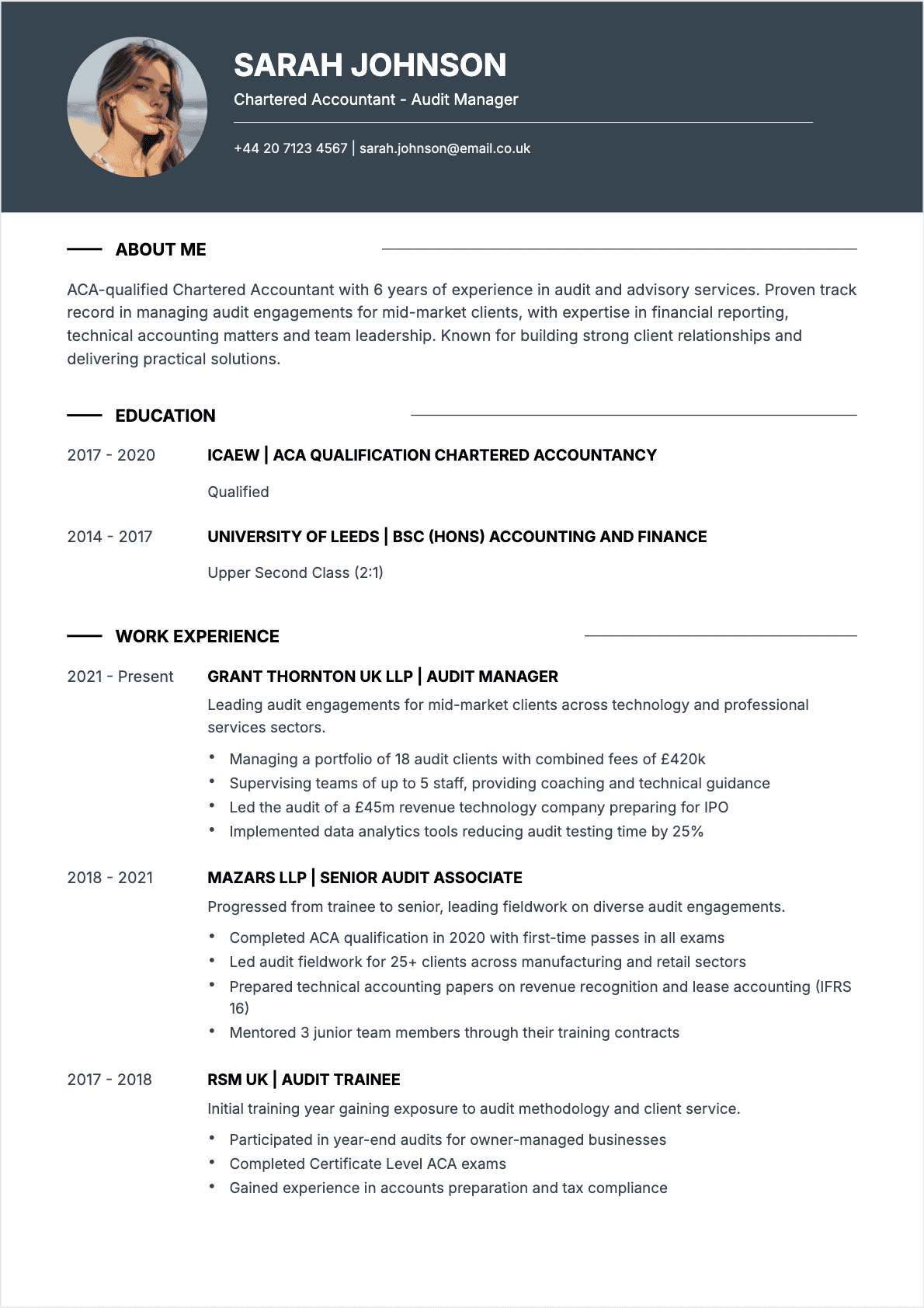
CV Certified Public Accountant Beginner
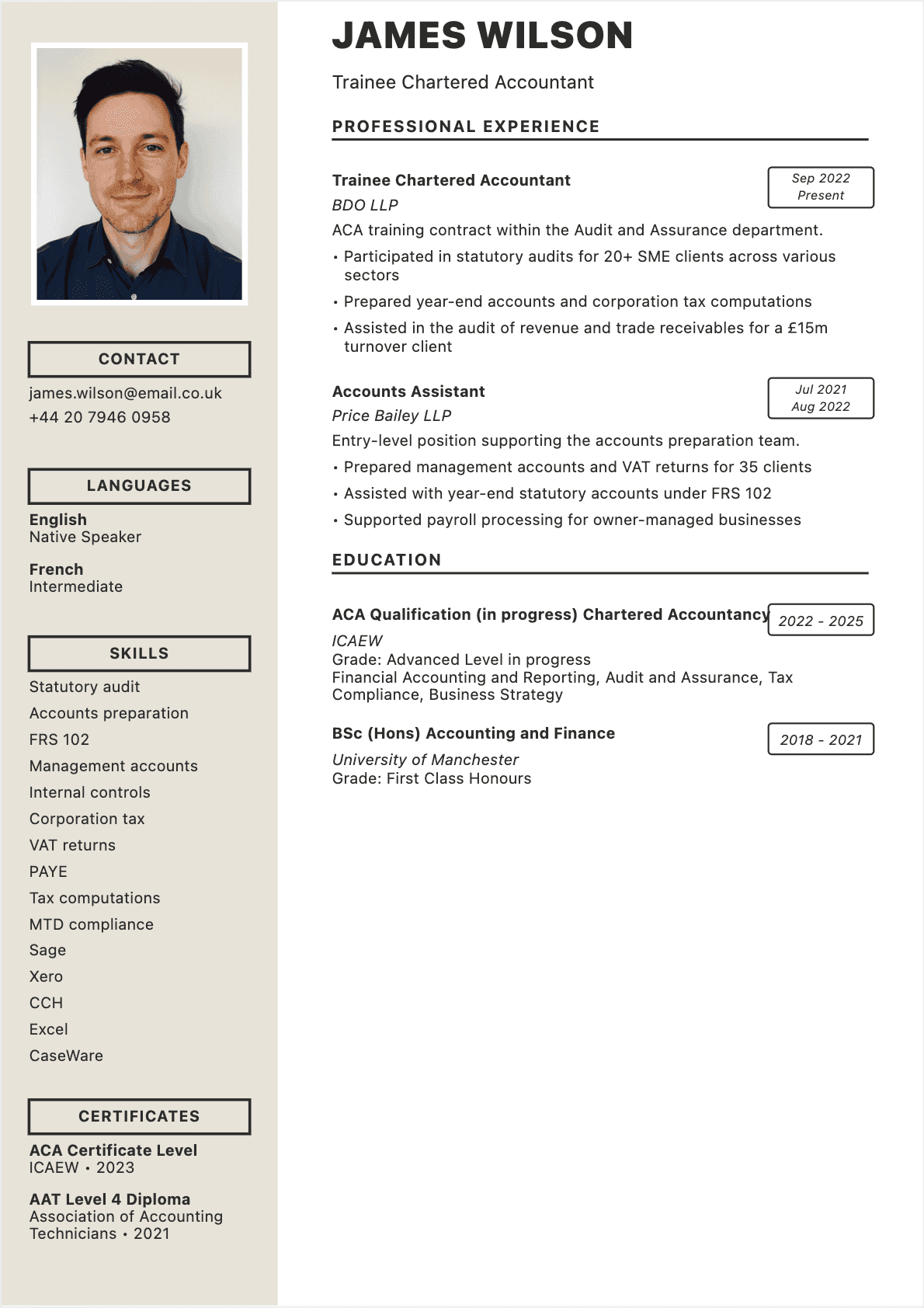
For new graduates and junior accountants targeting CPA-track roles, emphasizing internships, GAAP basics, Excel proficiency, and measurable contributions to close, reconciliations, and audit support.
Utiliser
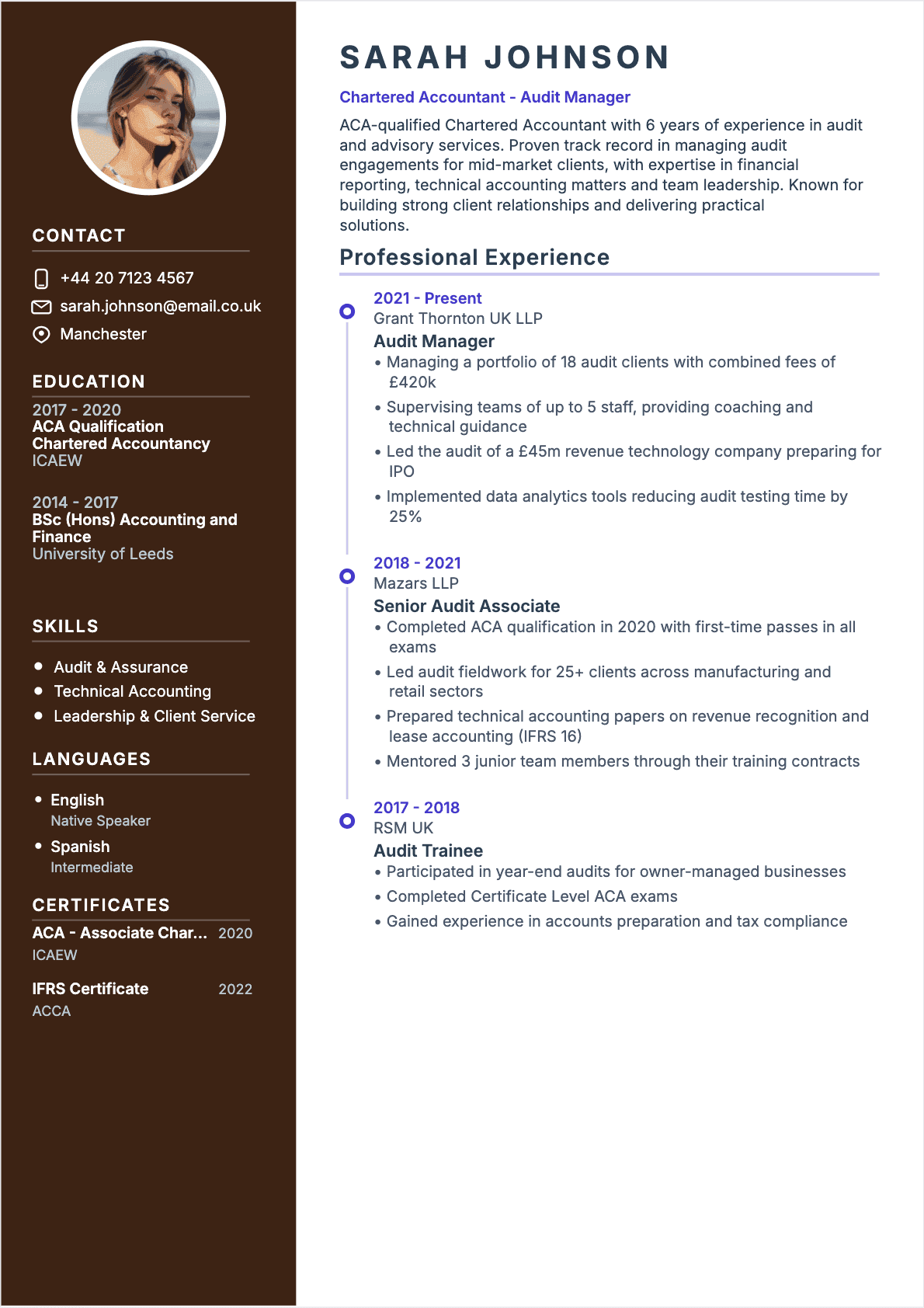
CV Certified Public Accountant Intermediate
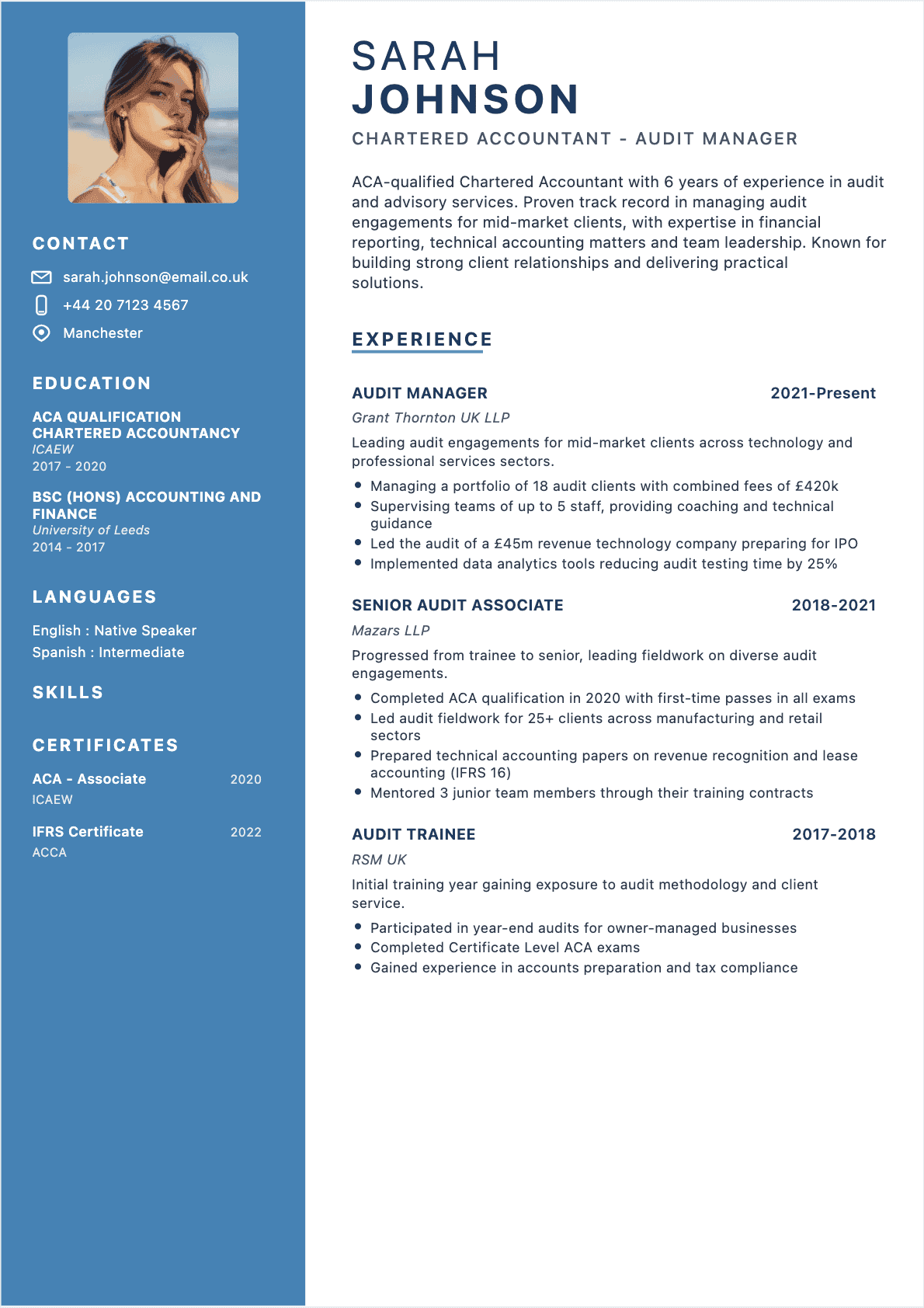
For CPAs with 3–7 years’ experience, focused on leading audit sections, owning month-end close, improving controls, and delivering measurable time savings using Excel, SAP, or NetSuite.
Utiliser
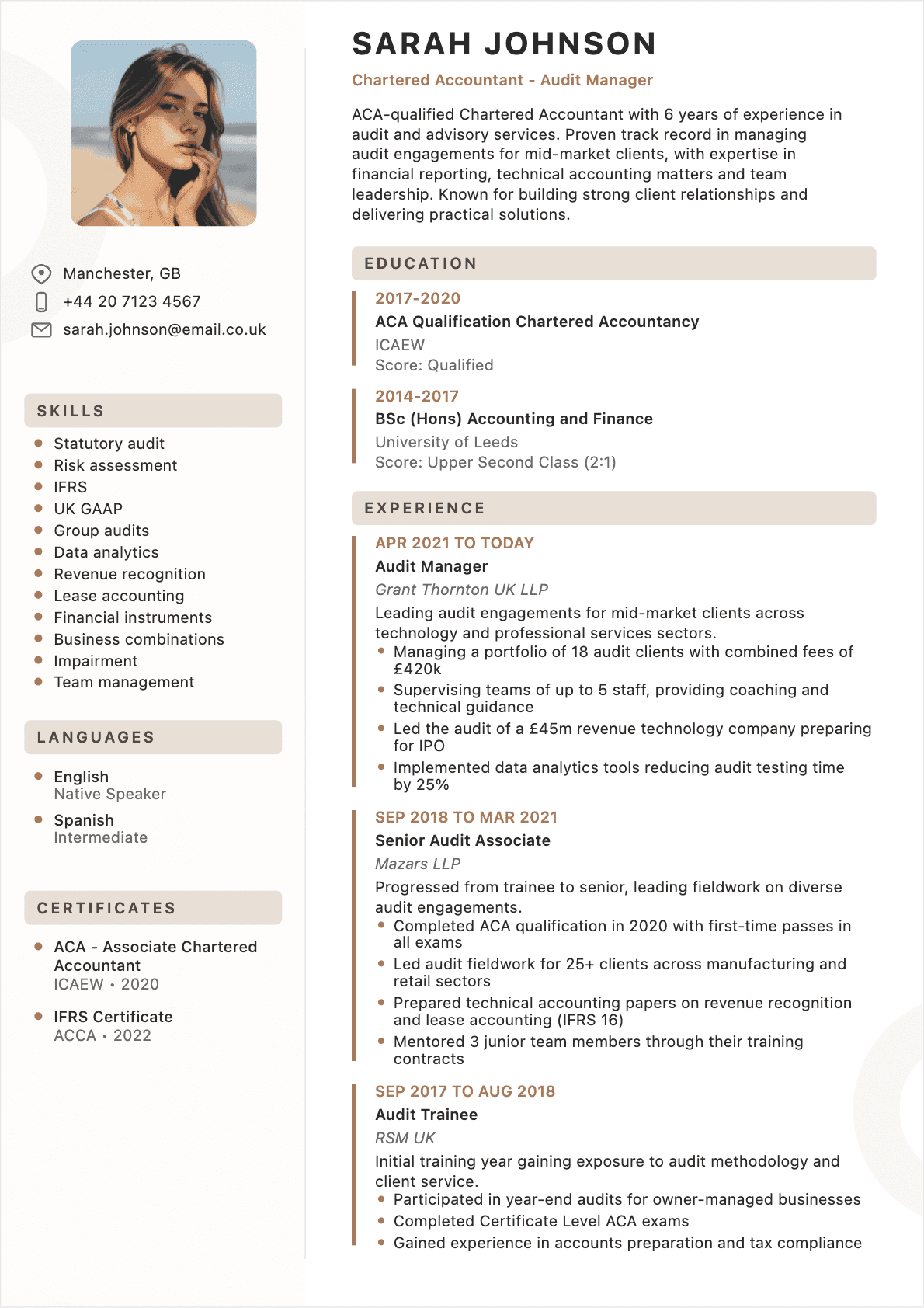
CV Certified Public Accountant Senior
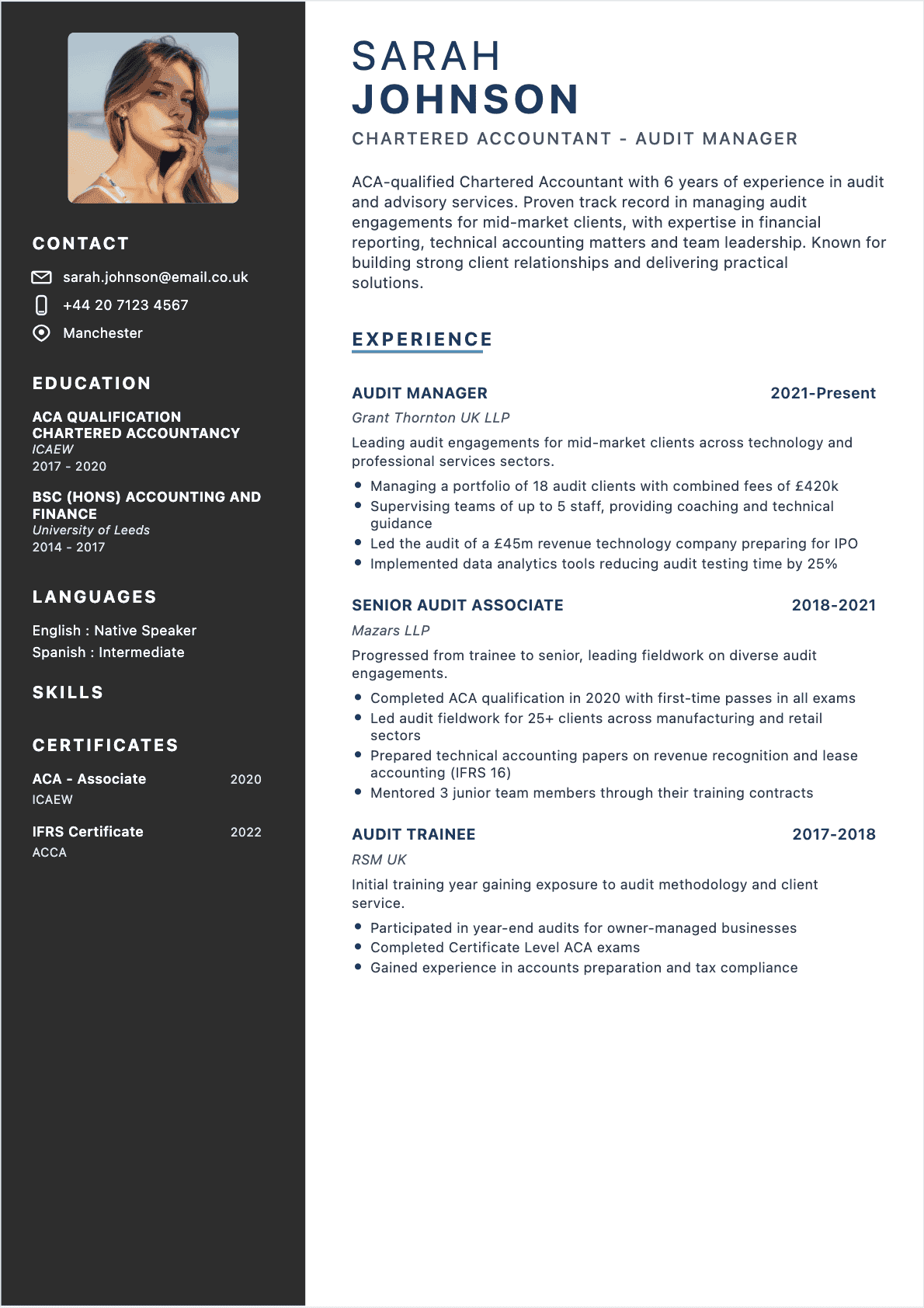
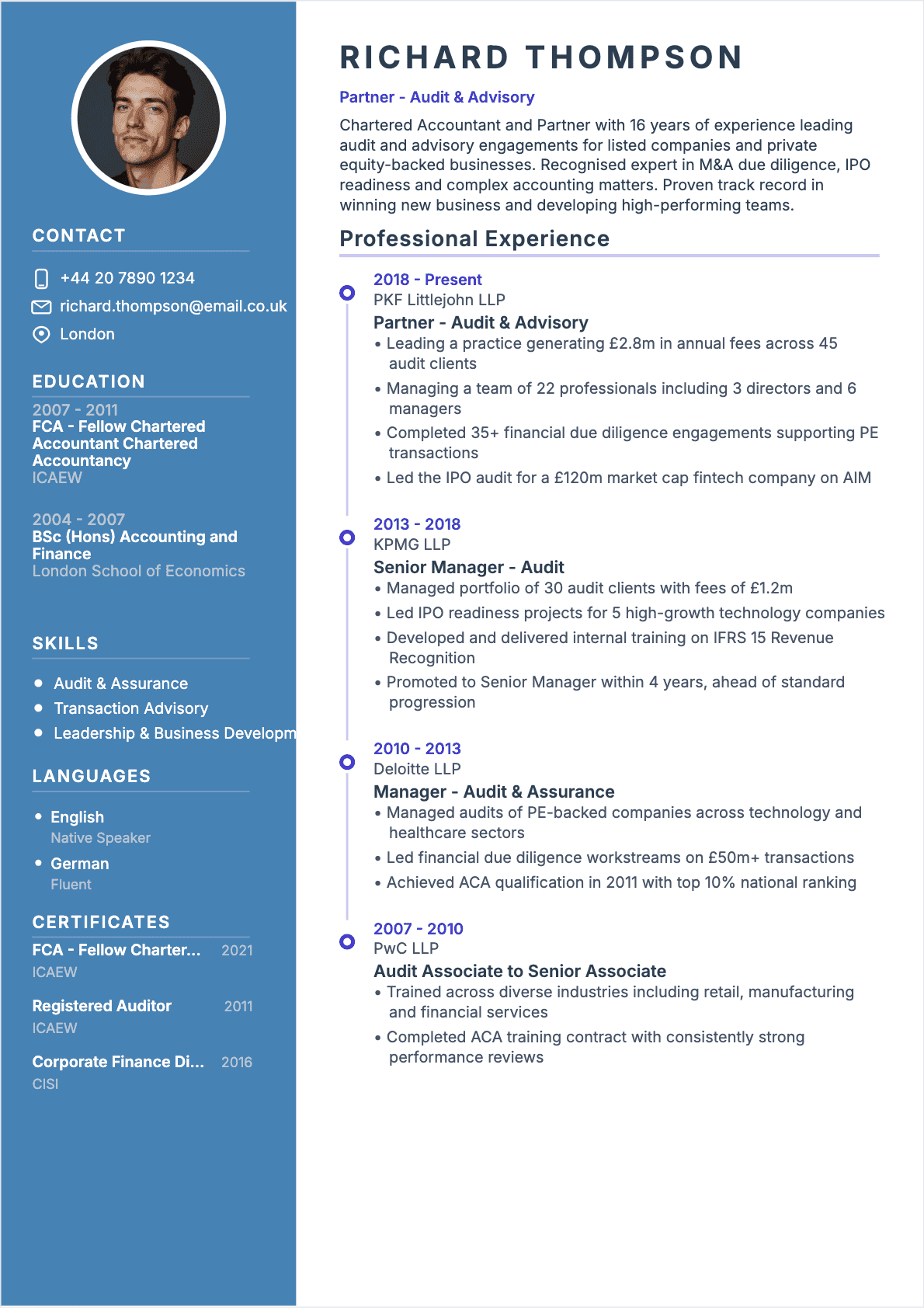
For senior CPAs managing teams and stakeholders, highlighting complex reporting, SOX, consolidations, tax planning, audit readiness, and quantified outcomes across multi-entity or global environments.
UtiliserPerfect CV Checklist - CV Certified Public Accountant
Check each item to ensure your CV is complete and optimized.
Professional Summary - CV Certified Public Accountant
The professional summary is the first thing recruiters see. It should summarize your profile in a few impactful lines.
“CPA with 6 years in public accounting and SaaS, leading GAAP close and audit readiness for $120M revenue. Reduced month-end close from 8 to 5 days and cut audit PBC turnaround by 30% using Excel Power Query, NetSuite, and BlackLine.”
“Motivated and dynamic CPA passionate about accounting, available immediately, eager to learn and join a great team to take on new challenges.”
Why is it effective?
Le bon exemple est efficace car il :
- Chiffre le périmètre (revenu $120M) et la séniorité (6 ans), ce qui situe immédiatement ton niveau
- Met en avant des résultats concrets (close de 8 à 5 jours, PBC -30%) plutôt que des missions
- Cite des compétences recherchées (GAAP, audit readiness) et des outils réels (NetSuite, BlackLine, Power Query)
- Reste spécifique à un contexte (public accounting + SaaS), facilitant le matching avec l’offre
Le mauvais exemple échoue car il :
- Utilise des clichés (“motivated”, “dynamic”, “passionate”) sans preuve
- N’indique ni années d’expérience, ni industrie, ni périmètre
- Ne mentionne aucun résultat mesurable ou réalisation
- Ne contient aucun mot-clé technique clair (GAAP, SOX, close, audit)
Professional experience examples
Here are examples of professional experiences. Note how results are quantified.
Senior Accountant (CPA)
Deloitte, Chicago
Led audit sections for mid-market manufacturing and SaaS clients ($50M–$300M revenue). Coordinated a 6-person engagement team, managed PBC requests, reviewed workpapers, and partnered with client controllers on GAAP issues and control remediation.
Key Achievements
Key skills for your resume
Here are the technical and soft skills most sought after by recruiters.
Technical skills (hard skills)
Technical Skills
- GAAP financial reporting and disclosures
- Audit execution (planning, testing, PBC, findings remediation)
- Microsoft Excel (PivotTables, Power Query, XLOOKUP)
- NetSuite (GL, fixed assets, reporting)
- SOX / ICFR controls documentation and walkthroughs
- Tax compliance support (provisions, filings coordination, SALT basics)
- Account reconciliations and flux analysis
- Revenue recognition (ASC 606) and contract review
Professional skills (soft skills)
Soft Skills
- Stakeholder management with FP&A, Legal, Sales Ops, and external auditors
- Clear writing for memos, policies, and audit documentation
- Prioritization during close and busy season
- Risk-based thinking and professional skepticism
- Coaching and review skills (workpaper review, feedback loops)
- Meeting facilitation and status reporting
- Attention to detail under time pressure
- Conflict resolution around deadlines and audit requests
ATS Keywords to Include
ATS systems filter CVs based on specific keywords. Include these terms to maximize your chances.
ATS Tip
Click on a keyword to copy it. ATS systems filter CVs based on these exact terms.
Mots-clés importants
Hiring Sectors
Discover the most promising sectors for your career.
Public accounting (audit and assurance)
Corporate accounting (industry)
Financial services (banking, insurance, asset management)
Technology and SaaS
Healthcare and life sciences
Manufacturing and distribution
Education & Degrees
For Certified Public Accountant roles, employers typically expect a Bachelor’s degree in Accounting or a related field, plus progress toward (or completion of) CPA licensure. A Master’s in Accounting or an MBA can help for advisory, controllership, or leadership tracks, especially in larger companies or complex industries.
Common paths include a Bachelor’s followed by CPA exam completion, or a combined Bachelor’s + Master’s program to meet the 150-credit requirement. If you have strong experience (close ownership, audits, SOX), highlight measurable outcomes prominently, while listing education succinctly.
Recommended Degrees
- Bachelor’s in Accounting
- Master of Accountancy (MAcc)
- MBA (Finance or Accounting concentration)
- Bachelor’s in Finance
- Bachelor’s in Business Administration (Accounting track)
- Master’s in Taxation
Languages
Languages matter for CPAs working with international subsidiaries, shared service centers, or cross-border audits. Even in domestic roles, you may collaborate with offshore accounting teams, global auditors, or vendors where clear written English is critical.
- Group reporting with foreign entities (IFRS-to-GAAP bridges, consolidation packages)
- Global audit coordination (component auditors, multi-location PBC tracking)
- Tax and statutory compliance support (local filings, documentation requests)
Present your level and the context you use it in (meetings, documentation, client communication), and avoid vague claims without a benchmark.
English
Native
Spanish
Proficient (professional working proficiency)
French
Intermediate (can draft emails and participate in meetings)
Recommended certifications
The CPA license is the most valued credential for this career path and is often required for public accounting senior roles or advancement to manager. Additional certifications are a strong bonus when aligned with your target role: audit, controls, data analytics, or ERP expertise.
Mistakes to avoid
Listing responsibilities without audit-ready outcomes
A CPA CV that only lists duties (“prepared reconciliations”, “assisted in audits”) forces recruiters to guess your level. Hiring managers want proof you can deliver under deadlines, resolve issues, and improve processes. Replace task lists with outcomes tied to quality, speed, and risk reduction.
Toujours inclure :
- A measurable result (days saved, % reduction, $ exposure found, error rate improved)
- The scope (revenue, entity count, transaction volume, close timeline)
- The tools or standards used (GAAP, SOX, Excel Power Query, NetSuite, SAP)
Use this rule: Action + Scope + Method + Metric.
Overloading the CV with technical jargon and acronyms
Acronyms are expected in accounting, but stacking them without context hurts clarity and ATS matching. If your CV reads like a glossary, the reviewer may miss what you actually did. Introduce acronyms once and anchor them to an outcome.
À éviter : "Owned SOX ICFR PBC TB AR AP JE flux testing for multiple BUs."
À privilégier : "Owned SOX (ICFR) evidence for 14 key controls and improved PBC completeness to 95% by standardizing templates."
Clear phrasing increases credibility and improves screening speed.
Hiding CPA status or exam progress
Recruiters filter for CPA status quickly. If your license is active, make it easy to find near the top. If you are CPA-eligible or in progress, state exam sections passed and timeline. For industry roles, showing active CPA plus strong close ownership can be decisive.
À mentionner :
- License status (Active/Inactive) and state
- Exam progress (e.g., 3/4 sections passed) and expected completion month
- Continuing education highlights (CPE hours, recent GAAP updates, SOX training)
Weak formatting that breaks ATS parsing
CPAs often use clean formatting, but design-heavy templates can cause ATS errors. Tables, headers/footers with key info, and text boxes may not parse correctly. Keep it simple so the system can read your titles, dates, and keywords.
Checklist :
- One-column layout, standard headings (Experience, Education, Skills)
- Dates in a consistent format (MMM YYYY – MMM YYYY)
- No tables for Experience and Skills; keep bullet points as plain text
Expert tips
- 1
Mirror the job posting keywords : Use the employer’s wording for core skills (GAAP, SOX, month-end close, revenue recognition). Keep it truthful, and place the exact phrases in Experience and Skills for ATS matching.
- 2
Quantify close and audit impact : Track days to close, reconciliation volume, PBC cycle time, and audit adjustments. Add 2–3 metrics per role to show speed, quality, and risk reduction.
- 3
Show scope like a controller would : Include revenue, entity count, and reporting complexity (multi-currency, acquisitions, ASC 606). Scope helps recruiters calibrate your seniority in 10 seconds.
- 4
Name the tools behind the outcome : Tie results to Excel Power Query, BlackLine, NetSuite, SAP, or Alteryx. “Automated” without a tool sounds vague; a tool-backed claim sounds verifiable.
- 5
Add one line on controls : Even for non-SOX roles, mention reconciliations, approvals, and documentation. A single bullet on control improvements often differentiates strong CPA resumes.
- 6
Use a targeted achievements section : Add 3–5 “Key achievements” bullets near the top for senior profiles. This highlights value before the reader reaches the chronological details.
- 7
Keep the summary specific and short : 2 lines with years, industry, core specialties (audit/tax/reporting), one major metric, and tools. Skip personality claims and focus on evidence.
Frequently asked questions
Find answers to the most frequently asked questions.
Include your CPA status and state prominently. Adding the license number is optional and depends on privacy preference and local norms; many candidates omit it. If you include it, place it in a “Certifications” line under your name with “Active” status and state to help recruiters screen quickly.
For 0–7 years of experience, one page is usually sufficient if your bullets are quantified and relevant. For senior CPAs, managers, or specialized roles (SOX, technical accounting, complex consolidations), two pages can be appropriate. Prioritize recent, high-impact work and keep older roles concise.
Use keywords that reflect the job description and your real experience: Certified Public Accountant (CPA), GAAP, month-end close, account reconciliations, internal controls, SOX, audit planning, variance analysis, consolidations, ASC 606, tax compliance, and your ERP (SAP, NetSuite, Oracle). Place them naturally in bullets.
Highlight audit-facing responsibilities: preparing PBC packages, coordinating with external auditors, resolving requests, documenting controls, and reducing audit adjustments. Quantify outcomes like fewer open items, faster turnaround, or reduced fees. Mention standards you applied (GAAP, SOX) and the size/complexity of the environment.
In the US, do not include a photo; it is uncommon and can raise bias concerns. In the UK, it’s still usually not needed, though it may be seen occasionally. If you apply internationally, follow local conventions, but when in doubt for English-language CPA roles, skip the photo.
Use ranges and operational metrics: close cycle days, number of entities, reconciliation count, PBC turnaround time, on-time filing rate, or percentage reduction in adjustments. For financial figures, use approximate values (e.g., “identified $0.5M exposure”) or percentages. Keep it accurate and defensible.
Create your Certified Public Accountant CV in minutes
Use our CV builder to create a Certified Public Accountant CV with ATS-friendly formatting, CPA keywords, and quantified bullet prompts. Choose a template, tailor your sections, and export a polished PDF.
Create my Resume