CV Accounting Assistant : Accounting Assistant CV Guide (2025)
Learn how to write an Accounting Assistant CV that recruiters can scan in seconds. Use ATS-friendly keywords, quantified achievements, and role-specific examples for AP/AR, month-end, and reconciliations.
Key Takeaways
An Accounting Assistant CV needs to prove you can keep day-to-day finance operations clean, fast, and audit-ready. Hiring managers typically screen for evidence that you can process invoices at scale, reconcile accounts with minimal variance, and support month-end close without creating rework for accountants.
In many mid-size companies, an Accounting Assistant can touch 300–800 invoices per month, manage 50–200 supplier accounts, and help reduce close from 8–10 days down to 5–7 days when processes are tight and reporting is consistent.
A strong Accounting Assistant CV must demonstrate:
- Accuracy and control (reconciliations, 3-way match, GL coding discipline)
- Operational throughput (invoice volume, backlog reduction, on-time payments)
- Tool proficiency (Excel reporting plus ERP/accounting software)
Use the guide below to build an ATS-friendly CV with quantified bullets that match AP/AR, reconciliations, and month-end expectations.
CV Examples - CV Accounting Assistant
Discover our CV templates adapted to all experience levels. Each example is ATS-optimized.

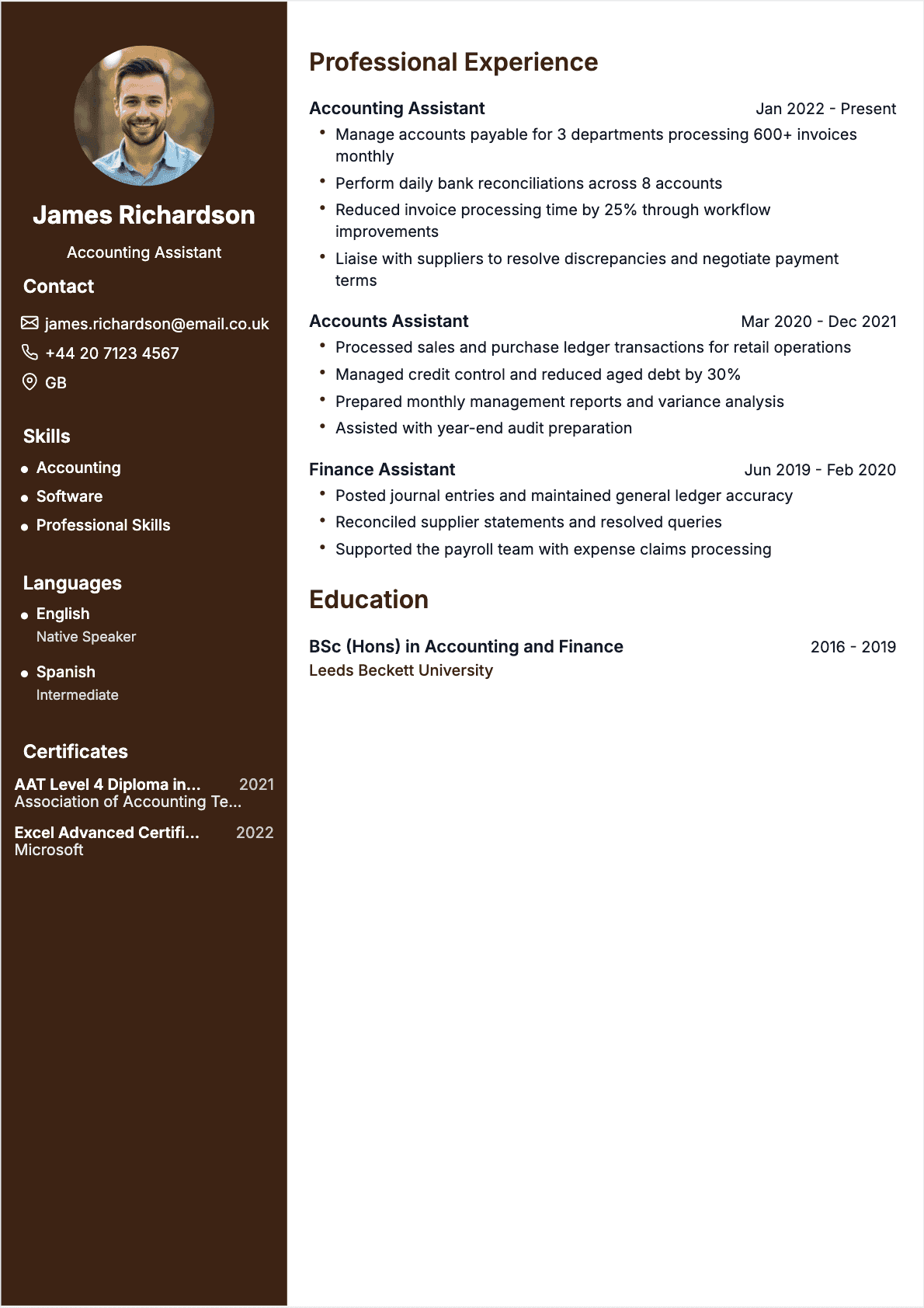
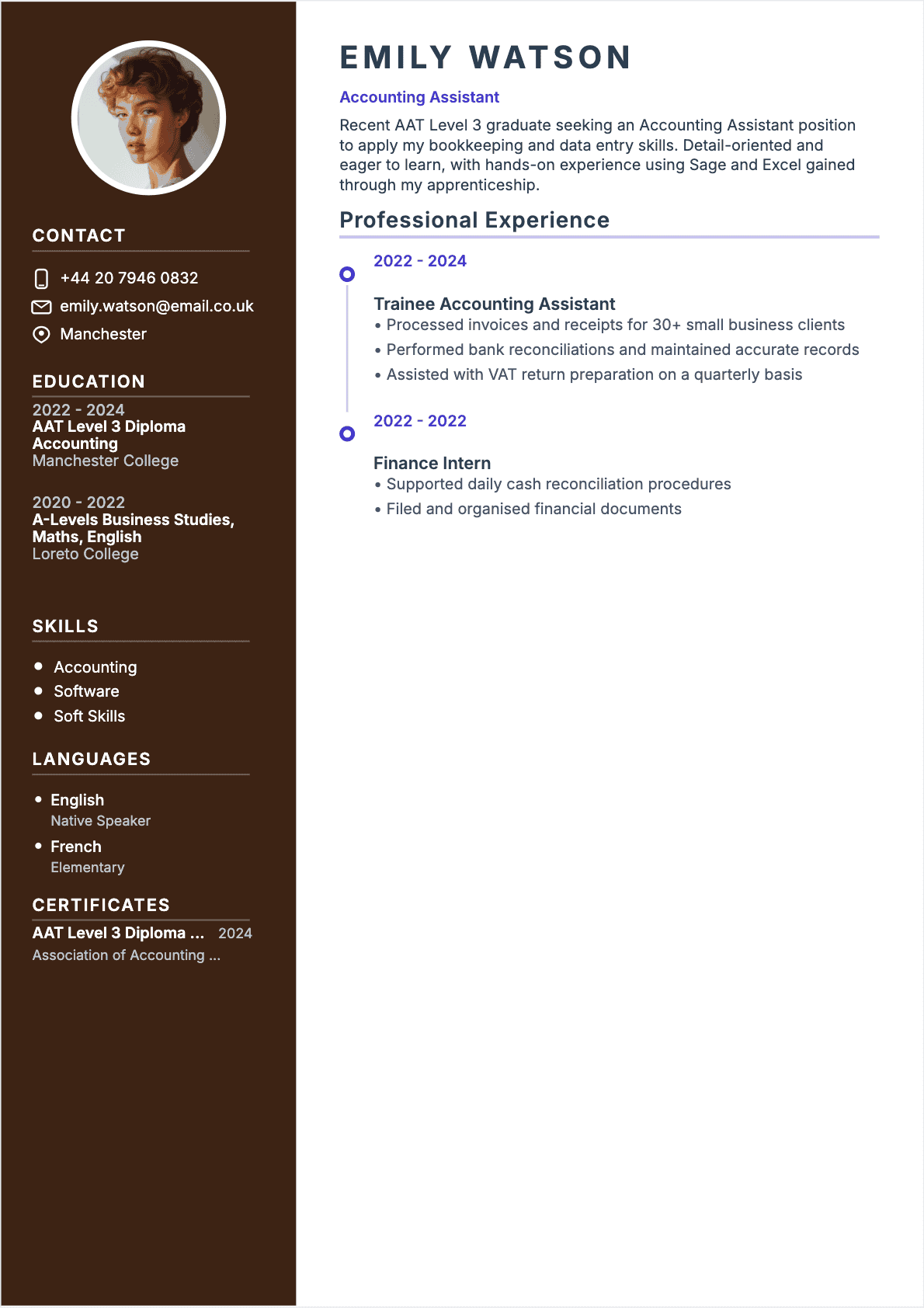
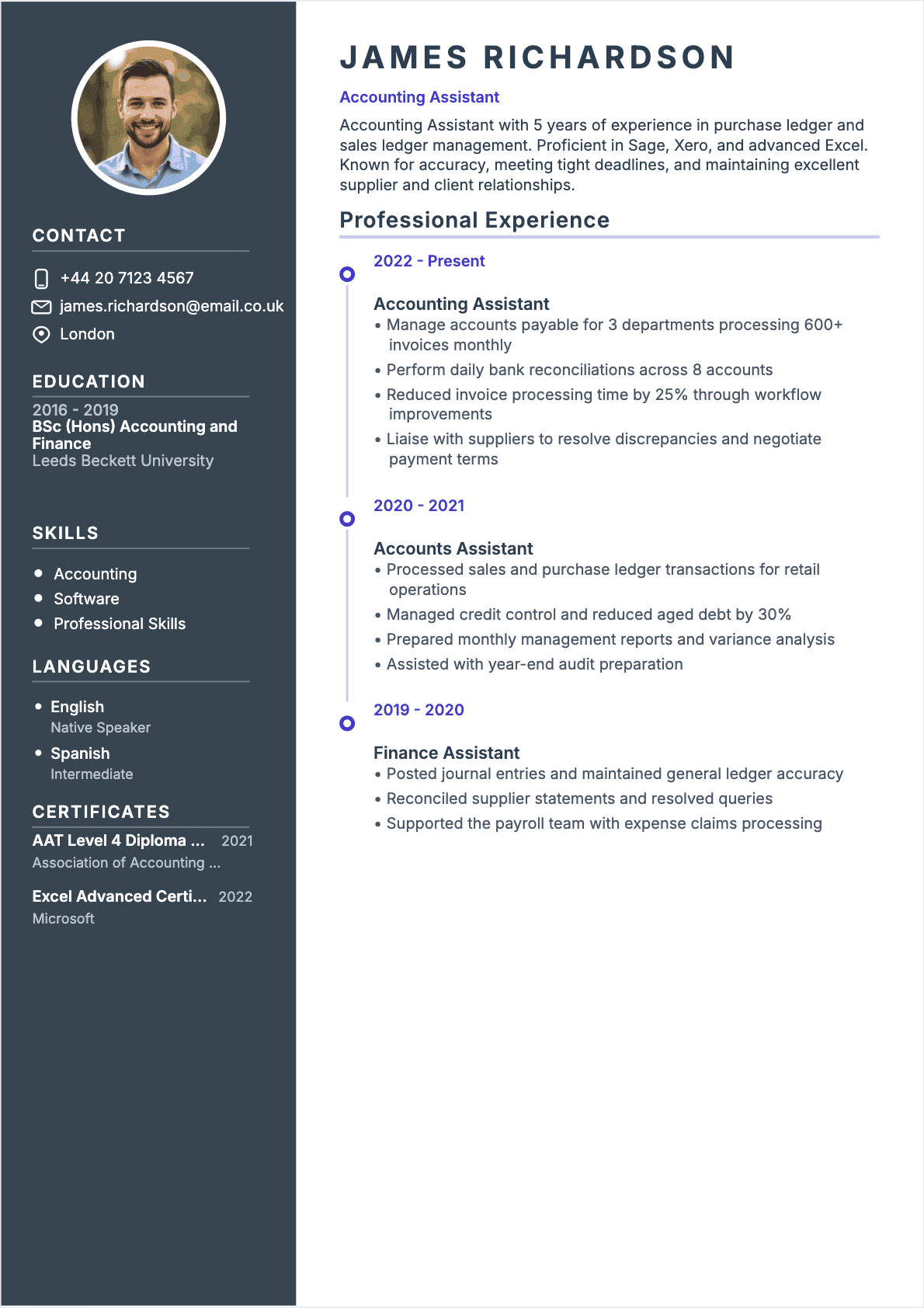
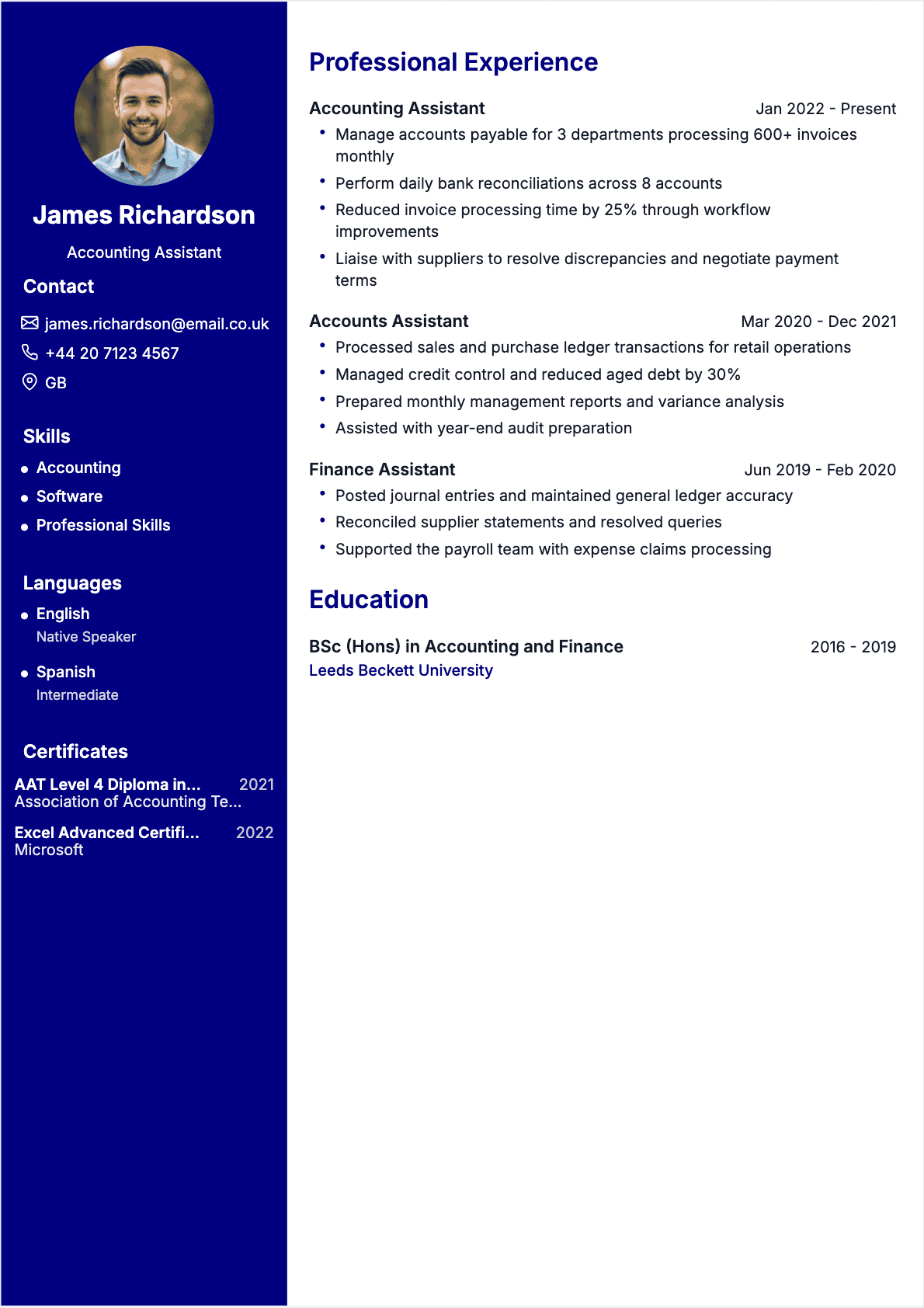
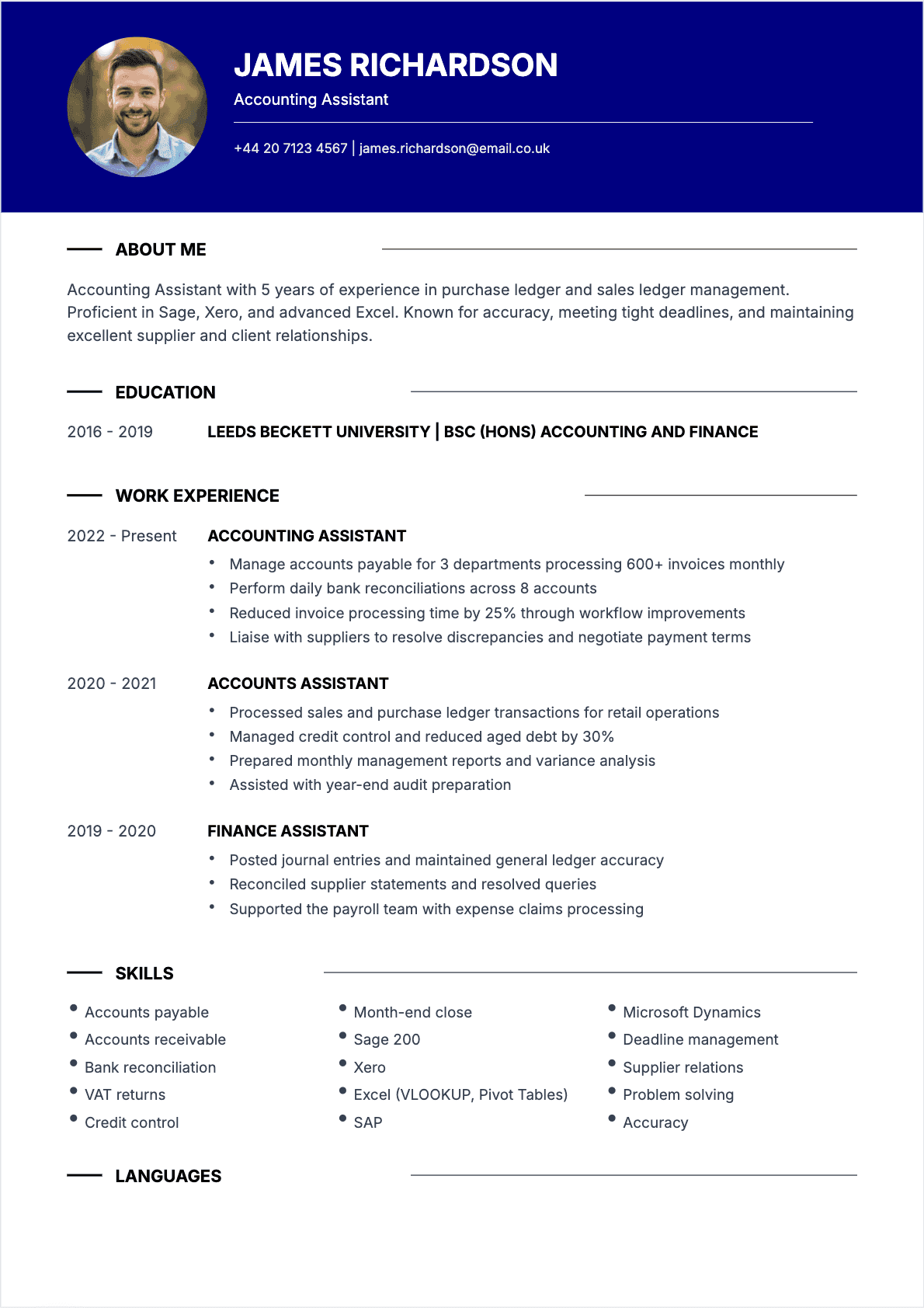
CV Accounting Assistant Débutant
Best for graduates and junior profiles targeting AP/AR support. Includes clear coursework, internships, and measurable outcomes like invoice volume, accuracy, and Excel reporting basics.
Utiliser
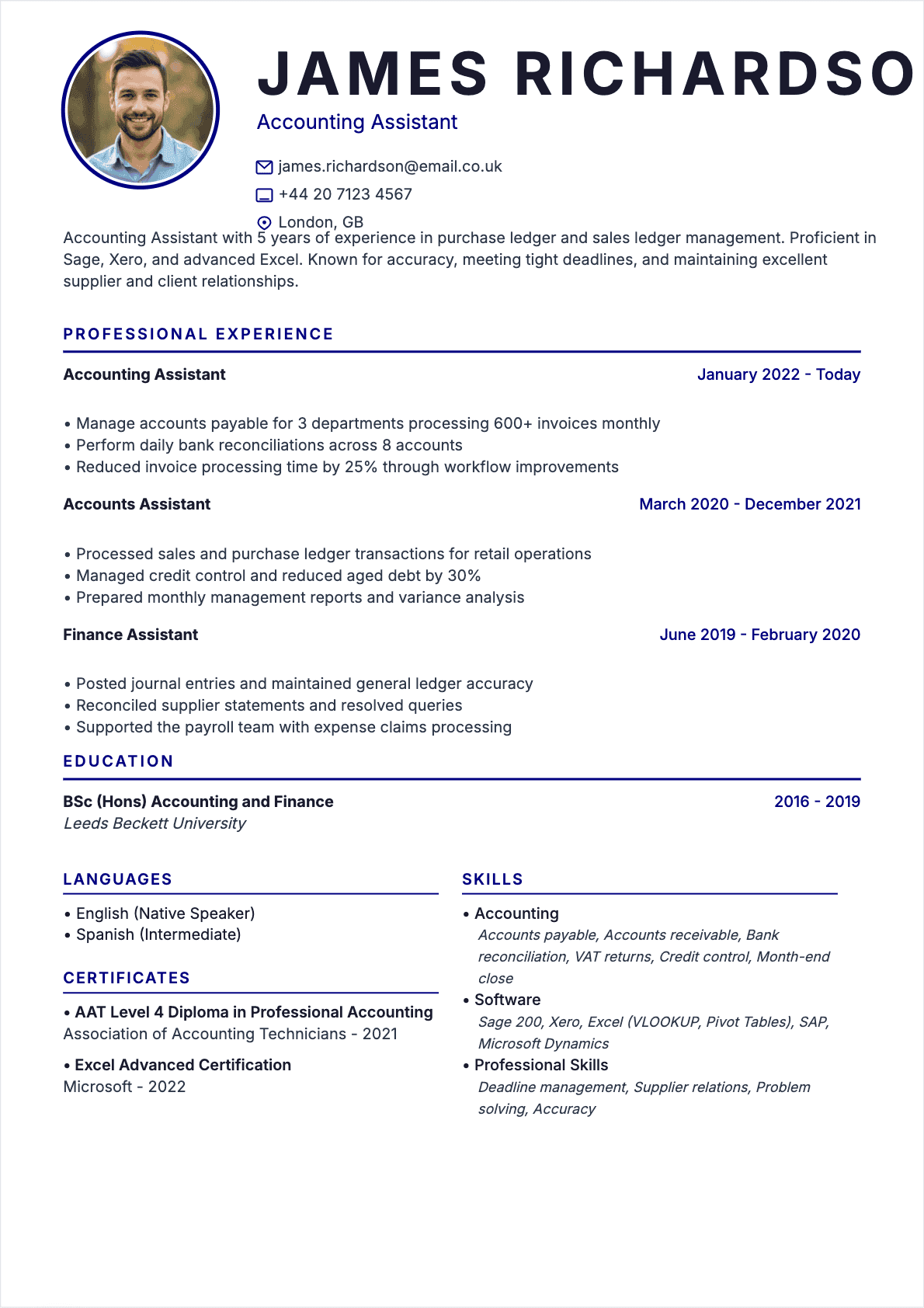
CV Accounting Assistant Confirmé
For 3–7 years’ experience handling end-to-end invoice processing, bank reconciliations, and month-end support. Highlights KPIs, controls, ERP exposure, and cross-team coordination.
Utiliser
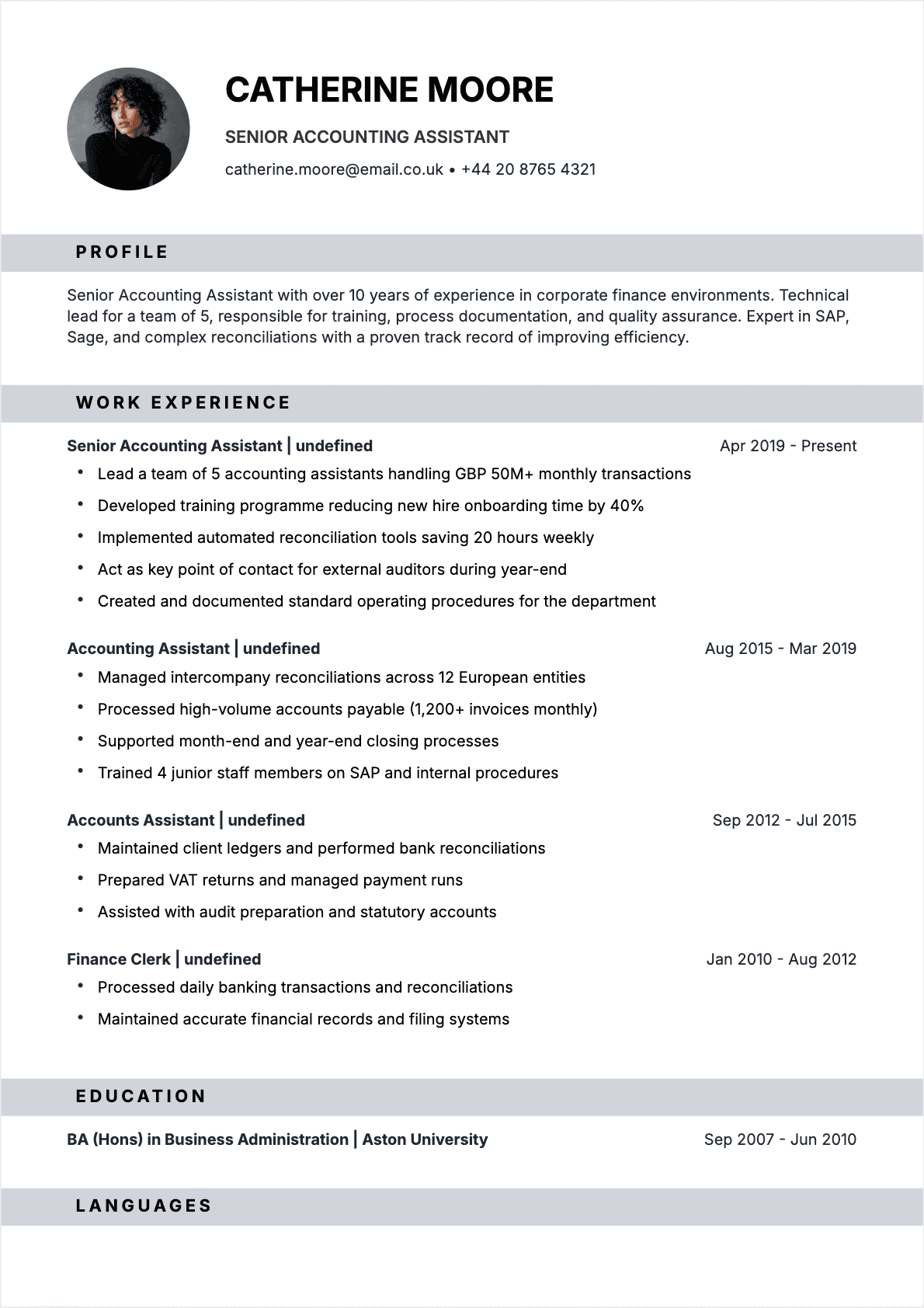
CV Accounting Assistant Senior
For senior assistants leading AP/AR routines, improving close timelines, coaching juniors, and owning reconciliations. Emphasizes audit readiness, process automation, and stakeholder management.
UtiliserPerfect CV Checklist - CV Accounting Assistant
Check each item to ensure your CV is complete and optimized.
Professional Summary - CV Accounting Assistant
The professional summary is the first thing recruiters see. It should summarize your profile in a few impactful lines.
“Accounting Assistant with 4 years’ experience in retail and SaaS finance teams, processing 550+ invoices/month and maintaining 98.5% first-pass accuracy. Supported month-end close by posting 40–60 journals and completing 12 balance-sheet reconciliations. Advanced Excel (Power Query, PivotTables) and QuickBooks Online/Xero.”
“Motivated and dynamic Accounting Assistant, passionate about finance. Available immediately and ready to learn. Great team player with strong communication skills.”
Why is it effective?
Le bon exemple est efficace car il :
- Quantifies scope: “550+ invoices/month” and “98.5% first-pass accuracy” set a clear performance baseline.
- Shows month-end impact: journals posted and reconciliations completed link your work to close quality and speed.
- Names real tools: Excel features plus QuickBooks Online/Xero improve ATS matching and credibility.
- Signals domain fit: retail and SaaS imply high volume, tight deadlines, and structured reporting.
Le mauvais exemple échoue car il :
- Uses empty claims without proof (“motivated”, “dynamic”, “passionate”) and no measurable outcomes.
- Doesn’t specify AP/AR, reconciliations, or close responsibilities, so your level is unclear.
- Includes no tools, so recruiters can’t assess ramp-up time.
- Focuses on availability instead of value delivered and reliability.
Professional experience examples
Here are examples of professional experiences. Note how results are quantified.
Accounting Assistant (AP/AR)
BDO UK, Manchester
Supported a 9-person finance team across two business units (£18M annual revenue). Owned high-volume AP processing, assisted AR cash allocation, and prepared schedules for month-end close and external audit requests.
Key Achievements
Key skills for your resume
Here are the technical and soft skills most sought after by recruiters.
Technical skills for an Accounting Assistant CV
Technical Skills
- Accounts payable (invoice capture, approvals, payment runs)
- Accounts receivable (billing support, cash allocation, dunning follow-up)
- QuickBooks Online
- Xero
- Bank reconciliations and variance analysis
- General ledger coding and journal entry preparation
- Month-end close support (accruals, prepayments, schedules)
- Advanced Excel (PivotTables, XLOOKUP, Power Query)
Work habits recruiters look for
Soft Skills
- Attention to detail under high volume
- Prioritisation across deadlines (supplier payments, close, audits)
- Clear written communication with vendors and internal approvers
- Ownership of follow-ups (missing POs, approvals, credit notes)
- Discretion with confidential financial data
- Structured problem solving for recon breaks
- Consistency in documentation and filing
- Collaboration with procurement, operations, and finance
ATS Keywords to Include
ATS systems filter CVs based on specific keywords. Include these terms to maximize your chances.
ATS Tip
Click on a keyword to copy it. ATS systems filter CVs based on these exact terms.
Mots-clés importants
Hiring Sectors
Discover the most promising sectors for your career.
Professional services (accounting firms, payroll bureaus)
Retail and e-commerce
Manufacturing and supply chain
Technology and SaaS
Healthcare providers
Construction and real estate
Education & Degrees
Accounting Assistant roles are accessible through several education paths, but employers consistently value practical bookkeeping knowledge, strong Excel, and familiarity with AP/AR workflows. A Bachelor’s degree in Accounting or Finance can help you compete for roles with broader month-end exposure, while business or economics degrees work well if you add accounting-focused modules or certifications.
Alternative routes include vocational accounting programs and part-time study (especially in the UK via AAT), plus internships or temporary roles that prove you can handle invoice volume and reconciliations. If you have limited experience, prioritise demonstrable outcomes from placements: invoice counts, reconciliation frequency, and reporting tasks you owned.
Recommended Degrees
- Bachelor’s degree in Accounting
- Bachelor’s degree in Finance
- Bachelor’s degree in Business Administration
- Master’s degree in Accounting
- Master’s degree in Finance
- MBA (Finance)
Languages
Languages can be a direct advantage for Accounting Assistants in companies with international vendors, shared service centres, or multi-entity reporting. You may need to resolve invoice queries with suppliers abroad, explain remittance details, or follow up on missing documentation across time zones.
- Vendor onboarding and payment queries (bank details, tax IDs, address changes)
- Cross-border AP approvals (PO matching, delivery notes, credit notes)
- Group reporting support (intercompany reconciliations, shared close calendars)
Present your level with a clear label (Native/Fluent/Proficient/Intermediate) and add proof when possible (test score, degree taught in English, or daily work usage).
English
Native
Spanish
Proficient
French
Intermediate
Recommended certifications
Certifications are usually not mandatory for Accounting Assistant roles, but they can significantly strengthen your CV when you have limited experience or want to move into more technical month-end work. Prioritise bookkeeping/accounting credentials and tool certifications that match the company stack (Excel, QuickBooks, Xero).
Mistakes to avoid
Listing duties without proving scale or outcomes
Many Accounting Assistant CVs read like a job description: “processed invoices, did reconciliations, helped month-end.” The issue is that recruiters can’t tell whether you processed 40 invoices a month or 700, or whether your reconciliations were clean or constantly breaking. In finance operations, scale and accuracy are the difference between trust and rework.
Toujours inclure :
- Monthly volume (invoices processed, payments prepared, cash postings)
- Quality indicator (first-pass accuracy, error rate, aged items reduced)
- Time impact (cycle time, close days, hours saved per week)
Use this rule: Duty + scope + metric + tool. Example: “Processed 650 invoices/month in NetSuite with 98% first-pass accuracy.”
Hiding your accounting tools behind vague wording
Writing “used accounting software” is a missed opportunity, especially for ATS screening. Many employers filter by QuickBooks, Xero, Sage, NetSuite, SAP, or Excel. If your tools aren’t visible, your CV can be rejected even if you have the right experience.
À éviter : "Experienced with various finance systems and office tools"
À privilégier : "QuickBooks Online (AP), Xero (bank rec), Excel (Power Query, PivotTables), Dext Prepare for invoice capture"
Add the tools where they matter: in your skills section and inside bullets that show what you achieved with them.
Leaving gaps in controls, compliance, and audit readiness
Accounting Assistants often handle sensitive steps: supplier setup, bank details, payment approvals, and reconciliations. If your CV never mentions controls, employers may worry about payment risk and audit findings. You don’t need to claim ownership of SOX, but you should show you understand verification and documentation.
À mentionner :
- Supplier master data checks (bank detail change validation, duplicate detection)
- Approval workflows (PO match, delegated authority, supporting documents)
- Audit support (invoice samples, reconciliation evidence, clear file naming)
Submitting a CV that fails basic finance-proofreading checks
In finance, small mistakes can signal bigger risks. A CV with inconsistent dates, unclear totals, or typos in currency/number formatting raises doubts about your attention to detail. Before sending, treat your CV like a reconciliation: ensure everything ties out and is easy to verify.
Checklist :
- Dates, company names, and job titles are consistent and aligned on the page
- Numbers are comparable (per month vs per week) and use the same format
- File name and PDF export are professional (e.g., Firstname_Lastname_Accounting_Assistant_CV.pdf)
Expert tips
- 1
Use a KPI headline section : Add 3–4 metrics at the top (invoice volume, accuracy rate, reconciliations per month, close support). It lets recruiters validate your level in under 10 seconds.
- 2
Mirror the job ad keywords : If the role says “3-way match” and “payment runs,” use the same wording in your bullets, provided you did it. ATS matching improves without keyword stuffing.
- 3
Show Excel depth, not just “Excel” : Mention PivotTables, XLOOKUP, Power Query, and templates you built. Tie each to a concrete output: tracker, variance report, aging dashboard.
- 4
Turn vendor communication into results : Write what changed after your follow-ups: fewer blocked invoices, faster approvals, reduced aged payables, or fewer payment queries from suppliers.
- 5
Make month-end visible : List the number of journals, reconciliations, and schedules you supported. It positions you for progression into Assistant Accountant roles.
- 6
Add controls without overclaiming : Describe checklists, dual approvals, and evidence retention. This reassures employers while staying accurate to an assistant-level scope.
- 7
Tailor by workflow (AP vs AR) : Keep the core CV stable, but reorder bullets: AP-first for invoice roles, AR-first for cash application/collections roles, close-first for general finance support.
Frequently asked questions
Find answers to the most frequently asked questions.
Use internships, campus roles, or part-time work to prove transferable finance routines: handling cash, issuing receipts, tracking expenses, or reconciling simple logs. Add relevant coursework (financial accounting, Excel) and 2–3 quantified mini-projects, such as “built an Excel budget tracker for 120 transactions with 0 formula errors.”
Aim for one page if you have under 5 years’ experience, and two pages if you have broader scope (multi-entity, audit support, advanced reconciliations). Prioritise recent roles and measurable outputs. Remove unrelated details and keep bullets to 3–5 per role, each with a metric and tool when possible.
In most English-speaking markets, a photo is optional and often discouraged in the US. If you’re applying in the UK, it’s still generally unnecessary. Use the space for a KPI snapshot and tools. If a photo is requested by a local norm, keep it professional and avoid large formats.
Recruiters typically prioritise AP/AR fundamentals, bank reconciliations, month-end support, Excel reporting, and reliability in follow-ups. Add evidence of controls (approval workflows, documentation) and your systems stack (QuickBooks, Xero, Sage, NetSuite, SAP). Show scale: invoices/month, reconciliations/month, and accuracy rate.
Break it into the steps you owned and attach metrics: capture/entry, coding, matching, approvals, exceptions, and payment runs. Example: “3-way matched 420 PO invoices/month; reduced exception queue by 35% by fixing GRN mismatches with procurement.” This shows depth beyond “processed invoices.”
Use keywords that reflect the workflow: accounts payable, accounts receivable, invoice processing, three-way match, purchase orders, bank reconciliation, journal entries, month-end close, general ledger coding, cash application, vendor management, and Excel PivotTables. Add your software names where truthful, since many ATS filters check them.
Build your Accounting Assistant CV in minutes
Use the CVtoWork builder to create an ATS-ready Accounting Assistant CV with ready-to-edit bullet points, keyword suggestions, and templates designed for accounting hiring standards.
Create my Resume