CV Accountant: ATS-ready example and template (2025)
Learn how to write a CV Accountant CV recruiters can scan fast and ATS can parse: summary, skills, keywords, and quantified achievements with real accounting tools (SAP, NetSuite, Excel).
Key Takeaways
Accounting teams are under pressure to close faster, improve controls, and deliver analysis to the business. In many mid-size companies, the close is expected within D+5 to D+8, and finance leaders increasingly track reconciliation completion rates and audit adjustments as performance indicators. Recruiters therefore look for CV Accountant profiles who can combine rigorous bookkeeping with process ownership and clean documentation for audit trails.
A good CV of CV Accountant must demonstrate :
- Ownership of month-end close tasks (journals, accruals, reconciliations) with clear scope and timelines
- Accuracy and control mindset (audit support, evidence, policies, segregation of duties)
- Practical system skills (ERP + Excel) and the ability to turn data into reliable reporting
Use the guide below to structure your CV, select the right keywords, and translate your work into measurable results.
CV Examples - CV Accountant
Discover our CV templates adapted to all experience levels. Each example is ATS-optimized.

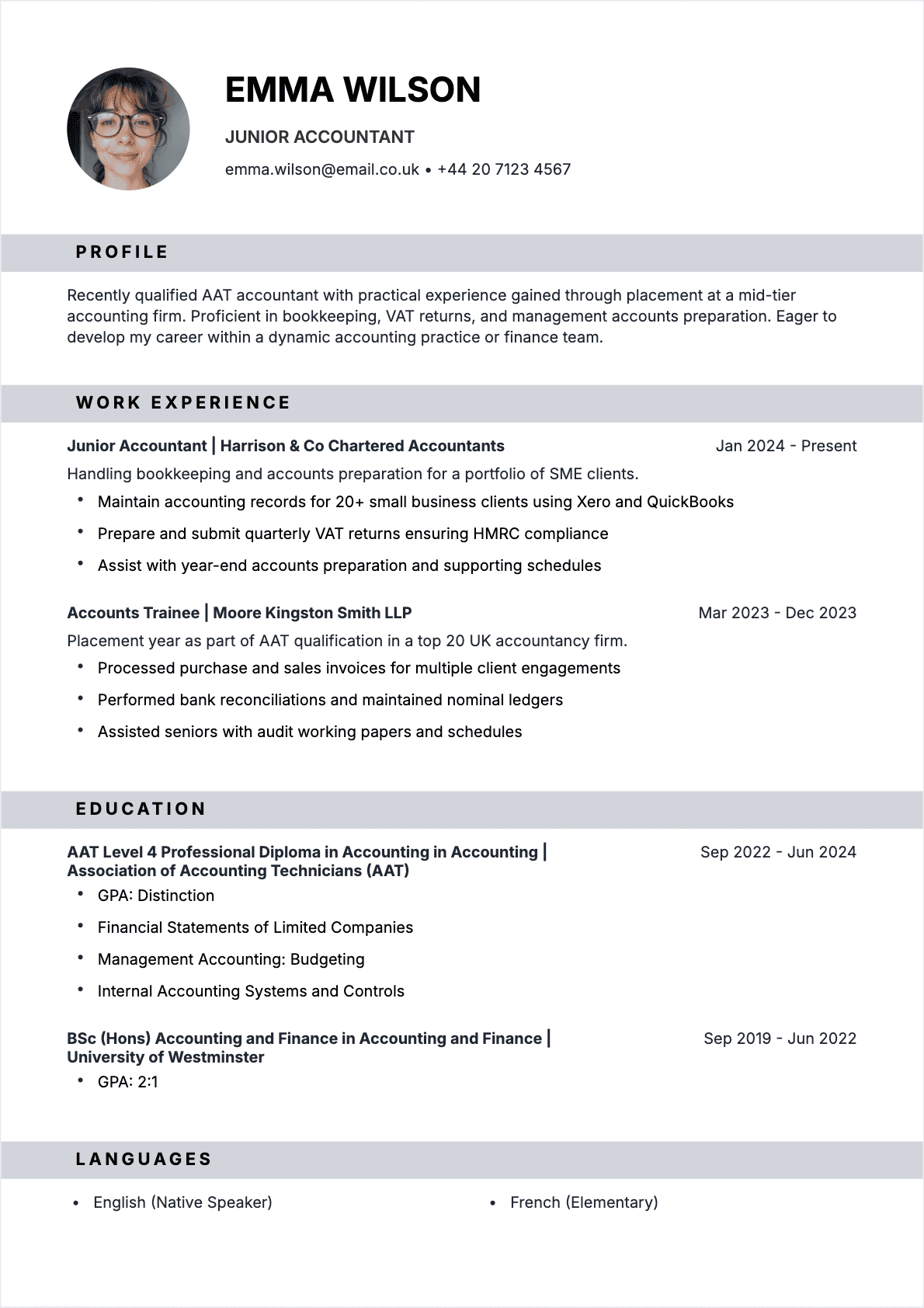
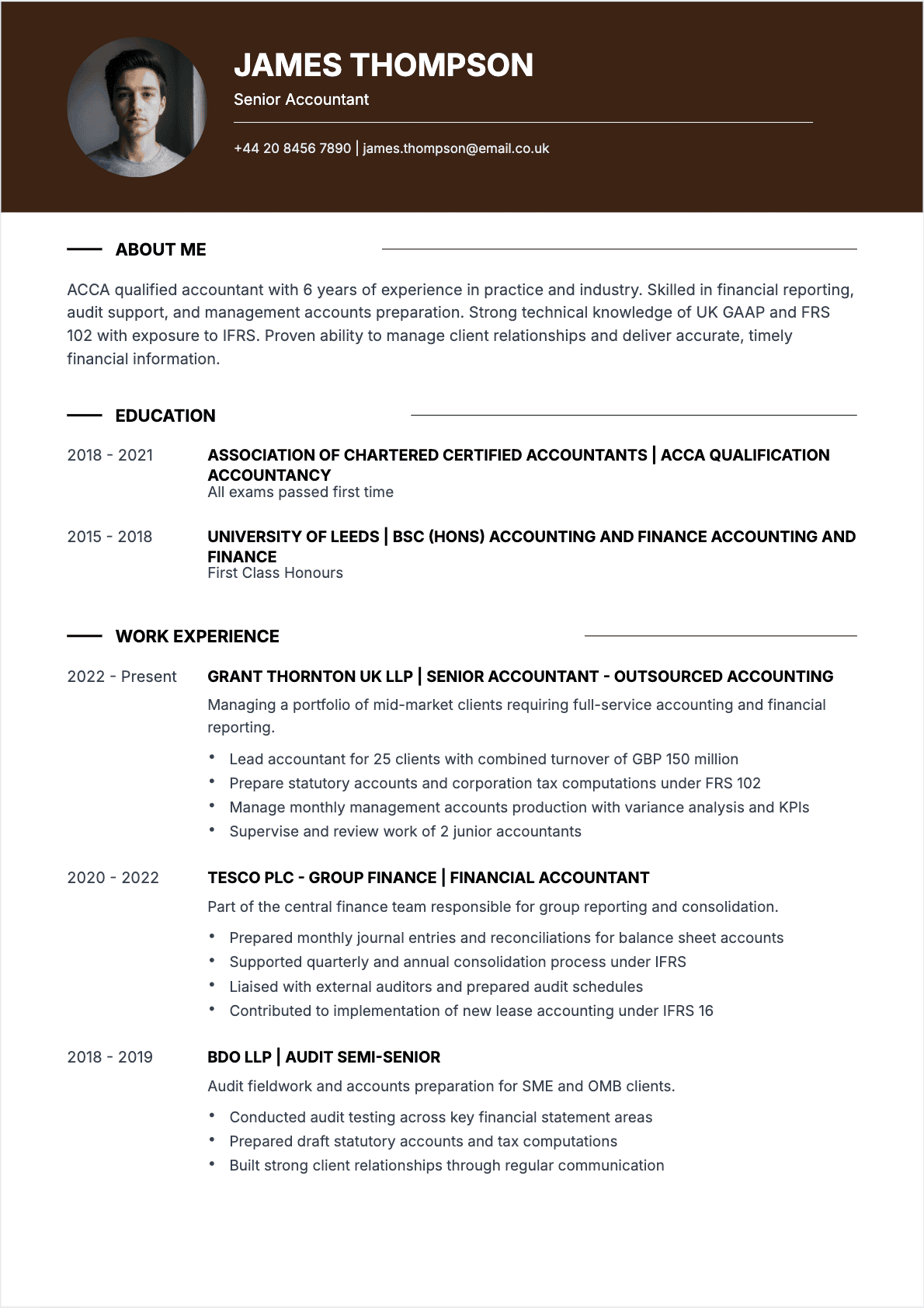
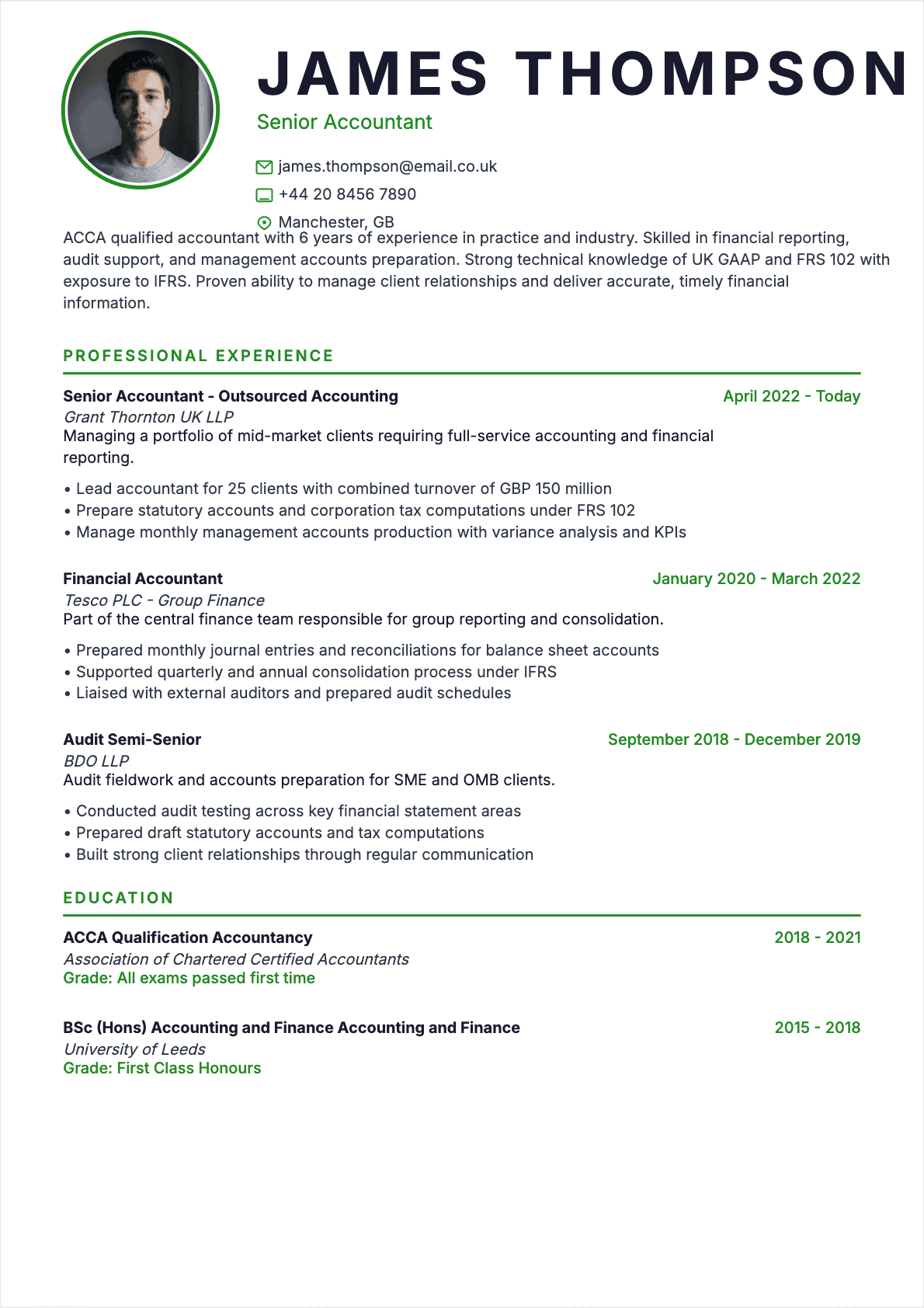
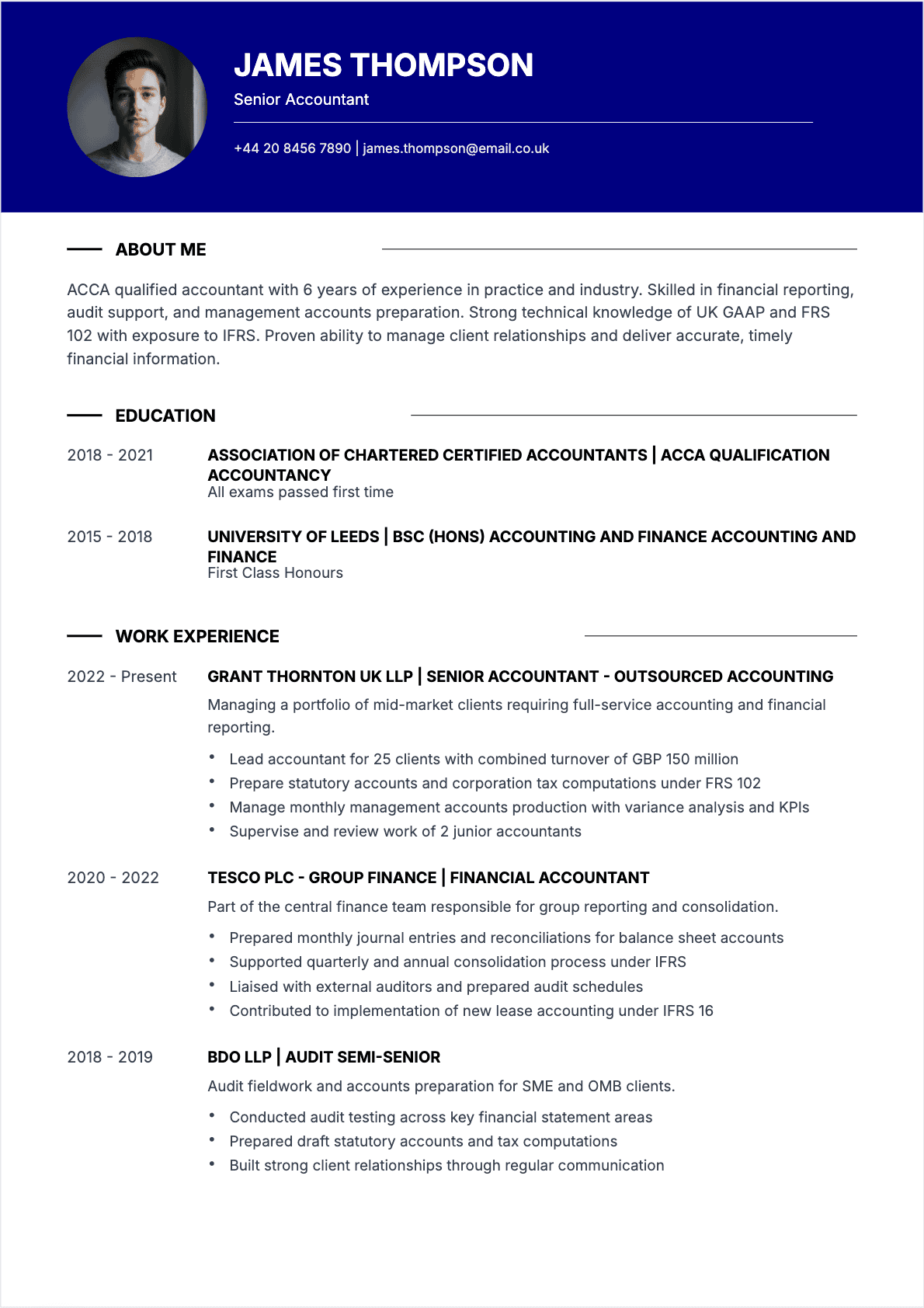
CV Accountant (Beginner)
For graduates and junior accountants: clear education, internships, and reconciliations. Highlight Excel, month-end support, and 2–3 quantified results from projects or placements.
Utiliser
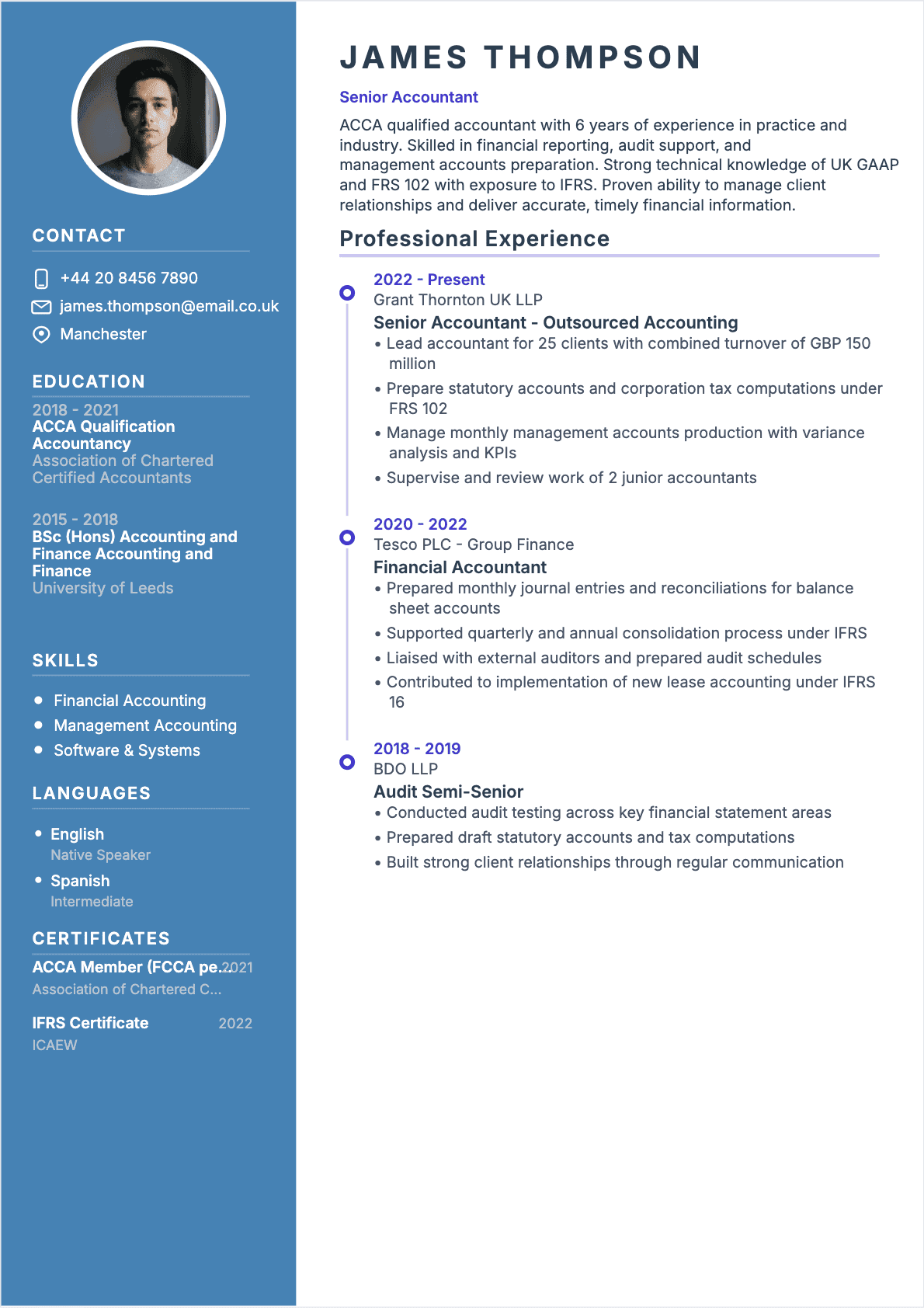
CV Accountant (Intermediate)
For 3–7 years’ experience: ownership of close, AP/AR, and reporting. Emphasize process improvements, audit readiness, IFRS/GAAP exposure, and measurable cycle-time and error reductions.
Utiliser
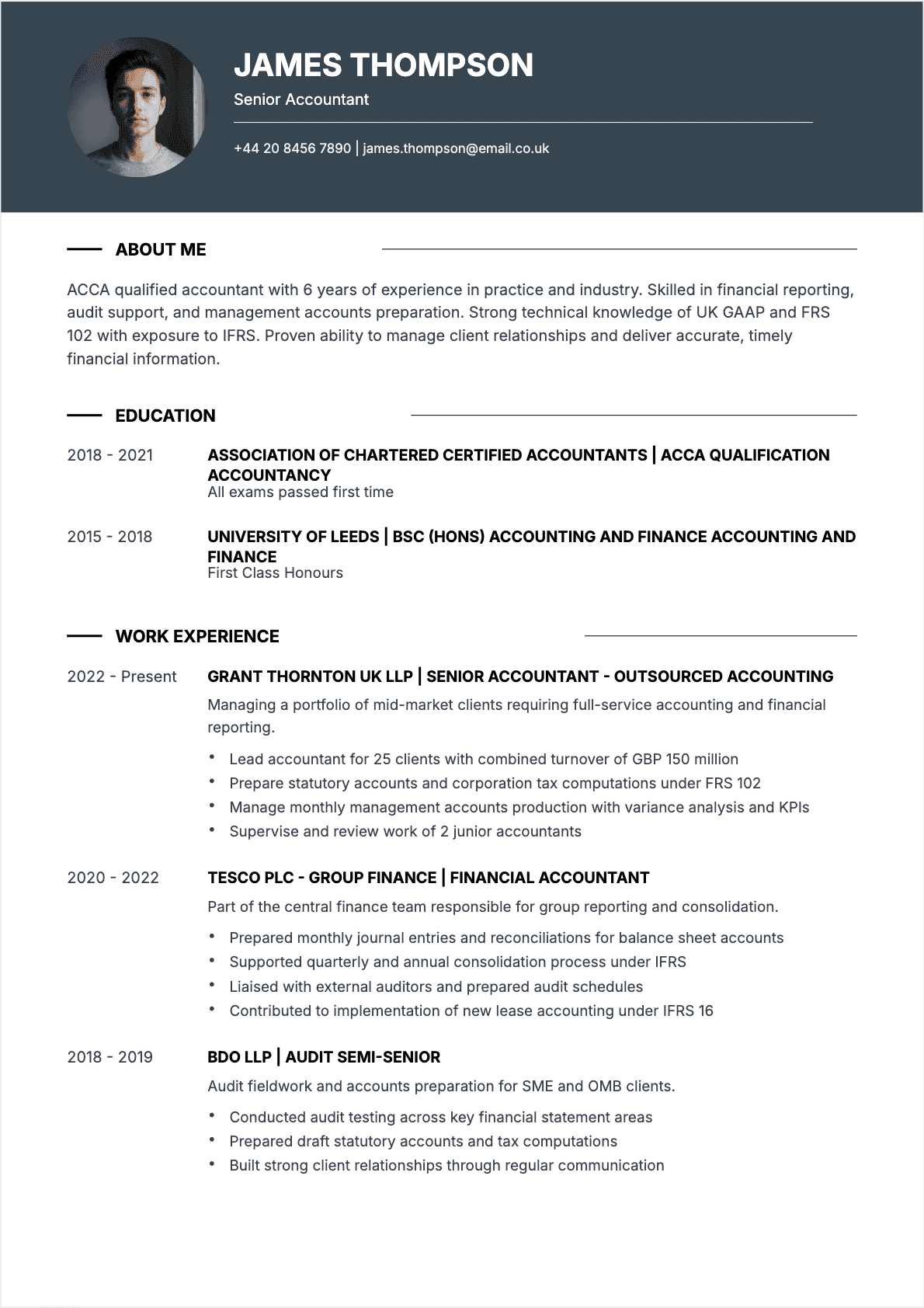
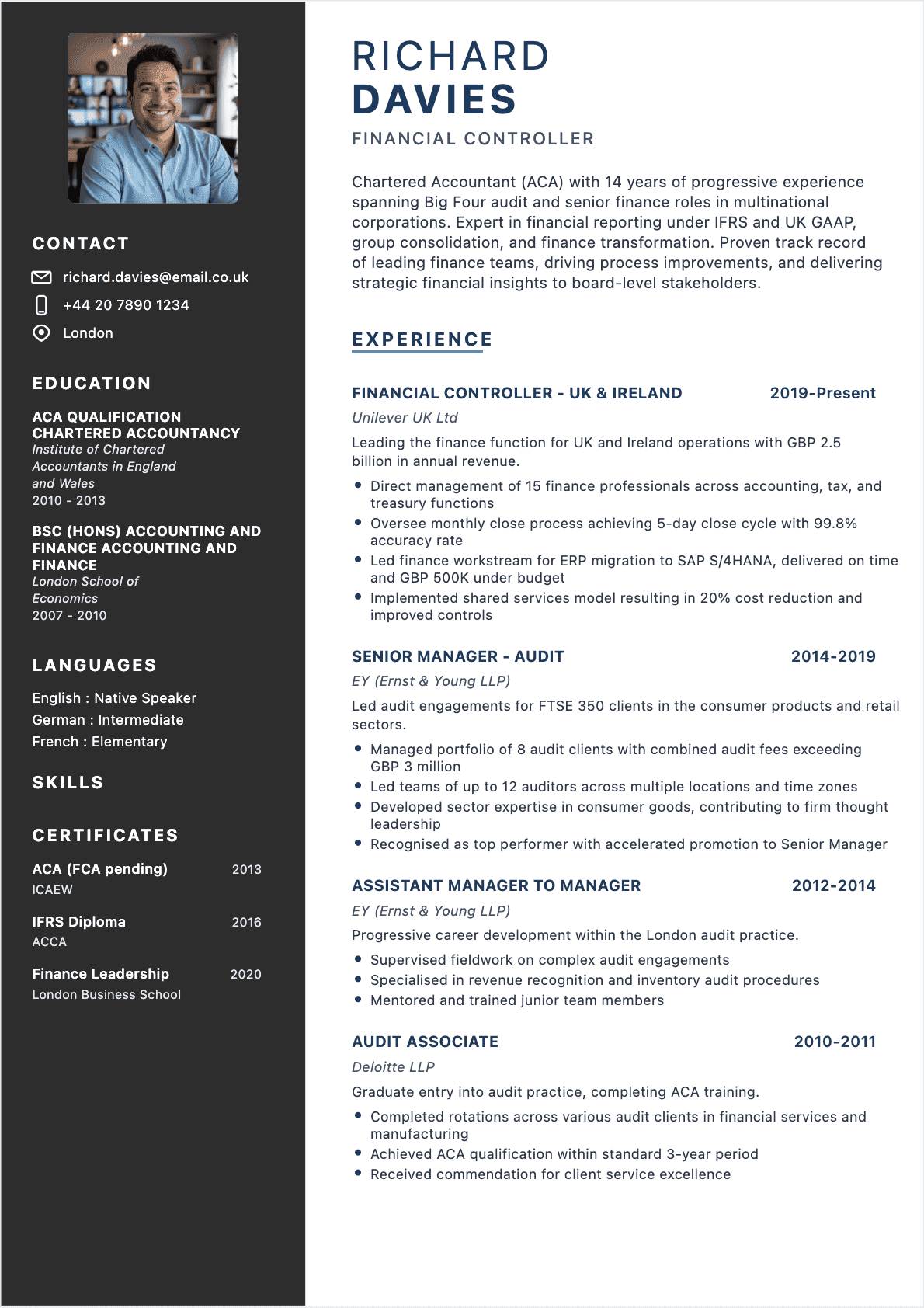
CV Accountant (Senior)
For senior roles with responsibility: lead close, manage stakeholders, and improve controls. Showcase multi-entity consolidation support, audit leadership, SOX-style controls, and quantified impact on accuracy and timelines.
UtiliserPerfect CV Checklist - CV Accountant
Check each item to ensure your CV is complete and optimized.
Professional Summary - CV Accountant
The professional summary is the first thing recruiters see. It should summarize your profile in a few impactful lines.
“Accountant with 6+ years in SaaS and multi-entity environments, managing month-end close (D+5), balance sheet reconciliations, and IFRS reporting. Reduced unreconciled items by 42% and cut close tasks by 1.5 days through SAP FI standardization and Excel Power Query automation.”
“Motivated and dynamic accountant, passionate about finance, available immediately, with strong team spirit and willingness to learn in any environment.”
Why is it effective?
Le bon exemple est efficace car il :
- States seniority and context (6+ years, SaaS, multi-entity) so a recruiter can benchmark your level in 5 seconds
- Specifies core deliverables (D+5 close, reconciliations, IFRS) that match common job requirements
- Proves impact with metrics (42% reduction, 1.5 days saved) rather than vague claims
- Names real tools (SAP FI, Excel Power Query) to strengthen ATS matching and credibility
Le mauvais exemple échoue car il :
- Uses generic clichés instead of accounting outcomes and scope
- Gives no indication of processes owned (GL, AP, AR, close) or standards (IFRS/GAAP)
- Contains zero metrics, so performance cannot be assessed
- Does not mention systems, reporting, or controls, which are central for an accountant role
Professional experience examples
Here are examples of professional experiences. Note how results are quantified.
General Ledger Accountant
Capgemini, London
Supported a multi-entity client portfolio (8 legal entities) in a shared service setup. Owned month-end close activities, balance sheet reconciliations, and audit coordination. Worked with a 6-person finance team using SAP FI and Excel to deliver D+6 reporting.
Key Achievements
Key skills for your resume
Here are the technical and soft skills most sought after by recruiters.
Technical skills (hard skills)
Technical Skills
- Month-end close (journals, accruals, prepayments)
- Balance sheet reconciliations and flux analysis
- SAP FI/CO
- Oracle NetSuite
- IFRS and basic consolidation concepts
- Fixed assets accounting (capitalization, depreciation, disposals)
- VAT/GST preparation and indirect tax support
- Advanced Excel (PivotTables, Power Query, XLOOKUP)
Professional skills (soft skills)
Soft Skills
- Attention to detail and error-spotting
- Prioritization during close deadlines
- Clear written documentation (workpapers, narratives, PBC lists)
- Stakeholder management with budget owners and auditors
- Root-cause analysis for reconciliation breaks
- Confidential handling of sensitive data
- Structured communication (status, blockers, next steps)
- Continuous improvement mindset focused on controls and efficiency
ATS Keywords to Include
ATS systems filter CVs based on specific keywords. Include these terms to maximize your chances.
ATS Tip
Click on a keyword to copy it. ATS systems filter CVs based on these exact terms.
Mots-clés importants
Hiring Sectors
Discover the most promising sectors for your career.
Public accounting and audit firms
SaaS and technology companies
Manufacturing and industrial groups
Retail and e-commerce
Financial services and insurance
Healthcare and pharmaceuticals
Education & Degrees
For accounting roles, recruiters expect a solid foundation in financial accounting, reporting, and controls. A Bachelor’s degree in Accounting, Finance, or Business is common, but candidates also come from Economics or Mathematics if they can demonstrate practical accounting experience (close, reconciliations, audit support).
Typical routes include university degrees, professional bodies (ACCA/ACA/CIMA), and employer-sponsored training. If you are early-career, compensate for limited experience with concrete coursework projects (financial statements, case studies) and internships where you handled real reconciliations or ledger tasks.
Recommended Degrees
- Bachelor’s degree in Accounting
- Bachelor’s degree in Finance
- Master’s degree in Accounting and Finance
- Master’s degree in Financial Management
- MBA (Finance concentration)
- PhD in Accounting (for academic or research-focused roles)
Languages
Languages can be a differentiator for accountants working with international entities, shared service centers, or global audits. Even when the local ledger is domestic, audit requests, group reporting packages, and ERP documentation may be in English. If you interact with vendors or customers abroad, language skills can also reduce delays in AP/AR issue resolution.
- Group reporting and consolidation packages for headquarters
- Audit coordination with international audit teams and PBC requests
- Vendor/customer communication for invoice disputes and payment terms
Present your level with an honest proficiency label and add proof (work context or certification) when possible.
English
Fluent (daily professional use in reporting and audit)
French
Proficient
Spanish
Intermediate
Recommended certifications
Certifications are not always mandatory for accountant roles, but they can accelerate shortlisting, especially in regulated environments or where progression is tied to professional bodies. ACCA/ACA are strong signals in the UK and internationally. Excel and ERP certifications are a credible bonus when they match the tools used in the role.
Mistakes to avoid
Listing responsibilities without showing close scope
If your experience reads like a task list (posting journals, doing reconciliations), recruiters cannot judge your level. The same task can mean very different complexity depending on entity count, ERP, reporting standard, and close deadlines. Without scope, your CV may be filtered out for being “too junior” or “too generic” even when you are qualified.
Toujours inclure :
- Close timeline (e.g., D+5), frequency, and critical deadlines
- Scope (number of entities, currencies, revenue size, team size)
- Standards and stakeholders (IFRS/US GAAP, auditors, group finance)
Use this formula: “Did X for Y scope, delivering Z deadline, with A tool, improving B metric.”
Using vague impact statements instead of measurable outcomes
Phrases like “improved processes” or “helped reduce costs” are hard to validate. Accounting hiring managers want to see what changed: fewer recon breaks, fewer audit adjustments, faster close, cleaner AR ageing, or lower manual journal volume. Without numbers, your improvements look like opinions rather than results.
À éviter : "Improved month-end close and reporting quality."
À privilégier : "Reduced close cycle from D+8 to D+6 by automating 12 recurring journals and increasing reconciliation completion to 95%."
This also strengthens ATS performance because it naturally includes keywords like close cycle, reconciliations, journals, and automation.
Not naming the ERP and reporting tools you actually used
Many accounting CVs mention “ERP” or “advanced Excel” but omit specifics. Recruiters often search directly for SAP FI, NetSuite, Dynamics 365, QuickBooks, Power BI, or BlackLine. If you used a tool, name it and describe the use case (e.g., SAP postings, fixed asset module, bank uploads, reconciliation templates).
À mentionner :
- ERP and modules (e.g., SAP FI, CO, AA; NetSuite GL/AP)
- Reporting stack (Excel Power Query, Power BI, Tableau)
- Close/support tools (e.g., SharePoint evidence packs, ticketing workflow)
Formatting that breaks ATS parsing
Over-designed CVs can hide your keywords from ATS, especially when content sits in text boxes, columns, headers/footers, or graphics. Accounting roles are often high-volume; if your CV is not parsed, it may never reach the hiring manager. Keep the layout clean, use standard headings, and write dates and job titles consistently.
Checklist :
- One-column layout with simple section titles (Summary, Experience, Skills, Education)
- Job titles and company names as plain text (no icons or shapes)
- Save as PDF (unless the employer requests DOCX) and verify the text can be selected and copied
Expert tips
- 1
Build a “Close & Controls” block : Add 3–5 lines summarizing close timeline, reconciliations volume, audit exposure, and standards (IFRS/US GAAP). It gives instant context before the recruiter reads bullets.
- 2
Quantify reconciliation work : Mention how many accounts you reconcile (e.g., 25–40) and your on-time rate. Pair it with an accuracy indicator such as audit adjustments reduced or aged recon items cleared.
- 3
Show journal quality, not just volume : If you post many journals, add a control metric: fewer reclasses, fewer reversals, or fewer posting errors after implementing templates and reviews.
- 4
Translate projects into accounting outcomes : System migrations and process projects should link to close time, control quality, or reporting reliability (e.g., reduced manual entries by 30%, improved traceability).
- 5
Mirror the job description keywords : If the role says “intercompany” or “fixed assets,” ensure those exact terms appear in your CV, supported by a concrete example and a metric.
- 6
Add a tools line per role : After each position, add “Tools: SAP FI, NetSuite, Excel Power Query, Power BI” to improve ATS matching and reduce ambiguity for recruiters.
- 7
Keep compliance visible : If relevant, mention PBC handling, audit walkthroughs, policy adherence, and evidence retention. These signals matter in regulated sectors even for non-manager roles.
Frequently asked questions
Find answers to the most frequently asked questions.
Aim for one page if you have under 5 years of experience, and two pages if you have 5+ years or multi-entity scope. Prioritize recent roles and quantify impact (close timeline, reconciliations, audit outcomes). Remove repetitive task bullets and keep a compact skills/tools section.
In the US, avoid adding a photo; it is not expected and can create bias concerns. In the UK it is usually optional, but still uncommon in finance. Use the space for keywords, tools (SAP/NetSuite), and quantified outcomes (close D+6, reconciliation completion rate).
Use keywords that match the job description and your real experience: month-end close, general ledger, journal entries, accruals, prepayments, balance sheet reconciliations, AP/AR, IFRS or US GAAP, audit support, and your ERP (SAP FI, NetSuite, Dynamics 365, QuickBooks).
Use operational finance metrics: close cycle time (D+8 to D+6), reconciliation on-time rate (80% to 96%), number/value of aged items cleared (e.g., £310k), reduction in manual journals (e.g., -30%), fewer audit adjustments, or fewer posting errors after controls were implemented.
Not always. Many roles accept a Bachelor’s or Master’s degree plus relevant experience in close and reconciliations. However, ACCA/ACA can significantly improve shortlisting, especially for UK roles, audit-heavy environments, or promotion tracks. If you are part-qualified, state papers passed and expected completion date.
Avoid vague labels like “advanced.” Instead, list specific functions and outcomes: Power Query for data cleansing, PivotTables for reporting packs, XLOOKUP for mapping, and templates for recurring journals. Add a line showing scale (e.g., automated 14 journals; built a monthly pack used by 6 stakeholders).
Create your CV Accountant in minutes
Use our CV builder to structure your CV Accountant CV, add ATS keywords, and turn your close and reconciliation work into quantified achievements recruiters can shortlist fast.
Create my Resume