
CV Chief Accountant: ATS-ready guide with examples (2025)
Learn how to write a Chief Accountant CV that highlights month-end leadership, reporting accuracy, compliance, and process improvement. Get role-specific sections, quantified bullet examples, ATS keywords, and common mistakes to avoid in 2025.
Key Takeaways
A Chief Accountant sits at the center of reporting reliability: you translate transactions into accurate financial statements, run a predictable month-end close, and keep auditors, tax, and leadership aligned on the numbers. In 2025, many finance teams are expected to shorten close timelines while improving controls, especially in multi-entity environments and ERP transformations.
In practice, strong candidates can demonstrate measurable outcomes: a close reduced from 8 to 5 business days, reconciliation coverage above 98%, or audit adjustments cut by 40% year over year. Hiring managers also look for tool fluency (SAP, Oracle, NetSuite, Power BI) and a clear grasp of IFRS or US GAAP.
A good CV of Chief Accountant must demonstrate :
- Ownership of month-end close, reconciliations, and reporting accuracy at scale
- Control mindset (SOX/ICFR) and effective audit coordination with measurable outcomes
- Process improvement using ERP/reporting tools and documented accounting policies
Use the guide below to structure your CV, write quantified bullet points, and select ATS keywords that match Chief Accountant job descriptions.
CV Examples - CV Chief Accountant
Discover our CV templates adapted to all experience levels. Each example is ATS-optimized.
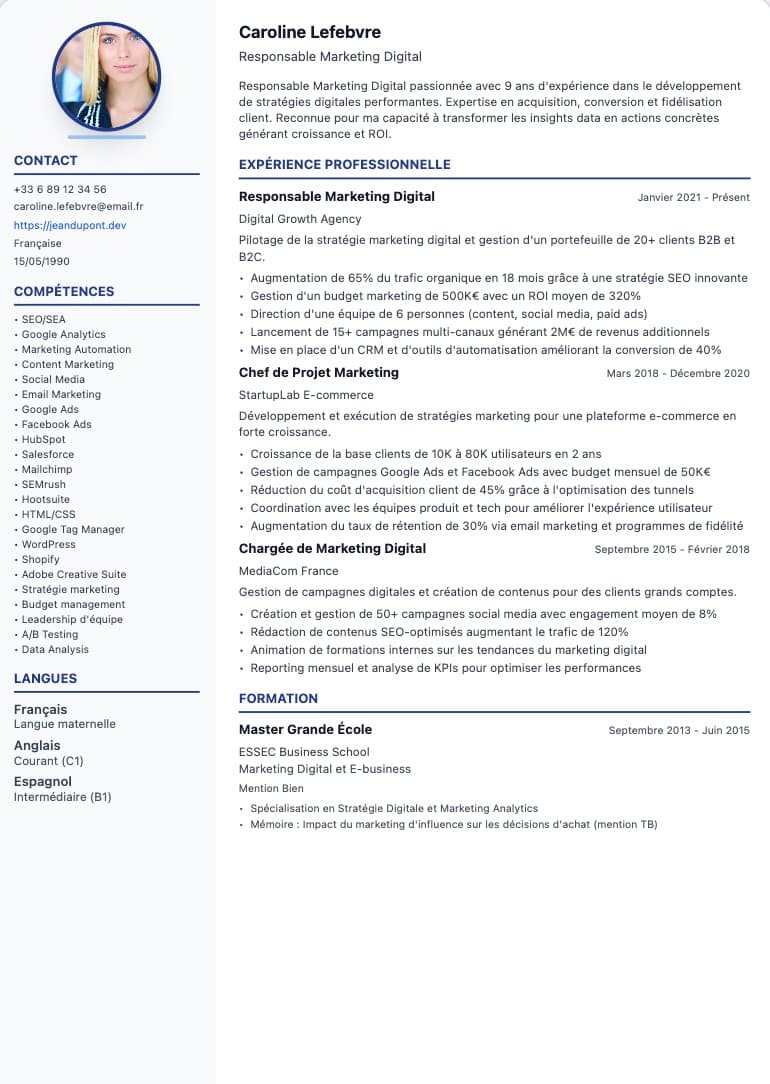
CV Chief Accountant Beginner
Ideal if you have internships or 0–2 years’ experience. Emphasize month-end support, reconciliations, Excel skills, and accuracy metrics tied to close tasks and audit readiness.
Utiliser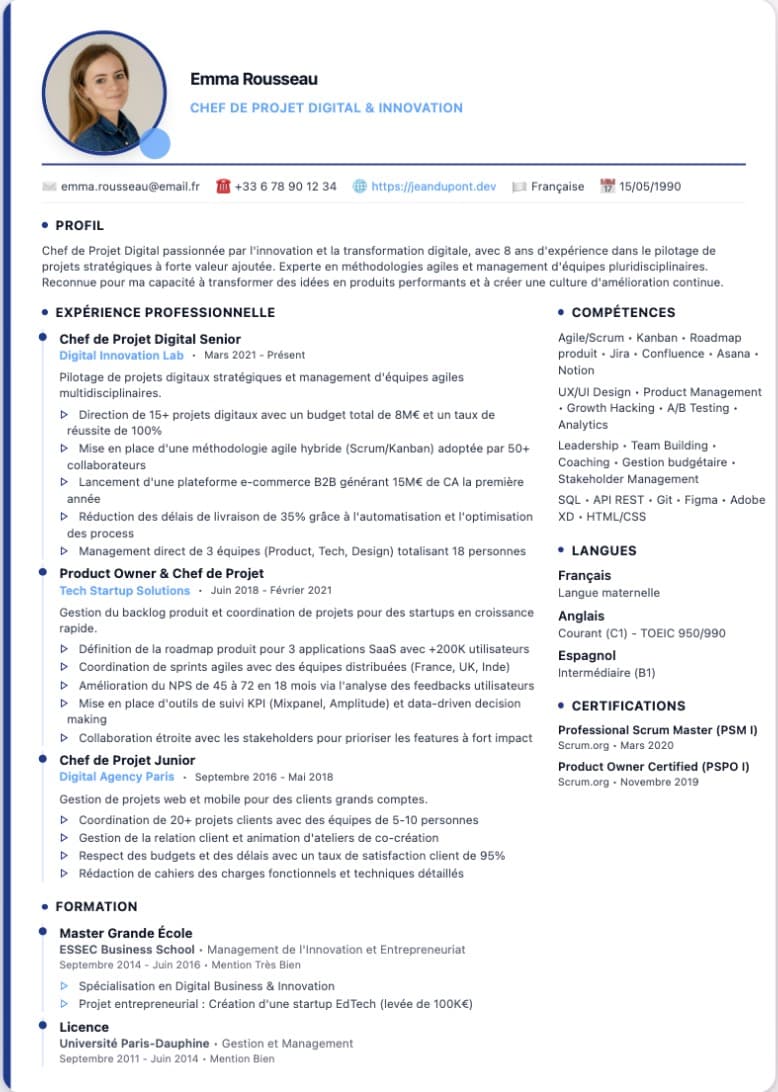
CV Chief Accountant Intermediate
For 3–7 years’ experience. Showcase ownership of close cycles, team coordination, IFRS/US GAAP exposure, ERP mastery, and improvements that reduce close time and errors.
Utiliser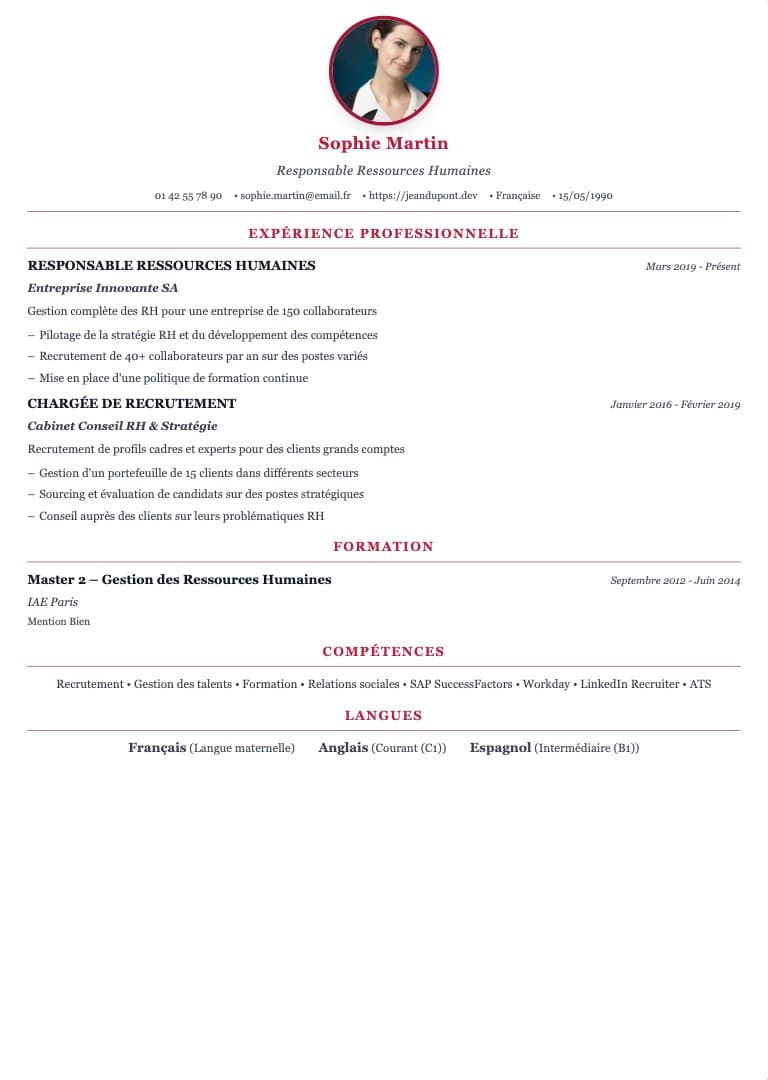
CV Chief Accountant Senior
For leaders managing multi-entity accounting. Highlight consolidation scope, audit liaison, internal controls, policy design, and measurable outcomes like faster closes, fewer adjustments, and stronger compliance.
UtiliserPerfect CV Checklist - CV Chief Accountant
Check each item to ensure your CV is complete and optimized.
Professional Summary - CV Chief Accountant
The professional summary is the first thing recruiters see. It should summarize your profile in a few impactful lines.
“Chief Accountant with 7+ years in SaaS and multinational environments, leading a 4-person GL team and month-end close for 6 entities. Reduced close from 7 to 4.5 days, improved reconciliation coverage to 99%, and cut audit adjustments by 38% using NetSuite, BlackLine, and Power BI.”
“Motivated, dynamic, passionate accountant available immediately, able to work under pressure and handle many tasks with a positive mindset.”
Why is it effective?
The good example is effective because it :
- States seniority and context (7+ years, SaaS, 6 entities) so scope is immediately clear
- Names leadership and ownership (4-person GL team, month-end close) rather than vague responsibilities
- Proves impact with metrics (close 7 to 4.5 days, 99% coverage, adjustments -38%)
- Shows relevant tools (NetSuite, BlackLine, Power BI) that recruiters search for in ATS
The bad example fails because it :
- Uses generic traits instead of job-specific proof (no close, reporting, audit, or controls)
- Provides no scope (entities, revenue, team, deadlines) and no metrics
- Adds availability and attitude statements that do not differentiate performance
- Misses key keywords (GL, reconciliations, IFRS/US GAAP, SOX, ERP)
Professional experience examples
Here are examples of professional experiences. Note how results are quantified.
Chief Accountant
BlueRiver Software, Boston
Owned general ledger and monthly reporting for a 6-entity SaaS group ($180M revenue). Led a 4-person team covering close, reconciliations, and statutory packs. Partnered with FP&A and auditors during a NetSuite optimization and controls uplift.
Key Achievements
Key skills for your resume
Here are the technical and soft skills most sought after by recruiters.
Technical skills (Chief Accountant)
Technical Skills
- Month-end close management and close calendar governance
- Balance sheet reconciliations and account substantiation
- SAP S/4HANA
- Oracle NetSuite
- IFRS and/or US GAAP financial reporting
- Consolidation and intercompany eliminations
- SOX/ICFR controls design, testing support, and remediation
- Advanced Excel (Power Query, PivotTables) and management reporting
Professional skills
Soft Skills
- Prioritization across competing close deadlines
- Clear written explanations of accounting judgments and estimates
- Stakeholder management with FP&A, Tax, Payroll, and external auditors
- Root-cause analysis for recon breaks and posting errors
- Coaching and review discipline (quality checks, feedback loops)
- Ownership of timelines and deliverables without micromanagement
- Attention to detail with documented review evidence
- Conflict resolution on cut-off issues and revenue/expense classification
ATS Keywords to Include
ATS systems filter CVs based on specific keywords. Include these terms to maximize your chances.
ATS Tip
Click on a keyword to copy it. ATS systems filter CVs based on these exact terms.
Mots-clés importants
Hiring Sectors
Discover the most promising sectors for your career.
Technology and SaaS
Manufacturing and industrials
Pharmaceuticals and life sciences
Financial services and insurance
Retail and e-commerce
Professional services and consulting
Education & Degrees
For Chief Accountant roles, employers typically expect a solid accounting foundation plus evidence that you can run a close and defend numbers to auditors. In English-speaking markets, a Bachelor’s in Accounting/Finance is common, while a Master’s can help for larger groups or technical accounting tracks.
Paths vary: public accounting to industry, corporate accounting rotations, or shared services leadership. What matters most is how your training connects to outcomes—clean reconciliations, reliable reporting, and control ownership.
If your degree is not strictly accounting, compensate with relevant certifications (CPA/ACCA/CMA) and clear, quantified experience (close performance, audit outcomes, multi-entity scope).
Recommended Degrees
- Bachelor’s degree in Accounting
- Master’s degree in Accounting or Finance
- Bachelor’s degree in Finance with accounting concentration
- Master of Science in Accounting (MAcc)
- MBA with Finance
- Bachelor’s degree in Business Administration (accounting focus)
Languages
Languages matter for Chief Accountants in multinational groups, shared service models, and audit coordination across countries. Even in local roles, English is often required for audit memos, ERP documentation, and group reporting instructions.
- Group reporting calls with HQ and regional controllers
- Coordination with external auditors across multiple jurisdictions
- Reading and applying accounting policy under IFRS/US GAAP and internal manuals
Present your level with business context (reporting, audit, stakeholder meetings) and, when possible, add a recognized test score or certification to make the claim credible.
English
Native
Spanish
Proficient (used for audit coordination and vendor escalations)
French
Intermediate (working level for group reporting emails)
Recommended certifications
Certifications are not always mandatory for Chief Accountant roles, but they are a strong differentiator in competitive markets and for technical accounting responsibilities. A CPA or ACCA signals depth in reporting and audit readiness; CMA supports management reporting and performance focus. Tool certifications (NetSuite, SAP) are useful when the role includes ERP ownership.
Mistakes to avoid
Listing responsibilities without close metrics
Many Chief Accountant CVs read like a job description: “handled month-end close” or “prepared financial statements.” That wording does not show scale, reliability, or improvement. Recruiters want evidence you can deliver a predictable close, control reconciliations, and reduce audit pain.
Always include :
- Close performance (e.g., 5-day close, 220 JEs/month, 60+ reconciliations)
- Scope (entities, countries, revenue, headcount supported, accounting framework)
- Quality indicators (recon completion %, audit adjustments $, findings count)
Use this formula: Action + scope + tool + metric + business outcome (time saved, risk reduced, accuracy improved).
Hiding technical accounting and controls behind vague wording
If you supported IFRS/US GAAP topics, provisions, revenue cut-off, leases, or share-based compensation, spell it out. “Ensured compliance” is too broad and does not help ATS matching. Be explicit about the standards, the control you own, and what improved.
À éviter : "Ensured compliance and supported audits."
À privilégier : "Owned SOX close controls (JE approval, recon review, access review) and reduced control exceptions from 9 to 2 in one year through documented evidence and remediation tracking."
This level of detail demonstrates judgment, governance, and audit readiness.
Under-selling ERP and automation impact
Chief Accountants are often hired to stabilize processes during growth, system changes, or shared services transitions. If you have improved workflows, automation, or reporting, quantify it and name the tool. Otherwise, your CV looks interchangeable with purely transactional profiles.
À mentionner :
- Specific tools (SAP, Oracle, NetSuite, BlackLine, Power BI) and modules
- Automation delivered (number of JEs automated, hours saved per close, controls enabled)
- Data quality outcomes (posting error rate, recon aging, manual adjustments reduced)
Formatting that breaks ATS parsing
Even strong profiles lose interviews due to ATS-unfriendly formatting: columns, text boxes, headers with icons, or missing dates. Keep structure simple and consistent so systems can extract titles, companies, and keywords correctly. Also ensure every role shows month/year dates and a clear location.
Checklist :
- Use a single-column layout with standard headings (Experience, Education, Skills)
- Write dates as “MMM YYYY – MMM YYYY” and keep job titles consistent
- Export as PDF unless the application explicitly requests DOCX
Expert tips
- 1
Write like an owner of the close : Replace “assisted with close” with measurable ownership (close days, JEs volume, reconciliations). Add how you managed the calendar and dependencies across AP, AR, Payroll, and FP&A.
- 2
Quantify audit outcomes : Include number of audit requests, PBC turnaround time, adjustments value, and findings trend. Even “0 late PBC items across 2 audits” is a meaningful operational metric.
- 3
Show control evidence : Mention the specific key controls you owned (JE approval, account review, access review) and the result (exceptions reduced, faster remediation, better documentation quality).
- 4
Name your accounting framework : Put IFRS or US GAAP near the top and reinforce it in bullet points (policy memos, judgments, disclosures). It improves ATS matching and senior reviewer confidence.
- 5
Translate complexity into scope : Add entity count, countries, revenue, and transaction volume so recruiters can compare your experience to their environment in 10 seconds.
- 6
Make tools credible : Pair each ERP/reporting tool with what you did (implemented BlackLine matching rules, built Power BI close dashboard, redesigned NetSuite approval workflow).
- 7
Tailor keywords to the posting : Mirror exact phrases like “account substantiation,” “SOX,” “consolidation,” and “statutory accounts,” but only when they match your real work and examples.
Frequently asked questions
Find answers to the most frequently asked questions.
Aim for 1 page if you have under 7 years of experience, and 2 pages if you lead teams, manage multi-entity reporting, or have significant audit/control scope. Prioritize quantified close, reconciliations, reporting, and audit outcomes over long task lists and older roles.
Common ATS keywords include month-end close, general ledger, account reconciliations, financial reporting, IFRS/US GAAP, consolidation, intercompany, audit coordination, SOX/ICFR, and statutory accounts. Match them to your scope and tools (SAP, Oracle, NetSuite, BlackLine) in bullets.
Use evidence: team size you guided, work you reviewed, and deadlines you owned. Examples include “reviewed 25 reconciliations/month,” “trained 2 accountants,” or “ran close stand-ups.” Add outcomes like fewer late items, reduced recon aging, and faster PBC responses.
In most US hiring processes, a photo is not recommended. In the UK it is usually optional but still uncommon in corporate finance. Focus space on metrics, scope, and tools. If you apply in a market where photos are standard, follow local norms and keep the photo professional.
Use ranges and operational metrics: number of entities, close days, volume of journal entries, reconciliation count, % completion, and audit findings trend. For financial metrics, use rounded figures (e.g., “$150–200M revenue”) or relative improvements (e.g., “audit adjustments -35%”).
List the ERP in Skills, then prove it in Experience bullets with actions and outcomes: “Automated 15 recurring JEs in NetSuite,” “built a Power BI close tracker,” or “implemented BlackLine matching rules.” This shows applied skill, not just exposure.
Build your Chief Accountant CV in minutes (2025)
Use our CV builder to structure an ATS-friendly Chief Accountant CV, add quantified bullet points, and generate a clean PDF tailored to your target job in 2025.
Create my Resume